
Life, 1915-03-25 · page 24 of 44
Life — March 25, 1915 — page 24: what you’re looking at
What you’re looking at
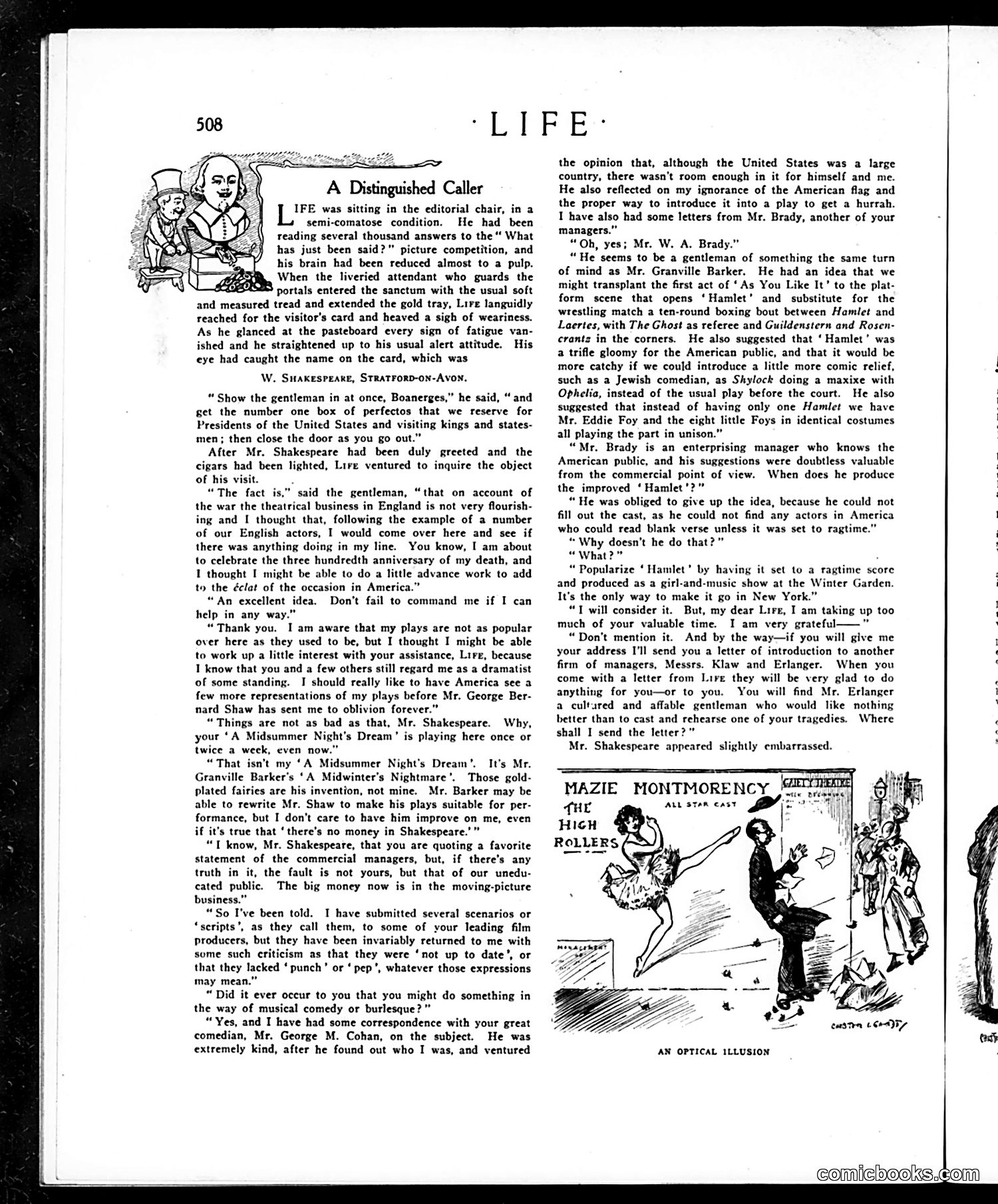
This satirical piece depicts **William Shakespeare** visiting Life magazine's editor during WWI to promote his works in America. The humor targets multiple subjects: **The Setup:** Shakespeare, preparing for the 300th anniversary of his death, seeks assistance boosting American interest in his plays, which he claims have waned. **The Satire Points:** 1. **Granville Barker's adaptations**: Shakespeare complains that Barker's "Midsummer Night's Dream" production (with "gold-plated fairies") misrepresents his work—mocking contemporary theatrical directors who heavily reimagined classics. 2. **Moving pictures over Shakespeare**: The editor notes film now makes real money, suggesting Americans prefer cinema to stage classics. 3. **George M. Cohan's dismissal**: The famous American composer/performer reportedly told Shakespeare there wasn't room for both of them in America—a joke about ego and commercial competition. 4. **"No money in Shakespeare"**: A recurring complaint that managers cite to justify ignoring classic drama for more commercial entertainment. The cartoon satirizes early 20th-century American popular taste, theatrical commercialism, and the struggle of high culture against emerging mass entertainment.
📄 Transcribed text from this page (OCR, searchable)
Machine-transcribed from the original scan — historical spelling and the odd misread are preserved.
A Distinguished Caller | Bats was sitting in the editorial chair, in a semi-comatose condition. He had been reading several thousand answers to the “ What has just been said?” picture competition, and his brain had been reduced almost to a pulp. When the liveried attendant who guards the portals entered the sanctum with the usual soft and measured tread and extended the gold tray, Lire languidly reached for the visitor's card and heaved a sigh of weariness. As he glanced at the pasteboard every sign of fatigue van- ished and he straightened up to his usual alert attitude. His eye had caught the name on the card, which was W. Suakesreare, STRATFORD-ON-AVON. “ Show the gentleman in at once, Boanerges,” he said, “ and get the number one box of perfectos that we reserve for Presidents of the United States and visiting kings and states- men; then close the door as you go out After Mr. Shakespeare had been duly greeted and the cigars had been lighted, Lire ventured to inquire the object of his visit. r “The fact is,” said the gentleman, “that on account of the war the theatrical business in England is not very flourish- ing and [ thought that, following the example of a number of our English actors, I would come over here and see if there was anything doing in my line. You know, I am about to celebrate the three hundredth anniversary of my death, and I thought I might be able to do a little advance work to add to the éclat of the occasion in America.” “An excellent idea. Don’t fail to command me if I can help in any way.” “Thank you. I am aware that my plays are not as popular over here as they used to be, but I thought I might be able to work up a little interest with your assistance, Lire, because 1 know that you and a few others still regard me as a dramatist of some standing. I should really like to have America see a few more representations of my plays before Mr. George Ber- nard Shaw has sent me to oblivion forever.” “Things are not as bad as that, Mr. Shakespeare. Why, your ‘A Midsummer Night's Dream’ is playing here once or twice a week, even now.” “That isn’t my ‘A Midsummer ht's Dream’. It’s Mr. Granville Barker's ‘A Midwinter’s Nightmare’. Those gold- plated fairies are his invention, not mine. Mr. Barker may be able to rewrite Mr. Shaw to make his plays suitable for per- formance, but I don’t care to have him improve on me, even if it's true that ‘there's no money in Shakespeare.’” “T know, Mr. Shakespeare, that you are quoting a favorite statement of the commercial managers, but, if there’s any truth in it, the fault is not yours, but that of our unedu- cated public. The big money now is in the moving-picture business.’ “So I've been told. I have submitted several scenarios or ‘scripts’, as they call them, to some of your leading film Producers, but they have been invariably returned to me with some such criticism as that they were ‘not up to date’, or that they lacked ‘punch’ or ‘ pep’, whatever those expressions may mean.” “Did it ever occur to you that you might do something in the way of musical comedy or burlesque? “Yes, and I have had some correspondence with your great comedian, Mr. George M. Cohan, on the subject. He was extremely kind, after he found out who I was, and ventured ‘LIPE: the opinion that, although the United States was a large country, there wasn't room enough in it for himself and me. He also reflected on my ignorance of the American flag and the proper way to introduce it into a play to get a hurrah. I have also had some letters from Mr. Brady, another of your managers.” “Oh, yes; Mr. W. A. Brady.” “He seems to be a gentleman of something the same turn of mind as Mr. Granville Barker. He had an idea that we might transplant the first act of ‘As You Like It’ to the plat- form scene that opens ‘Hamlet’ and substitute for the wrestling match a ten-round boxing bout between Hamlet and Laertes, with The Ghost as referee and Guildenstern and Rosen- crantz in the corners. He also suggested that ‘Hamlet’ was a trifle gloomy for the American public, and that it would be more catchy if we could introduce a little more comic relief, such as a Jewish comedian, as Shylock doing a maxixe with Ophelia, instead of the usual play before the court. He also suggested that instead of having only one Hamlet we have Mr. Eddie Foy and the eight little Foys in identical costumes all playing the part in unison.” “Mr. Brady is an enterprising manager who knows the American public, and his suggestions were doubtless valuable from the commercial point of view. When does he produce the improved ‘Hamlet’?” “ He was obliged to give up the idea, because he could not fill out the cast, as he could not find any actors in America who could read blank verse unless it was set to ragtime.” “Why doesn’t he do that?” “What?” ‘ “ Popularize ‘Hamlet’ by having it set to a ragtime score and produced as a girl-and-music show at the Winter Garden. It's the only way to make it go in New York.” “TT will consider it. But, my dear Lire, I am taking up too much of your valuable time. I am very grateful—” “Don't mention it. And by the way—if you will give me your address I'll send you a letter of introduction to another firm of managers, Messrs. Klaw and Erlanger. When you come with a letter from Lire they will be very glad to do anything for you—or to you. You will find Mr. Erlanger a cultured and affable gentleman who would like nothing better than to cast and rehearse one of your tragedies. Where shall I send the letter?” Mr. Shakespeare appeared slightly embarrassed. = Pes \ MAZIE MONTMORENCY | re AN OPTICAL ILLUSION comichooks.