
A complete issue · 44 pages · 1915
Life — January 14, 1915
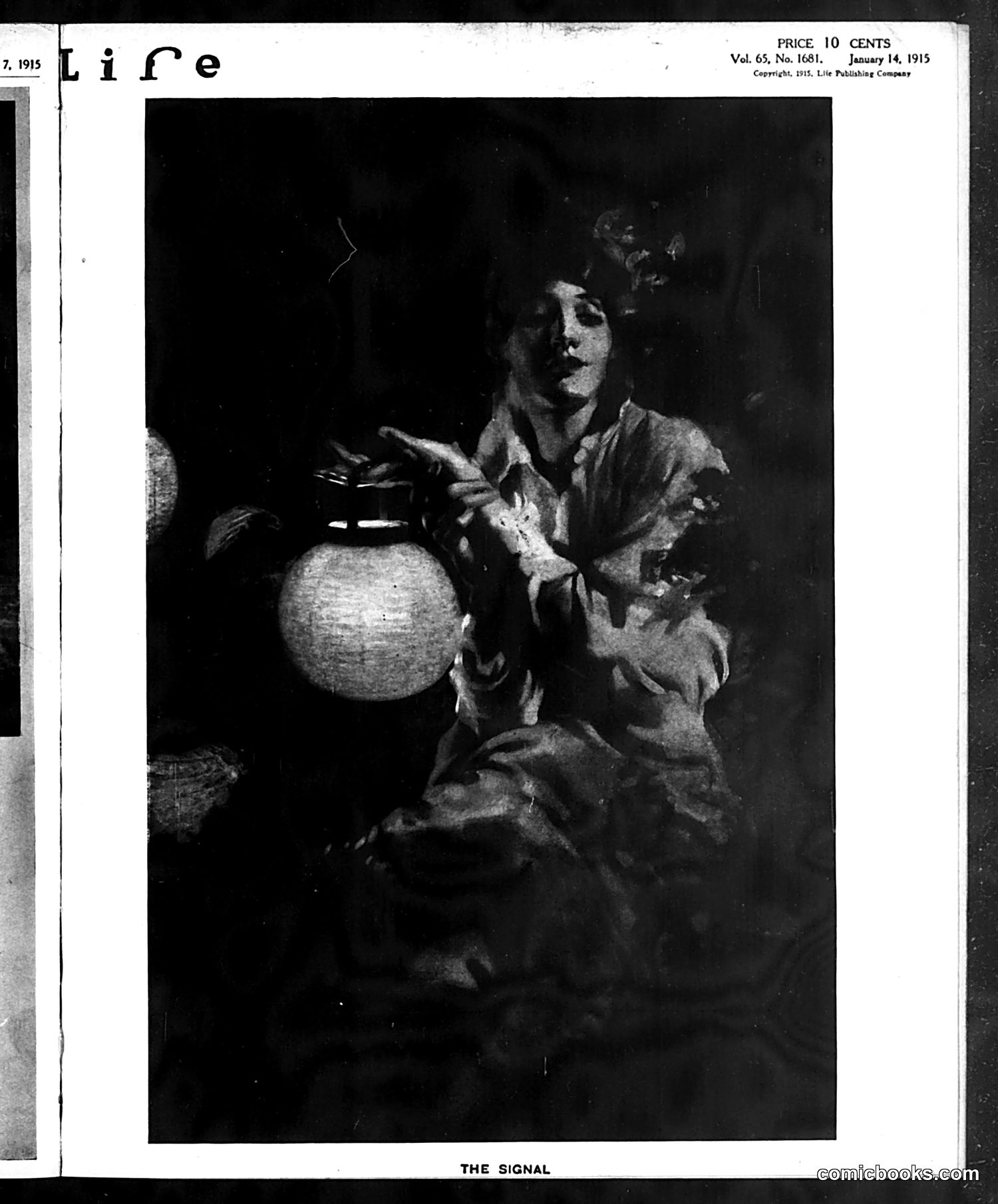
This page from Life shows a dramatic black and white photograph titled "The Signal." The image depicts a woman in early 1900s dress holding what appears to be a lantern or light source, seemingly communicating or signaling to someone in the darkness beyond the frame. Given Life's satirical mission and the date (1915, during World War I in Europe), this likely comments on wartime communication, espionage, or signaling activities—possibly referencing women's roles during the conflict or contemporary anxieties about spy networks and secret communications. The theatrical lighting and composition suggest this may reference either a stage production or a contemporary news event related to WWI. Without additional context or text visible on this page, the specific political or social critique remains unclear.
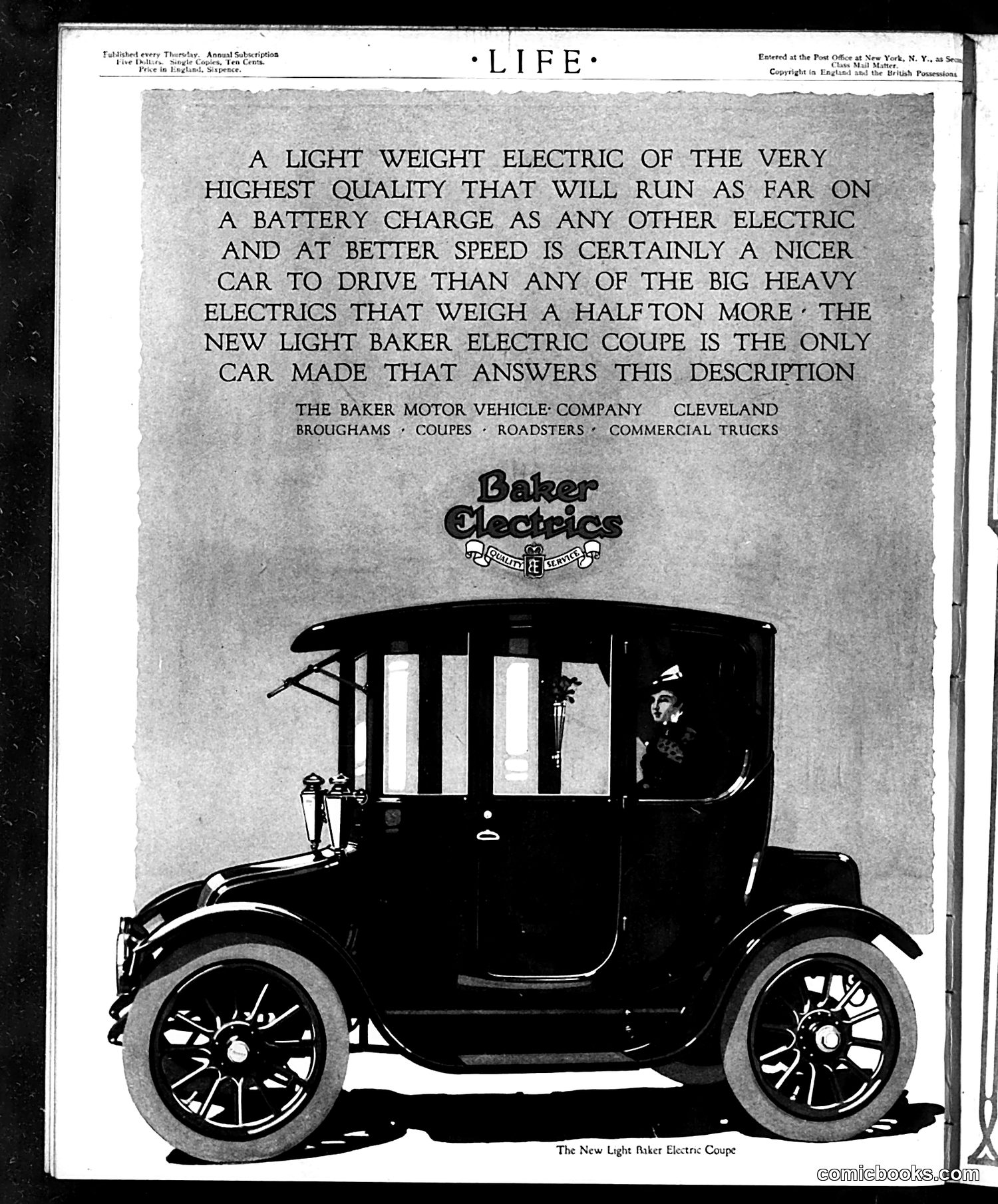
This is a **straightforward advertisement**, not satire. It promotes the Baker Motor Vehicle Company's "Light Baker Electric Coupe" from Cleveland, Ohio. The ad argues that lightweight electric cars are superior to heavier models—they run longer on battery charge and achieve better speed. The Baker Electric Coupe is positioned as the only car meeting these specifications. The vehicle shown is an early electric automobile, featuring the characteristic enclosed cabin with large windows typical of 1910s-era cars. Electric vehicles were viable transportation alternatives before gasoline engines became dominant. **No political cartoon or satire is present here.** This is period advertising for an actual electric car manufacturer that operated in the early 20th century before the industry shifted toward internal combustion engines.
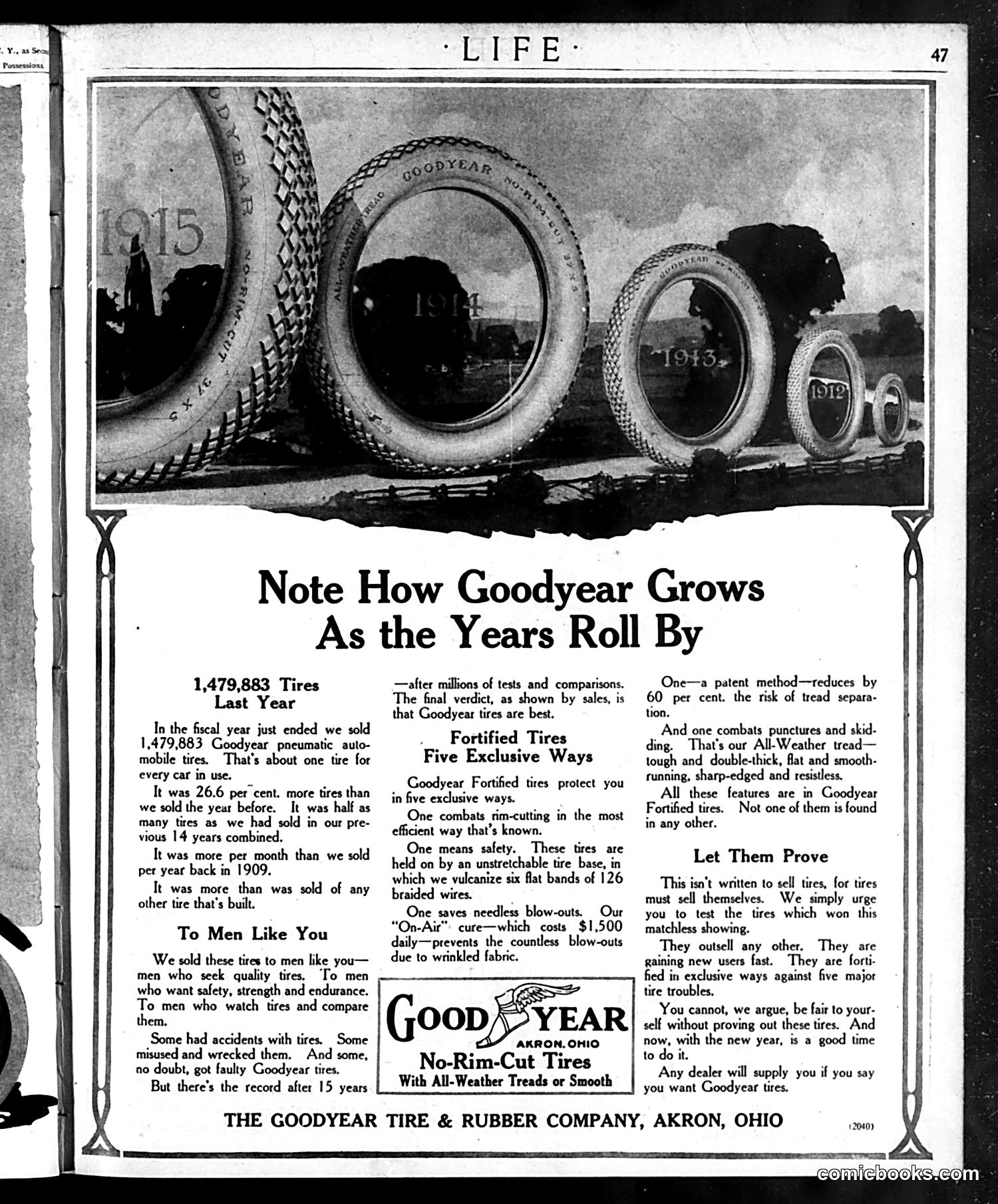
This is **not a cartoon or satire page**—it's a full-page advertisement for Goodyear Tires from the early 1910s (dates visible on tires: 1915, 1914, 1913, 1912). The image shows five tires of decreasing size arranged to represent Goodyear's growth over five years. The ad's rhetorical strategy appeals to male readers ("To Men Like You") by emphasizing durability, safety, and comparative testing—not humor or satire. Key claims advertised: Goodyear sold 1.48 million tires the previous year, 26.6% more than the year before. The "Fortified Tires" feature five exclusive improvements, including puncture resistance and an "On-Air cure" technology costing $1,500 daily. This is straightforward product marketing using testimonial-style language typical of early 20th-century advertising.
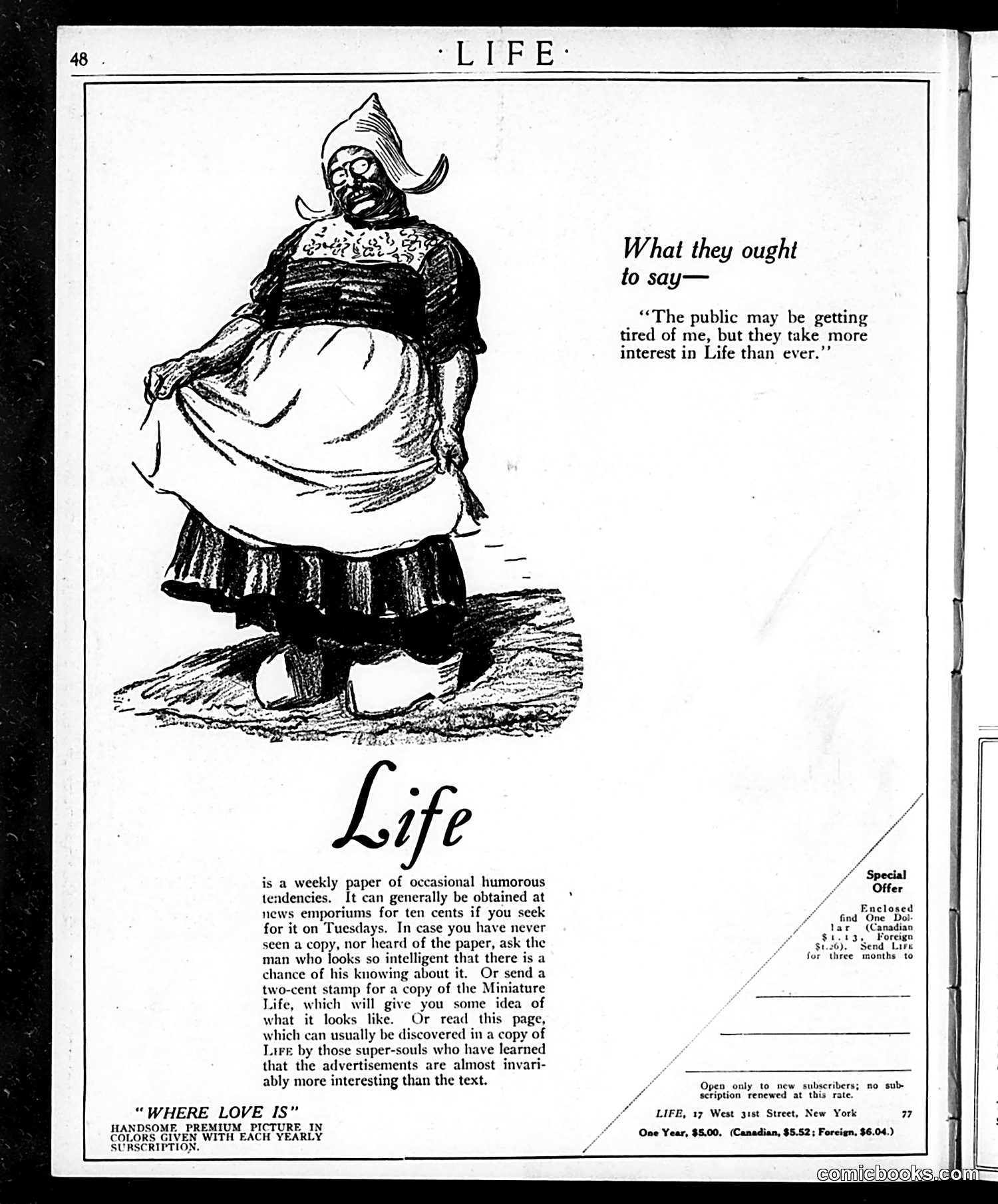
This page is primarily **advertisement for Life magazine itself** rather than political commentary. The illustration depicts a caricatured figure in old-fashioned dress with exaggerated features, though the specific identity is unclear from the image alone. The advertisement emphasizes Life's identity as "a weekly paper of occasional humorous tendencies," positioning it as satirical and accessible humor ($0.10 per issue). The quote "The public may be getting tired of me, but they take more interest in Life than ever" appears designed to promote the magazine's appeal and reach. The lower section advertises a premium annual subscription offer, suggesting Life was competing for reader loyalty in this era. The "Where Love Is" premium picture offer indicates Life bundled entertainment value with subscriptions to attract subscribers.
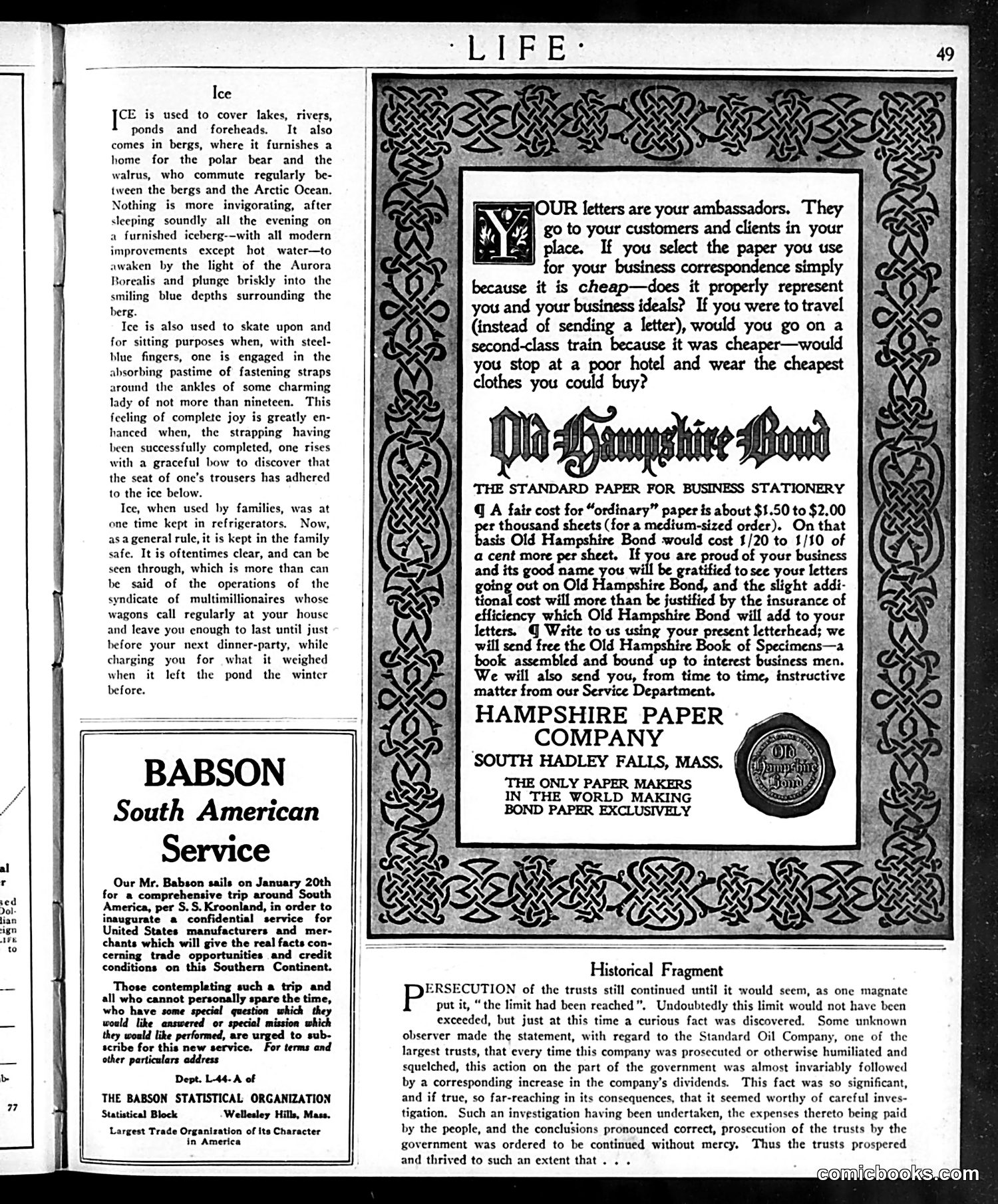
This page contains **no political cartoon**. Instead, it features: 1. **An article on ice** (left column) — describing ice's practical uses in refrigeration and recreation, written in the magazine's characteristic humorous style. 2. **Three advertisements:** - Old Hampshire Bond paper (center, large): argues that cheap business stationery reflects poorly on one's company - Babson South American Service (bottom left): announces Mr. Babson's January voyage to promote US trade opportunities - Babson Statistical Organization (bottom): promotes their trade analysis services 3. **"Historical Fragment"** (bottom right): discusses trust prosecution under government action, likely referencing antitrust cases. This is primarily an **advertising and informational page** rather than satirical content.
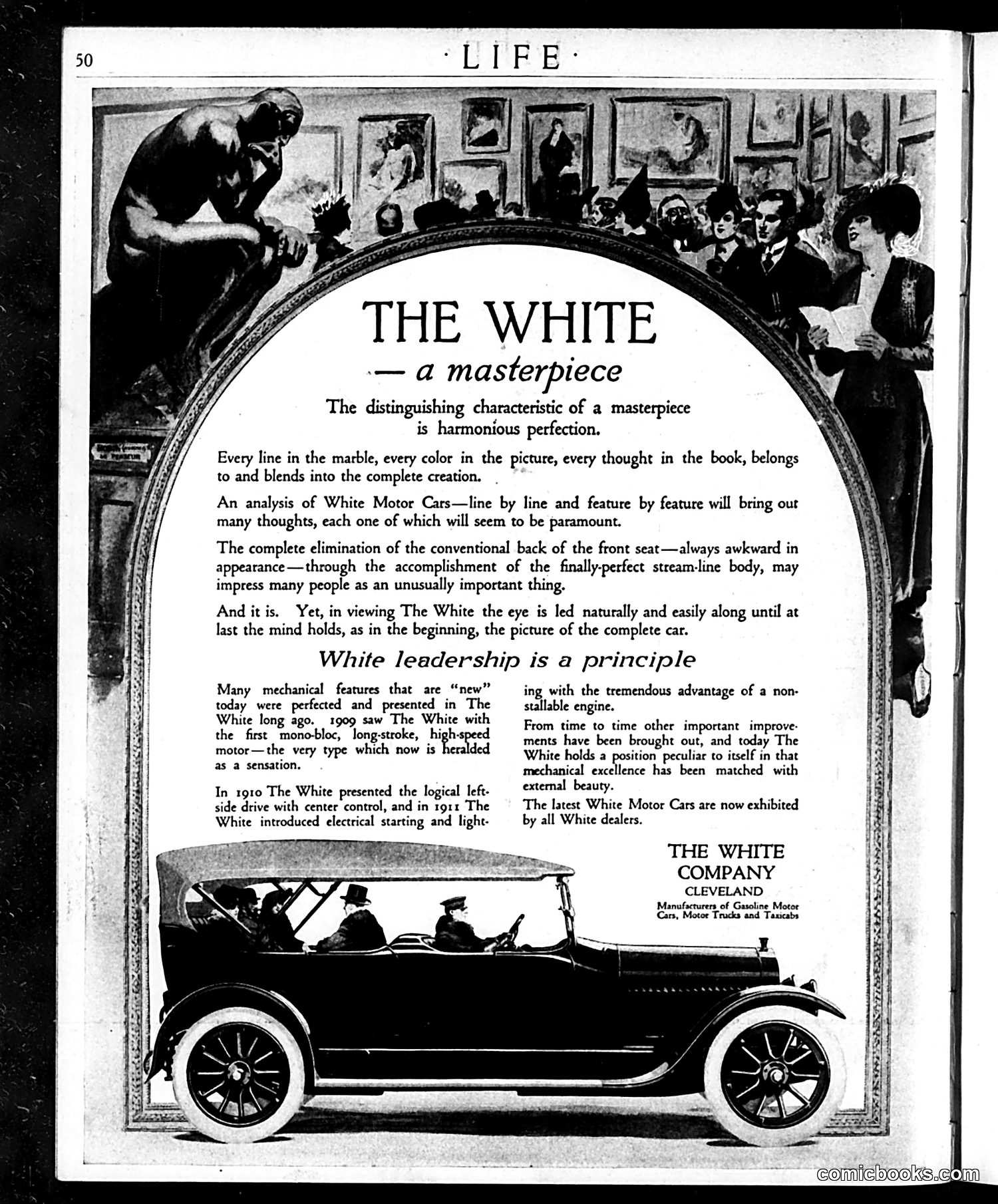
This is **primarily an advertisement**, not satire or political commentary. It's a full-page ad for The White Company, an automobile manufacturer based in Cleveland, promoting their motor cars. The ad uses the framing device of an art gallery scene (top border) to position the White car as a "masterpiece" worthy of museum display. The accompanying illustration shows an open-air automobile with three occupants. The text emphasizes technical innovations: The White introduced the first mono-block long-stroke engine (1909), left-side drive with center control (1910), and electrical starting and lighting (1911). The ad argues these mechanical advances represent "harmonious perfection" and that "White leadership is a principle." This reflects early 1900s automotive advertising strategy—positioning cars as technological and aesthetic achievements rather than mere transportation.
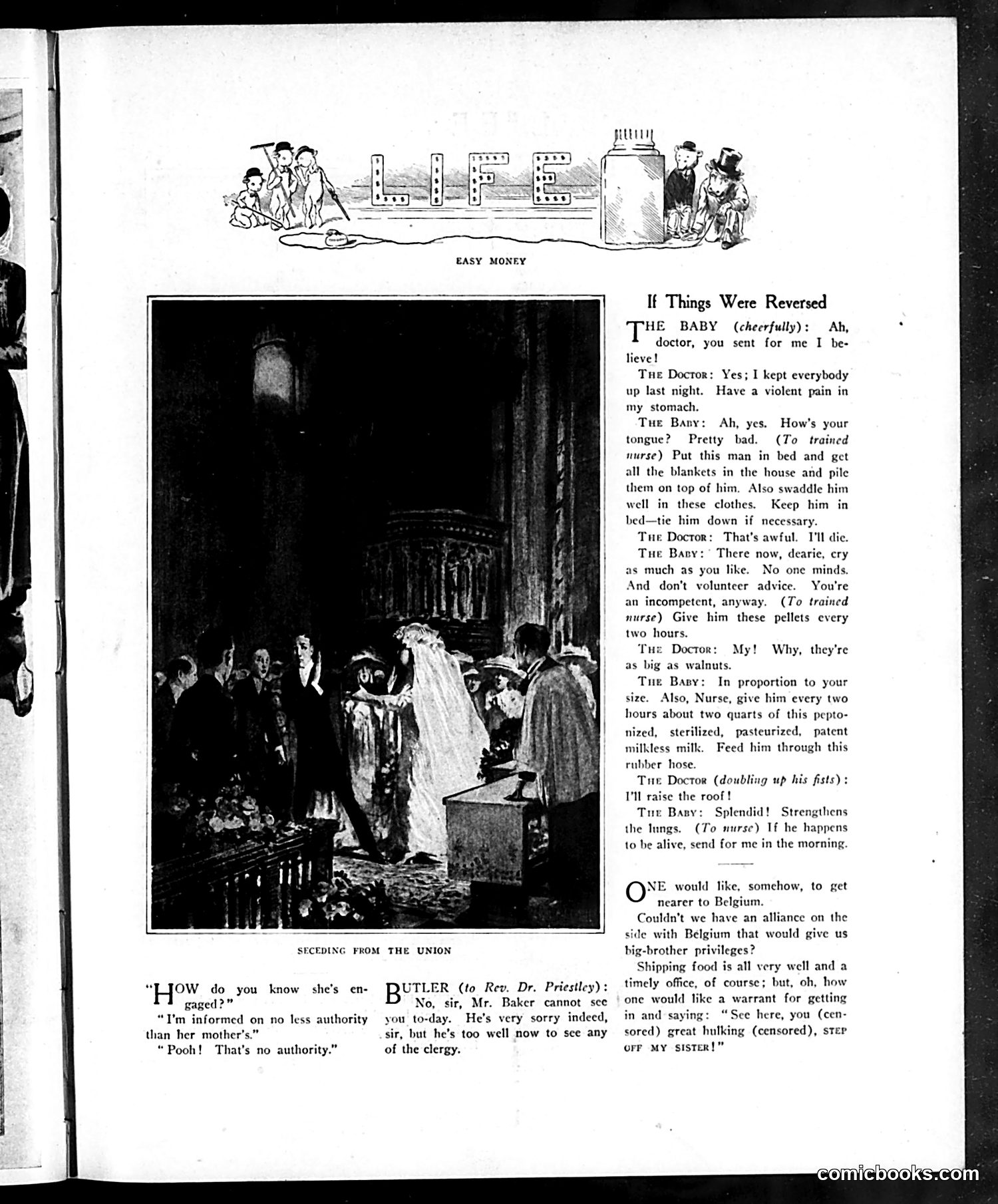
This page contains two separate satirical pieces: **"Seeding from the Union"** (bottom): A dialogue between a butler and Reverend Dr. Priestley about Mr. Baker's absence. The butler claims knowledge from "no less authority than her mother"—a humorous dig at servants' gossip and unreliable sources of information. **"If Things Were Reversed"** (right): A comedic sketch inverting doctor-patient roles. A baby instructs a doctor with absurd medical advice (oversized blankets, excess milk through rubber hose), while the doctor becomes the patient. The satire mocks medical pretension and overconfidence, suggesting doctors can be as foolish as laypeople when roles reverse. **"Easy Money"** (header illustration): Shows people lounging near buildings labeled "LUCK"—likely satirizing get-rich-quick schemes or easy financial shortcuts. The overall theme appears to be social commentary through role reversal and authority mockery.
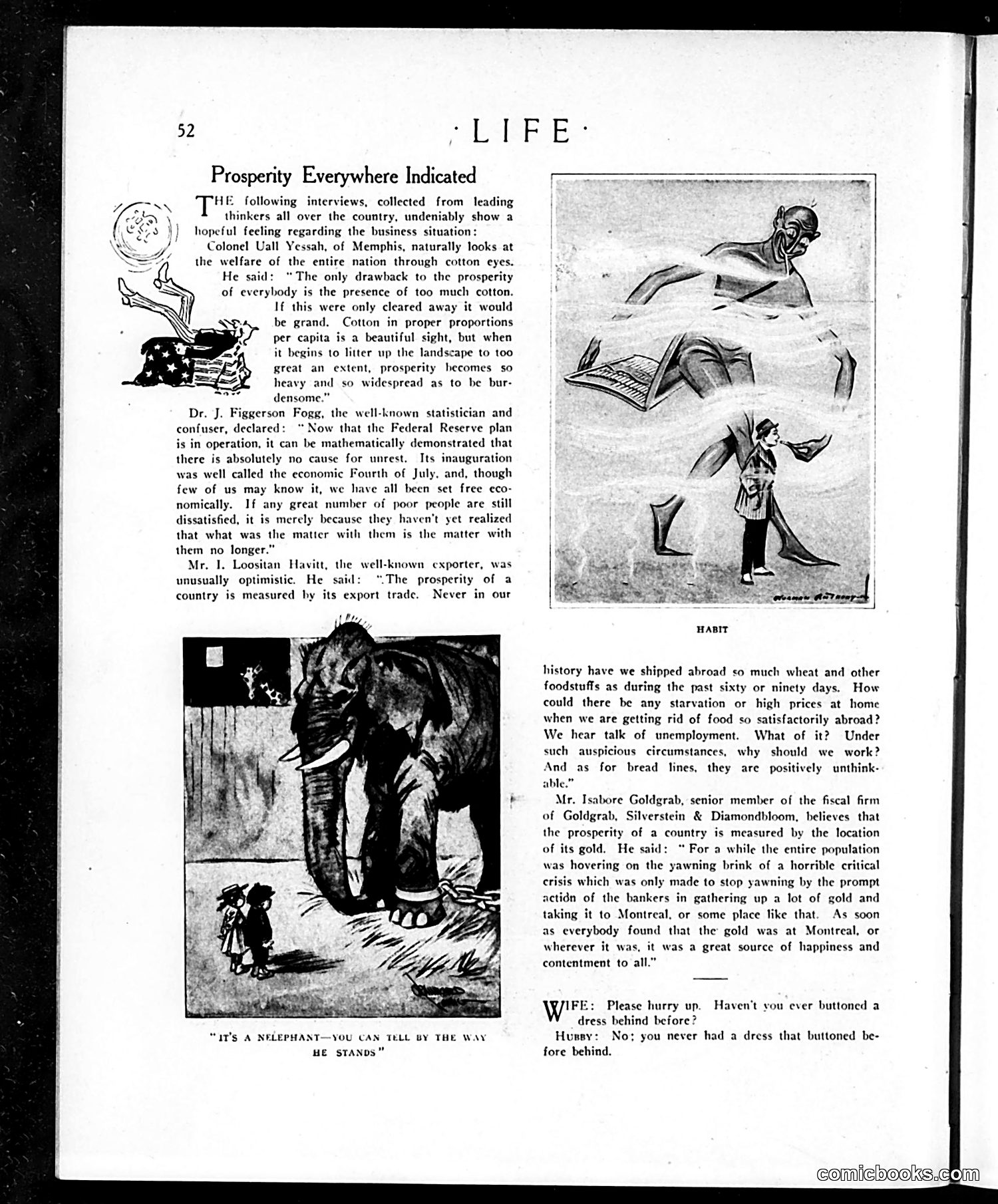
This page satirizes American optimism about economic prosperity following implementation of the Federal Reserve banking system. The text presents quotes from prominent businessmen (Colonel Uall Yessah, Dr. J. Fingerson Foss, I. Loositan Havit, and Isabore Goldbrab) who claim prosperity is assured and concerns about unemployment or bread lines are unfounded. The cartoons mock this false confidence: one shows a well-dressed man amid poverty, another depicts an elephant with tiny humans below (suggesting disproportion between wealthy institutions and ordinary people). The bottom dialogue joke about a wife asking her husband to button her dress—"you never had a dress that buttoned before"—implies the couple is newly poor, undercutting the prosperity narrative. The satire suggests these businessmen are delusional about actual conditions.
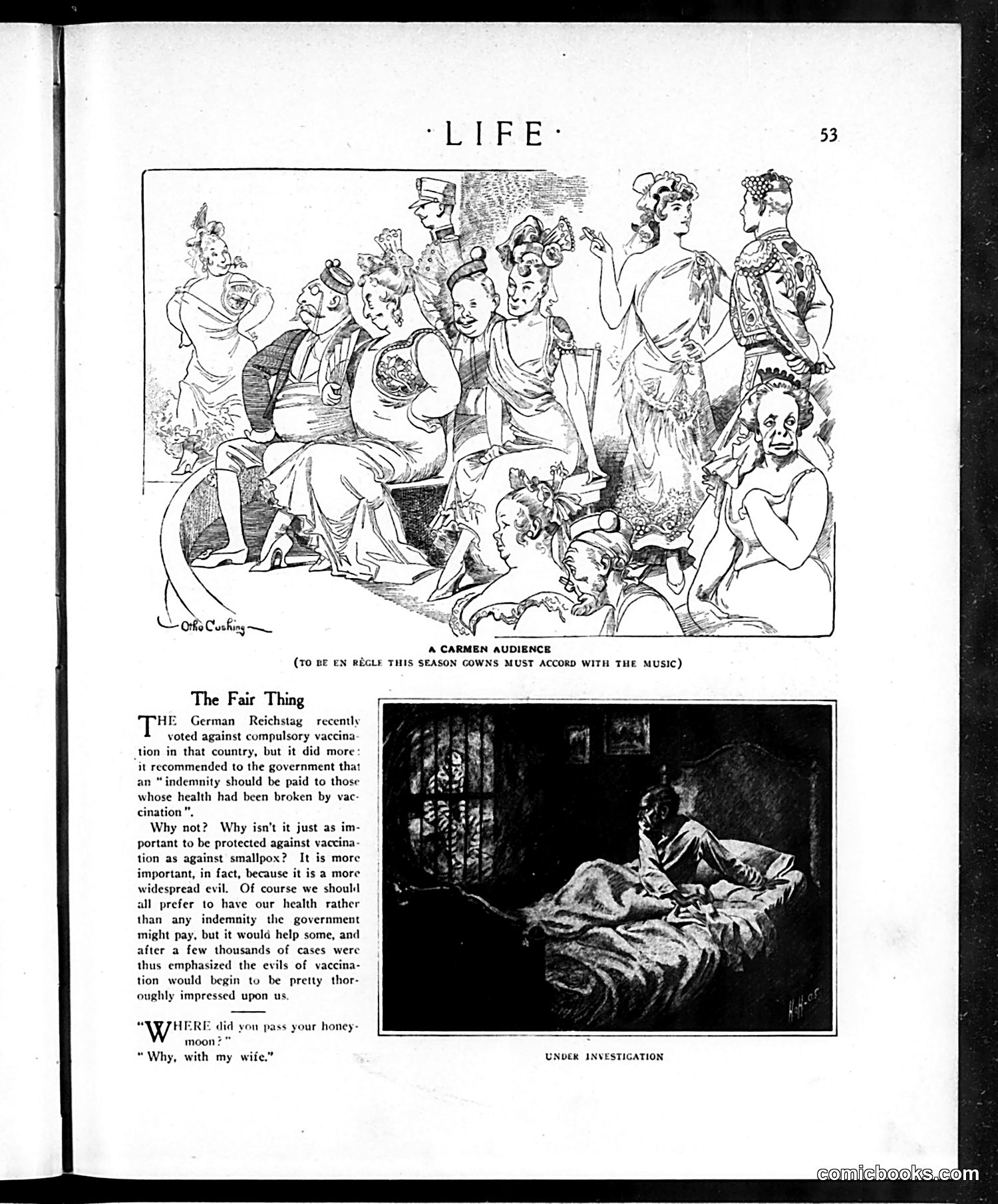
The page contains two distinct pieces: **Top cartoon ("A Carmen Audience"):** A satirical sketch showing fashionably dressed opera-goers in exaggerated poses, captioned to note that "this season gowns must accord with the music." The joke targets high society's pretentiousness at the opera—the implication being that attendees are more concerned with fashion display than the actual performance. **"The Fair Thing" article:** Discusses the German Reichstag's vote against compulsory vaccination, advocating instead for "indemnity" (compensation) to those harmed by vaccines. The piece argues this is insufficient protection and questions why smallpox protection shouldn't receive equal priority. A small joke follows about a honeymoon. **Bottom photo ("Under Investigation"):** A dark domestic scene, likely illustrating a marital or criminal investigation, though specific context is unclear from the image alone.
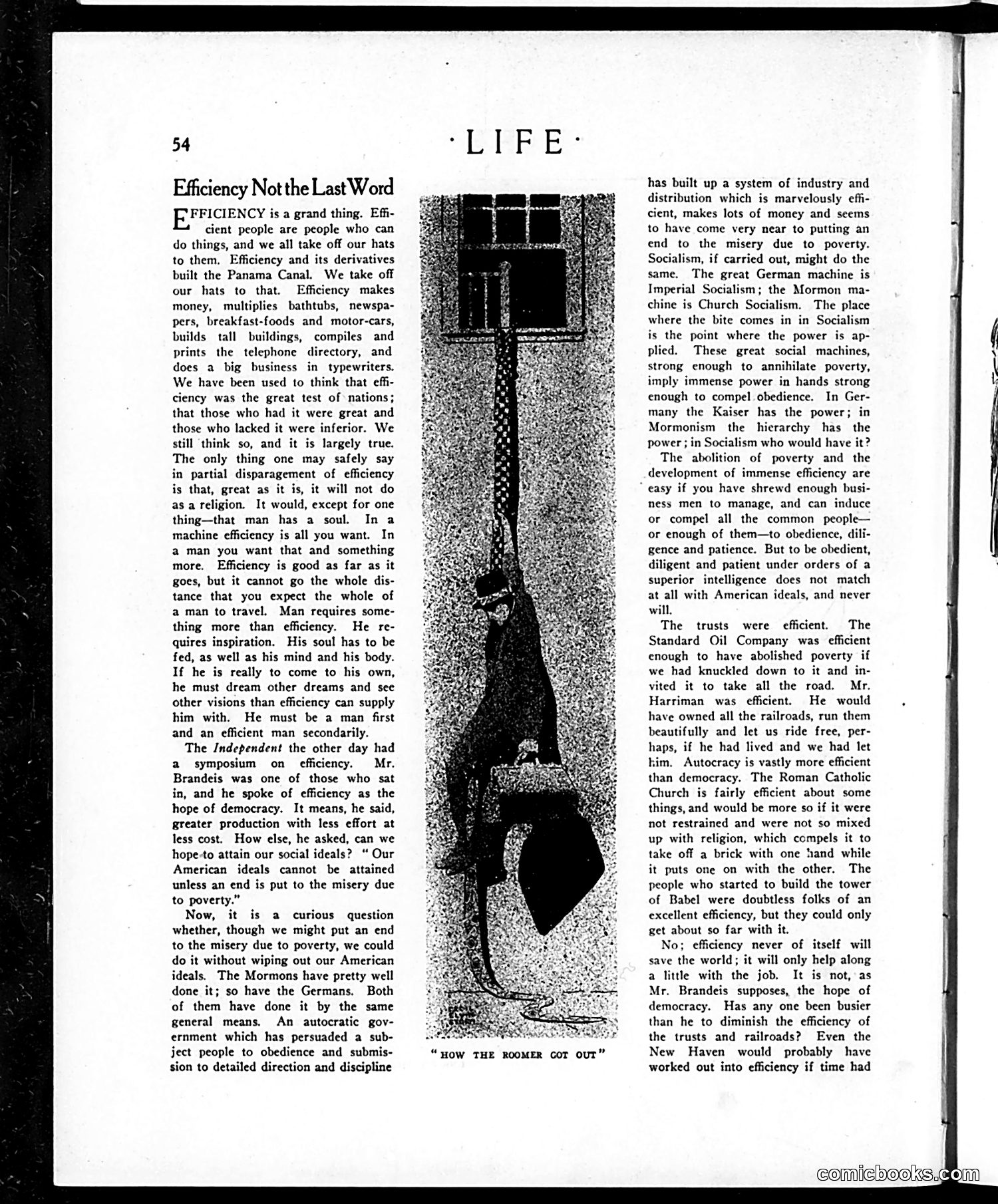
This page from *Life* magazine presents an article titled "Efficiency Not the Last Word," accompanied by a single illustration labeled "HOW THE BOOMER GOT OUT." The cartoon depicts a figure escaping from what appears to be a tall tower or building—likely representing institutional confinement or constraint. The article argues that while efficiency is valuable, it cannot be the sole measure of human achievement or social progress. The text critiques various "efficient" systems—Socialism, Mormonism, the Standard Oil Company, autocracy—suggesting that efficiency alone, without ethical considerations or human dignity, is insufficient. The "boomer" figure represents someone breaking free from such purely mechanistic, efficiency-focused systems, asserting the primacy of individual aspiration and democratic ideals over regimented control.
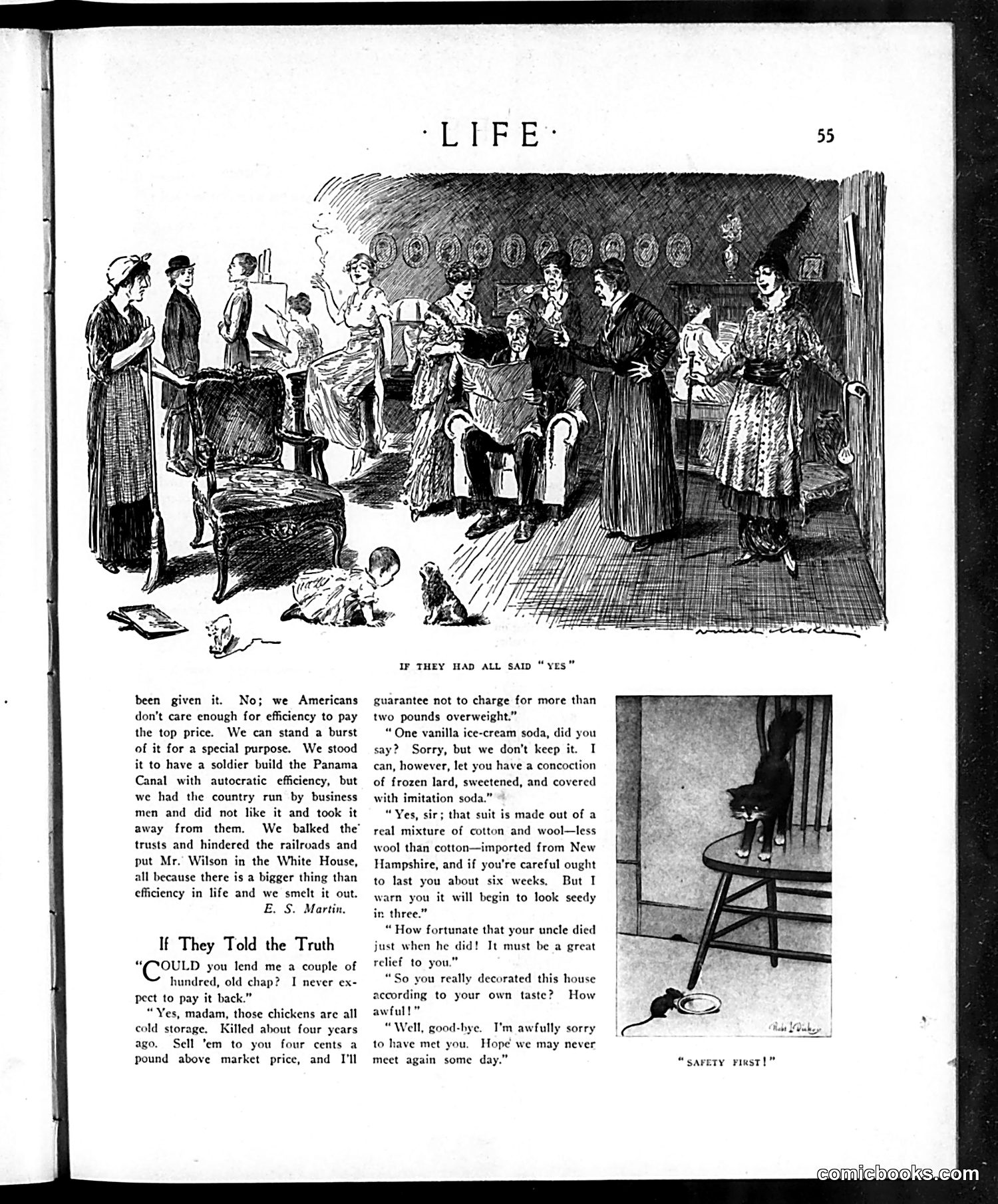
The main cartoon satirizes social pretense and false politeness in upper-class gatherings. The illustration shows a crowded parlor scene where guests appear to be receiving refreshments, with the caption suggesting a hypothetical scenario where everyone agreed to something (likely an uncomfortable request or proposal). The accompanying text snippets mock various social hypocrisies: a vendor hawking old chickens as fresh goods, a shop assistant refusing to stock vanilla ice cream while offering inferior substitutes, dismissive remarks about homemade decorating, and insincere condolences. The cartoon's title and these vignettes work together to satirize how Americans accept falsehoods and poor treatment rather than demand honesty—a critique of both consumer culture and social courtesy masking dissatisfaction.
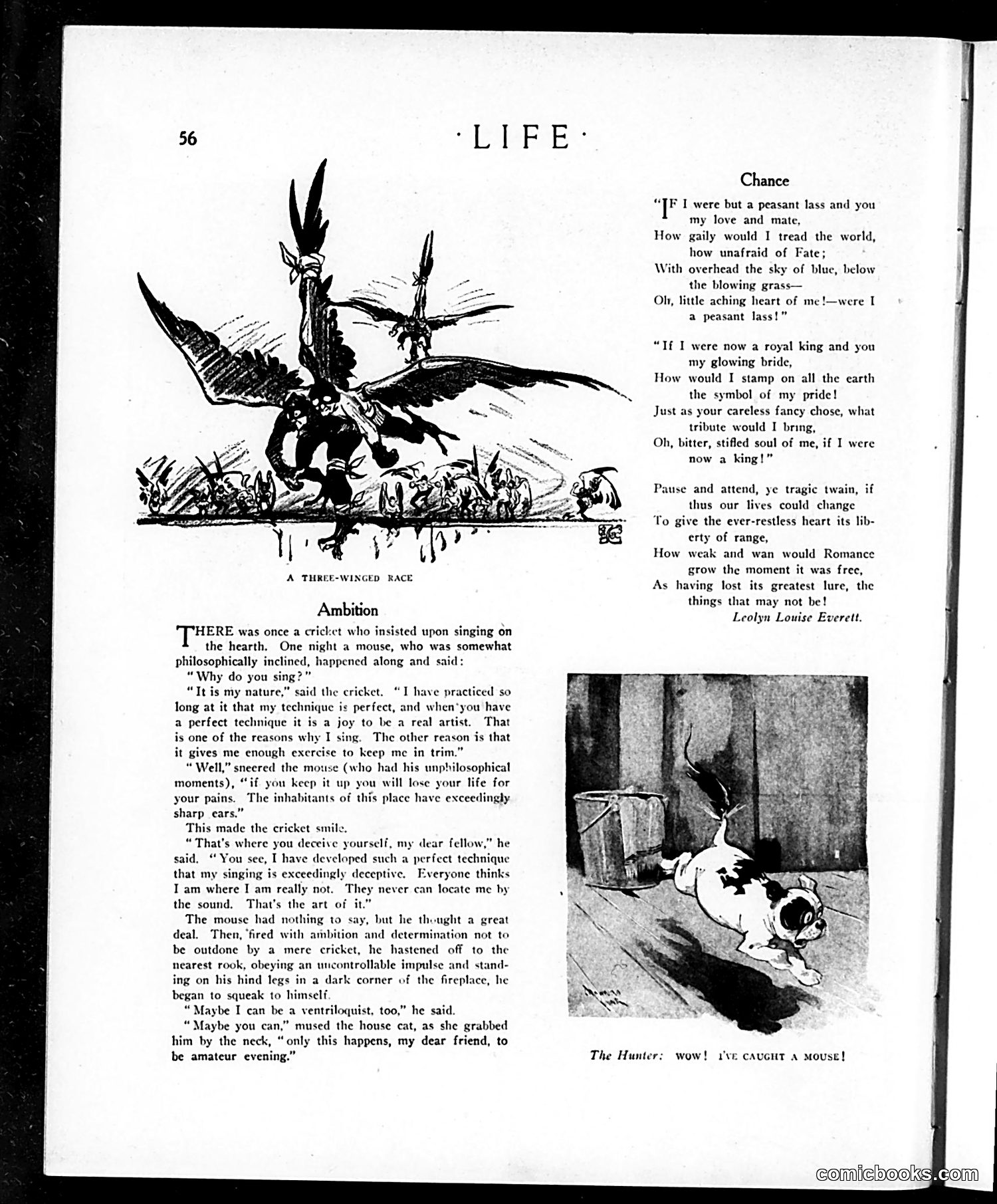
This page contains two separate pieces: **"A Three-Winged Race"** (illustration, top left): A fantastical creature with three wings appears to be racing or in motion. The specific satirical target is unclear from the image alone—it may reference a contemporary invention, scientific claim, or technological competition, but without additional context, I cannot identify what "three-winged race" specifically mocks. **"Ambition"** (story, left column): A fable about a cricket who sings despite a mouse's warning. The mouse predicts the cricket will lose his life to his "pains," but the cricket continues, eventually attempting ventriloquism. The tale satirizes artistic ambition and self-deception—the cricket believes his technique masks his true location, but the house cat easily catches him anyway, revealing that ambition and perfectionism can be dangerously delusional.
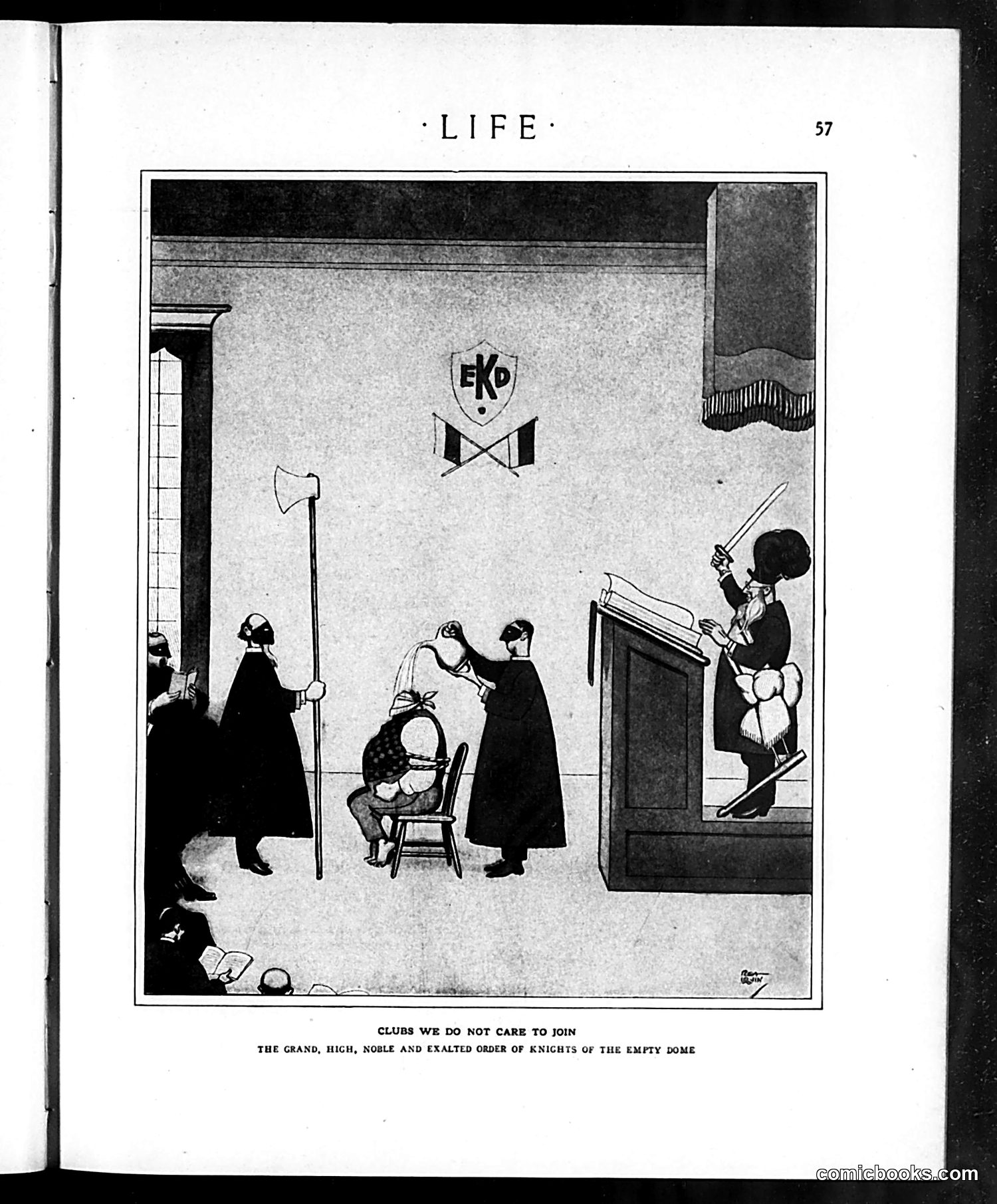
This is a satirical cartoon from *Life* magazine mocking a secretive fraternal organization. The caption reads: "CLUBS WE DO NOT CARE TO JOIN: THE GRAND, HIGH, NOBLE AND EXALTED ORDER OF KNIGHTS OF THE EMPTY DOME." The cartoon depicts an initiation ceremony where robed figures (likely representing the Ku Klux Klan, based on the visual style and "empty dome" reference—a derogatory term for lacking intelligence) perform ritualistic actions on a seated initiate. The "EKO" shield at top suggests the organization's purported name. The satire ridicules fraternal groups claiming grandiose titles while actually being composed of unintelligent members. The phrase "empty dome" is a deliberate insult to members' intellectual capacity. This represents *Life*'s editorial stance against such secretive, ritualistic organizations popular in early 20th-century America.
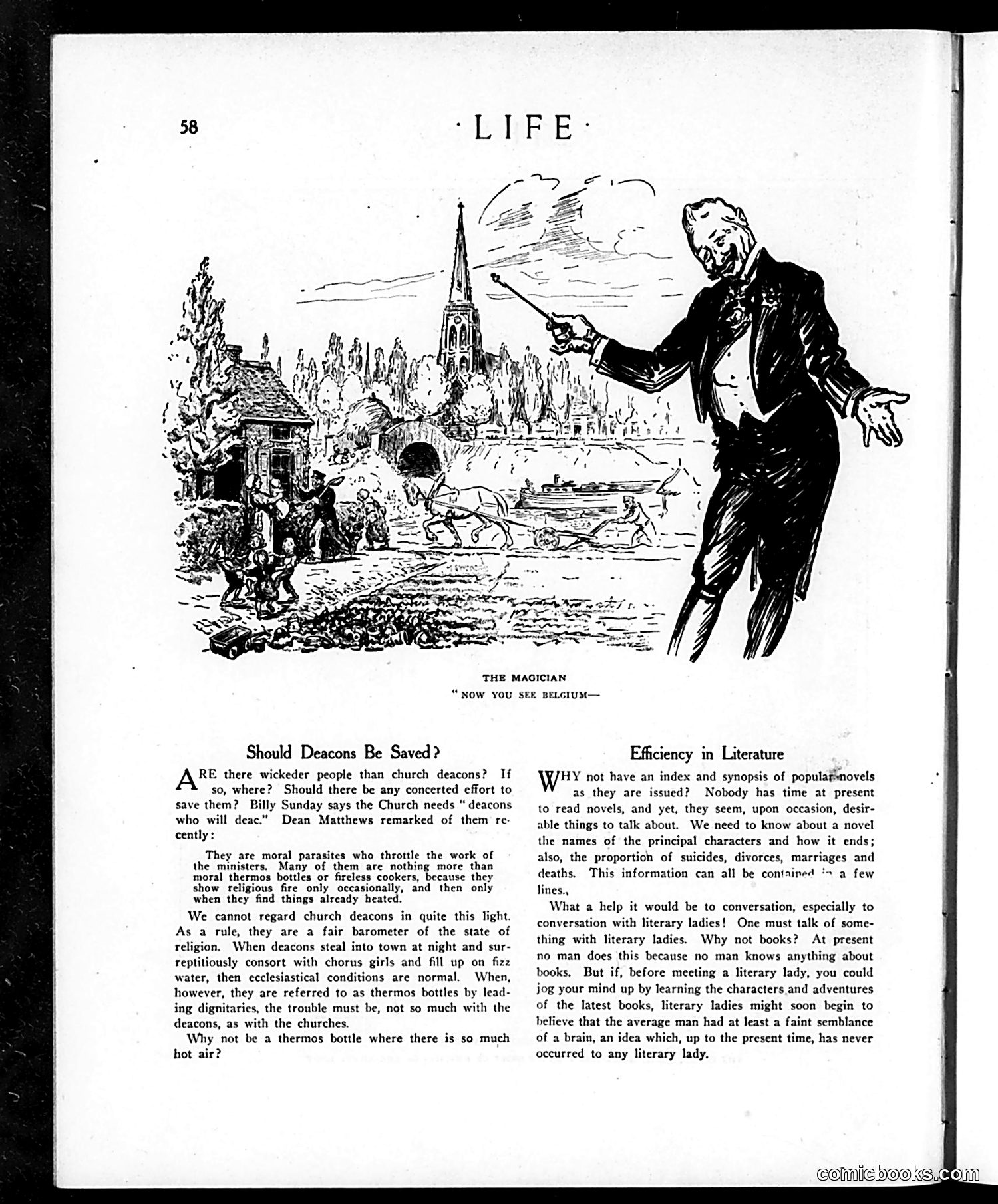
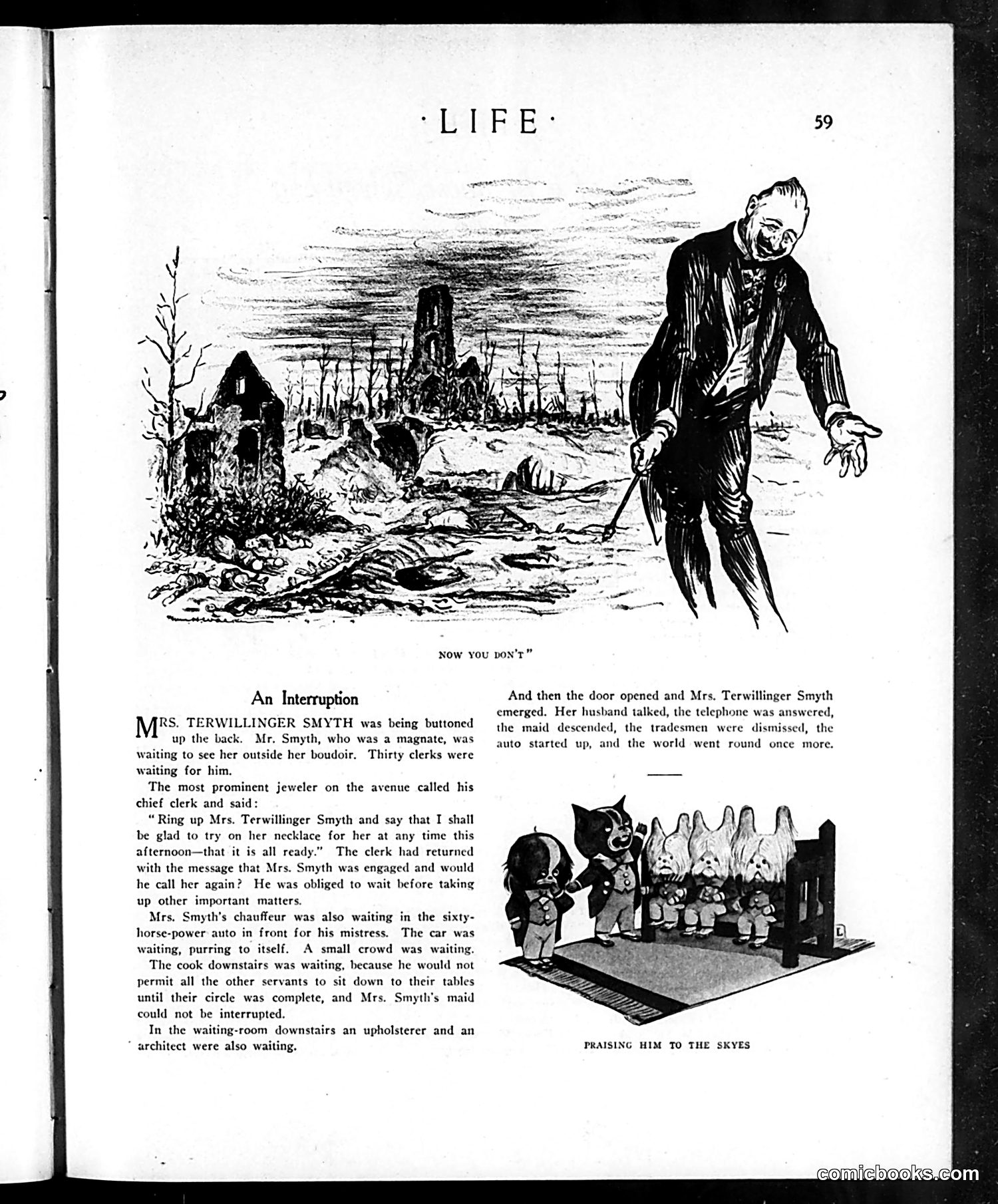
This page features a satirical cartoon showing a magician gesturing dramatically toward a European landscape while Belgium appears to vanish or disappear—a clear reference to Belgium's invasion and occupation during World War I. The magician represents either German military power or wartime deception, making "Belgium disappear" as a darkly comic commentary on the country's conquest. The accompanying articles—"Should Deacons Be Saved?" and "Efficiency in Literature"—are unrelated domestic topics typical of Life magazine's satirical mix. The Belgium cartoon's placement alongside mundane American concerns creates ironic contrast, suggesting the magazine's readers should notice the gravity of European conflict amid ordinary daily discussions.
This story satirizes the absurd power dynamics of wealthy wives in early 20th-century America. Mrs. Terwillinger Smyth, a society woman, holds up an entire ecosystem of people—her magnate husband, thirty clerks, a prominent jeweler, chauffeur, cook, servants, tradesmen, an architect, and an upholsterer—while she gets dressed in her boudoir. The satire mocks how a woman's mere act of dressing creates cascading delays affecting important business and daily operations. The illustration labeled "Praising Him to the Skyes" (likely a religious reference) shows what appears to be a figurine or shrine, emphasizing the quasi-religious devotion society grants wealthy women's leisure time. The humor targets both the vanity of privileged women and the social system that enables them—everyone must wait because she cannot be interrupted. It's social commentary on gender roles, class hierarchy, and wasted time in the leisure class.
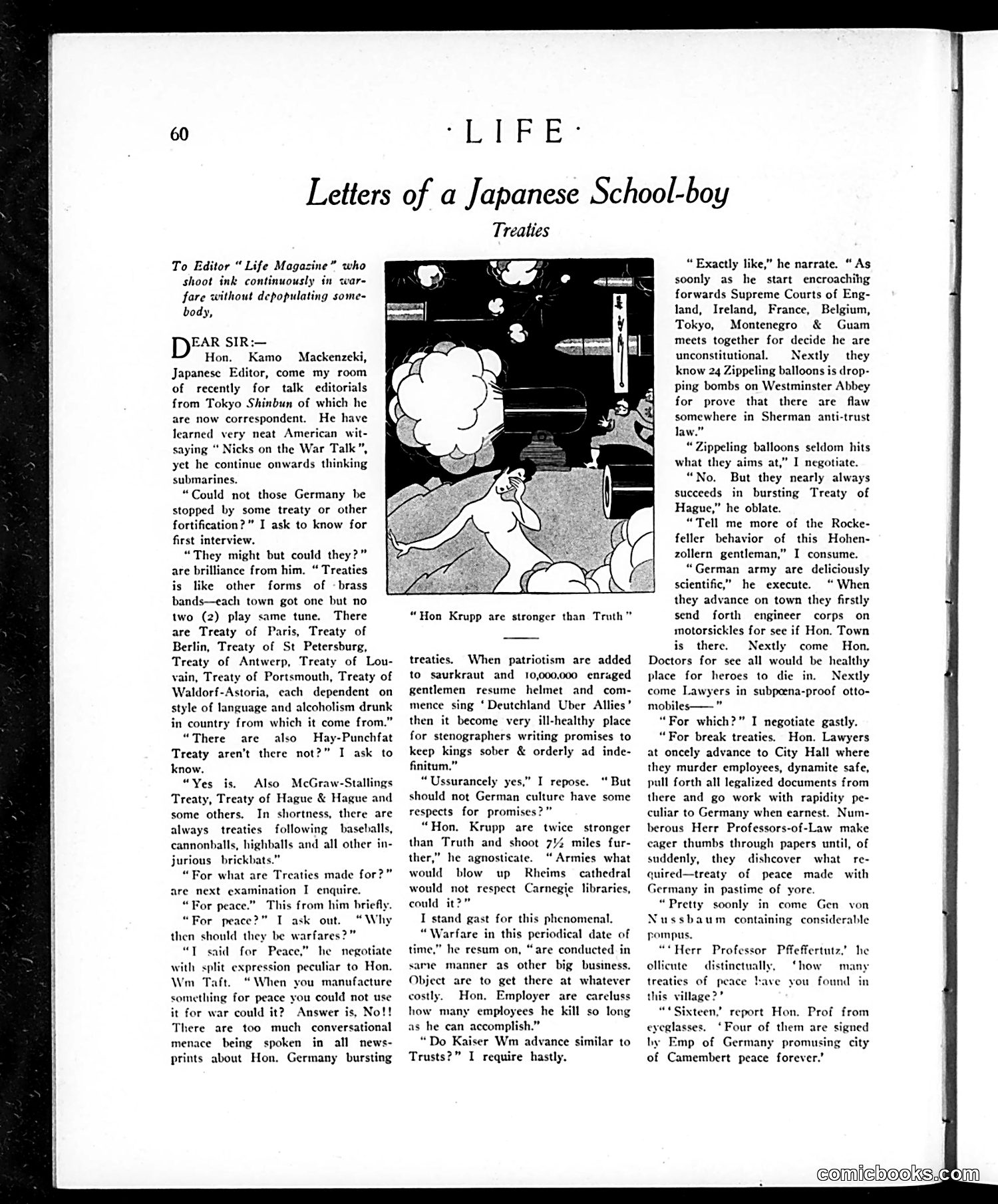
This is a satirical "Letters" column where a Japanese schoolboy writes to *Life* magazine in deliberately broken English, ostensibly interviewing a Japanese newspaper editor about international treaties and war. The satire targets **American naïveté about treaties and warfare** during what appears to be the early WWI era. The Japanese editor mockingly explains that treaties are meaningless—each nation follows its own version depending on "alcoholism drunk in country from which it come from." He argues that Germany's military strength (invoking **Krupp**, the famous German arms manufacturer) supersedes treaty obligations, and that warfare operates like big business with casualty figures as acceptable costs. The crude cartoon depicts what appears to be **aerial bombing**, likely referencing Zeppelins (German airships) dropping bombs on British targets like Westminster Abbey—a contemporary fear. The satire's point: American faith in treaties as peace guarantees is foolishly optimistic. Power and military capability, not legal documents, determine nations' behavior in war.
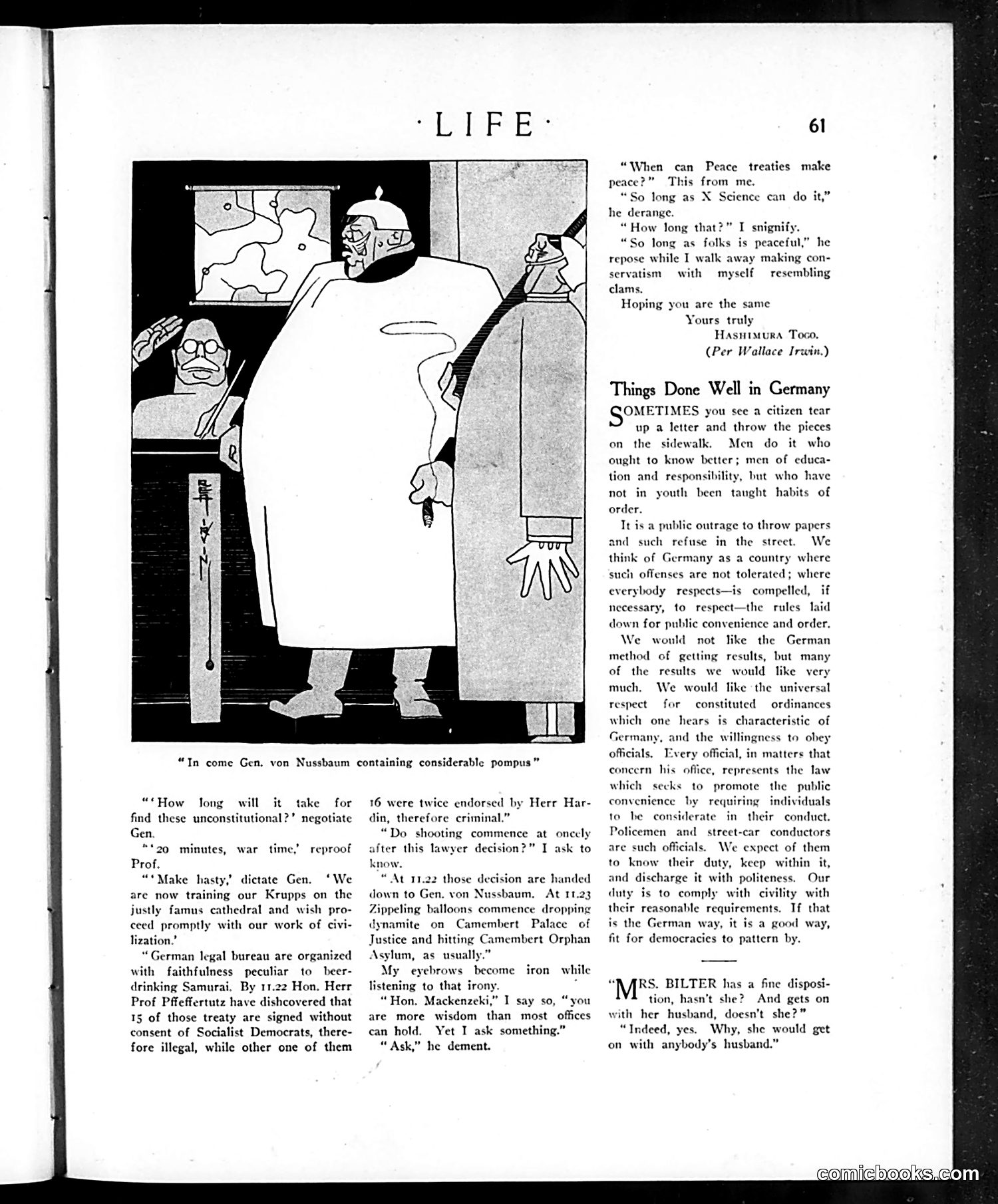
This page satirizes **German militarism and hypocrisy** during what appears to be the pre-WWI or early WWI period. The cartoon depicts **General von Nussbaum** (a fictional caricature representing German military leadership) receiving legal rulings that are immediately ignored. The satire's point: German officials theatrically debate constitutional procedure—treaties signed improperly, lawyer's decisions handed down at precise times—yet simultaneously bomb civilian targets (the Palace of Justice and an orphan asylum) without hesitation. The dialogue mocks German bureaucratic formality as mere theater masking barbarism. When asked "when can peace treaties make peace?" the response is cynical: "as long as folks is peaceful"—implying Germany will continue aggression. The secondary article, titled "Things Done Well in Germany," reinforces this through bitter irony: it praises German respect for law and order while the cartoon has just shown the military disregarding all such niceties. The joke is that Germany's famous discipline serves only to execute atrocities *efficiently*.
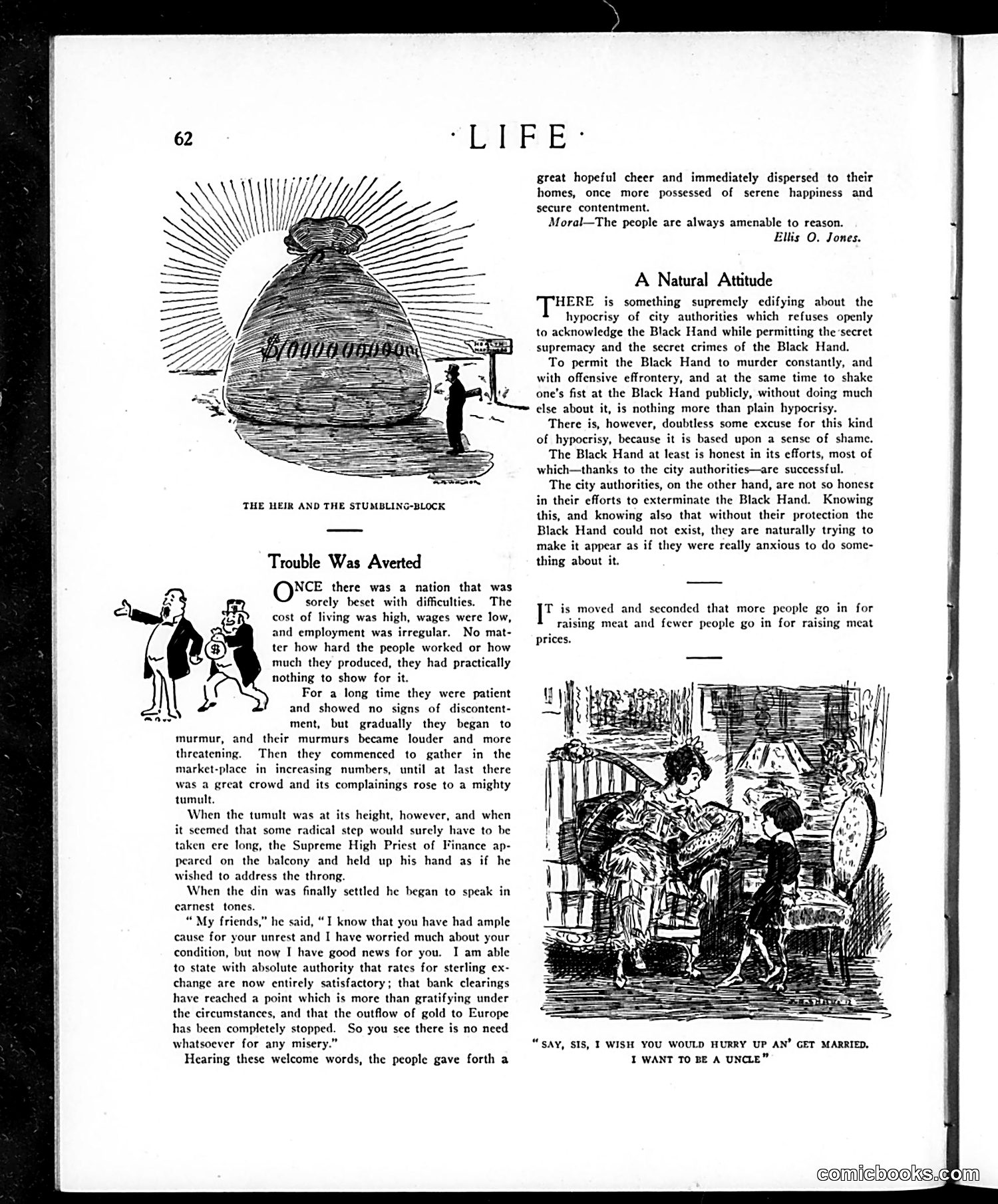
**"Trouble Was Averted"** mocks economic inequality and political deception. A financial authority addresses a rioting crowd suffering from high living costs and low wages. Rather than addressing these material problems, he announces satisfactory exchange rates and bank clearings—abstract financial metrics meaningless to starving workers. The crowd, foolishly pacified by this rhetoric, disperses happy. The satire suggests ordinary people are easily manipulated by irrelevant statistics when they should demand actual economic relief. **"The Heir and the Stumbling-Block"** (top illustration) appears to show wealth or inheritance blocked by some obstacle, though specific referents are unclear. **"A Natural Attitude"** criticizes municipal hypocrisy regarding the Black Hand (Italian organized crime/extortion rings operating in early 20th-century American cities). Authorities publicly condemn it while tacitly permitting its operations, maintaining plausible deniability while organized crime flourishes. The page reflects Progressive-era concerns: economic injustice, political corruption, and organized crime in cities.
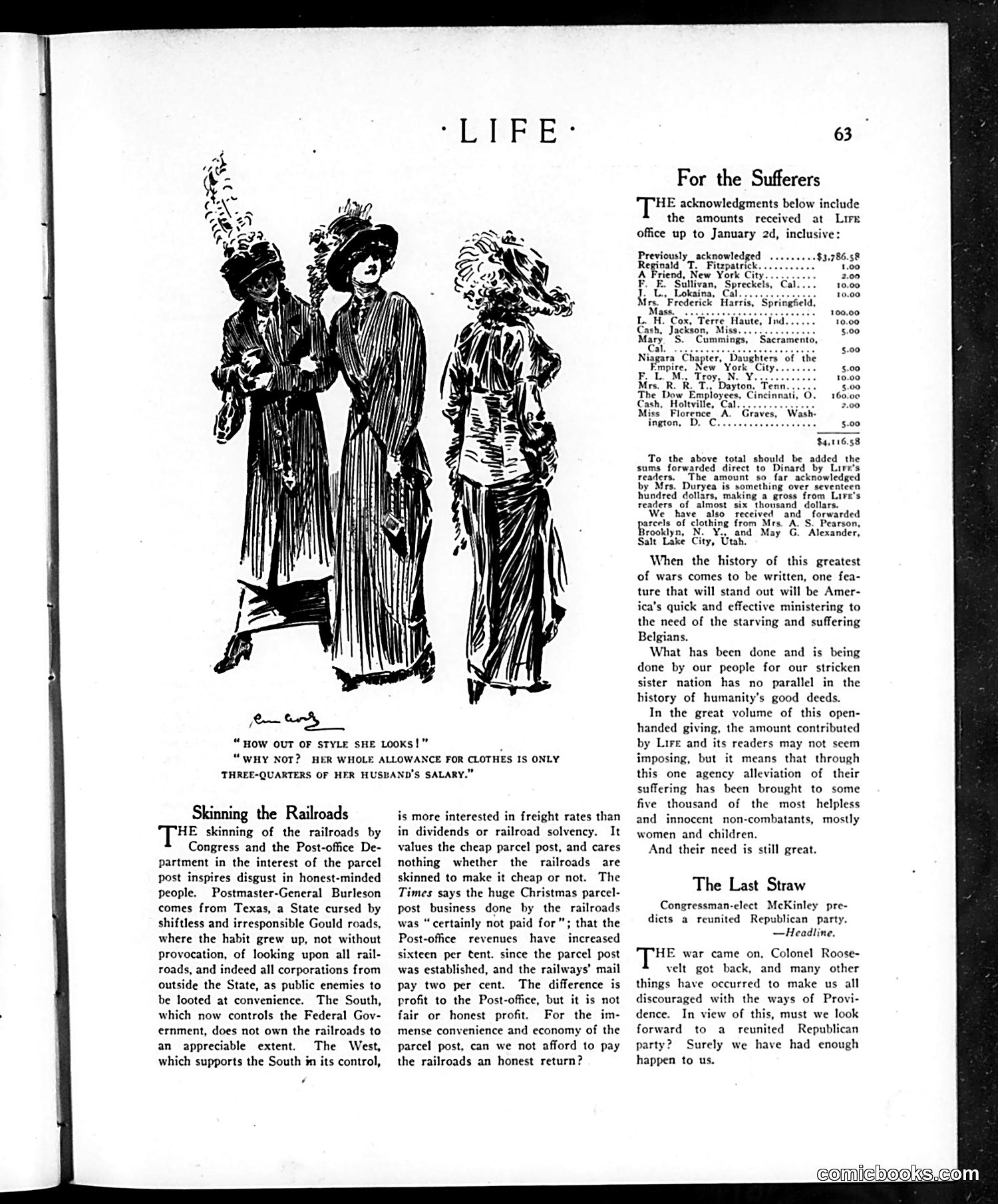
**The Cartoon (top):** Depicts three fashionable women. The caption satirizes a woman's outdated appearance, revealing she can only spend three-quarters of her husband's salary on clothes—implying this meager allowance makes her look shabby compared to her peers. This mocks both the economic inequality between spouses and the absurdity of judging women's worth by fashion. **"Skinning the Railroads":** Criticizes the Wilson administration (Postmaster-General Burleson from Texas) for allegedly unfairly profiting from parcel post at railroads' expense. The editorial argues that while the cheap parcel post benefits Western constituents, the railroads aren't fairly compensated—a regional political complaint about how Southern and Western political interests exploit Eastern railroad corporations. **"For the Sufferers":** Documents charitable donations for Belgian war relief, listing contributions to help starving Belgian civilians affected by WWI. **"The Last Straw":** A brief political jab suggesting that if Republican Congressman-elect McKinley predicts party reunification after all recent disasters, Americans have endured enough misfortune.
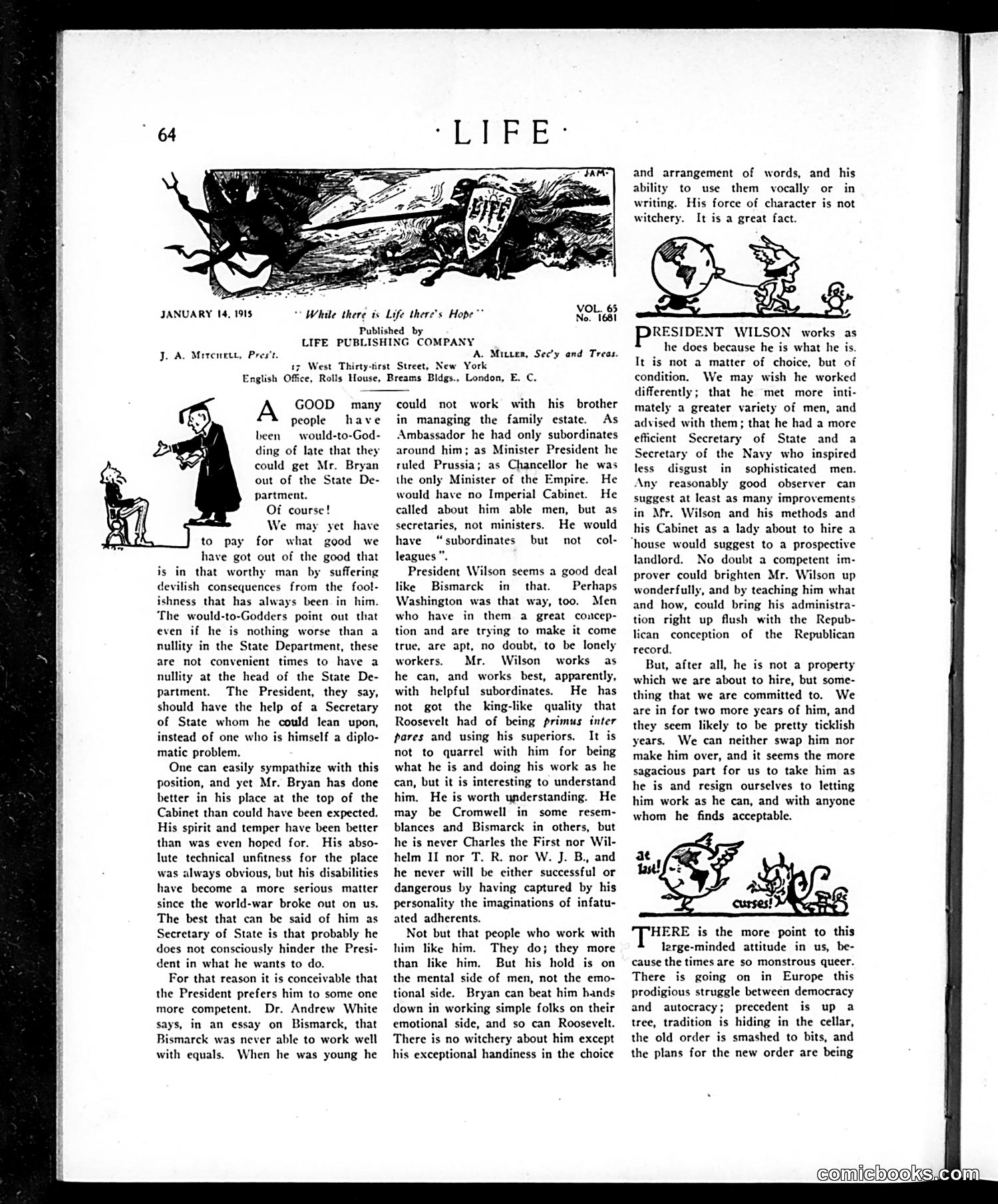
This editorial critiques President Woodrow Wilson's leadership approach, particularly his reliance on subordinates rather than equals. The article compares Wilson to Bismarck—both brilliant strategists who work best with helpers rather than collaborators. The piece defends Secretary of State William Jennings Bryan against criticism, arguing he hasn't actively hindered Wilson despite lacking diplomatic expertise. The author suggests Wilson *prefers* such subordinates because his temperament demands working alone on his vision. The cartoons (small illustrations with captions) satirize this dynamic—depicting the tension between Wilson's intellectual control and Bryan's more emotionally-driven populism. Context: Published during WWI's early stages, when strong diplomatic leadership was crucial. The article essentially argues Wilson's aloneness is both his strength and liability.
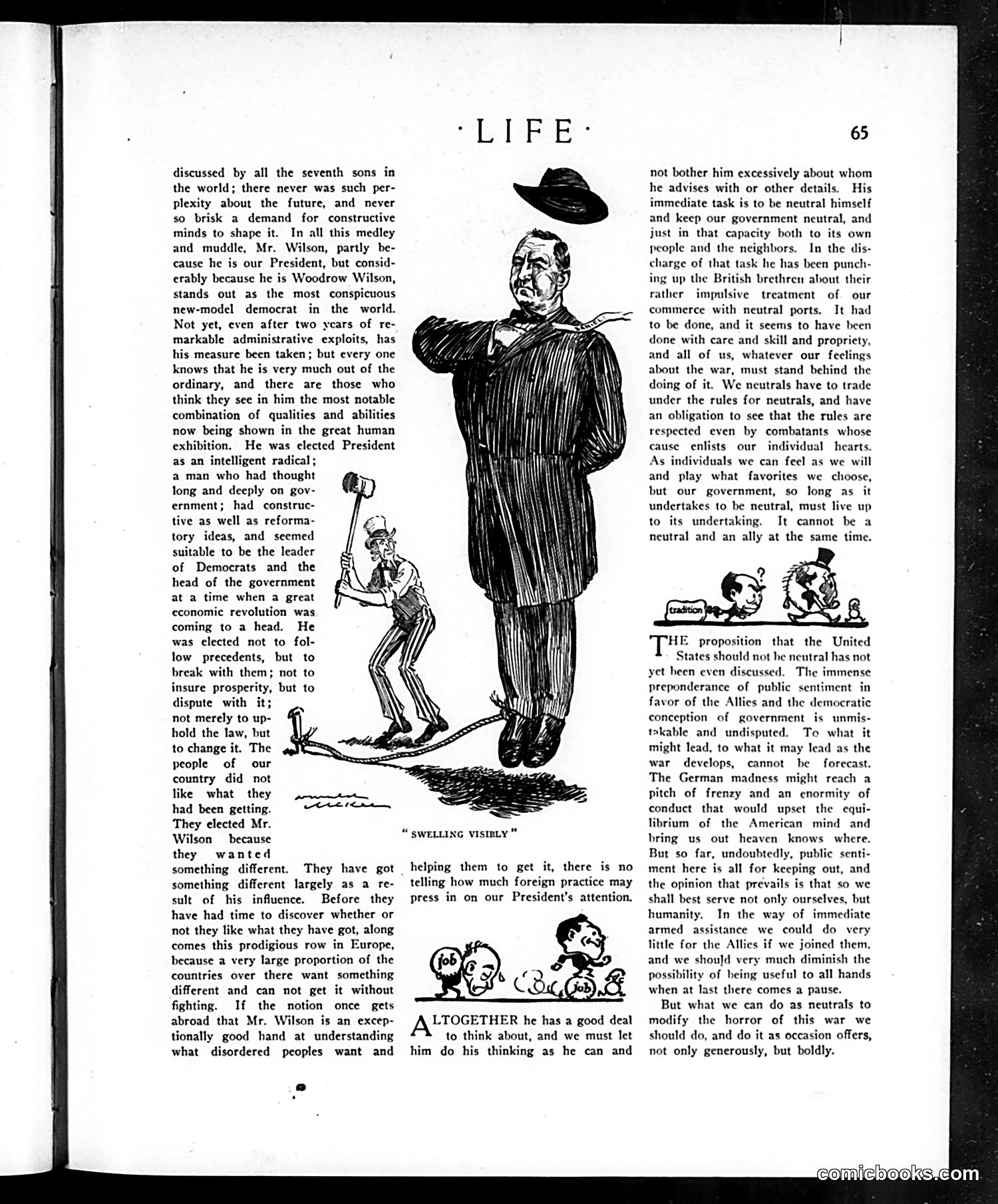
This page discusses President Woodrow Wilson during World War I (the text references "this prodigious row in Europe"). The main cartoon, titled "Swelling Visibly," depicts Wilson as a giant figure being inflated by two small figures pulling on a rope—likely representing the competing pressures on his presidency from foreign powers seeking U.S. support. The article praises Wilson as an intellectual, reform-minded Democrat elected to change the status quo. However, it warns that foreign nations may increasingly pressure him to abandon American neutrality. The satire suggests Wilson is being literally "swollen" by these external demands. The text emphasizes that while Americans sympathize with the Allies, the government must maintain strict neutrality and cannot simultaneously be "neutral and an ally at the same time"—a principle the author argues Wilson has properly upheld by protesting British interference with American commerce. The cartoon illustrates the mounting pressure Wilson faced to abandon neutrality.
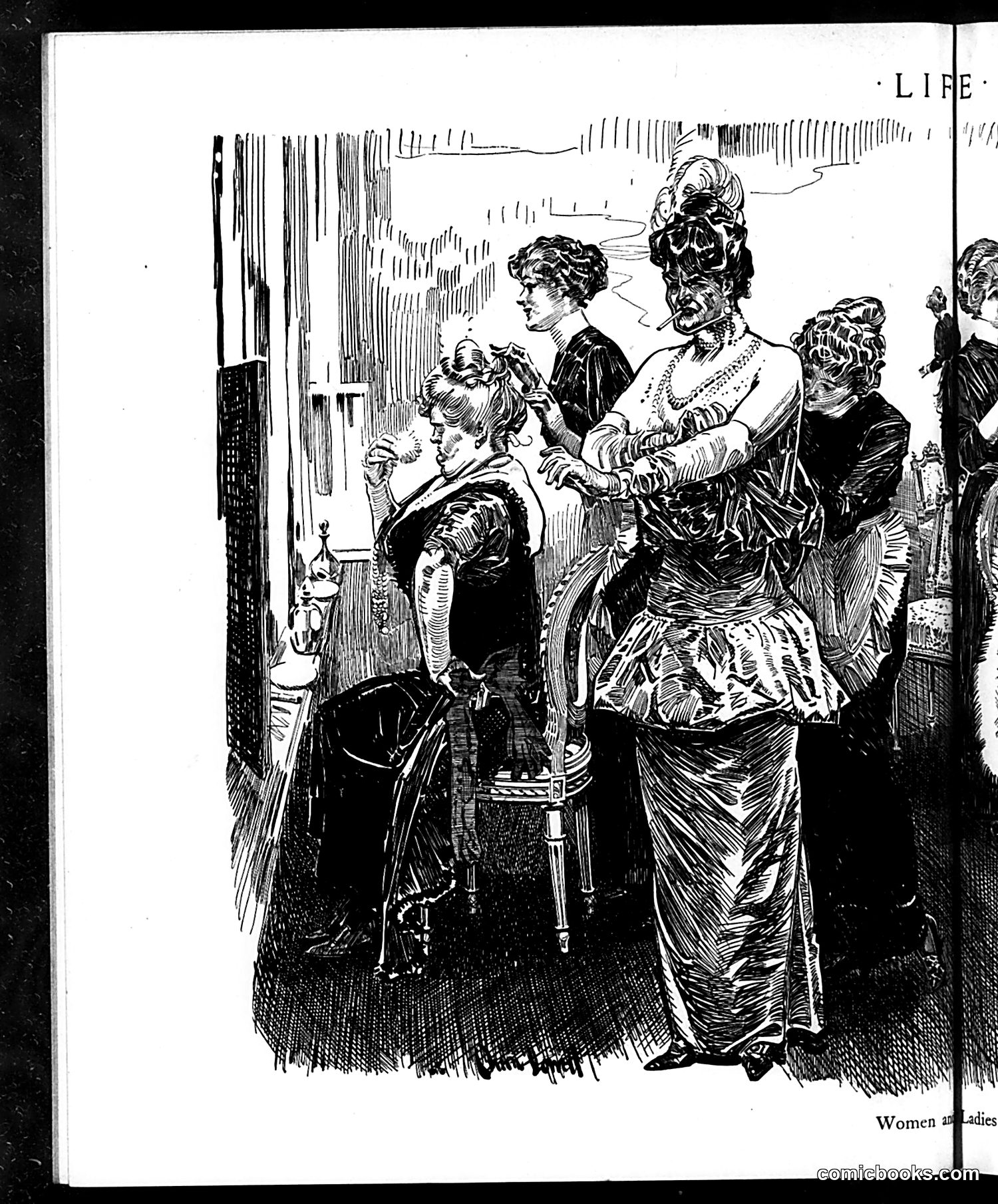
This is a satirical illustration titled "Women as Ladies" from *Life* magazine. The sketch depicts a social scene with elegantly dressed women in early 20th-century attire, gathered indoors. The cartoon appears to satirize the pretensions and affectations of wealthy or upper-class women presenting themselves as "ladies." The detailed cross-hatching and dramatic rendering emphasize the ornate clothing, elaborate hairstyles, and formal posturing of the figures. The satire likely critiques the performative nature of genteel femininity—the gap between women's actual behavior and their cultivated social image as refined "ladies." The exact historical context and specific targets remain unclear from the visible text alone, but the overall point seems to mock artifice in high society.
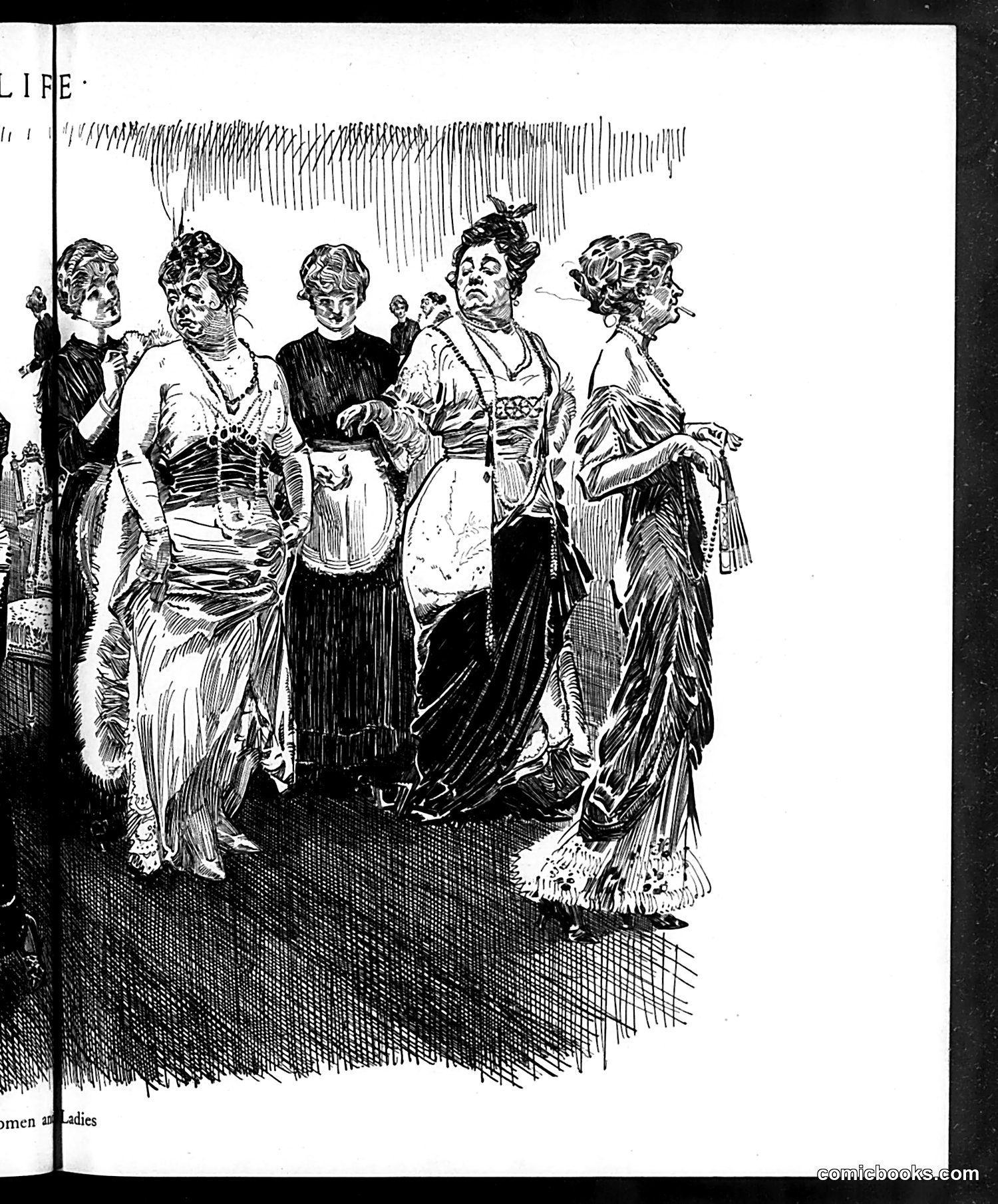
This is a satirical illustration from *Life* magazine showing five women in elaborate Edwardian-era formal dress gathered together. The caption at bottom reads "Women and Ladies," suggesting a social distinction the cartoon is mocking. The satire appears to target class pretensions and social hierarchy among women of the period. By labeling some as "women" and others as "ladies," the cartoon ridicules the artificial distinctions made in high society—implying that despite their finery and affected postures, there's little real difference between them. The exaggerated facial expressions and elaborate clothing styles emphasize the artificiality of their social positioning. This reflects early 20th-century satirical commentary on women's social climbing and class consciousness in American high society.
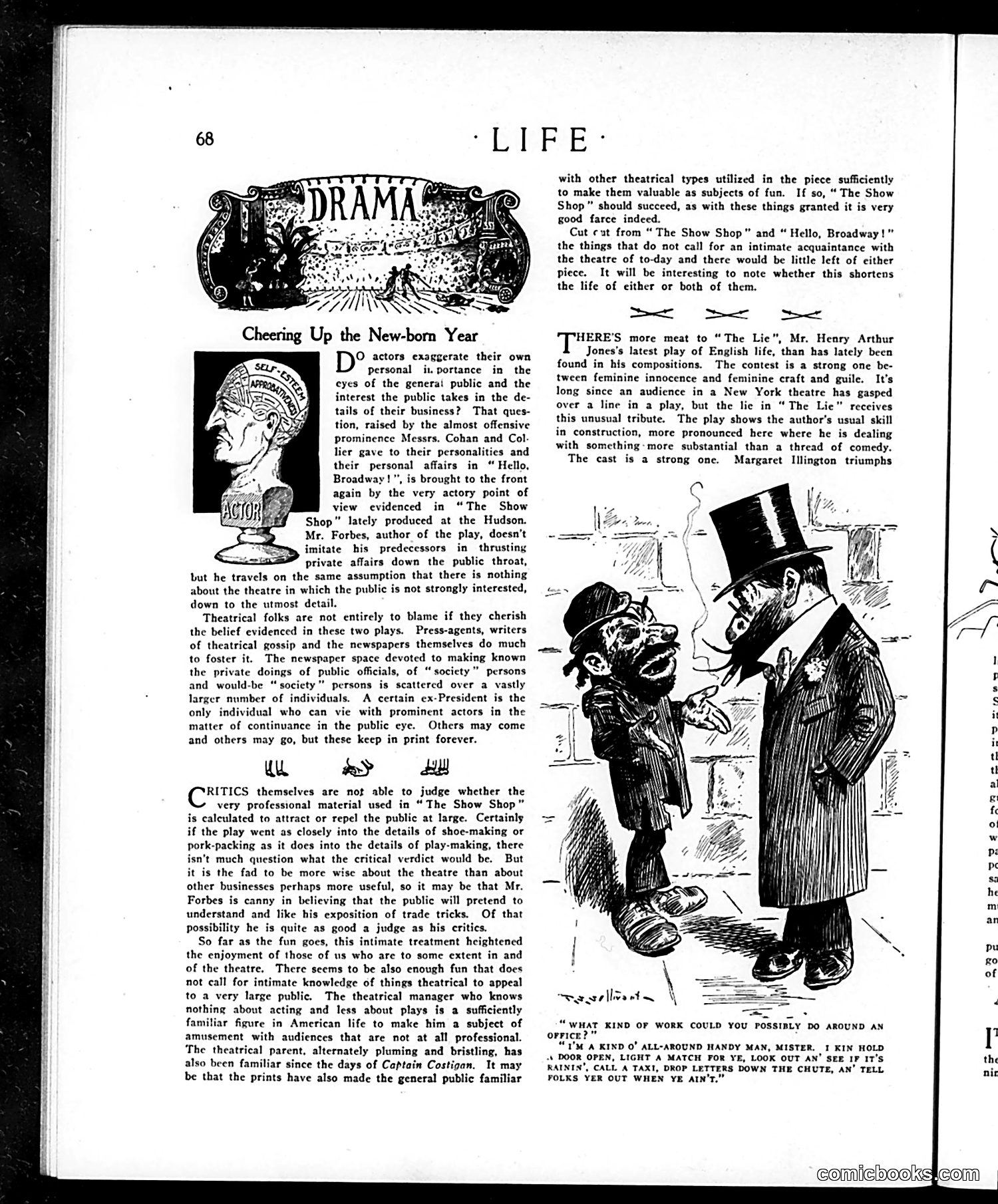
This page critiques two Broadway plays: "The Show Shop" (at the Hudson Theatre) and "Hello, Broadway!" The cartoons and text mock actors' self-importance and theatrical industry's obsession with celebrities' private lives. The main criticism: playwrights like Mr. Forbes assume the public craves intimate theatrical gossip and behind-the-scenes details. The author argues newspapers and press agents enable this by treating actors like ex-Presidents—constantly in print. The accompanying cartoon (right) illustrates a theatrical "jack-of-all-trades" character, emphasizing how the industry recycled stock character types familiar to audiences through repeated theatrical traditions and newspaper coverage. The piece concludes that "The Show Shop" works as farce *because* it exploits this public familiarity with theatrical stereotypes—suggesting the plays' success depends entirely on insider knowledge, not genuine dramatic merit.
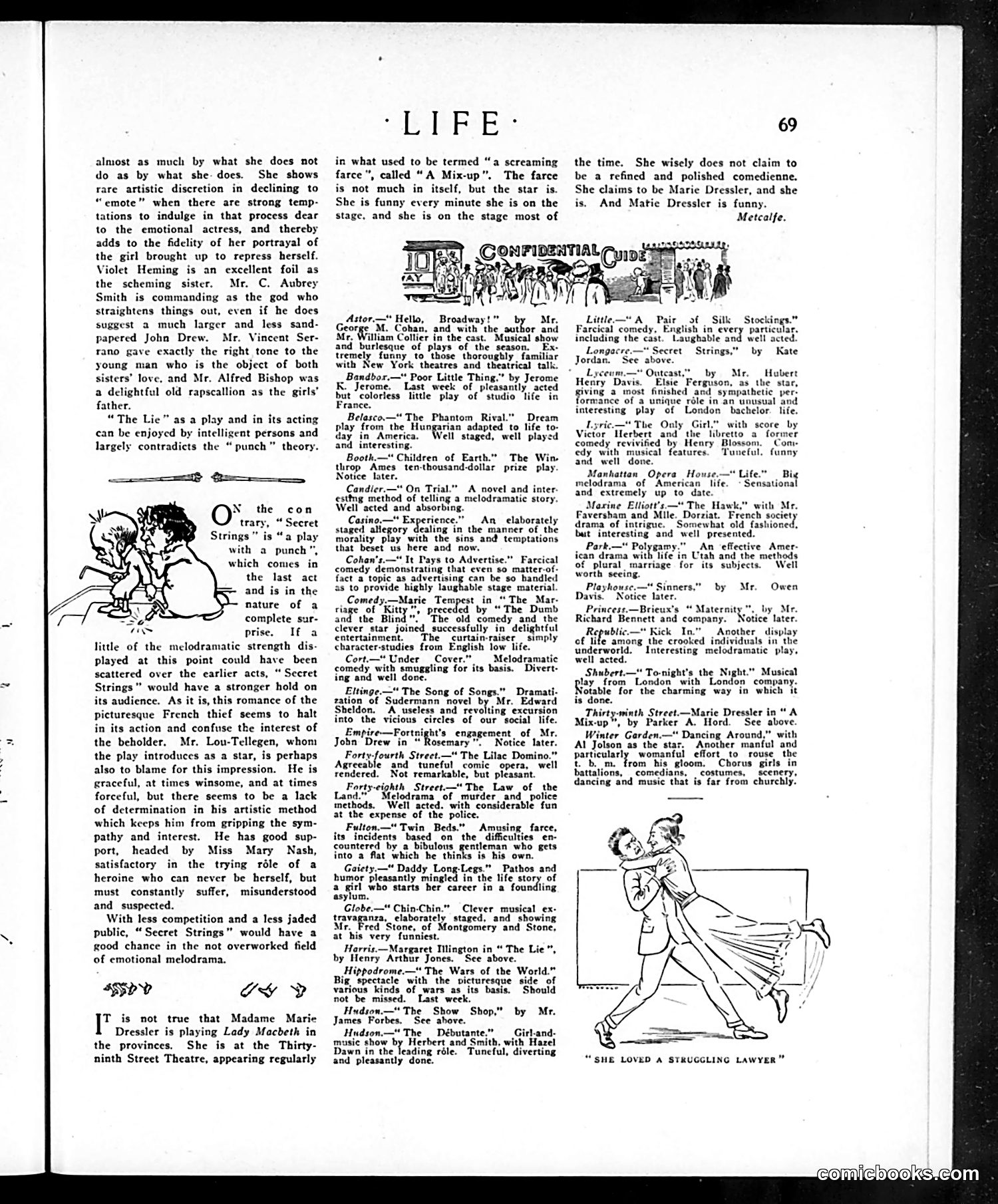
This page contains theater reviews rather than political cartoons. The main content critiques Broadway productions from the early 1900s, with a small illustration labeled "She Loved a Struggling Lawyer" showing a couple in period dress. The reviews discuss plays like "The Lie," "Secret Strings," and "A Mix-up" (featuring Marie Dressler), evaluating their plots, acting, and theatrical merit. The text reflects contemporary theater criticism standards, praising restrained acting over "emoting" and discussing melodrama's strengths and weaknesses. One notable element: the page criticizes Lou Tellegen's performance in "Secret Strings" for lacking determination, suggesting the review reflects early 1900s theater aesthetics valuing emotional intensity balanced with artistic restraint. The reviews are written for an educated, theater-attending audience familiar with Broadway conventions.
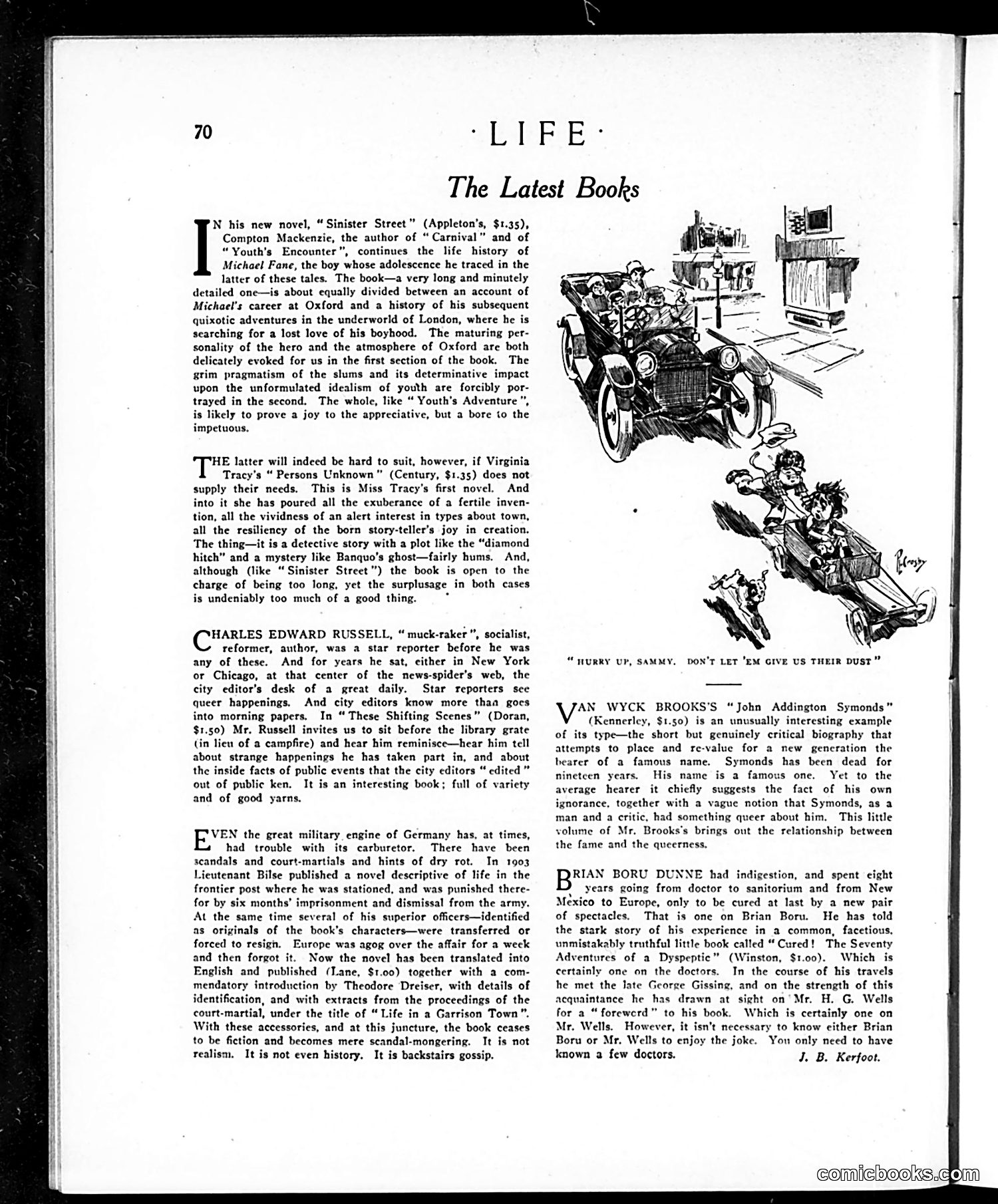
This is a **book review page** from Life magazine featuring literary criticism of contemporary novels. The page includes one cartoon illustration captioned "Hurry Up, Sammy, Don't Let 'Em Give Us Their Dust." The cartoon depicts two figures in what appears to be a racing or competitive scene—one driving an early automobile and another on what looks like a motorcycle or similar vehicle, moving at high speed. The caption suggests a competitive race or rivalry, with "giving dust" being a colloquial expression meaning to be left behind or defeated. The text reviews several books including Compton Mackenzie's "Sinister Street," Virginia Tracy's "Persons Unknown," and Charles Edward Russell's "These Shifting Scenes." The reviews discuss literary merit, character development, and narrative style typical of early 20th-century criticism. The cartoon likely serves as visual entertainment accompanying these serious literary discussions, though the specific topical reference it makes remains unclear without additional context about 1915 events or personalities.
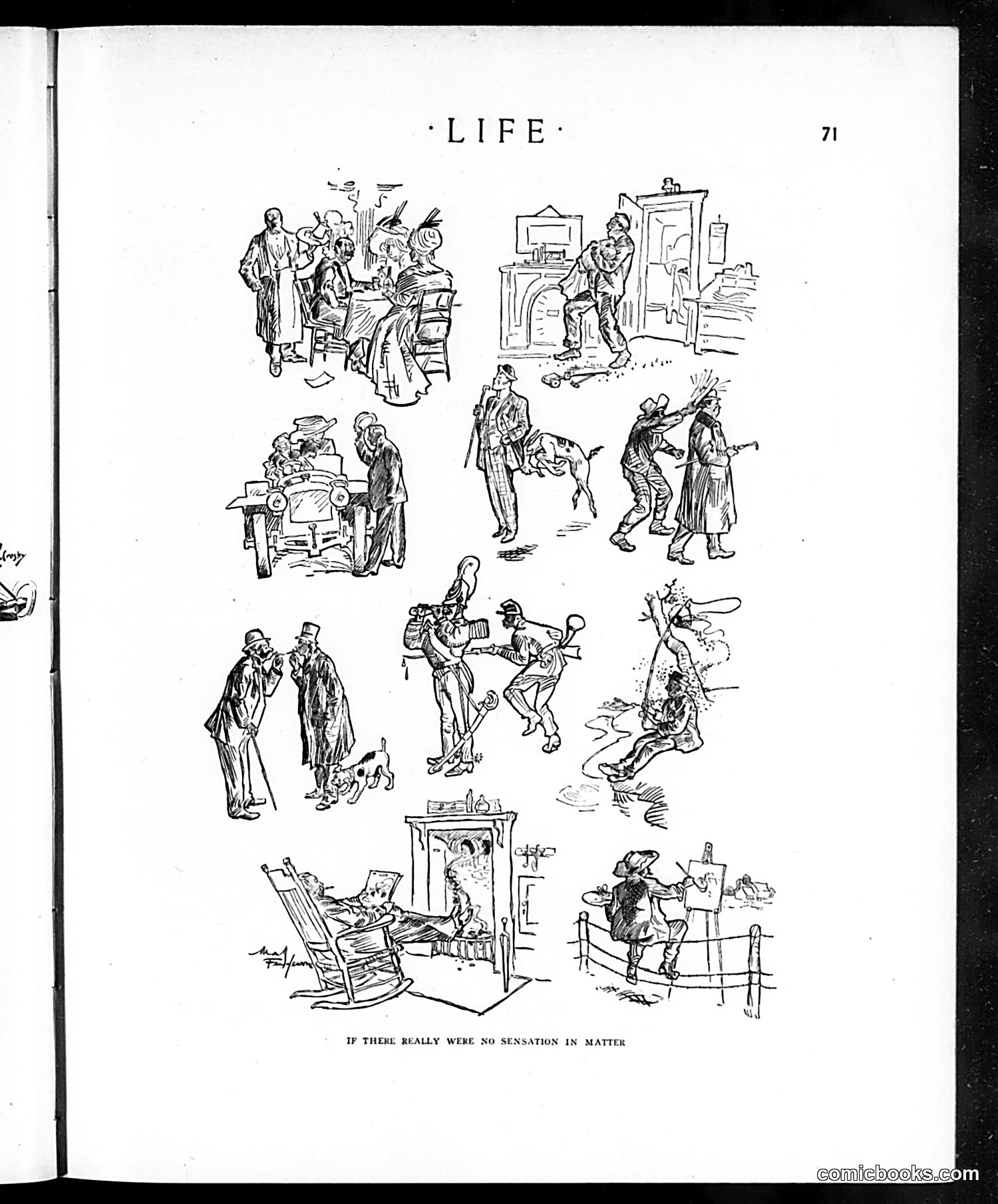
This page presents a series of humorous vignettes illustrating the caption "If There Really Were No Sensation in Matter." The cartoon satirizes philosophical materialism—the idea that matter is the only substance in existence and that sensation/consciousness cannot arise from it. Each scene depicts ordinary human activities rendered absurd if matter truly had no sensation: people at social gatherings, driving automobiles, playing sports, romantic encounters, and domestic scenes all proceed mechanically without feeling or response. The humor lies in the contradiction—showing how ridiculous daily life would be if materialist philosophy were literally true, since humans would behave like unfeeling automatons despite appearing to act normally. This reflects early 20th-century debates between materialism and vitalism regarding consciousness and human experience.
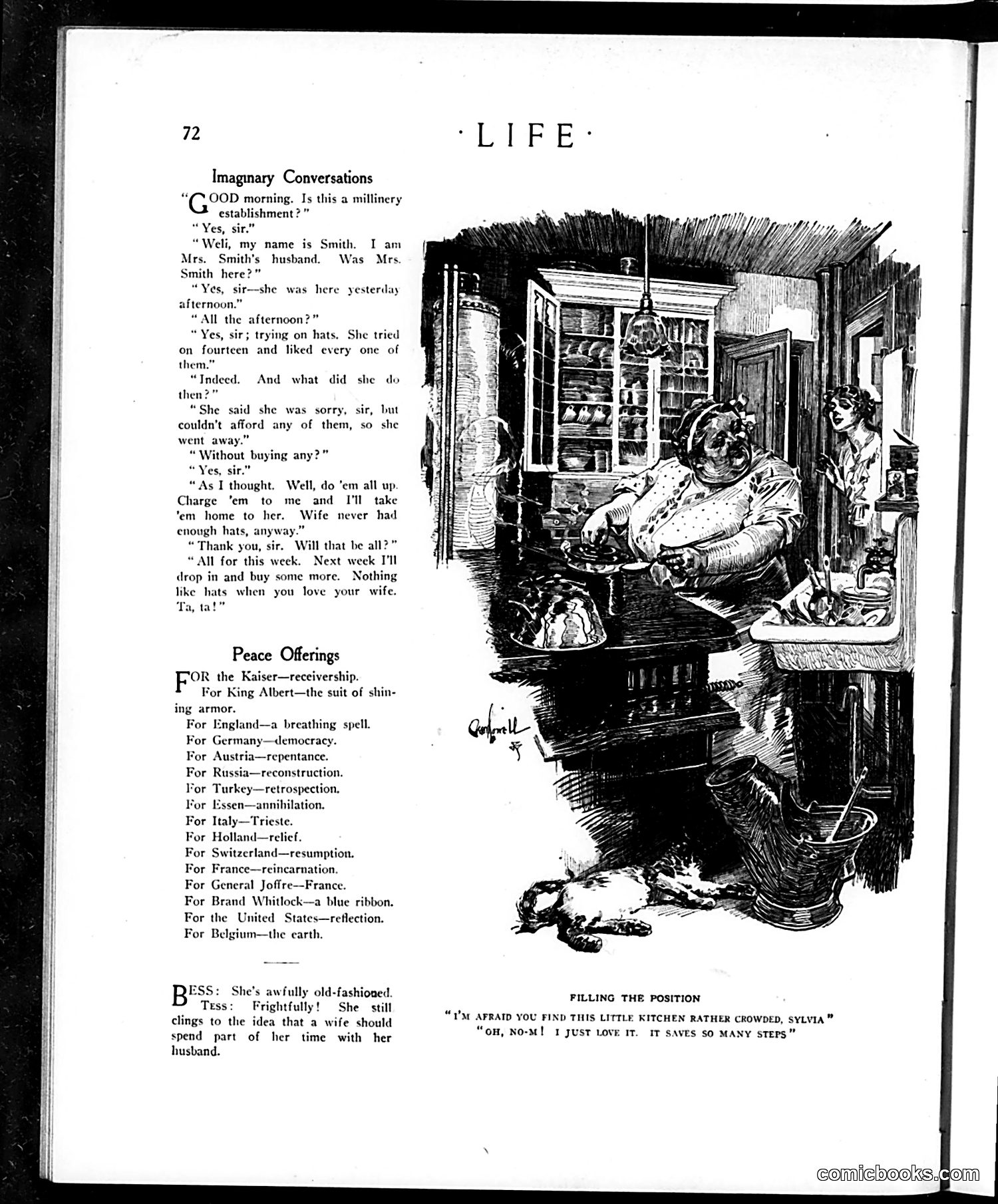
This *Life* magazine page contains satirical humor about marriage and World War I. **"Imaginary Conversations"** depicts a husband buying fourteen hats for his wife after she couldn't afford them at a millinery shop. The joke plays on the stereotype of wives spending recklessly on hats (a period status symbol) and husbands indulging them—framed as proof of love. **"Peace Offerings"** is political satire listing what various WWI nations "need" as peace settlements—mostly punitive or ironic (Kaiser gets "receivership," Germany gets "democracy," etc.). This reflects post-war sentiment about how to handle defeated powers. **The kitchen scene** shows a couple in cramped quarters. The wife claims she loves the space because "it saves so many steps"—satirizing women accepting poor domestic conditions while praising efficiency, likely reflecting wartime housing shortages or working-class conditions during the war era. The overall tone mixes domestic humor with pointed commentary on war consequences and gender relations of that period.
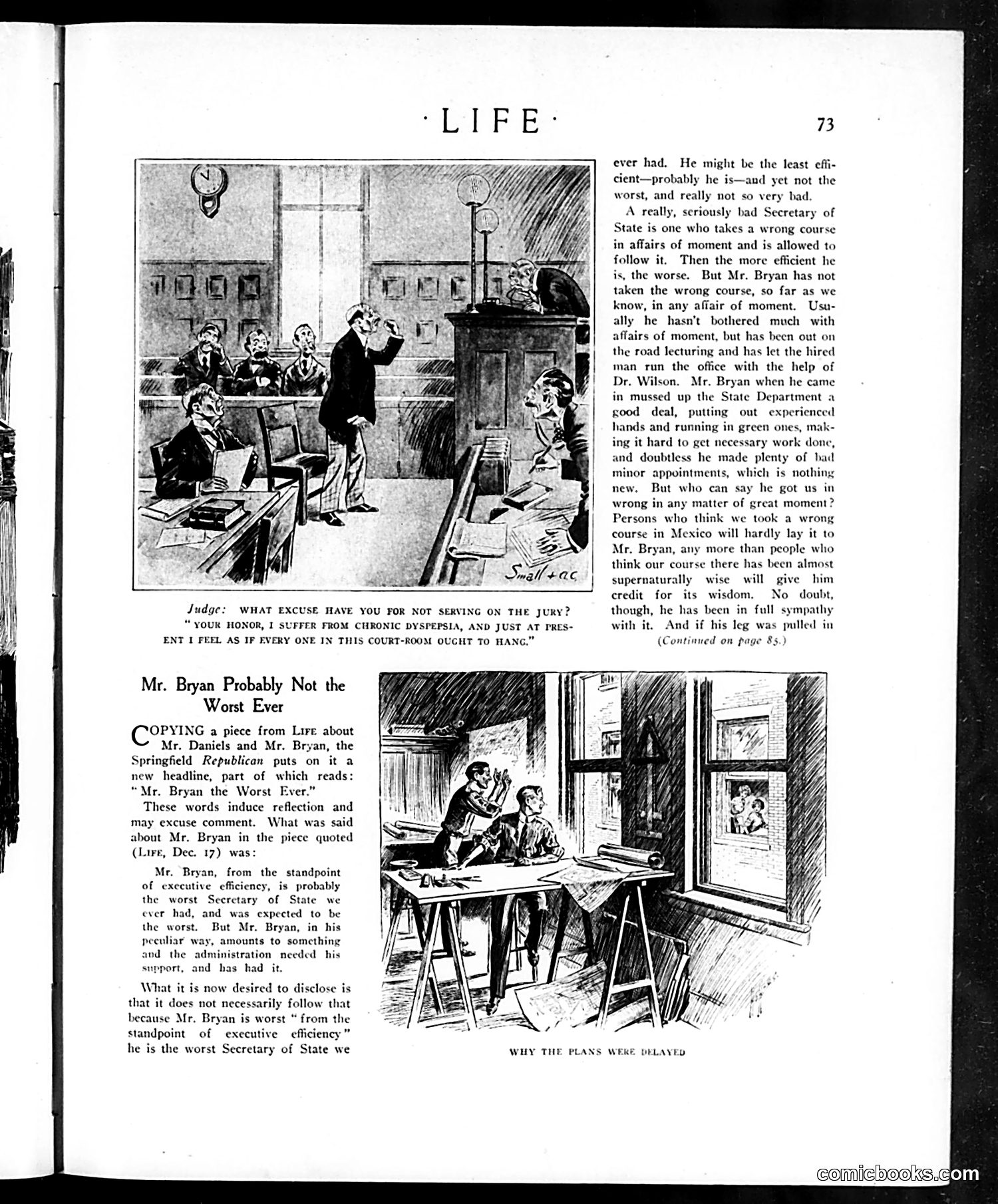
This Life magazine article defends Secretary of State William Jennings Bryan against criticism that he was "the worst ever." The piece distinguishes between **executive inefficiency** and actual **policy failure**. The top cartoon satirizes Bryan's absence from State Department duties—he's shown lecturing while Dr. Wilson and hired staff run the office, suggesting Bryan prioritized his speaking tours over diplomatic work. The lower cartoon, "Why the Plans Were Delayed," appears to show bureaucratic obstruction or miscommunication causing administrative problems. The article's key argument: Bryan may be disorganized and inexperienced, but he hasn't made catastrophic *policy* mistakes (particularly regarding Mexico). The author suggests critics conflate poor management with poor judgment—Bryan bumbled the department's operations but didn't steer the nation into disaster, unlike a Secretary who actively pursued harmful courses while efficiently executing them.
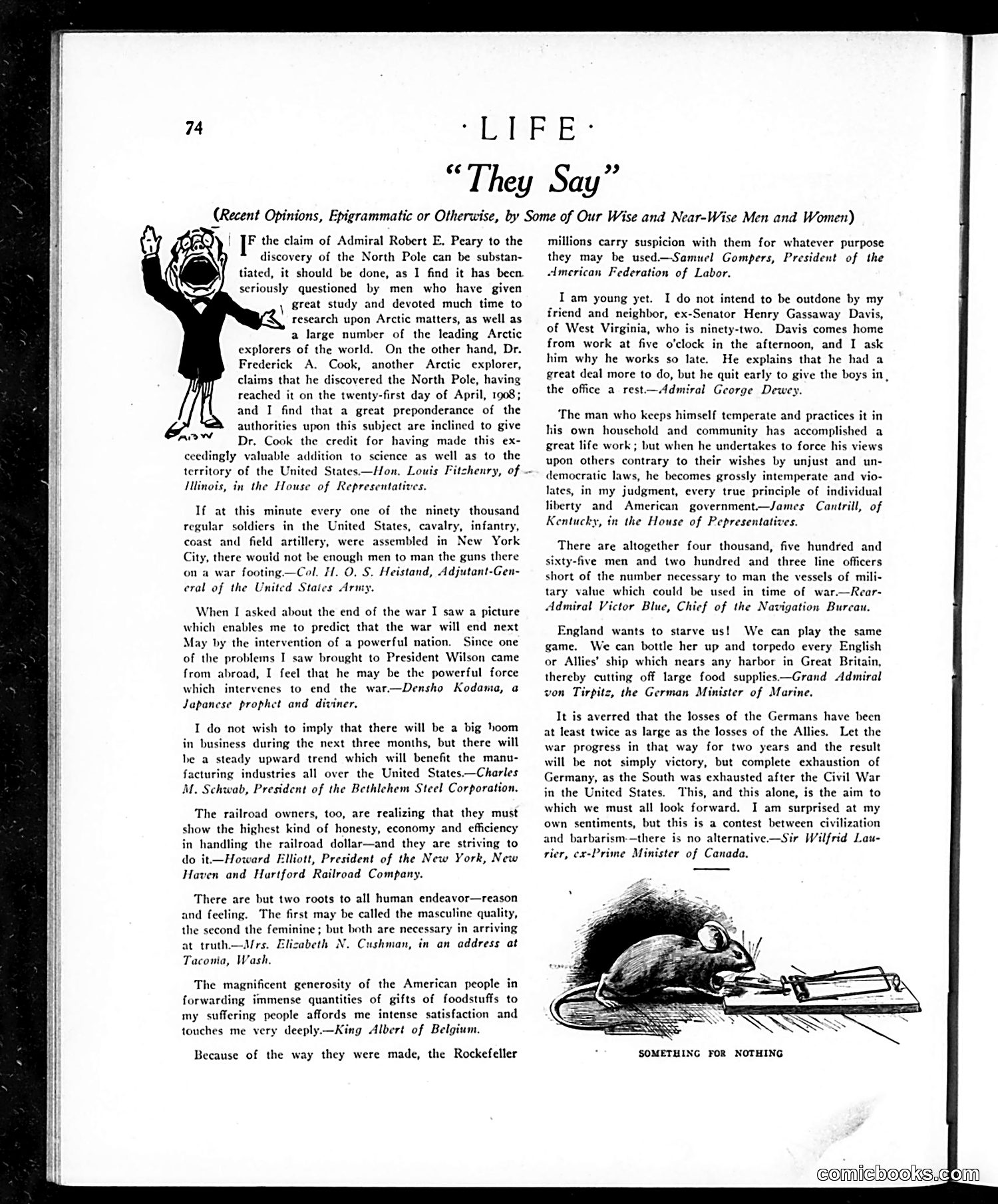
This is a satirical opinions column from *Life* magazine featuring brief quotes from prominent public figures of the era (likely WWI period, circa 1916-1918). The page lampoons these "wise and near-wise" statements through juxtaposition. **Key figures quoted:** - Admiral Robert Peary and Dr. Frederick Cook (competing North Pole discoverers) - Military/industrial leaders (Col. Heistand, Charles Schwab, Howard Elliott) - Samuel Gompers (labor leader) criticizing Rockefeller's money - Admiral Dewey and ex-Senator Davis (on work/retirement) - King Albert of Belgium (thanking Americans for aid) - A Japanese "prophet" predicting war's end **The satire:** By presenting unvetted, sometimes contradictory or self-serving statements without editorial comment, *Life* mocks these figures' pretensions to wisdom. The accompanying cartoon—showing a mouse working at drafting equipment, captioned "SOMETHING FOR NOTHING"—appears to mock futile effort or empty promises. The effect ridicules both vanity and the uncritical media amplification of celebrity pronouncements.
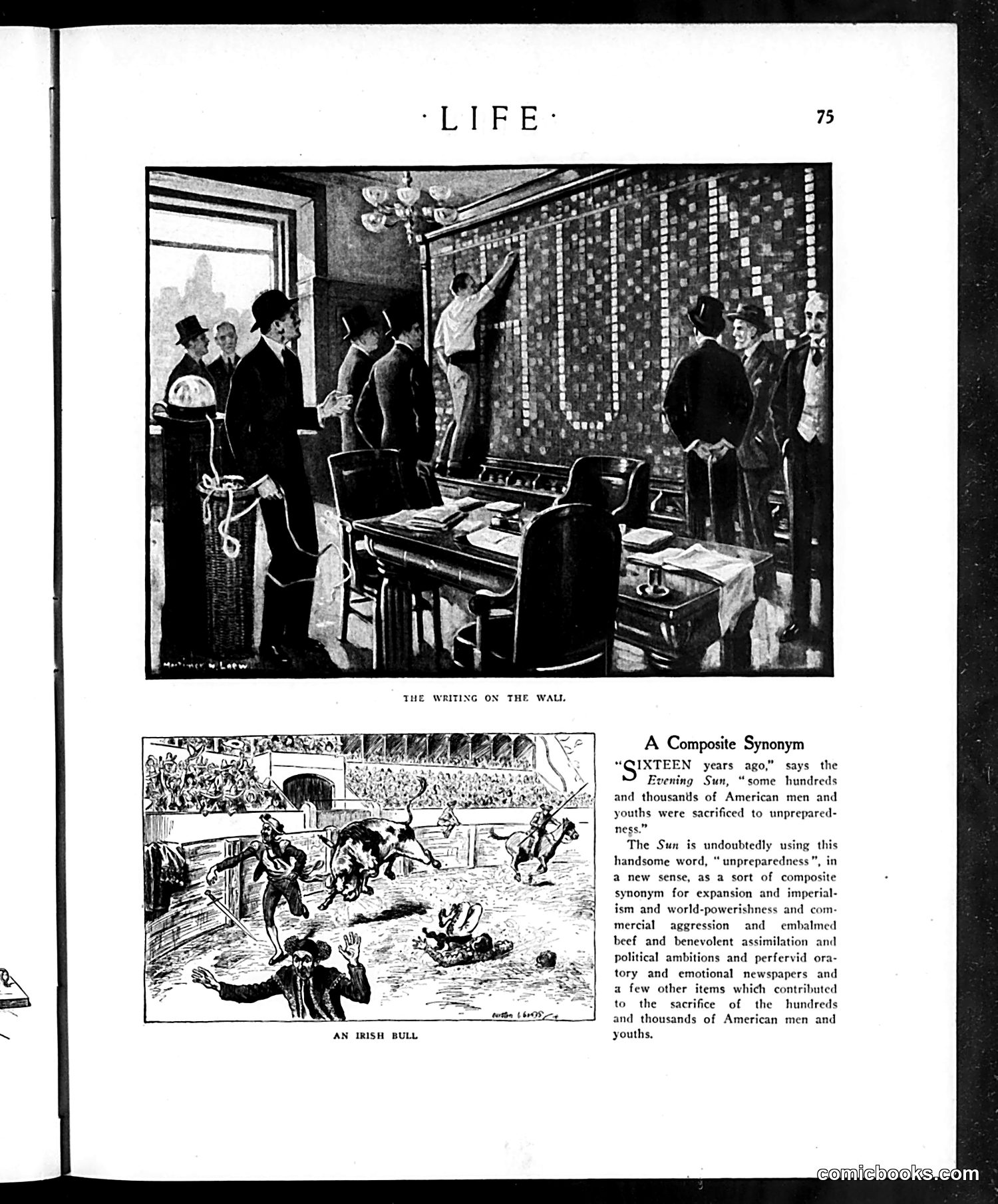
This page satirizes American imperial expansion, likely referencing the Spanish-American War (1898) and Philippine-American War aftermath. The top image, "The Writing on the Wall," depicts officials examining charts—possibly representing casualty figures or military data. The text mocks the *Evening Sun* newspaper's use of "unpreparedness" as a euphemism for America's actual culprits in wartime deaths: imperial ambitions, commercial aggression, "benevolent assimilation" (a contemporary phrase for colonial occupation), sensationalist journalism, and political rhetoric. The lower cartoon, "An Irish Bull," reinforces this critique through absurdist imagery—the "bull" being the logical contradiction of blaming mere unpreparedness when expansionist ideology, propaganda, and war profiteering were the real causes. Life's editors argue newspapers obscured these uncomfortable truths behind sanitized language.
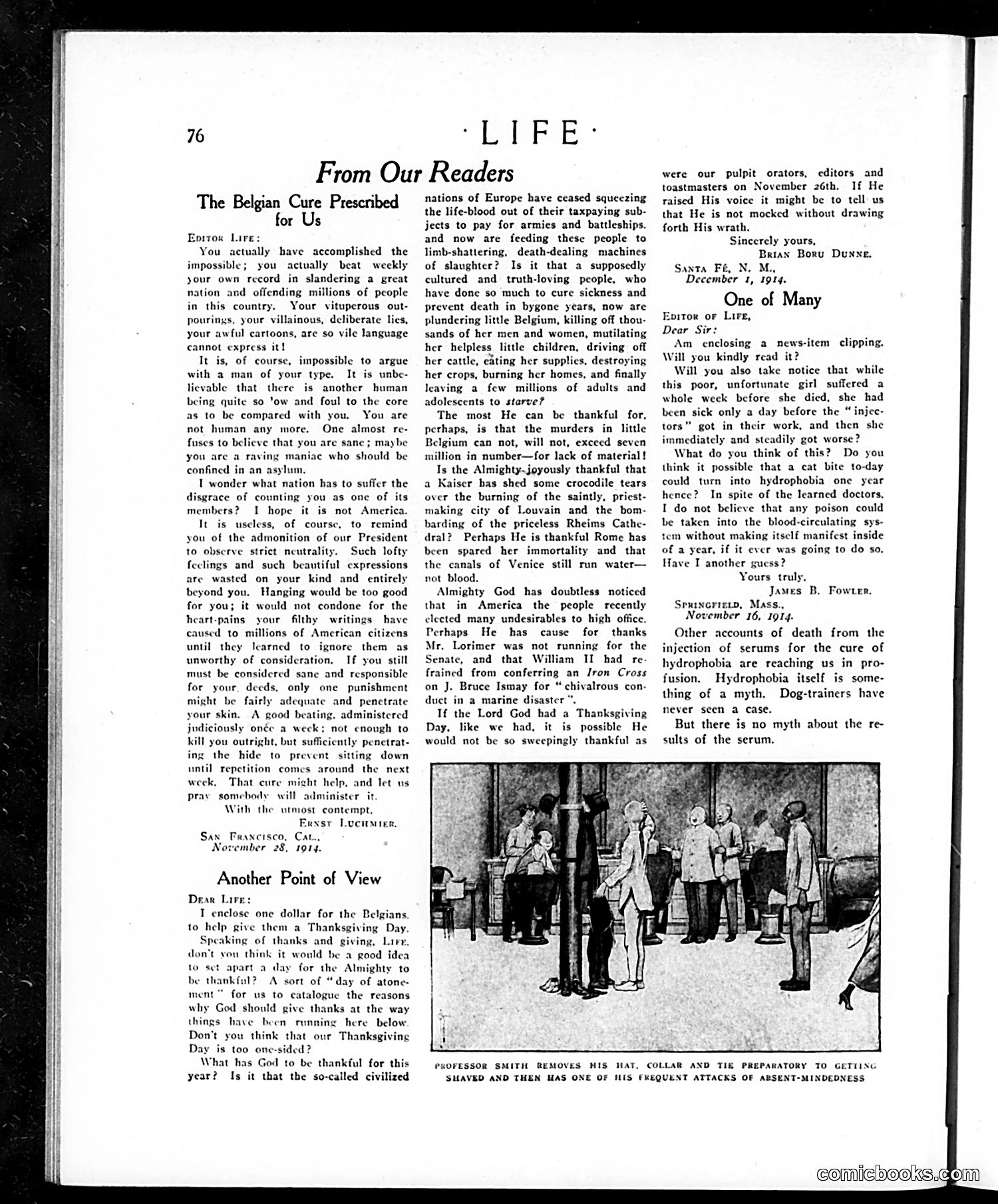
This page presents reader letters responding to Life magazine's WWI coverage during American neutrality. The first letter (from Ernst Luedtke, San Francisco) furiously attacks Life for anti-German bias, calling the magazine's cartoons and writing "vile" and "filthy," demanding President Wilson's neutrality be observed. He sarcastically suggests a "Belgian cure"—a weekly beating—as punishment. The second letter offers satirical counterpoint: if Americans thank God on Thanksgiving, shouldn't God reciprocate? The author ironically catalogs atrocities in Belgium (plundering, killing civilians, burning Louvain, destroying Rheims Cathedral) to argue God has nothing to be thankful for in 1914—a biting critique of German conduct disguised as pious questioning. The photograph shows Professor Smith removing formal attire, apparently illustrating absent-mindedness or institutional propriety. The page reflects American debate over neutrality versus moral judgment of German actions in Belgium—a contentious issue before U.S. entry in 1917.
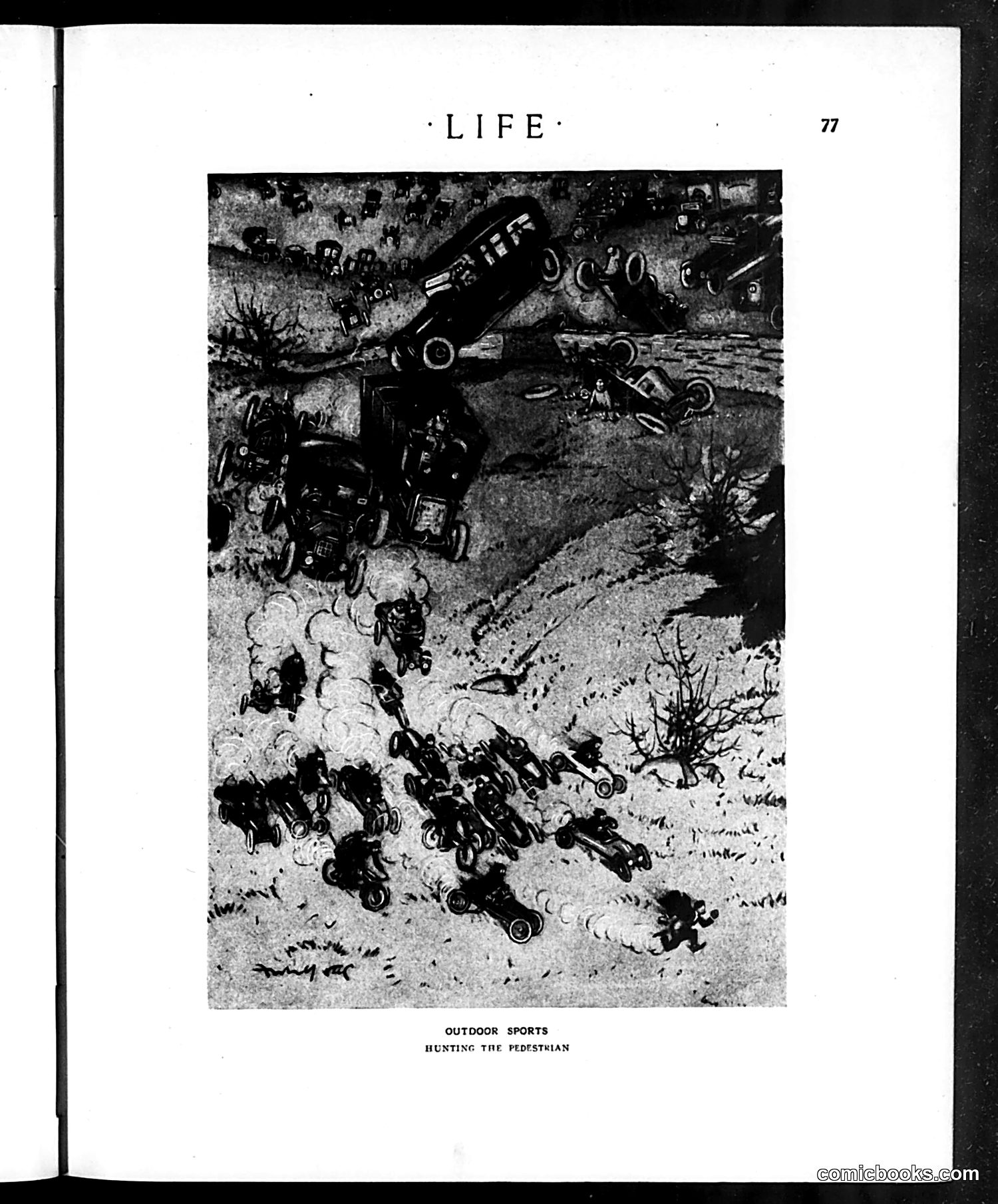
This page satirizes dangerous driving as a "sport." The caption "Hunting the Pedestrian" pairs with an aerial photograph showing multiple toy vehicles scattered across ground with pedestrian figures, creating a darkly humorous metaphor: drivers are depicted as hunters pursuing pedestrians as prey. The satire targets reckless motorists and the epidemic of pedestrian deaths in early-to-mid 20th century America, when automobile traffic fatalities were rising sharply. By literalizing "hunting" language, Life magazine critiques how carelessly drivers endangered pedestrians on streets and roads. This reflects genuine anxiety about automotive safety during an era when traffic rules were poorly enforced and driver training minimal. The joke's bitter tone underscores real public concern about preventable deaths.
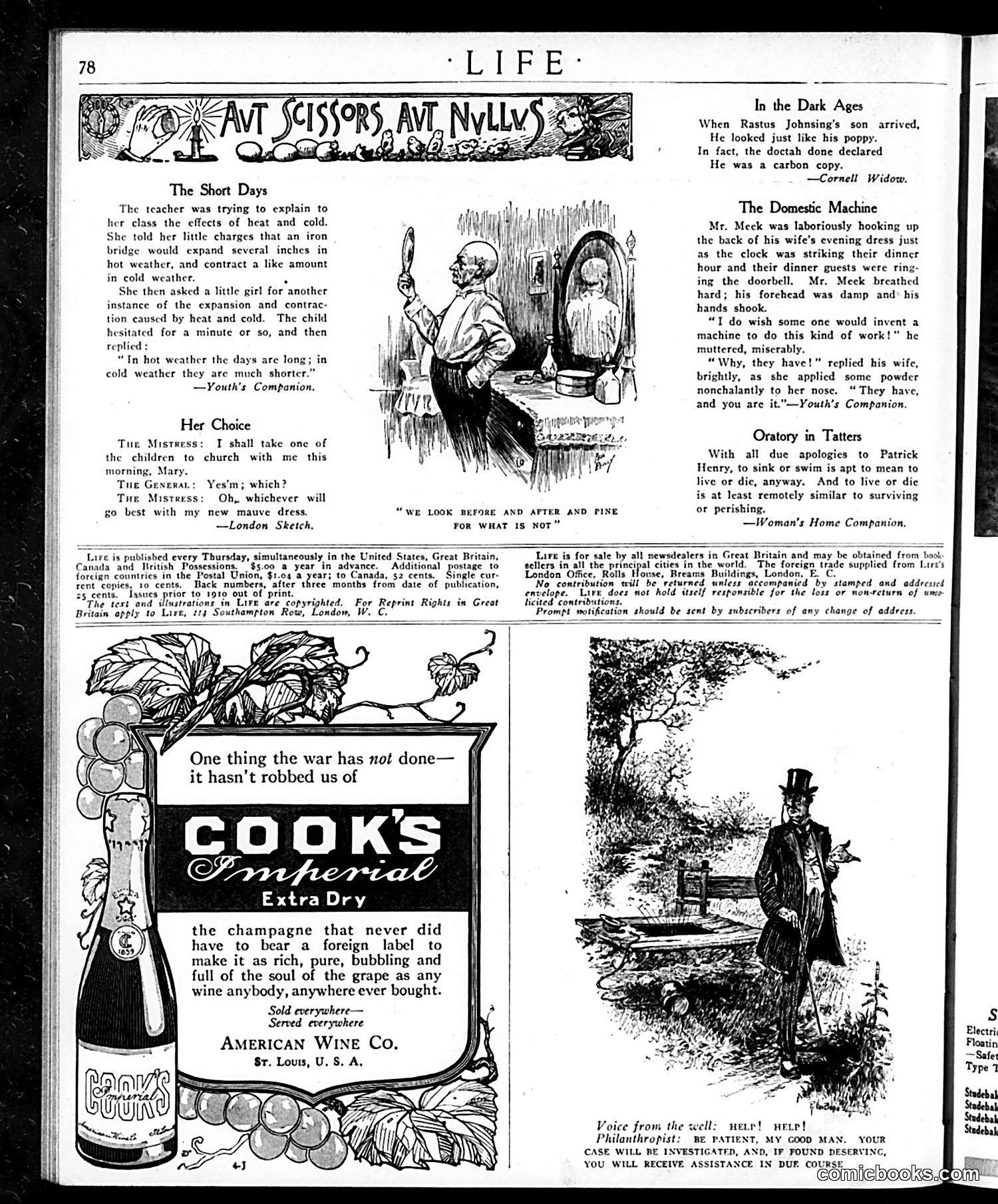
This page contains several humorous short pieces typical of early 20th-century American satirical magazines: **"The Short Days"** presents a child's literal logic about thermal expansion—days seem longer in summer heat, shorter in winter cold—a innocent misunderstanding of physical principles. **"Her Choice"** satirizes shallow materialism: a woman selects which child to bring to church based on which coordinates with her dress, rather than any meaningful criterion. **"The Domestic Machine"** uses irony to comment on gender roles: a frustrated husband wishes for a machine to hook corsets, and his wife replies he *is* that machine—he's the one doing the laborious work while she applies makeup. **"In the Dark Ages"** appears to be a racial humor piece (Cornell Widow), typical of the era's problematic conventions. The page also contains a Cook's Imperial champagne advertisement claiming the war hasn't diminished quality, and a sketch showing a philanthropist promising investigation and aid to a desperate man—likely commentary on charity bureaucracy. These pieces reflect popular humor of their time, emphasizing domestic situations, class observations, and wordplay.
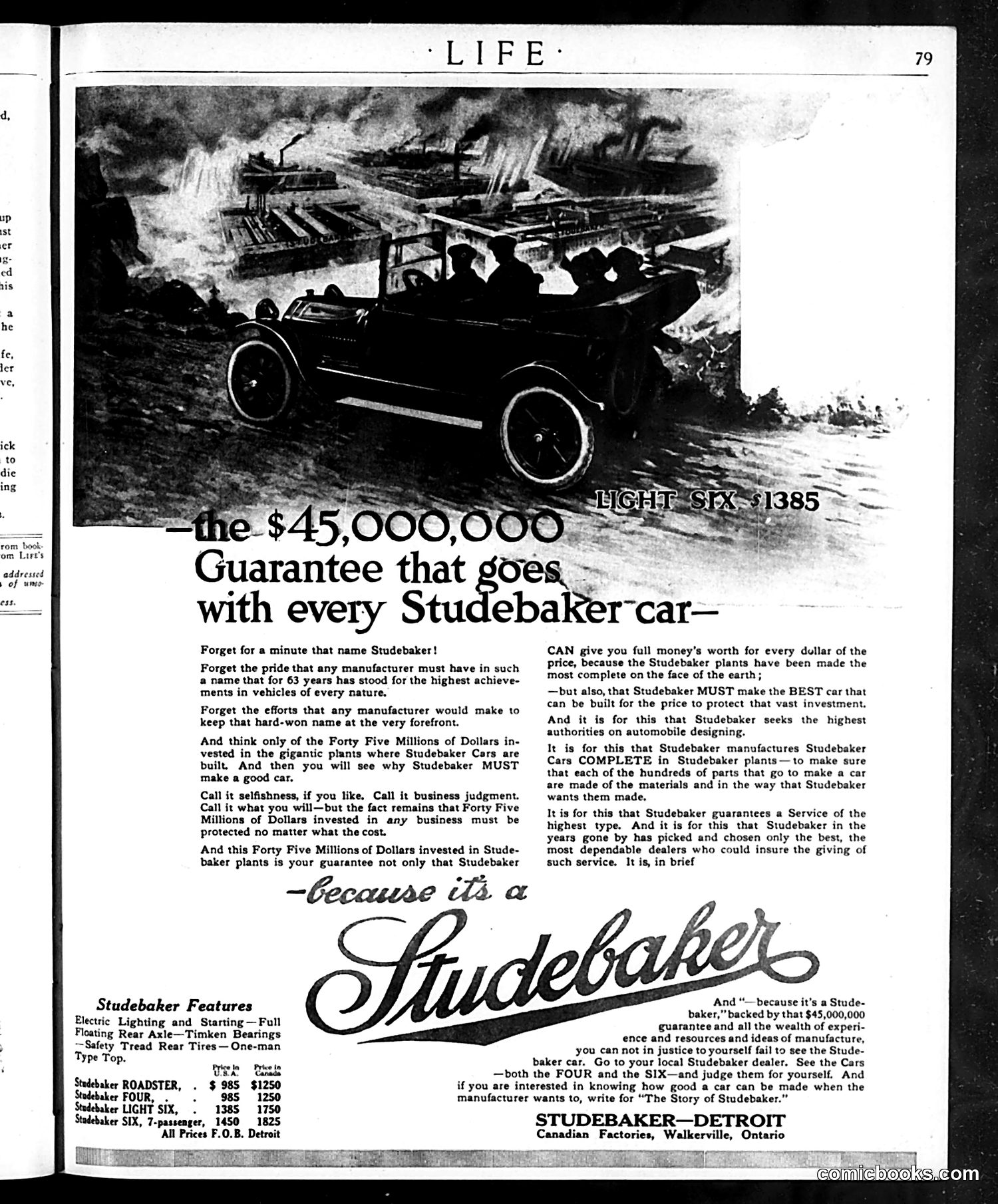
This is primarily a **car advertisement**, not a political cartoon. It appears in *Life* magazine (page 79) promoting Studebaker automobiles. The ad uses a rhetorical strategy common to early 20th-century marketing: it asks readers to "forget" the brand name itself and instead focus on the company's massive capital investment ($45 million in manufacturing plants). The argument is that this financial commitment guarantees quality—the company *must* build excellent cars to protect its investment. The image shows a Studebaker Light Six automobile with passengers, positioned near industrial plants with smoke, emphasizing manufacturing scale and modernity. The ad lists various Studebaker models (Roadster, Four, Light Six, Six) with prices ranging from $385 to $1825 (F.O.B. Detroit). It promotes features like electric lighting, floating rear axles, and Timken bearings—technical selling points for an automotive audience of the era. There is no satire or political commentary visible; this is straightforward product marketing leveraging industrial prestige.
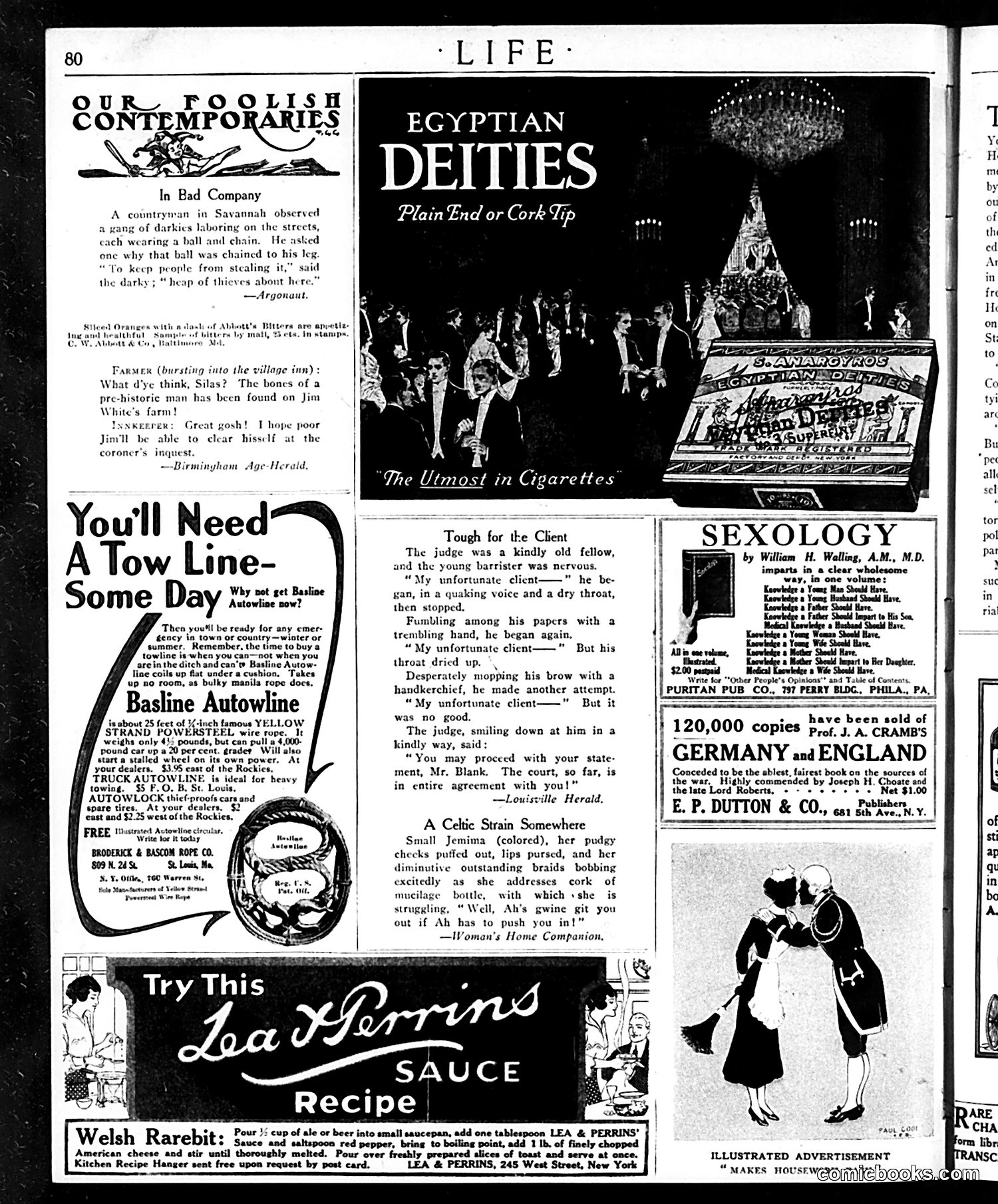
This page combines satirical humor with period advertising. The main cartoons employ racial stereotypes common to early 20th-century American humor—a deeply problematic approach by modern standards. **"Our Foolish Contemporaries"** features three brief jokes mocking rural/working-class speech and intelligence, including one using a racial slur that reflects the magazine's casual racism. **"Sexology"** advertises a medical text promising frank discussion of sexual matters—notable for the era's general prudishness about such topics. **"Tough for the Client"** depicts a nervous young barrister repeatedly stammering "My unfortunate client" to an amused judge—satirizing legal anxiety and courtroom incompetence. **"A Celtic Strain Somewhere"** uses a caricatured Black child character in a condescending "dialect" joke about struggling with a mucilage bottle. The remaining content is advertisements (tow lines, sauce recipes, books), typical of Life's mixed editorial-commercial format. The overall tone reflects attitudes toward race, gender, and class that would be considered offensive today.
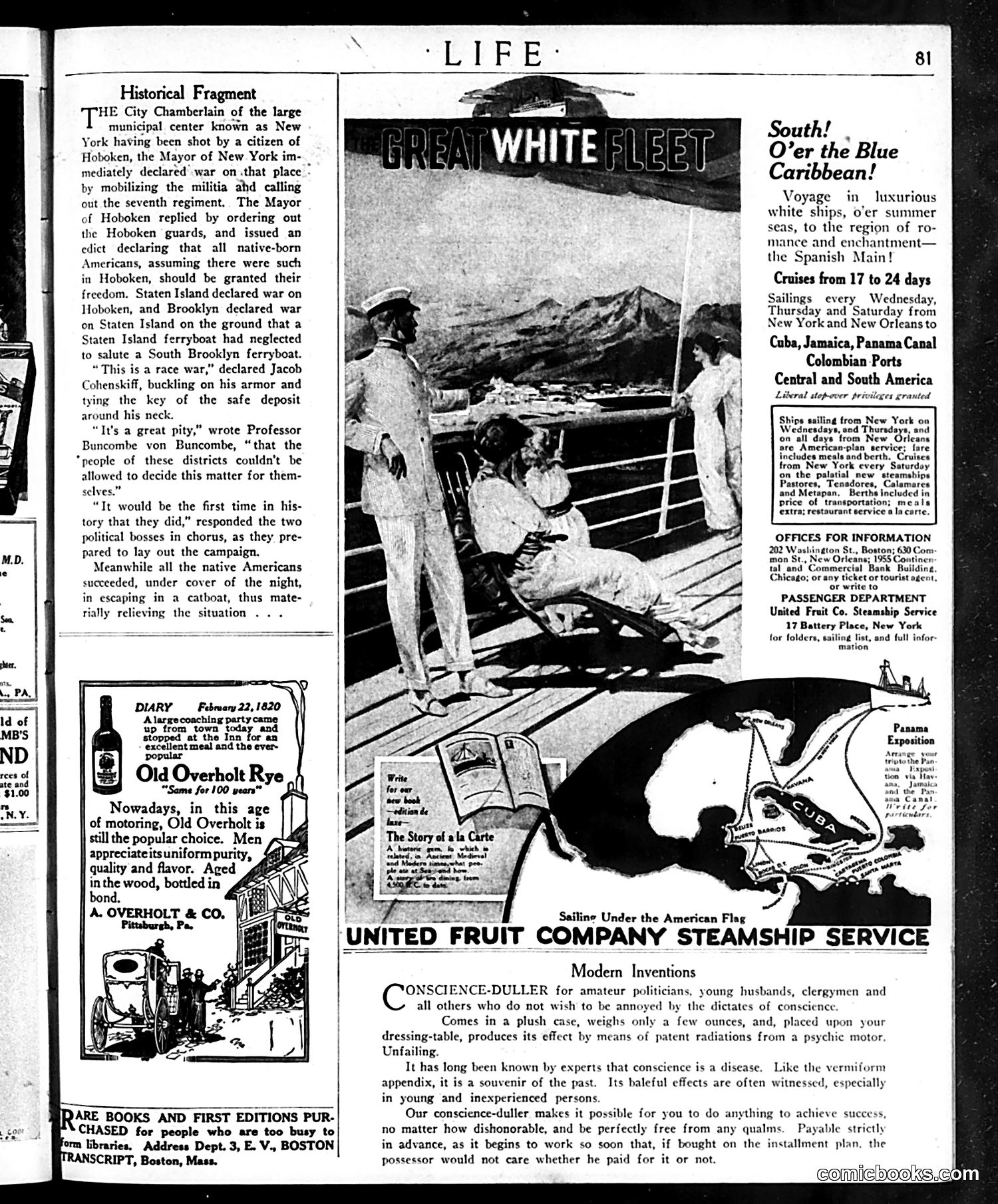
This page satirizes **municipal corruption and political incompetence** through a mock historical fragment dated 1820. It depicts an absurd escalating "war" between New York City boroughs triggered by a minor incident—a New York City chamberlain shot by a Hoboken citizen. Rather than handle it reasonably, the mayors mobilize militias, and neighboring jurisdictions comically declare war on each other over ferry-boat protocol violations. The satire targets **political bosses** who exploit such trivial conflicts for campaign purposes, while ethnic tensions ("race war") are invoked cynically. The fragment mocks how ordinary citizens (native Americans) sensibly flee the manufactured chaos. The "Modern Inventions" section at bottom extends the satire: a **"Conscience-Duller"** device allows unethical behavior guilt-free—a dark commentary on how corrupt politicians and business figures rationalize dishonesty for success. The advertisements (cruise ships, whiskey) contrast sharply with this cynical political humor, typical of Life's satirical format.
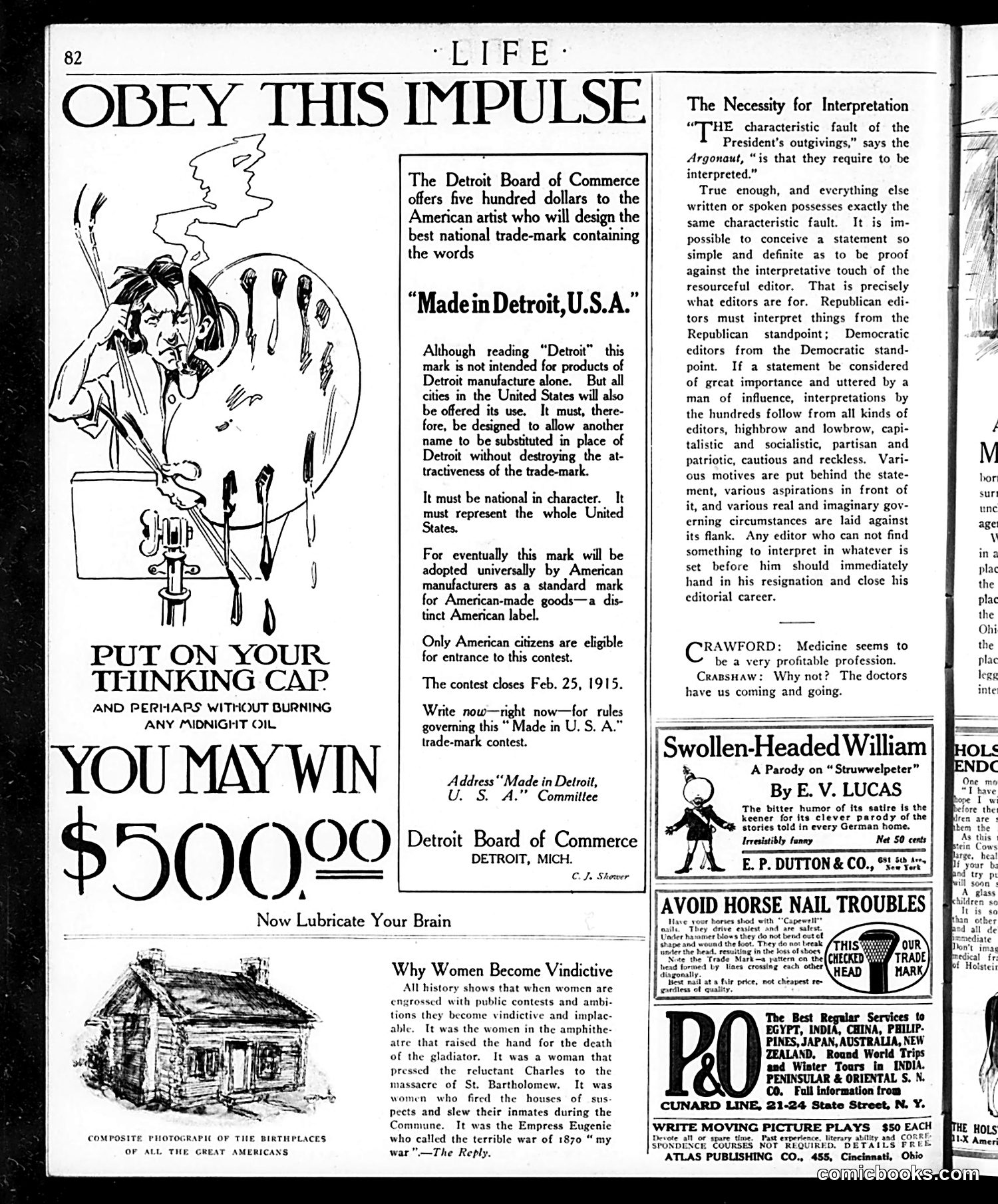
The main cartoon, "Obey This Impulse," sarcastically mocks a Detroit Board of Commerce contest offering $500 for designing a "Made in Detroit, U.S.A." trade-mark. The caricatured figure appears to be straining with effort—the satire suggests that "lubricating your brain" (thinking hard) about this civic boosterism is absurdly difficult work, hardly worth the prize. The accompanying text articles address separate topics: one defends interpretive journalism (arguing all statements require interpretation), another dismisses claims that women become vindictive during public contests (citing historical examples), and a third advertises a satirical children's parody book. The page is primarily **advertisements and opinion pieces** rather than hard news, reflecting Life's role as a humor and commentary magazine. The cartoon ridicules provincial patriotism and commercial self-promotion—typical of Life's satirical stance toward American business culture of the era.
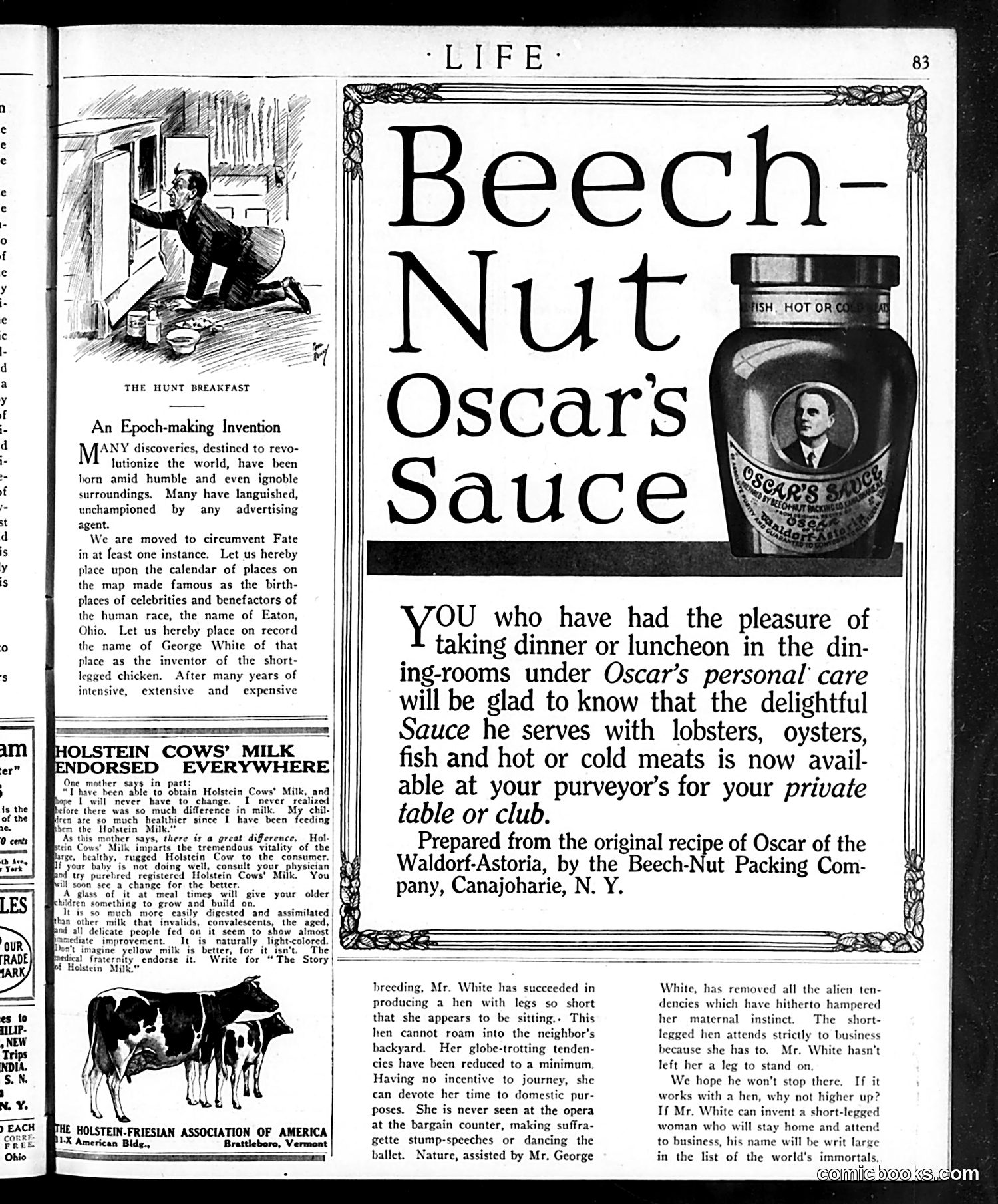
This cartoon satirizes both a dubious agricultural "invention" and contemporary attitudes toward women. **The Main Joke:** George White of Eaton, Ohio, has supposedly invented a short-legged chicken that cannot wander from home. Life presents this absurdity as a genuine discovery worthy of historical recognition. **The Satirical Twist:** The piece then extends the mockery to women's rights. The text suggests that if this breeding technique works on hens, someone should invent a "short-legged woman who will stay home and attend to business"—sarcastically implying women should be physically confined to domestic duties like confined chickens. **Historical Context:** This reflects early 20th-century anxieties about women's expanding freedoms. The mention of women at "the opera" and making "suffragette stump-speeches" references women's suffrage activism. The joke mocks both the absurdity of trying to biologically engineer compliance and the desire to restrict women's mobility and independence. The cartoon uses exaggeration to mock anti-feminist sentiment of the era.
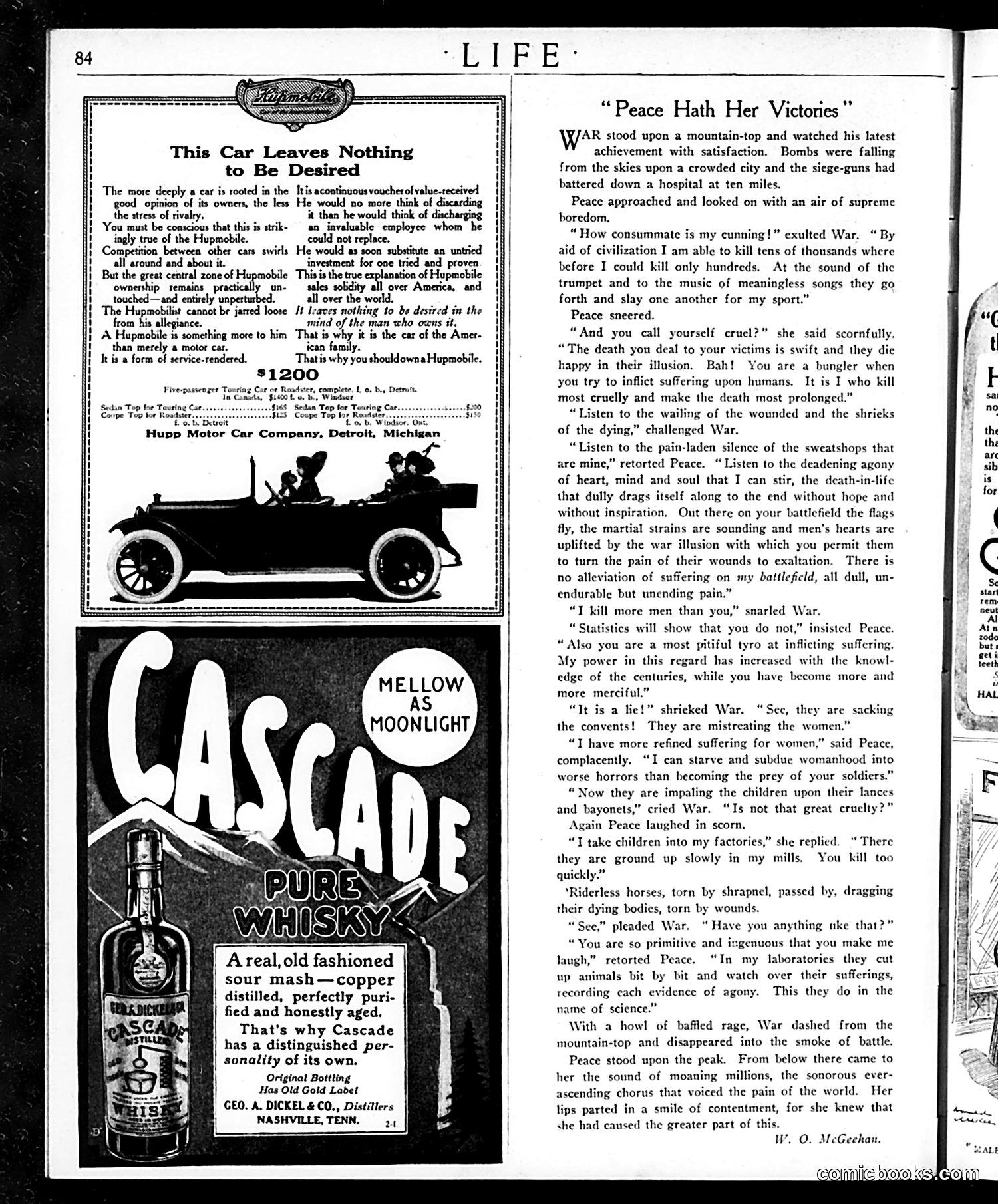
This allegorical dialogue presents **Peace and War as personified figures** debating whose suffering is worse. The satire, likely written during or shortly after WWI, argues that **peacetime causes more prolonged human suffering than warfare**. War boasts of killing masses through modern warfare ("civilization"). Peace counters that she inflicts subtler, crueler torment: the "death-in-life" of sweatshops, starvation, and the systematic degradation of women and the poor. She claims her suffering is unrelenting and numberless, while War's victims at least experience the "illusion" of noble purpose through patriotic fervor. The satire critiques both militarism AND the economic/social brutality of peacetime capitalism—suggesting that civilian workers endure worse conditions than soldiers do in battle. This reflects early 20th-century labor reform sentiment and anti-war perspectives questioning whether industrial civilization truly represented "progress."
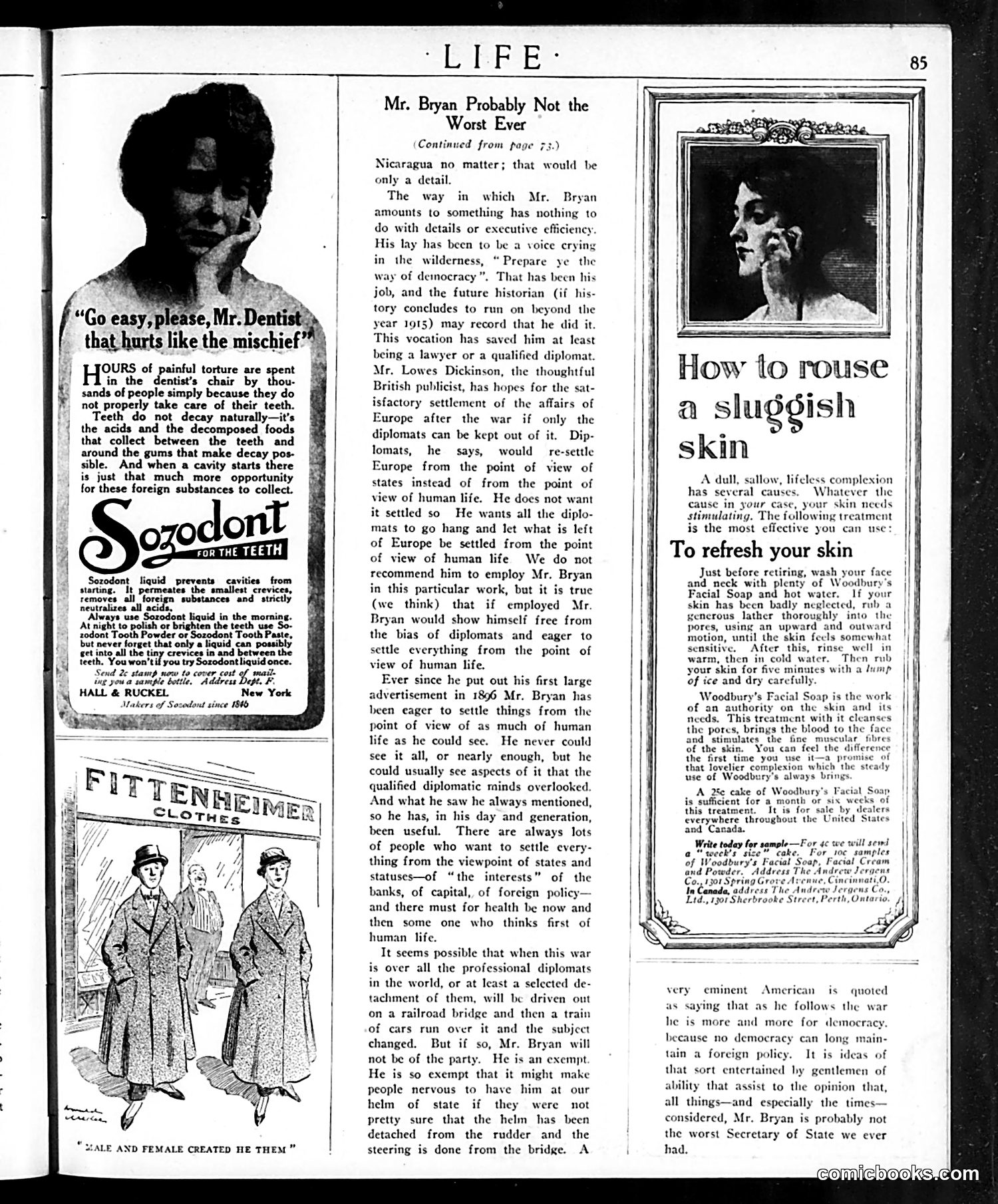
This page contains **political commentary on William Jennings Bryan** (identifiable from context: "first large advertisement in 1896," three-time presidential candidate). The article argues Bryan is "probably not the worst" Secretary of State, defending him against criticism. The satire's point: Bryan's strength lies not in diplomatic efficiency or administrative competence—areas where he admittedly fails—but in his moral voice advocating for "human life" over state interests and capitalist concerns. The author notes that trained diplomats would settle post-WWI Europe from perspectives of power and capital, while Bryan would argue for humanitarian principles. The joke is backhanded: Bryan is defended as useless at his actual job, but valuable as a conscience-voice. The final metaphor—the ship's "helm has been detached from the rudder"—suggests Bryan's actual power to steer policy is nil, making his presence harmless theater. The page also contains unrelated advertisements for **Sozodont** (dental product) and **Fittenheimer Clothes**, typical of the era's magazine format.
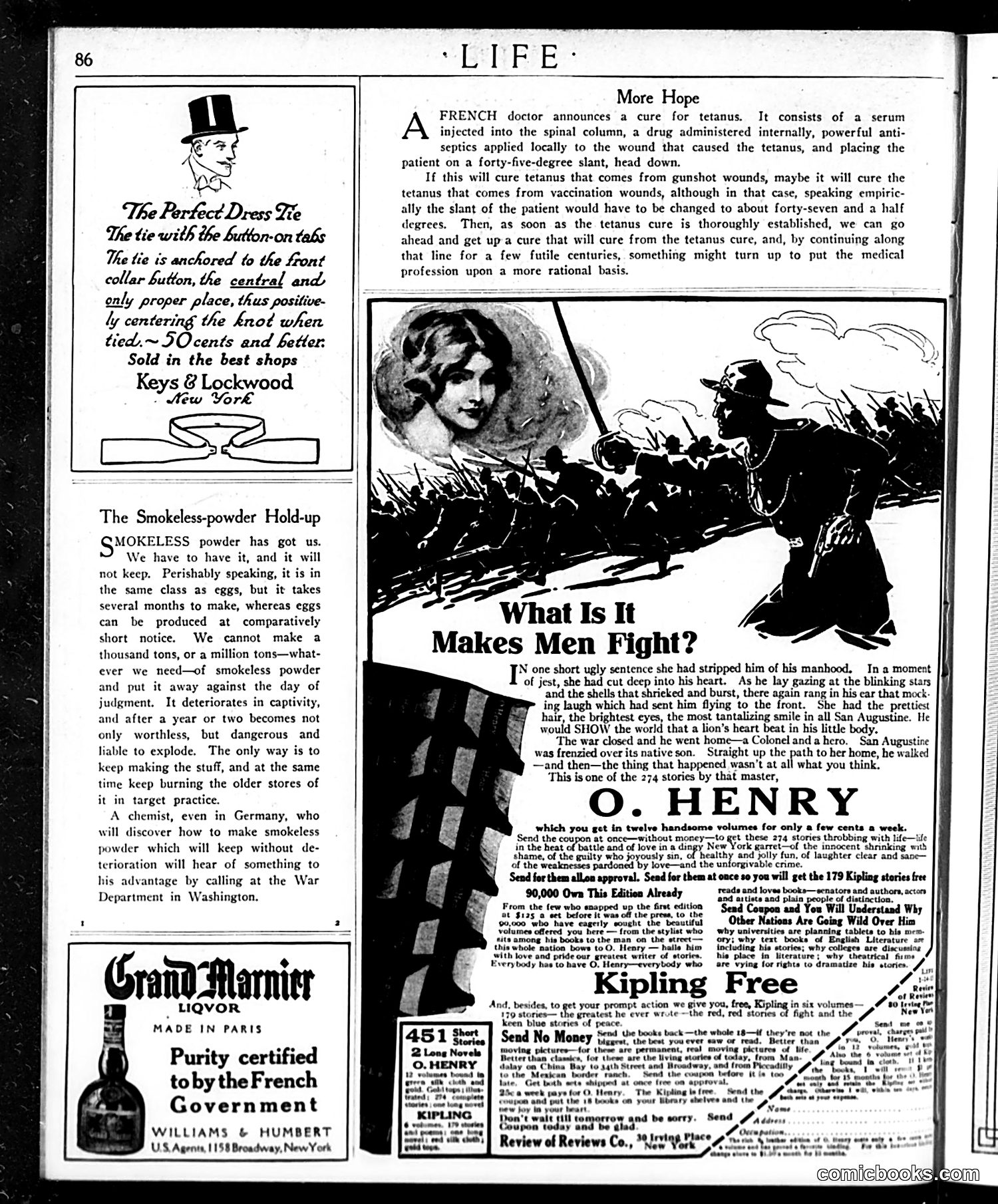
This page combines several distinct editorial and advertising elements from what appears to be a WWI-era Life magazine. The main satirical content is **"More Hope,"** which mocks medical progress through exaggerated logic. A French doctor's tetanus cure is presented seriously, but Life's commentary absurdly suggests the cure itself will require future cures, spiraling into perpetual medical "advancement"—satirizing the era's sometimes questionable medical claims. **"What Is It Makes Men Fight?"** advertises O. Henry short stories, using a melodramatic narrative: a woman's mockery of a man's manhood drives him to enlist and become a war hero. The copy implies romantic redemption awaits his return—typical sentimental wartime propaganda framing military service as romantic vindication. Secondary pieces include advertisements (Grand Marnier liquor, necktie products) and commentary on smokeless powder production shortages, reflecting genuine WWI supply-chain concerns. The overall tone reflects Life's satirical approach to contemporary issues while implicitly supporting the war effort through romanticized narratives of masculine valor.
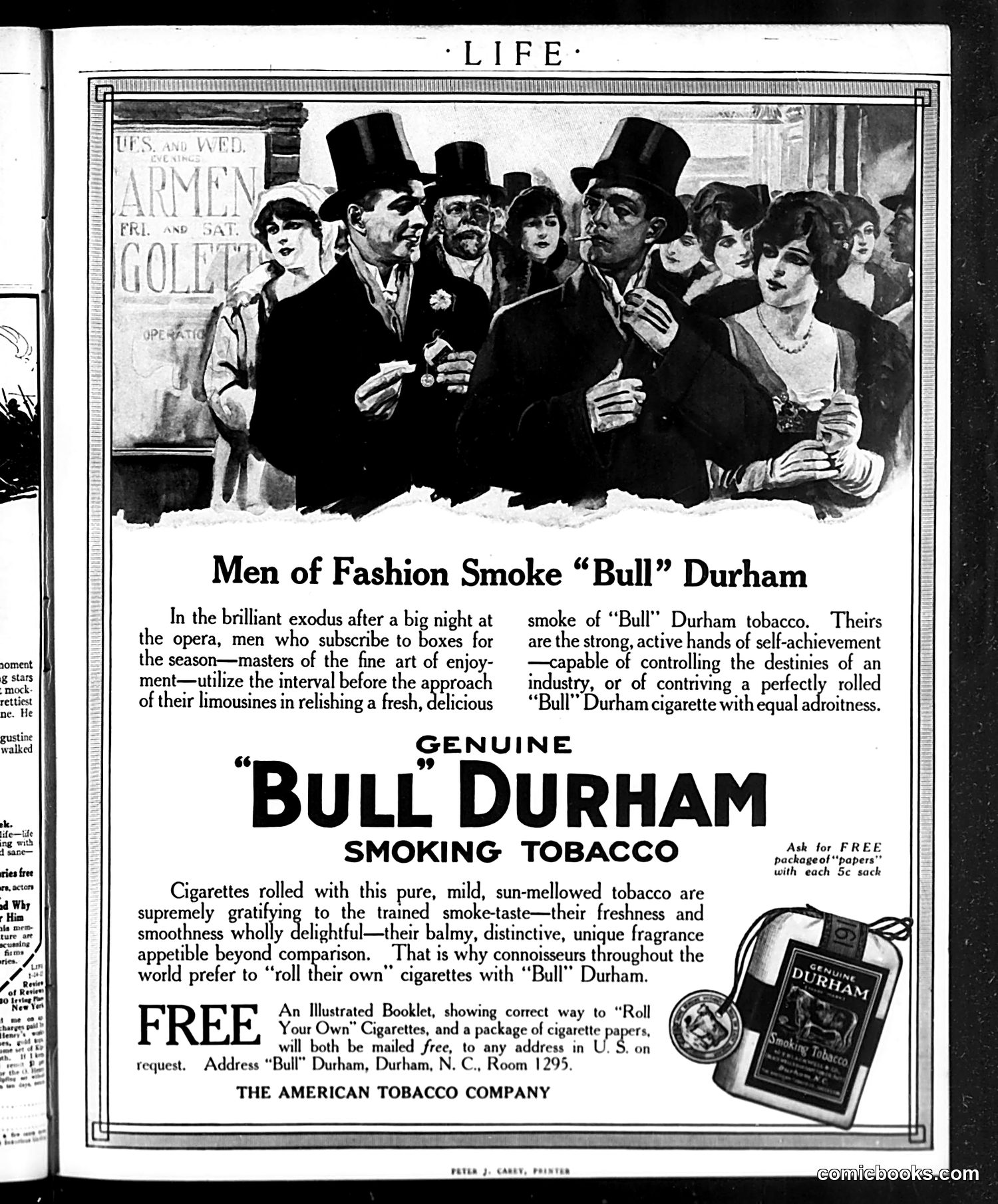
This is primarily a **tobacco advertisement**, not satire. It appeared in *Life* magazine during the early 20th century when cigarette ads were commonplace in mainstream publications. The ad depicts well-dressed men in top hats leaving the opera—a marker of upper-class refinement. The copy associates "Bull" Durham smoking tobacco with sophistication and masculine achievement, claiming that cultured gentlemen roll their own cigarettes with this brand. The "joke" (if any) is gentle: despite their wealth and status, these fashionable men pause to enjoy a humble tobacco product, suggesting its quality transcends social class. **Context modern readers miss:** This advertisement normalizes smoking as an aspirational activity tied to elegance and self-made success. The "roll your own" angle positioned the product as economical yet refined—accessible luxury. No health warnings appear; such advertising was legal and culturally accepted.
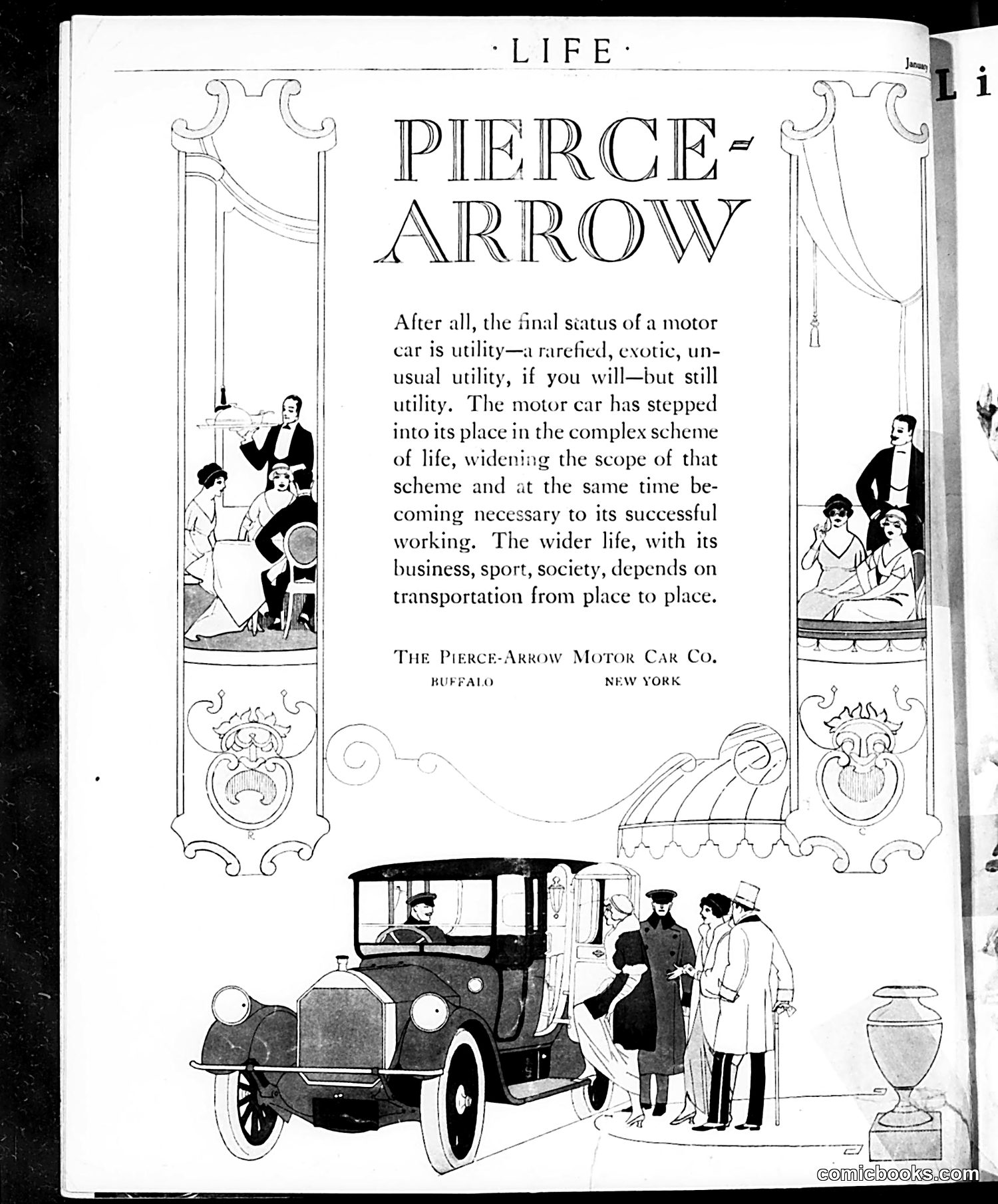
This is an advertisement for the Pierce-Arrow Motor Car Company. The page argues that automobiles have become essential to modern life, not mere luxuries. The decorative borders feature vignettes of fashionable people in elegant settings—at parties, in drawing rooms, being transported—suggesting that owning a Pierce-Arrow is necessary for participating in refined society and business life. The central image shows a well-dressed couple arriving at what appears to be an upscale venue, with attendants greeting them. The message reflects early-20th-century attitudes about automobiles as status symbols integrated into the lifestyle of the wealthy and socially ambitious. The ornate Art Deco styling emphasizes luxury and sophistication.