
Life, 1915-01-14 · page 30 of 44
Life — January 14, 1915 — page 30: what you’re looking at
What you’re looking at
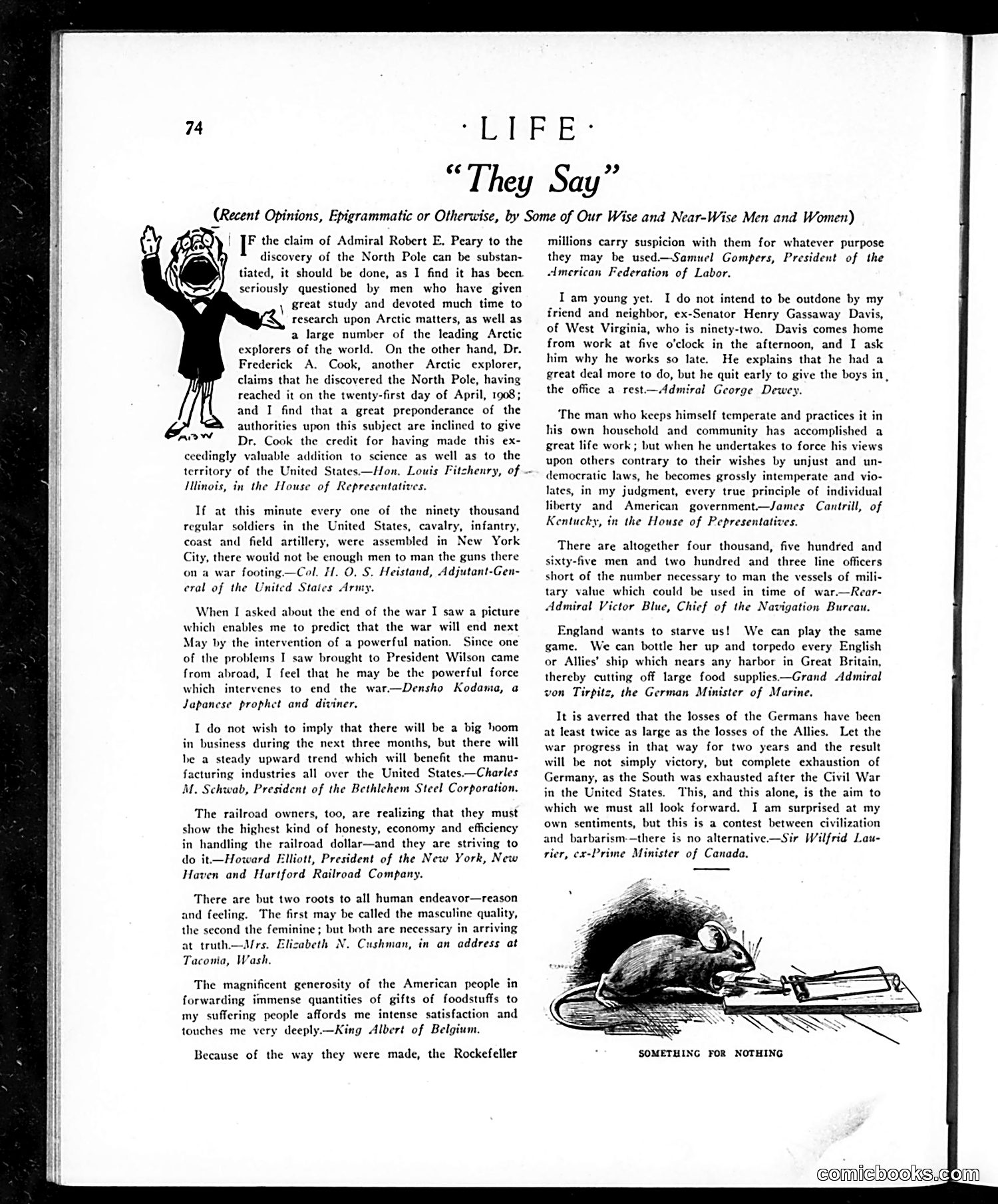
This is a satirical opinions column from *Life* magazine featuring brief quotes from prominent public figures of the era (likely WWI period, circa 1916-1918). The page lampoons these "wise and near-wise" statements through juxtaposition. **Key figures quoted:** - Admiral Robert Peary and Dr. Frederick Cook (competing North Pole discoverers) - Military/industrial leaders (Col. Heistand, Charles Schwab, Howard Elliott) - Samuel Gompers (labor leader) criticizing Rockefeller's money - Admiral Dewey and ex-Senator Davis (on work/retirement) - King Albert of Belgium (thanking Americans for aid) - A Japanese "prophet" predicting war's end **The satire:** By presenting unvetted, sometimes contradictory or self-serving statements without editorial comment, *Life* mocks these figures' pretensions to wisdom. The accompanying cartoon—showing a mouse working at drafting equipment, captioned "SOMETHING FOR NOTHING"—appears to mock futile effort or empty promises. The effect ridicules both vanity and the uncritical media amplification of celebrity pronouncements.
📄 Transcribed text from this page (OCR, searchable)
Machine-transcribed from the original scan — historical spelling and the odd misread are preserved.
“ie ee Be “They Say” (Recent Opinions, Epigrammatic or Otherwise, by Some of Our Wise and Near-Wise Men and Women) | ]F the claim of Admiral Robert E. Peary to the discovery of the North Pole can be substan- tiated, it should be done, as I find it has becn. seriously questioned by men who have given \ great study and devoted much time to research upon Arctic matters, as well as a large number of the leading Arctic explorers of the world. On the other hand, Dr. Frederick A. Cook, another Arctic explorer, claims that he discovered the North Pole, having reached it on the twenty-first day of April, 1908; and I find that a great preponderance of the authorities upon this subject are inclined to give Dr. Cook the credit for having made this ex- dingly valuable addition to science as well as to the territory of the United States—Hon, Louis Fitzhenry, of — Mlinois, in the House of Representatives. If at this minute every one of the ninety thousand regular soldiers in the United States, cavalry, infantry, coast and field artillery, were assembled in New York City, there would not be enough men to man the guns there on a war footing —Col. H. O. S. Heistand, Adjutant-Gen- eral of the United States Army. When I asked about the end of the war I saw a picture which enables me to predict that the war will end next May by the intervention of a powerful nation. Since one of the problems I saw brought to President Wilson came from abroad, I feel that he may be the powerful force which intervenes to end the war—Densho Kodama, a Japanese prophet and diviner, I do not wish to imply that there will be a big boom in business during the next three months, but there will be a steady upward trend which will benefit the manu- facturing industries all over the United States—Charles M. Schwab, President of the Bethlehem Steel Corporation, The railroad owners, too, are realizing that they must show the highest kind of honesty, economy and efficiency in handling the railroad dollar—and they are striving to do it—Howard Elliott, President of the New York, New Haven and Hartford Railroad Company. There are but two roots to all human endeavor—reason and feeling. The first may be called the masculine quality, the second the feminine; but both are necessary in arriving at truth—aA/rs. Elizabeth N. Cushman, in an address at Taconia, Wash. The magnificent generosity of the American people in forwarding immense quantities of gifts of foodstuffs to my suffering people affords me intense satisfaction and touches me very deeply—King Albert of Belgium. Because of the way they were made, the Rockefeller millions carry suspicion with them for whatever purpose they may be used.—Samuel Gompers, President of the elmerican Federation of Labor. I am young yet. I do not intend to be outdone by my friend and neighbor, ex-Senator Henry Gassaway Davis, of West Virginia, who is ninety-two. Davis comes home from work at five o'clock in the afternoon, and I ask him why he works so late. He explains that he had a great deal more to do, but he quit early to give the boys in, the office a rest—Admiral George Dewey. ‘The man who keeps himself temperate and practices it in his own household and community has accomplished a great life work; but when he undertakes to force his views upon others contrary to their wishes by unjust and un- democratic laws, he becomes grossly intemperate and vio- lates, in my judgment, every true principle of individual liberty and American government.—James Cantrill, of Kentucky, in the House of Pepresentatives. There are altogether four thousand, five hundred and sixty-five men and two hundred and three line officers short of the number necessary to man the vessels of mili- tary value which could be used in time of war.—Rear- Admiral Victor Blue, Chief of the Navigation Bureau, England wants to starve us! We can play the same game. We can bottle her up and torpedo every English or Allies’ ship which nears any harbor in Great Britain, thereby cutting off large food supplies—Grand Admiral von Tirpitz, the German Minister of Marine. It is averred that the losses of the Germans have been at least twice as large as the losses of the Allies. Let the war progress in that way for two years and the result will be not simply victory, but complete exhaustion of Germany, as the South was exhausted after the Civil War in the United States. This, and this alone, is the aim to which we must all look forward. I am surprised at my own sentiments, but this is a contest between civilization and barbarism-—there is no alternative—Sir Wilfrid Lau- rier, cx-Prime Minister of Canada. SOMETHING FOR NOTHING comichooks.com