
Life, 1915-01-14 · page 10 of 44
Life — January 14, 1915 — page 10: what you’re looking at
What you’re looking at
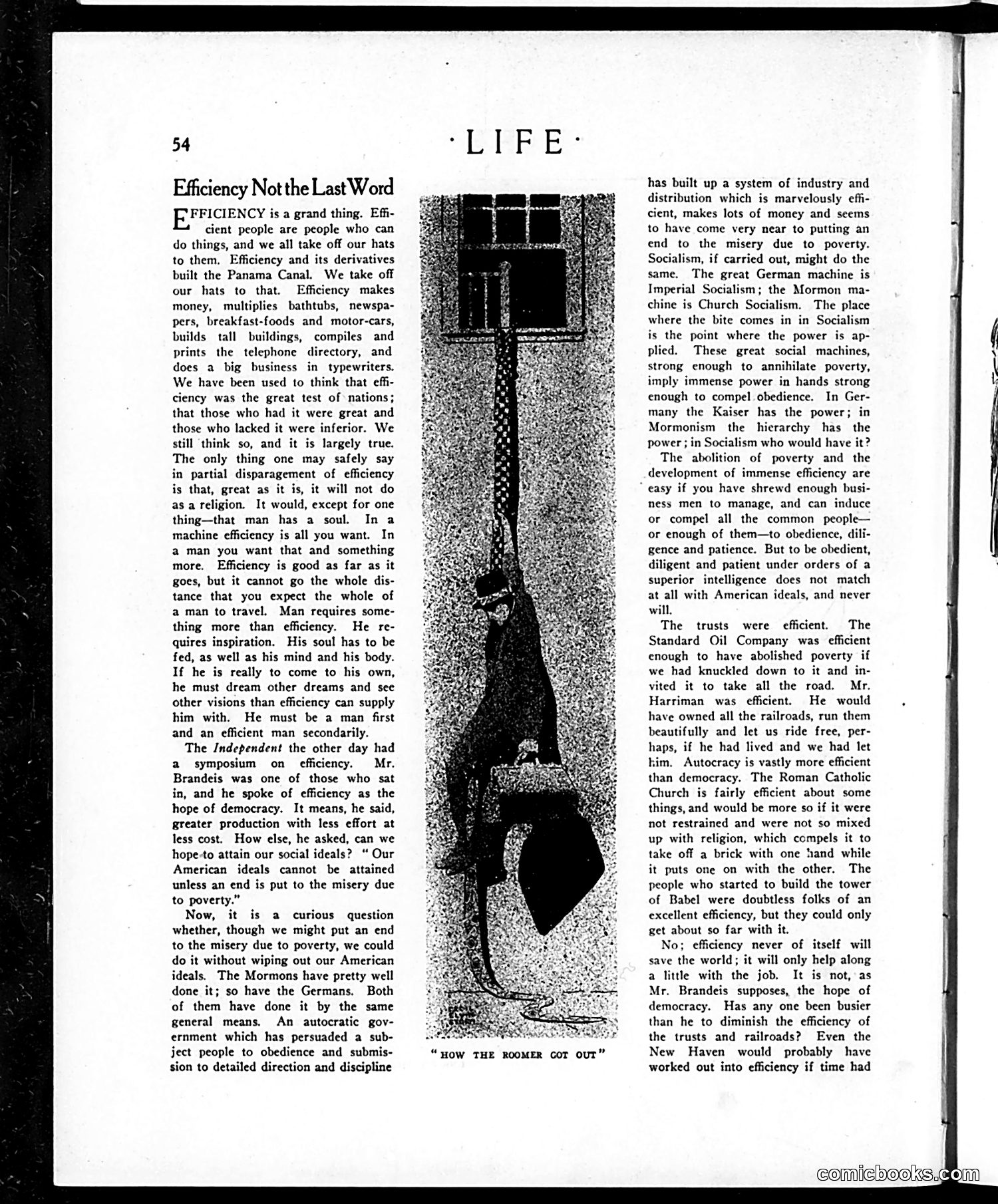
This page from *Life* magazine presents an article titled "Efficiency Not the Last Word," accompanied by a single illustration labeled "HOW THE BOOMER GOT OUT." The cartoon depicts a figure escaping from what appears to be a tall tower or building—likely representing institutional confinement or constraint. The article argues that while efficiency is valuable, it cannot be the sole measure of human achievement or social progress. The text critiques various "efficient" systems—Socialism, Mormonism, the Standard Oil Company, autocracy—suggesting that efficiency alone, without ethical considerations or human dignity, is insufficient. The "boomer" figure represents someone breaking free from such purely mechanistic, efficiency-focused systems, asserting the primacy of individual aspiration and democratic ideals over regimented control.
📄 Transcribed text from this page (OCR, searchable)
Machine-transcribed from the original scan — historical spelling and the odd misread are preserved.
54 Efficiency Not the Last Word FFICIENCY is a grand thing. Effi- cient people are people who can do things, and we all take off our hats to them. Efficiency and its derivatives built the Panama Canal. We take off our hats to that. Efficiency makes money, multiplies bathtubs, newspa- pers, breakfast-foods and motor-cars, builds tall buildings, compiles and prints the telephone directory, and does a big business in typewriters. We have been used to think that effi- ciency was the great test of nations; that those who had it were great and those who lacked it were inferior. We still ‘think so, and it is largely true. The only thing one may safely say in partial disparagement of efficiency is that, great as it is, it will not do asa religion. It would, except for one thing—that man has a soul. In a machine efficiency is all you want. In a man you want that and something more. Efficiency is good as far as it goes, but it cannot go the whole dis- tance that you expect the whole of a man to travel. Man requires some- thing more than efficiency. He re- quires inspiration. His soul has to be fed, as well as his mind and his body. If he is really to come to his own, he must dream other dreams and see other visions than efficiency can supply him with. He must be a man first and an efficient man secondarily. The Independent the other day had a symposium on efficiency. Mr. Brandeis was one of those who sat in, and he spoke of efficiency as the hope of democracy. It means, he said, greater production with less effort at less cost. How else, he asked, can we hope-to attain our social ideals? “ Our American ideals cannot be attained unless an end is put to the misery due to poverty.” Now, it is a curious question whether, though we might put an end to the misery due to poverty, we could do it without wiping out our American ideals. The Mormons have pretty well done it; so have the Germans. Both of them have done it by the same general means. An autocratic gov- ernment which has persuaded a sub- ject people to obedience and submis- sion to detailed direction and discipline ponenner £5 y Cnmemwnreee we “HOW THE ROOMER GOT OUT” has built up a system of industry and distribution which is marvelously effi- cient, makes lots of money and seems to have come very near to putting an end to the misery due to poverty. Socialism, if carried out, might do the same. The great German machine is Imperial Socialism; the Mormon ma- chine is Church Socialism. The place where the bite comes in in Socialism is the point where the power is ap- plied. These great social machines, strong enough to annihilate poverty, imply immense power in hands strong enough to compel obedience. In Ger- many the Kaiser has the power; in Mormonism the hierarchy has the power ; in Socialism who would have it? The abolition of poverty and the development of immense efficiency are * easy if you have shrewd enough busi- ness men to manage, and can induce or compel all the common people— or enough of them—to obedience, dili- gence and patience. But to be obedient, diligent and patient under orders of a superior intelligence does not match at all with American ideals, and never will. The trusts were efficient. The Standard Oil Company was efficient enough to have abolished poverty if we had knuckled down to it and in- vited it to take all the road. Mr. Harriman was efficient. He would have owned all the railroads, run them beautifully and let us ride free, per- haps, if he had lived and we had let kim. Autocracy is vastly more efficient than democracy. The Roman Catholic Church is fairly efficient about some things, and would be more so if it were not restrained and were not so mixed up with religion, which compels it to take off a brick with one hand while it puts one on with the other. The people who started to build the tower of Babel were doubtless folks of an excellent efficiency, but they could only get about so far with it. No; efficiency never of itself will save the world; it will only help along a little with the job. It is not, as Mr. Brandeis supposes, the hope of democracy. Has any one been busier than he to diminish the efficiency of the trusts and railroads? Even the New Haven would probably have worked out into efficiency if time had comichooks.cem