
Life, 1915-01-14 · page 40 of 44
Life — January 14, 1915 — page 40: what you’re looking at
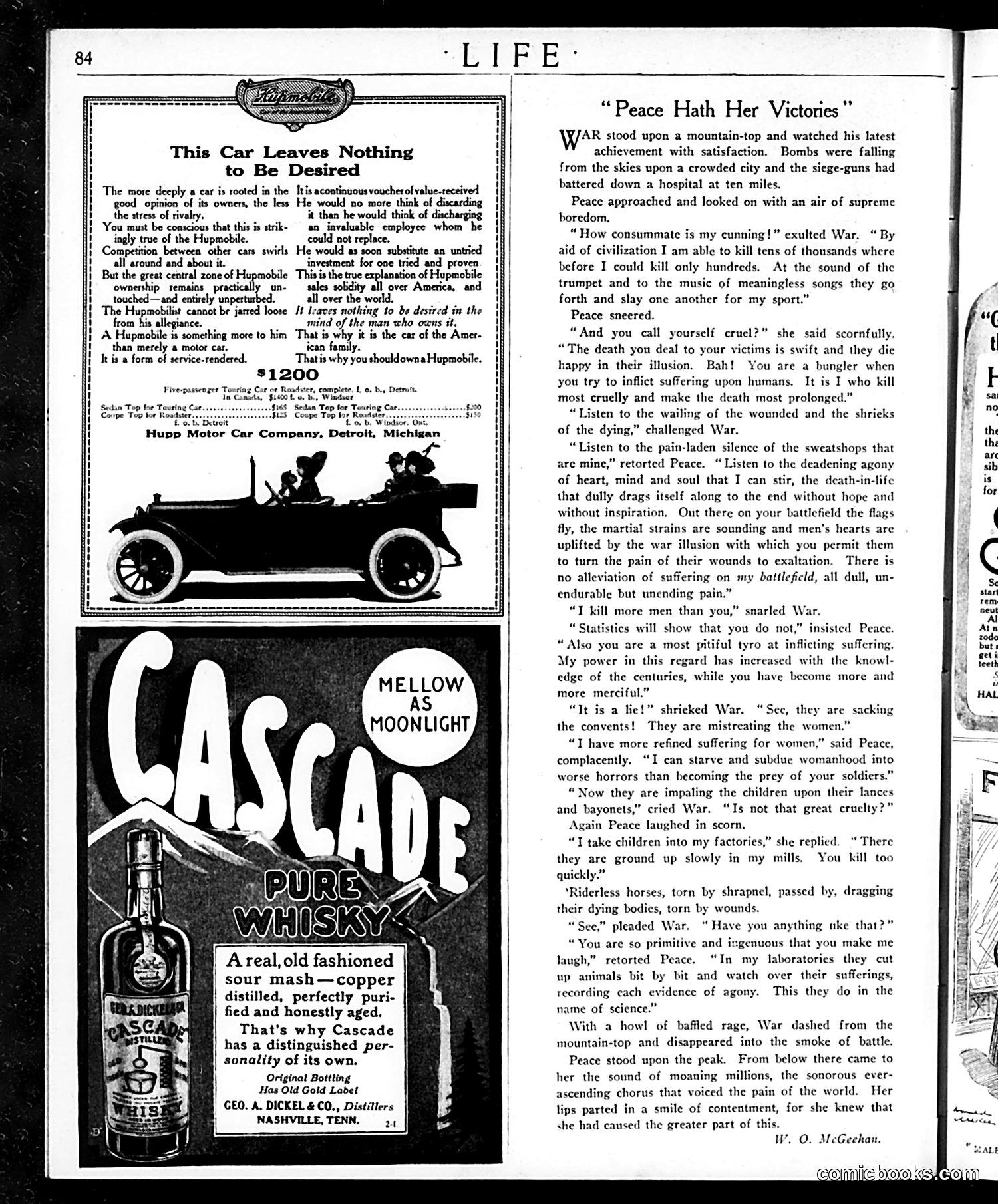
What you’re looking at
This allegorical dialogue presents **Peace and War as personified figures** debating whose suffering is worse. The satire, likely written during or shortly after WWI, argues that **peacetime causes more prolonged human suffering than warfare**. War boasts of killing masses through modern warfare ("civilization"). Peace counters that she inflicts subtler, crueler torment: the "death-in-life" of sweatshops, starvation, and the systematic degradation of women and the poor. She claims her suffering is unrelenting and numberless, while War's victims at least experience the "illusion" of noble purpose through patriotic fervor. The satire critiques both militarism AND the economic/social brutality of peacetime capitalism—suggesting that civilian workers endure worse conditions than soldiers do in battle. This reflects early 20th-century labor reform sentiment and anti-war perspectives questioning whether industrial civilization truly represented "progress."
📄 Transcribed text from this page (OCR, searchable)
Machine-transcribed from the original scan — historical spelling and the odd misread are preserved.
SENS MSS C3 This Car Leaves Nothing to Be Desired The mote deeply a car is rooted in the Itis acontinuous voucherof value-received good opinion of its owners, the less He would no more think of discarding the stress of rivalry. it than he would think of discharging You must be conscious that this is strik- an invaluable employee whom he ingly true of the Hupmobile. could not replace. Competition between other cars swirls He would as soon substitute an untried all around and about it. investment for one tried and proven But the great central zone of Hupmobile This is the true explanation of Hupmobile ownership remains practic un- sales sobdity all cover America, and touched—and entirely unperturbed. all over the world. The Hupmobilist cannot be jarred loose /t leaves nothing to be desired in the from his allegiance. mind of the man who owns tt. Hupmobile is something more to him That is why it is the car of the Amer- than merely a motor car. ican family. It is a form of service-rendered. Thatis why you shouldowna Hupmobile. $1200 Fiverpassenzer Tooriag Car or Roadster, complete. f, 0, buy Detrott. In Casa, $1600 Lo, be, Windsor Sedan Top for Touring © Sedan Top for Touring Coupe Te toe Kou ste Coupe Top for Rowtster Ww oy Lo Hupp Motor Car Company, Detroit, Michigan sour mash—copper distilled, perfectly puri- fied and honestly aged. That's why Cascade has a distinguished per- sonality of its own. Originat Bottting Has Old Gold Labet GEO. A. DICKEL & CO., Distillers NASHVILLE, TENN. 2 “Peace Hath Her Victories” wr stood upon a mountain-top and watched his latest achievement with satisfaction. Bombs were falling from the skies upon a crowded city and the siege-guns had battered down a hospital at ten miles. Peace approached and looked on with an air of supreme boredom, “ How consummate is my cunning!” exulted War. “ By aid of civilization I am able to kill tens of thousands where before I could kill only hundreds. At the sound of the trumpet and to the music of meaningless songs they go forth and slay one another for my sport.” Peace sneered. “And you call yourself cruel?” she said scornfully. “The death you deal to your victim swift and they die happy in their illusion. Bah! You are a bungler when you try to inflict suffering upon humans. It is I who kill most cruelly and make the death most prolonged.” “Listen to the wailing of the wounded and the shrieks of the dying,” challenged War. “Listen to the pain-laden silence of the sweatshops that are mine,” retorted Peace. “Listen to the deadening agony of heart, mind and soul that I can stir, the death-in-life that dully drags itself along to the end without hope and without inspiration, Out there on your battlefield the flags fly, the martial strains are sounding and men’s hearts are uplifted by the war illusion with which you permit them to turn the pain of their wounds to exaltation. There is no alleviation of suffering on my battlefield, all dull, un- endurable but unending pain. “T kill more men than you,” snarled War. “Statistics will show that you do not,” insisted Peace. “Also you are a most pitiful tyro at inflicting suffering. My power in this regard has increased with the knowl- edge of the centuries, while you have become more and more merciful.” “Tt is a lie!” shrieked War. “Sec, they are sacking the convents! They are mistreating the women.” “T have more refined suffering for women,” said Peace, complacently. “I can starve and subdue womanhood into worse horrors than becoming the prey of your soldiers.” “Now they are impaling the children upon their lances and bayonets,” cried War. “Is not that great cruelty?” Again Peace laughed in scorn. “T take children into my factories,” she replied. “ There they are ground up slowly in my mills. You kill too quickly.” ‘Riderless horses, torn by shrapnel, passed by, dragging their dying bodies, torn by wounds. “See,” pleaded War. “Have you anything ke that?” “You are so primitive and ingenuous that you make me laugh,” retorted Peace. “In my laboratories they cut up animals bit by bit and watch over their sufferings, recording cach evidence of agony. This they do in the name of science.” With a howl of baffled rage, War dashed from the mountain-top and disappeared into the smoke of battle. Peace stood upon the peak. From below there came to her the sound of moaning millions, the sonorous ever- ascending chorus that voiced the pain of the world. Her lips parted in a smile of contentment, for she knew that she had caused the greater part of this. W. O. McGeehan.