
Life, 1915-01-14 · page 24 of 44
Life — January 14, 1915 — page 24: what you’re looking at
What you’re looking at
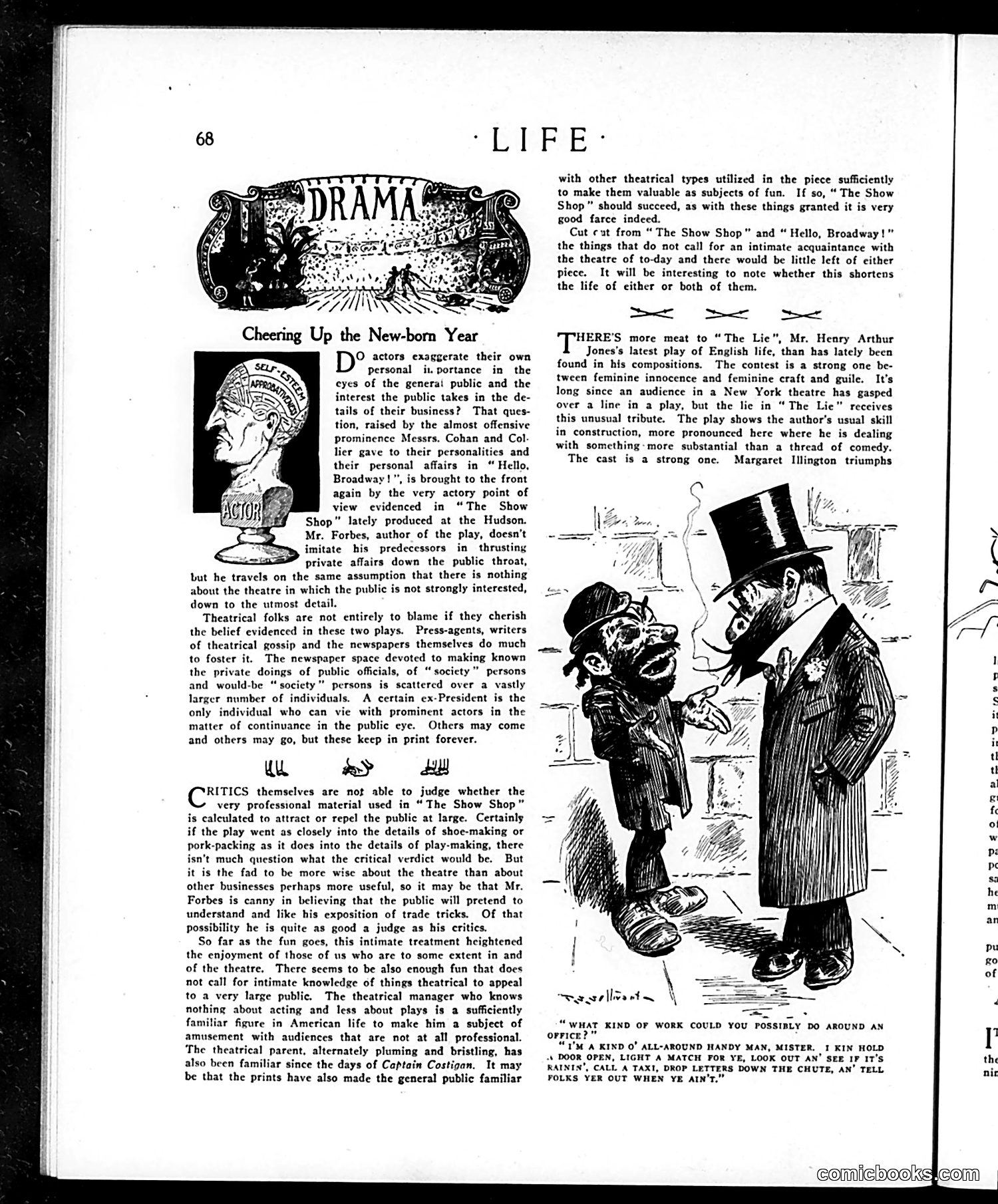
This page critiques two Broadway plays: "The Show Shop" (at the Hudson Theatre) and "Hello, Broadway!" The cartoons and text mock actors' self-importance and theatrical industry's obsession with celebrities' private lives. The main criticism: playwrights like Mr. Forbes assume the public craves intimate theatrical gossip and behind-the-scenes details. The author argues newspapers and press agents enable this by treating actors like ex-Presidents—constantly in print. The accompanying cartoon (right) illustrates a theatrical "jack-of-all-trades" character, emphasizing how the industry recycled stock character types familiar to audiences through repeated theatrical traditions and newspaper coverage. The piece concludes that "The Show Shop" works as farce *because* it exploits this public familiarity with theatrical stereotypes—suggesting the plays' success depends entirely on insider knowledge, not genuine dramatic merit.
📄 Transcribed text from this page (OCR, searchable)
Machine-transcribed from the original scan — historical spelling and the odd misread are preserved.
Cheering Up the New-born Year © actors exaggerate their own Personal it. portance in the eyes of the generai public and the interest the public takes in the de- tails of their business? That ques- tion, raised by the almost offensive prominence Messrs. Cohan and Col- lier gave to their personalities and their personal affairs in “ Hello, Broadway!", is brought to the front again by the very actory point of view evidenced in “The Show Shop” lately produced at the Hudson. Mr. Forbes, author of the play, doesn’t imitate his predecessors in thrusting private aff: down the public throat, but he travels on the same assumption that there is nothing about the theatre in which the public is not strongly interested, down to the utmost detail. Theatrical folks are not entirely to blame if they cherish the belief evidenced in these two plays. Press-agents, writers of theatrical gossip and the newspapers themselves do much to foster it. The newspaper space devoted to making known the private doings of public officials, of “society” persons and would-be “society” persons is scattered over a vastly larger number of individuals. A certain ex-President is the only individual who can vie with prominent actors in the matter of continuance in the public eye. Others may come and others may go, but these keep in print forever. qu ay au RITICS themselves are not able to judge whether the very professional material used in “The Show Shop” is calculated to attract or repel the public at large. Certainly if the play went as closely into the details of shoe-making or pork-packing as it does into the details of play-making, there isn’t much question what the critical verdict would be. But it is the fad to be more wise about the theatre than about other businesses perhaps more useful, so it may be that Mr. Forbes is canny in believing that the public will pretend to understand and like his exposition of trade ks. Of that possibility he is quite as good a judge as his critics, So far as the fun goes, this intimate treatment heightened the enjoyment of those of us who are to some extent in and of the theatre. There seems to be also enough fun that does not call for intimate knowledge of things theatrical to appeal to a very large public. The theatrical manager who knows nothing about acting and less about plays is a sufficiently familiar figure in American life to make him a subject of amusement with audiences that are not at all professional. The theatrical parent, alternately pluming and bristling, has also been familiar since the days of Captain Costigan. It may be that the prints have also made the general public familiar “BUGPtE * with other theatrical types utilized in the piece sufficiently to make them valuable as subjects of fun. If so, “ The Show Shop” should succeed, as with these things granted it is very good farce indeed. Cut cut from “ The Show Shop” and “ Hello, Broadway!” the things that do not call for an intimate acquaintance with the theatre of to-day and there would be little left of cither Piece. It will be interesting to note whether this shortens the life of either or both of them. a HERE'S more meat to “The Lie", Mr. Henry Arthur Jones's latest play of English life, than has lately been found in his compositions. The contest is a strong one be- tween feminine innocence and feminine craft and guile. It’s long since an audience in a New York theatre has gasped over a line in a play, but the lie in “The Lie” receives this unusual tribute. The play shows the author's usual skill in construction, more pronounced here where he is dealing with something: more substantial than a thread of comedy. The cast is a strong one. Margaret Illington triumphs “WHAT KIND OF WORK COULD YOU POSSIBLY DO AROUND AN rn?” ‘MA KIND O° ALL-AROUND HANDY MAN, MISTER. I KIN HOLD <s DOOR OPEN, LIGHT A MATCH FOR YE, LOOK OUT AN’ SEE IF IT'S RAININ', CALL A TAXI, DROP LETTERS DOWN THE CHUTE, AN’ TELL FOLKS YER OUT WHEN YE AIN'T, comichool