
Life, 1915-01-14 · page 26 of 44
Life — January 14, 1915 — page 26: what you’re looking at
What you’re looking at
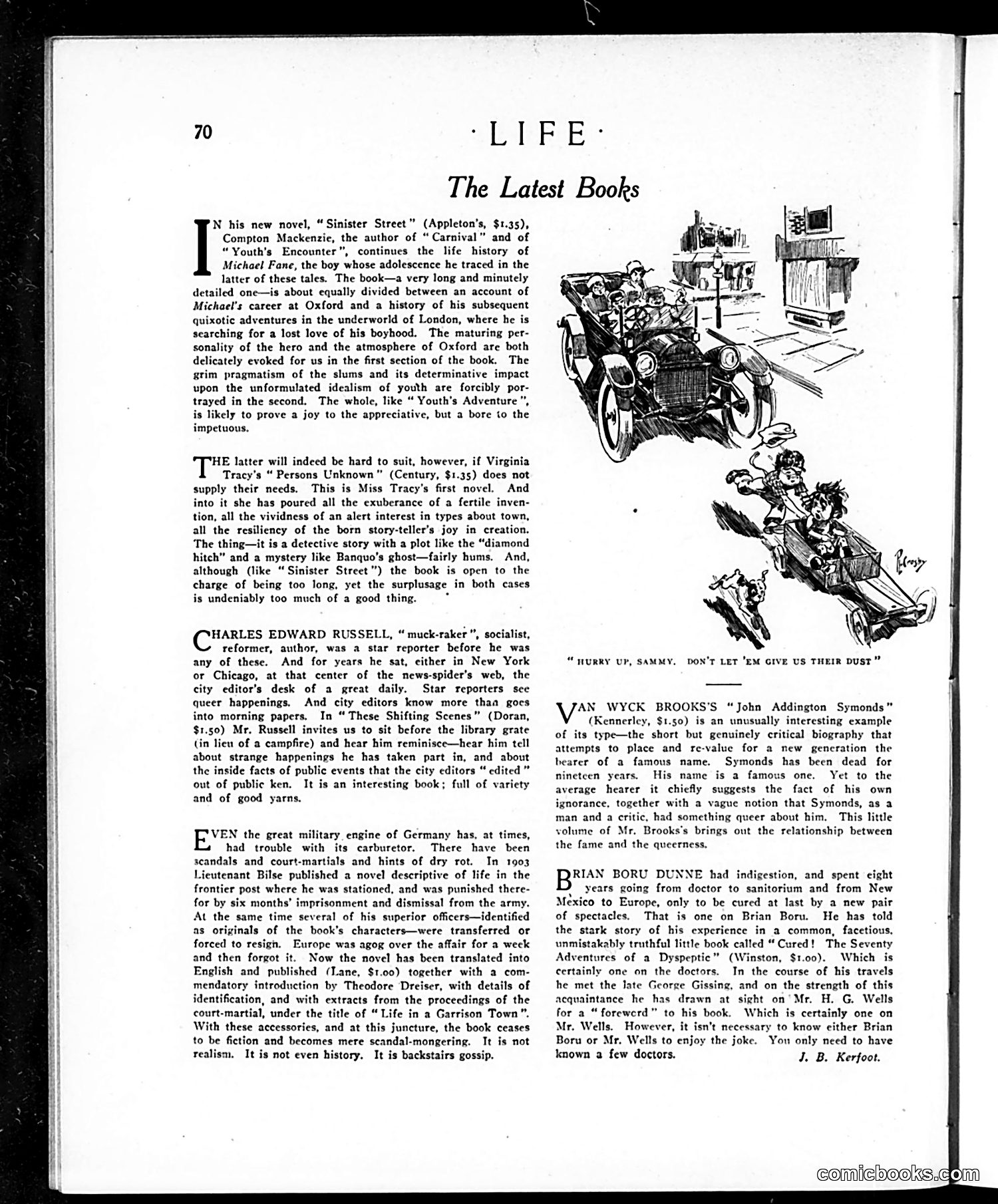
This is a **book review page** from Life magazine featuring literary criticism of contemporary novels. The page includes one cartoon illustration captioned "Hurry Up, Sammy, Don't Let 'Em Give Us Their Dust." The cartoon depicts two figures in what appears to be a racing or competitive scene—one driving an early automobile and another on what looks like a motorcycle or similar vehicle, moving at high speed. The caption suggests a competitive race or rivalry, with "giving dust" being a colloquial expression meaning to be left behind or defeated. The text reviews several books including Compton Mackenzie's "Sinister Street," Virginia Tracy's "Persons Unknown," and Charles Edward Russell's "These Shifting Scenes." The reviews discuss literary merit, character development, and narrative style typical of early 20th-century criticism. The cartoon likely serves as visual entertainment accompanying these serious literary discussions, though the specific topical reference it makes remains unclear without additional context about 1915 events or personalities.
📄 Transcribed text from this page (OCR, searchable)
Machine-transcribed from the original scan — historical spelling and the odd misread are preserved.
= /IRRSE The Latest Books N his new novel, “Sinister Street” (Appleton’s, $1.35), Compton Mackenzie, the author of “Carnival” and of “Youth’s Encounter”, continues the life history of Michael Fane, the boy whose adolescence he traced in the latter of these tales. The book—a very long and minutely detailed one—is about equally divided between an account of Michael's career at Oxford and a history of his subsequent quixotic adventures in the underworld of London, where he is searching for a lost love of his boyhood. The maturing per- sonality of the hero and the atmosphere of Oxford are both delicately evoked for us in the first section of the book, The grim pragmatism of the slums and its determinative impact upon the unformulated idealism of youth are forcibly por- trayed in the second. The whole, like “ Youth's Adventure ”, is likely to prove a joy to the appreciative, but a bore to the impetuous. HE latter will indeed be hard to suit, however, if Virginia Tracy's “ Persons Unknown” (Century, $1.35) does not supply their needs. This is Miss Tracy's first novel. And into it she has poured all the exuberance of a fertile inven- tion, all the vividness of an alert interest in types about town, all the resiliency of the born story-teller’s joy in creation. The thing—it is a detective story with a plot like the “diamond hitch” and a mystery like Banquo’s ghost—fairly hums. And, although (like “Sinister Street”) the book is open to the charge of being too long, yet the surplusage in both cases is undeniably too much of a good thing. 7 HARLES EDWARD RUSSELL, “ muck-raker”, socialist, reformer, author, was a star reporter before he was any of these. And for years he sat, either in New York or Chicago, at that center of the news-spider’s web, the city editor's desk of a great daily. Star reporters see queer happenings. And city editors know more thaa gocs into morning papers. In “ These Shifting Scenes” (Doran, $1.50) Mr. Russell invites us to sit before the library grate Cin liew of a campfire) and hear him reminisce—hear him tell about strange happenings he has taken part in, and about the inside facts of public events that the city editors “ edited” out of public ken. It is an interesting book; full of variety and of good yarns. Ee. the great military engine of Germany has, at times, had trouble with its carburetor. There have been scandals and court-martials and hints of dry rot. In 1903 Lieutenant Bilse published a novel descriptive of life in the frontier post where he was stationed, and was punished there- for by six months’ imprisonment and dismissal from the army. At the same time several of his superior officers—identified as originals of the book's characters—were transferred or forced to resign. Europe was agog over the affair for a week and then forgot it. Now the novel has been translated into English and published (Lane, $1.00) together with a com- mendatory introduction by Theodore Dreiser, with details of identification, and with extracts from the proceedings of the court-martial, under the title of “Life in a Garrison Town”. With these accessories, and at this juncture, the book ceases to be fiction and becomes mere scandal-mongering. It is not realism. It is not even history. It is backstairs gossip. “HURRY UP, SAMMY, DON'T LET 'EM GIVE US THEIR DUST” AN WYCK BROOKS’S “John Addington Symonds” (Kennerley, $1.50) is an unusually interesting example of its type—the short but genuinely critical biography that attempts to place and re-value for a new gencration the bearer of a famous name. Symonds has been dead for ninetcen years. His name is a famous one. Yet to the average hearer it chiefly suggests the fact of his own ignorance, together with a vague notion that Symonds, as a man and a critic, had something queer about him. This little volume of Mr. Brooks's brings out the relationship between the fame and the queerness, RIAN BORU DUNNE had indigestion, and spent eight 2 years going from doctor to sanitorium and from New Mexico to Europe, only to be cured at last by a new pair of spectacles. That is one on Brian Boru. He has told the stark story of his experience in a common, facetious, unmistakably truthful little book called “ Cured! The Seventy Adventures of a Dyspeptic” (Winston, $1.00). Which is certainly one on the doctors. In the course of his travels he met the late George Gissing, and on the strength of this acquaintance he has drawn at sight on’ Mr. H. G. Wells for a “forewcrd" to his book. Which is certainly one on Mr. Wells. However, it isn't necessary to know either Brian Boru or Mr. Wells to enjoy the joke. You only need to have known a few doctors. J. B. Kerfoot. comichooks.com