
Life, 1915-01-14 · page 21 of 44
Life — January 14, 1915 — page 21: what you’re looking at
What you’re looking at
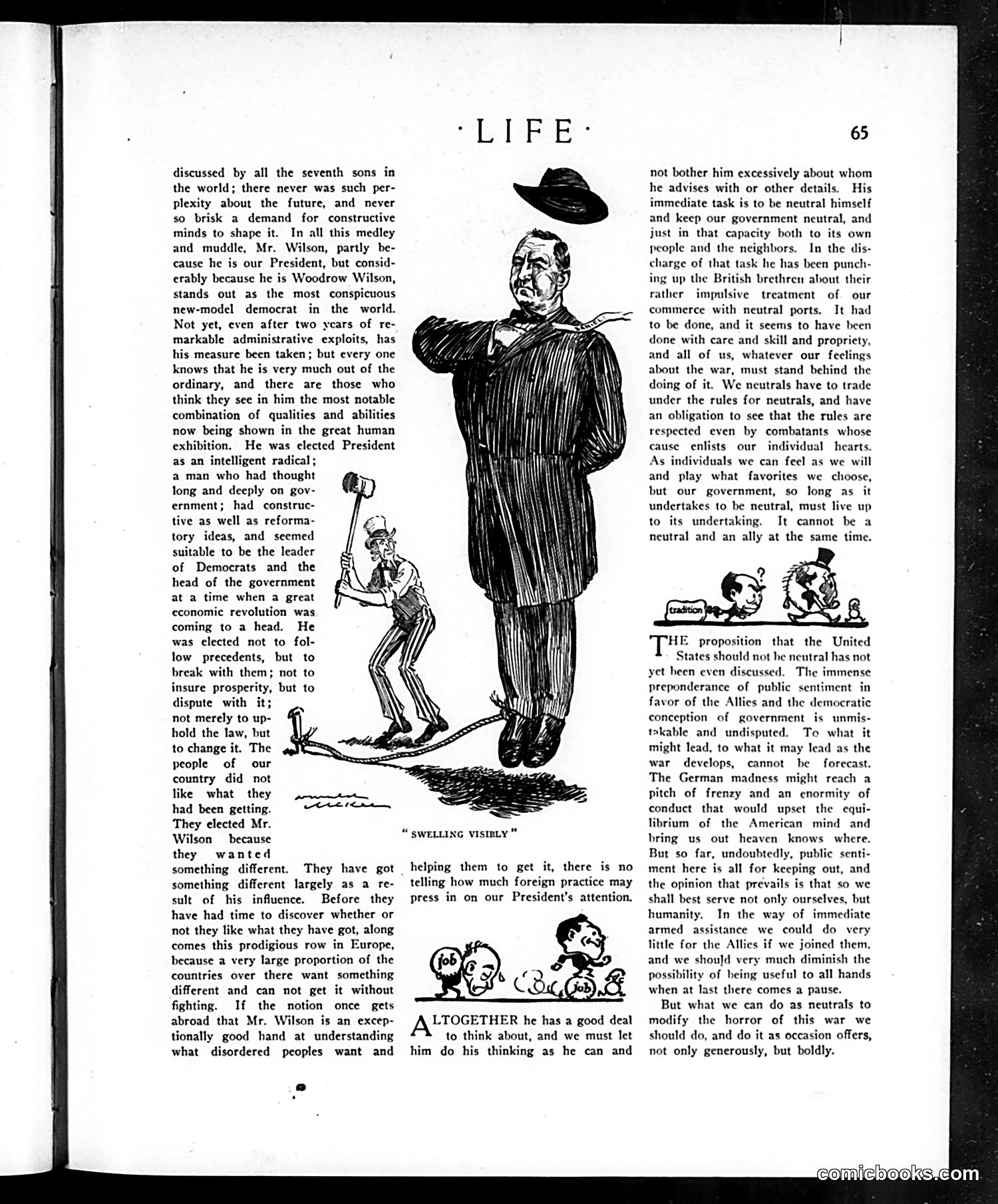
This page discusses President Woodrow Wilson during World War I (the text references "this prodigious row in Europe"). The main cartoon, titled "Swelling Visibly," depicts Wilson as a giant figure being inflated by two small figures pulling on a rope—likely representing the competing pressures on his presidency from foreign powers seeking U.S. support. The article praises Wilson as an intellectual, reform-minded Democrat elected to change the status quo. However, it warns that foreign nations may increasingly pressure him to abandon American neutrality. The satire suggests Wilson is being literally "swollen" by these external demands. The text emphasizes that while Americans sympathize with the Allies, the government must maintain strict neutrality and cannot simultaneously be "neutral and an ally at the same time"—a principle the author argues Wilson has properly upheld by protesting British interference with American commerce. The cartoon illustrates the mounting pressure Wilson faced to abandon neutrality.
📄 Transcribed text from this page (OCR, searchable)
Machine-transcribed from the original scan — historical spelling and the odd misread are preserved.
discussed by all the seventh sons in the world; there never was such per- plexity about the future, and never so brisk a demand for constructive minds to shape it. In all this medley and muddle, Mr. Wilson, partly be- cause he is our President, but consid- erably because he is Woodrow Wilson, stands out as the most conspicuous new-model democrat in the world. Not yet, even after two ycars of re- markable administrative exploits, has his measure been taken; but every one knows that he is very much out of the ordinary, and there are those who think they see in him the most notable combination of qualities and abilities now being shown in the great human exhibition. He was elected President as an intelligent radical; a man who had thought long and deeply on gov- ernment; had construc- tive as well as reforma- tory ideas, and seemed suitable to be the leader of Democrats and the head of the government at a time when a great economic revolution was coming to a head. He was elected not to fol- low precedents, but to break with them; not to insure prosperity, but to dispute with it; not merely to up- hold the law, but to change it. The people of our country did not like what they had been getting. They elected Mr. Wilson because they wanted something different. They have got something different largely as a re- sult of his influence. Before they have had time to discover whether or not they like what they have got, along comes this prodigious row in Europe, because a very large proportion of the countries over there want something different and can not get it without fighting. If the notion once gets abroad that Mr. Wilson is an excep- tionally good hand at understanding what disordered peoples want and “ SWELLING VISIBLY " helping them to get it, there is no telling how much foreign practice may press in on our President's attention. ALIOGEIHER he has a good deal to think about, and we must let him do his thinking as he can and 65 not bother him excessively about whom he advises with or other details. His immediate task is to be neutral himself and keep our government neutral, and just in that capacity both to its own people and the neighbors. In the dis- charge of that task he has been punch- ing up the British brethren about their rather impulsive treatment of our commerce with neutral ports. It had to be done, and it seems to have been done with care and skill and propriety, and all of us, whatever our feelings about the war, must stand behind the doing of it. We neutrals have to trade under the rules for neutrals, and have an obligation to see that the rules are respected even by combatants whose cause enlists our individual hearts. As individuals we can feel as we will and play what favorites we choose, but our government, so long as it undertakes to be neutral, must live up to its undertaking. It cannot be a neutral and an ally at the same time. 'HE proposition that the United States should not he neutral has not yet been even discussed. The immense preponderance of public sentiment in favor of the Allies and the democratic conception of government is unmis- tokable and undisputed. To what it might lead, to what it may lead as the war develops, cannot be forecast. The German madness might reach a pitch of frenzy and an enormity of conduct that would upset the equi- librium of the American mind and bring us out heaven knows where. But so far, undoubtedly, public senti- ment here is all for keeping out, and the opinion that prevails is that so we shall best serve not only ourselves, but humanity. In the way of immediate armed assistance we could do very little for the Allies if we joined them, should very much diminish the y of being useful to all hands when at last there comes a pause. But what we can do as neutrals to modify the horror of this war we should do, and do it as occasion offers, not only generously, but boldly.