
Life, 1915-01-14 · page 20 of 44
Life — January 14, 1915 — page 20: what you’re looking at
What you’re looking at
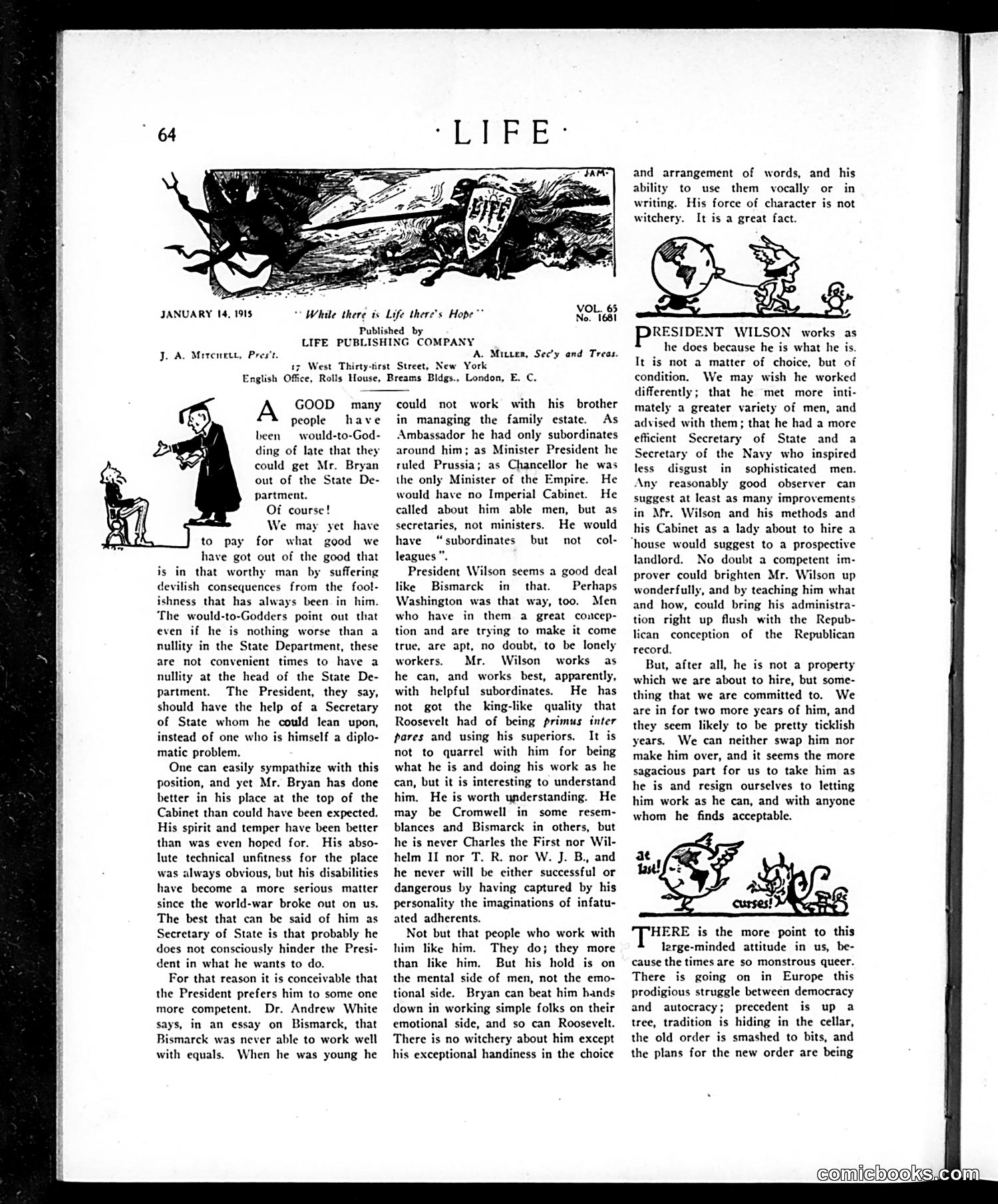
This editorial critiques President Woodrow Wilson's leadership approach, particularly his reliance on subordinates rather than equals. The article compares Wilson to Bismarck—both brilliant strategists who work best with helpers rather than collaborators. The piece defends Secretary of State William Jennings Bryan against criticism, arguing he hasn't actively hindered Wilson despite lacking diplomatic expertise. The author suggests Wilson *prefers* such subordinates because his temperament demands working alone on his vision. The cartoons (small illustrations with captions) satirize this dynamic—depicting the tension between Wilson's intellectual control and Bryan's more emotionally-driven populism. Context: Published during WWI's early stages, when strong diplomatic leadership was crucial. The article essentially argues Wilson's aloneness is both his strength and liability.
📄 Transcribed text from this page (OCR, searchable)
Machine-transcribed from the original scan — historical spelling and the odd misread are preserved.
JANUARY 14, 1915 “While there ts Life there's Hope” No. 1681 Published by LIFE PUBLISHING COMPANY J. A. Mirenett, Pres't. A. Miturr, Secy and Treas. tz West Thirty-tirst Street, New York English Office, Rolls House, Breams Bldgs., London, E. C. A GOOD many people have been — would-to-God- ding of late that they could get Mr. Bryan out of the State De- partment. Of course! We may yet have to pay for what good we have got out of the good that in that worthy man by suffering devilish consequences from the fool- ishness that has always been in him. The would-to-Godders point out that even if he is nothing worse than a nullity in the State Department, these are not convenient times to have a nullity at the head of the State De- partment. The President, they say, should have the help of a Secretary of State whom he could lean upon, instead of one who is himself a diplo- matic problem. One can easily sympathize with this position, and yet Mr. Bryan has done better in his place at the top of the Cabinet than could have been expected. His spirit and temper have been better than was even hoped for. His abso- lute technical unfitness for the place was always obvious, but his disabilities have become a more serious matter since the world-war broke out on us. The best that can be said of him as Secretary of State is that probably he does not consciously hinder the Presi- dent in what he wants to do. For that reason it is conceivable that the President prefers him to some one more competent. Dr. Andrew White says, in an essay on Bismarck, that Bismarck was never able to work well with equals. When he was young he could not work with his brother in managing the family estate. As Ambassador he had only subordinates around him; as Minister President he ruled Prussia; as Chancellor he was the only Minister of the Empire. He would have no Imperial Cabinet. He called about him able men, but as secretaries, not ministers. He would have “subordinates but not col- leagues”. President Wilson seems a good deal like Bismarck in that. Perhaps Washington was that way, too. Men who have in them a great concep- tion and are trying to make it come true, are apt, no doubt, to be lonely workers. Mr. Wilson works as he can, and works best, apparently, with helpful subordinates. He has not got the king-like quality that Roosevelt had of being primus inter pares and using his superiors, It is not to quarrel with him for being what he is and doing his work as he can, but it is interesting to understand him. He is worth understanding. He may be Cromwell in some resem- blances and Bismarck in others, but he is never Charles the First nor Wil- helm II nor T. R. nor W. J. B., and he never will be either successful or dangerous by having captured by his personality the imaginations of infatu- ated adherents. Not but that people who work with him like him. They do; they more than like him, But his hold is on the mental side of men, not the emo- tional side. Bryan can beat him hands down in working simple folks on their emotional side, and so can Roosevelt. There is no witchery about him except his exceptional handiness in the choice and arrangement of words, and his ability to use them vocally or in writing. His force of character is not witchery. It is a great fact. RESIDENT WILSON works as he does because he is what he is. Tt is not a matter of choice, but of condition. We may wish he worked differently; that he met more inti- mately a greater variety of men, and advised with them; that he had a more efficient Secretary of State and a Secretary of the Navy who inspired less disgust in sophisticated men. Any reasonably good observer can suggest at least as many improvements in Mr. Wilson and his methods and his Cabinet as a lady about to hire a ‘house would suggest to a prospective landlord. No doubt a competent im- prover could brighten Mr. Wilson up wonderfully, and by teaching him what and how, could bring his administra- tion right up flush with the Repub- lican conception of the Republican record. But, after all, he is not a property which we are about to hire, but some- thing that we are committed to. We are in for two more years of him, and they scem likely to be pretty ticklish years. We can neither swap him nor make him over, and it seems the more sagacious part for us to take him as he is and resign ourselves to letting him work as he can, and with anyone whom he finds acceptable. T# SRE is the more point to this large-minded attitude in us, be- cause the times are so monstrous queer. There is going on in Europe this prodigious struggle between democracy and autocracy; precedent is up a tree, tradition is hiding in the cellar, the old order is smashed to bits, and the plans for the new order are being