
A complete issue · 40 pages · 1914
Life — December 24, 1914
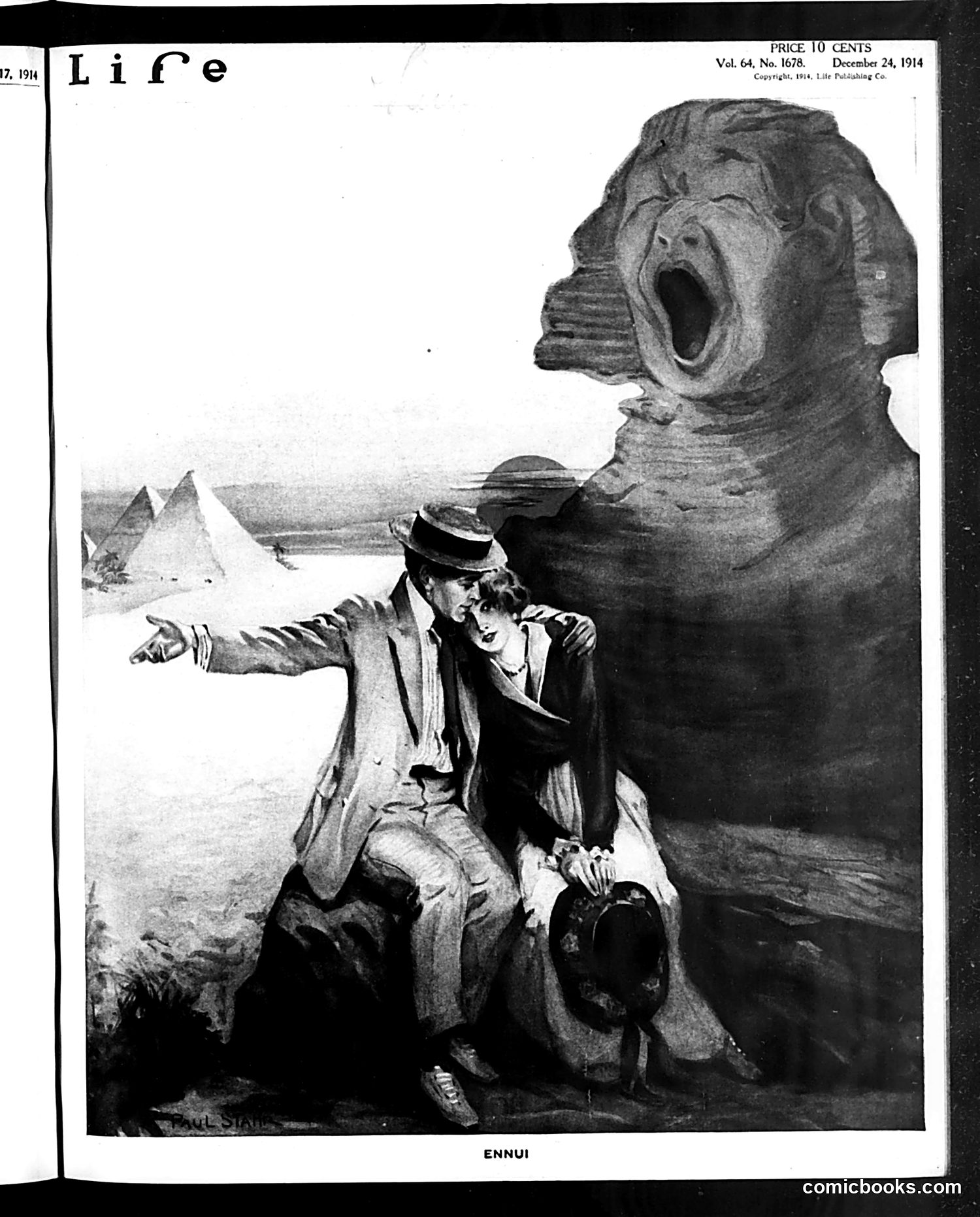
This satirical illustration titled "ENNUI" depicts a well-dressed man and woman sitting before an enormous, yawning hippopotamus head in what appears to be a safari camp setting (tents visible in background). The cartoon appears to satirize wealthy tourists or big-game hunters on African expeditions. The couple's bored, listless posture contrasts with the dramatic wildlife encounter before them—suggesting they've become so jaded by exotic adventures that even a massive hippo fails to impress them. The title "ENNUI" (fashionable world-weariness) reinforces this critique of upper-class ennui and the pursuit of ever-more-extreme experiences to combat boredom. This likely mocks the era's wealthy adventurers who treated African safaris as entertainment.
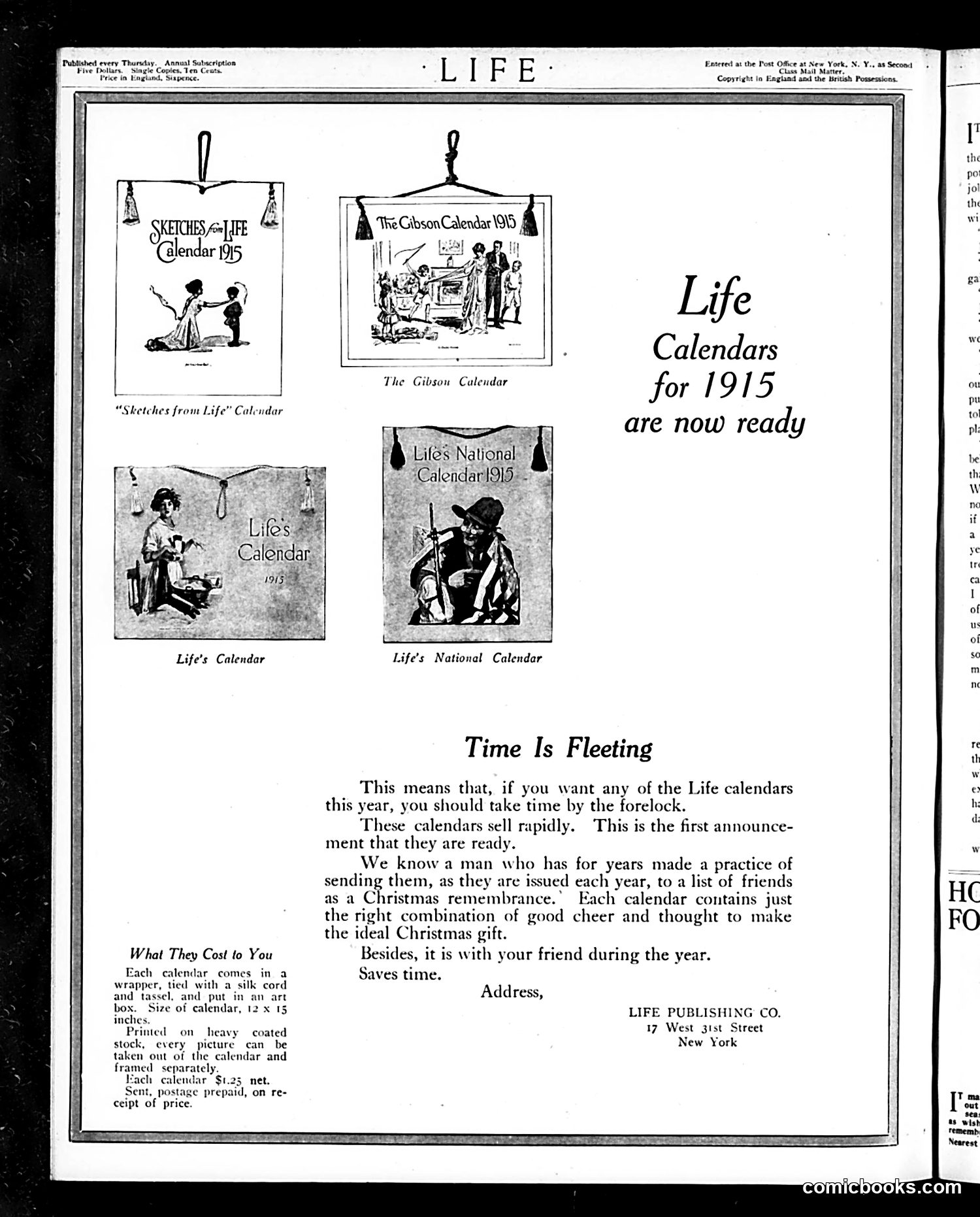
This page is primarily **advertising, not satire or political content**. It promotes Life magazine's 1915 calendar offerings. The page displays four calendar designs available for purchase: - "Sketches from Life" Calendar - The Gibson Calendar - Life's Calendar - Life's National Calendar The copy emphasizes urgency ("Time Is Fleeting"), noting these calendars "sell rapidly" and urging readers to order as Christmas gifts. Each calendar costs $1.25, comes wrapped in silk cord with tassel in an art box (12 x 15 inches), and individual pictures can be framed separately. The designs feature illustrations typical of early 1900s Life magazine style—likely including Charles Dana Gibson's famous "Gibson Girl" imagery, given one calendar's attribution. This is a straightforward commercial appeal to readers, not political commentary.
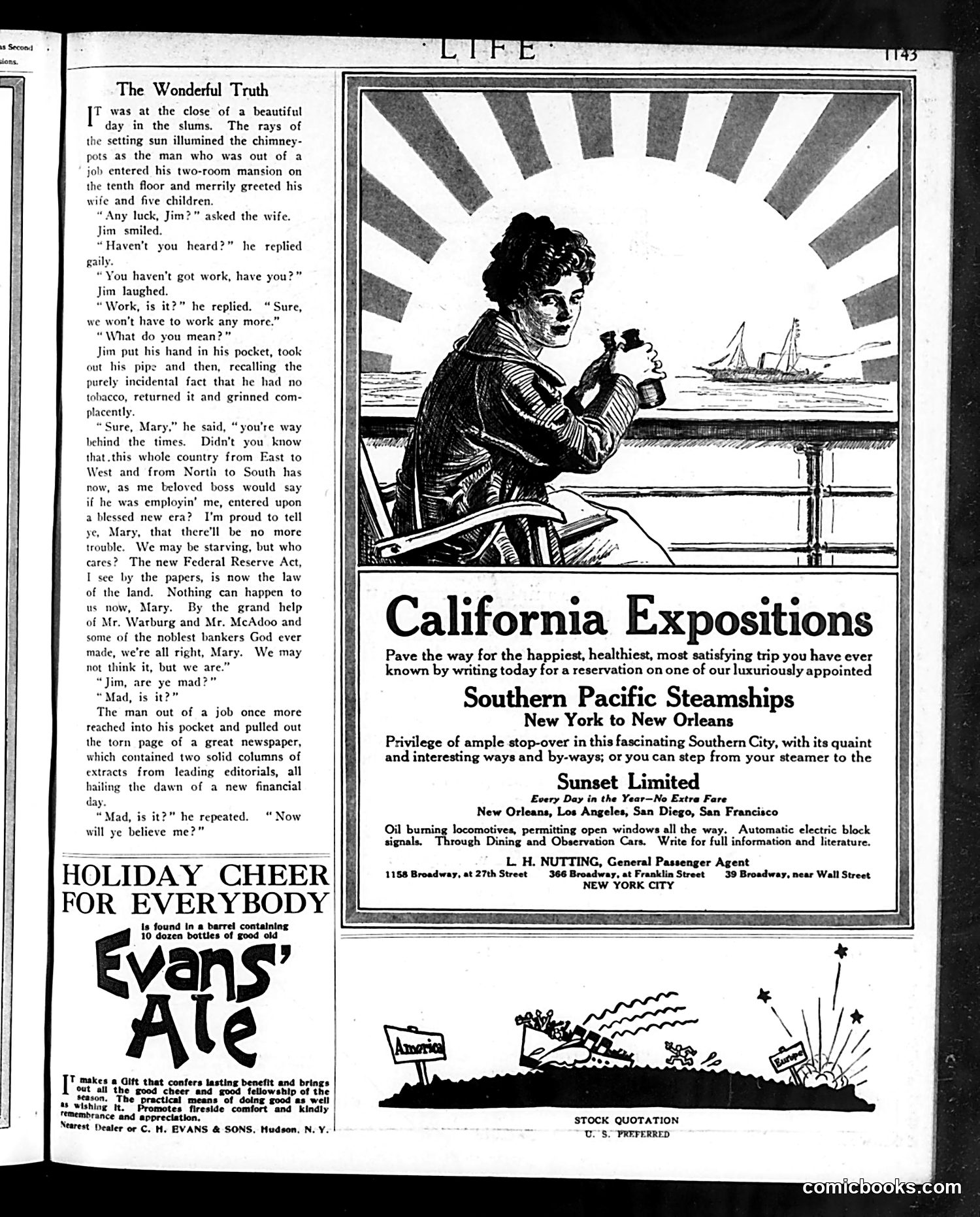
This page is primarily **advertising and fiction**, not political satire. The left column contains "The Wonderful Truth," a short story about Jim, a man newly employed who tells his wife Mary about job security provided by the Federal Reserve Act—suggesting optimism about new financial legislation. The dominant imagery is a **California Expositions advertisement** for Southern Pacific Steamships, featuring an illustration of a woman gazing from a ship toward coastal scenery. Below is an **Evans' Ale advertisement** promoting holiday gift-giving. The bottom corner shows a small "Stock Quotation" illustration. No political cartoons or caricatures appear on this page. It reflects early 20th-century American consumer culture and commercial optimism.
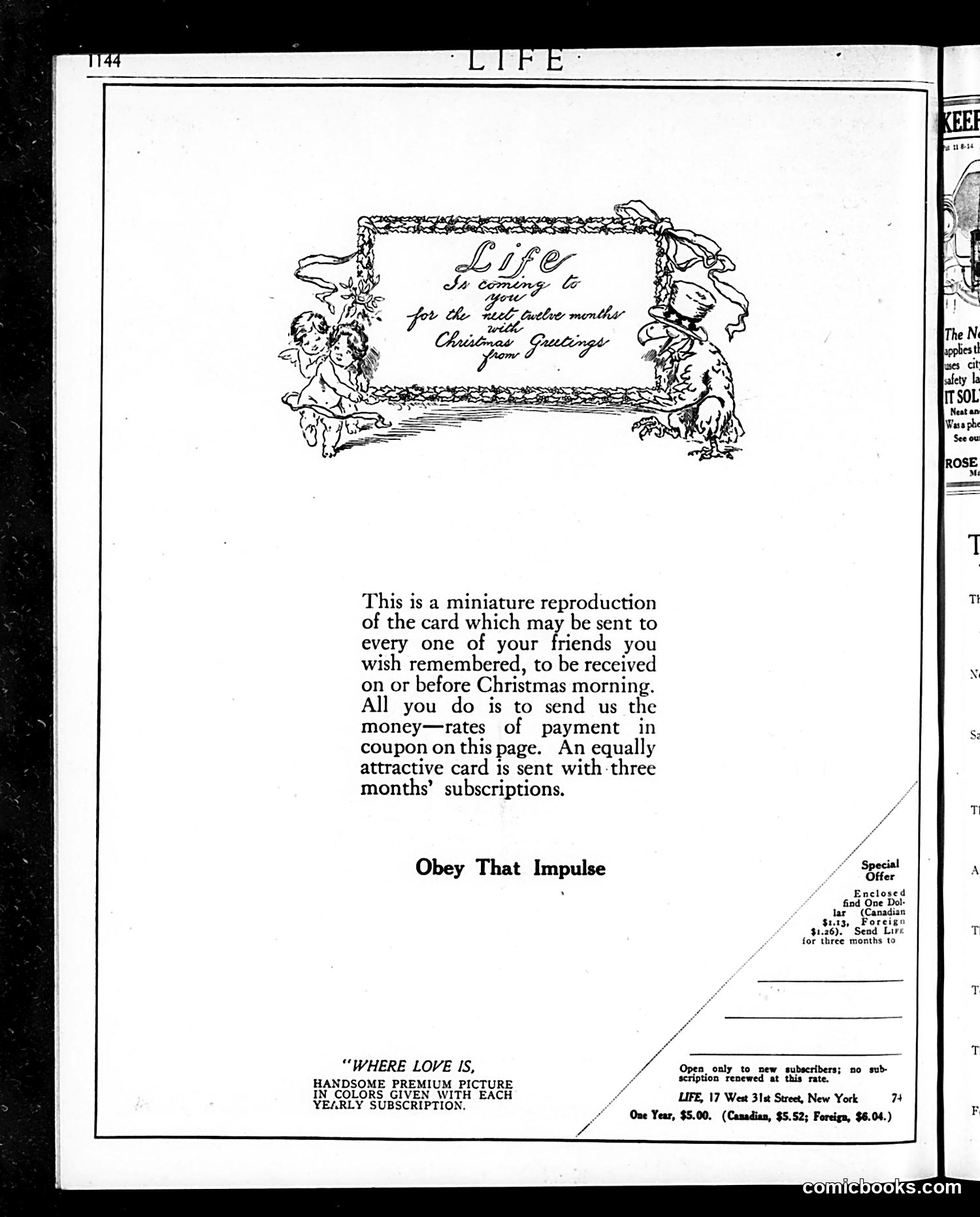
This page is primarily **advertising**, not satire or political commentary. It promotes a Life magazine Christmas gift subscription service. The decorative header shows cherubs holding a wreath-framed text offering Life magazine subscriptions as Christmas gifts. The ad explains that subscribers can send miniature reproductions of an attractive holiday card to friends, arriving by Christmas morning. The section titled "Obey That Impulse" encourages impulse purchases of subscriptions at listed rates (One Year: $5.00 in the US; $5.52 Canadian; $6.00 foreign). At bottom, text notes that yearly subscriptions include "handsome premium pictures in colors." This is a straightforward holiday marketing campaign, not political or satirical content. The page number indicates this is from Life magazine itself (page 1144).
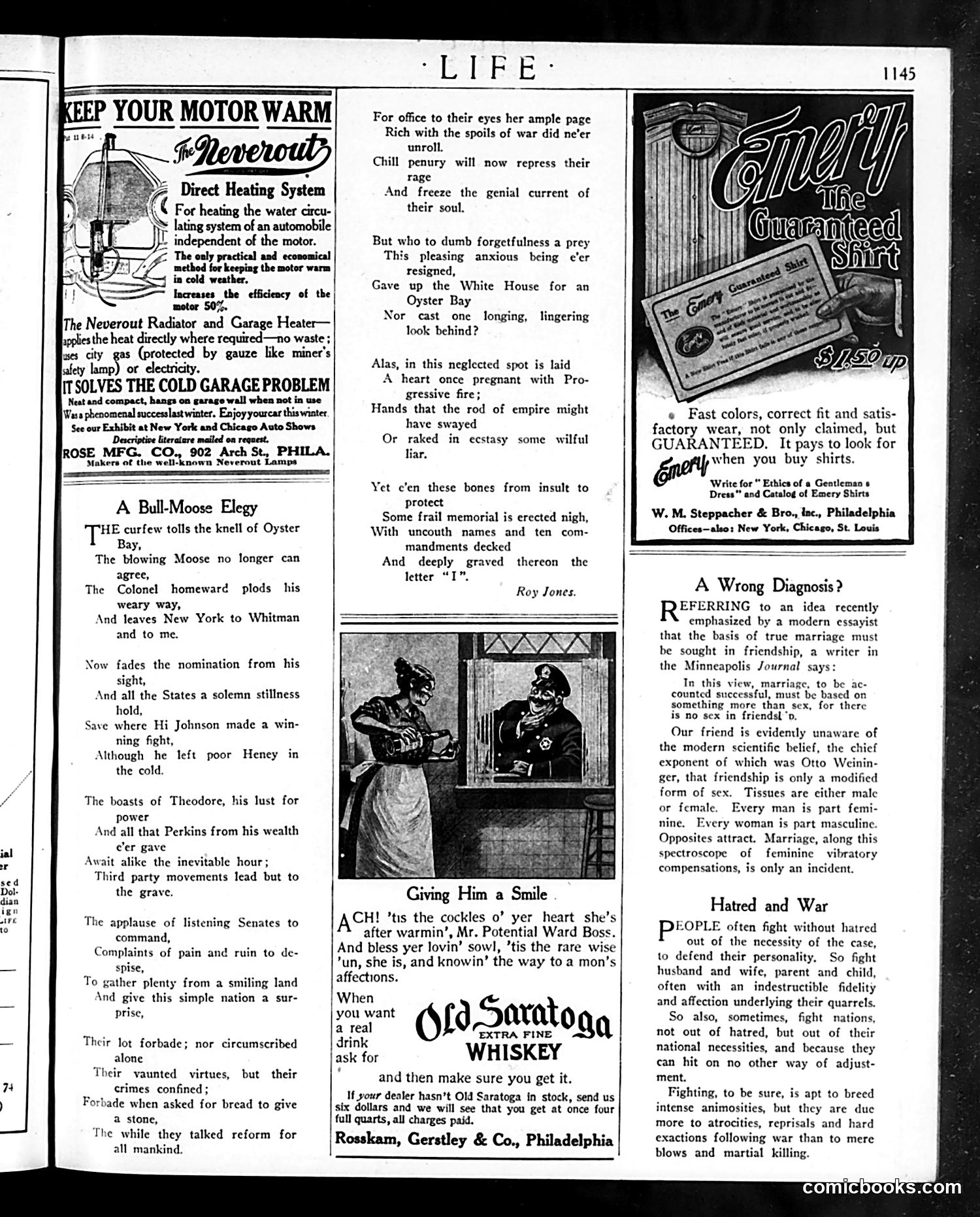
The poem satirizes Theodore Roosevelt's failed 1912 presidential comeback. The "Bull-Moose" refers to Roosevelt's Progressive Party, which split the Republican vote. References to "the Colonel homeward plods," "nomination from his sight," and "Hi Johnson made a winning fight" allude to Roosevelt's defeat and Woodrow Wilson's victory. The cartoon below depicts a woman attempting to console a military officer, captioned "Giving Him a Smile." The accompanying Old Saratoga whiskey ad repurposes this domestic scene for advertising, with text about cheering up "Mr. Potential Ward Boss." The page mixes political commentary on Roosevelt's failed ambitions with unrelated consumer advertisements, typical of *Life* magazine's satirical-commercial format.
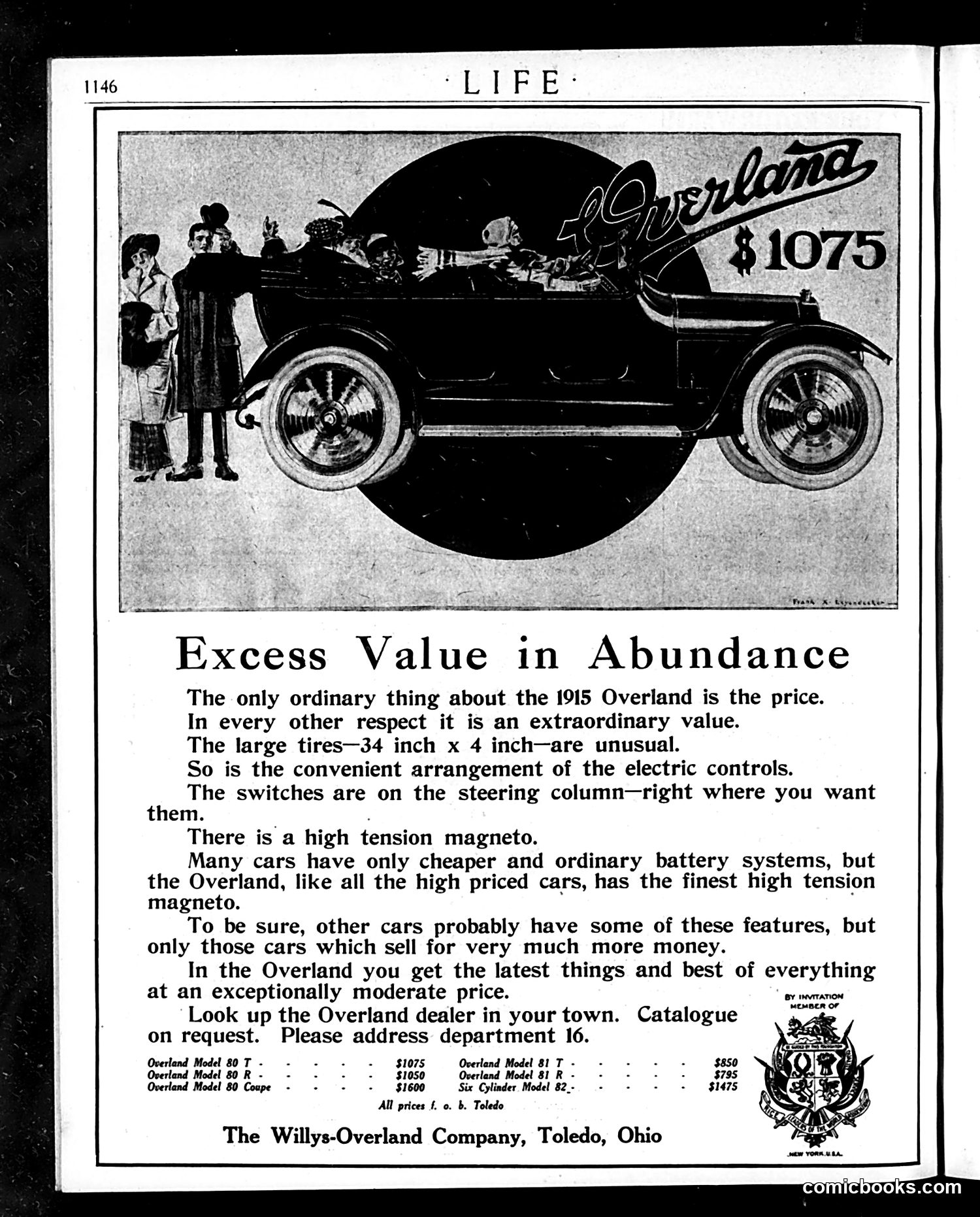
This page is **primarily an automobile advertisement**, not political satire. It promotes the 1915 Overland car at $1,075, using the headline "Excess Value in Abundance." The illustration shows a well-dressed couple and chauffeur with the vehicle, a common advertising visual of the era suggesting luxury and status. The accompanying text emphasizes the car's affordable price relative to its features—large tires, electric controls conveniently positioned on the steering column, and a high-tension magneto (typically found in more expensive cars). The "satire" is gentle marketing humor: the ad claims the Overland offers premium features at moderate cost, positioning it as exceptional value for middle-class buyers. The Willys-Overland Company, based in Toledo, Ohio, was emphasizing democratic access to automobile luxury during this early automotive era.
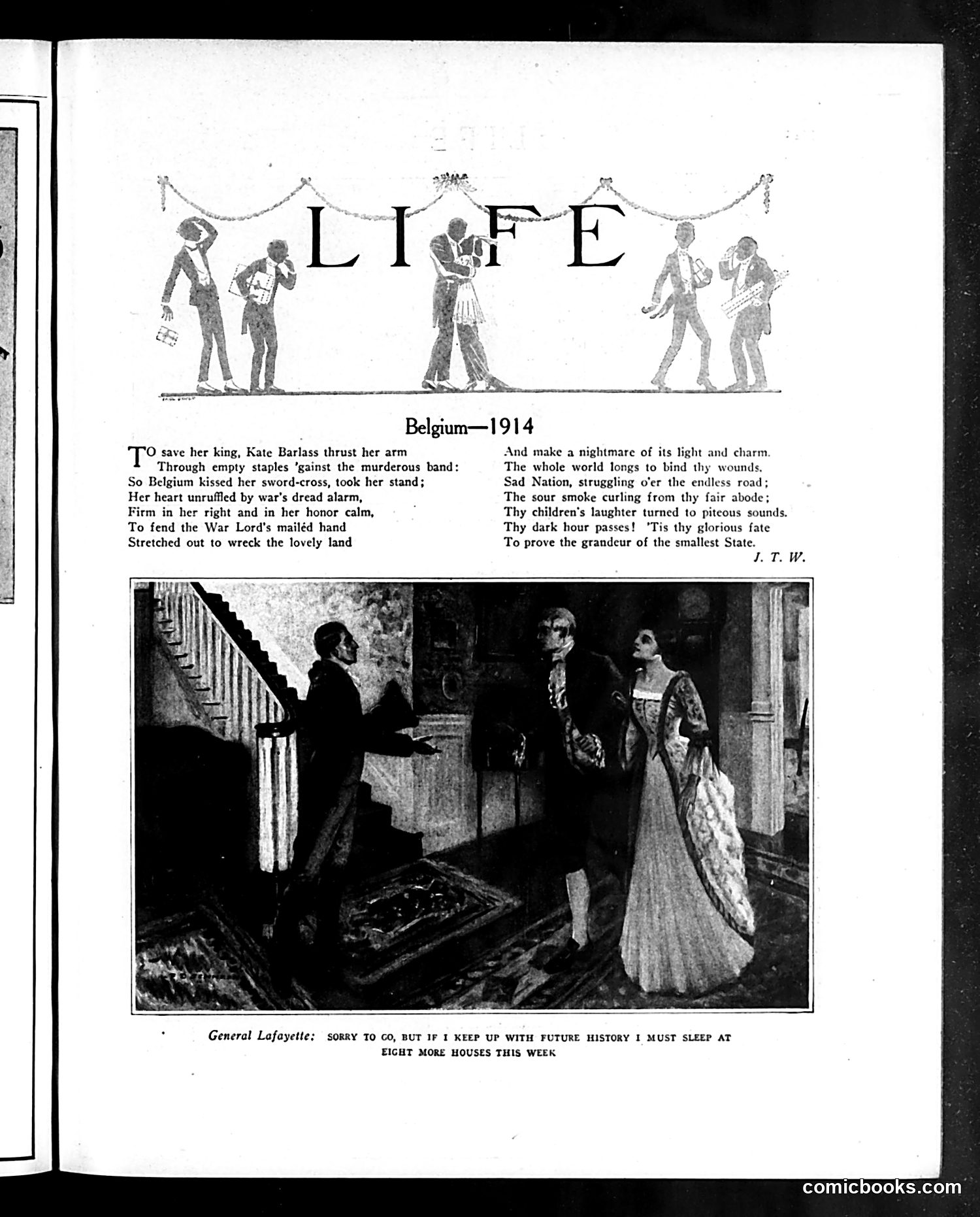
This page satirizes Belgium's situation during World War I's opening months. The illustrated header shows figures holding up letters spelling "LIFE," depicting Belgium's struggle. The poem narrates how Belgian Queen Kate Barlass (a historical reference to a Scottish queen) defended her nation against German invasion, "thrust her arm through empty staples 'gainst the murderous band." Belgium "kissed her sword-cross, took her stand" with honor despite military disadvantage. The photograph below shows what appears to be a dramatic domestic scene, captioned with General Lafayette apologizing that he cannot keep up with "future history"—a joke about how rapidly the war is unfolding and how many nations Belgium must host. The satire celebrates Belgium's courageous resistance against overwhelming German military power in 1914.
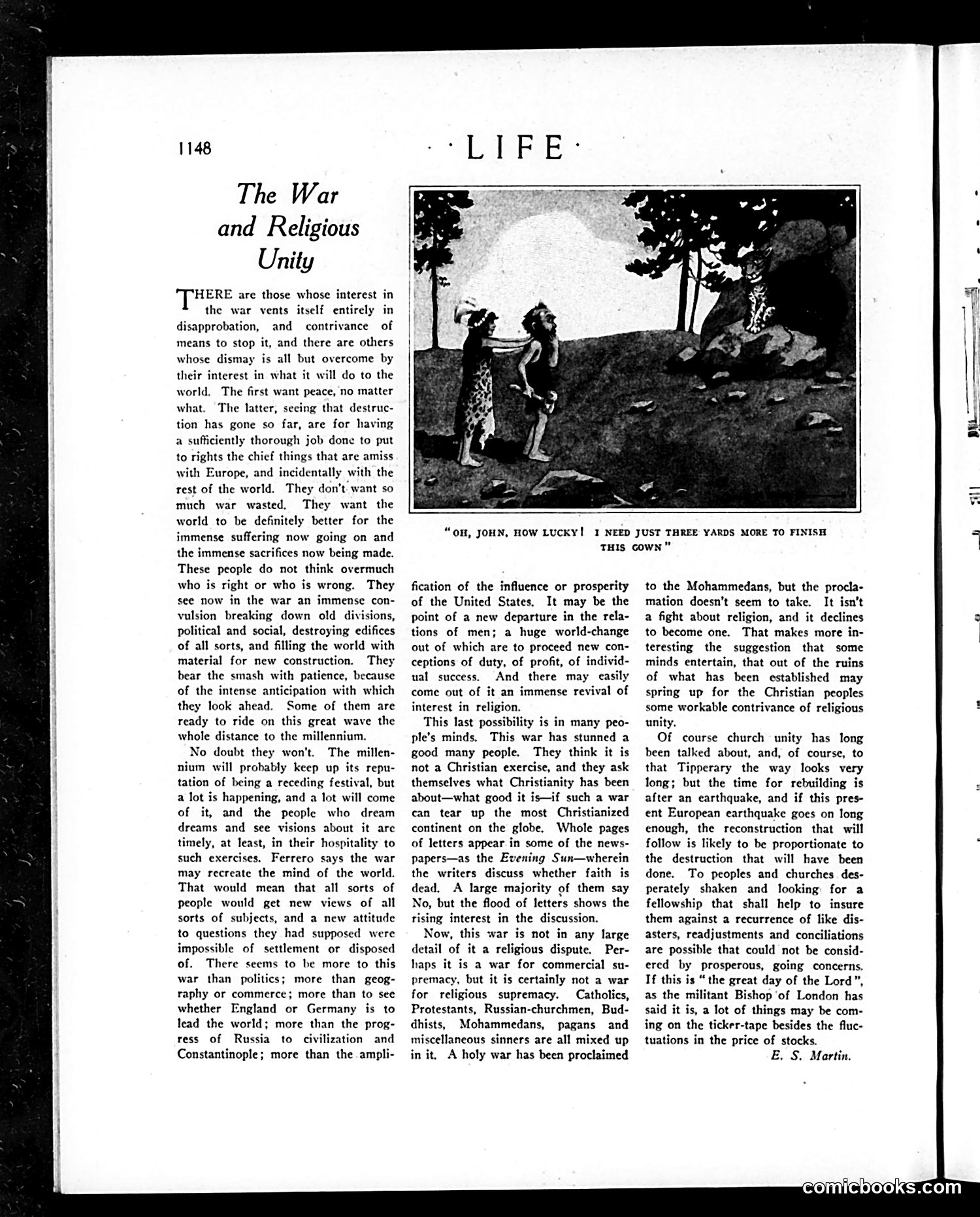
The illustration depicts two figures in a pastoral setting, with a caption reading "Oh, John, how lucky! I need just three yards more to finish this gown." This cartoon satirizes the disconnect between civilians' mundane concerns and the catastrophic war occurring around them. While soldiers fight and die, a woman focuses entirely on completing a dress—needing just three more yards of fabric. The satire suggests how ordinary life continues obliviously during wartime, or how civilian priorities seem trivial against massive human suffering. The accompanying article discusses how WWI has prompted religious reflection across different faiths—Catholics, Protestants, Buddhists, Mohammedans—all questioning war's compatibility with their beliefs. The cartoon implicitly critiques this civilian detachment, suggesting people remain absorbed in petty domestic matters rather than grappling with the war's moral implications.
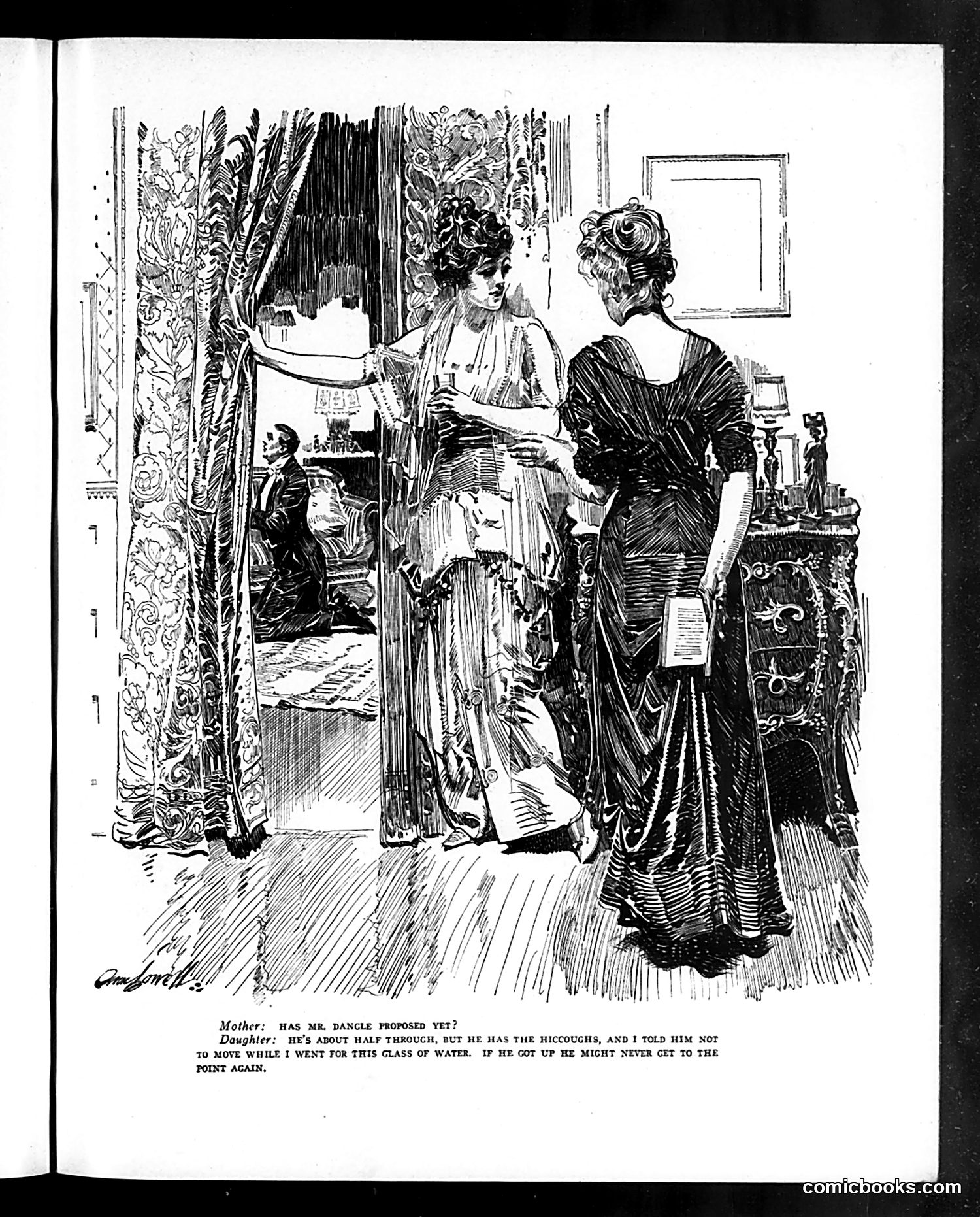
This illustration depicts a domestic comedy scene from early 20th-century Life magazine. A mother questions her daughter about a gentleman caller named Mr. Dangle. The daughter's response reveals that Dangle is "about half through" a social visit but has "the hiccoughs" (hiccups), which she claims will prevent him from ever "getting to the point again." The humor turns on the social awkwardness of Victorian-era courtship rituals. A proposal of marriage was a formal, serious matter requiring proper composure. The daughter's suggestion that hiccups have permanently derailed Mr. Dangle's marriage proposal satirizes both the rigidity of courtship conventions and the absurdity of letting a physical affliction disrupt such an important social moment. The joke depends on understanding that proposals required careful, dignified presentation.
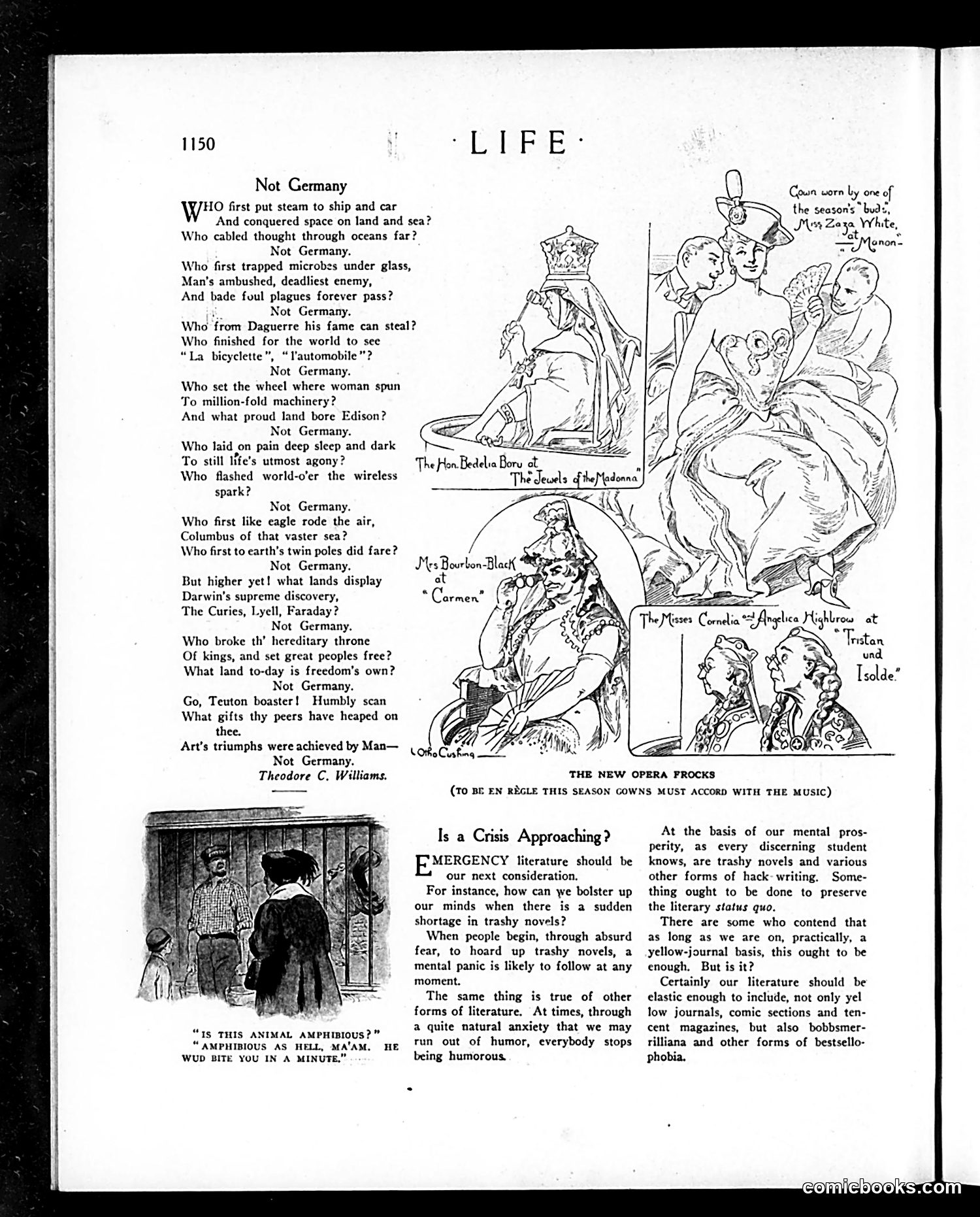
**Main Content:** The page features a poem titled "Not Germany" by Theodore C. Williams, attributing various human achievements (steam power, microscopes, wireless technology, aviation) to sources other than Germany—a pointed rejection of German claims to civilizational superiority, likely written during or after WWI. **Illustrations:** The right side shows "The New Opera Frocks," depicting fashionable women in elaborate costumes for operatic roles, identifying figures from productions like "Cormèn" and "Tristan and Isolde." **Lower Cartoon:** A small comic sketch shows two figures at a window with the caption: "Is this 'ambidextrous'? Ambidious as hell, m'am. He wud bite you in a minute."—a pun on manual dexterity versus aggressive behavior. **Context:** This appears to be WWI-era satire asserting that Germany deserves no credit for modern civilization's advances.
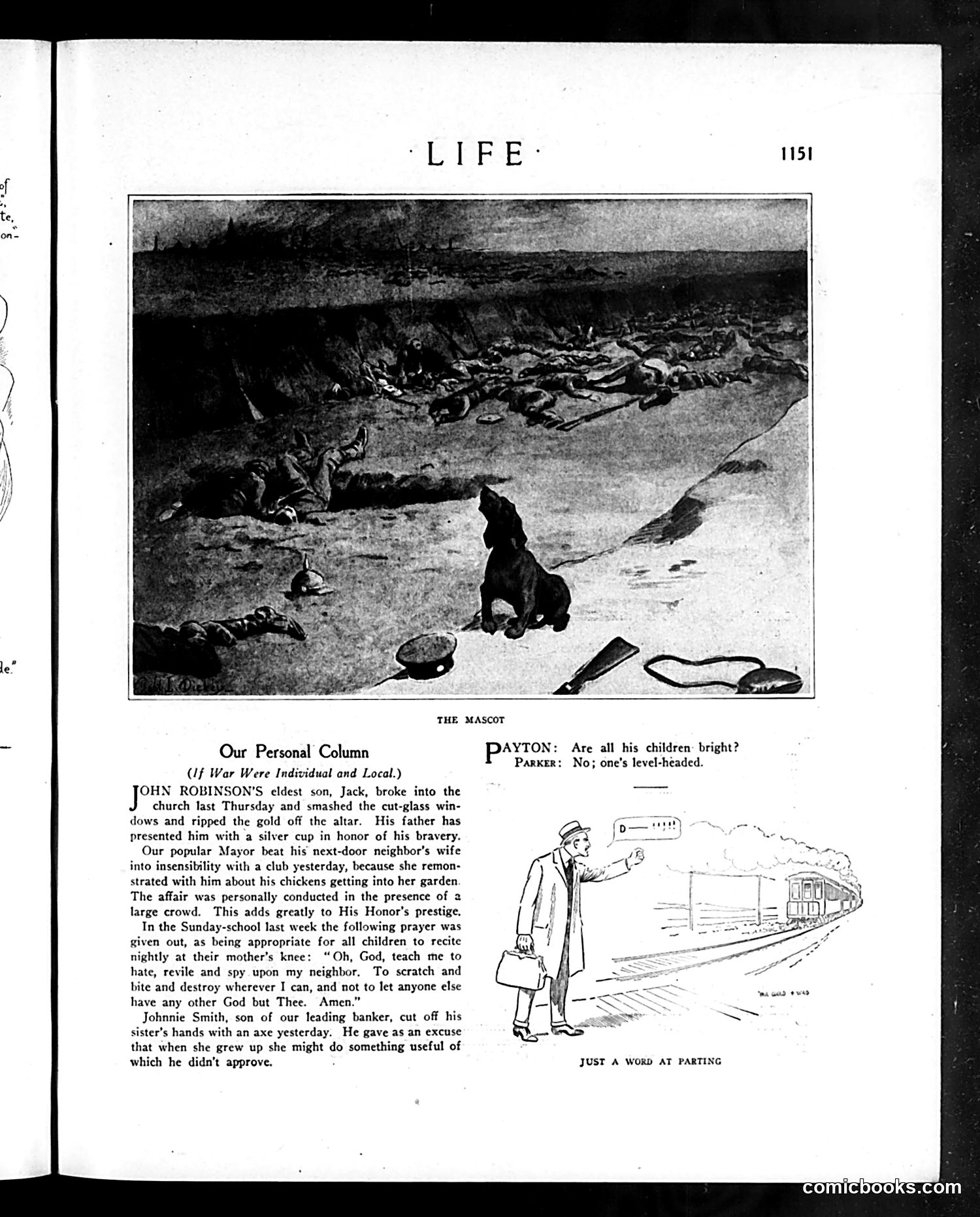
This page contains two distinct satirical pieces from Life magazine: **"The Mascot"** (top photograph): Shows a dog sitting among scattered military equipment and what appear to be fallen soldiers. The caption and context suggest this illustrates the mascot concept—animals accompanying military units—though the specific reference is unclear without additional context. **"Our Personal Column"** (middle text): A gossip column mocking local misbehavior, including vandalism by a banker's son and inappropriate conduct by the mayor. It satirizes both wealthy individuals' children escaping consequences and hypocrisy among community leaders. **"Just a Word at Parting"** (bottom cartoon): A man in a coat addresses a departing train, with text about wishing someone "do something useful" they didn't previously approve of—likely satirizing parental hypocrisy or social contradiction regarding proper behavior and ambition.
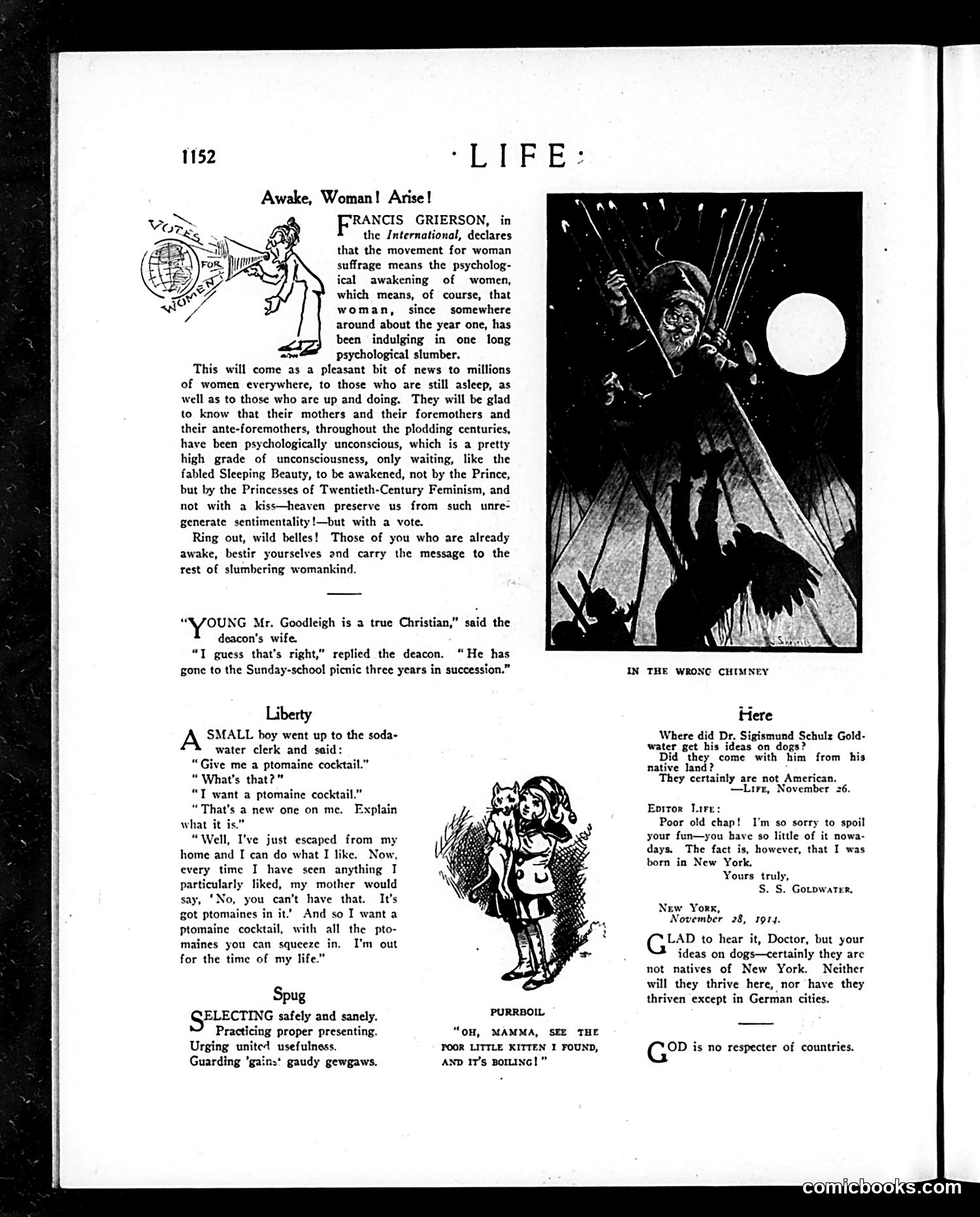
**Main Article: "Awake, Woman! Arise!"** Francis Griberson argues in the *International* that women's suffrage represents psychological awakening after centuries of unconsciousness. The author mocks this comparison, suggesting women have been in a "long psychological slumber" like Sleeping Beauty—but will be awakened by "the Princesses of Twentieth-Century Feminism" rather than romantic rescue. The satire targets both suffragists' grand rhetoric and dismissive attitudes toward women's political consciousness. **Secondary Humor Items:** "Liberty" depicts a boy ordering a "ptomaine cocktail" (food poisoning joke). "Spug" offers brief satirical advice on proper etiquette. The "Purrholi" cartoon shows a mother cat with a kitten. The page reflects early 20th-century American attitudes toward women's suffrage—simultaneously mocking both feminist activists and those resistant to women's political participation.
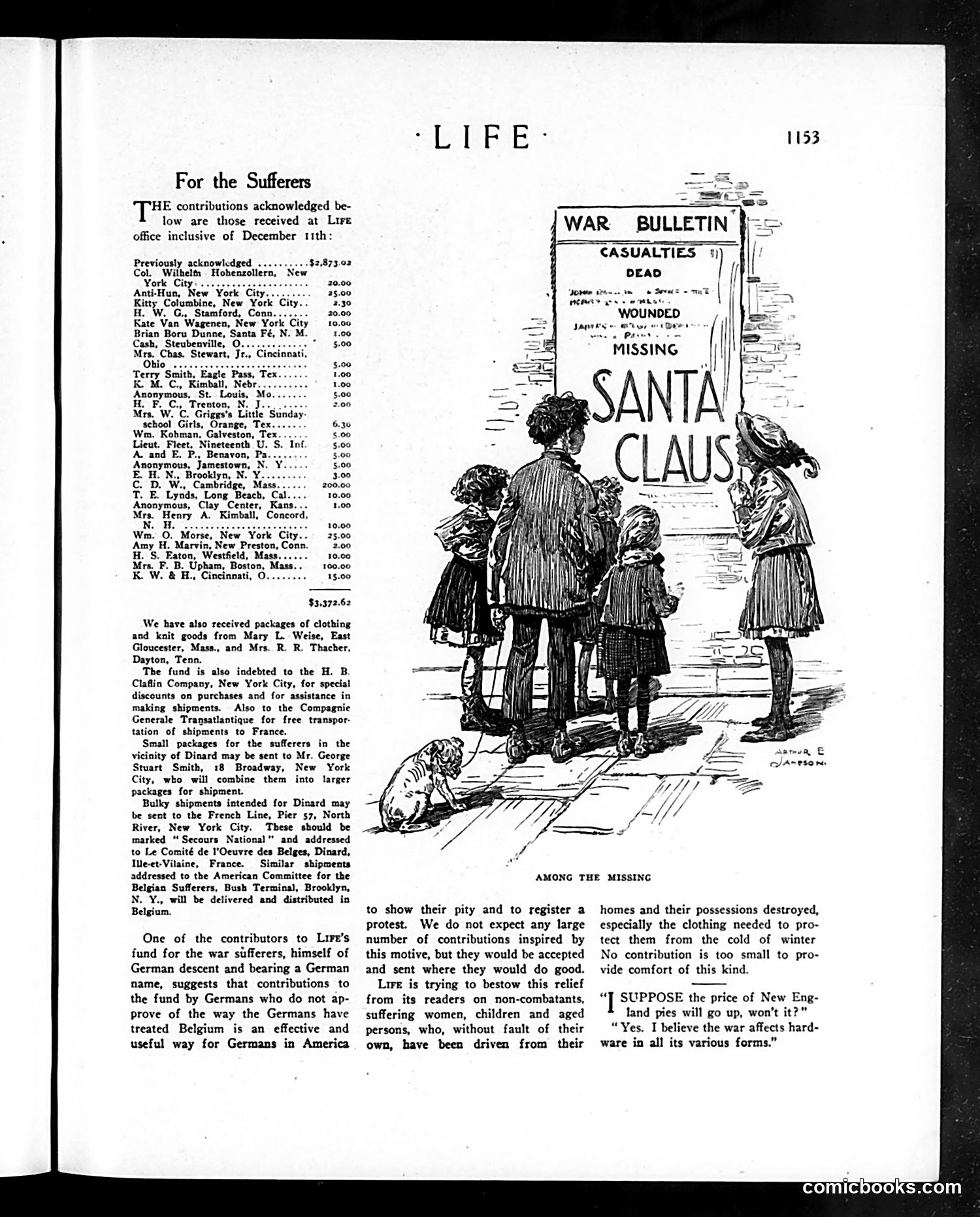
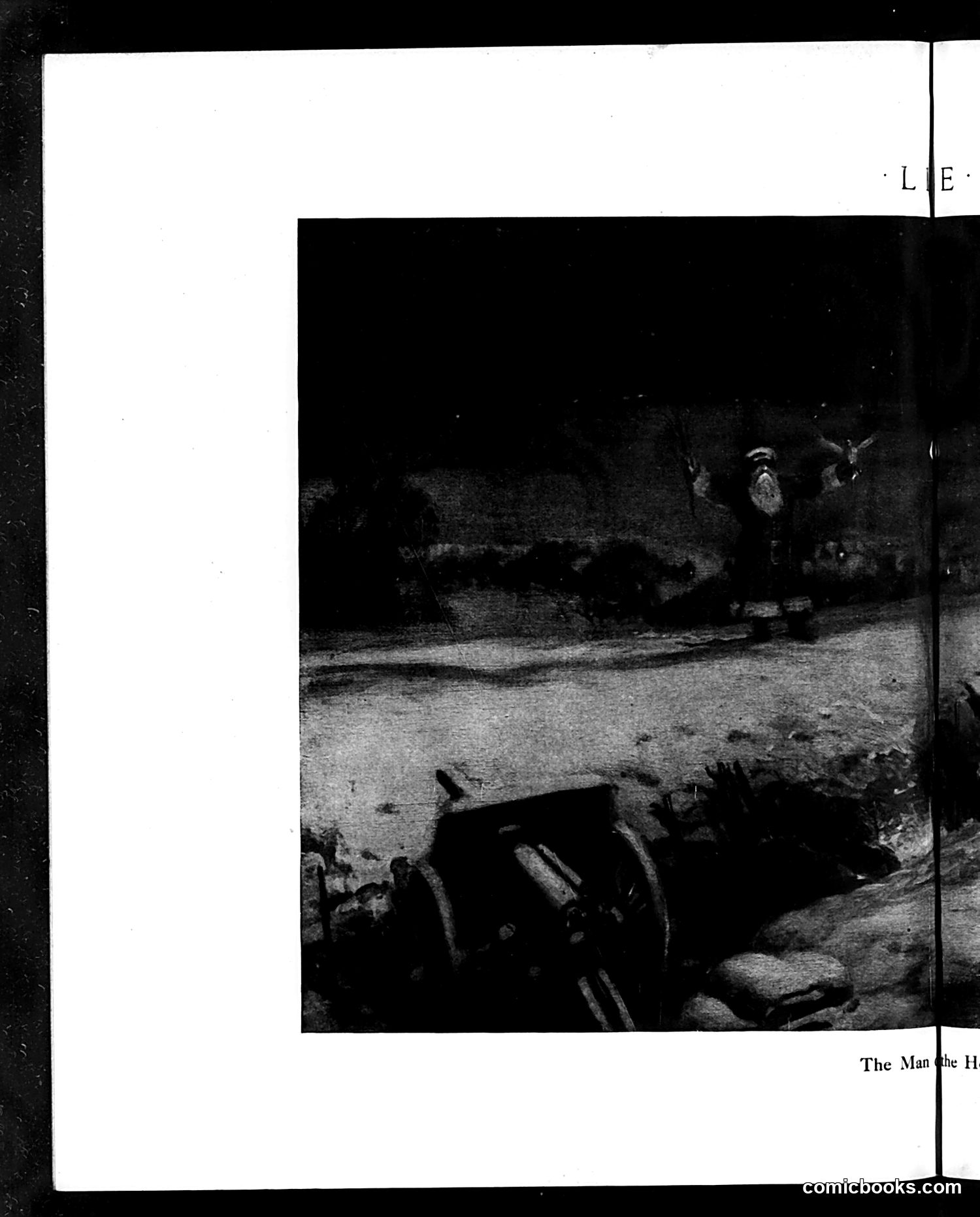
This illustration depicts Santa Claus as missing, with a War Bulletin listing casualties (dead, wounded, missing). An adult figure stands with several children, gazing at the empty space where Santa should be—suggesting his absence during wartime. The satire comments on how World War I disrupted civilian life and childhood experiences. Santa Claus, a symbol of peace, joy, and normalcy, appears conscripted or lost to war's demands. The children's disappointed postures emphasize how the conflict deprived the young of traditional comforts and holiday traditions. Contextually, this reflects American anxieties about wartime scarcity, resource allocation to military efforts, and the pervasive reach of war into domestic spaces—even threatening cultural institutions meant to comfort children during hardship.
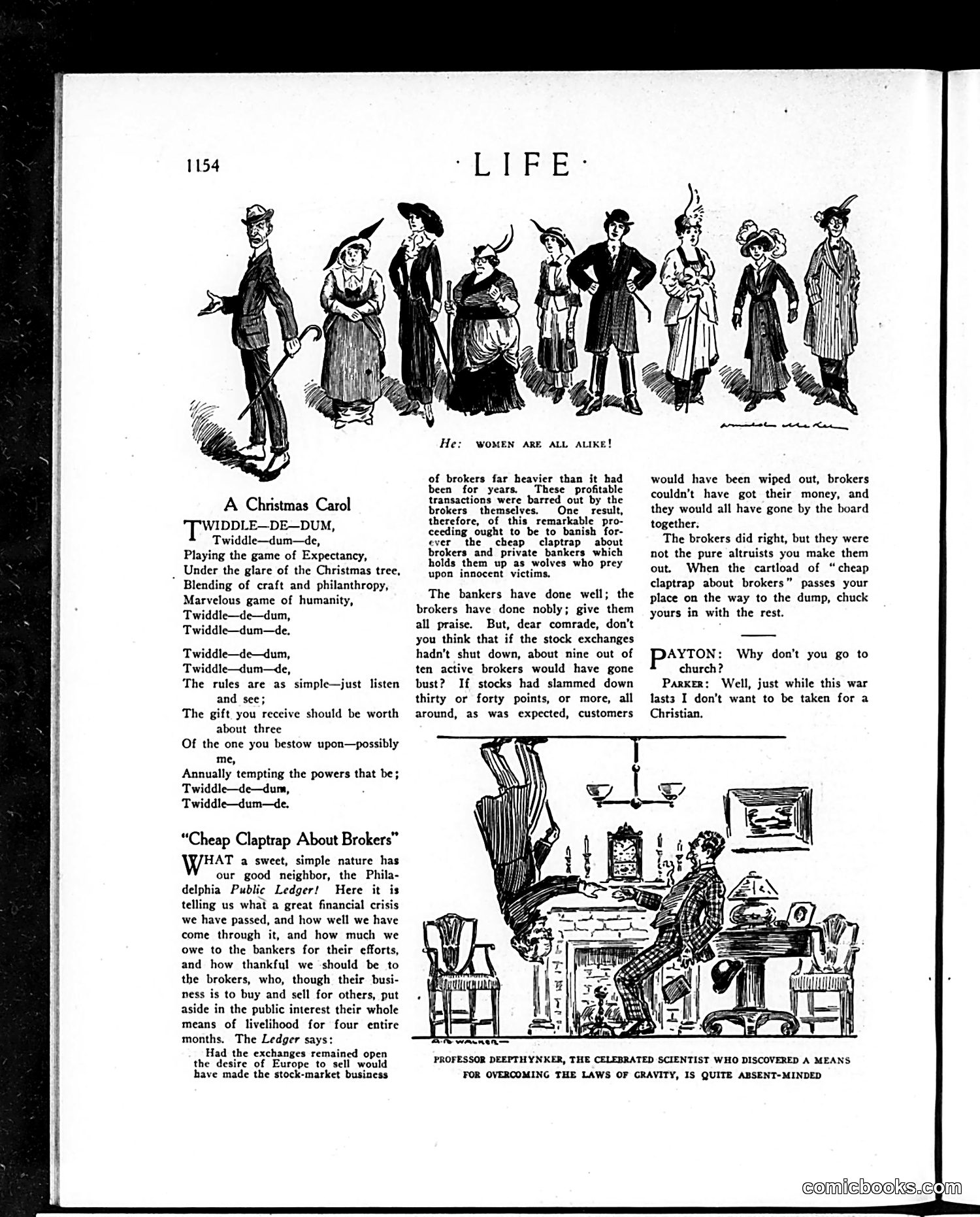
This page contains **"A Christmas Carol"** — a satirical poem mocking financial brokers during what appears to be a stock market crisis. The illustrated header shows nine figures in period dress representing different social types, with the caption "HE: WOMEN ARE ALL ALIKE!" The main article **"Cheap Claptrap About Brokers"** criticizes Philadelphia's *Ledger* newspaper for praising bankers and brokers as heroes who "saved" the financial system. Life's satire argues instead that brokers engaged in risky speculation that nearly destroyed the market, and they deserve little credit for merely preventing total collapse. The bottom cartoon shows Professor Depthynker, a distracted scientist, apparently oblivious to gravity — a visual pun on the financial world's disconnection from reality during the crisis.
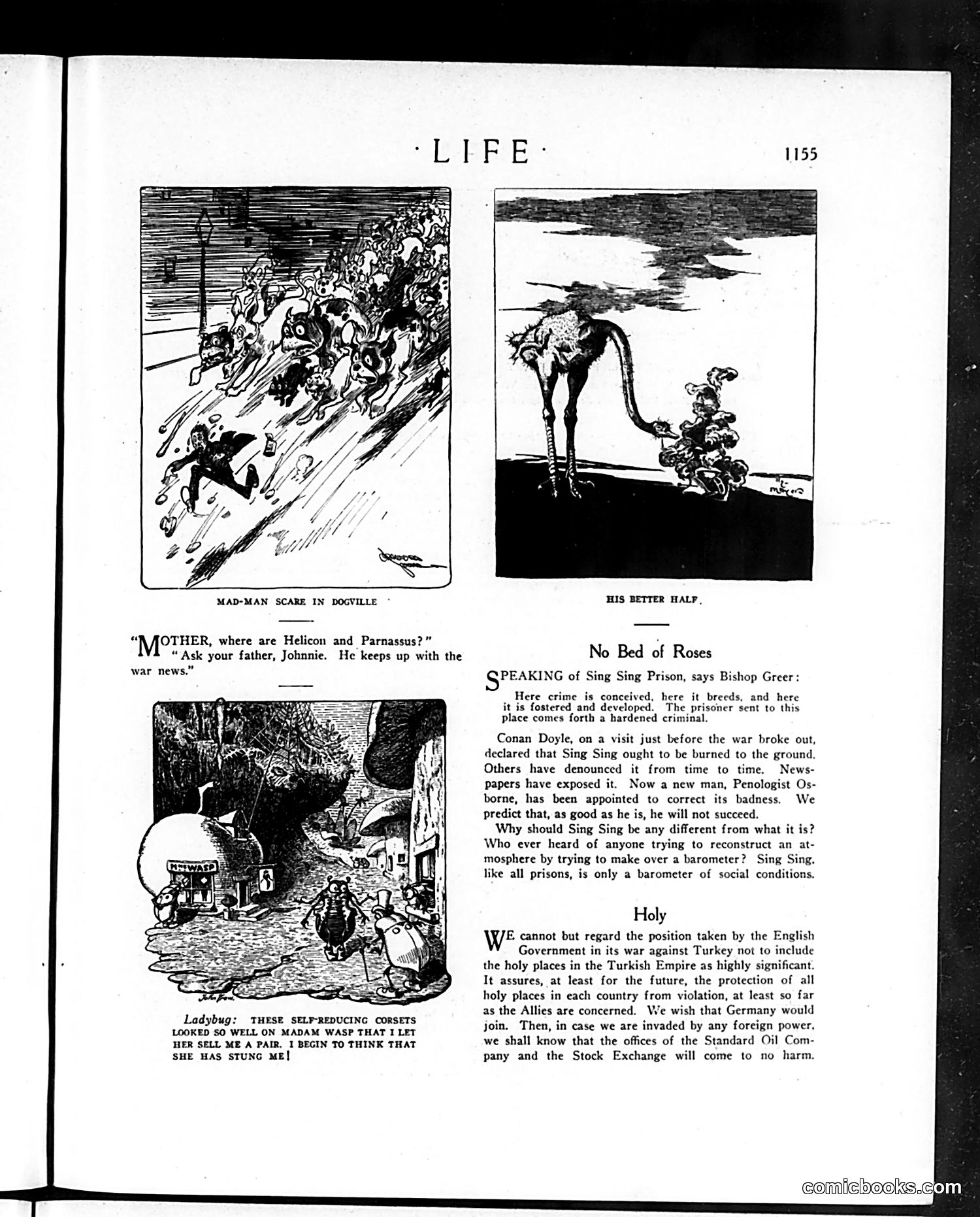
This page contains three separate cartoons and commentary pieces: **Top cartoons:** "Mad-Man Scare in Dogville" and "His Better Half" appear to be humorous domestic/animal scenes with no clear political content visible. **"No Bed of Roses":** This article discusses Sing Sing Prison, citing Bishop Greer's criticism that the prison system creates hardened criminals rather than reforming them. It references Conan Doyle's pre-war condemnation and mentions newly-appointed penologist Osborne's reform efforts, pessimistically suggesting systemic reform is impossible—prisons merely reflect broader social conditions. **"Holy":** This commentary criticizes the British government's war strategy against Turkey during WWI, sarcastically praising their protection of holy places while mocking their apparent concern for protecting American corporate interests (Standard Oil, Stock Exchange) from invasion. The satire suggests Britain's stated moral principles mask economic priorities. **Bottom cartoon:** Features a corset joke about a woman's deceptive salesmanship.
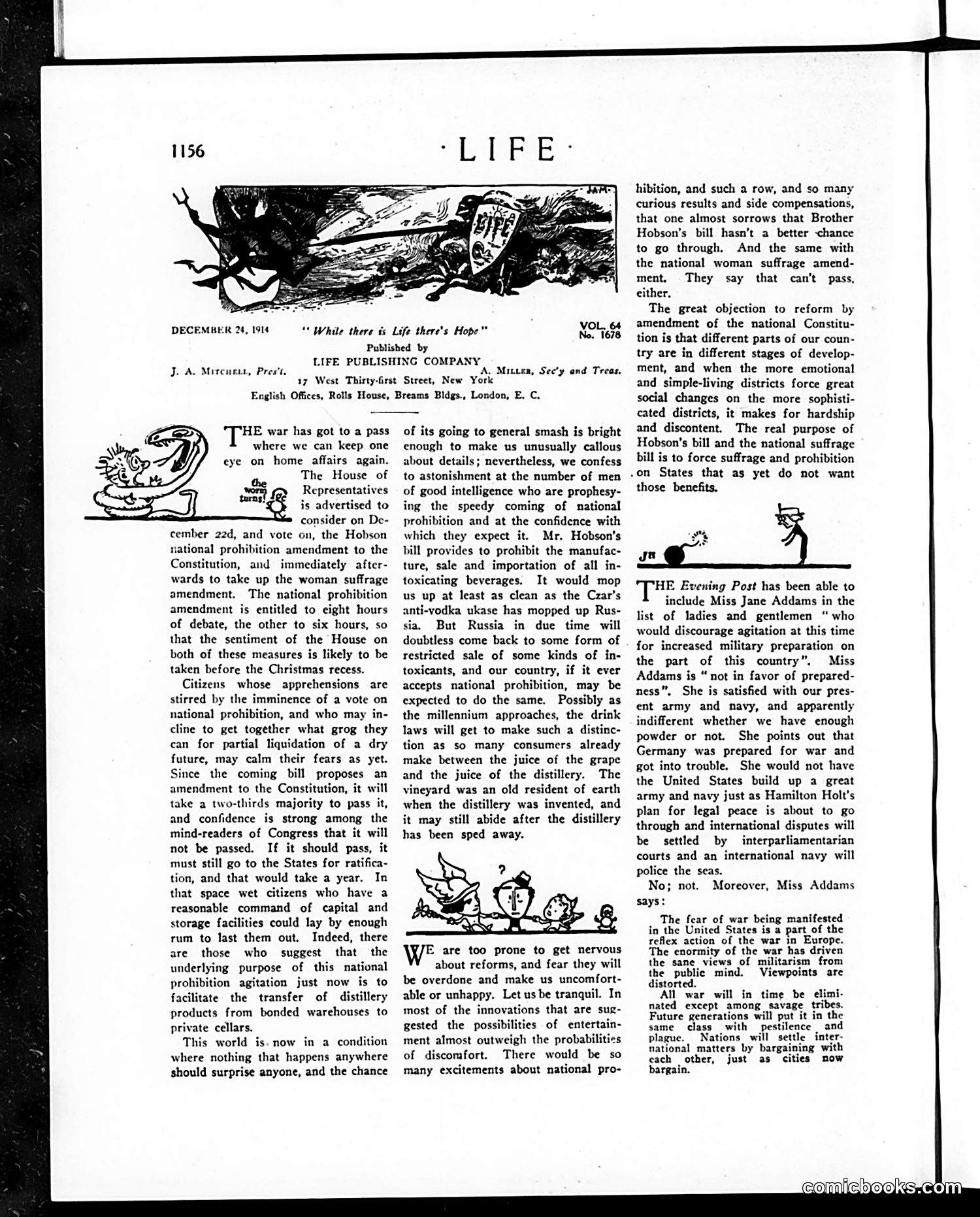
This page discusses two pending Constitutional amendments: national prohibition (the Hobson bill) and women's suffrage. The author adopts a cynical, detached tone befitting wartime (WWI is ongoing), arguing that both measures likely won't pass but wouldn't be catastrophic if they did. The satire targets: 1. **Prohibition advocates**: The piece mocks their confidence while noting the amendment requires two-thirds Congressional approval plus state ratification—a lengthy process. It suggests "wet" citizens opposed to prohibition could stockpile alcohol during the ratification year. 2. **Reform anxiety**: The author ridicules Americans who fear reforms will be "overdone," suggesting the entertainment value of watching national prohibition and suffrage debates would almost compensate for their implementation. 3. **Constitutional inflexibility**: The real critique focuses on using Constitutional amendments for piecemeal reforms, since different U.S. regions develop at different rates, making uniform national mandates problematic. The cartoons (small illustrations) appear decorative rather than carrying specific commentary.
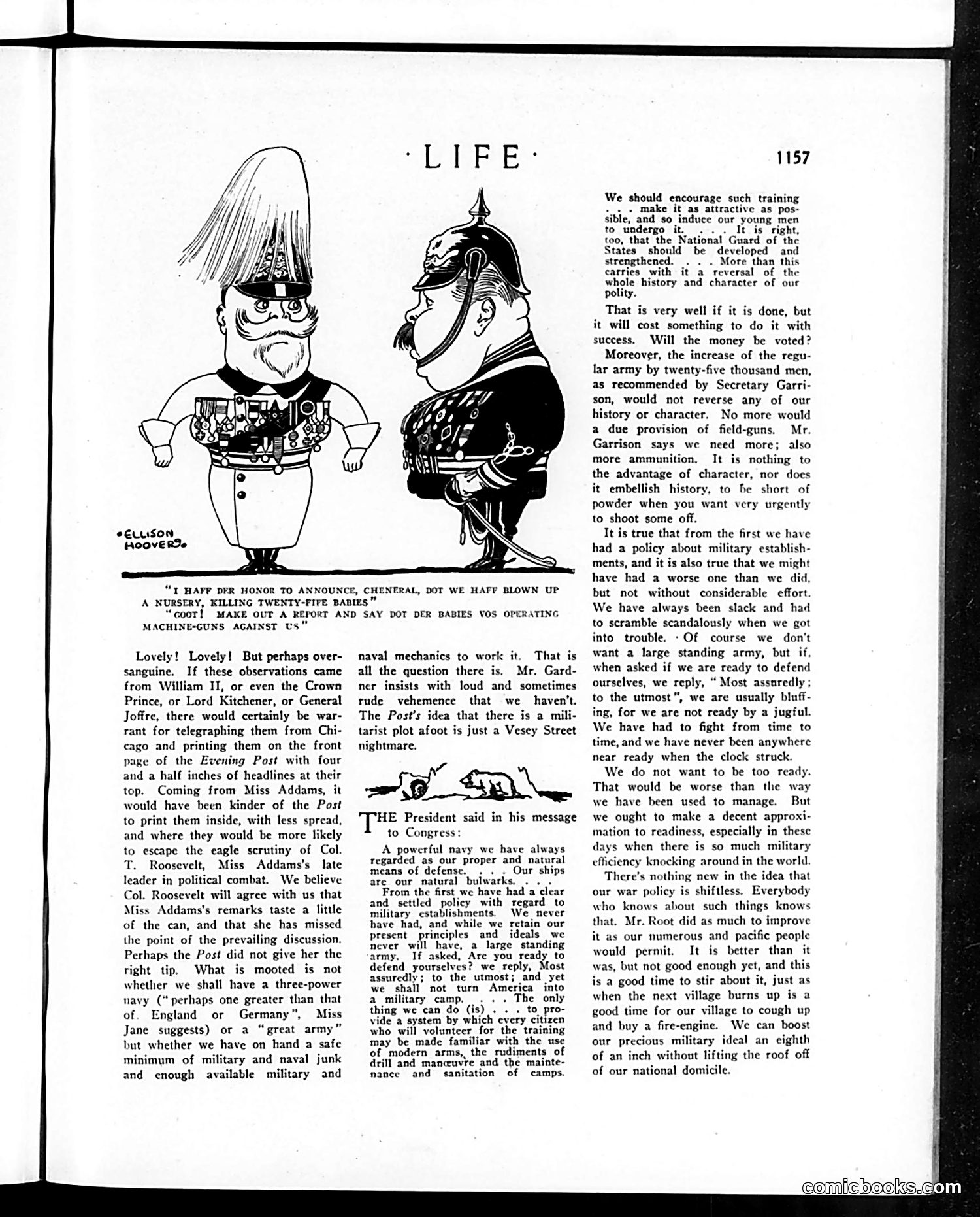
**The Cartoon:** Cartoonist Ellison depicts two military figures in caricatured German uniforms—one with an exaggerated spiked helmet and facial hair, the other similarly styled—discussing the killing of civilians ("twenty-five babies") and destruction of a factory. The German accent ("haff," "cheneral," "dot") underscores the satire. **The Context:** This appears to reference Jane Addams, the pacifist social reformer, who apparently made controversial statements about German military conduct. The surrounding editorial mocks her position, suggesting she was naive or her comments were misused by the *Chicago Evening Post*. The cartoon satirizes German militarism and brutality while simultaneously critiquing American pacifists who might sympathize with or excuse such conduct. **The Point:** The satire juxtaposes German military boasting about civilian casualties against Addams's pacifist rhetoric, implying her anti-militarism is dangerously disconnected from real-world military aggression. The cartoon suggests pacifism, however well-intentioned, ignores genuine threats—a common pre-WWI American debate about military preparedness.
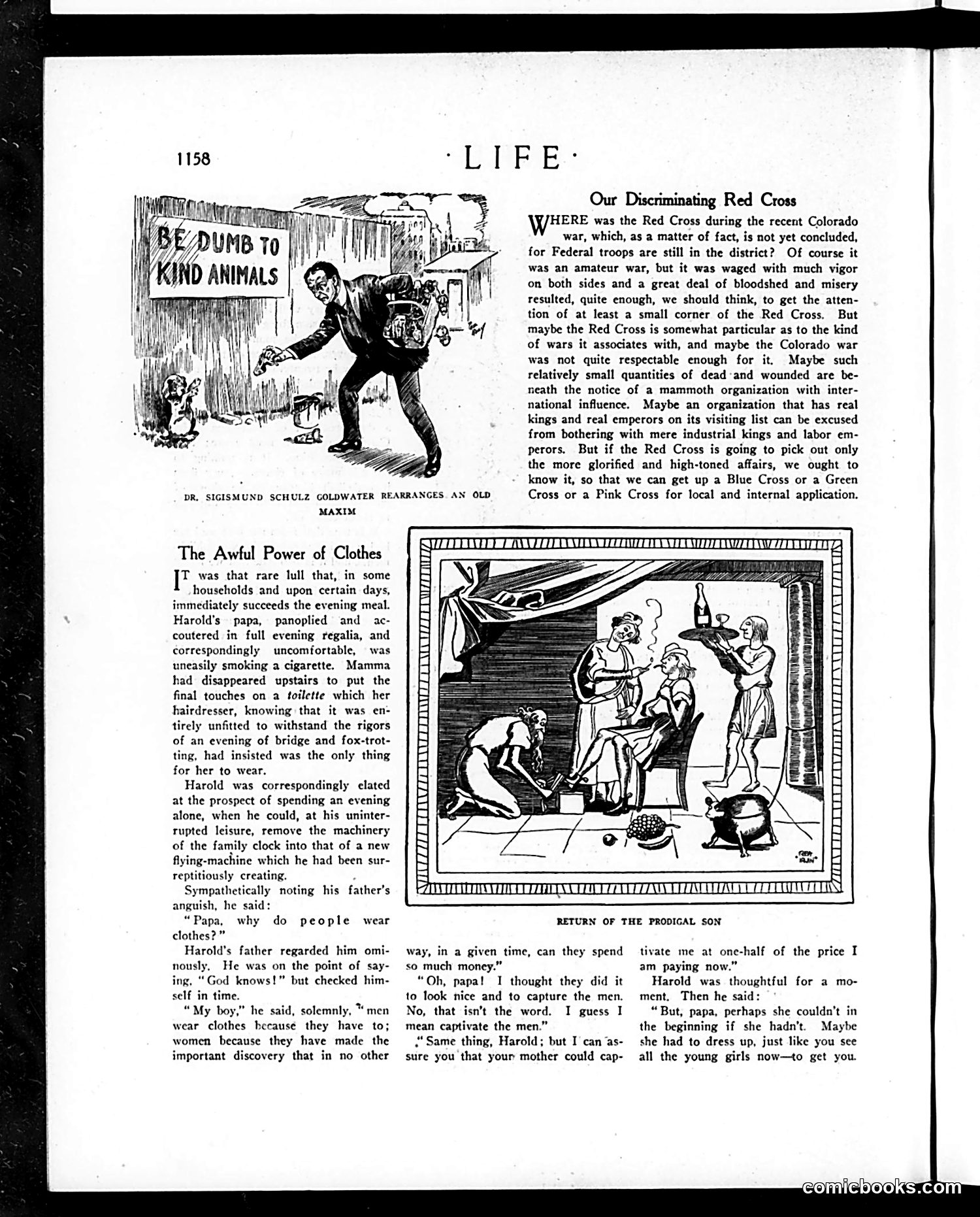
This *Life* magazine page contains three distinct satirical pieces: **"Our Discriminating Red Cross"** (top right) critiques the Red Cross for ignoring casualties in the recent Colorado labor conflict (likely the 1913-1914 Ludlow Massacre), suggesting the organization only responds to wars involving international dignitaries rather than "industrial kings and labor emperors." The satire proposes alternative organizations—a "Blue Cross" or "Pink Cross"—for domestic conflicts the Red Cross deems insufficiently prestigious. **"The Awful Power of Clothes"** (bottom) is a humorous domestic sketch where Harold asks his father why people wear clothes. His father cynically explains women wear clothes to spend money on fashion rather than to attract men. Harold cleverly counters that his mother *needed* fancy dress initially to "captivate" his father—implying women strategically use appearance to secure husbands, after which the expensive wardrobe becomes unnecessary. **Top cartoon** (by Dr. Sigismund Schulz Goldwater) shows a man kicking a dog beneath a "Be Dumb to Kind Animals" sign—ironic visual commentary on hypocrisy.
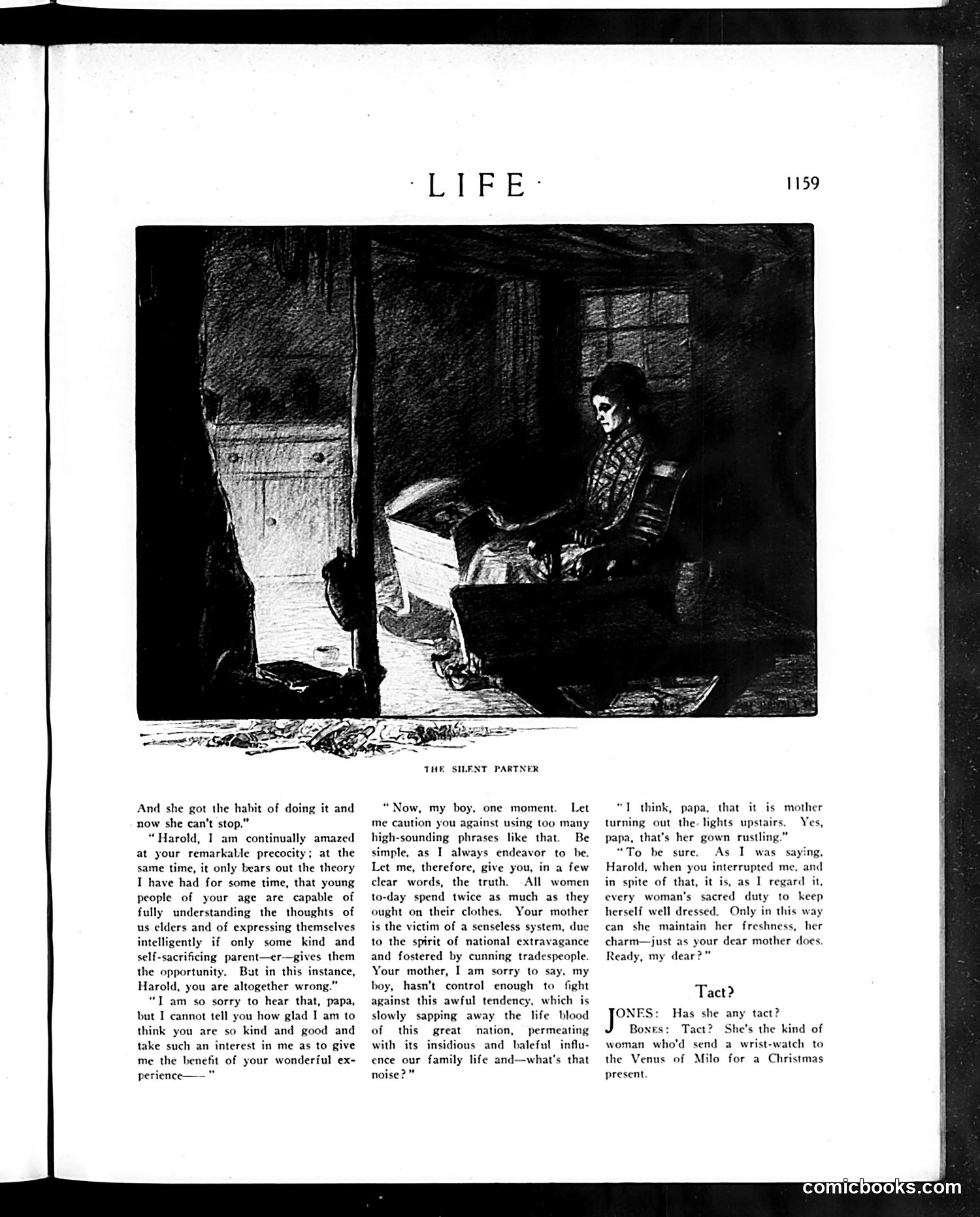
This comic sketch satirizes male hypocrisy and domestic power dynamics. A father lectures his son Harold about women's excessive spending on clothes, condemning it as a "senseless system" that weakens the nation. He moralizes about his wife's lack of self-control while spending money frivolously. The joke's punch line arrives when the father hears his wife rustling upstairs—he immediately reverses position, praising women's duty to "keep herself well dressed" for freshness and charm, specifically citing his own wife as an example. His principles evaporate the moment his wife might overhear criticism. The title "Silent Partner" suggests the wife's quiet power: though absent from the scene, she controls the father's behavior through mere proximity. The accompanying "Tact?" joke reinforces the theme—women use social intelligence strategically. The satire targets male self-righteousness and the gap between public moralizing and private behavior in early 20th-century domestic life.
This appears to be a page from Life magazine featuring a black and white photograph or illustration. The image shows what looks like a horse or donkey in the foreground on sandy/dusty ground, with several human figures visible in the background near what may be a building or structure. The caption reads "The Man @he H." (likely "The Man at the H[ouse]" or similar, partially cut off). However, without the complete caption text or additional context visible on the page, I cannot definitively identify the specific political or social reference, the figures depicted, or the intended satirical point. The image quality and cropping limit interpretation of the exact subject matter and meaning.
This page appears to be from Life magazine and shows a black and white photograph labeled "Man of the Hour." The image depicts what seems to be a figure lying or reclining on the ground in an outdoor setting, with dark trees or forest in the background and some structural elements visible. However, the OCR text is minimal and unclear, providing only the caption "Man of the Hour" without context identifying who this person is or what specific event or political situation is being referenced. Without additional visible text, caption information, or clear identifying features in the photograph, I cannot definitively explain what satire or political commentary this represents or which public figure it depicts. The page's purpose and satirical intent remain unclear from the available information.
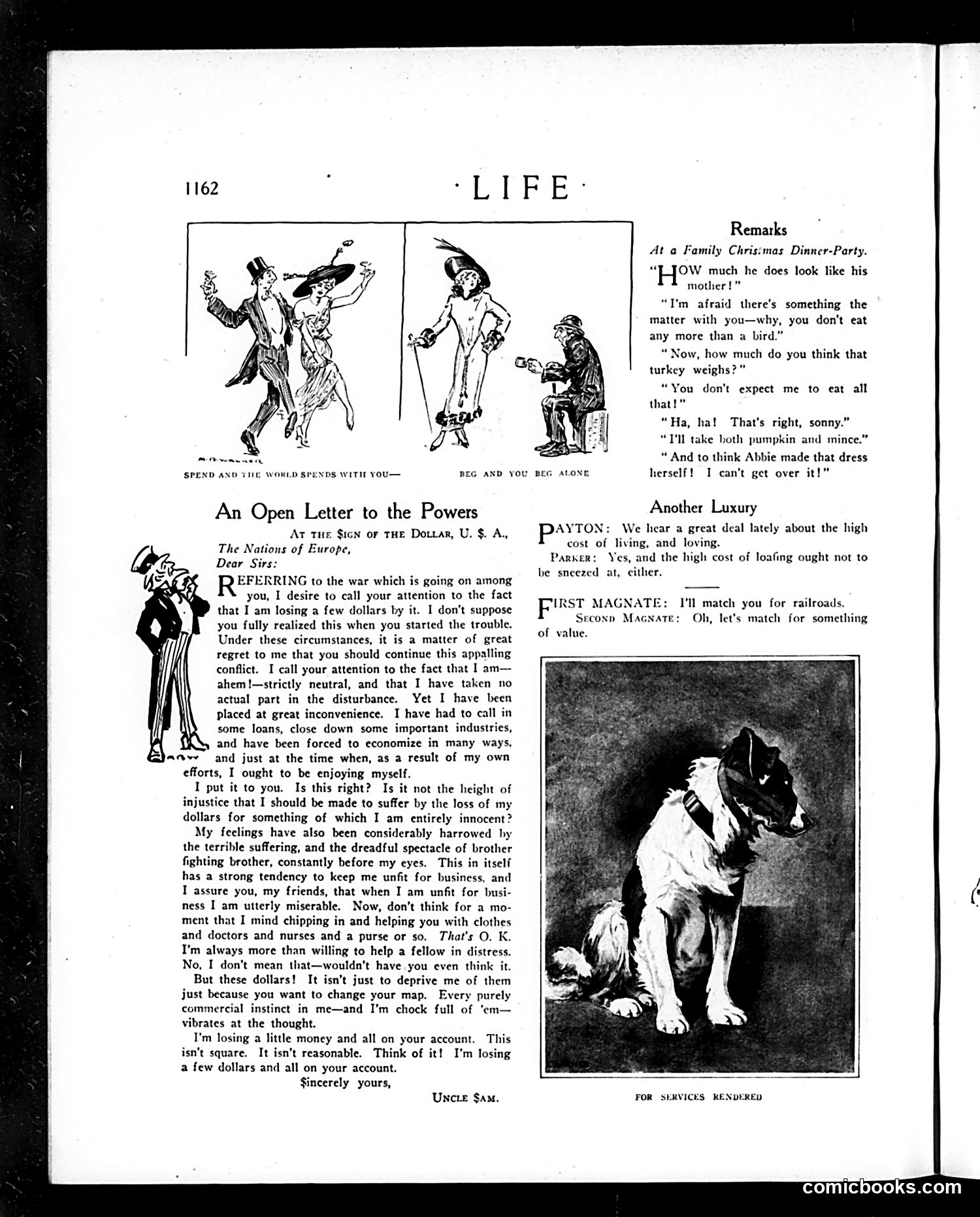
This page satirizes American attitudes during World War I (the "war which is going on among you"). The main cartoon features "Uncle Sam" (personified America, shown as the figure marked with the dollar sign) writing to European powers complaining that their war is costing *him* money—losses in loans, closed industries, and forced economizing—despite his claimed neutrality. The satire is sharp: Uncle Sam professes emotional sympathy for European suffering while his actual grievance centers entirely on lost profits. He claims willingness to help ("chipping in with clothes and doctors") but obsesses over lost dollars, revealing American commercial priorities. The accompanying dialogue snippets and cartoon vignettes mock wartime social pretense and materialism. This reflects pre-1917 American neutrality debates and criticisms of American financial interests profiting from or being disrupted by European conflict—a common satirical target in Life magazine during this period.
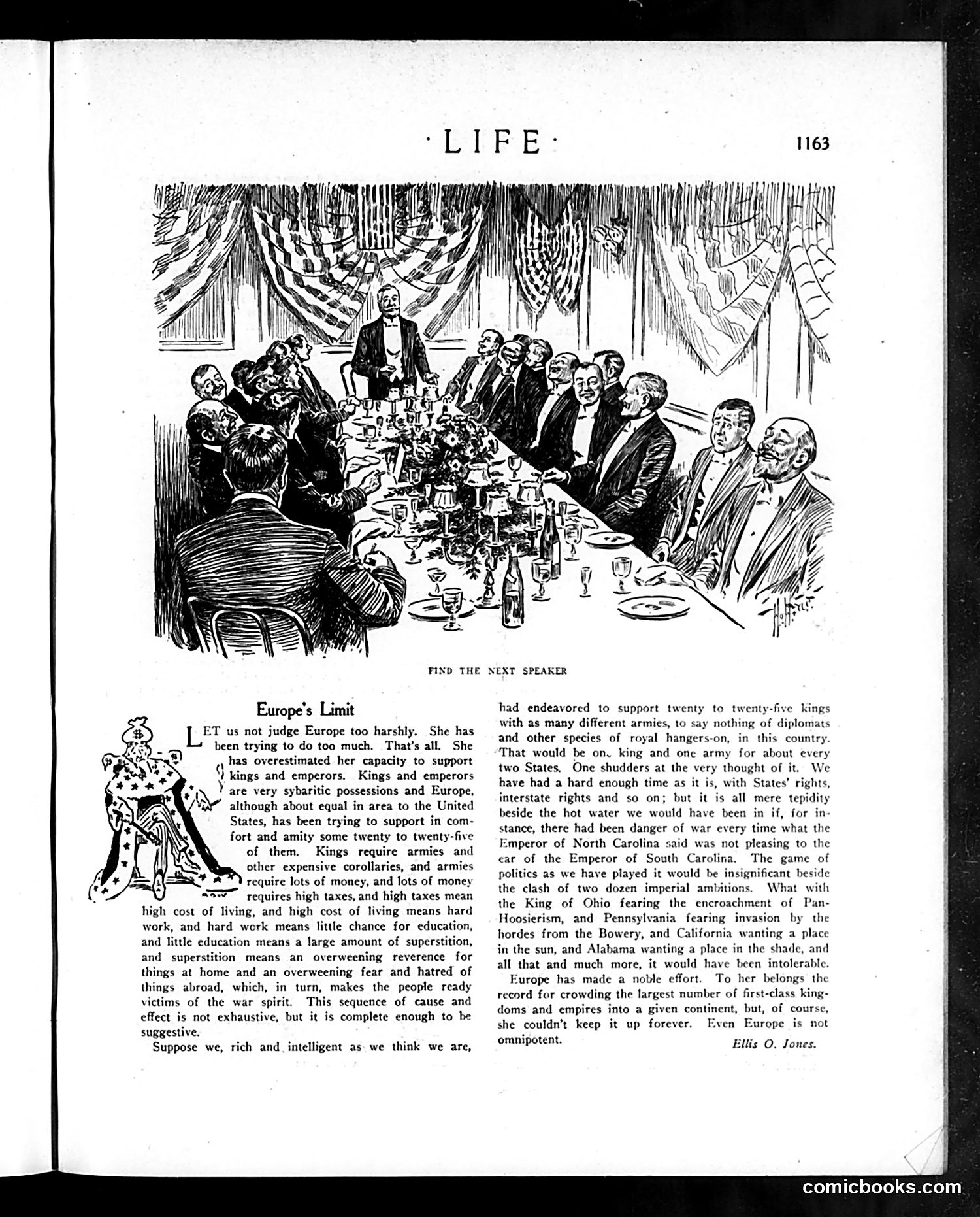
**The Cartoon:** Shows a formal dinner with men in evening dress seated around a table. One man stands to speak while others listen—the caption "Find the Next Speaker" suggests a parlor game identifying who will speak next. **The Satire:** Ellis O. Jones uses this scene to mock European political instability. The article argues Europe's fundamental problem is supporting too many kings and emperors (roughly 20-25) across a continent similar in size to the United States. **The Point:** Jones creates a logical chain: maintaining monarchies requires expensive armies, which require high taxes, which impoverish citizens, limiting education and breeding superstition, fear, and nationalism—thus causing war. He humorously contrasts this by imagining if American *states* each had their own kings (Ohio, Pennsylvania, Carolina emperors), showing how absurd and destructive such arrangements would be. **Context:** This reflects post-WWI American skepticism toward European monarchy and suggests republicanism's superiority—a common Progressive-era argument.
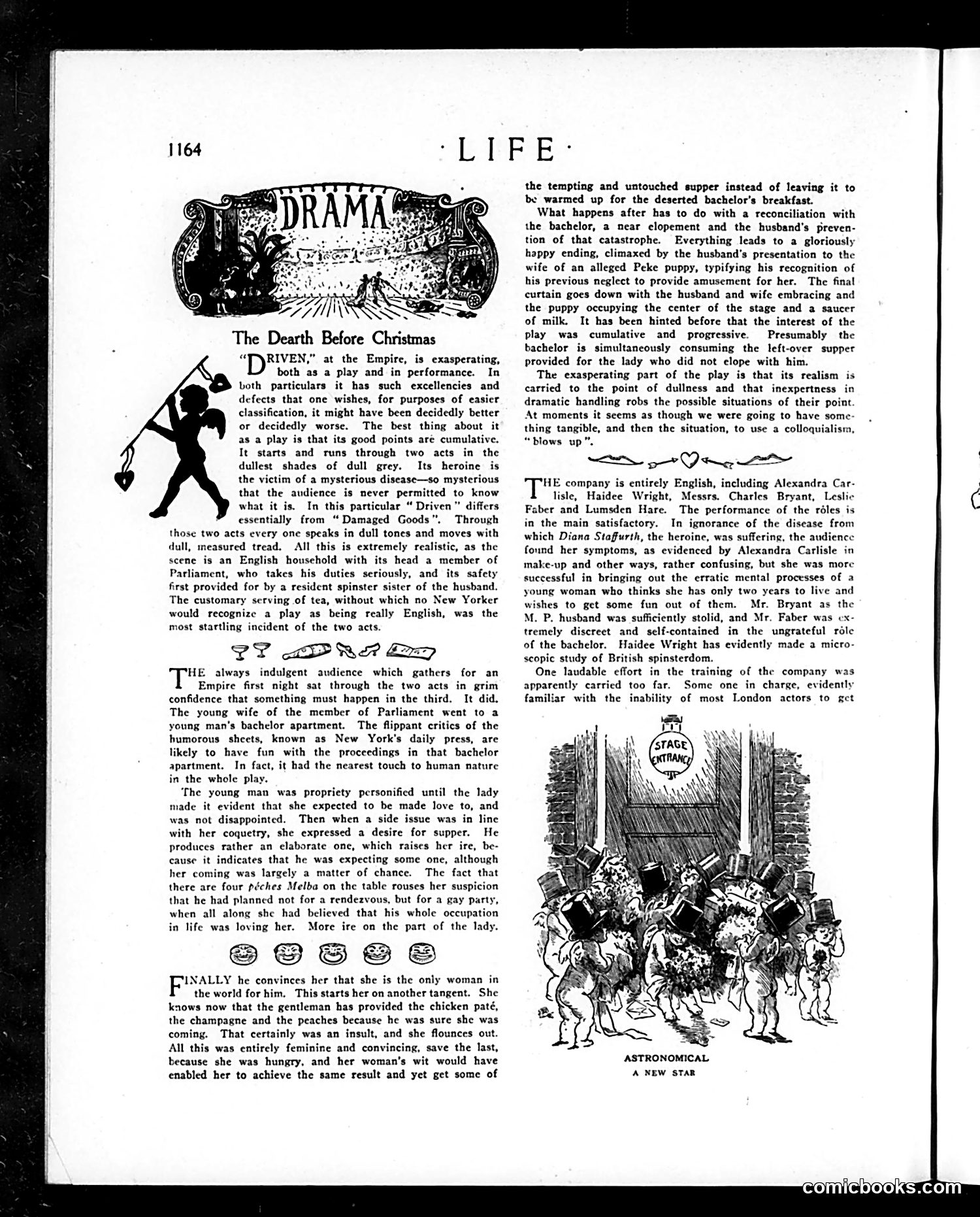
This page reviews the play "Driven" at the Empire Theatre. The critic satirizes both the production and the audience's predictable reactions. The review mocks the play's melodramatic plot: a bored parliamentary wife visits a bachelor's apartment, discovers a suspiciously elaborate supper (four *pêches Melba*), suspects infidelity, storms out hungry despite the food tempting her, then reconciles with her husband—who seals the happy ending with a Peke puppy and saucer of milk. The satire targets the play's overwrought emotional logic and the wife character's inconsistent behavior. The critic notes she's simultaneously insulted by the supper *and* too proud to eat it—mocking both the script's feminine stereotypes and the audience's acceptance of such unrealistic dramatics. The final jab: the bachelor presumably enjoys the leftover feast alone, suggesting the entire domestic crisis resolves into comfortable absurdity.
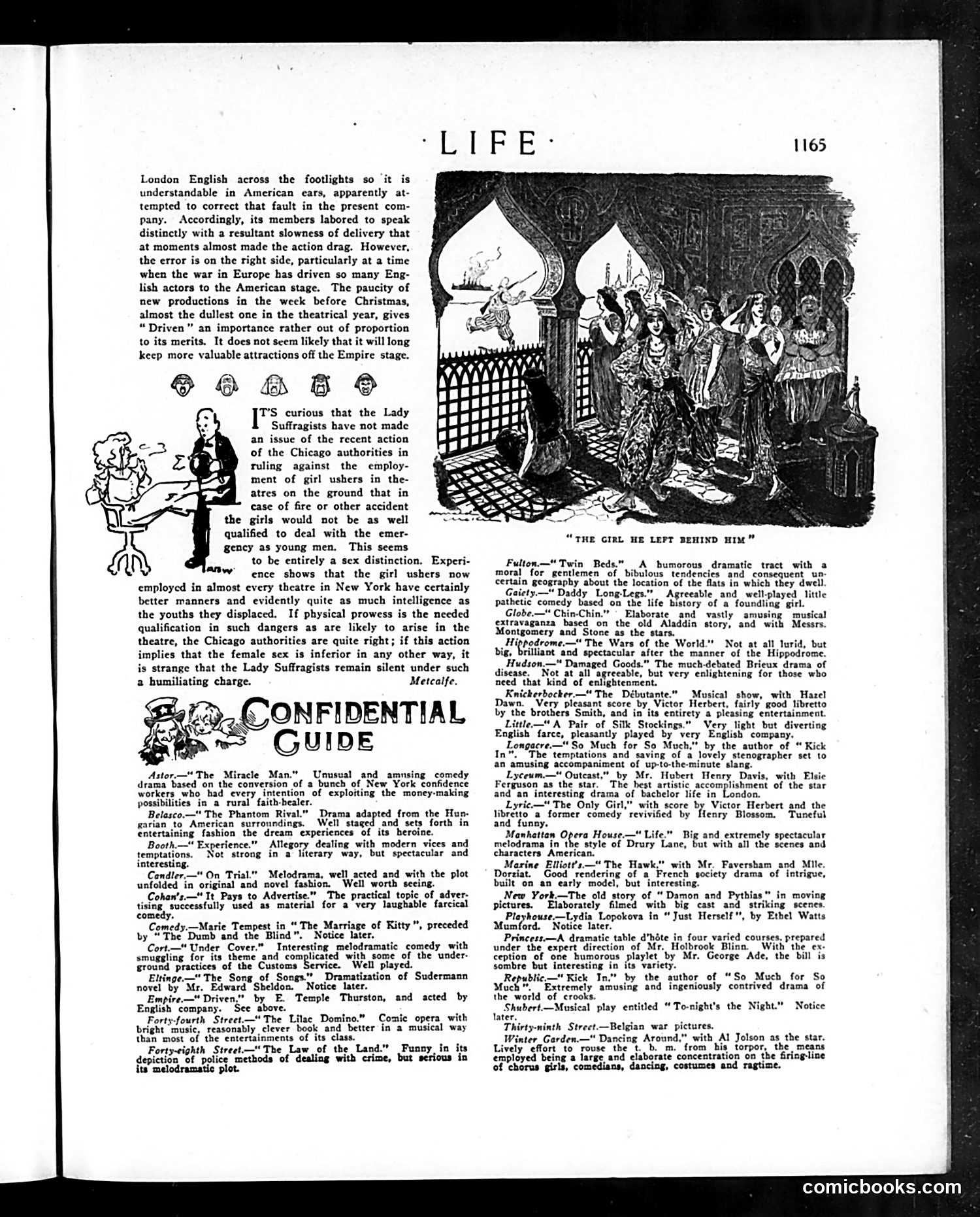
This page contains theater reviews and two related cartoons critiquing gender discrimination. The small cartoon on the left shows a man dismissing a woman's complaint—satirizing how women's concerns are often ignored. The main cartoon, titled "The Girl He Left Behind Him," illustrates the article's central argument: Chicago authorities had banned female ushers from theaters, claiming women couldn't handle emergencies as well as men. The author "Metcalfe" finds this sexist and hypocritical, noting that female ushers in New York theaters demonstrate equal intelligence and better manners than their male counterparts. He expresses bewilderment that women suffragists haven't protested this discriminatory ruling—a pointed jab suggesting they should be outraged by such blatant sex-based exclusion. The satire targets both Chicago's paternalistic logic and the apparent passivity of the suffrage movement on this particular issue.
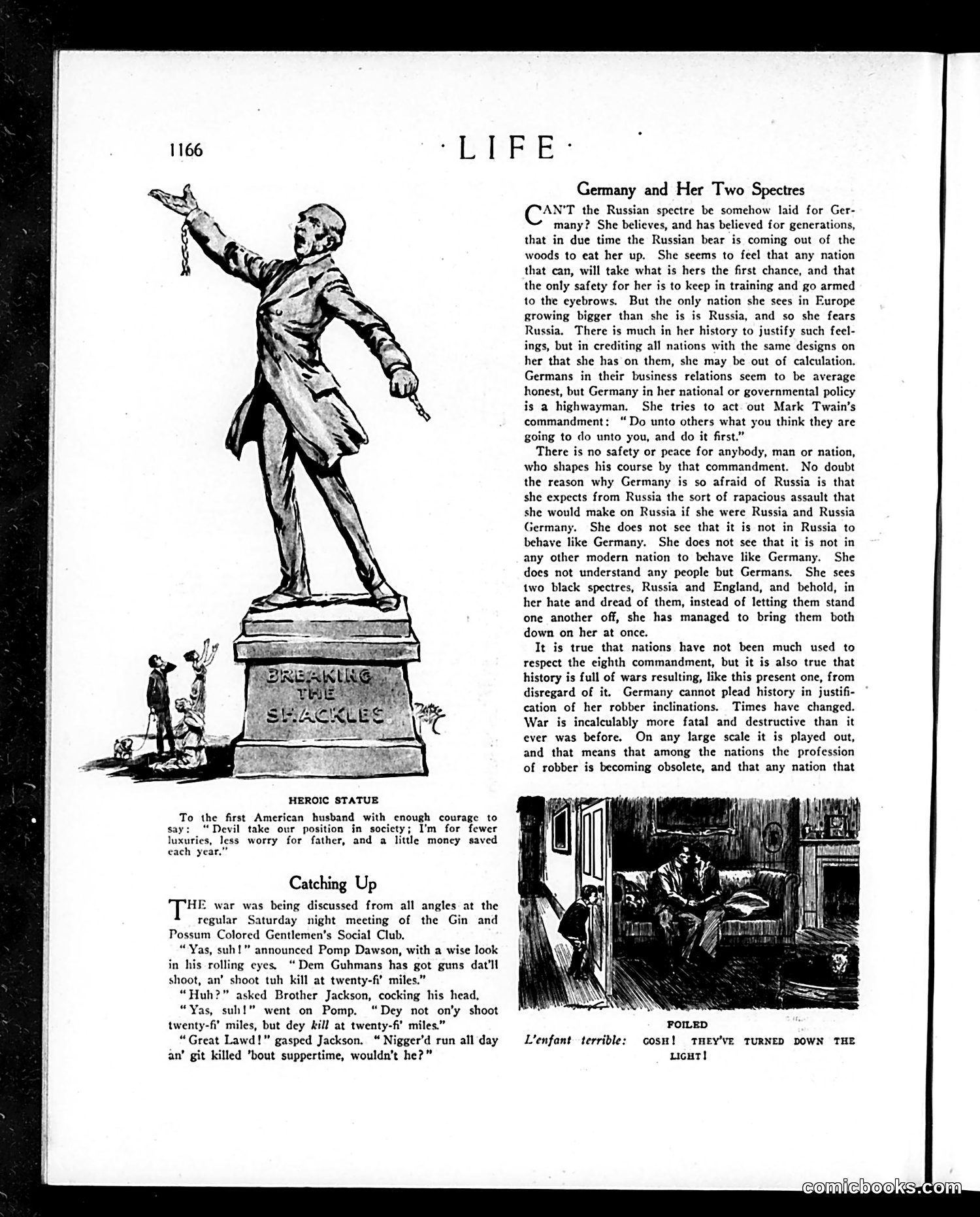
**"Germany and Her Two Spectres"** (main article): This piece criticizes Germany's paranoid foreign policy, particularly its fear of Russia. The author argues Germany projects its own aggressive, "highwayman" mentality onto other nations—expecting them to behave as ruthlessly as Germany would. Germany sees Russia and England as threats and, through its preemptive aggression, has paradoxically united these two powers against itself. The article suggests modern warfare has become too destructive for traditional imperial conquest. **"Heroic Statue"** (left cartoon): Satirizes American materialism by praising a hypothetical husband willing to reduce luxury spending and save money—framing financial restraint as heroic, thereby mocking contemporary consumer culture. **"Catching Up"** (dialogue): Uses racist dialect humor common to the era, depicting African American characters discussing German military capability with malapropisms ("dill" instead of "kill"), reflecting contemporary stereotyping. **"Foiled"** (right illustration): Shows a figure turning off a light, with caption suggesting children ("l'enfant terrible") have been caught in mischief.
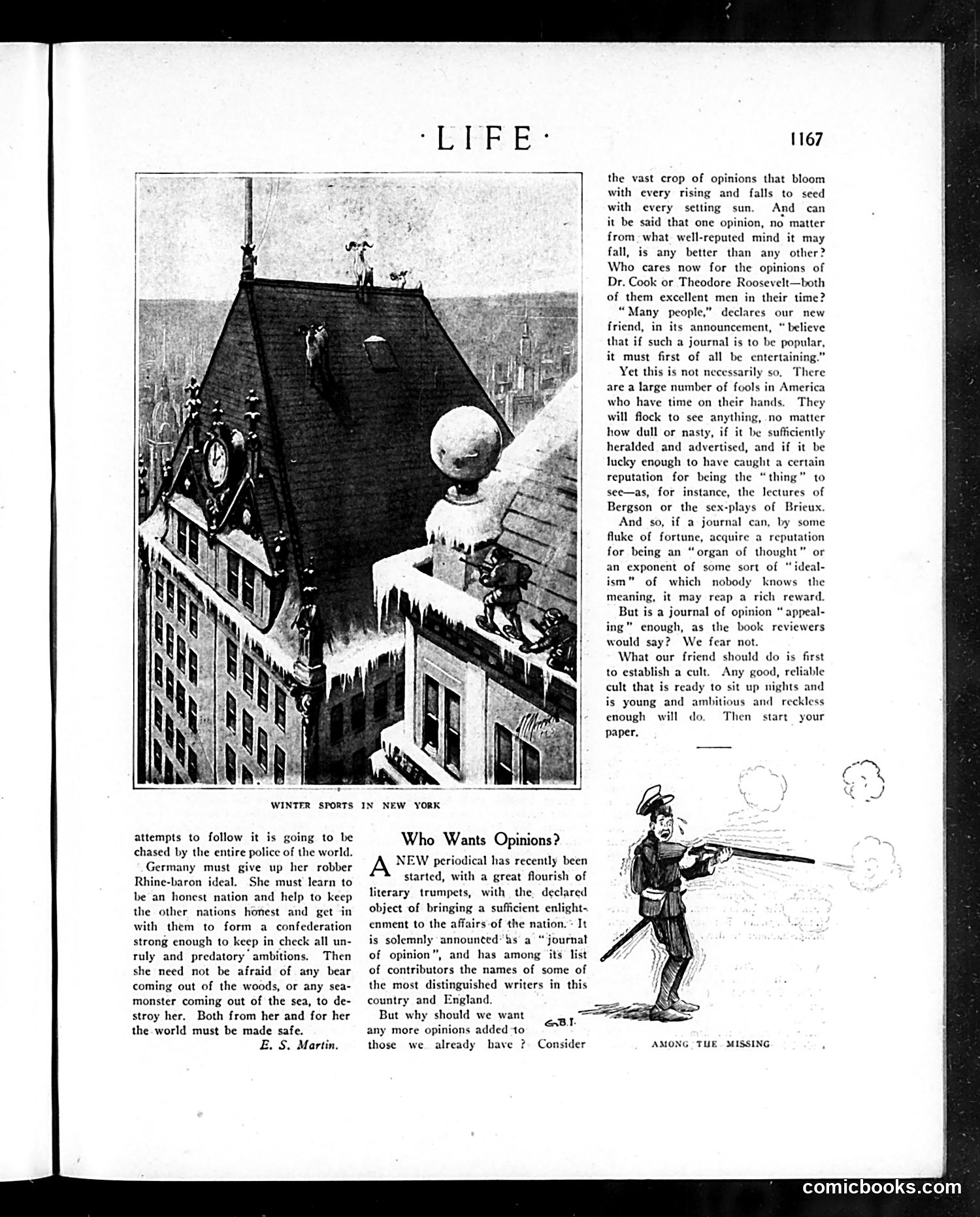
**The Main Cartoon:** "Winter Sports in New York" depicts a colossal snowball on an urban rooftop, looming over the city below. This appears to be satirizing the scale and danger of winter weather in New York. **The Article "Who Wants Opinions?":** This is a satirical critique of a newly-launched periodical claiming to be a serious "journal of opinion" featuring distinguished contributors like Dr. Cook and Theodore Roosevelt. The author (E.S. Martin) mocks the pretension, arguing that: - America has no shortage of opinions already - Past opinions from celebrated figures now seem worthless - The journal will likely succeed through entertainment and hype rather than intellectual merit - It appeals to "fools" with time on their hands who flock to trendy cultural products - The author advises instead establishing a "cult" rather than relying on genuine thought **The Satire's Point:** The piece ridicules intellectual vanity and the American appetite for fashionable ideas over substance, suggesting that a journal of "opinion" is ultimately just commercial entertainment dressed in idealistic language.
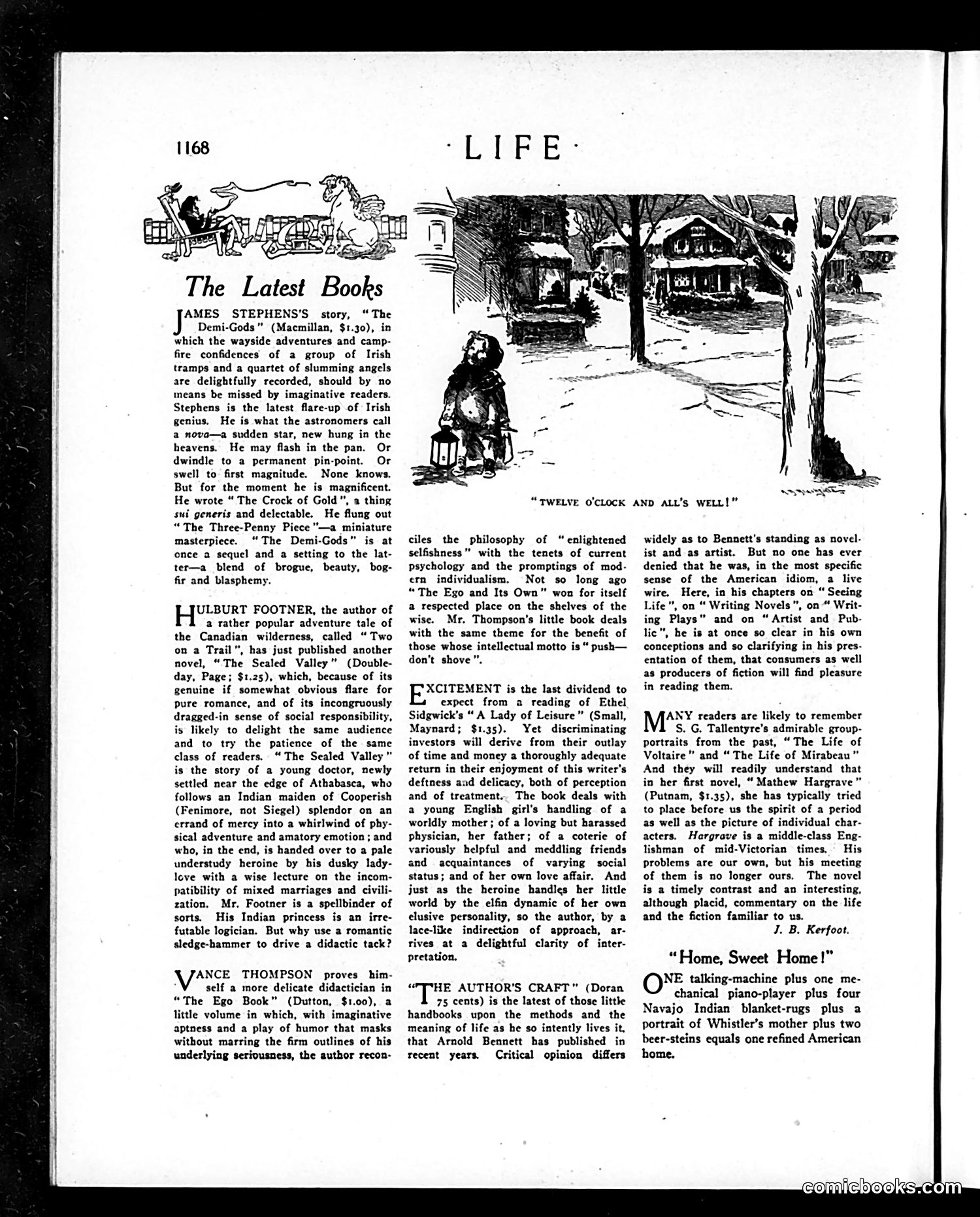
This page is a book review section from Life magazine (page 1168), featuring critical assessments of contemporary literature. The reviews discuss works by James Stephens ("The Demi-Gods"), Hulbert Footner ("The Sealed Valley"), Vance Thompson ("The Ego Book"), Ethel Sidgwick ("A Lady of Leisure"), and Arnold Bennett ("The Author's Craft"). The one illustration shows a figure sitting by a street at "TWELVE O'CLOCK AND ALL'S WELL!"—likely accompanying one of the reviewed books, though the specific connection isn't entirely clear from the visible text. The reviews themselves are straightforward literary criticism typical of early 20th-century magazine culture, evaluating plot, character development, and philosophical merit. There is no apparent political satire or caricature on this page—it functions as a standard cultural commentary section for educated readers interested in contemporary fiction.
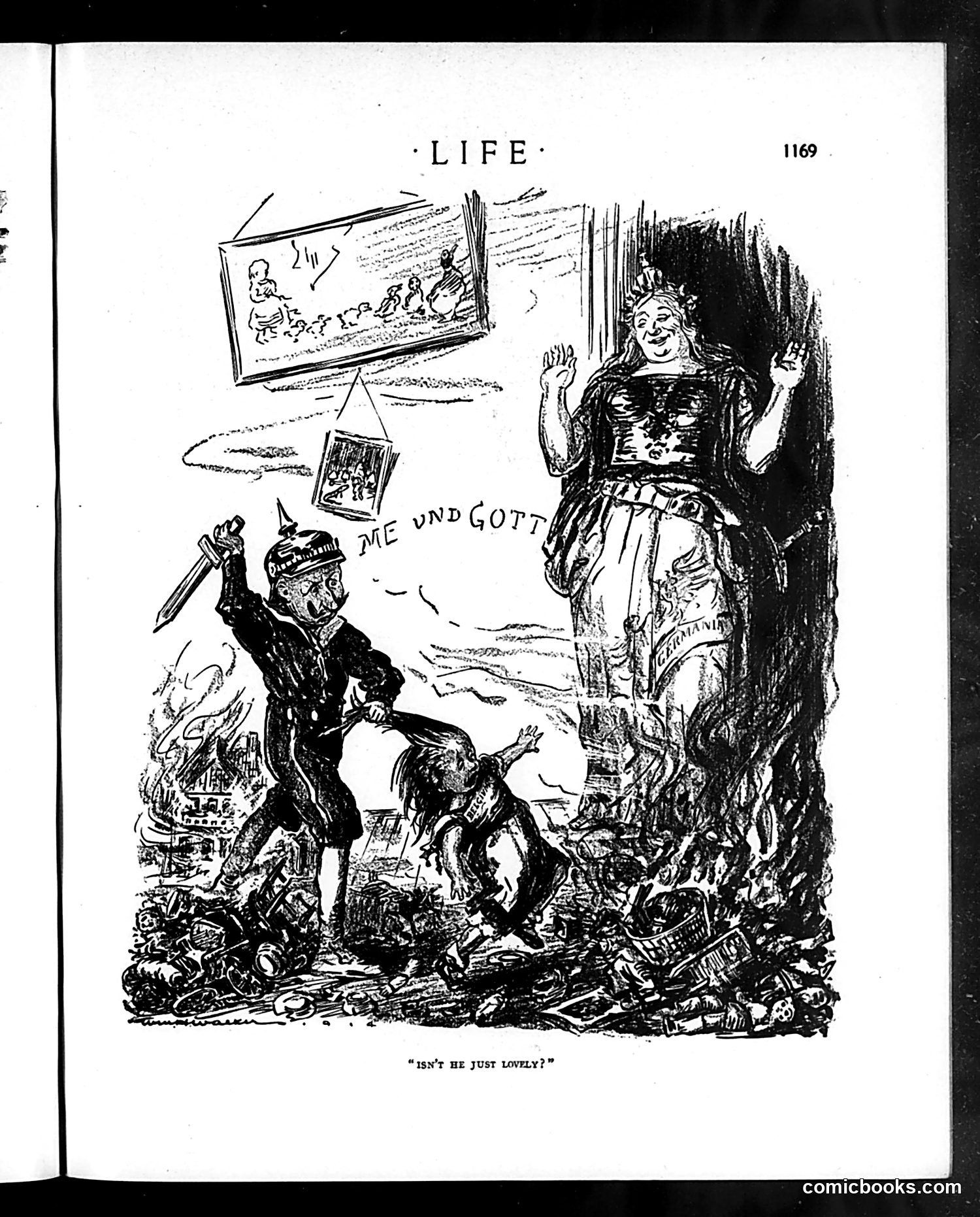
This political cartoon depicts a demonic or grotesque military figure (wearing a spiked Prussian helmet, suggesting German militarism) wielding a sword amid destruction and flames. The figure is labeled "ME UND GOTT" (German for "Me and God"), referencing the famous Prussian motto "Gott mit uns" ("God with us"). A majestic female figure (likely representing Liberty or a national ideal) stands to the right, looking down disapprovingly at the chaos. The caption reads "ISN'T HE JUST LOVELY?"—dripping with sarcasm. The imagery critiques German military aggression and the claim of divine sanction for warfare. The contrast between the destructive militarism below and the idealized figure above emphasizes the moral bankruptcy of such justifications. This likely dates to WWI-era American commentary on German imperialism.
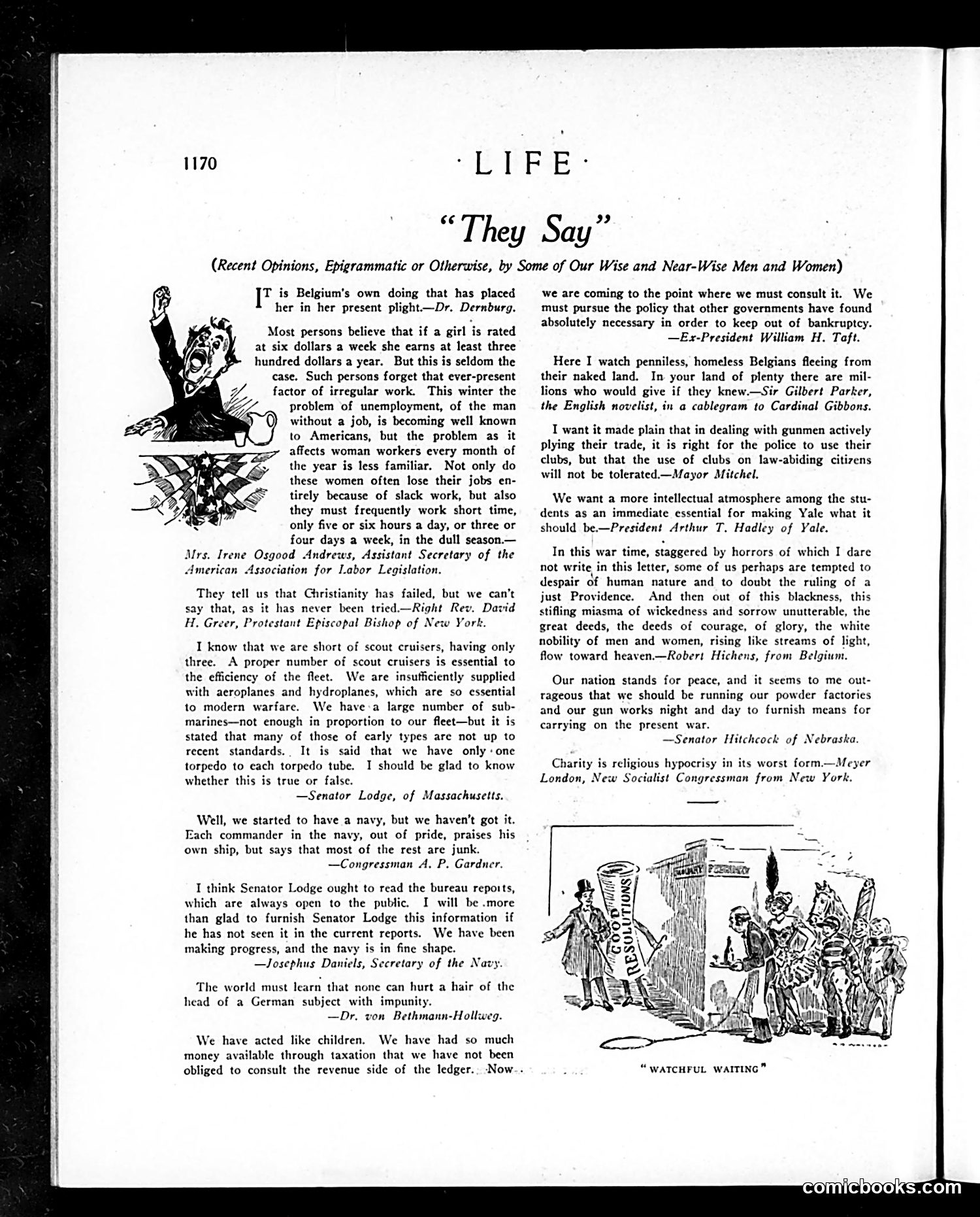
This is a satirical opinion column collecting quotes from prominent figures of the World War I era. The page features two illustrated cartoons accompanying the text. The left cartoon shows an animated speaker (likely a politician or public figure) gesticulating emphatically—satirizing bombastic rhetoric. The right cartoon titled "Watchful Waiting" depicts armed figures at a border or checkpoint, referencing President Woodrow Wilson's policy of cautious neutrality toward the Mexican Revolution. The quoted opinions cover contemporary controversies: women's labor conditions, military readiness (Senators Lodge and Gardner debate naval preparedness while Secretary Daniels defends current capacity), Belgian refugee crisis relief, police conduct during labor disputes, and the moral dimensions of WWI. The satire lies in juxtaposing these varied, sometimes contradictory opinions to highlight political posturing and empty rhetoric during a serious historical moment.
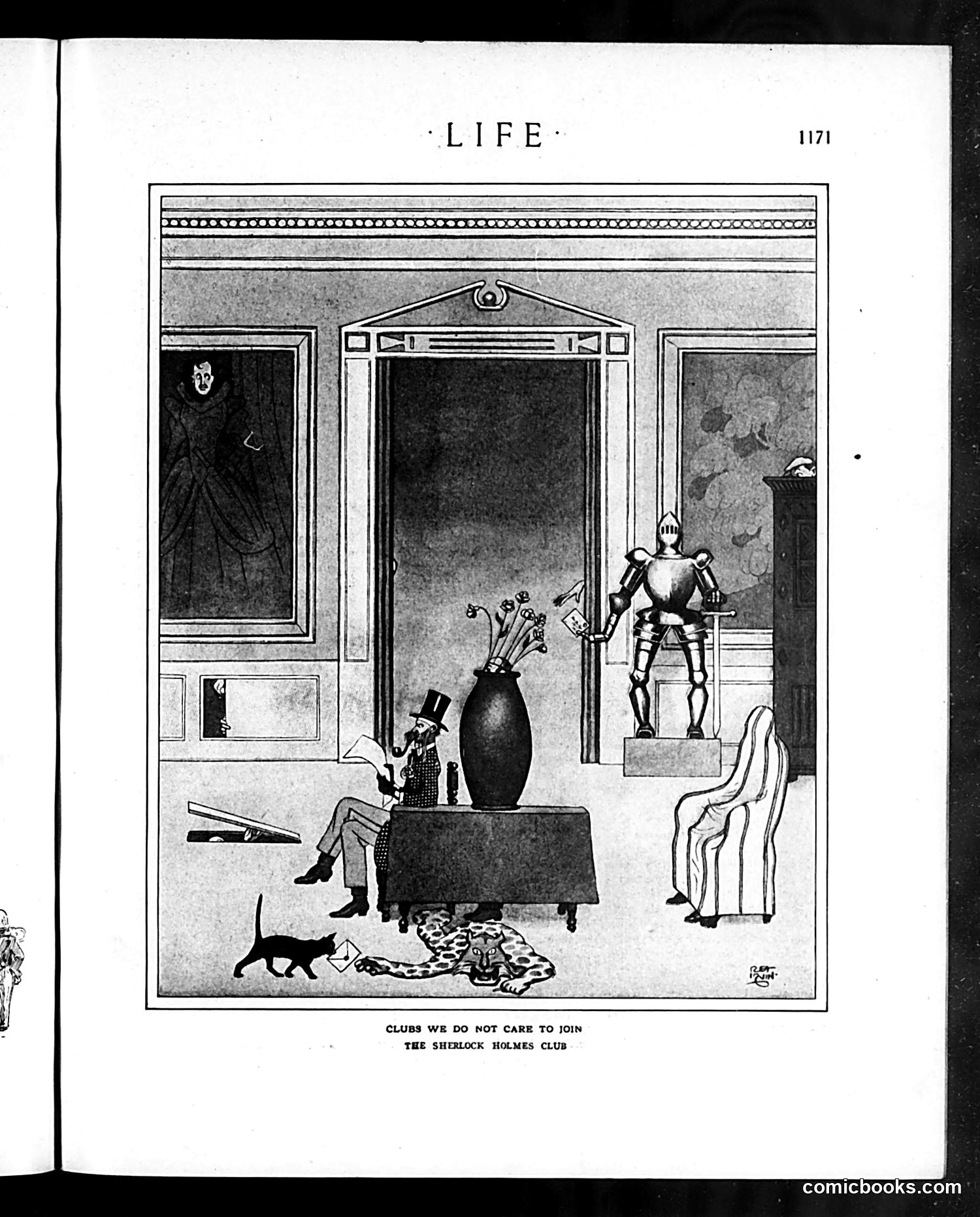
This is a satirical cartoon about the Sherlock Holmes Club. The image shows a wealthy woman seated at a table in an elegant room, surrounded by absurd objects: a large vase with flowers, a suit of armor, a black cat, scattered items on the floor, and a painting of a woman on the wall. The joke appears to be a play on Sherlock Holmes's famous deductive abilities. The cartoon satirizes club membership by suggesting that joining the Sherlock Holmes Club would require one to surround oneself with ridiculous, incongruous objects—as if only someone with Holmes's extraordinary observational powers could make sense of such a chaotic, illogical collection. The title "Clubs We Do Not Care to Join" frames this as social satire, mocking pretentious club culture by highlighting the absurdity of what membership might entail.
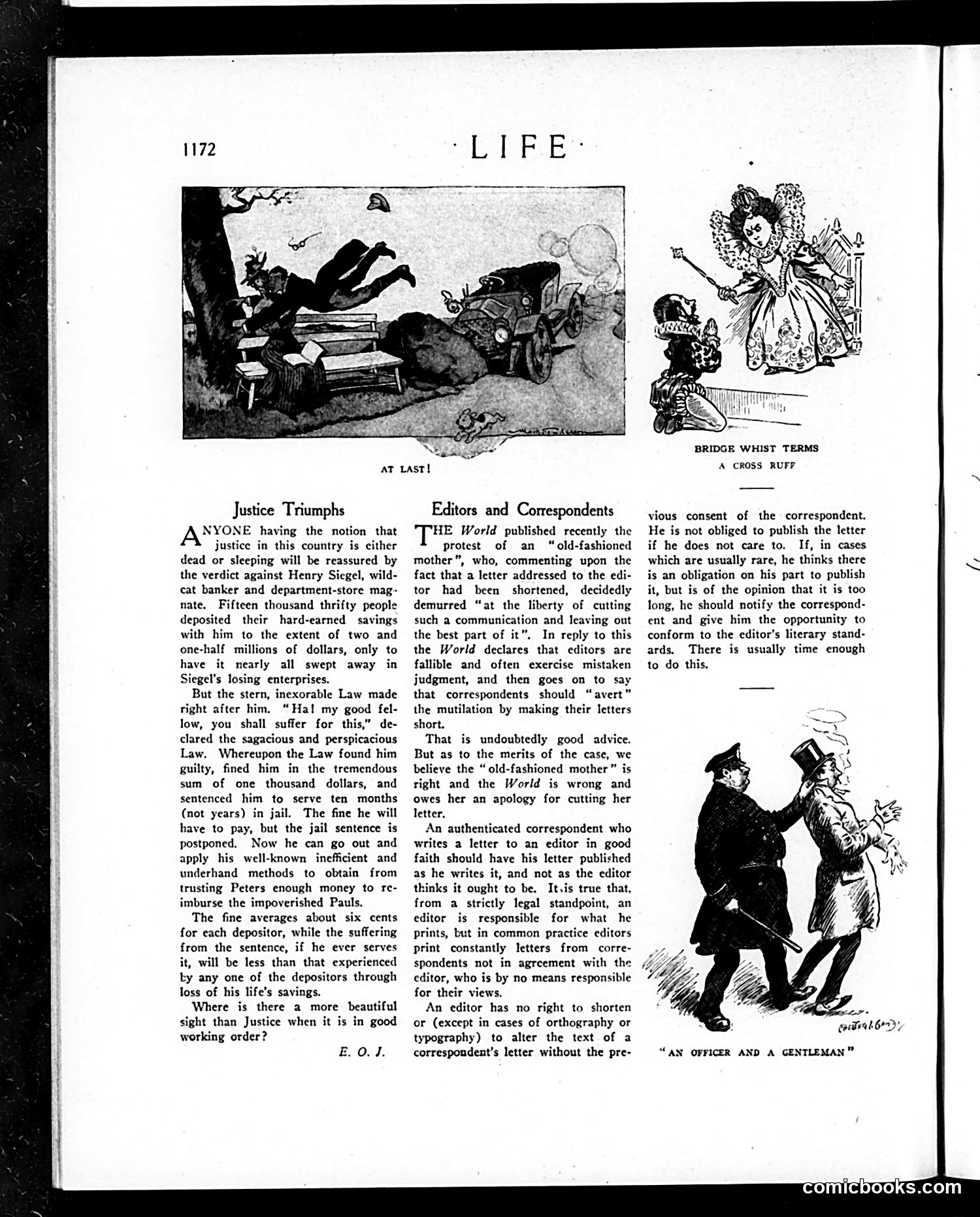
This page contains two distinct editorial pieces satirizing American institutions: **"Justice Triumphs"** mocks the Henry Siegel case—a banker who defrauded 15,000 depositors of $2.5 million. The cartoon shows Siegel's arrest. The satire's bite: despite his massive fraud, he received only a $1,000 fine (six cents per victim) and a suspended jail sentence. The author sarcastically calls this "beautiful" justice, highlighting how inadequate legal consequences were for wealthy financial criminals compared to ordinary people's losses. **"Editors and Correspondents"** debates editorial ethics. It supports an "old-fashioned mother" who protested a newspaper cutting her letter without permission, arguing editors have no right to alter reader submissions without consent—even if they disagree with the views expressed. This defends correspondent autonomy against editorial censorship. The illustrations are period cartoons unrelated to the main text (bridge whist, a gentleman and officer).
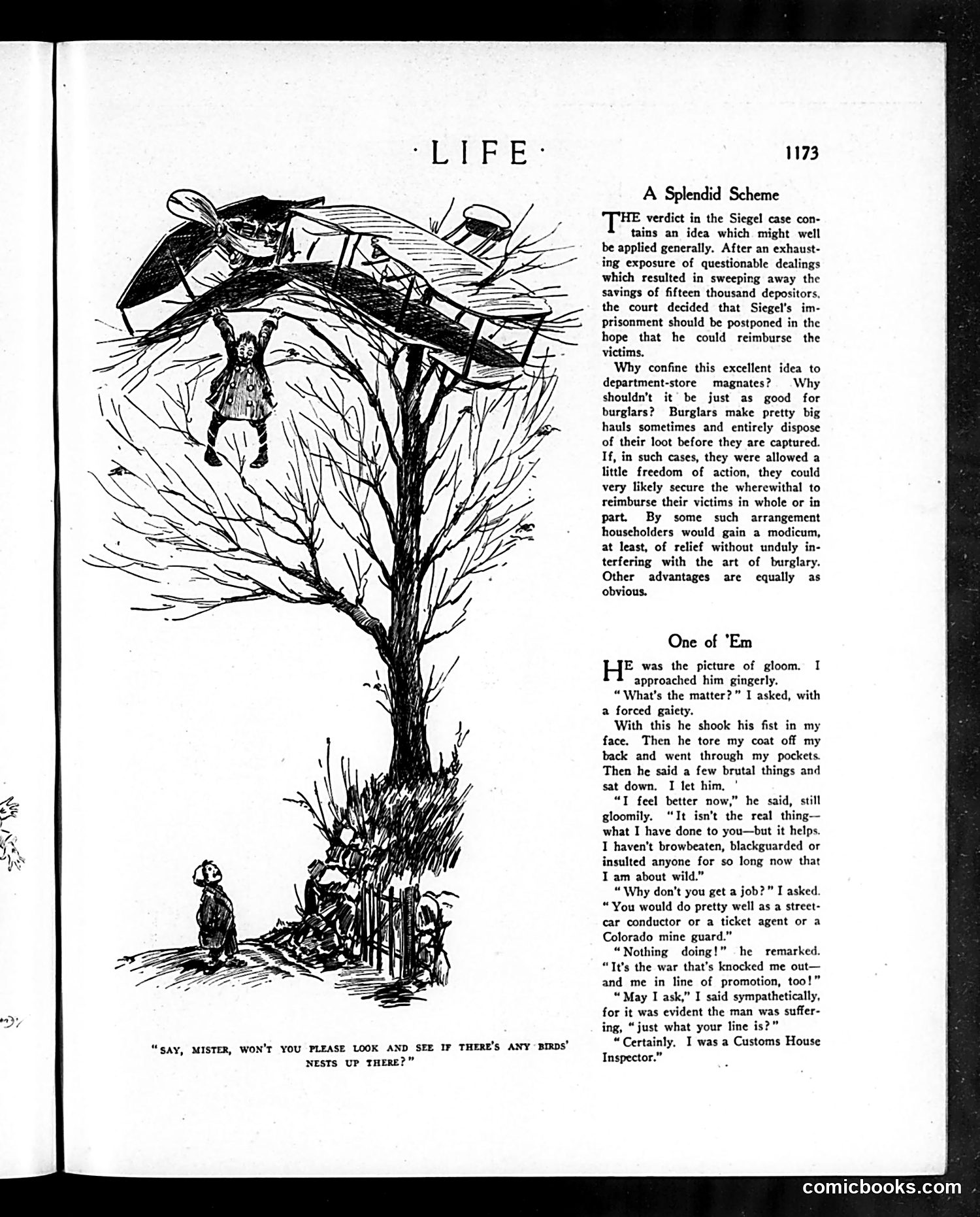
This Life magazine page satirizes the Siegel case verdict through two pieces: **"A Splendid Scheme"** (main article): Mocks a court decision allowing financier Siegel postponed imprisonment so he could reimburse defrauded depositors. The satire extends this "logic" absurdly to burglars—if wealthy swindlers get freedom to make restitution, why not criminals? The joke exposes the hypocrisy of treating white-collar crime more leniently than street crime. **"One of 'Em"** (narrative): A man, formerly a Customs House Inspector (government worker), is now unemployed and emotionally unstable due to "the war" disrupting his career advancement. He vents frustration violently on the narrator. The piece satirizes post-WWI displacement—how returning soldiers and displaced government workers, stripped of employment and purpose, became destabilized and potentially dangerous to society. The illustration of a bare tree with nesting birds appears decorative rather than directly illustrative of these texts.
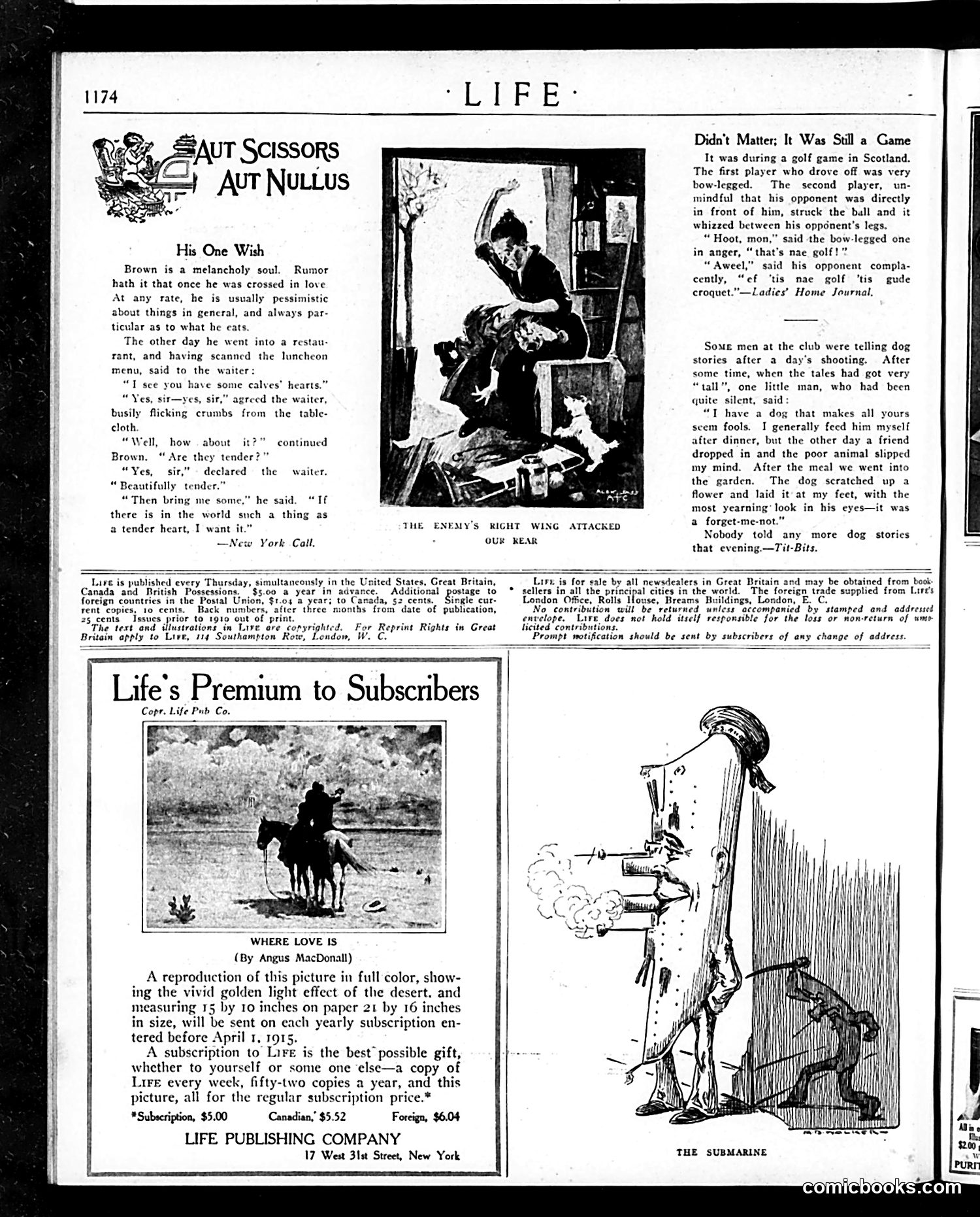
This page contains several humorous anecdotes typical of *Life* magazine's satirical humor: **"His One Wish"**: A pessimistic man named Brown enters a restaurant and orders calf's heart, making a bitter joke that if "a tender heart" exists anywhere in the world, he wants it—a dark commentary on his romantic disappointment and general misanthropy. **Golf and Dog Stories**: Two brief jokes about Scottish golfers and competitive storytelling at a gentleman's club, showcasing period humor about class and social one-upmanship. **"The Enemy's Right Wing Attacked Our Rear"**: A cartoon (unclear subject) appears to reference military conflict, possibly WWI-related given the caption. **Advertising Section**: The lower portion promotes *Life*'s subscription premium—a color landscape painting "Where Love Is" by Angus MacDonall—standard turn-of-the-century magazine marketing. The page reflects early 1900s American genteel humor focused on romance, dining etiquette, sporting culture, and subtle social criticism, aimed at educated middle and upper-class readers.
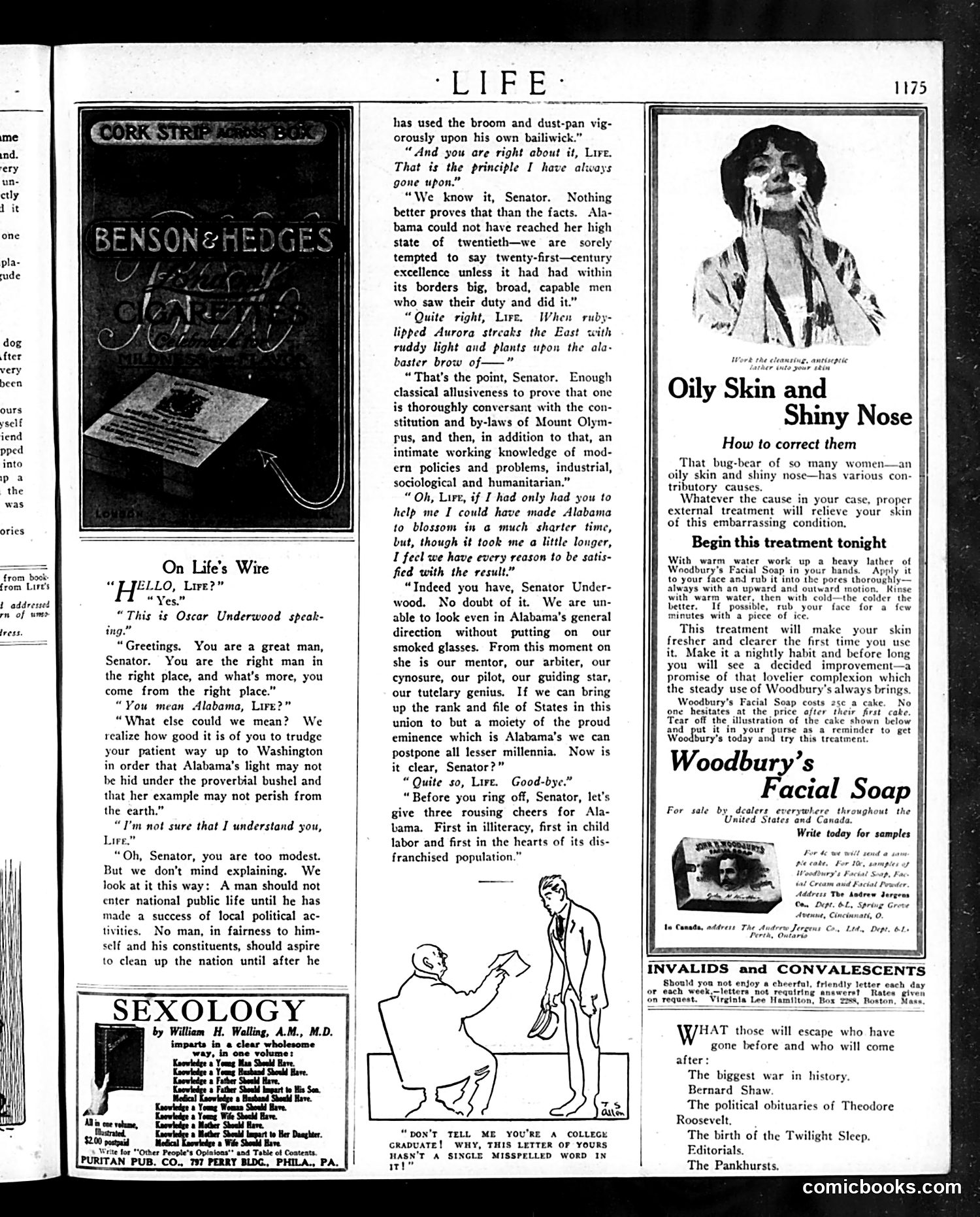
The main cartoon satirizes **Senator Oscar Underwood of Alabama**. A caller ("Lire," representing LIFE magazine) flatters Underwood for cleaning up his home state before entering national politics—but the satire is biting: the caller then mocks Alabama's actual record, sarcastically praising it while listing genuine failures: "First in illiteracy, first in child labor and first in the hearts of its disenfranchised population." The joke works by inverting expectations. Underwood expects genuine praise for local success; instead, LIFE exposes that Alabama's conditions were actually terrible, making his ascent to national office hypocritical. The flowery language and false politeness throughout emphasize the magazine's contempt for both the senator and Southern political pretensions. The smaller cartoon below mocks collegiate incompetence: someone is shocked a college graduate wrote without spelling errors, implying the expectation of poor education was standard.
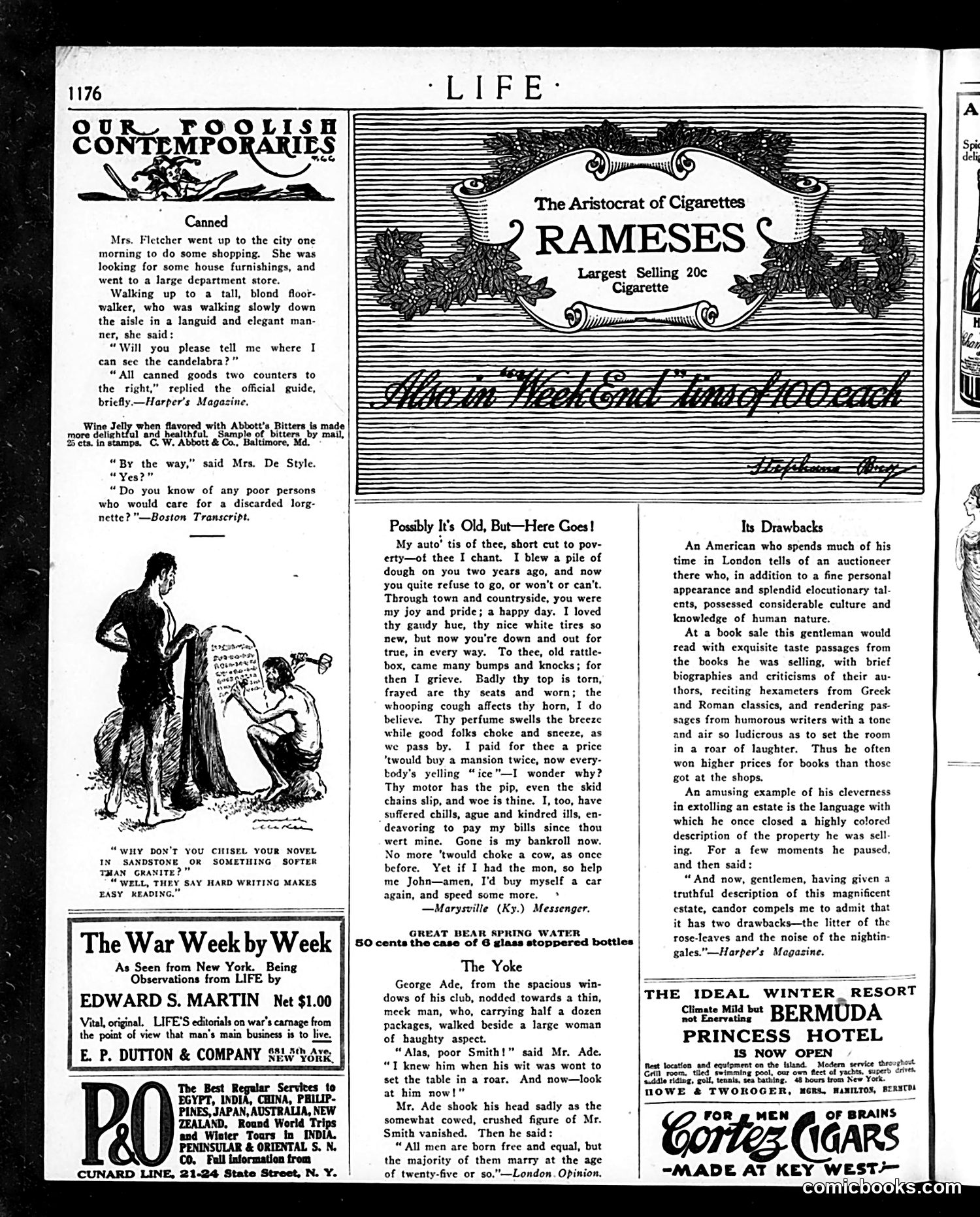
This page collects brief humorous anecdotes mocking social pretension and domestic life. The cartoon depicts a floor-walker (department store employee) so affected and self-important that he misunderstands a shopper's request for "candelabra" as "canned goods." Other jokes target: - **"The Yoke"**: Marriage as loss of freedom and wit—a man once witty is now "cowed, crushed" by his dominant wife - **"Possibly It's Old"**: Automobile ownership as financial ruin, sarcastically sung as patriotic verse - **"Its Drawbacks"**: Excessive education/culture in an auctioneer makes him pretentious The page satirizes early 20th-century anxieties: class affectation among service workers, marriage as domestication, automobile expense, and intellectual snobbery. The humor relies on readers recognizing these as common social frustrations of the era.
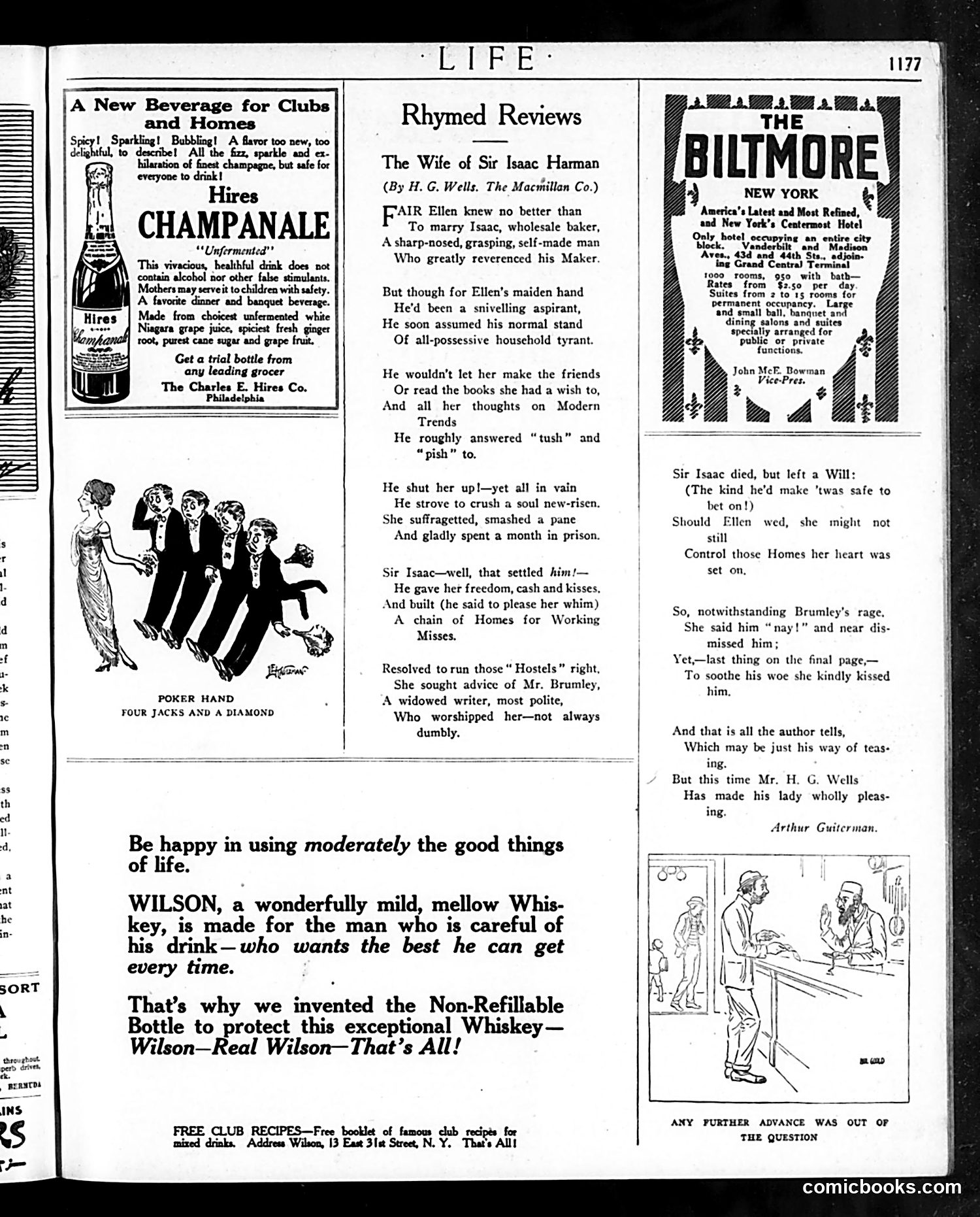
**The "Poker Hand" Cartoon:** This illustration satirizes high society's marriage market. A woman in elegant dress dangles four male suitors (represented as playing cards—"four jacks") while holding a diamond, suggesting she views marriage as a calculated game where men are expendable assets. The cartoon mocks both the mercenary nature of upper-class courtship and men's competitive desperation to win a wealthy bride. **"Rhymed Reviews":** Arthur Guiterman's verse summary of H.G. Wells' novel satirizes turn-of-the-century gender dynamics. Ellen, trapped in a controlling marriage to a wealthy baker, becomes a suffragette—smashing windows and accepting imprisonment to gain freedom. The satire mocks both Sir Isaac's patriarchal tyranny and the implied irony that Ellen's liberation comes only through her husband's death and inheritance, not genuine independence. Wells' ending, where Ellen rejects her admirer to keep her late husband's charitable institutions, is deemed "wholly pleasing"—suggesting compromise rather than true emancipation.
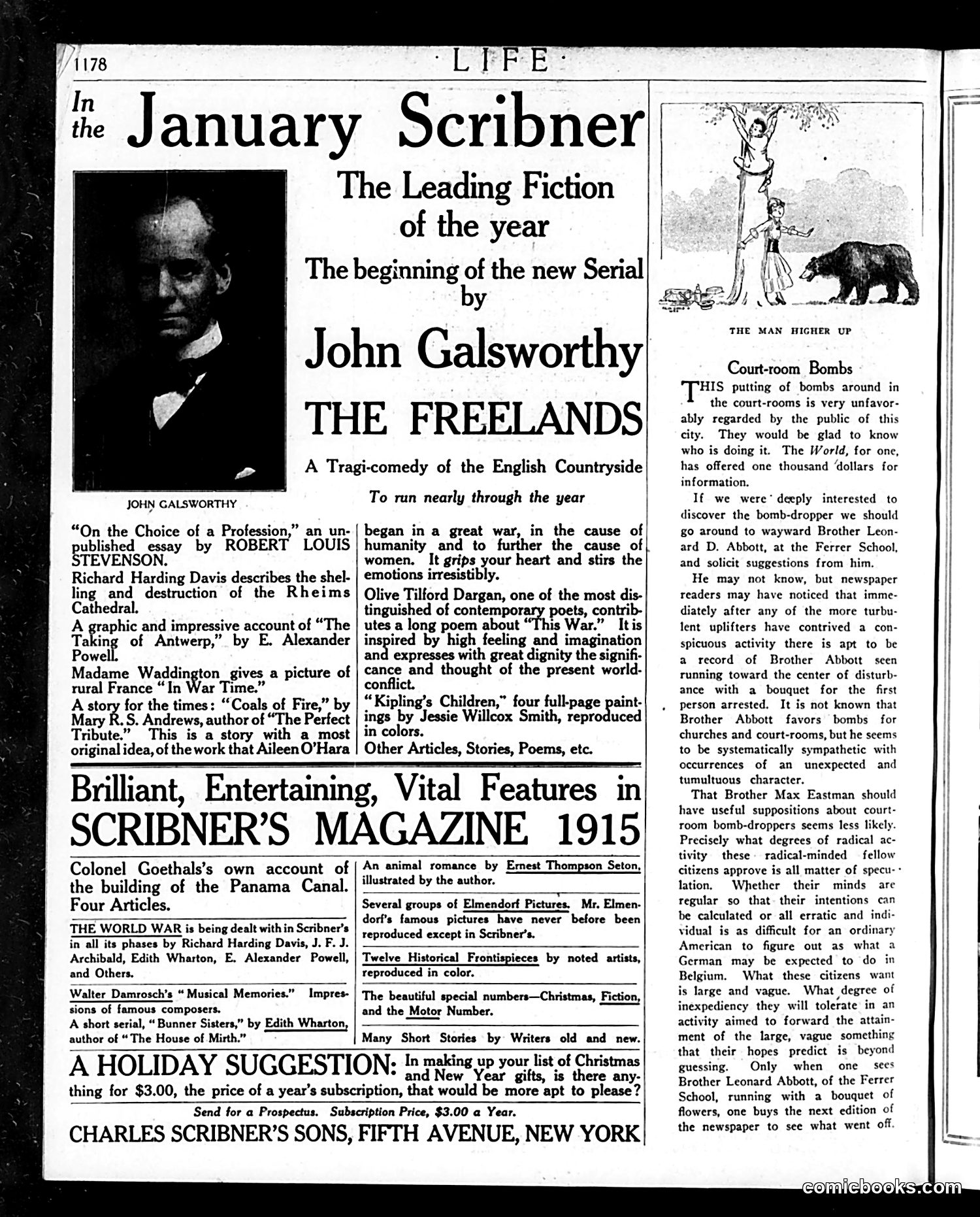
This page is primarily a Scribner's Magazine advertisement, but includes a pointed political cartoon titled "The Man Higher Up" attacking radical activists during a wave of courthouse bombings. The cartoon sarcastically suggests that Brother Leonard D. Abbott of the Ferrer School is complicit in anarchist bombing campaigns. It notes that Abbott conveniently appears at bombing sites with "a bouquet for the first person arrested," implying he supports radical direct action while maintaining plausible deniability. The piece also mentions Max Eastman, another radical intellectual, questioning whether such "radical-minded" citizens genuinely support violent tactics or merely sympathize with radical causes. This reflects genuine 1915 anxieties about anarchist violence and targets real figures associated with radical left activism and the Ferrer School (an anarchist educational institution in New York). The satire suggests radical intellectuals enable bombings through ideological support while distancing themselves from actual violence.
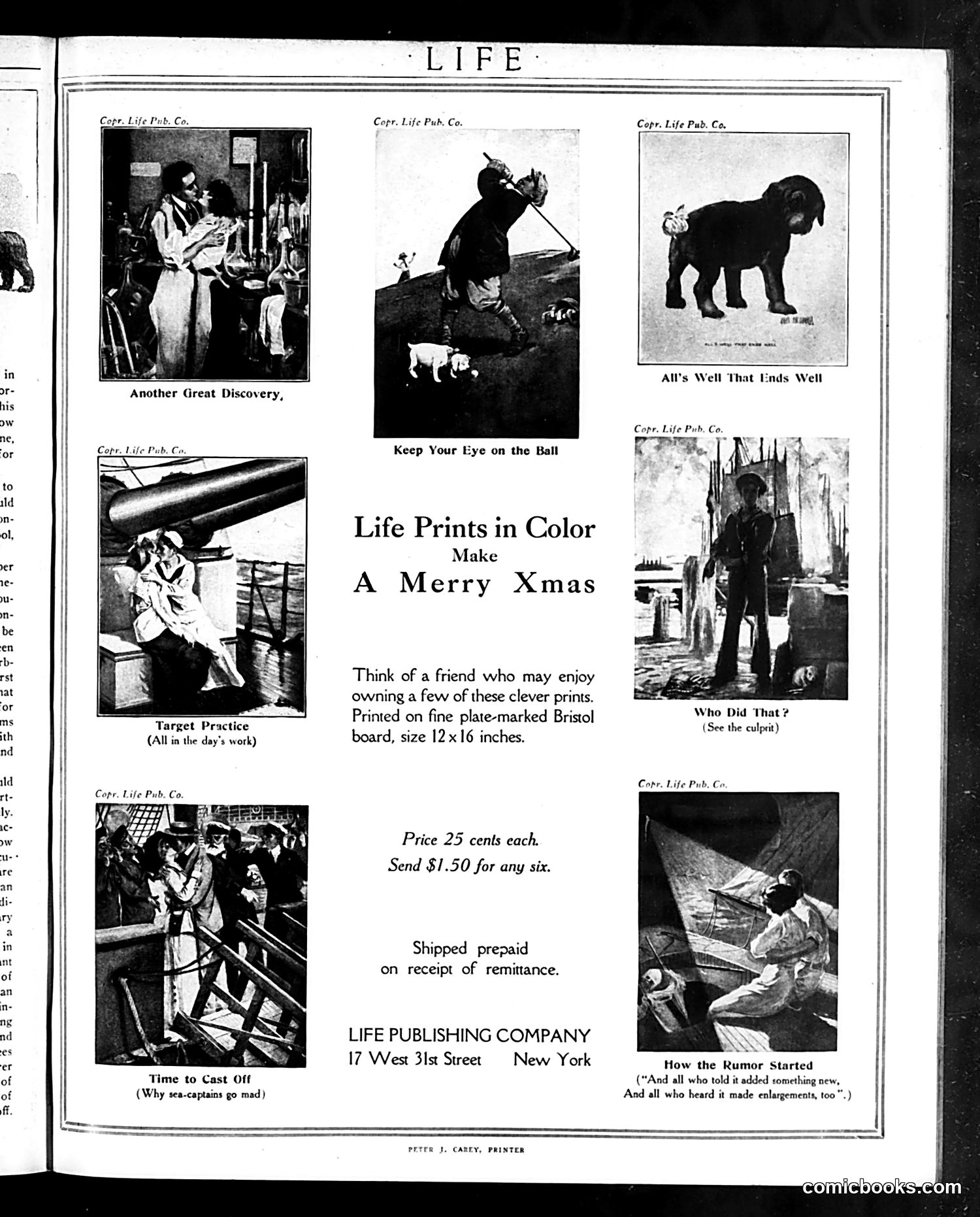
This is primarily a **Christmas gift advertisement** for Life Publishing Company's colored prints rather than political satire. The page promotes humorous prints priced at 25 cents each, designed as affordable holiday gifts. The six captioned cartoons illustrate gentle domestic and social humor typical of early 20th-century Life magazine: - **"Another Great Discovery"** and **"Target Practice"**: appear to show domestic scenarios - **"Keep Your Eye on the Ball"**: depicts someone golfing with a small animal - **"All's Well That Ends Well"**: shows a dog - **"Time to Cast Off"**: captioned about sea-captains going mad - **"Who Did That?"** and **"How the Rumor Started"**: illustrate mischief and gossip themes The humor is situational rather than political—aimed at middle-class readers seeking inexpensive, relatable cartoon prints for gift-giving. The page reflects the magazine's role as both satirical publication and commercial entertainment vehicle.
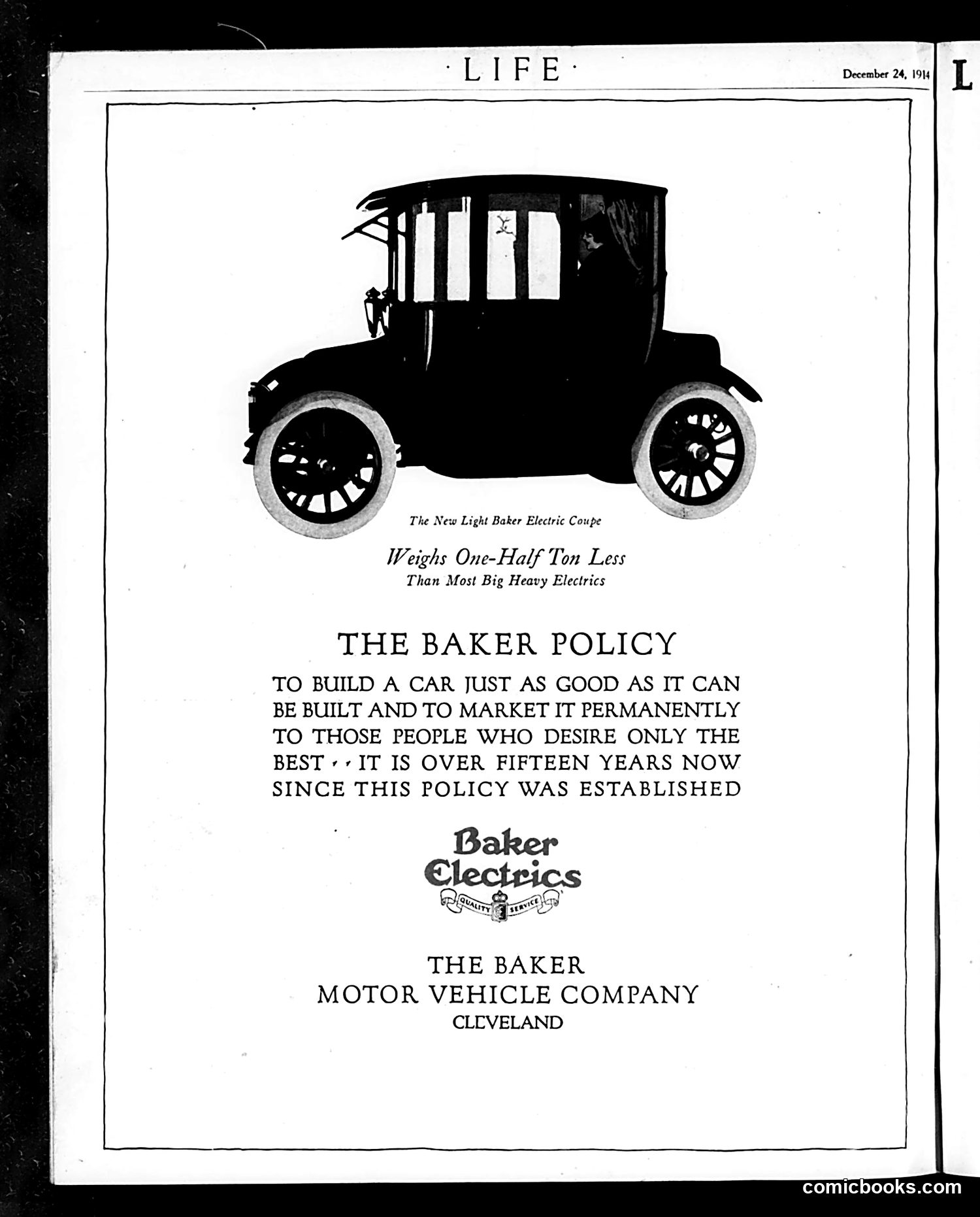
This is a **product advertisement**, not political satire. It promotes the Baker Electric Coupe, manufactured by the Baker Motor Vehicle Company in Cleveland, Ohio. The page presents a side-view silhouette of an early electric automobile with prominent spoked wheels. The advertisement emphasizes the vehicle's lightweight construction ("One-Half Ton Less Than Most Big Heavy Electrics") and the company's quality commitment—their "Baker Policy" of building the best possible cars for discerning customers, a practice they claim has lasted over fifteen years. This reflects the early automotive era (1914) when electric vehicles competed seriously with gasoline cars. The appeal to quality and permanence, rather than cost, suggests Baker targeted affluent buyers willing to pay premium prices for superior engineering and durability.