
Life, 1914-12-24 · page 17 of 40
Life — December 24, 1914 — page 17: what you’re looking at
What you’re looking at
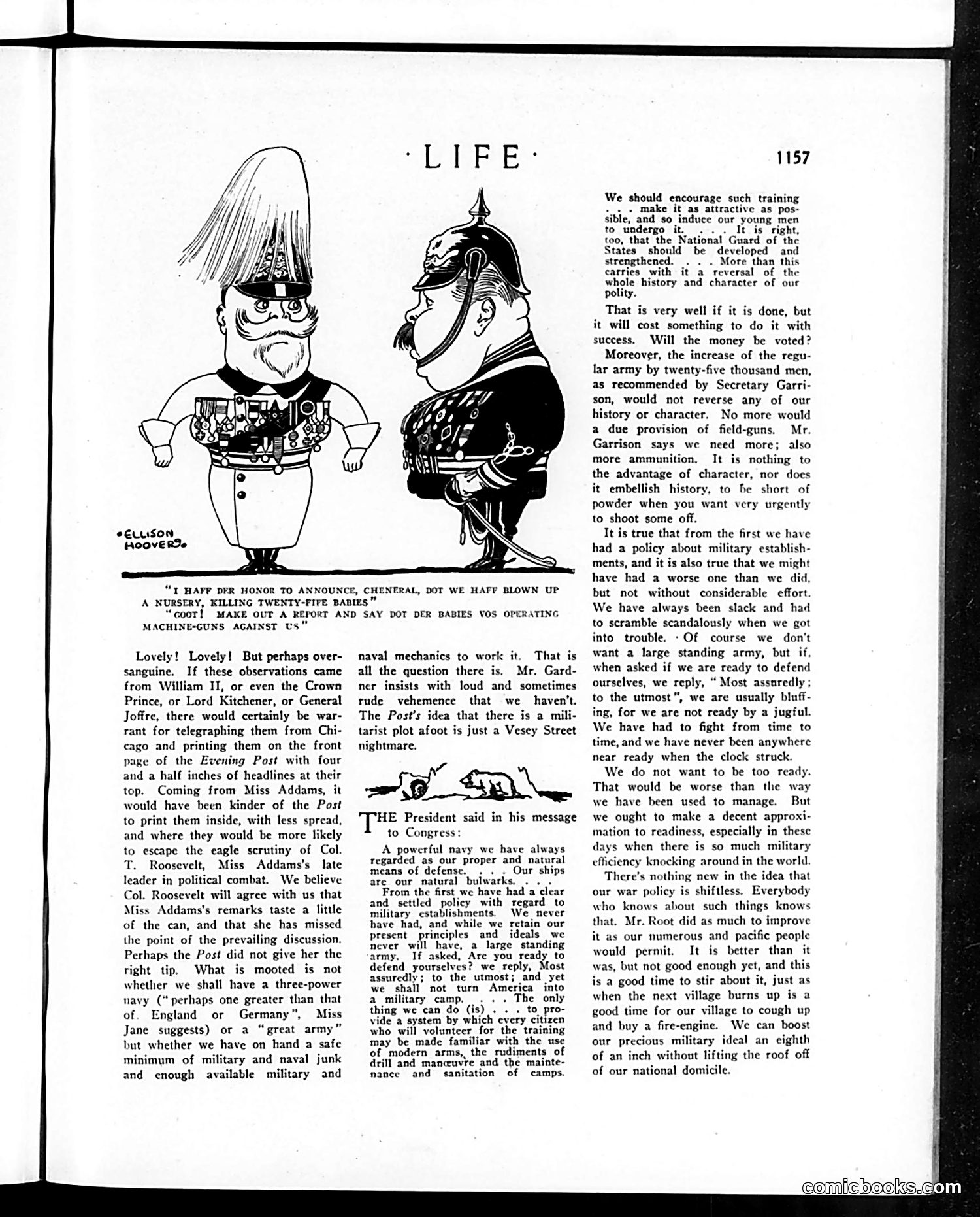
**The Cartoon:** Cartoonist Ellison depicts two military figures in caricatured German uniforms—one with an exaggerated spiked helmet and facial hair, the other similarly styled—discussing the killing of civilians ("twenty-five babies") and destruction of a factory. The German accent ("haff," "cheneral," "dot") underscores the satire. **The Context:** This appears to reference Jane Addams, the pacifist social reformer, who apparently made controversial statements about German military conduct. The surrounding editorial mocks her position, suggesting she was naive or her comments were misused by the *Chicago Evening Post*. The cartoon satirizes German militarism and brutality while simultaneously critiquing American pacifists who might sympathize with or excuse such conduct. **The Point:** The satire juxtaposes German military boasting about civilian casualties against Addams's pacifist rhetoric, implying her anti-militarism is dangerously disconnected from real-world military aggression. The cartoon suggests pacifism, however well-intentioned, ignores genuine threats—a common pre-WWI American debate about military preparedness.
📄 Transcribed text from this page (OCR, searchable)
Machine-transcribed from the original scan — historical spelling and the odd misread are preserved.
eEuuson Hoove Re “Y HAFF DER HONOR TO ANNOUNCE, CHENERAL, DOT WE HAFF BLOWN UP 'SERY, KILLING TWENTY-FIFE BABIES” “coot! MAKE OUT A MACHINE-GUNS AGAINST US” Lovely! Lovely! But perhaps over- sanguine. If these observations came from William II, or even the Crown Prince, or Lord Kitchener, or General Joffre, there would certainly be war- rant for telegraphing them from Chi- cago and printing them on the front page of the Evening Post with four and a half inches of headlines at their top. Coming from Miss Addams, it would have been kinder of the Post to print them inside, with less spread, and where they would be more likely to escape the eagle scrutiny of Col. T. Roosevelt, Miss Addams’s late leader in political combat. We believe Col. Roosevelt will agree with us that Miss Addams's remarks taste a little of the can, and that she has missed the point of the prevailing discussion. Perhaps the Post did not give her the right tip. What is mooted is not whether we shall have a three-power navy (“perhaps one greater than that of. England or Germany”, Miss Jane suggests) or a “great army” but whether we have on hand a safe minimum of military and naval junk and enough available military and RT AND SAY DOT DER BABIES VOS OPERATING naval mechanics to work it. That is all the question there is. Mr. Gard- ner insists with loud and sometimes rude vehemence that we haven't. The Post's idea that there is a mili- tarist plot afoot is just a Vesey Street nightmare. ie So 'HE President said in his message to Congress: A powerful navy we have always regarded as our proper and natural means of defense. . Our ships are our natural bulwarks. . . . From the first we have had a clear and settled policy with regard to military establishments. We never have had, and while we retain our present principles and ideals we never will have, a large standing army. If asked, Are you ready to defend yourselves? we reply, Most assuredly; to the utmost; and yet we shall not turn America into a military camp... . The only thing we can do (is). . . to pro- vide a system by which every citizen who will volunteer for the training may be made familiar with the use of modern arms, the rudiments of drill and manceuvre and the mainte- nance and sanitation of camps. 1157 We should encourage such training +. + make it as attractive as pos- Sible, and so induce our young men to undergo it. ... It is right, too, that the National Guard of the States should be developed and strengthened. + More than this carries with it a reversal of the whole history and character of our polity. That is very well if it is done, but it will cost something to do it with success. Will the money be voted? Moreover, the increase of the regu- lar army by twenty-five thousand men, as recommended by Secretary Garri- son, would not reverse any of our history or character. No more would a due provision of field-guns. Mr. Garrison says we need more; also more ammunition. It is nothing to the advantage of character, nor does it embellish history, to he short of powder when you want very urgently to shoot some off. It is true that from the first we have had a policy about military establish- ments, and it is also true that we might have had a worse one than we did, but not without considerable effort. We have always been slack and had to scramble scandalously when we got into trouble. - Of course we don't want a large standing army, but if, when asked if we are ready to defend ourselves, we reply, “ Most assuredly ; to the utmost”, we are usually bluff- ing, for we are not ready by a jugful. We have had to fight from time to time, and we have never been anywhere near ready when the clock struck. We do not want to be too ready. That would be worse than the way we have been used to manage. But we ought to make a decent approxi- mation to readiness, especially in these days when there is so much military efficiency knocking around in the world. There’s nothing new in the idea that our war policy is shiftless, Everybody who knows about such things knows that. Mr. Root did as much to improve it as our numerous and pacific people would permit. It is better than it was, but not good enough yet, and this is a good time to stir about it, just as when the next village burns up is a good time for our village to cough up and buy a fire-engine. We can boost our precious military ideal an eighth of an inch without lifting the roof off of our national domicile.