
Life, 1914-12-24 · page 28 of 40
Life — December 24, 1914 — page 28: what you’re looking at
What you’re looking at
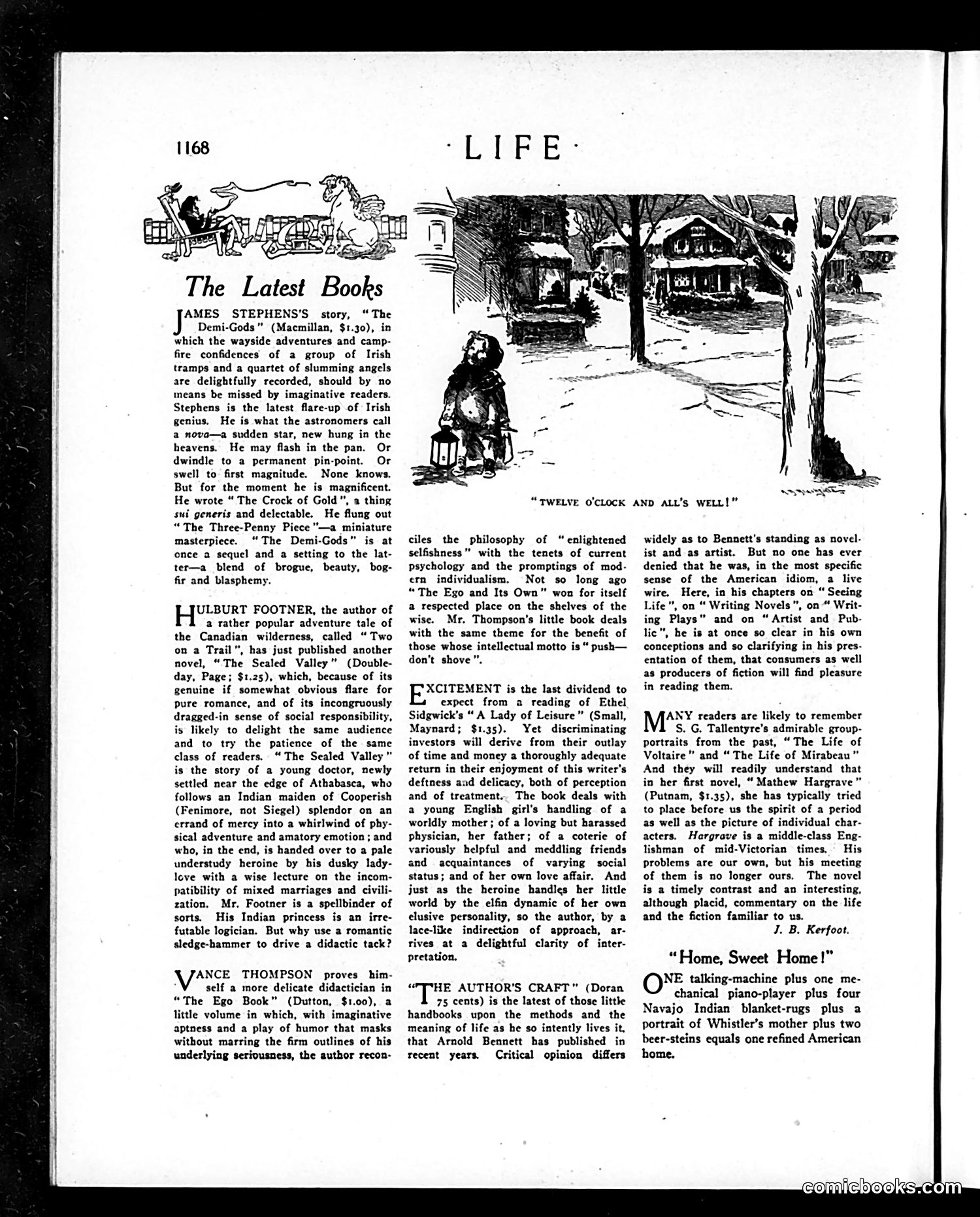
This page is a book review section from Life magazine (page 1168), featuring critical assessments of contemporary literature. The reviews discuss works by James Stephens ("The Demi-Gods"), Hulbert Footner ("The Sealed Valley"), Vance Thompson ("The Ego Book"), Ethel Sidgwick ("A Lady of Leisure"), and Arnold Bennett ("The Author's Craft"). The one illustration shows a figure sitting by a street at "TWELVE O'CLOCK AND ALL'S WELL!"—likely accompanying one of the reviewed books, though the specific connection isn't entirely clear from the visible text. The reviews themselves are straightforward literary criticism typical of early 20th-century magazine culture, evaluating plot, character development, and philosophical merit. There is no apparent political satire or caricature on this page—it functions as a standard cultural commentary section for educated readers interested in contemporary fiction.
📄 Transcribed text from this page (OCR, searchable)
Machine-transcribed from the original scan — historical spelling and the odd misread are preserved.
The Latest Books AMES STEPHENS'S story, “The Demi-Gods” (Macmillan, $1.30), in which the wayside adventures and camp- fire confidences of a group of Irish tramps and a quartet of slumming angels are delightfully recorded, should by no means be missed by imaginative readers. Stephens is the latest flare-up of Irish genius. He is what the astronomers call a nova—a sudden star, new hung in the heavens. He may flash in the pan. Or dwindle to a permanent pin-point. Or swell to first magnitude. None knows. But for the moment he is magnificent. He wrote “ The Crock of Gold”, a thing sui generis and delectable. He flung out “The Three-Penny Piece ”"—a miniature masterpiece. “The Demi-Gods” is at once a sequel and a setting to the lat- ter—a blend of brogue, beauty, bog- fir and blasphemy. ULBURT FOOTNER, the author of a rather popular adventure tale of the Canadian wilderness, called “Two on a Trail”, has just published another novel, “The Sealed Valley” (Double- day, Page; $1.25), which, because of its genuine if somewhat obvious flare for pure romance, and of its incongruously dragged-in sense of social responsibility, is likely to delight the same audience and to try the patience of the same class of readers, “The Sealed Valley” is the story of a young doctor, newly settled near the edge of Athabasca, who follows an Indian maiden of Cooperish (Fenimore, not Siegel) splendor on an errand of mercy into a whirlwind of phy- sical adventure and amatory emotion ; and who, in the end, is handed over to a pale understudy heroine by his dusky lady- love with a wise lecture on the incom- patibility of mixed marriages and civili- zation. Mr. Footner is a spellbinder of sorts. His Indian princess is an irre- futable logician. But why use a romantic sledge-hammer to drive a didactic tack? "ANCE THOMPSON proves him- self a more delicate didactician in “The Ego Book” (Dutton, $1.00), a little volume in which, with imaginative aptness and a play of humor that masks without marring the firm outlines of his underlying seriousness, the author recon- “TWELVE O'CLOCK AND ALL’S WELL!" ciles the philosophy of “enlightened selfishness” with the tenets of current psychology and the promptings of mod- ern individualism. Not so long ago “The Ego and Its Own” won for itself a respected place on the shelves of the wise. Mr. Thompson's little book deals with the same theme for the benefit of those whose intellectual motto is “ push— don’t shove”. XCITEMENT is the last dividend to expect from a reading of Ethel idgwick’s “A Lady of Leisure” (Small, Maynard; $1.35). Yet discriminating investors will derive from their outlay of time and money a thoroughly adequate return in their enjoyment of this writer's deftness and delicacy, both of perception and of treatment... The book deals with a young English girl's handling of a worldly mother; of a loving but harassed physician, her father; of a coterie of variously helpful and meddling friends and acquaintances of varying social status; and of her own love affair. And just as the heroine handles her little world by the elfin dynamic of her own elusive personality, so the author, by a lace-like indirection of approach, ar- rives at a delightful clarity of inter- pretation. “THE AUTHOR'S CRAFT" (Doran 75 cents) is the latest of those litthe handbooks upon the methods and the meaning of life as he so intently lives it, that Arnold Bennett has published in recent years. Critical opinion differs widely as to Bennett's standing as novel- ist and as artist. But no one has ever denied that he was, in the most specific sense of the American idiom, a live wire. Here, in his chapters on “ Secing Life”, on “ Writing Novels”, on “ Writ- ing Plays” and on “Artist and Pub- lic", he is at once so clear in his own conceptions and so clarifying in his pres- entation of them, that consumers as well as producers of fiction will find pleasure in reading them. ANY readers are likely to remember S. G. Tallentyre’s admirable group- portraits from the past, “The Life of Voltaire” and “ The Life of Mirabeau” And they will readily understand that in her first novel, “ Mathew Hargrave” (Putnam, $1.35), she has typically tried to place before us the spirit of a period as well as the picture of individual char- acters. Hargrave is a middle-class Eng- lishman of mid-Victorian times, His problems are our own, but his mecting of them is no longer ours. The novel is a timely contrast and an interesting, although placid, commentary on the life and the fiction familiar to us. J. B. Kerfoot. “Home, Sweet Home!” O*E talking-machine plus one me- chanical piano-player plus four Navajo Indian blanket-rugs plus a portrait of Whistler’s mother plus two beer-steins equals one refined American home.