
Life, 1914-12-24 · page 38 of 40
Life — December 24, 1914 — page 38: what you’re looking at
What you’re looking at
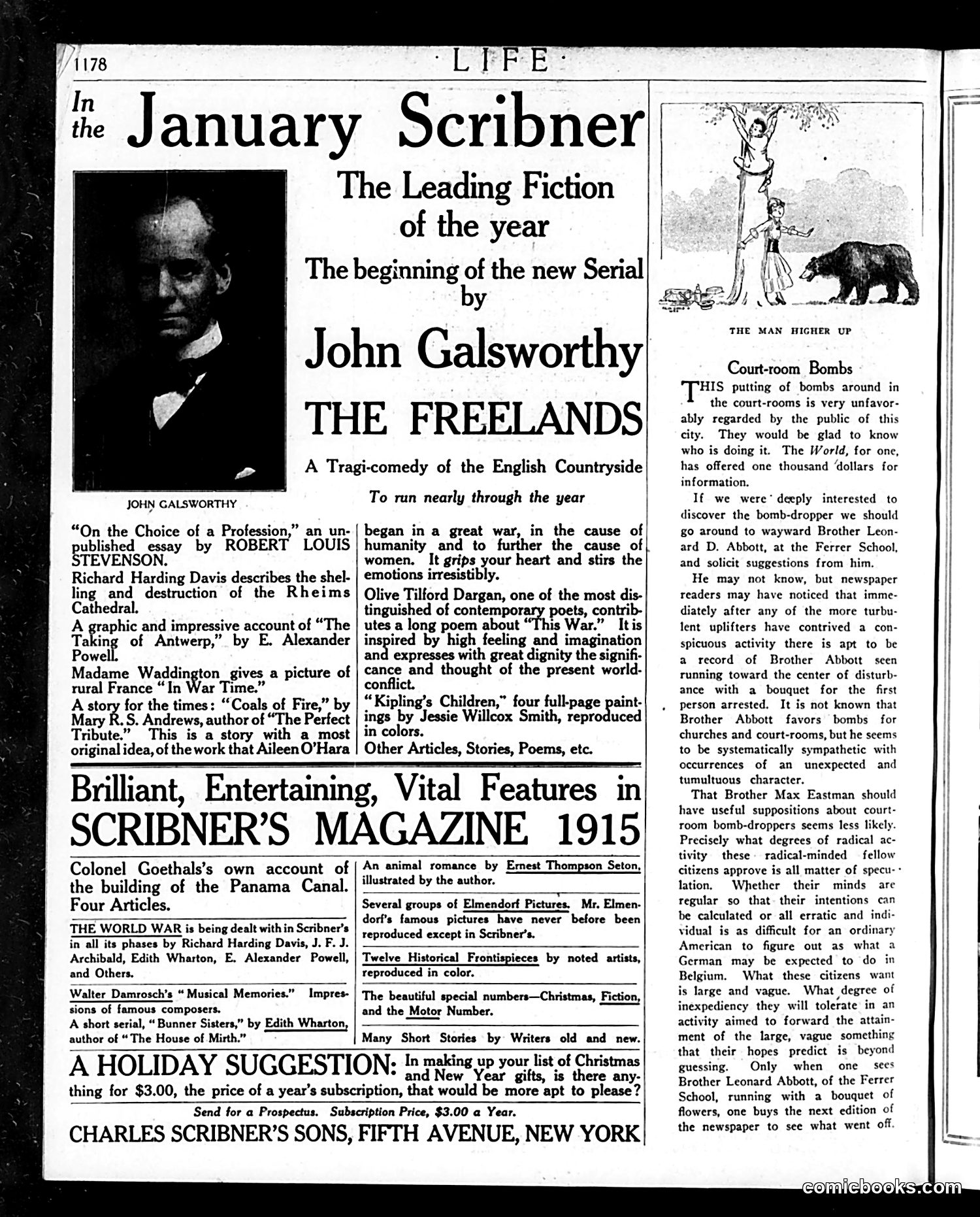
This page is primarily a Scribner's Magazine advertisement, but includes a pointed political cartoon titled "The Man Higher Up" attacking radical activists during a wave of courthouse bombings. The cartoon sarcastically suggests that Brother Leonard D. Abbott of the Ferrer School is complicit in anarchist bombing campaigns. It notes that Abbott conveniently appears at bombing sites with "a bouquet for the first person arrested," implying he supports radical direct action while maintaining plausible deniability. The piece also mentions Max Eastman, another radical intellectual, questioning whether such "radical-minded" citizens genuinely support violent tactics or merely sympathize with radical causes. This reflects genuine 1915 anxieties about anarchist violence and targets real figures associated with radical left activism and the Ferrer School (an anarchist educational institution in New York). The satire suggests radical intellectuals enable bombings through ideological support while distancing themselves from actual violence.
📄 Transcribed text from this page (OCR, searchable)
Machine-transcribed from the original scan — historical spelling and the odd misread are preserved.
The Leading Fiction of the year The beginning cf the new Serial John Galsworthy THE FREELANDS A Tragi-comedy of the English Countryside JOHN GALSWORTHY “On the Choice of a Profession,” an un- ublished essay by ROBERT LOUIS STEVENSON, Richard Harding Davis describes the shel- ling and destruction of the Rheims aera raphic and impressive account of “The RE ing of Antwerp,” by E. Alexander Powe! Madame Waddington. gives a picture of rural France “In Time.” A story for the times: “Coals of Fire,” by Mary R. S. Andrews, author of “The Perfect Tribute.” This is a story with a most original idea, of the work that Aileen O’Hara To run nearly through the year began in a great war, in the cause of humanity and to further the cause of women. It grips your heart and stirs the emotions irresistibly. Olive Tilford Dargan, one of the most dis- tinguished of contemporary poets, contrib- utes a long poem about “This War.” It is inspired by high f feeling and imagination expresses with great dignity the signifi- cance and thought of the present world- conflict. “Kipling’s Children,” four full-page paint- ings by Jessie Willcox Smith, reproduced in colors. Other Articles, Stories, Poems, etc. Brilliant, Entertaining, Vital Features in SCRIBNER’S MAGAZINE 1915 Colonel Goethals’s own account of the building of the Panama Canal. Four Articles. iE WORLD WAR is being dealt with in Scribner's in all its phases by Richard Harding Davis, J. F. J. Archibald, Edith Wharton, E. Alexander Powell, and Others, An animal romance by Emest Thompson Seton, illustrated by the author. Several groups of Elmendort Pictures, Mr. Elmen- dorf’s famous pictures bave never before been reproduced except in Scribner's. Twelve Historical Frontispieces by noted artists, reproduced in color. Walter Damrosch’s “ Musical Memories.” sions of famous composers. A short serial, “ Bunner Sisters,” by Edith Wharton, author of “ The House of Mirth.” Impres- The beautiful special numbers—Christmas, Fiction and the Motor Number. 7 Many Short Stories by Writers old and new. A HOLIDAY SUGGESTION: != patios vo you ist of Chisimes thing for $3.00, the price of a year’s subscription, that would be more apt to please? Send for a Prospectus. Subscription Price, $3.00 a Year. CHARLES SCRIBNER’S SONS, FIFTH AVENUE, NEW YORK THE MAN HIGHER UP Court-room Bombs 'HIS putting of bombs around in the court-rooms is very unfavor- ably regarded by the public of this city. They would be glad to know who is doing it. The World, for one, has offered one thousand ‘dollars for information. If we were’ deeply interested to discover the bomb-dropper we should go around to wayward Brother Leon- ard D. Abbott, at the Ferrer School, and solicit suggestions from him. He may not know, but newspaper readers may have noticed that imme- diately after any of the more turbu- lent uplifters have contrived a con- spicuous activity there is apt to be a record of Brother Abbott seen running toward the center of disturb- ance with a bouquet for the first person arrested. It is not known that Brother Abbott favors bombs for churches and court-rooms, but he seems to be systematically sympathetic with occurrences of an unexpected and tumultuous character. That Brother Max Eastman should have useful suppositions about court- room bomb-droppers seems less likely. Precisely what degrees of radical ac- tivity these radical-minded fellow citizens approve is all matter of specu-- lation. Whether their minds are regular so that their intentions can be calculated or all erratic and indi- vidual is as difficult for an ordinary American to figure out as what a German may be expected to do in Belgium. What these citizens want is large and vague. What degree of inexpediency they will tolerate in an activity aimed to forward the attain- ment of the large, vague something that their hopes predict is beyond guessing. Only when one sees Brother Leonard Abbott, of the Ferrer School, running with a bouquet of flowers, one buys the next edition of the newspaper to see what went off.