
Life, 1914-12-24 · page 23 of 40
Life — December 24, 1914 — page 23: what you’re looking at
What you’re looking at
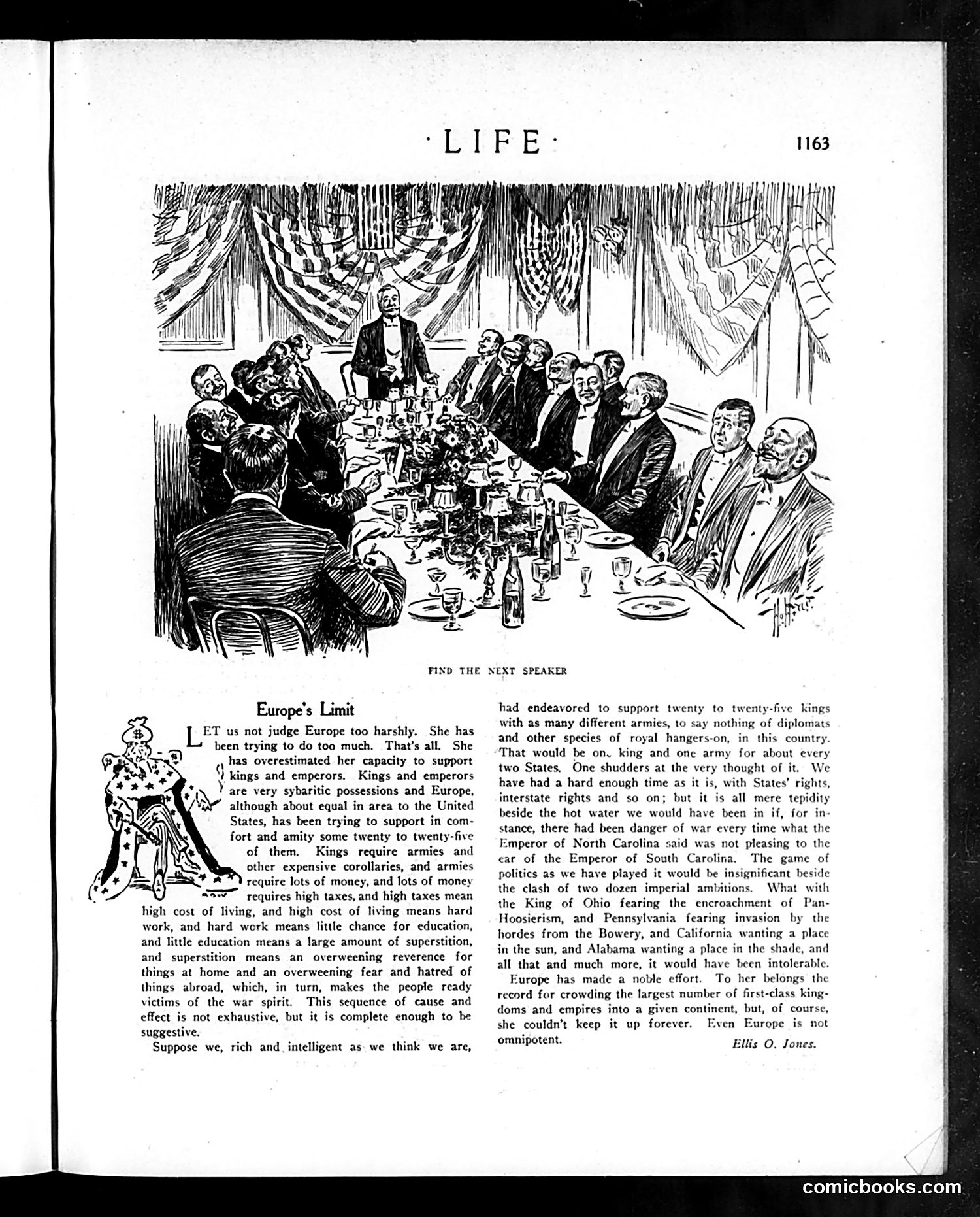
**The Cartoon:** Shows a formal dinner with men in evening dress seated around a table. One man stands to speak while others listen—the caption "Find the Next Speaker" suggests a parlor game identifying who will speak next. **The Satire:** Ellis O. Jones uses this scene to mock European political instability. The article argues Europe's fundamental problem is supporting too many kings and emperors (roughly 20-25) across a continent similar in size to the United States. **The Point:** Jones creates a logical chain: maintaining monarchies requires expensive armies, which require high taxes, which impoverish citizens, limiting education and breeding superstition, fear, and nationalism—thus causing war. He humorously contrasts this by imagining if American *states* each had their own kings (Ohio, Pennsylvania, Carolina emperors), showing how absurd and destructive such arrangements would be. **Context:** This reflects post-WWI American skepticism toward European monarchy and suggests republicanism's superiority—a common Progressive-era argument.
📄 Transcribed text from this page (OCR, searchable)
Machine-transcribed from the original scan — historical spelling and the odd misread are preserved.
FIND THE NEXT SPEAKER ET us not judge Europe too harshly, She has been trying to do too much. That's all. She has overestimated her capacity to support SV kings and emperors. Kings and emperors are very sybaritic possessions and Europe, although about equal in area to the United States, has been trying to support in com- fort and amity some twenty to twenty-five of them. Kings require armies and other expensive corollaries, and armies require lots of money, and lots of money requires high taxes, and high taxes mean high cost of living, and high cost of living means hard work, and hard work means little chance for education, and little education means a large amount of superstition, and superstition means an overweening reverence for things at home and an overweening fear and hatred of things abroad, which, in turn, makes the people ready victims of the war spirit. This sequence of cause and effect is not exhaustive, but it is complete enough to be suggestive. Suppose we, rich and_ intelligent as. we think we are, —=— aw had endeavored to support twenty to twenty-five kings with as many different armies, to say nothing of diplomats and other species of royal hangers-on, in this country. That would be on. king and one army for about every two States. One shudders at the very thought of it. We have had a hard enough time as it is, with States’ rights, interstate rights and so on; but it is all mere tepidity beside the hot water we would have been in if, for in- stance, there had been danger of war every time what the Emperor of North Carolina said was not pleasing to the ear of the Emperor of South Carolina. The game of politics as we have played it would be insignificant beside the clash of two dozen imperial ambitions. What with the King of Ohio fearing the encroachment of Pan- Hoosierism, and Pennsylvania fearing invasion by the hordes from the Bowery, and California wanting a place in the sun, and Alabama wanting a place in the shade, and all that and much more, it would have been intolerable. Europe has made a noble effort. To her belongs the record for crowding the largest number of first-class king- doms and empires into a given continent, but, of course, she couldn’t keep it up forever. Even Europe is not omnipotent. Ellis O. Jones. comicbooks.com