
Life, 1914-12-24 · page 8 of 40
Life — December 24, 1914 — page 8: what you’re looking at
What you’re looking at
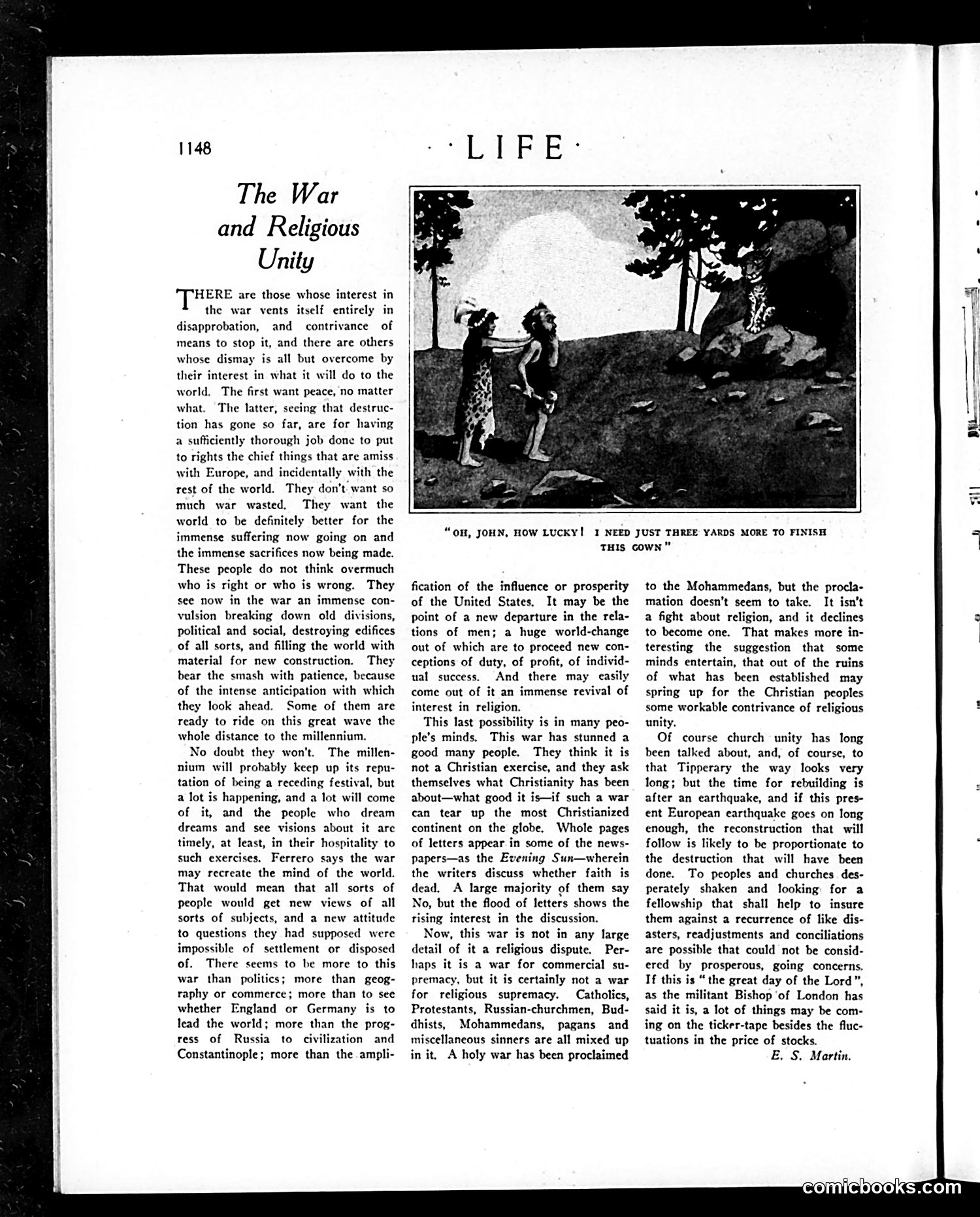
The illustration depicts two figures in a pastoral setting, with a caption reading "Oh, John, how lucky! I need just three yards more to finish this gown." This cartoon satirizes the disconnect between civilians' mundane concerns and the catastrophic war occurring around them. While soldiers fight and die, a woman focuses entirely on completing a dress—needing just three more yards of fabric. The satire suggests how ordinary life continues obliviously during wartime, or how civilian priorities seem trivial against massive human suffering. The accompanying article discusses how WWI has prompted religious reflection across different faiths—Catholics, Protestants, Buddhists, Mohammedans—all questioning war's compatibility with their beliefs. The cartoon implicitly critiques this civilian detachment, suggesting people remain absorbed in petty domestic matters rather than grappling with the war's moral implications.
📄 Transcribed text from this page (OCR, searchable)
Machine-transcribed from the original scan — historical spelling and the odd misread are preserved.
The War and Religious Unity HERE are those whose interest in the war vents itself entirely in disapprobation, and contrivance of means to stop it, and there are others whose dismay is all but overcome by their interest in what it will do to the world, The first want peace, no matter what. The latter, seeing that destruc- tion has gone so far, are for having a sufficiently thorough job done to put to rights the chief things that are amiss with Europe, and incidentally with the rest of the world. They don’t want so much war wasted. They want the world to be definitely better for the immense suffering now going on and the immense sacrifices now being made. These people do not think overmuch who is right or who is wrong. They see now in the war an immense con- vulsion breaking down old divisions, political and social, destroying edifices of all sorts, and filling the world with material for new construction. They bear the smash with patience, because of the intense anticipation with which they look ahead. Some of them are ready to ride on this great wave the whole distance to the millennium. No doubt they won't. The millen- nium will probably keep up its repu- tation of being a receding festival, but a lot is happening, and a lot will come of it, and the people who dream dreams and see visions about it are timely, at least, in their hospitality to such exercises. Ferrero says the war may recreate the mind of the world. That would mean that all sorts of people would get new views of all sorts of subjects, and a new attitude to questions they had supposed were impossible of settlement or disposed of. There seems to be more to this war than politics; more than geog- raphy or commerce; more than to see whether England or Germany is to lead the world; more than the prog- ress of Russia to civilization and Constantinople; more than the ampli- “OH, JOHN, HOW LUCKY! 1 NEED JUST THREE YARDS MORE TO FINISH THIS GOWN” fication of the influence or prosperity of the United States. It may be the point of a new departure in the rela- tions of men; a huge world-change out of which are to proceed new con- ceptions of duty, of profit, of individ- ual success. And there may easily come out of it an immense revival of interest in religion. This last possibility is in many peo- ple’s minds, This war has stunned a good many people. They think it is not a Christian exercise, and they ask themselves what Christianity has been about—what good it is—if such a war can tear up the most Christianized continent on the globe. Whole pages of letters appear in some of the news- papers—as the Evening Sun—wherein the writers discuss whether faith is dead. A large majority of them say No, but the flood of letters shows the rising interest in the discussion. Now, this war is not in any large detail of it a religious dispute. Per- haps it is a war for commercial su- premacy, but it is certainly not a war for religious supremacy. Catholics, Protestants, Russian-churchmen, Bud- dhists, Mohammedans, pagans and miscellaneous sinners are all mixed up in it, A holy war has been proclaimed to the Mohammedans, but the procla- mation doesn’t seem to take. It isn’t a fight about religion, and it declines to become one. That makes more in- teresting the suggestion that some minds entertain, that out of the ruins of what has been established may spring up for the Christian peoples some workable contrivance of religious unity. Of course church unity has long been talked about, and, of course, to that Tipperary the way looks very long; but the time for rebuilding is after an earthquake, and if this pres- ent European earthquake goes on long enough, the reconstruction that will follow is likely to be proportionate to the destruction that will have been done. To peoples and churches des- perately shaken and looking for a fellowship that shall help to insure them against a recurrence of like dis- asters, readjustments and conciliations are possible that could not be consid- ered by prosperous, going concerns. If this is “the great day of the Lord”, as the militant Bishop ‘of London has said it is, a lot of things may be com- ing on the ticker-tape besides the fluc- tuations in the price of stocks. E. S. Martin.