
Life, 1914-12-24 · page 16 of 40
Life — December 24, 1914 — page 16: what you’re looking at
What you’re looking at
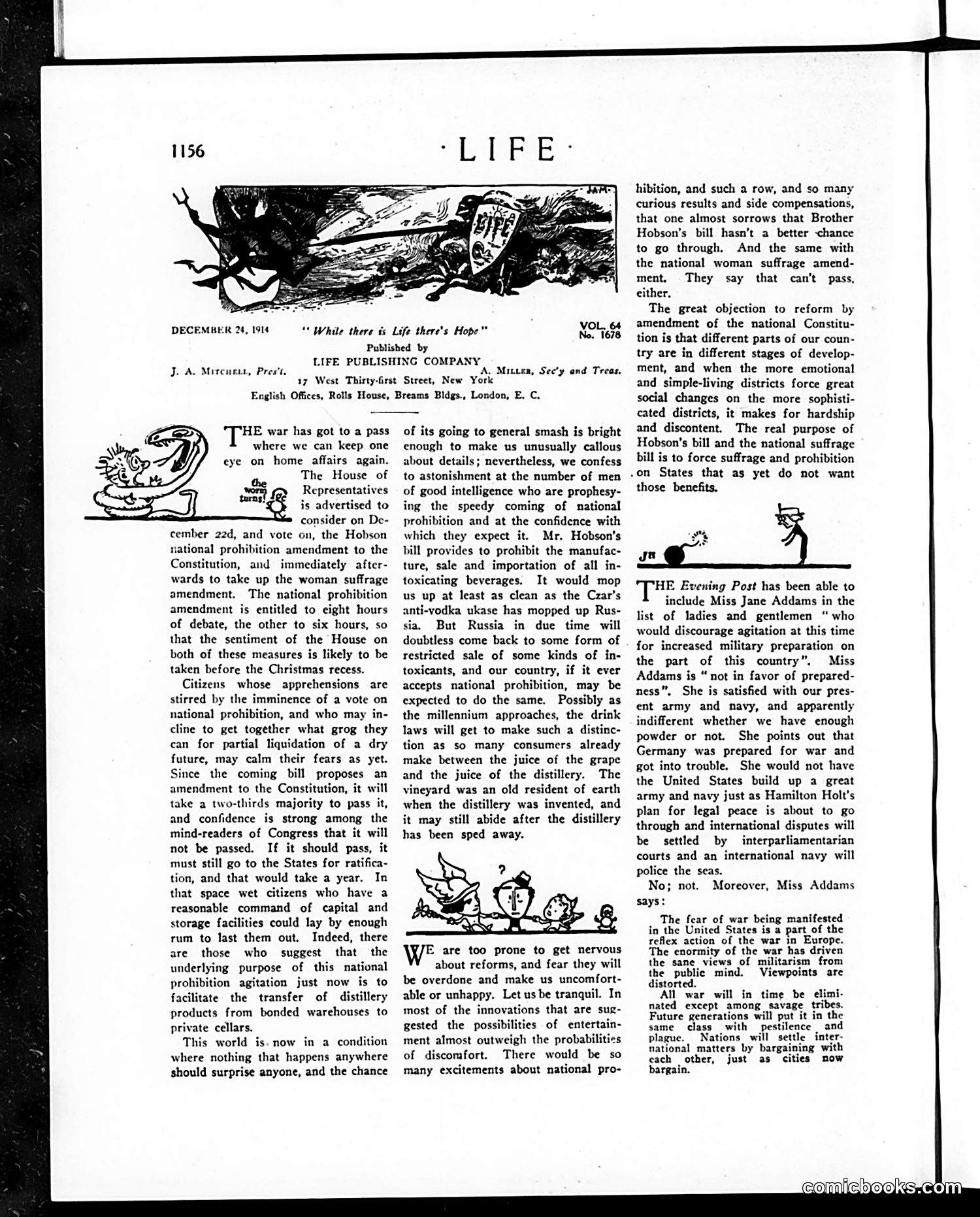
This page discusses two pending Constitutional amendments: national prohibition (the Hobson bill) and women's suffrage. The author adopts a cynical, detached tone befitting wartime (WWI is ongoing), arguing that both measures likely won't pass but wouldn't be catastrophic if they did. The satire targets: 1. **Prohibition advocates**: The piece mocks their confidence while noting the amendment requires two-thirds Congressional approval plus state ratification—a lengthy process. It suggests "wet" citizens opposed to prohibition could stockpile alcohol during the ratification year. 2. **Reform anxiety**: The author ridicules Americans who fear reforms will be "overdone," suggesting the entertainment value of watching national prohibition and suffrage debates would almost compensate for their implementation. 3. **Constitutional inflexibility**: The real critique focuses on using Constitutional amendments for piecemeal reforms, since different U.S. regions develop at different rates, making uniform national mandates problematic. The cartoons (small illustrations) appear decorative rather than carrying specific commentary.
📄 Transcribed text from this page (OCR, searchable)
Machine-transcribed from the original scan — historical spelling and the odd misread are preserved.
DECEMBER 24, 1914 “While there ts Life there’s Hope" VOL. 64 No. 1678 Published by LIFE PUBLISHING COMPANY 17 West Thirty-first Street, New York English Offices, Rolls House, Breams Bldgs. London, E. C. J. A. Mircusit, Pres’t. 'HE war has got to a pass where we can keep one eye on home affairs again. The House of Representatives is advertised to consider on De- cember 22d, and vote on, the Hobson national prohibition amendment to the Constitution, and immediately after- wards to take up the woman suffrage amendment. The national prohibition amendment is entitled to eight hours of debate, the other to six hours, so that the sentiment of the House on both of these measures is likely to be taken before the Christmas recess. Citizens whose apprehensions are stirred by the imminence of a vote on national prohibition, and who may in- cline to get together what grog they can for partial liquidation of a dry future, may calm their fears as yet. Since the coming bill proposes an amendment to the Constitution, it will take a two-thirds majority to pass it, and confidence is strong among the mind-readers of Congress that it will not be passed. If it should pass, it must still go to the States for ratifica- tion, and that would take a year. In that space wet citizens who have a reasonable command of capital and storage facilities could lay by enough rum to last them out. Indeed, there are those who suggest that the underlying purpose of this national prohibition agitation just now is to facilitate the transfer of distillery products from bonded warehouses to private cellars. This world is. now in a condition where nothing that happens anywhere should surprise anyone, and the chance A. Muuse, Sec’y and Treas. of its going to general smash is bright enough to make us unusually callous about details; nevertheless, we confess to astonishment at the number of men of good intelligence who are prophesy- ing the speedy coming of national prohibition and at the confidence with which they expect it. Mr. Hobson's bill provides to prohibit the manufac- ture, sale and importation of all in- toxicating beverages. It would mop us up at least as clean as the Czar’s anti-vodka ukase has mopped up Rus- sia, But Russia in due time will doubtless come back to some form of restricted sale of some kinds of in- toxicants, and our country, if it ever accepts national prohibition, may be expected to do the same. Possibly as the millennium approaches, the drink laws will get to make such a distinc- tion as so many consumers already make between the juice of the grape and the juice of the distillery. The vineyard was an old resident of earth when the distillery was invented, and it may still abide after the distillery has been sped away. WE are too prone to get nervous about reforms, and fear they will be overdone and make us uncomfort- able or unhappy. Let us be tranquil. In most of the innovations that are sug- gested the possibilities of entertain- ment almost outweigh the probabilities of discomfort. There would be so many excitements about national pro- hibition, and such a row, and so many curious results and side compensations, that one almost sorrows that Brother Hobson’s bill hasn't a better chance to go through. And the same with the national woman suffrage amend- ment. They say that can’t pass, either, The great objection to reform by amendment of the national Constitu- tion is that different parts of our coun- try are in different stages of develop- ment, and when the more emotional and simple-living districts force great social changes on the more sophisti- cated districts, it makes for hardship and discontent. The real purpose of Hobson’s bill and the national suffrage bill is to force suffrage and prohibition .on States that as yet do not want those benefits. 'HE Evening Post has been able to include Miss Jane Addams in the list of ladies and gentlemen “ who would discourage agitation at this time for increased military preparation on the part of this country”. Miss Addams is “ not in favor of prepared- ness”, She is satisfied with our pres- ent army and navy, and apparently indifferent whether we have enough powder or not. She points out that Germany was prepared for war and got into trouble, She would not have the United States build up a great army and navy just as Hamilton Holt’s plan for legal peace is about to go through and international disputes will be settled by interparliamentarian courts and an international navy will police the seas. No; not. Moreover, Miss Addams says: The fear of war being manifested in the United States is a part of the reflex action of the war in Europe. The enormity of the war has driven the sane views of militarism from the public mind. Viewpoints are distorted. All war will in time be elimi- nated except among savage tribes. Future generations will put it in the same class with pestilence and plague, Nations will settle inter- national matters by bargaining with cach other, just as cities now bargain.