
Life, 1914-12-24 · page 25 of 40
Life — December 24, 1914 — page 25: what you’re looking at
What you’re looking at
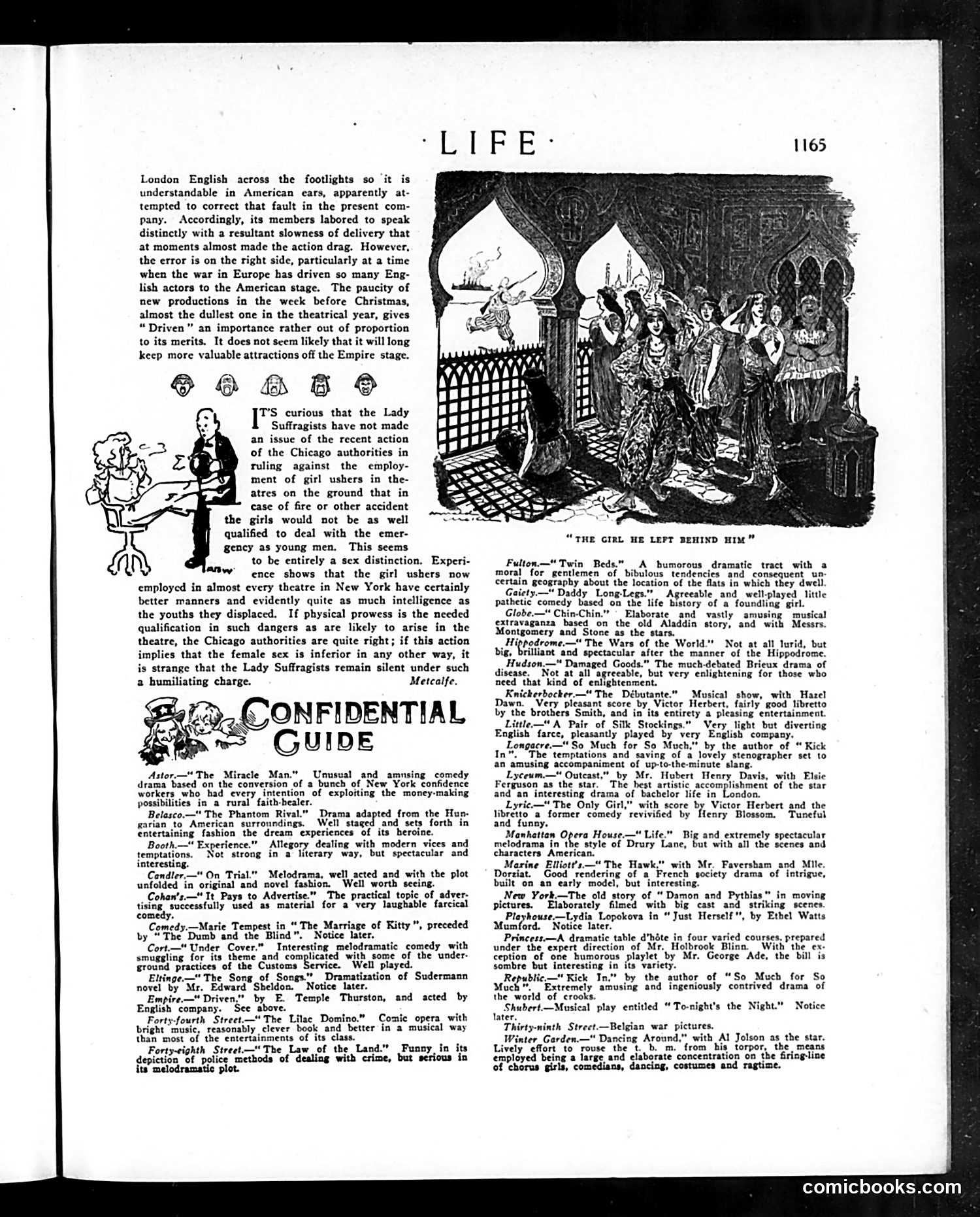
This page contains theater reviews and two related cartoons critiquing gender discrimination. The small cartoon on the left shows a man dismissing a woman's complaint—satirizing how women's concerns are often ignored. The main cartoon, titled "The Girl He Left Behind Him," illustrates the article's central argument: Chicago authorities had banned female ushers from theaters, claiming women couldn't handle emergencies as well as men. The author "Metcalfe" finds this sexist and hypocritical, noting that female ushers in New York theaters demonstrate equal intelligence and better manners than their male counterparts. He expresses bewilderment that women suffragists haven't protested this discriminatory ruling—a pointed jab suggesting they should be outraged by such blatant sex-based exclusion. The satire targets both Chicago's paternalistic logic and the apparent passivity of the suffrage movement on this particular issue.
📄 Transcribed text from this page (OCR, searchable)
Machine-transcribed from the original scan — historical spelling and the odd misread are preserved.
London English across the footlights so ‘it is understandable in American ears, apparently at- tempted to correct that fault in the present com- pany. Accordingly, its members labored to speak distinctly with a resultant slowness of delivery that at moments almost made the action drag. However, the error is on the right side, particularly at a time when the war in Europe has driven so many Eng- lish actors to the American stage. The paucity of new productions in the week before Christmas, almost the dullest one in the theatrical year, gives “Driven” an importance rather out of proportion to its merits. It does not seem likely that it will long keep more valuable attractions off the Empire stage. oo BB % T’S curious that the Lady Suffragists have not made an issue of the recent action of the Chicago authorities in ruling against the employ- ment of girl ushers in the- atres on the ground that in case of fire or other accident the girls would not be as well qualified to deal with the emer- gency as young men. This seems to be entirely a sex distinction. Experi- afiw' ence shows that the girl ushers now employed in almost every theatre in New York have certainly better manners and evidently quite as much intelligence as the youths they displaced. If physical prowess is the needed qualification in such dangers as are likely to arise in the theatre, the Chicago authorities are quite right; if this action implies that the female sex is inferior in any other way, it is strange that the Lady Suffragists remain silent under such a humiliating charge. Metcalfe. ONFIDENTIAL pour Astor.—" The Miracle Man." Unusual and a drama based on the conversion of a bunch of New intention of exploiting the money-making ities in a rural faith-bealer. Belasco.—" The Phantom Rival." Ds garian to American surroundings. Well staged and sets forth in Drama adapted from the Hun- entertaining fashion the dream experiences of its heroine. Booth.—" Experience.” Allegory dealing with modern vices and temptations. Not strong in a literary way, but spectacular and interesting. Condler.—" On Trial." Melodrama, well acted and with the plot unfolded in original and novel fashion. Well worth seeing. w’s.—" It Pays to Advertise.” The practical topic of adver. vst Tuccesstully used as material for a very laughable. farcical comedy. Comedy.—Marie Tempest in “ The Marriage of Kitty”, preceded by “The Dumb and the Blind”. Notice later. Cort.—" Under Cover." Interesting melodramatic comedy with smuggling for its theme and complicated with some of the under- ground practices of the Customs Service. Well played. Eltinge—" The Song of Songs.” Dramatization of Sudermann novel by Mr. Edward Sheldon. Notice later. Empire—" Driven.” by E. Temple Thurston, and acted by English company. See above. : Forty-fourth Street.—" The Lilac Domino." Comic opera with bright music, reasonably clever book and better in a musical way than most of the entertainments of its cl . Forty-eighth Street—"The Law of the Land.” depiction of police methods of dealing with crime, its melodramatic plot. Funny. in its but setious in “THE GIRL HE LEPT BEHIND HIM” Fulton.—" Twin Beds." A humorous dramatic tract with a moral for gentlemen of bibulous tendencies and consequent un- certain geography about the location of the flats in which they dwell. Gaiety.—" Daddy Long-Legs.” Agreeable and well-played little pathetic comedy based on the life history of a foundling git Globe.—" Chin-Chin.” | Elaborate and vastly amusing musical extravaganza based on the old Aladdin story, and with Messrs. Montgomery and Stone as the stars. _Hithodrome.— The Wars of the World.” Not at all lurid, but big, brilliant and spectacular after the manner of the Hippodrome. _Hudson.—" Damaged Goods.” The much-debated Brieux drama of disease. Not at all agreeable, but very enlightening for those who need that kind of enlightenment. Knickerbocker—" The Débutante.” Musical show, with Hazel Dawn. Very pleasant score by Victor Herbert, fairly good libretto by the brothers Smith, and in its entirety a pleasing entertainment, Little—" A Pair of Silk Stockings.” Very light but diverting English farce, pleasantly played by very English company. Longacre —"So Much for So Much.” by the author of “ Kick we The temptations and saving of a lovely stenographer set to an amusing accompaniment of up-to-the-minute slang. Lyceum—" Outeast,""_by Mr. Hubert Henry Davis, with Elsie Ferguson as the The best artistic accomplishment of the star and'an interesting drama of bachelor life in London. The Only Girl,” with score by Victor Herbert and the former comedy revivified by Henry Blossom. Tuneful Manhattan Opera House.—" Life.” Big and extremely spectacular melodrama in the style of Drury Lane, but with all the scenes and characters American. Merine Eltiott’s— The Hawk,” with Mr. Faversham and Mile. Dorziat. Good rendering of a French society drama of intrigue, built on an early model, but interesting. New York.—The old story of “Damon and Pythias” in moving pictures. Elaborately filmed with big cast and striking scenes. Playhouse.—Lydia Lopokova in “Just Herself", by Ethel Watts Mumford. Notice later. Princest—A dramatic table d’héte in four varied courses, prepared under the expert direction of Mr. Holbrook Blinn. the ex- ception of one humorous playlet ‘by Mr. George Ade, the bill is sombre but interesting in its variety. Republic.—" Kick In." by the author of “So Much for So Much". Extremely amusing and ingeniously contrived drama of the world of crooks. 7 Shubert.—Musical play entitled “To-night’s the Night.” later. Thirty-ninth Strect—Belgian war pictures. Winter Garden.—" Dancing Around,” with Al Jolson as the star. Lively effort to rouse the tb. m. from his torpor, the means employed being a large and elaborate concentration on the fring-line of chorus ‘comedians, dancing, costumes and ragtime. Notice comicbooks.com