
Life, 1914-12-24 · page 32 of 40
Life — December 24, 1914 — page 32: what you’re looking at
What you’re looking at
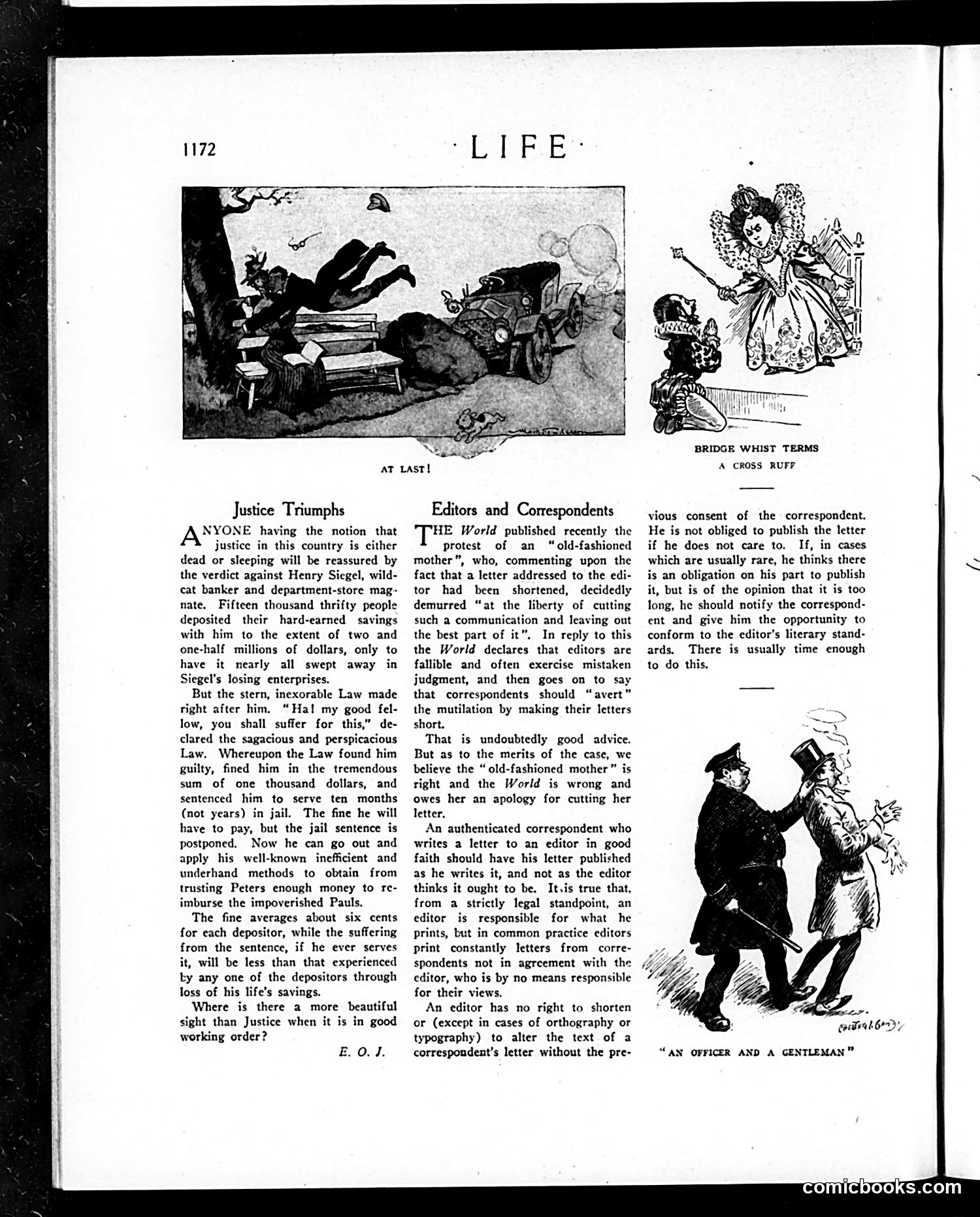
This page contains two distinct editorial pieces satirizing American institutions: **"Justice Triumphs"** mocks the Henry Siegel case—a banker who defrauded 15,000 depositors of $2.5 million. The cartoon shows Siegel's arrest. The satire's bite: despite his massive fraud, he received only a $1,000 fine (six cents per victim) and a suspended jail sentence. The author sarcastically calls this "beautiful" justice, highlighting how inadequate legal consequences were for wealthy financial criminals compared to ordinary people's losses. **"Editors and Correspondents"** debates editorial ethics. It supports an "old-fashioned mother" who protested a newspaper cutting her letter without permission, arguing editors have no right to alter reader submissions without consent—even if they disagree with the views expressed. This defends correspondent autonomy against editorial censorship. The illustrations are period cartoons unrelated to the main text (bridge whist, a gentleman and officer).
📄 Transcribed text from this page (OCR, searchable)
Machine-transcribed from the original scan — historical spelling and the odd misread are preserved.
AT Last! Justice Triumphs ANYONE having the notion that justice in this country is cither dead or sleeping will be reassured by the verdict against Henry Siegel, wild- cat banker and department-store mag- nate. Fifteen thousand thrifty people deposited their hard-earned savings with him to the extent of two and one-half millions of dollars, only to have it nearly all swept away in Siegel’s losing enterprises. But the stern, inexorable Law made right after him. “Ha! my good fel- low, you shall suffer for this,” de- clared the sagacious and perspicacious Law. Whereupon the Law found him guilty, fined him in the tremendous sum of one thousand dollars, and sentenced him to serve ten months (not years) in jail. The fine he will have to pay, but the jail sentence is postponed. Now he can go out and apply his well-known inefficient and underhand methods to obtain from trusting Peters enough money to re- imburse the impoverished Pauls. The fine averages about six cents for each depositor, while the suffering from the sentence, if he ever serves it, will be less than that experienced ty any one of the depositors through loss of his life’s savings. Where is there a more beautiful sight than Justice when it is in good working order? B.O.:5; Editors and Correspondents TH! World published recently the protest of an “old-fashioned mother”, who, commenting upon the fact that a letter addressed to the edi- tor had been shortened, decidedly demurred “at the liberty of cutting such a communication and leaving out the best part of it”. In reply to this the World declares that editors are fallible and often exercise mistaken judgment, and then goes on to say that correspondents should “avert” the mutilation by making their letters short. That is undoubtedly good advice. But as to the merits of the case, we believe the “old-fashioned mother” is right and the World is wrong and owes her an apology for cutting her letter, An authenticated correspondent who writes a letter to an editor in good faith should have his letter published as he writes it, and not as the editor thinks it ought to be. It,is true that, from a strictly legal standpoint, an editor is responsible for what he prints, but in common practice editors print constantly letters from corre- spondents not in agreement with the editor, who is by no means responsible for their views. An editor has no right to shorten or (except in cases of orthography or typography) to alter the text of a correspondent’s letter without the pre- BRIDGE WHIST TERMS A CROSS RUFF vious consent of the correspondent. He is not obliged to publish the letter if he does not care to. If, in cases which are usually rare, he thinks there is an obligation on his part to publish it, but is of the opinion that it is too long, he should notify the correspond- ent and give him the opportunity to conform to the editor’s literary stand- ards. There is usually time enough to do this. cere Trlr “AN OFFICER AND A GENTLEMAN” Ccomicbooks.com