
Life, 1914-12-24 · page 33 of 40
Life — December 24, 1914 — page 33: what you’re looking at
What you’re looking at
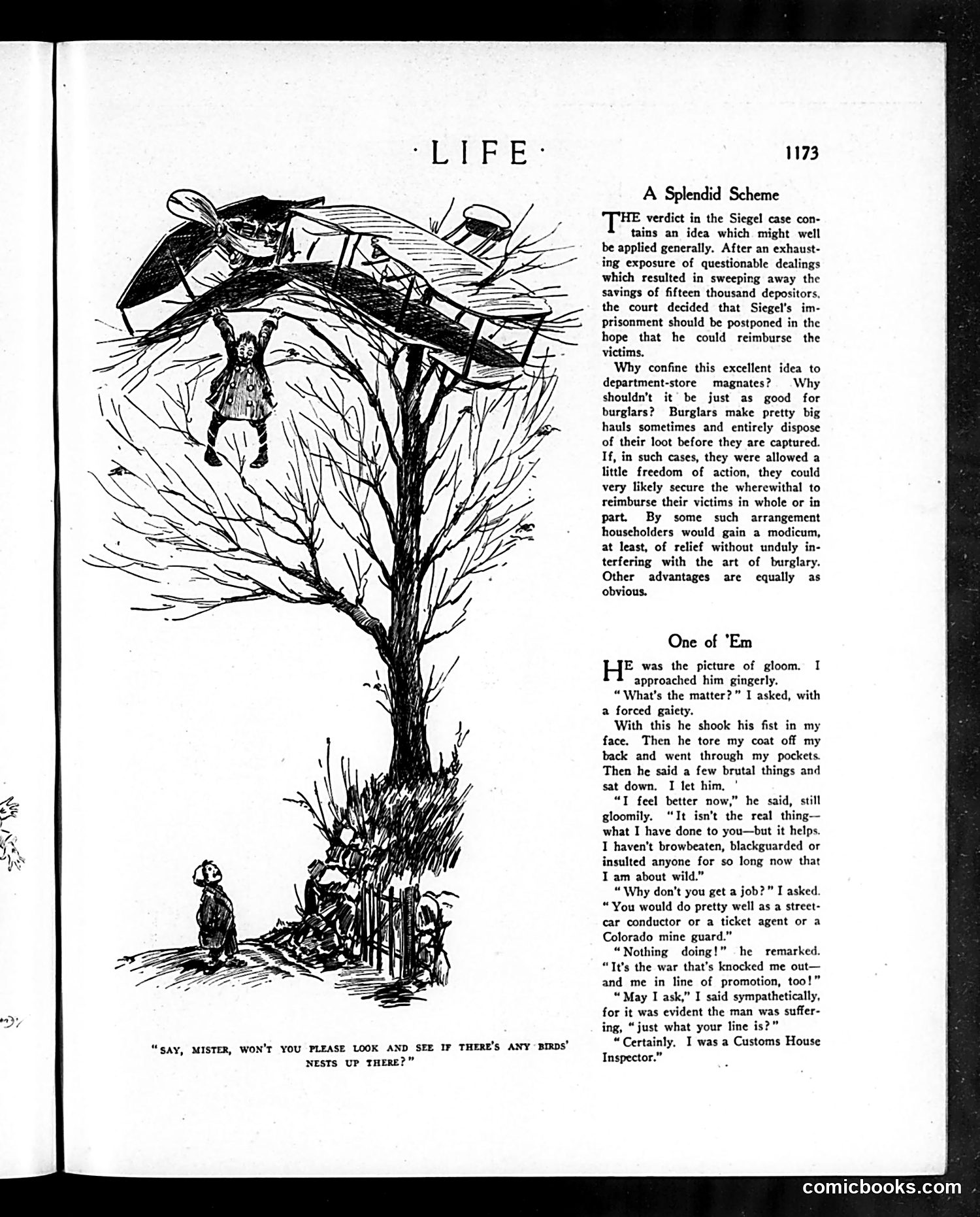
This Life magazine page satirizes the Siegel case verdict through two pieces: **"A Splendid Scheme"** (main article): Mocks a court decision allowing financier Siegel postponed imprisonment so he could reimburse defrauded depositors. The satire extends this "logic" absurdly to burglars—if wealthy swindlers get freedom to make restitution, why not criminals? The joke exposes the hypocrisy of treating white-collar crime more leniently than street crime. **"One of 'Em"** (narrative): A man, formerly a Customs House Inspector (government worker), is now unemployed and emotionally unstable due to "the war" disrupting his career advancement. He vents frustration violently on the narrator. The piece satirizes post-WWI displacement—how returning soldiers and displaced government workers, stripped of employment and purpose, became destabilized and potentially dangerous to society. The illustration of a bare tree with nesting birds appears decorative rather than directly illustrative of these texts.
📄 Transcribed text from this page (OCR, searchable)
Machine-transcribed from the original scan — historical spelling and the odd misread are preserved.
1173 A Splendid Scheme T# verdict in the Siegel case con- tains an idea which might well be applied generally. After an exhaust- ing exposure of questionable dealings which resulted in sweeping away the savings of fifteen thousand depositors, the court decided that Siegel's im- prisonment should be postponed in the hope that he could reimburse the victims. Why confine this excellent idea to department-store magnates? Why shouldn't it’ be just as good for burglars? Burglars make pretty big hauls sometimes and entirely dispose of their loot before they are captured. If, in such cases, they were allowed a little freedom of action, they could very likely secure the wherewithal to reimburse their victims in whole or in part. By some such arrangement householders would gain a modicum, at least, of relief without unduly in- terfering with the art of burglary. Other advantages are equally as obvious. One of ‘Em E was the picture of gloom. I approached him gingerly. “What's the matter?” I asked, with a forced gaiety. With this he shook his fist in my face. Then he tore my coat off my back and went through my pockets. Then he said a few brutal things and sat down. I let him, ' “I feel better now,” he said, still gloomily. “It isn’t the real thing— what I have done to you—but it helps. I haven't browbeaten, blackguarded or insulted anyone for so long now that I am about wild.” “Why don’t you get a job?” I asked. “You would do pretty well as a strect- car conductor or a ticket agent or a Colorado mine guard.” “Nothing doing!” he remarked. “It's the war that's knocked me out— and me in line of promotion, too!” “May I ask,” I said sympathetically, for it was evident the man was suffer- ing, “just what your line is?” “Certainly. I was a Customs House “SAY, MISTER, WON'T YOU PLEASE LOOK AND SEE IF THERE'S ANY BIRDS’ a NESTS UP THERE?” Inspector.’ comicbooks.com