
Life, 1914-12-24 · page 18 of 40
Life — December 24, 1914 — page 18: what you’re looking at
What you’re looking at
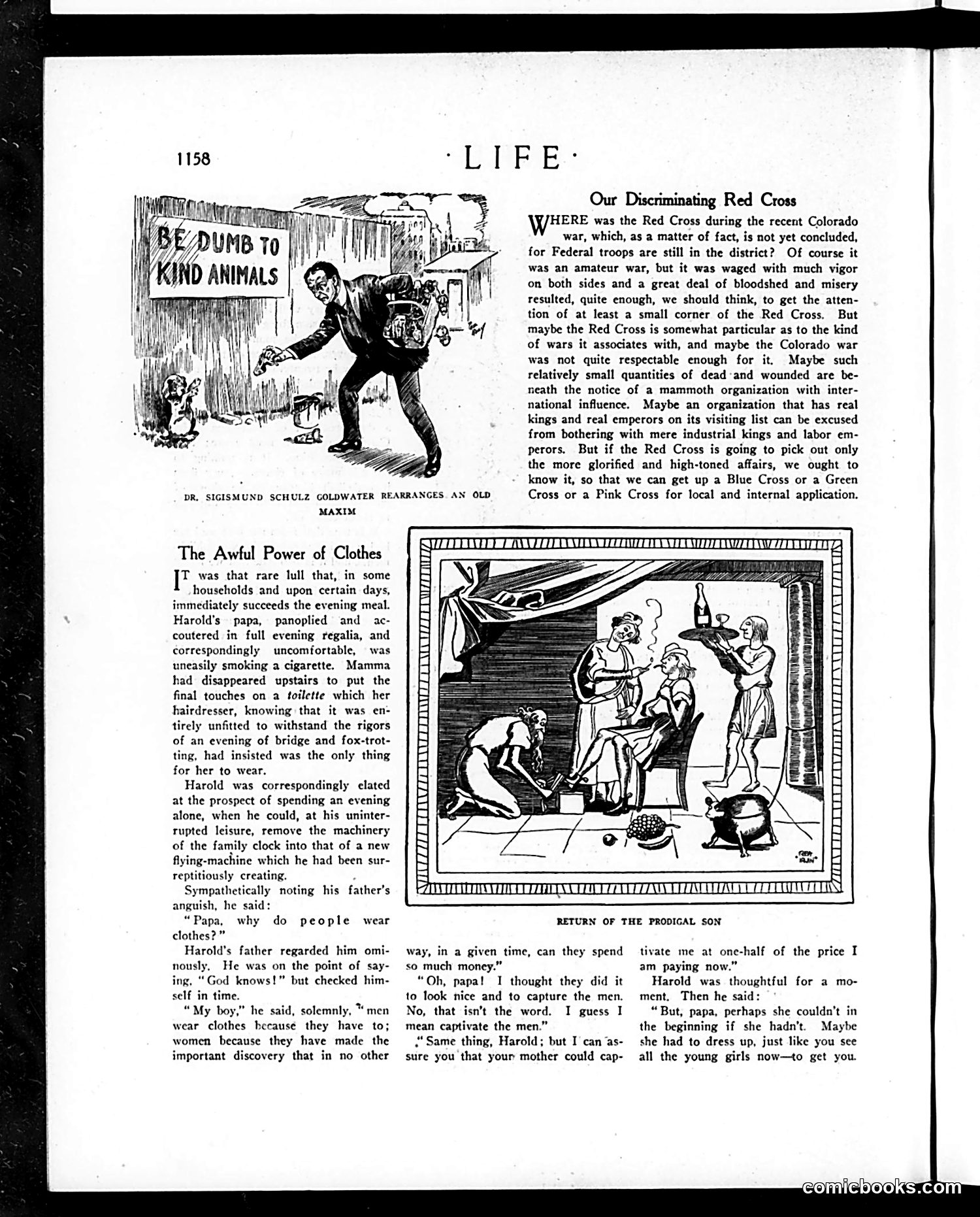
This *Life* magazine page contains three distinct satirical pieces: **"Our Discriminating Red Cross"** (top right) critiques the Red Cross for ignoring casualties in the recent Colorado labor conflict (likely the 1913-1914 Ludlow Massacre), suggesting the organization only responds to wars involving international dignitaries rather than "industrial kings and labor emperors." The satire proposes alternative organizations—a "Blue Cross" or "Pink Cross"—for domestic conflicts the Red Cross deems insufficiently prestigious. **"The Awful Power of Clothes"** (bottom) is a humorous domestic sketch where Harold asks his father why people wear clothes. His father cynically explains women wear clothes to spend money on fashion rather than to attract men. Harold cleverly counters that his mother *needed* fancy dress initially to "captivate" his father—implying women strategically use appearance to secure husbands, after which the expensive wardrobe becomes unnecessary. **Top cartoon** (by Dr. Sigismund Schulz Goldwater) shows a man kicking a dog beneath a "Be Dumb to Kind Animals" sign—ironic visual commentary on hypocrisy.
📄 Transcribed text from this page (OCR, searchable)
Machine-transcribed from the original scan — historical spelling and the odd misread are preserved.
“RSE: REO etree By DR, SIGISMUND SCHULZ GOLDWATER REARRANGES AN OLD MAXIM The Awful Power of Clothes T was that rare lull that, in some households and upon certain days, immediately succeeds the evening meal. Harold's papa, panoplied and ac- coutered in full evening regalia, and correspondingly uncomfortable, was uneasily smoking a cigarette. Mamma had disappeared upstairs to put the final touches on a toilette which her hairdresser, knowing that it was en- tirely unfitted to withstand the rigors of an evening of bridge and fox-trot- ting, had insisted was the only thing for her to wear. Harold was correspondingly elated at the prospect of spending an evening alone, when he could, at his uninter- rupted leisure, remove the machinery of the family clock into that of a new flying-machine which he had been sur- reptitiously creating. . Sympathetically noting his father’s anguish, he said: “Papa, why do people wear clothes?” Our Discriminating Red Cross WHERE was the Red Cross during the recent Colorado war, which, as a matter of fact, is not yet concluded, for Federal troops are still in the district? Of course it was an amateur war, but it was waged with much vigor on both sides and a great deal of bloodshed and misery resulted, quite enough, we should think, to get the atten- tion of at least a small corner of the Red Cross. But maybe the Red Cross is somewhat particular as to the kind of wars it associates with, and maybe the Colorado war was not quite respectable enough for it. Maybe such relatively small quantities of dead:and wounded are be- neath the notice of a mammoth organization with inter- national influence. Maybe an organization that has real kings and real emperors on its visiting list can be excused from bothering with mere industrial kings and labor em- perors. But if the Red Cross is going to pick out only the more glorified and high-toned affairs, we ought to know it, so that we can get up a Blue Cross or a Green Cross or a Pink Cross for local and internal application. RETURN OF THE PRODIGAL SON Harold's father regarded him omi- nously, He was on the point of say- ing, ‘God knows!” but checked him- self in time. “My boy,” he said, solemnly, * men wear clothes because they have to; women because they have made the important discovery that in no other way, in a given time, can they spend so much money.” “Oh, papa! I thought they did it to look nice and to capture the men. No, that isn’t the word. I guess I mean captivate the men.” “Same thing, Harold; but I can as- sure you that your mother could cap- tivate me at one-half of the price I am paying now.” Harold was thoughtful for a mo- ment. Then he said: “But, papa, perhaps she couldn't in the beginning if she hadn’t. Maybe she had to dress up, just like you see all the young girls now—to get you.