
A complete issue · 40 pages · 1914
Life — July 16, 1914
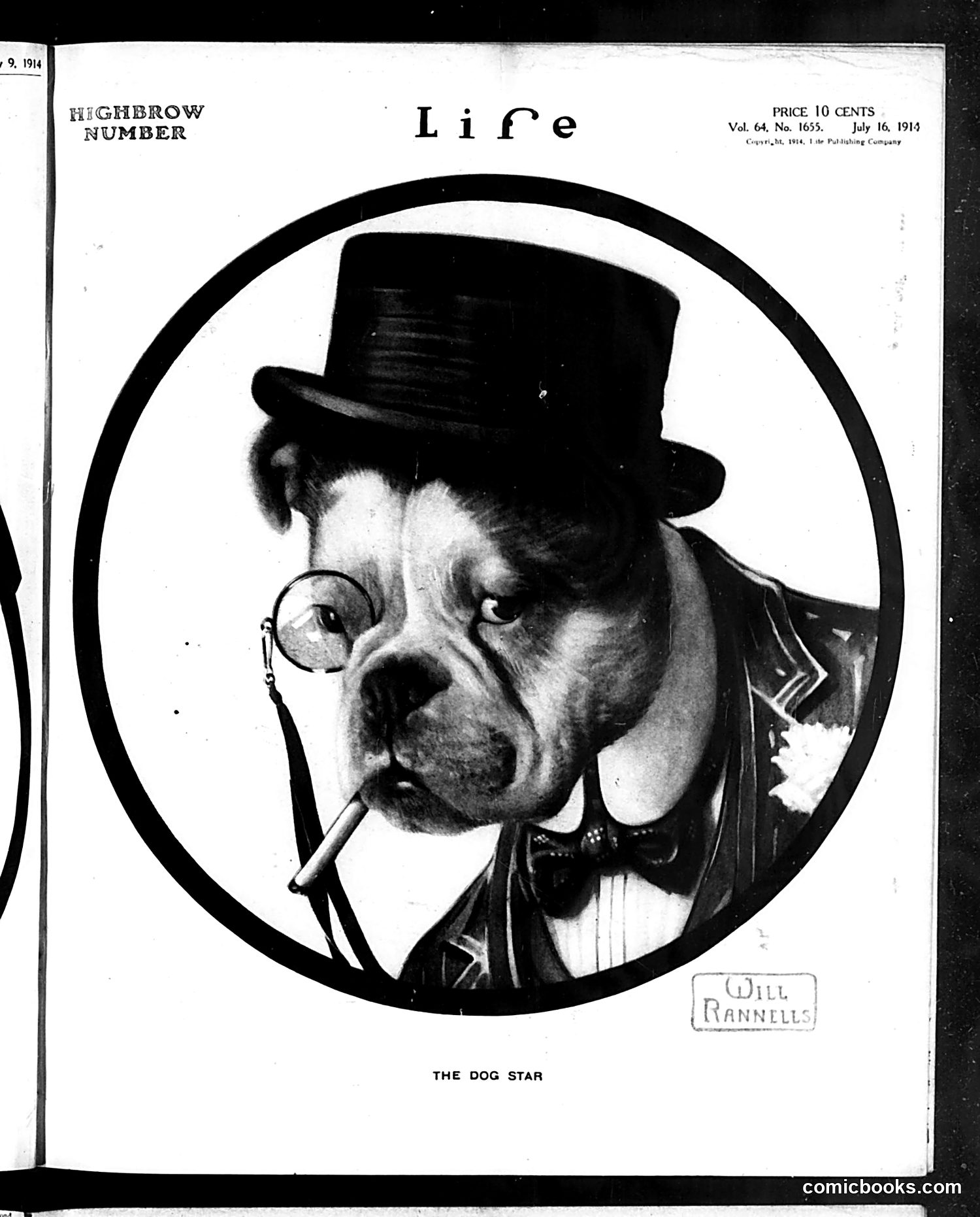
This cover features **Will Ranell's** anthropomorphized bulldog character dressed as a gentleman in formal attire—top hat, monocle, bow tie, and smoking a cigar. The title "THE DOG STAR" indicates this is likely promoting a dog character as an entertainment or comic figure of the period. The satirical humor derives from depicting a dog with distinctly human pretensions and sophistication: the formal wear, monocle, and cigar suggest aristocratic affectation. The joke appears to mock either upper-class pretentiousness or, possibly, to promote a popular canine character as a "star" worthy of high society status. Without additional context about Ranell's work or 1913 entertainment, the precise satirical target remains unclear, though the humanized animal format was common in early 20th-century American comics and advertising.
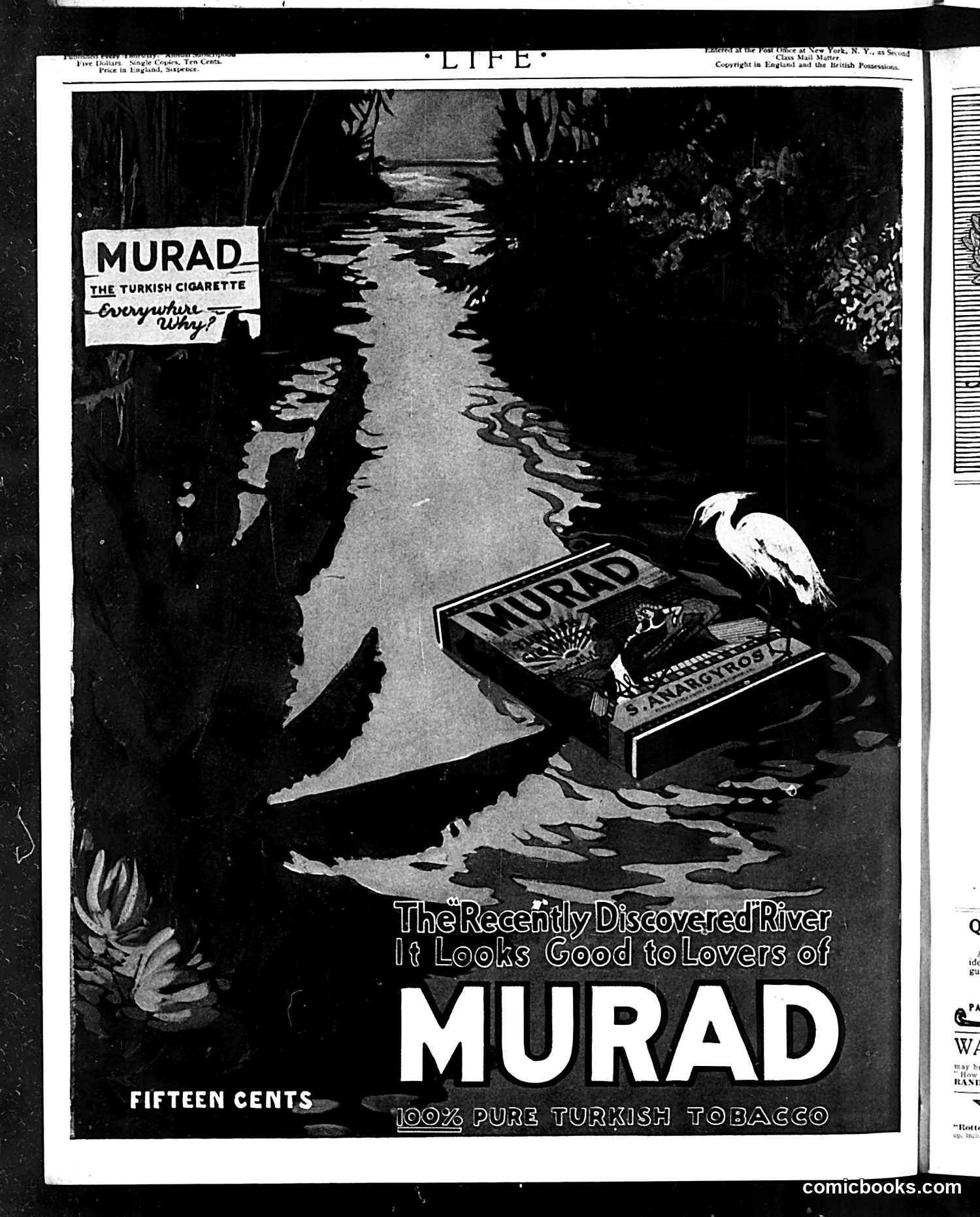
This page is primarily a **cigarette advertisement** for Murad Turkish tobacco, not political satire. The ad depicts an exotic riverside scene with tropical vegetation and a white egret, designed to evoke the mystique of the Ottoman Empire and distant lands. The tagline "The Recently Discovered River It Looks Good to Lovers of MURAD" suggests romantic adventure and travel. The small inset logo in the upper left ("MURAD: THE TURKISH CIGARETTE everywhere why?") reinforces the product branding. The price of "FIFTEEN CENTS" and claim of "100% PURE TURKISH TOBACCO" were standard advertising claims of the era. This represents typical early 20th-century advertising that capitalized on orientalist fantasies to market luxury consumer goods to American audiences.
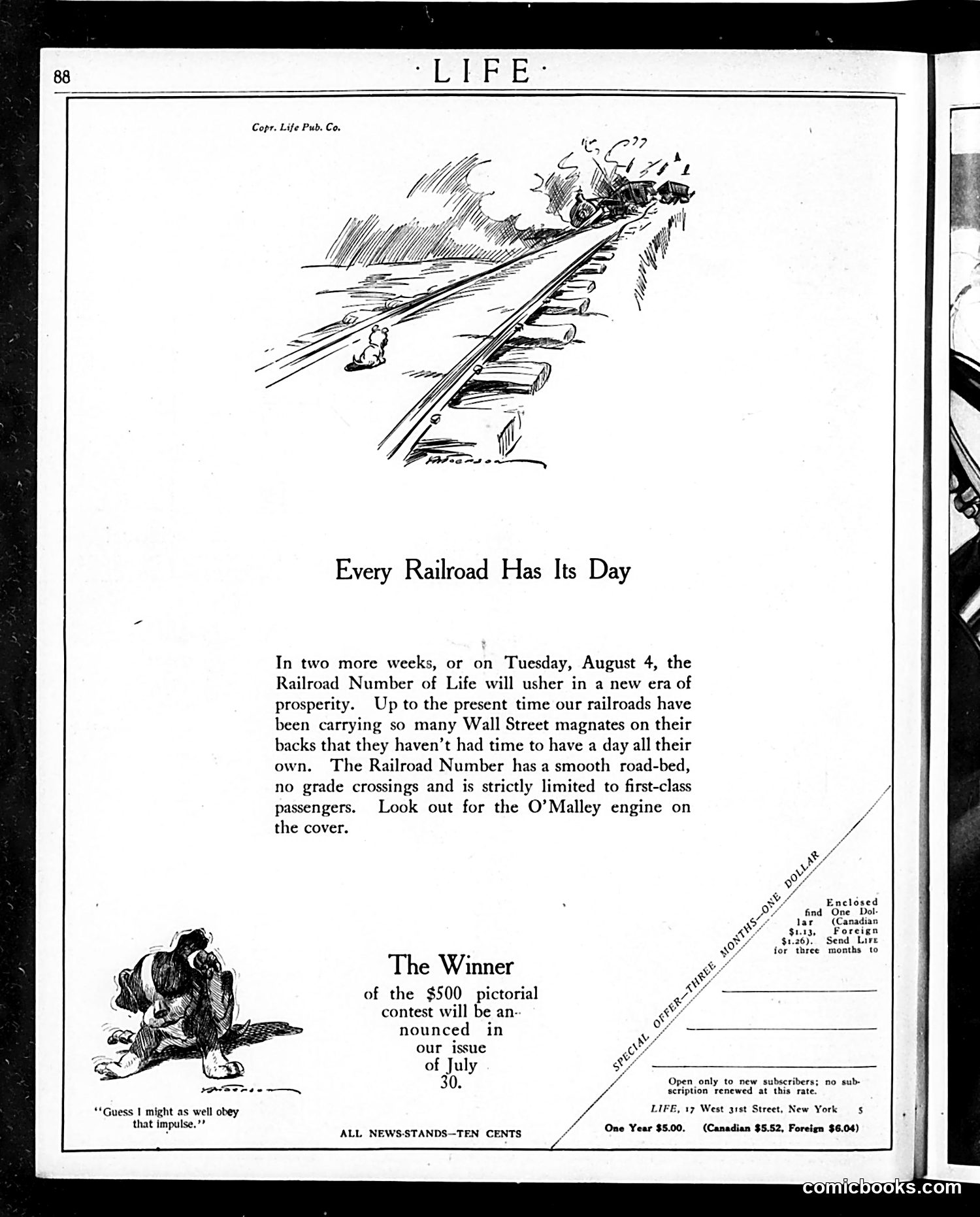
This page is primarily **advertising for Life magazine's upcoming "Railroad Number"** (August 4 issue), not political satire. The main illustration shows a train on an inclined track with passengers, accompanying the headline "Every Railroad Has Its Day." The text humorously describes this special issue as giving railroads their own day of prominence, joking that railroads have been so busy carrying "Wall Street magnates" that they haven't had time for their own celebration. The cartoon features a small dog with the caption "Guess I might as well obey that impulse," making a mild joke about compliance or instinct—unrelated to railroads. A secondary notice announces a $500 pictorial contest winner to be revealed in the July 30 issue. The page functions as a promotional announcement rather than political commentary.
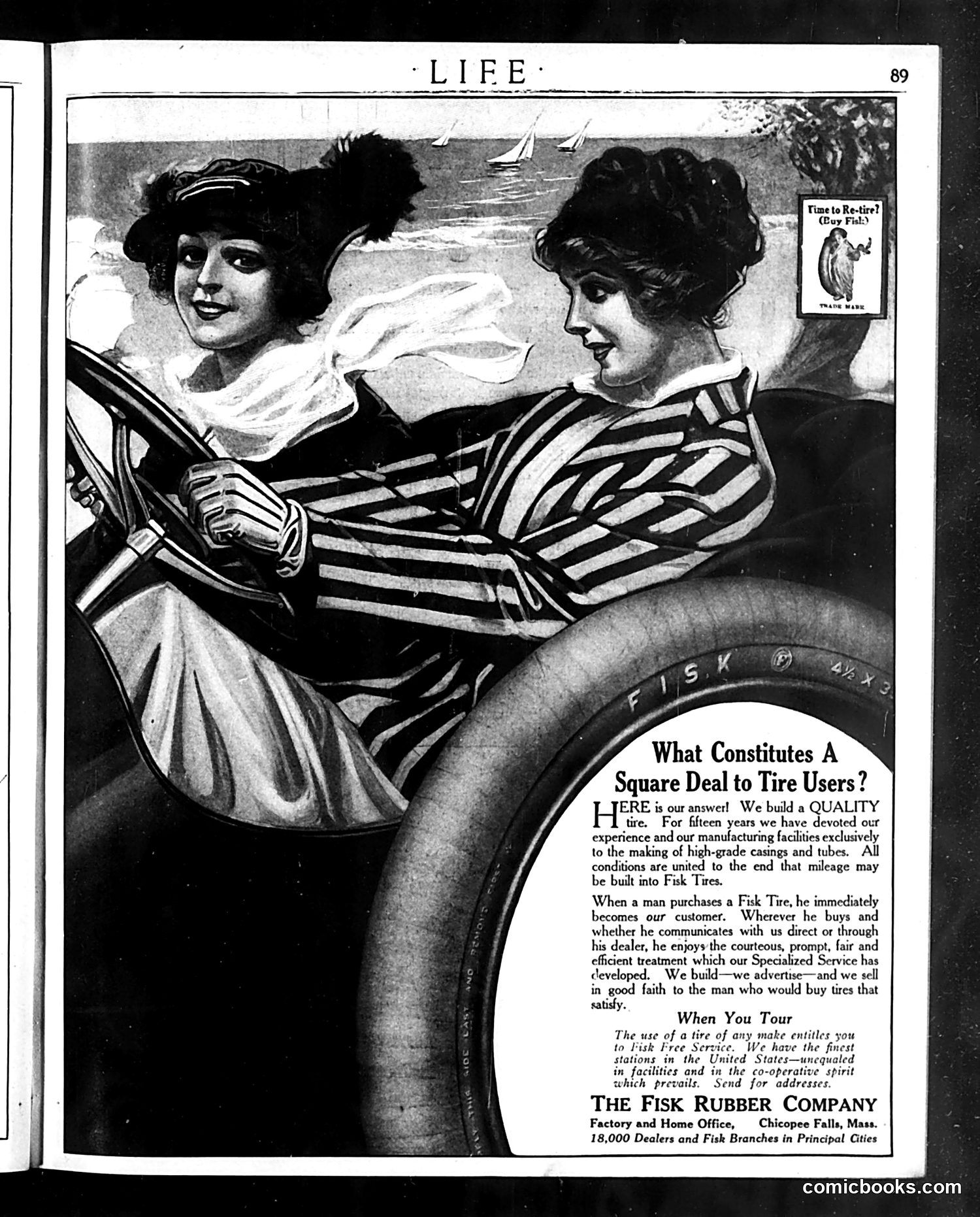
This page is primarily a **Fisk Rubber Company advertisement**, not political satire. The image shows two fashionably dressed women in a convertible automobile, wearing striped clothing and elaborate hairstyles typical of the 1910s-1920s era. The illustration represents leisure and modernity—automobiles were still relatively novel and associated with wealth and style. The advertisement's text emphasizes Fisk Tires' quality, manufacturing standards, and customer service. The small inset shows Fisk's trademark mascot (the "Fisk Boy"), suggesting this ran repeatedly in Life magazine. The "satire" here is gentle: the ad humorously positions tire-purchasing as offering a "square deal" to consumers, invoking Theodore Roosevelt's famous political slogan to sell a consumer product—typical of how 1910s-20s advertising borrowed political rhetoric for commercial purposes.
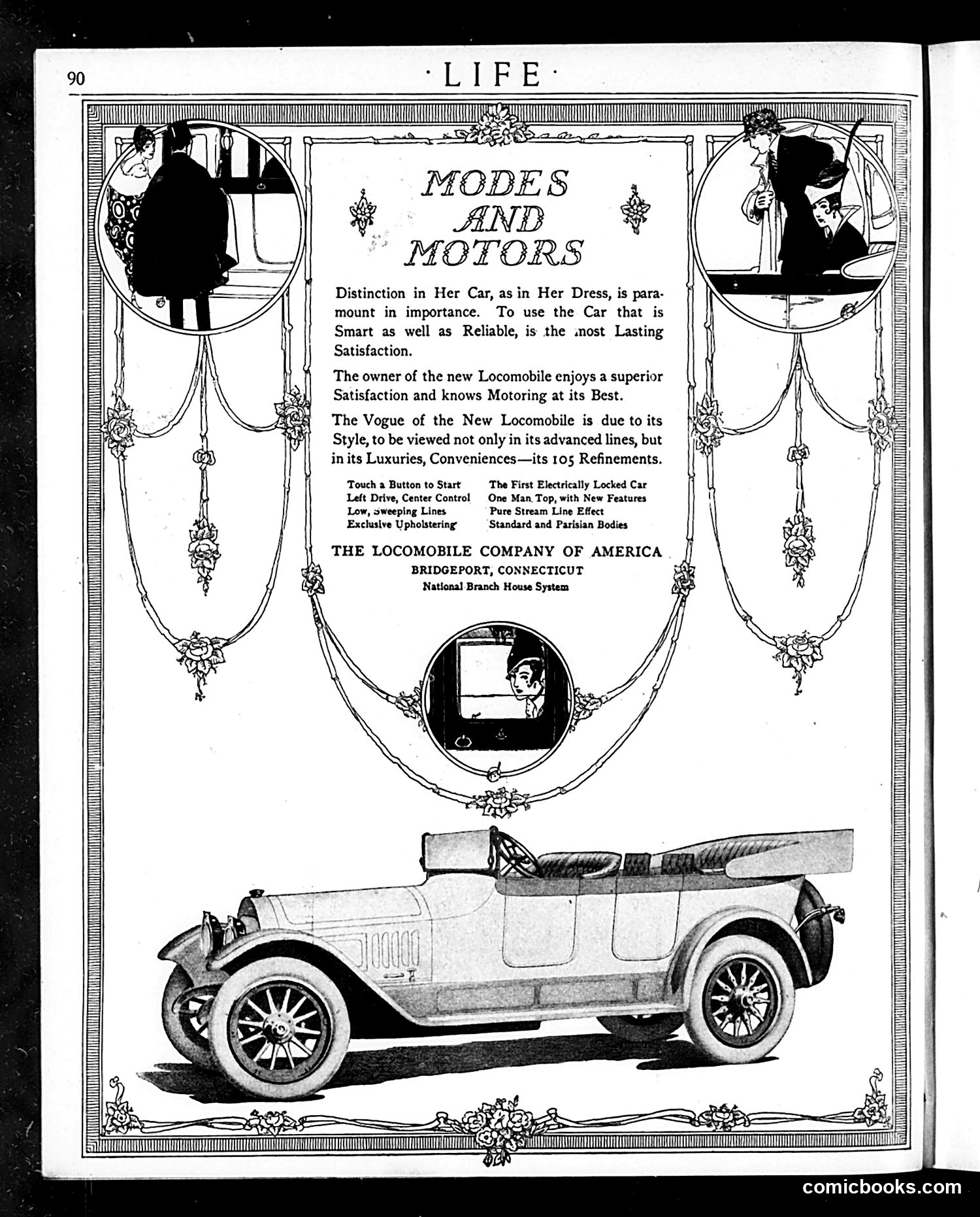
This page is primarily **advertising**, not satire or political commentary. It's a Locomobile Company of America advertisement for their automobiles, appearing in Life magazine (page 90). The decorative Art Nouveau border frames text emphasizing that a car—like fashionable dress—reflects the owner's status and taste. The illustrated vignettes at top show well-dressed passengers, suggesting the Locomobile appeals to wealthy, stylish consumers. The advertisement highlights luxury features: electric start, locking doors, and refined styling. The detailed side-view illustration showcases the vehicle's elegant proportions and engineering. This represents early 1900s automotive marketing targeting affluent Americans, positioning the Locomobile as a status symbol combining mechanical innovation with aesthetic sophistication—paralleling high fashion as markers of social distinction.
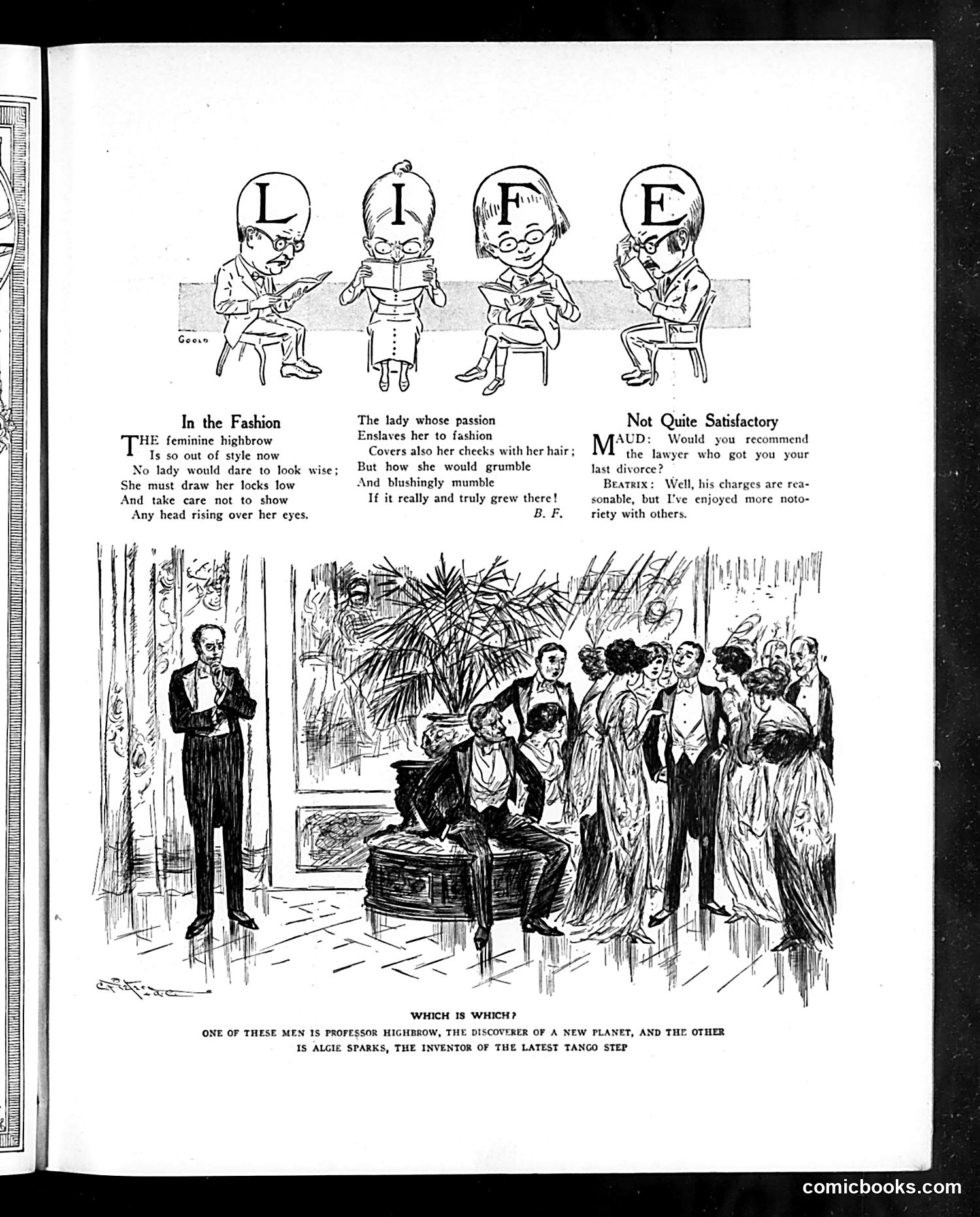
This page contains satirical commentary on early 20th-century fashion and social trends. **Top Section ("In the Fashion"):** Mocks women who draw their eyebrows low and wear their hair pulled down to appear fashionable—a style described as "out of style now." The satire criticizes women slavishly following trends. **"Not Quite Satisfactory":** A brief joke about a lawyer recommending divorce, suggesting marital discord. **Bottom Cartoon ("Which is Which?"):** The caption identifies one figure as Professor Highbrow (discoverer of a new planet) and another as Algie Sparks (inventor of the latest tango step). The scene appears to satirize the era's obsession with both scientific achievement and dance crazes as equally notable accomplishments, likely mocking the public's fascination with trivial entertainment versus serious intellectual work.
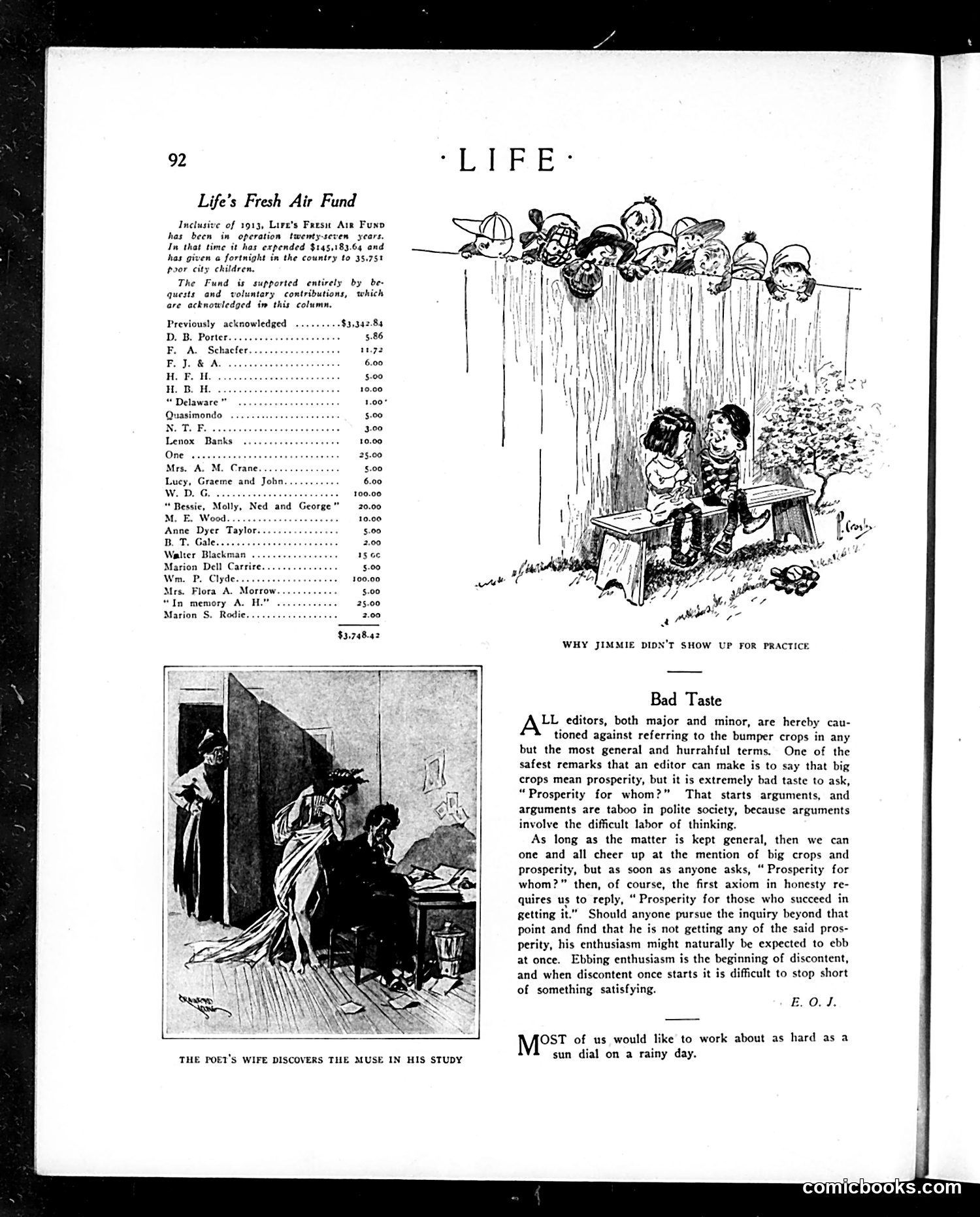
The page features two distinct elements: **Upper section:** A fundraising list for Life's Fresh Air Fund, an initiative providing outdoor experiences for impoverished children. The detailed donor list shows contributions ranging from small amounts to substantial gifts (W.D.G. gave $100). **Cartoon "Why Jimmie Didn't Show Up for Practice":** Shows children at play outdoors near a fence, illustrating why a child might miss scheduled activities—suggesting the appeal of unstructured outdoor play. **Essay "Bad Taste":** A satirical piece cautioning editors against discussing "bumper crops" in relation to prosperity. The author argues such language is tactless when many lack basic prosperity, raising uncomfortable questions about who benefits from agricultural abundance. The piece critiques how polite language obscures uncomfortable economic realities. Together, these elements address poverty and childhood welfare—core Progressive Era concerns.
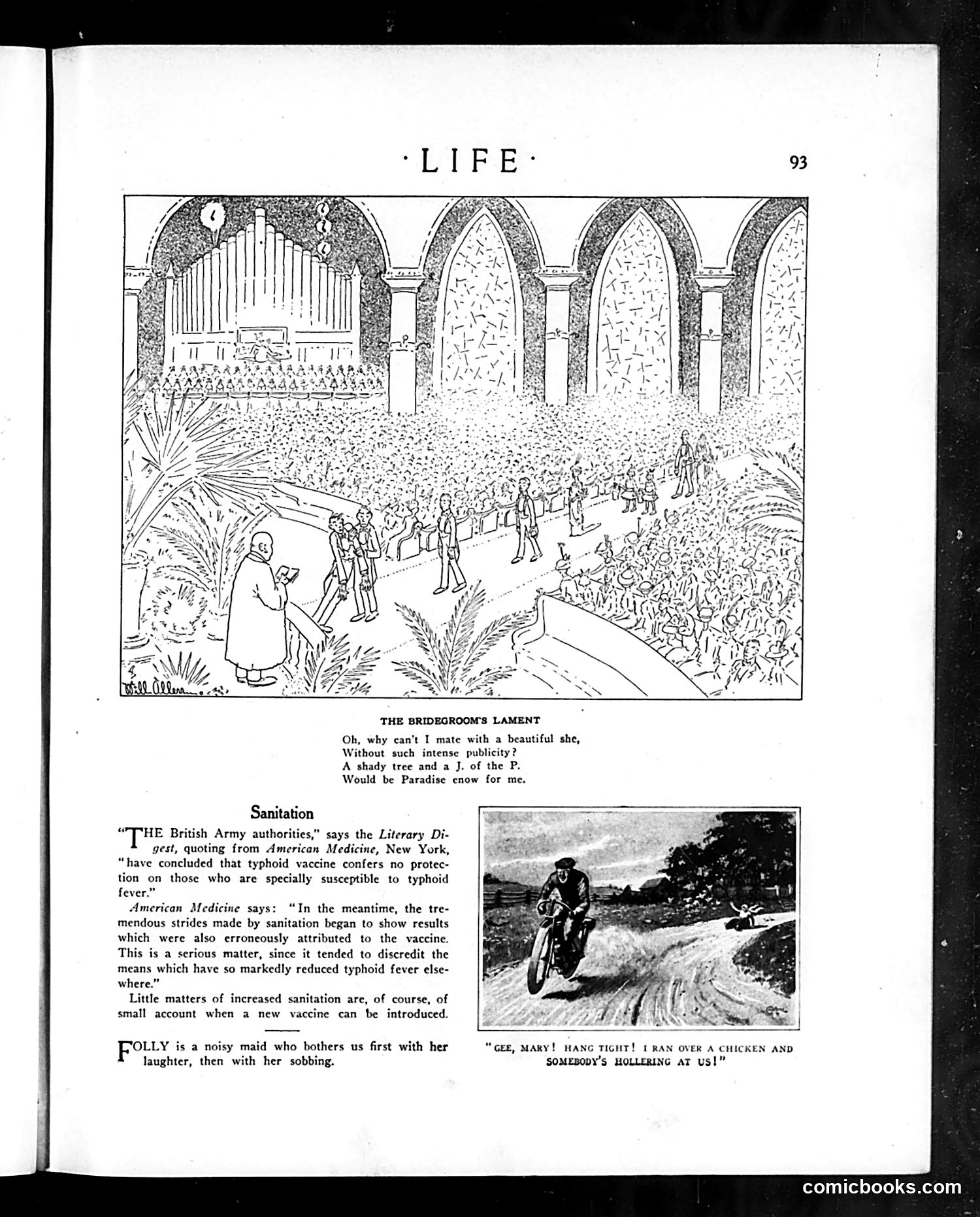
This page contains **three distinct pieces**: 1. **Top illustration**: A grand interior scene (cathedral or large hall) with crowds and formal proceedings—likely depicting a significant public event, though the specific reference is unclear from the image alone. 2. **"The Bridegroom's Lament"**: A brief humorous poem about a groom frustrated by his bride's publicity-seeking behavior and desire for social prominence ("a shady tree and a J. of the P."). 3. **"Sanitation" article**: Discusses a scientific debate over typhoid vaccination efficacy. British medical authorities credited sanitation improvements (not vaccines) for reducing typhoid, citing *American Medicine* journal. The satire criticizes those who wrongly attribute health improvements to vaccines rather than proper sanitation practices. 4. **Motorcycle photograph**: An unrelated humorous caption about a reckless rider hitting a chicken. 5. **"Folly" definition**: A brief character sketch of an annoying maid.
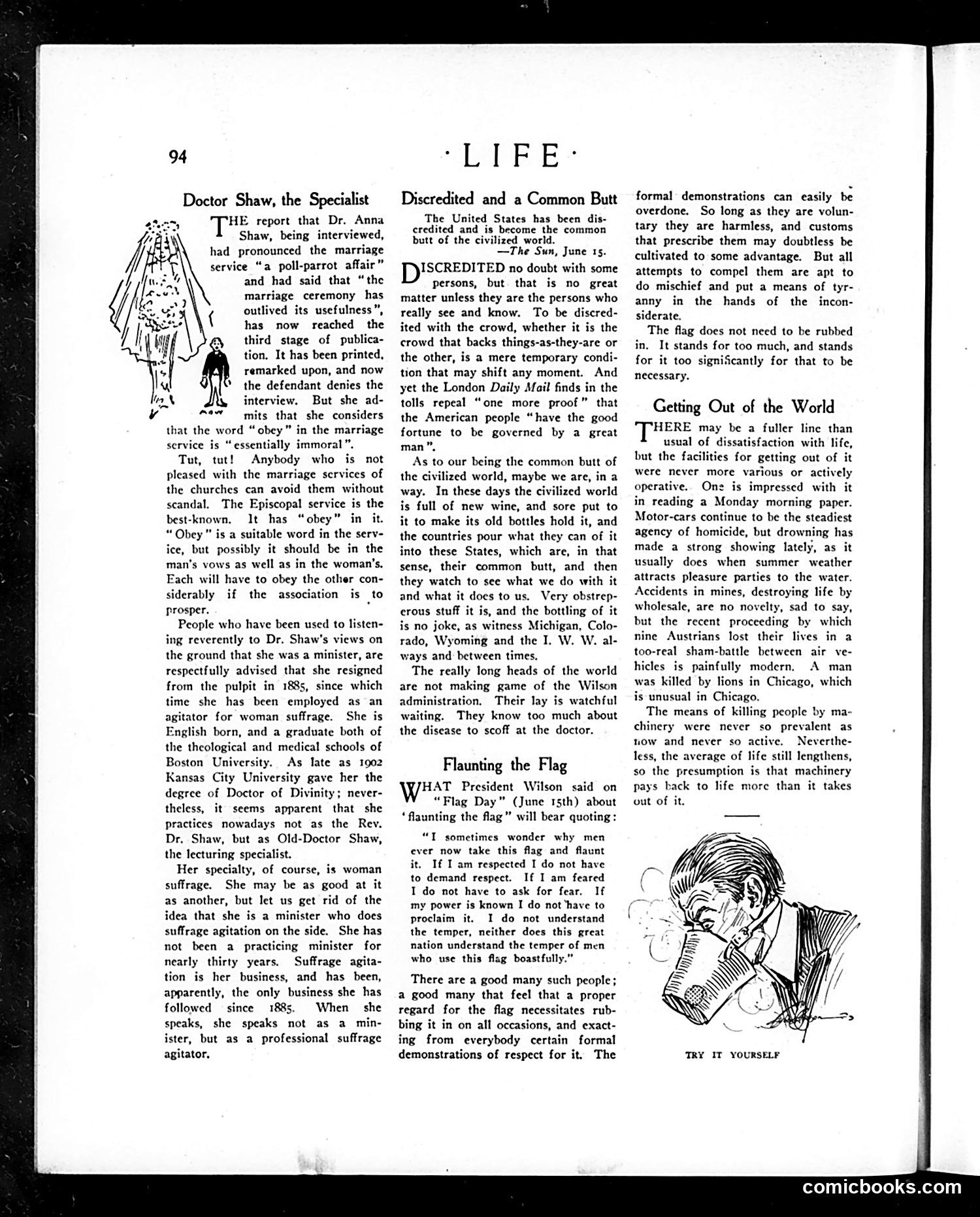
This page contains three satirical pieces critiquing early 20th-century social conventions: 1. **"Doctor Shaw, the Specialist"**: Mocks a female minister who performed a "high-church affair" wedding. The satire questions whether the word "obey" belongs in marriage services, arguing it's outdated. The piece critiques both the novelty of female clergy and rigid marital customs. 2. **"Discredited and a Common Butt"**: Discusses America becoming a "common butt" of civilized nations—a target for mockery—due to its informal customs and lack of deference to tradition. 3. **"Flaunting the Flag"**: Quotes President Wilson on flag etiquette, satirizing excessive patriotic display and those who demand formal flag respect while claiming strength needs no such assertion. A cartoon labeled "TRY IT YOURSELF" appears to accompany the content.
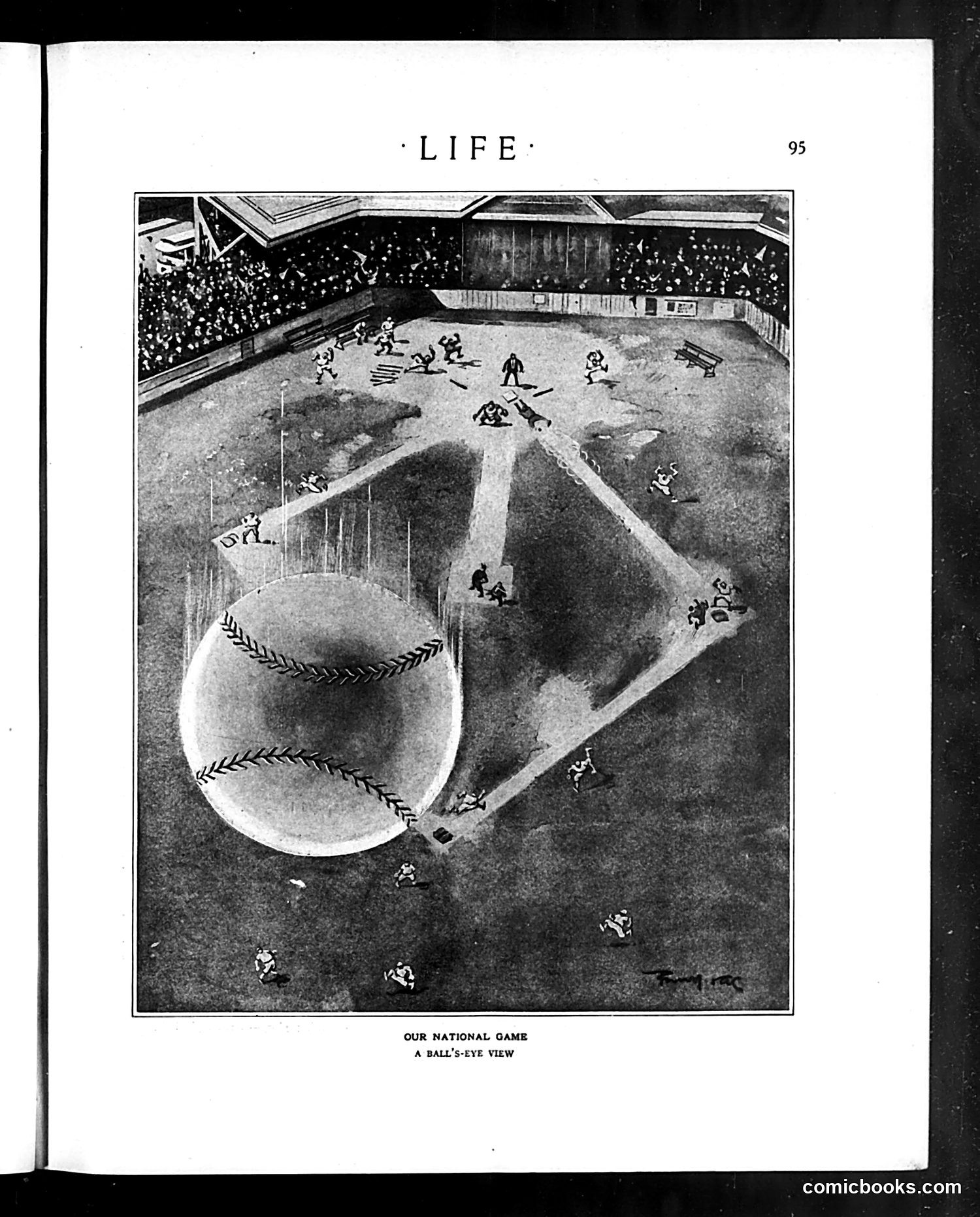
This page from *Life* magazine (page 95) shows a bird's-eye view of a baseball diamond overlaid with an enormously enlarged baseball. The caption reads "OUR NATIONAL GAME: A BALL'S-EYE VIEW." This is a visual pun rather than political satire. The humor derives from the phrase "ball's-eye view"—a play on "bird's-eye view" (meaning overhead perspective). By literally showing the scene from the ball's perspective, the artist creates an absurdist joke where an impossibly giant baseball dominates the field while tiny players and crowds appear around it. The satire appears gently mocking rather than biting—poking fun at Americans' obsession with baseball as "the national game" by comically exaggerating the sport's centrality. It's accessible humor typical of *Life*'s lighter editorial content.
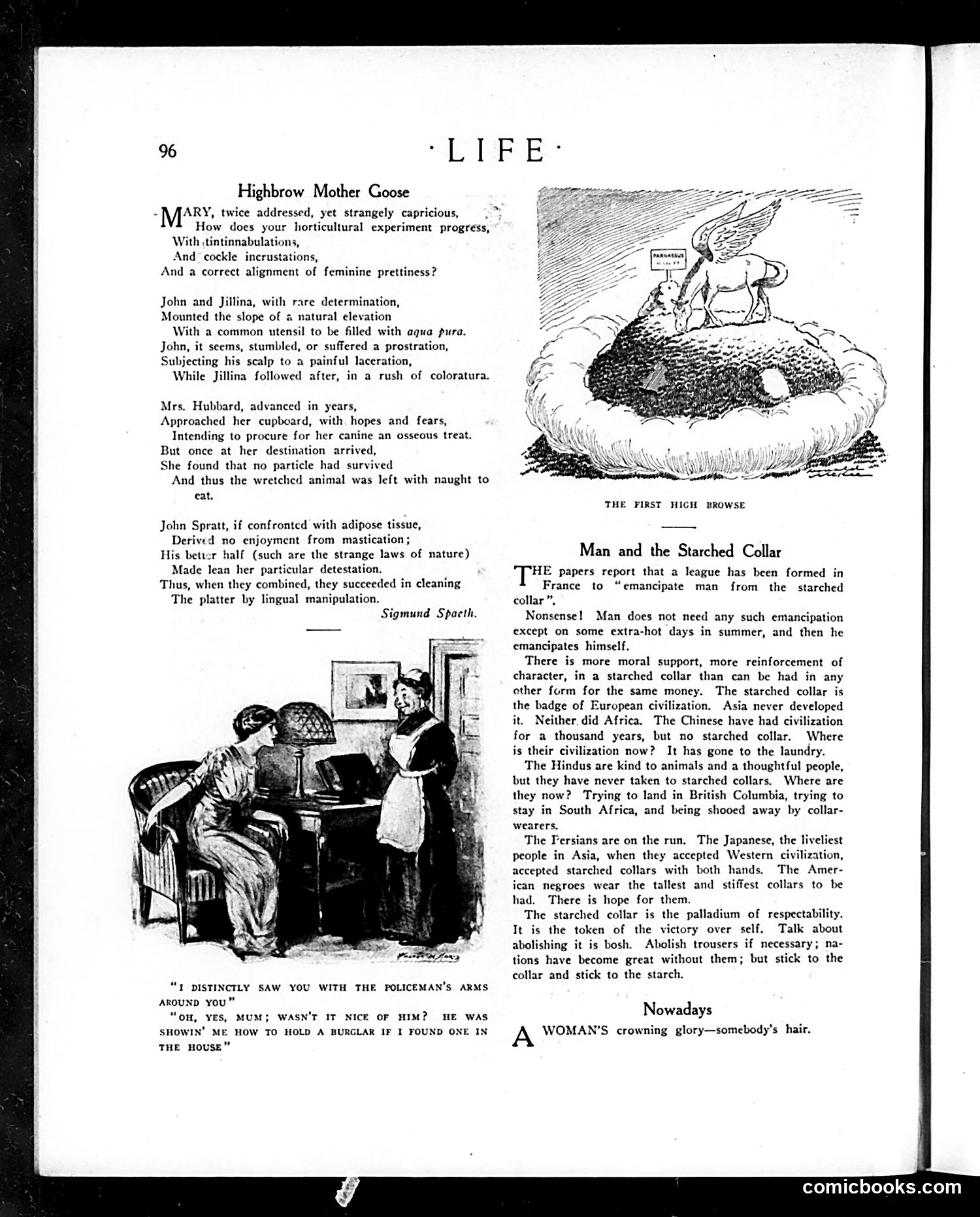
This page contains three distinct pieces of satirical content: 1. **"Highbrow Mother Goose"** (top left): A poem by Sigmund Spaeth mocking overly intellectual approaches to child-rearing, referencing characters named Mary, John, and Jillina engaged in absurd "scientific" parenting experiments. 2. **"The First High Browse"** (top right): An illustration showing a goose on elevated terrain, likely satirizing fashionable or pretentious behavior—the term "browse" suggests both literal grazing and affected social posturing. 3. **"Man and the Starched Collar"** (center): A lengthy essay criticizing the starch collar as a marker of civilization. It argues the starch collar represents superficial European superiority, noting that Asian and African cultures functioned without this "essential" garment. The piece mocks Western pretension to moral progress. 4. **Bottom illustration and caption**: Shows a domestic scene with the caption about a policeman's arms and holding a burglar—appearing to be a separate humorous anecdote.
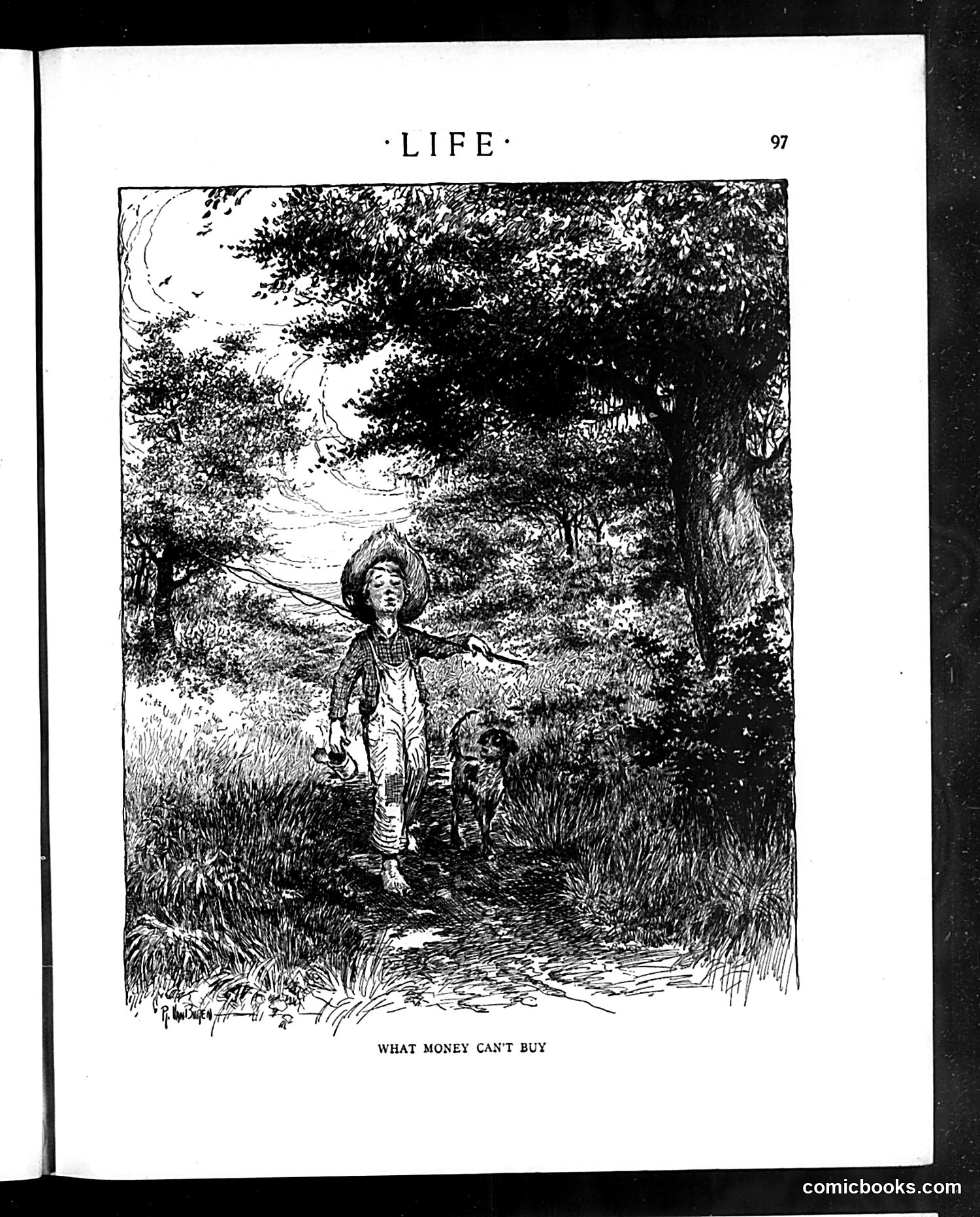
This illustration depicts a child and dog walking together through a wooded, pastoral landscape. The title suggests the cartoon's message: certain things—depicted here as nature, companionship, and innocent childhood experiences—cannot be purchased with wealth. The image appears to be *Life* magazine's commentary on materialism and consumer culture, likely from the early-to-mid 20th century. By showing a simple, bucolic scene of a child and pet, the artist argues that genuine happiness and meaningful life experiences exist outside commercial transactions. The contrast between nature's freely available gifts and money's limitations forms the satire's core point—a gentle critique of the era's growing consumer culture and emphasis on material acquisition.
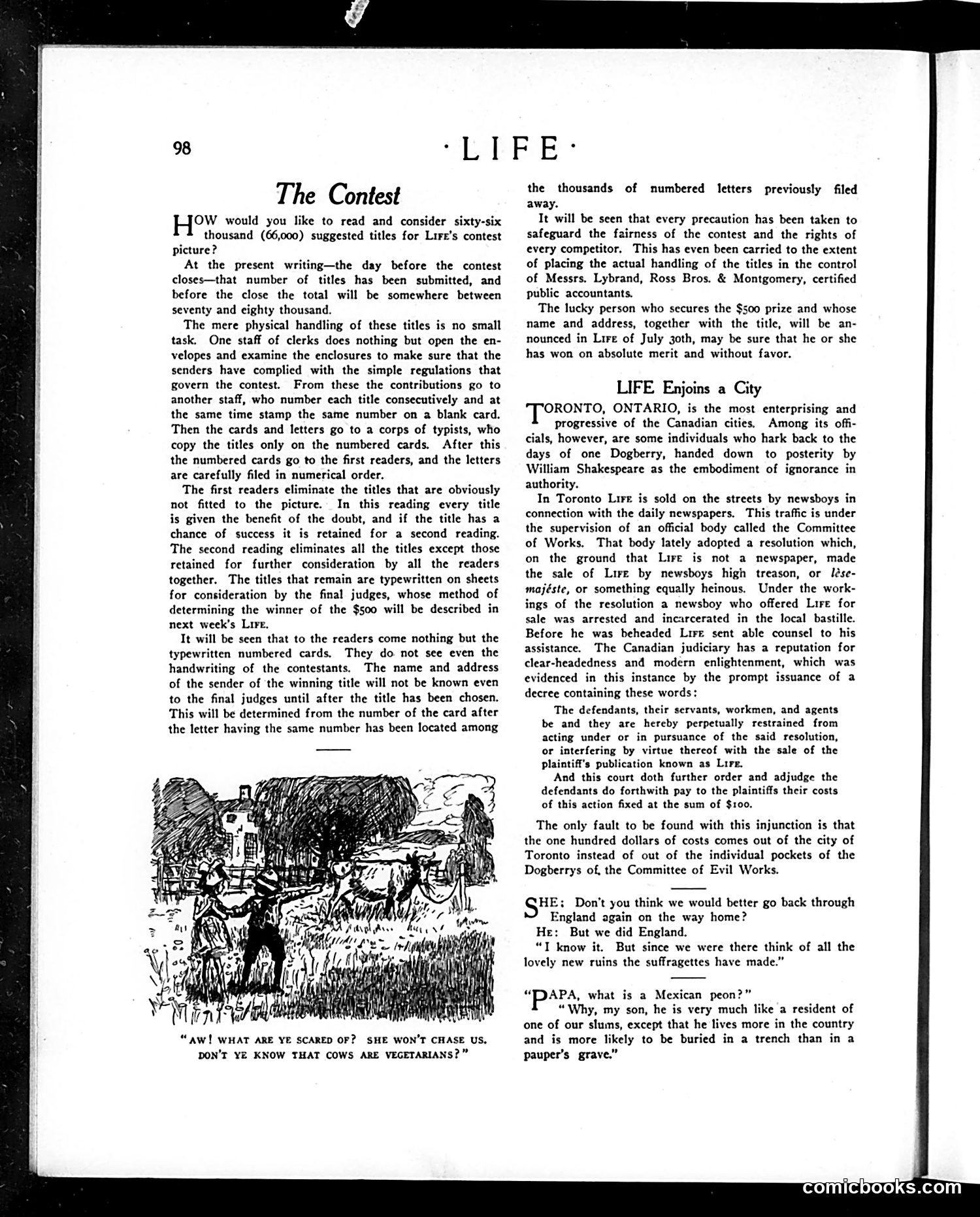
This page contains two distinct elements: **"The Contest"** article describes Life magazine's title-picture competition, explaining the logistical process for judging 66,000 submitted entries fairly. **The cartoon** (bottom left) depicts rural figures alarmed by cattle, with the caption: "Aw! what are ye scared of? She won't chase us. Don't ye know that cows are vegetarians?" The joke relies on simple rural humor—the irony that cows, being vegetarians, shouldn't pose a threat despite the characters' obvious fear. This reflects early 20th-century satirical magazines' use of country-folk stereotypes for comedic effect. **"Life Enjoins a City"** discusses Toronto's legal action against newsboys selling Life magazine, involving copyright disputes and court injunctions.
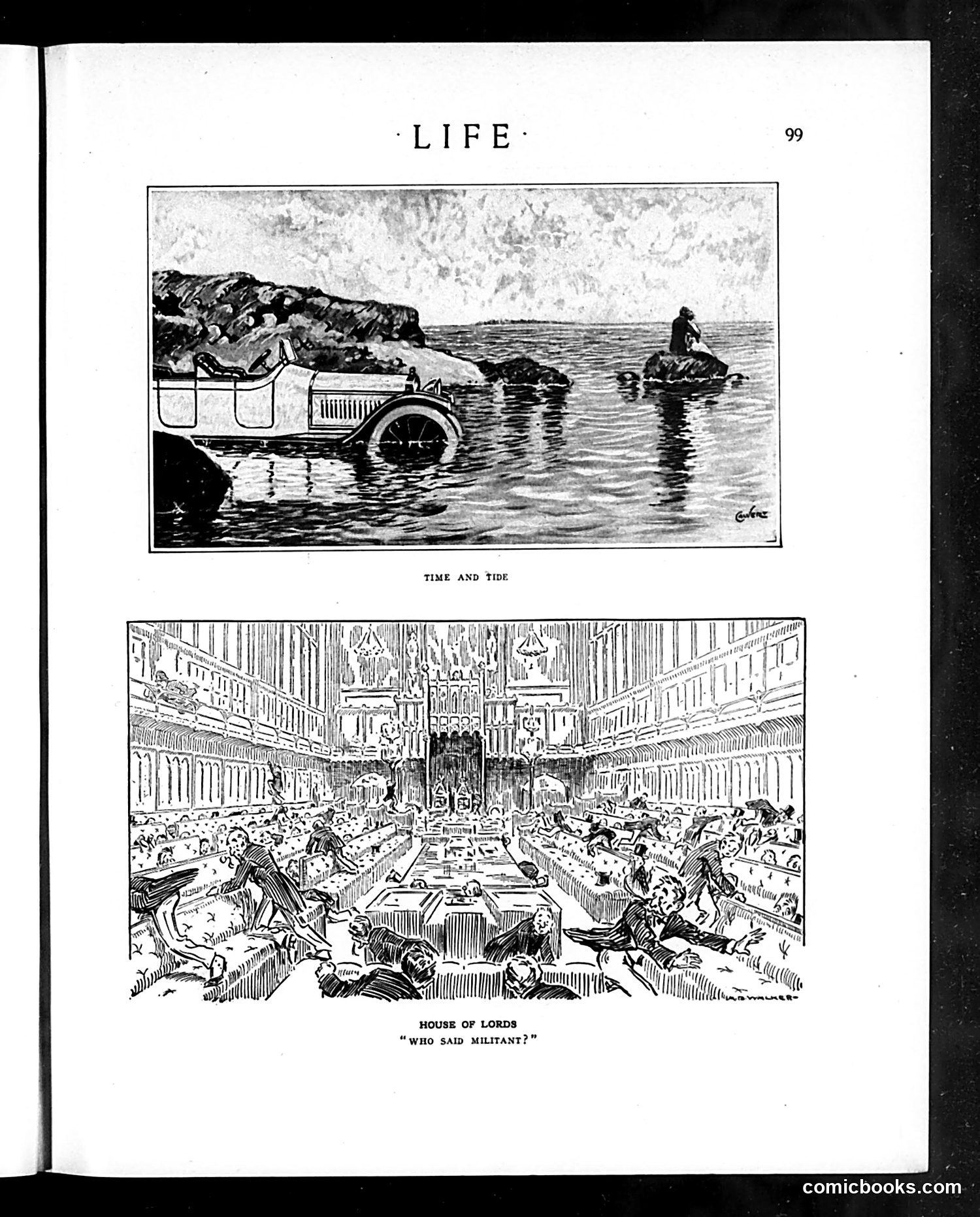
**Top cartoon ("Time and Tide"):** A car is submerged in water while occupants swim nearby. The title suggests a play on words—the vehicle is literally caught by tides, satirizing the phrase "time and tide wait for no man." This appears to be humor about early automobiles and their unreliability or vulnerability to natural conditions. **Bottom cartoon ("House of Lords"):** A chaotic indoor scene shows figures in apparent disorder or conflict within an ornate chamber, likely depicting the British House of Lords. The caption "Who Said Militant?" suggests satire about the Lords being accused of militant or aggressive behavior—possibly referencing political tensions or debates within Parliament. The scene's disorder seems to mock the supposed dignity of the institution. Both cartoons appear British in focus, typical of *Life* magazine's political satire from the early 20th century, though the specific historical moment remains unclear without dating information.
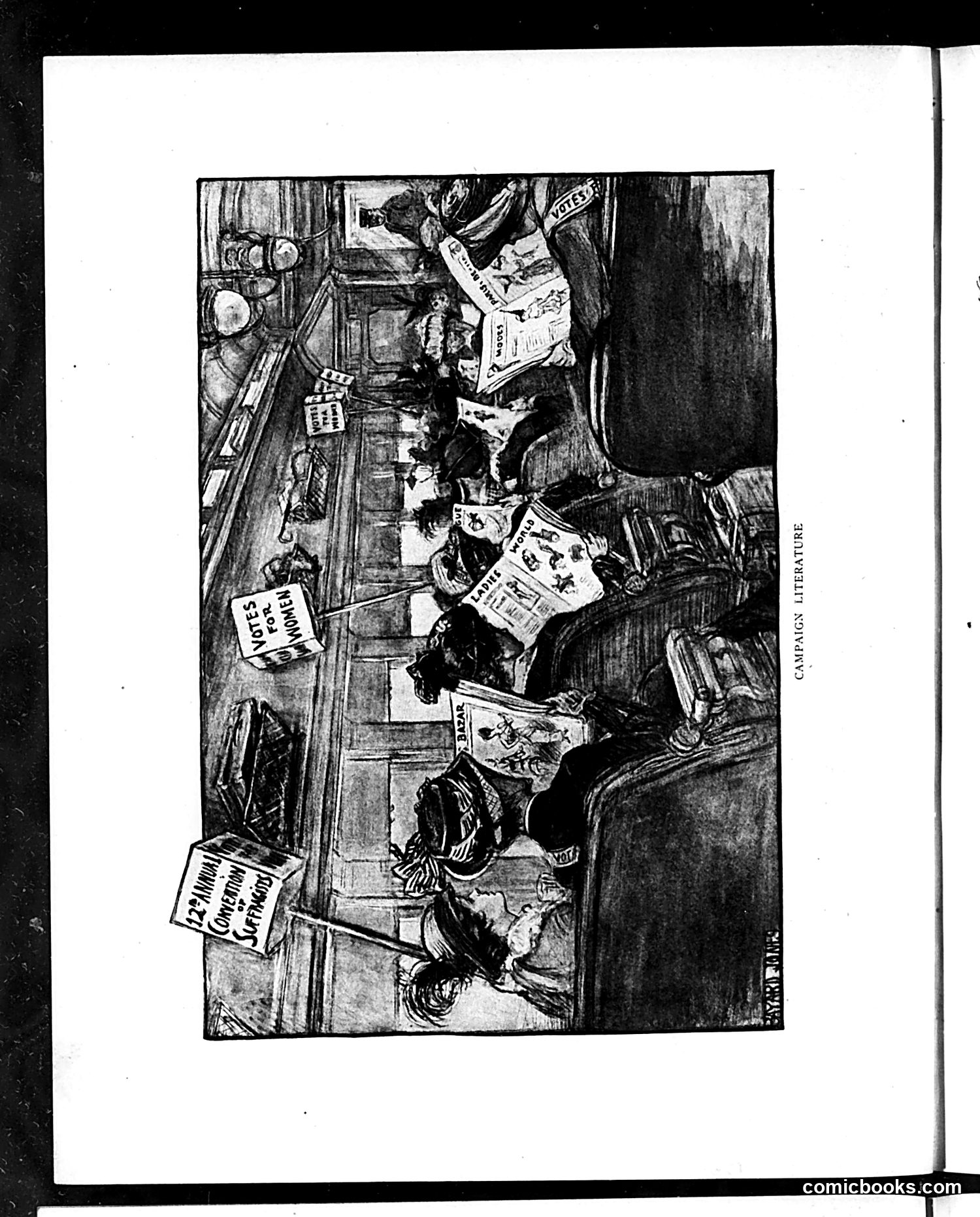
This image shows a satirical illustration titled "CAMPAIGNS' LITERATURE" depicting people reading various political campaign materials and pamphlets. The figures are seated and holding papers marked with what appear to be campaign slogans or candidate names (though specific text is difficult to read in this reproduction). The cartoon satirizes the volume and ubiquity of campaign literature distributed during election seasons. By showing multiple people simultaneously absorbed in reading political materials, the artist mocks either the excessive amount of such propaganda or the gullibility of voters who consume it uncritically. The style and subject matter suggest this is early-to-mid 20th century American political satire, criticizing the nature of electoral campaigns and voter engagement with campaign communications.
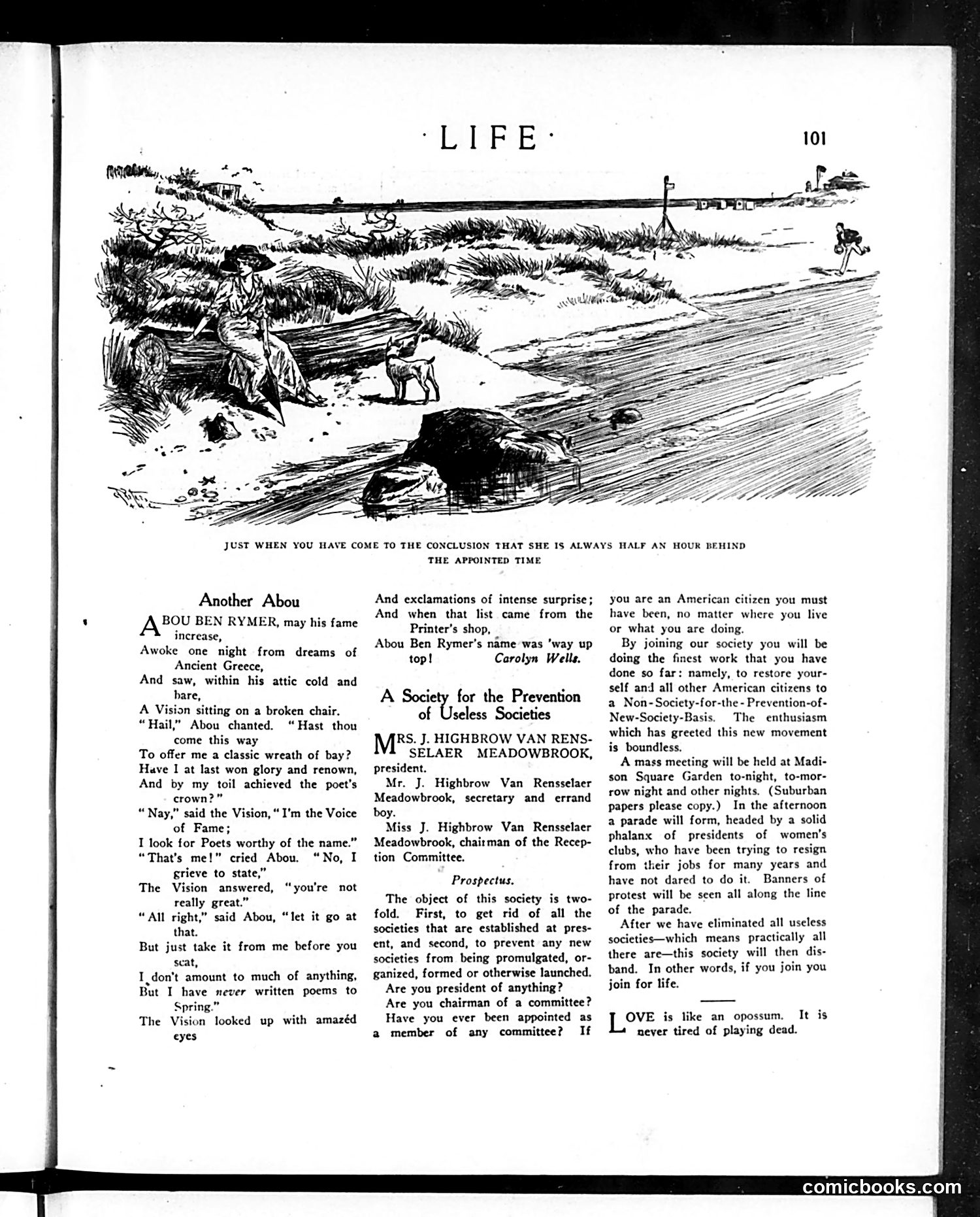
This page contains two separate satirical pieces: **"Another Abou"** (top): A poem by Carolyn Wells mocking pretentious poets. Abou Ben Rymer, a mediocre poet who has never even written spring poetry (a cliché of the era), appears on Fame's list of great poets simply by admitting his own worthlessness. The satire targets both self-deprecating false modesty and the arbitrary nature of literary reputation. **"A Society for the Prevention of Useless Societies"** (bottom): This satirizes the early 1900s proliferation of women's clubs and civic organizations in America. The joke is that a society created to *eliminate* other societies is itself useless and will paradoxically exist forever ("if you join you join for life"). The named officers—all variations of "Highbrow Van Rensselaer Meadowbrook"—mock the pretentious names wealthy women adopted for club leadership. The reference to women's club presidents desperate to resign satirizes how these organizations trapped their members in endless obligations.
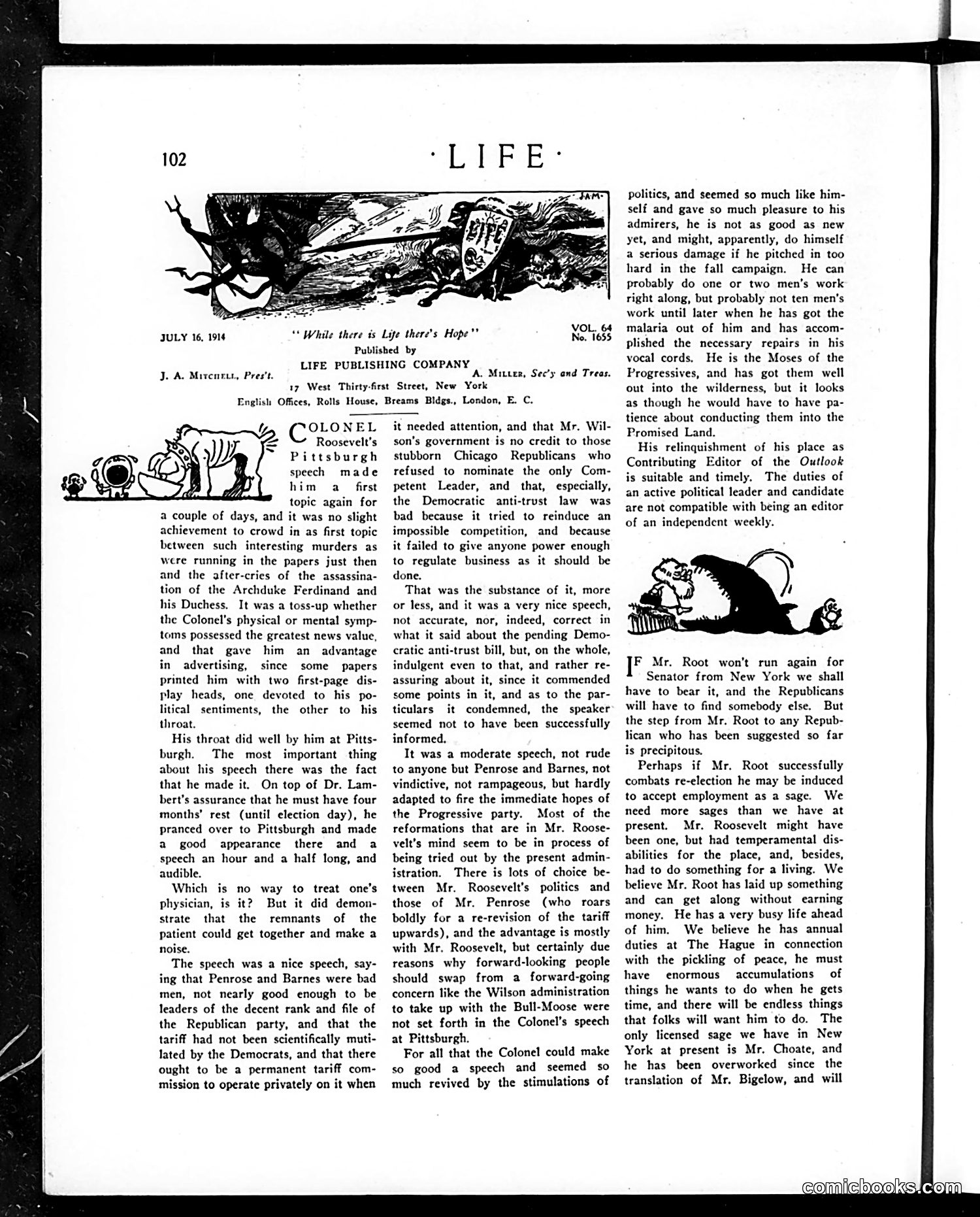
This page satirizes Theodore Roosevelt's Pittsburgh speech following his recent illness. The cartoon depicts Roosevelt as a corpse or skeleton, visually mocking his physical condition after Dr. Lambert advised four months' rest—yet Roosevelt immediately traveled to Pittsburgh to deliver a lengthy public address. The accompanying text is equally cutting: it praises the speech's moderation while suggesting Roosevelt compromised his health recklessly. The author notes Roosevelt criticized Republican leaders Penrose and Barnes, endorsed some Democratic anti-trust measures, and praised the Wilson administration—hardly rousing calls for his Progressive "Bull Moose" party to retake power. The satire's point: Roosevelt appears revitalized by politics but remains genuinely weakened. He might accomplish "one or two men's work" at most, contradicting his vigorous public persona. Life mocks both his physical limitations and the tepid political message that fails to energize his followers.
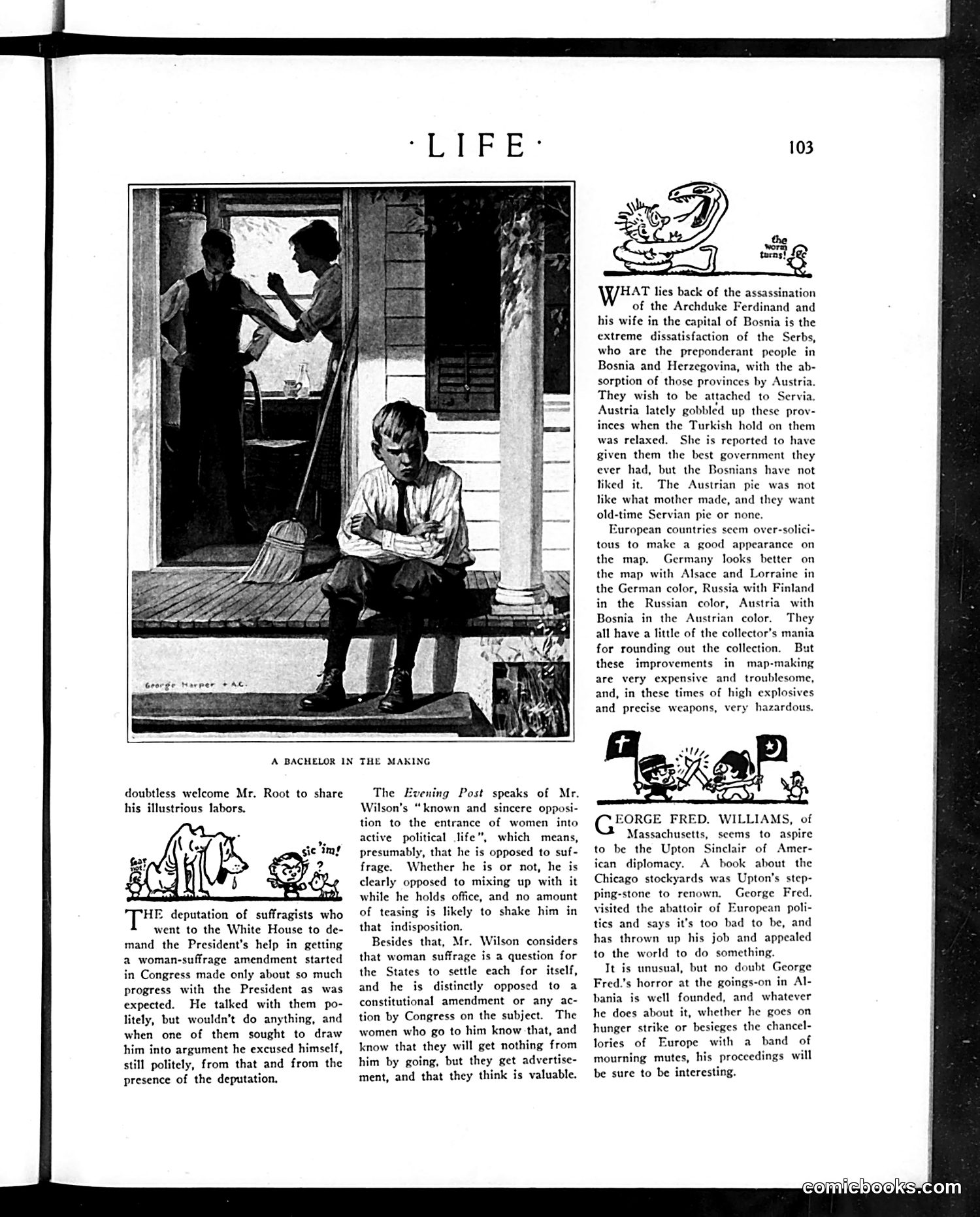
**Main Cartoon: "A Bachelor in the Making"** The illustration depicts a young boy sitting alone while adults argue in a doorway behind him—likely representing parental discord. The satire suggests that witnessing marital conflict produces emotionally damaged "bachelors" (unmarried men), implying such boys grow up avoiding marriage. **Political Content:** The page discusses President Wilson's refusal to support a woman-suffrage amendment, despite a suffragist delegation visiting the White House. The text notes Wilson considers suffrage a state matter, not federal, and actively avoids the issue—though the magazine observes that suffragists gain valuable publicity regardless. **International Commentary:** The final section addresses the assassination of Archduke Ferdinand in Bosnia, contextualizing Serbian nationalist dissatisfaction with Austrian rule. Life critiques European nations' territorial ambitions ("collector's mania"), arguing that map-making improvements through conquest are expensive and dangerous—a prescient observation given this article appears to predate World War I's outbreak by months.
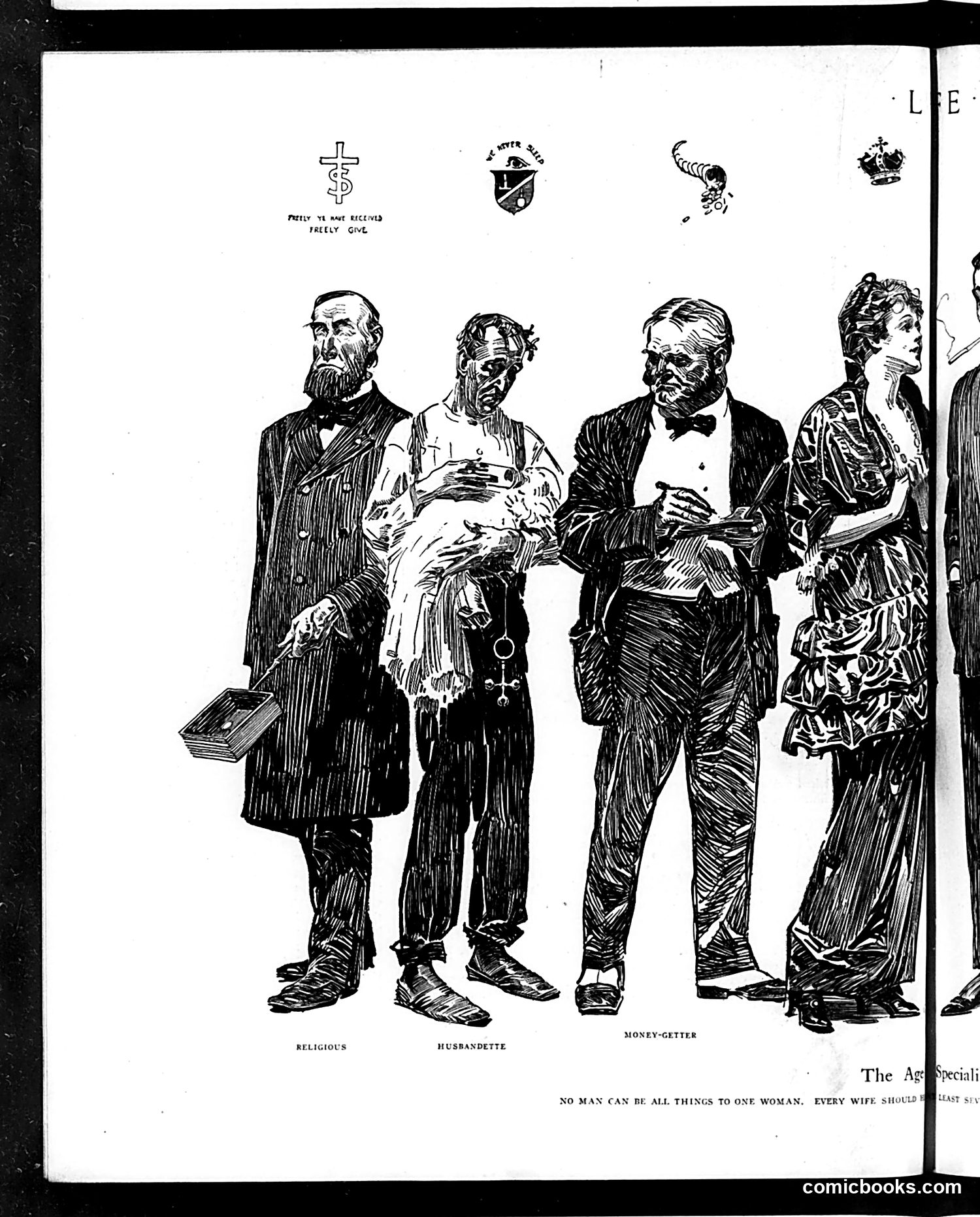
This satirical cartoon depicts four male character types labeled "Religious," "Husbandette" (likely "Husband-ette"), and "Money-Getter." The illustration critiques societal expectations of marriage by suggesting no single man can fulfill all a woman's needs. The caption "No man can be all things to one woman. Every wife should..." (text cuts off) implies wives must accept husbands with multiple, often contradictory qualities—spiritual devotion, domestic involvement, and financial success. The satirical point targets both unrealistic marital expectations and perhaps the compartmentalization of male roles in early 20th-century society. Each figure's exaggerated appearance emphasizes the impossibility of one man embodying all these ideals simultaneously, mocking both rigid gender roles and women's limited agency in marriage.
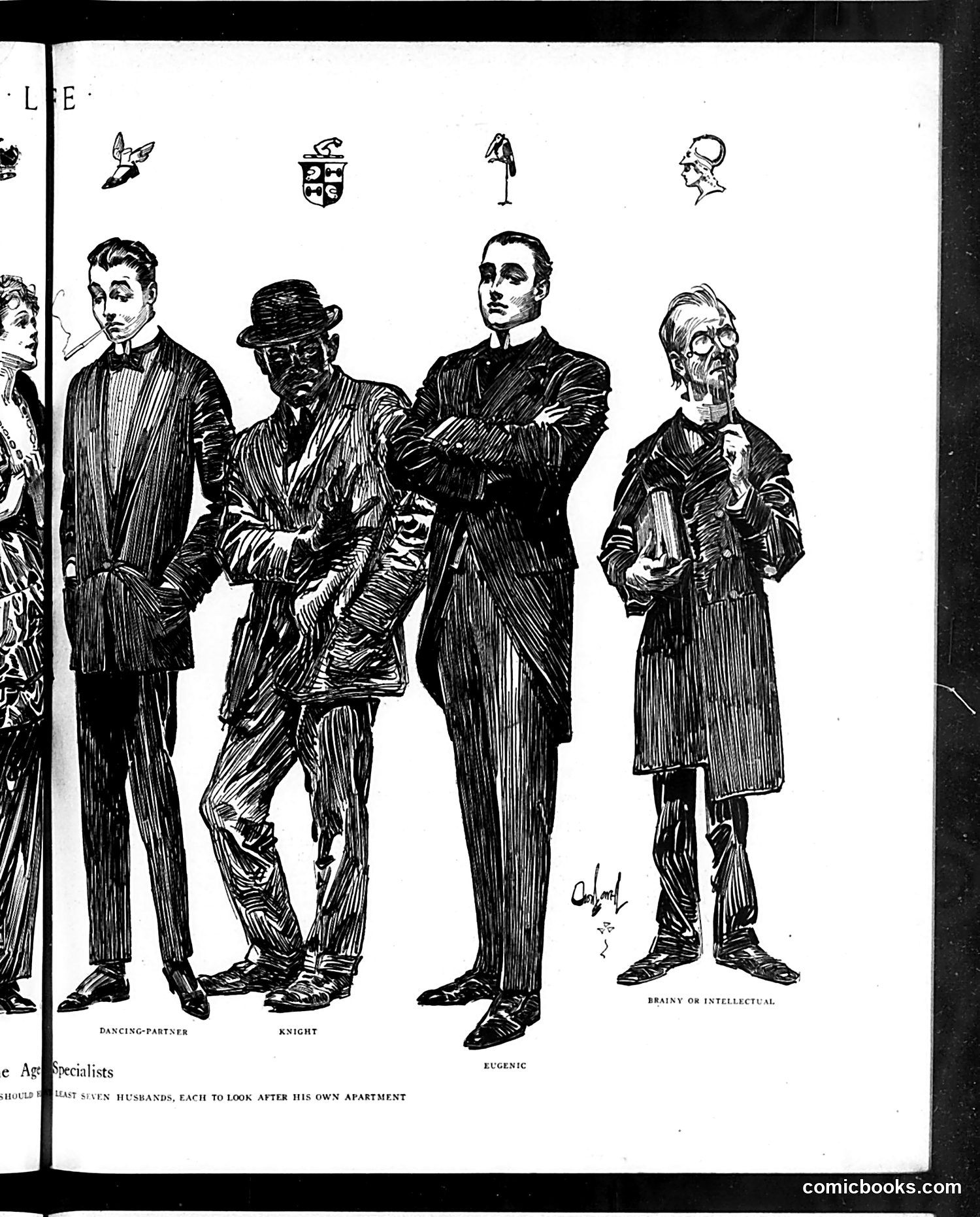
This page shows four male figures in formal late 19th/early 20th-century dress, labeled (left to right): "Dancing-Partner," "Knight," "Eugenic," and "Brainy or Intellectual." The caption states: "...LEAST SEVEN HUSBANDS, EACH TO LOOK AFTER HIS OWN APARTMENT." This appears to be satire about eugenics and social specialization—a woman supposedly needs different husbands with distinct roles (one for dancing/entertainment, one for chivalry, one for biological/eugenic purposes, one for intellectual conversation). The joke mocks both the eugenics movement popular in early 20th-century America and the idea of "specialized" husbands for different marital functions, presenting an absurdist commentary on contemporary social attitudes. The small heraldic and profile sketches at top reinforce the satirical tone of exaggerated classification.
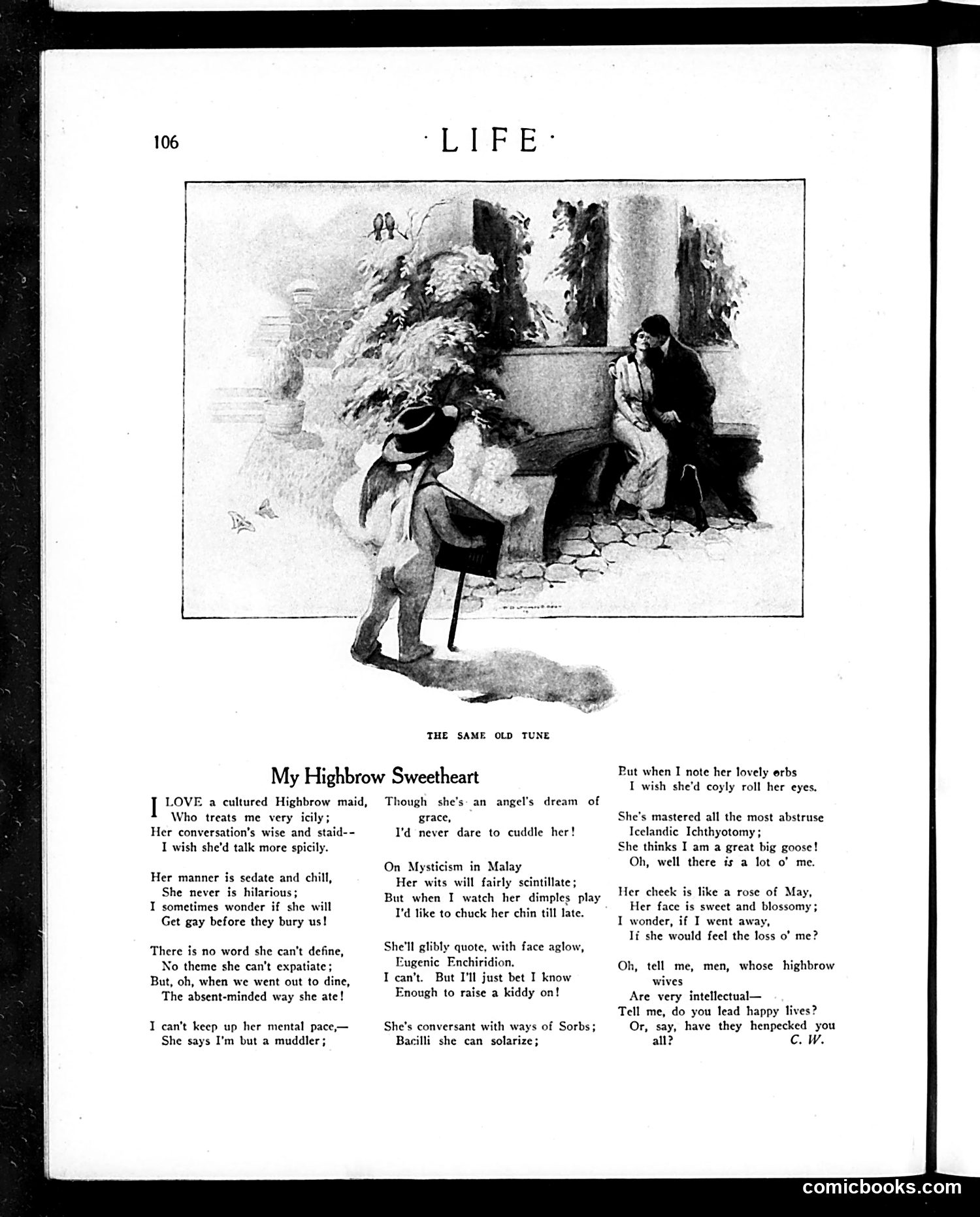
This humorous poem satirizes the tension between intellectual women and romantic relationships in early 20th-century America. The narrator loves a highly educated, cultured woman whose intelligence intimidates him—she discusses mysticism, eugenics, Icelandic ichthyology, and bacteriology with ease, while he admits he's "but a muddler." The joke is the contradiction: she's intellectually superior and beautiful, yet her very education makes her emotionally distant and unapproachable ("never dare to cuddle her"). He yearns for traditional feminine warmth (wanting her to "coyly roll her eyes") but she seems above such sentimentality. The cartoon illustrates this dynamic: two figures interact awkwardly near ivy-covered ruins, suggesting the mismatch between romantic ideals and reality. The satire mocks both the "new woman" of the era and male insecurity about female education—poking fun at men threatened by intelligent wives.
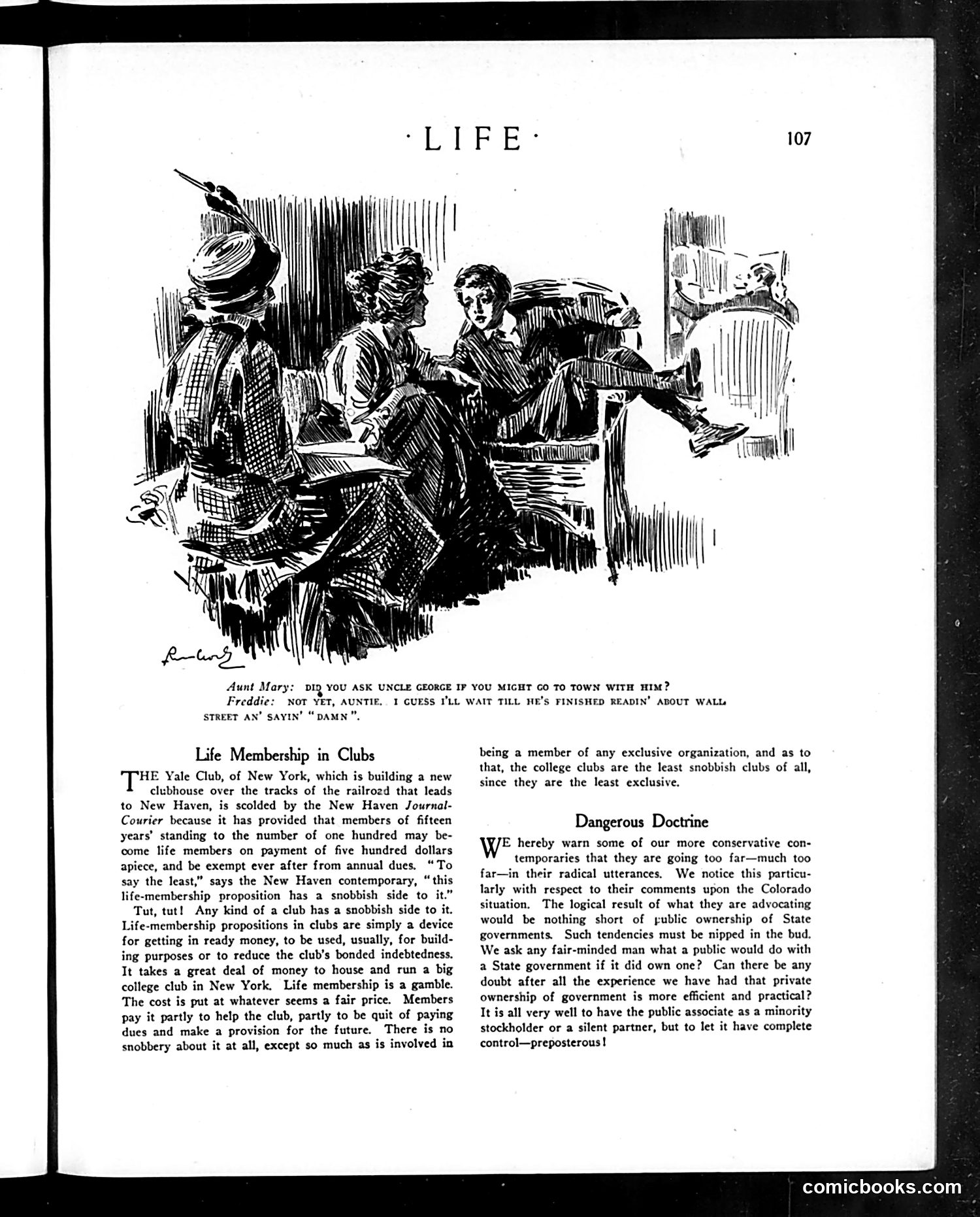
**The Cartoon:** A domestic scene shows a child (Freddie) asking his aunt about visiting town with Uncle George. Freddie hasn't asked yet because Uncle George is absorbed reading about "Wall Street" and "saying damn"—the joke being that the child is waiting for the adult to finish reading scandalous financial news before interrupting. **The Articles:** The page discusses two topics: 1. **Yale Club Life Membership:** Life defends the Yale Club's practice of offering lifetime memberships for $500, dismissing accusations of snobbery. The argument: such schemes simply raise construction funds; college clubs are actually *less* exclusive than other clubs. 2. **"Dangerous Doctrine":** Life satirizes conservative contemporaries warning against radical speech regarding Colorado (likely the labor conflicts/Ludlow Massacre era). Life mockingly suggests these conservatives are advocating "public ownership of State governments" and sarcastically questions whether the public could manage government better than private interests—implying the absurdity of such radical ideas. The page reflects Progressive Era debates about labor, class, and governmental control.
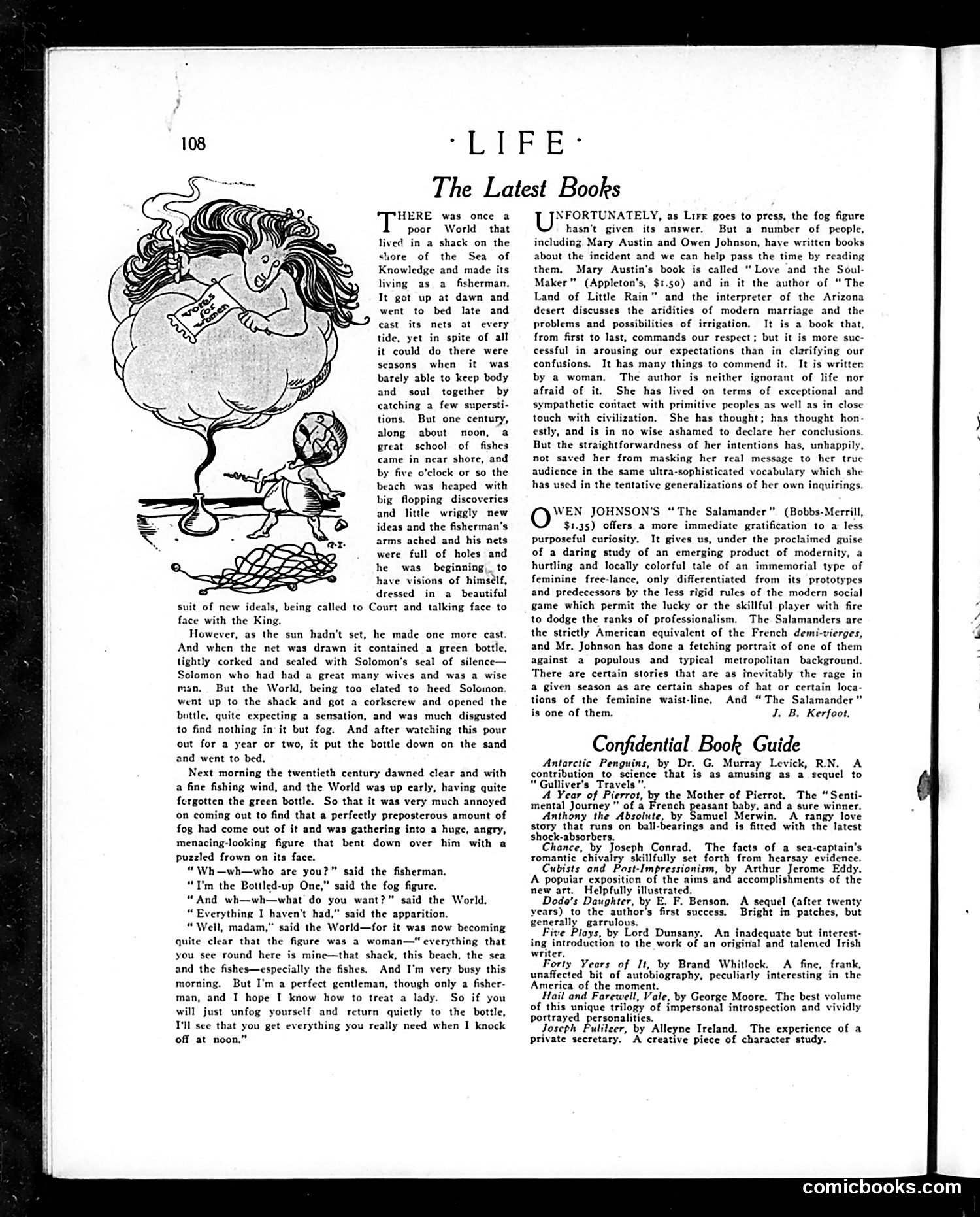
This page features an allegorical cartoon and book review section. The main illustration depicts the "World" as a poor fisherman who discovers a mysterious bottle sealed with "Solomon's seal of silence." When opened, it releases fog that materializes into a demanding female figure—representing suppressed desires or social forces demanding "everything I haven't had." The allegory appears to address tensions between traditional society (the fisherman/World) and emerging demands for change, particularly women's rights and social reform. The "bottled-up" figure represents these pressure points waiting to explode into the twentieth century. The text then transitions to book reviews, notably Mary Austin's *Love and the Soul-Maker*, which addresses modern marriage problems. The reviewer praises Austin's forthright treatment of intimate subjects by a female author unafraid to engage philosophical questions, though notes her sophisticated vocabulary sometimes obscures her message to ordinary readers. This reflects early 1900s anxieties about social change and intellectual discourse on relationships.
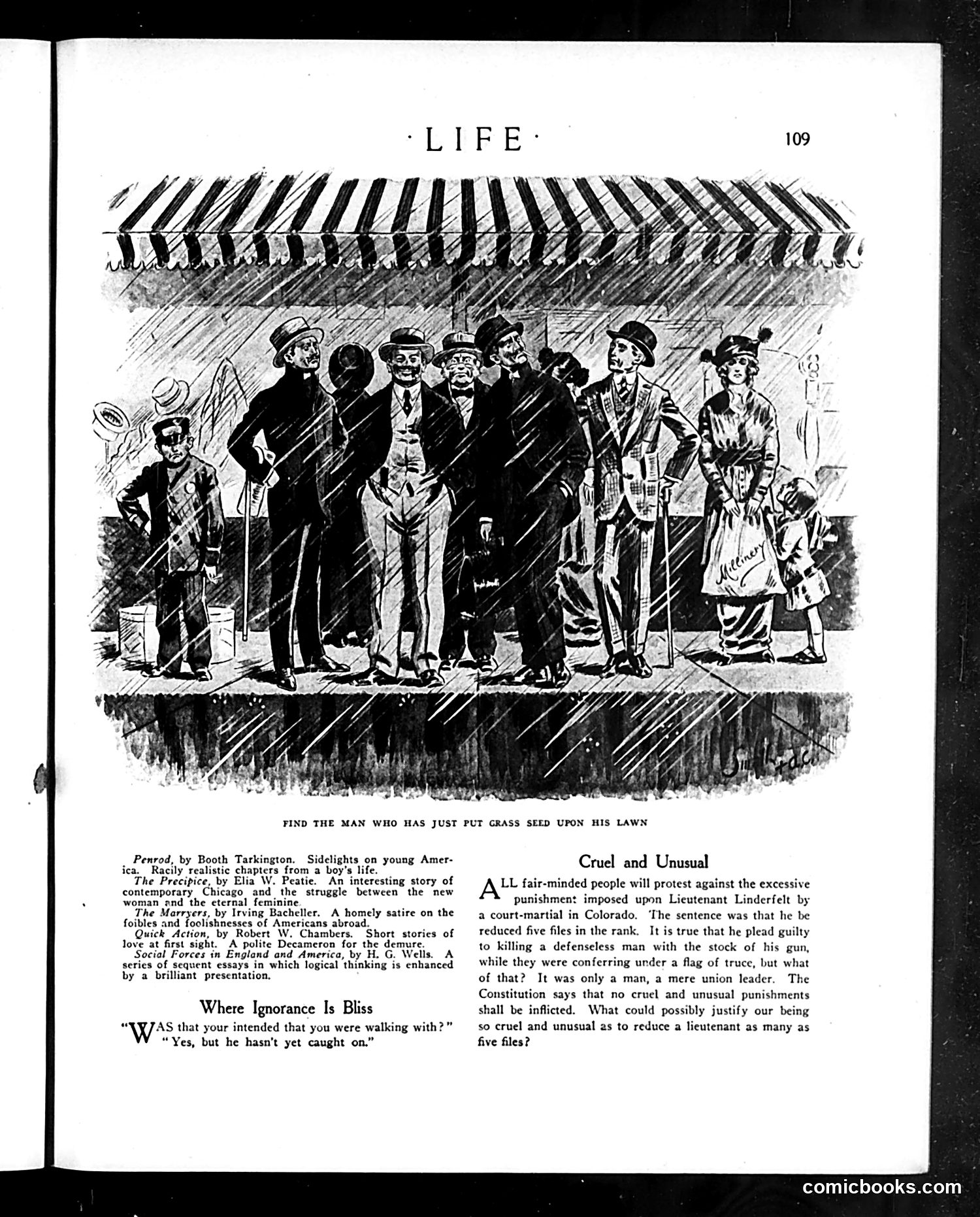
The top illustration is a cartoon captioned "Find the Man Who Has Just Put Grass Seed Upon His Lawn"—a visual puzzle showing a group of well-dressed people standing together, with the joke being that one should spot someone who looks freshly foolish or uncomfortable (though the specific figure isn't clearly identifiable in the image). Below are book advertisements and two brief satirical pieces. "Where Ignorance Is Bliss" is a small joke about a man walking with his fiancée who "hasn't yet caught on"—meaning she's unaware of some unstated flaw or deception, playing on the phrase that ignorance is bliss. "Cruel and Unusual" is heavy sarcasm criticizing a court-martial sentence against Lieutenant Linderfelt in Colorado. The piece sarcastically defends his punishment (reduced rank) for killing an unarmed union leader under a truce flag, mocking those who call the sentence "excessive" by ironically suggesting that punishing an officer for killing a mere "union leader" is itself cruel and unusual. It's biting social commentary about labor violence and class justice.
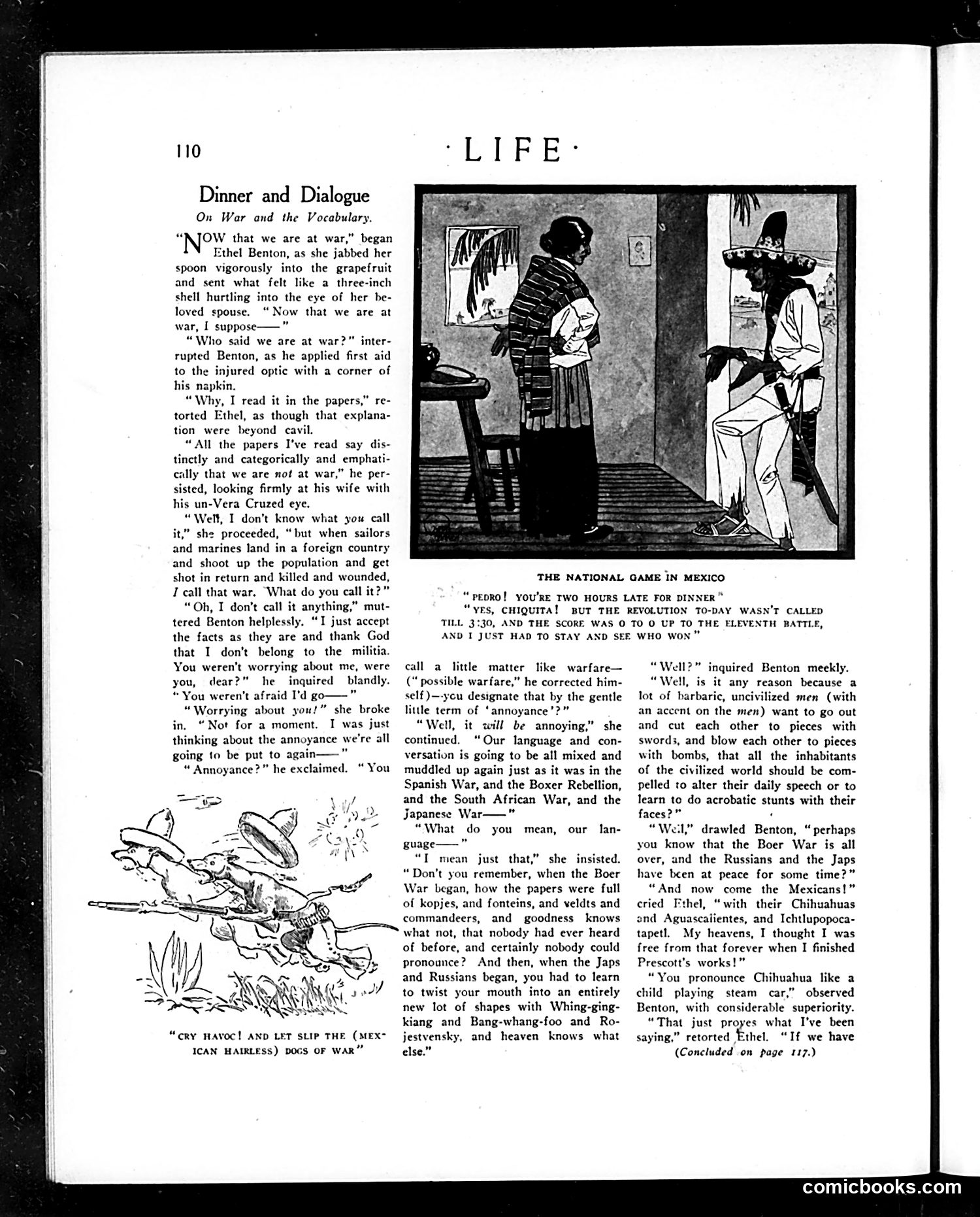
This 1913 *Life* magazine piece satirizes U.S. military interventions and their linguistic fallout. The dialogue between Ethel and Benton centers on America's involvement in Mexico—the text references sailors and marines landing in a foreign country, likely referring to the Veracruz occupation of 1914 (or anticipating it). Ethel's complaint is that each military conflict forces Americans to learn foreign place names and terms: Spanish War, Boxer Rebellion, South African War, Japanese War created vocabularies of "kopjes," "veldts," and "Rojestvensky." Now Mexico threatens more linguistic chaos with "Chihuahuas" and "Aguascalientes." The bottom cartoon, "The National Game in Mexico," uses baseball as metaphor—a Mexican couple quarrels because the husband stayed to watch the "revolution" (scored 0-0 through the eleventh battle) instead of coming to dinner. This equates military conflict to entertainment and absurdity. The satire mocks both unnecessary foreign interventions and Americans' provincial annoyance at having to accommodate foreign vocabulary, suggesting imperial entanglement is an irritating inconvenience rather than serious moral concern.
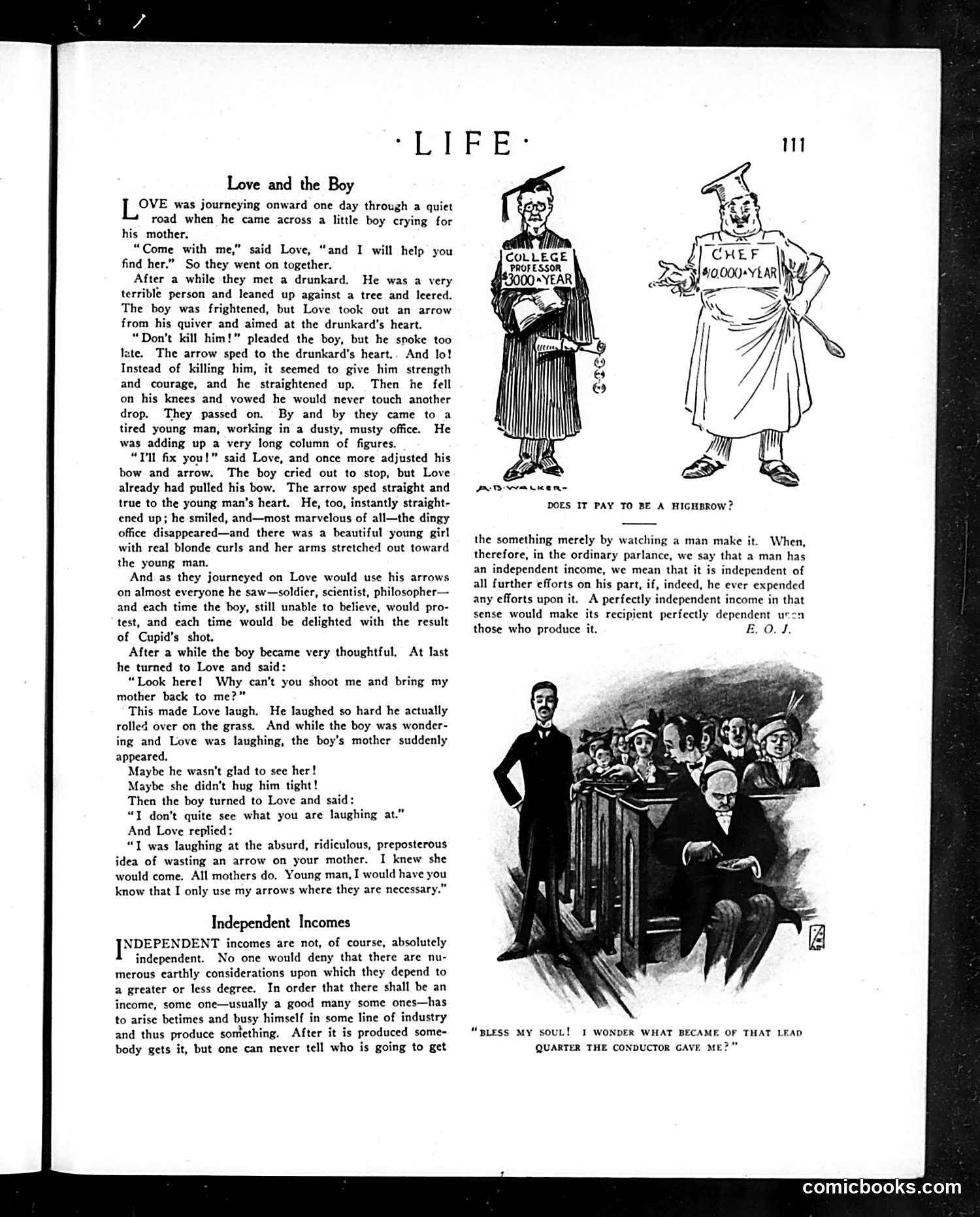
This page contains two distinct satirical pieces: **"Love and the Boy"** (allegorical fable): Cupid's arrows reform a drunkard and inspire a tired office worker by revealing love/beauty to him, but cannot resurrect the boy's mother. The joke mocks maternal inevitability—Love cannot "waste" an arrow on something already guaranteed. The satire targets romantic idealism by suggesting love conquers some human failings but remains powerless against natural certainties. **"Independent Incomes"** (text essay with cartoon): The piece mocks wealthy people claiming "independent" income. The satire exposes the hypocrisy: such income actually depends entirely on others' labor. A truly independent income would paradoxically make its recipient dependent on workers who produce it. The cartoon shows a well-dressed man amid laborers, likely illustrating this dependency the wealthy deny. Both pieces critique self-delusion—romantic fantasy in one case, economic pretension in the other.
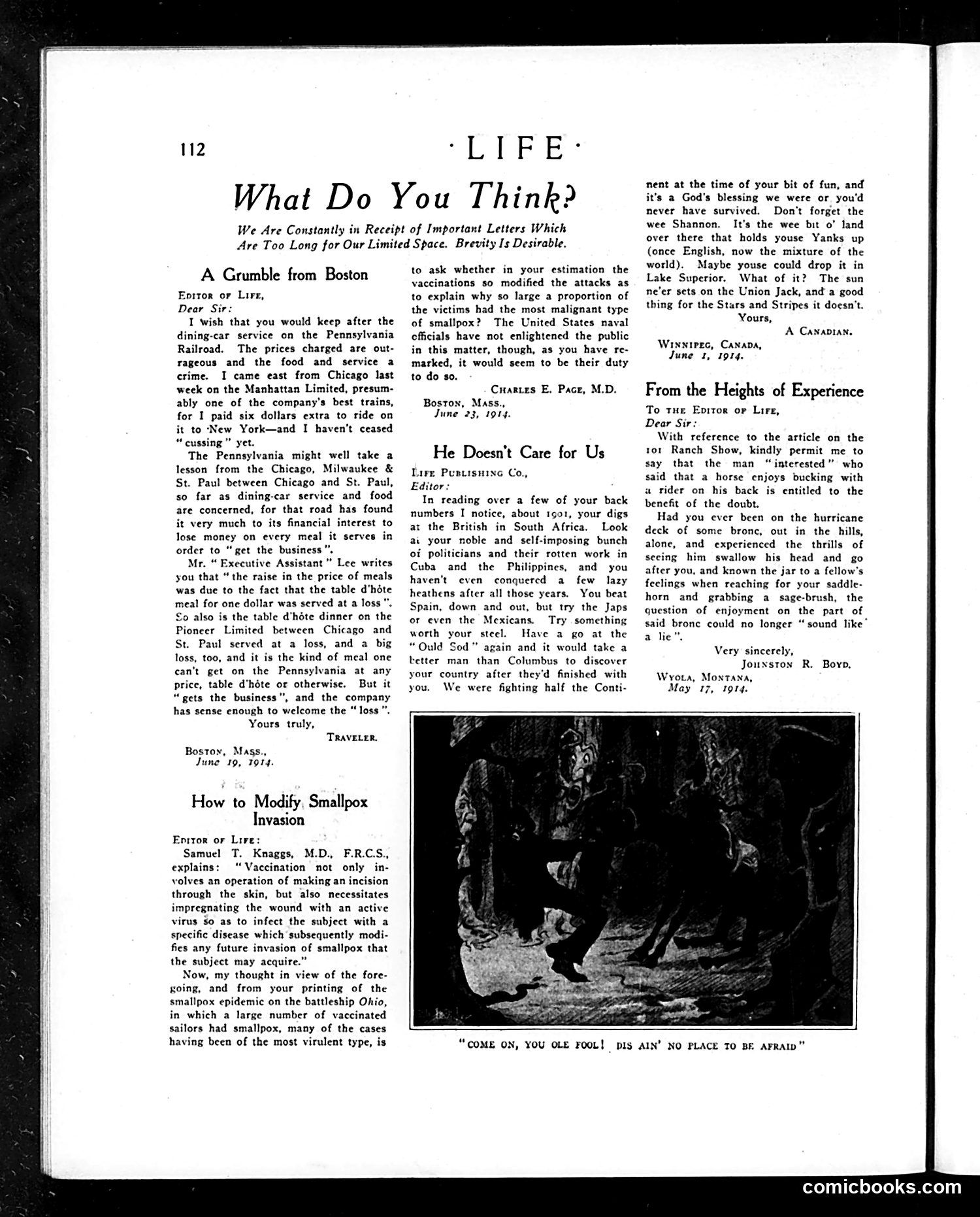
This page reproduces reader letters responding to Life's editorial content. The "What Do You Think?" section published abbreviated correspondence addressing contemporary issues. **Letter 1** ("A Grumble from Boston"): A traveler complains about the Pennsylvania Railroad's expensive, poor-quality dining cars compared to competitors like the Chicago, Milwaukee & St. Paul line, which sacrifices short-term profit to build customer loyalty. **Letter 2** ("How to Modify Smallpox Invasion"): A Boston physician questions whether vaccinations actually prevented severe smallpox, citing a recent epidemic aboard the USS Ohio where vaccinated sailors still contracted virulent cases. He questions Navy transparency. **Letter 3** ("He Doesn't Care for Us"): A Canadian reader sarcastically criticizes American military achievements and foreign policy—Spain's defeat was easy, but Americans couldn't conquer Japan or Mexico. He boasts about British imperial power while mocking American pretensions. The cartoon caption at bottom ("Come on, you ole fool! Dis ain't no place to be afraid") appears unrelated to these letters.
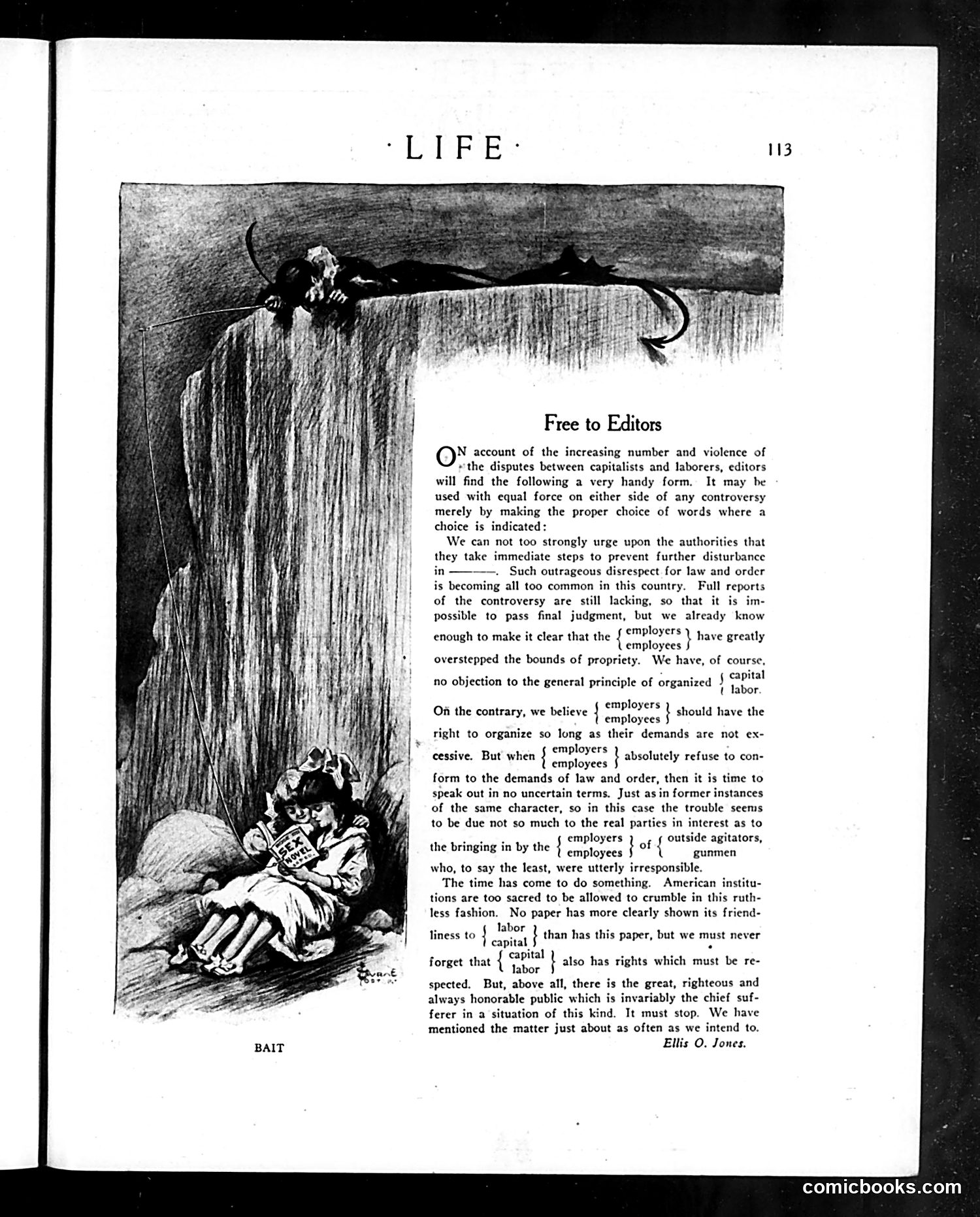
This page satirizes the editorial hypocrisy surrounding labor disputes in early 20th-century America. The cartoon "Bait" depicts a figure dangling from a noose or trap above a small, crouching person below—visualizing how workers are exploited and endangered. The accompanying text by Ellis O. Jones is a **fill-in-the-blank template** mocking standard newspaper editorials about labor-capital conflicts. Editors could swap "employers/employees" in identical sentences to argue either side without changing substance, revealing how newspapers used boilerplate language favoring whoever owned them while claiming neutrality. The satire exposes: editorial dishonesty, the invocation of "law and order" to suppress workers, blaming "outside agitators" for strikes, and the fictional "public interest" used to shut down labor organizing. The template's absurdity—using identical phrasing for opposite positions—reveals how meaningless such editorials actually were.
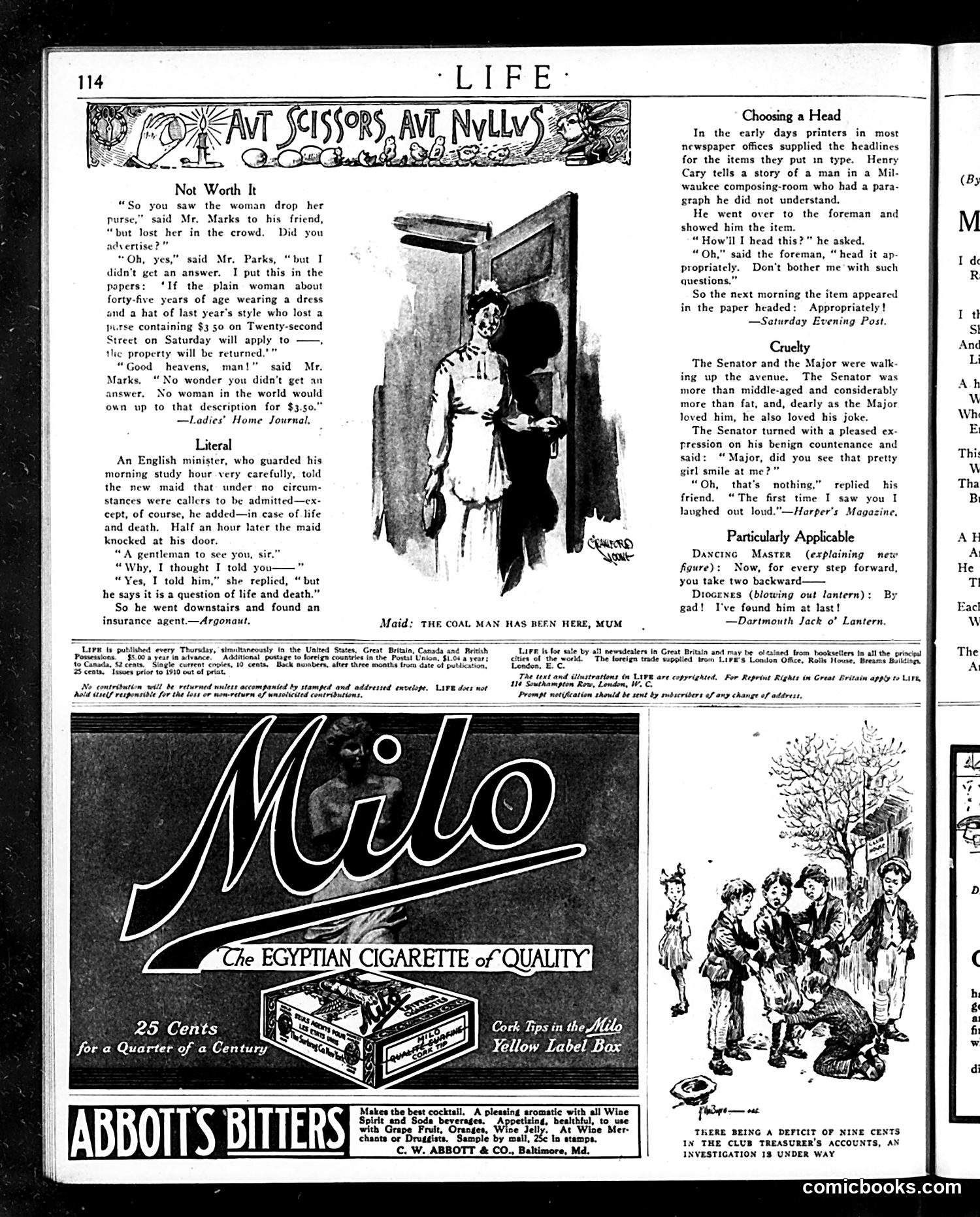
This page from *Life* magazine contains four brief humorous anecdotes typical of early 20th-century American satire: **"Not Worth It"** mocks a man's failed attempt to recover a lost purse by advertising for its owner. The joke: his ad describing the woman as "plain" and "forty-five years of age wearing a dress and hat of last year's style" is so unflattering that no woman would claim ownership, even for the $3.50 reward. **"Literal"** satirizes a maid's overly literal interpretation of orders. A minister forbids callers except in emergencies; an insurance agent claims his visit involves "life and death," exploiting the loophole. **"Choosing a Head"** ridicules a newspaper compositor's confusion, resulting in the absurd headline "Appropriately!" for an item he didn't understand. **"Cruelty"** presents a fat, middle-aged senator asking a friend if a girl smiled at him. The friend's cruel response: the first time he saw the senator, he laughed aloud. The page also contains advertisements for Milo cigarettes and Abbott's Bitters—typical period advertising.
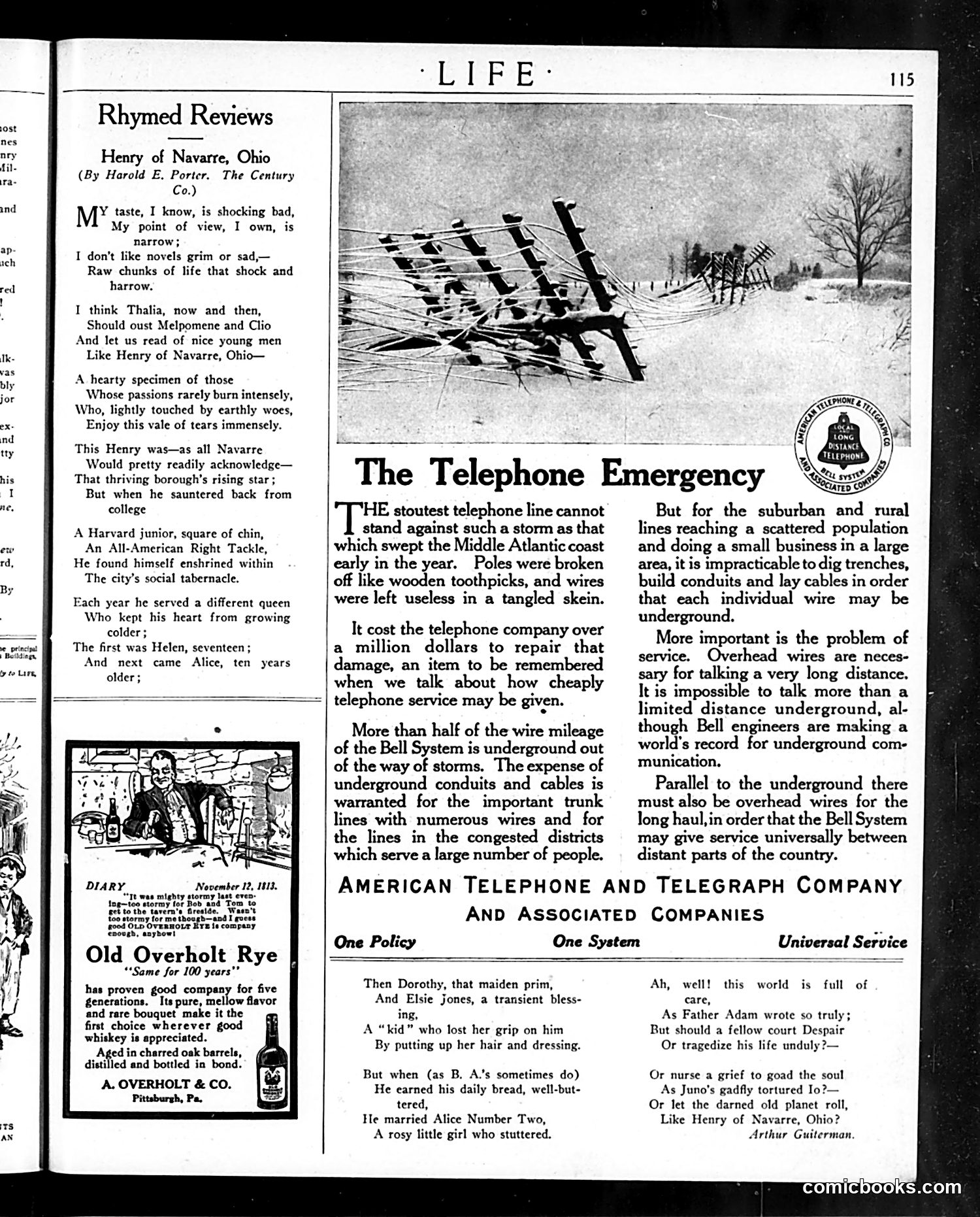
This page contains two distinct pieces: **"Henry of Navarre, Ohio"** (left): A humorous poem reviewing a novel about a shallow, wealthy Harvard graduate from Ohio who serially romances various women before marrying. The satire targets the vapidity of certain young aristocratic men and lightweight popular fiction that celebrates their aimless lives rather than treating serious human concerns. The poem's speaker ironically praises such "nice young men" while admitting to preferring escapist entertainment over serious literature. **"The Telephone Emergency"** (right): A corporate advertisement for American Telephone & Telegraph disguised as public interest journalism. It justifies expensive telephone infrastructure by referencing storm damage costing "over a million dollars" to repair. The piece defends why rural areas can't have underground lines (too expensive) while urban areas receive them, framing corporate limitations as reasonable engineering challenges rather than service inequities. Both pieces reflect early 20th-century American class attitudes and corporate messaging conventions.
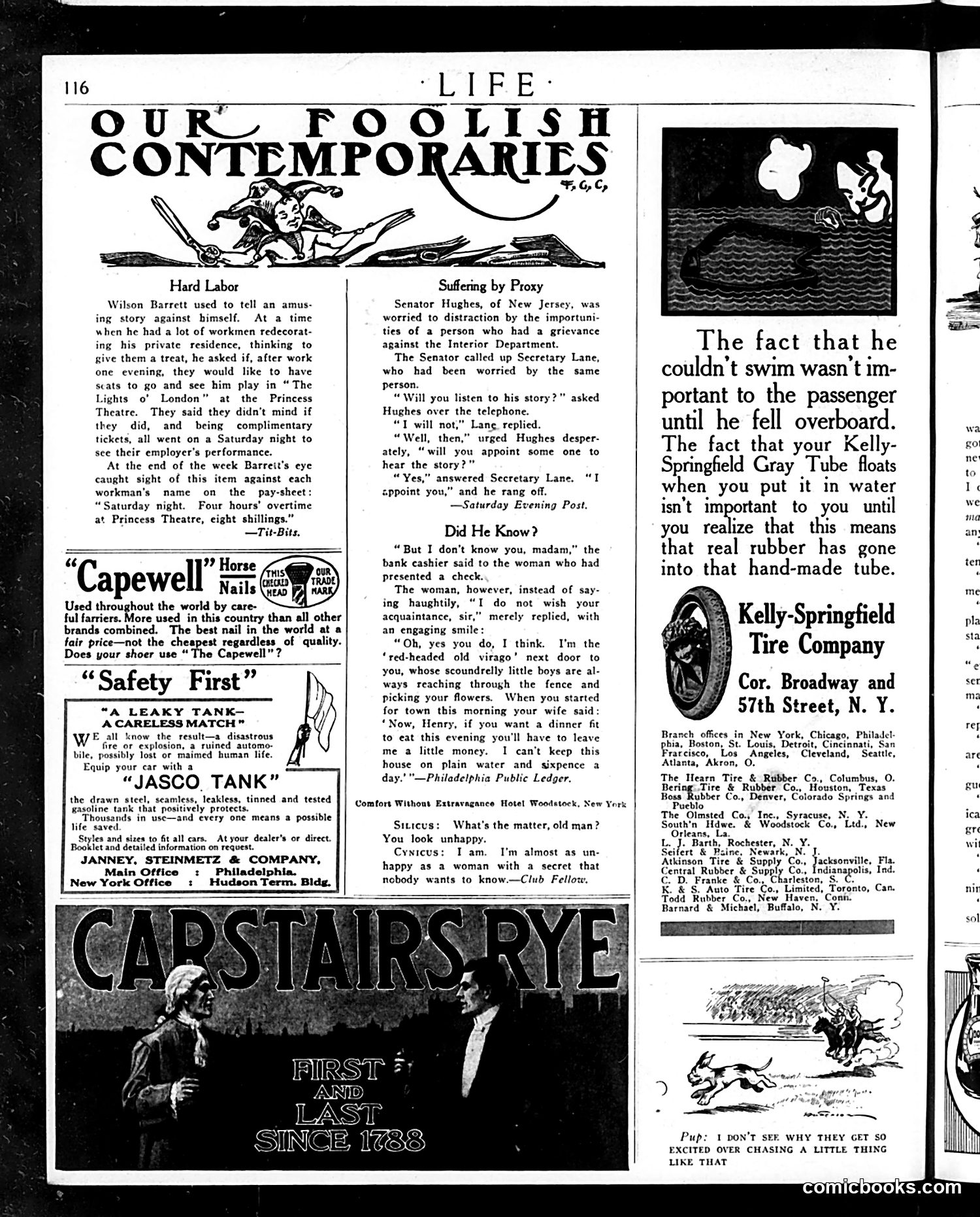
This page from *Life* magazine contains several satirical anecdotes mocking contemporary figures and situations: **"Hard Labor"** ridicules actor Wilson Barrett, who invited his workers to see his theatrical performance as a treat, only to have them charge four hours' overtime pay for attending—turning his generosity into a financial loss. **"Suffering by Proxy"** jokes about Senator Hughes of New Jersey pestering Secretary Lane about a constituent's complaint. Lane's solution—appointing Hughes himself to hear the complaint—is absurdist humor mocking bureaucratic buck-passing. **"Did He Know?"** presents a humorous anecdote where a woman cashing a check at a bank, unfamiliar to the cashier, delivers a witty monologue about being his neighbor—the "red-headed old virago" whose boys steal his flowers. The page also includes period advertisements for horseshoe nails, safety tank equipment, and Kelly-Springfield tires, plus a caption about dogs chasing rabbits. The humor relies on everyday social awkwardness and bureaucratic absurdity recognizable to early 20th-century readers.
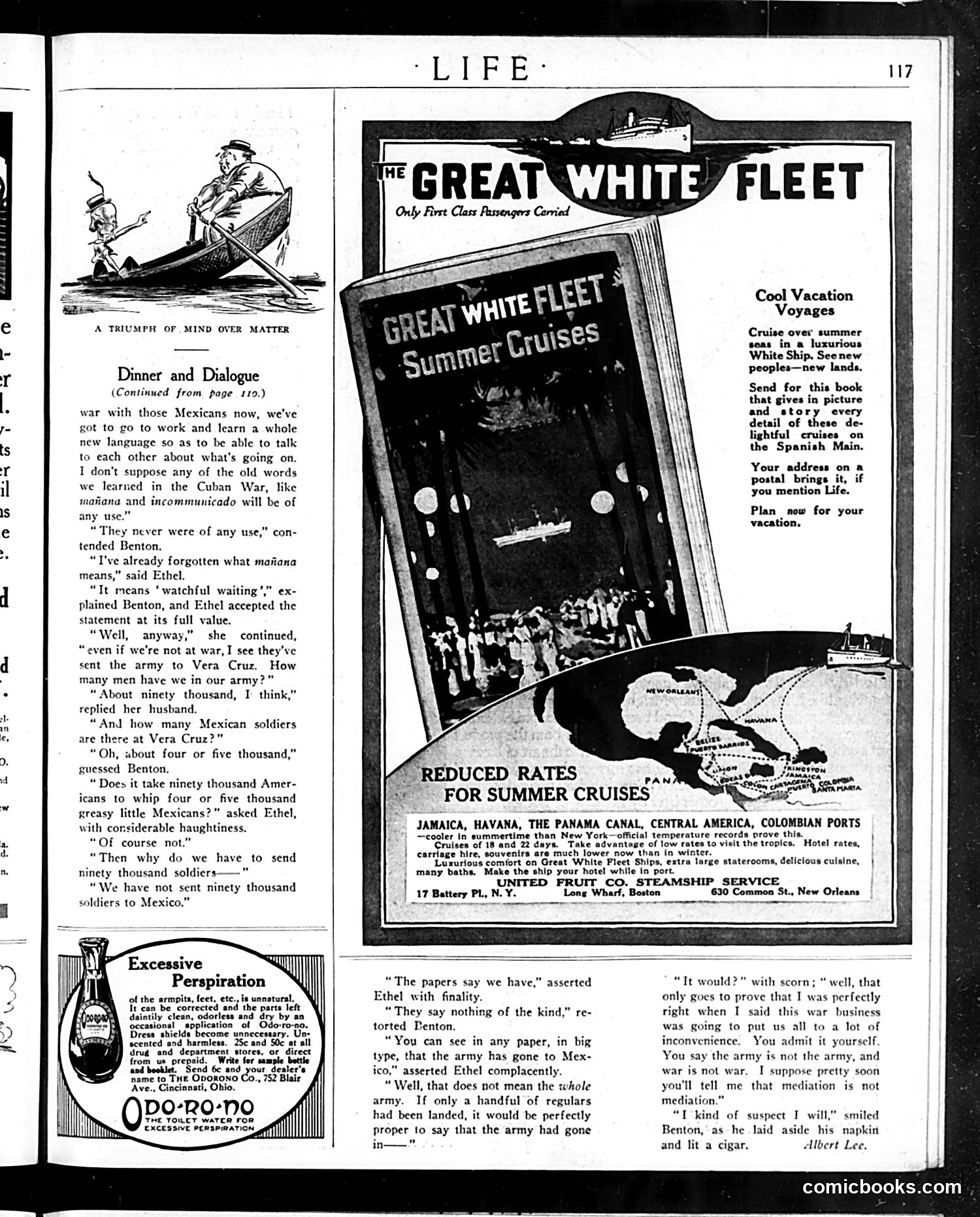
This dialogue satirizes early 20th-century American attitudes toward Mexico and military intervention. The cartoon depicts a husband and wife debating U.S. military action at Vera Cruz (likely referencing the 1914 Veracruz occupation). The satire targets: 1. **American linguistic arrogance**: The couple jokes about needing to learn Spanish, dismissively referencing Mexican words from the earlier Cuban War as useless. 2. **Military logic**: Ethel humorously exposes the absurdity of deploying 90,000 troops against 4,000-5,000 Mexican soldiers, asking why such overwhelming force is necessary. 3. **Government doublespeak**: Benton's evasive argument that sending "the army" doesn't mean the *whole* army ridicules official obfuscation about military involvement. 4. **American condescension**: Ethel's reference to Mexicans as "greasy little Mexicans" reflects period racism; the joke undercuts this attitude by showing her logic superior to male political reasoning. The cartoon lampoons both gender relations and American imperial overconfidence.
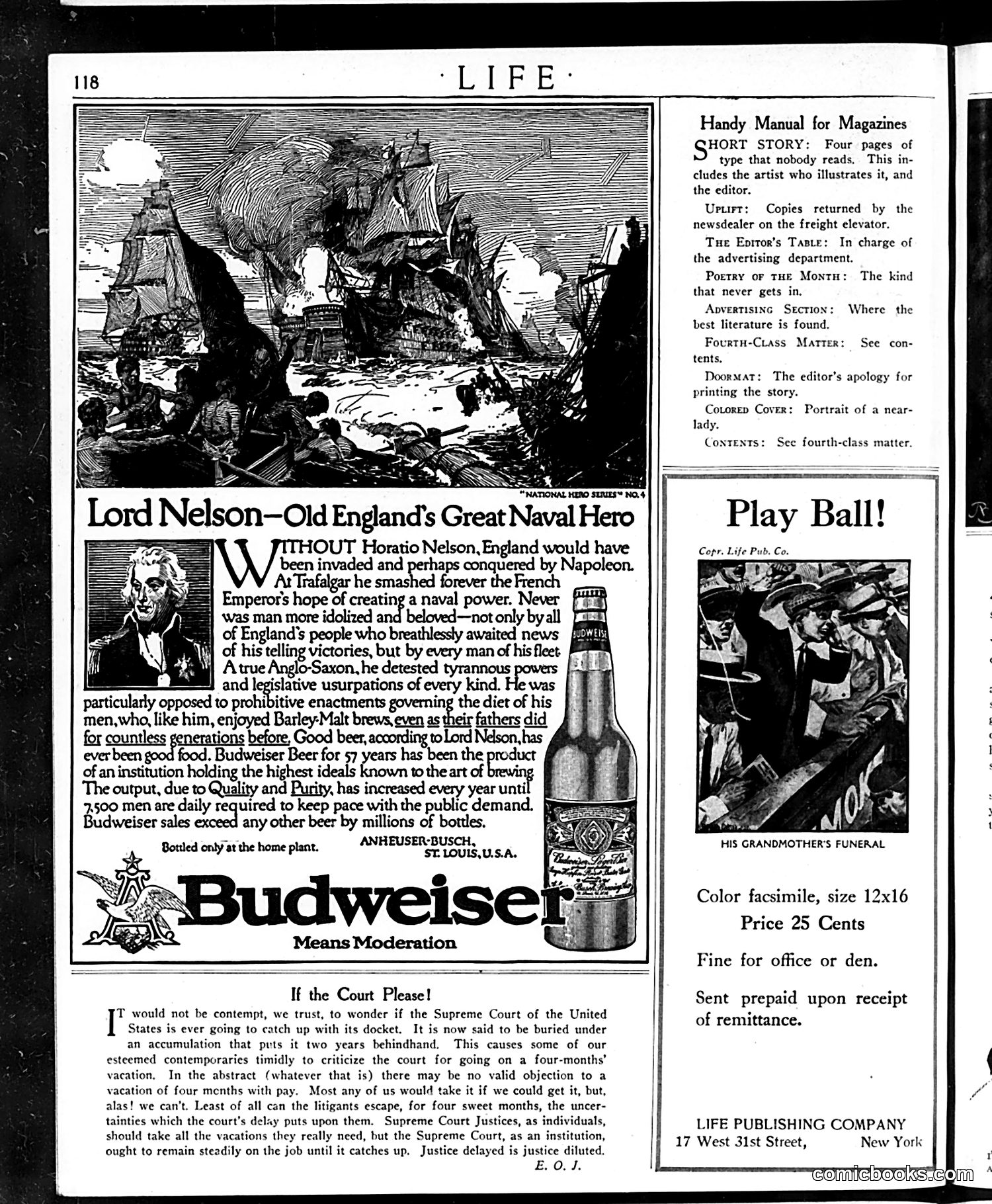
This page contains three distinct sections: **Budweiser Advertisement (Main):** A "National Hero Series" ad linking Lord Nelson, England's celebrated naval commander who defeated Napoleon at Trafalgar, to Budweiser beer. The advertisement absurdly claims Nelson opposed dietary restrictions on his sailors and enjoyed beer—therefore endorsing Budweiser as wholesome food. This is pure propaganda: it exploits patriotic reverence for a historical figure to sell beer by creating a false association between the admiral's heroism and the product. **"If the Court Please!" Editorial:** Satirizes the U.S. Supreme Court's backlog and justices' four-month vacations. The author criticizes the contradiction: while individual justices deserve rest, the institution's delay harms litigants. The closing line—"Justice delayed is justice diluted"—is biting social commentary on court dysfunction. **"Handy Manual" & Advertisements:** Satirical definitions mocking magazine publishing practices, and an advertisement for a "Play Ball!" color print. The overall tone is satirical critique mixed with commercial advertising.
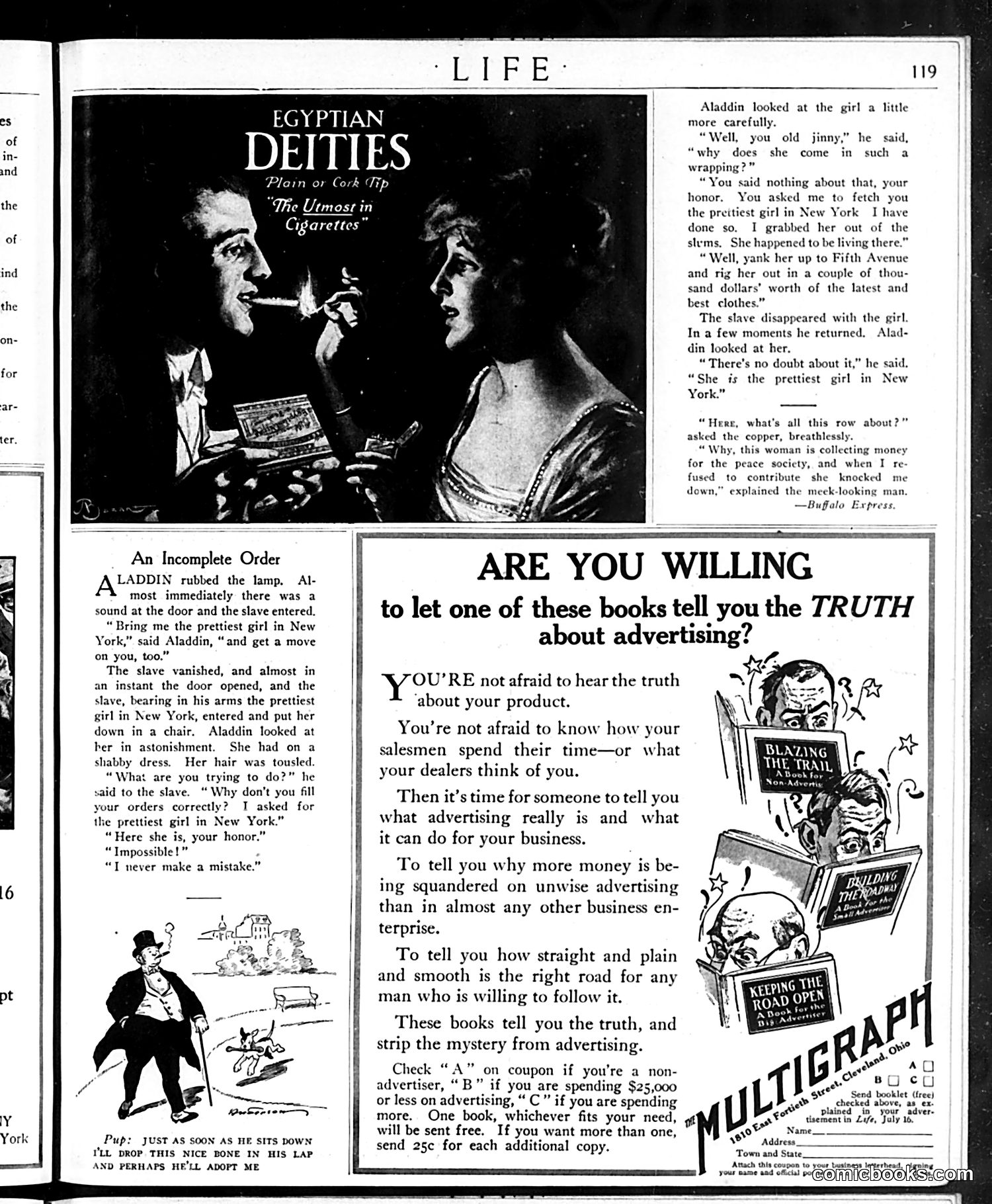
This page contains three distinct elements: **"Egyptian Deities" Cigarette Ad**: A stylized advertisement depicting two figures smoking, with Egyptian-inspired imagery. The absurdist title jokes that cigarettes represent the "utmost" in luxury. **"An Incomplete Order"**: A satirical story playing on the Aladdin lamp fairy tale. The joke critiques how *appearance* defines worth in society: Aladdin's magic slave literally fulfills his request for "the prettiest girl in New York" by retrieving a slum-dwelling woman—who becomes the "prettiest" only after Fifth Avenue clothing transforms her. The satire mocks the notion that beauty is purchasable and clothing-dependent, not intrinsic. **Two Minor Cartoons**: A brief anecdote about a man and a dog seeking adoption (gentler humor), and a domestic dispute about peace society donations (social satire). **"Are You Willing" Advertisement**: A full-page pitch for advertising advice books, promising to reveal "truth" about business practices and eliminate marketing "mystery." The page reflects early 20th-century Life magazine's blend of social satire, consumerism critique, and commercial advertising.
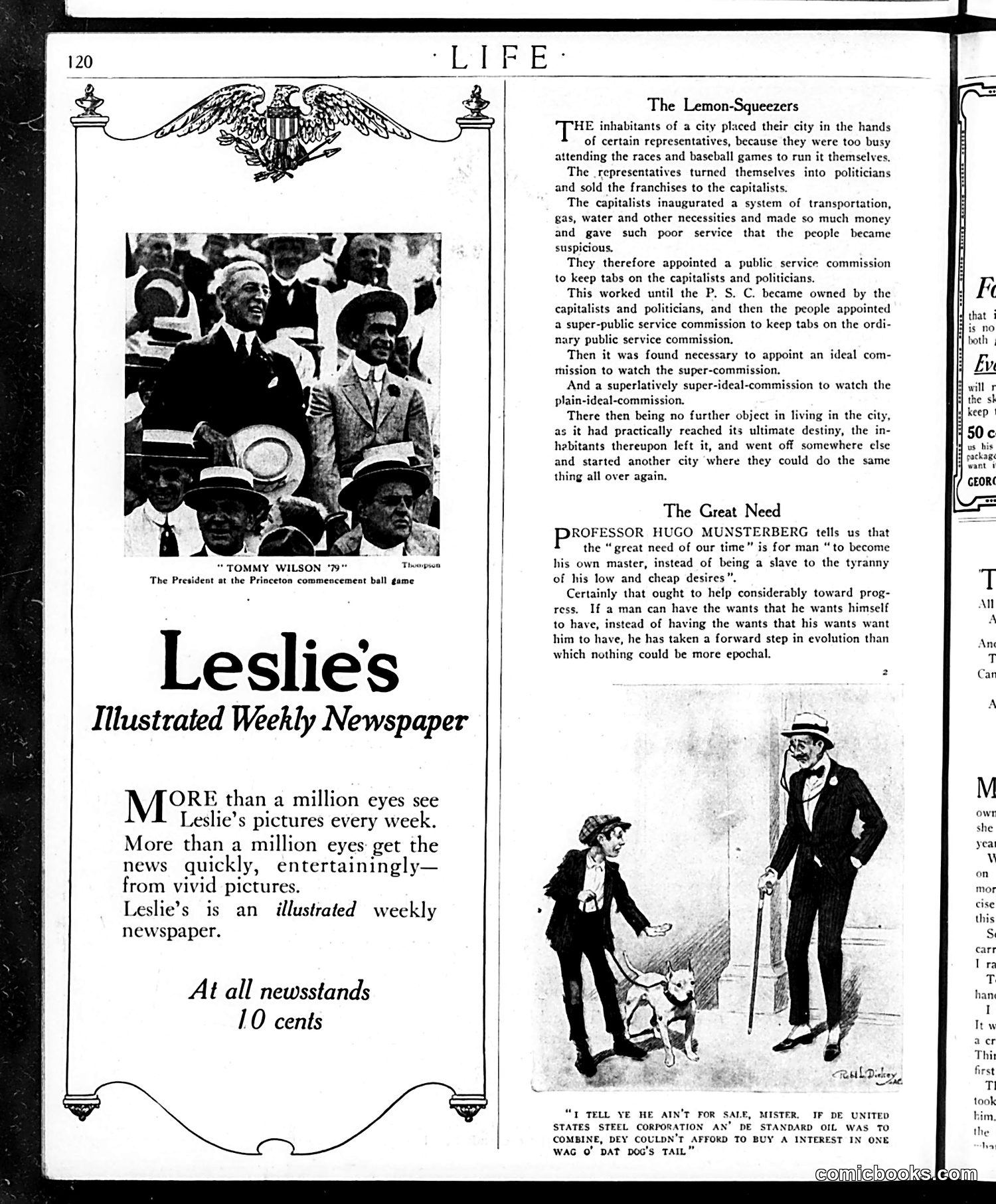
**"The Lemon-Squeezers"** is a satirical narrative attacking municipal corruption and regulatory capture. The story describes how citizens delegate city governance to representatives (too busy with sports), who sell franchises to capitalists who provide terrible services. Citizens then create commissions to oversee capitalists—but those commissions become corrupted too. Citizens respond by creating *more* commissions to watch the previous ones, in an infinite regress of bureaucracy. Eventually, exhausted by the absurdity, residents abandon the city entirely to repeat the cycle elsewhere. The satire mocks both corporate exploitation of public utilities and the futile faith in regulatory bureaucracy to solve the problem. **"The Great Need"** ridicules Professor Hugo Munsterberg's philosophy, sarcastically suggesting that wanting what you want (rather than what your wants want) represents epochal human progress—obvious, not profound. **The bottom cartoon** depicts a working-class figure refusing to sell his dog's tail, joking that even the combined might of U.S. Steel and Standard Oil couldn't afford it—a barb at monopolistic corporate power during the trust-busting era. The page also advertises *Leslie's Illustrated Weekly Newspaper* (10 cents).
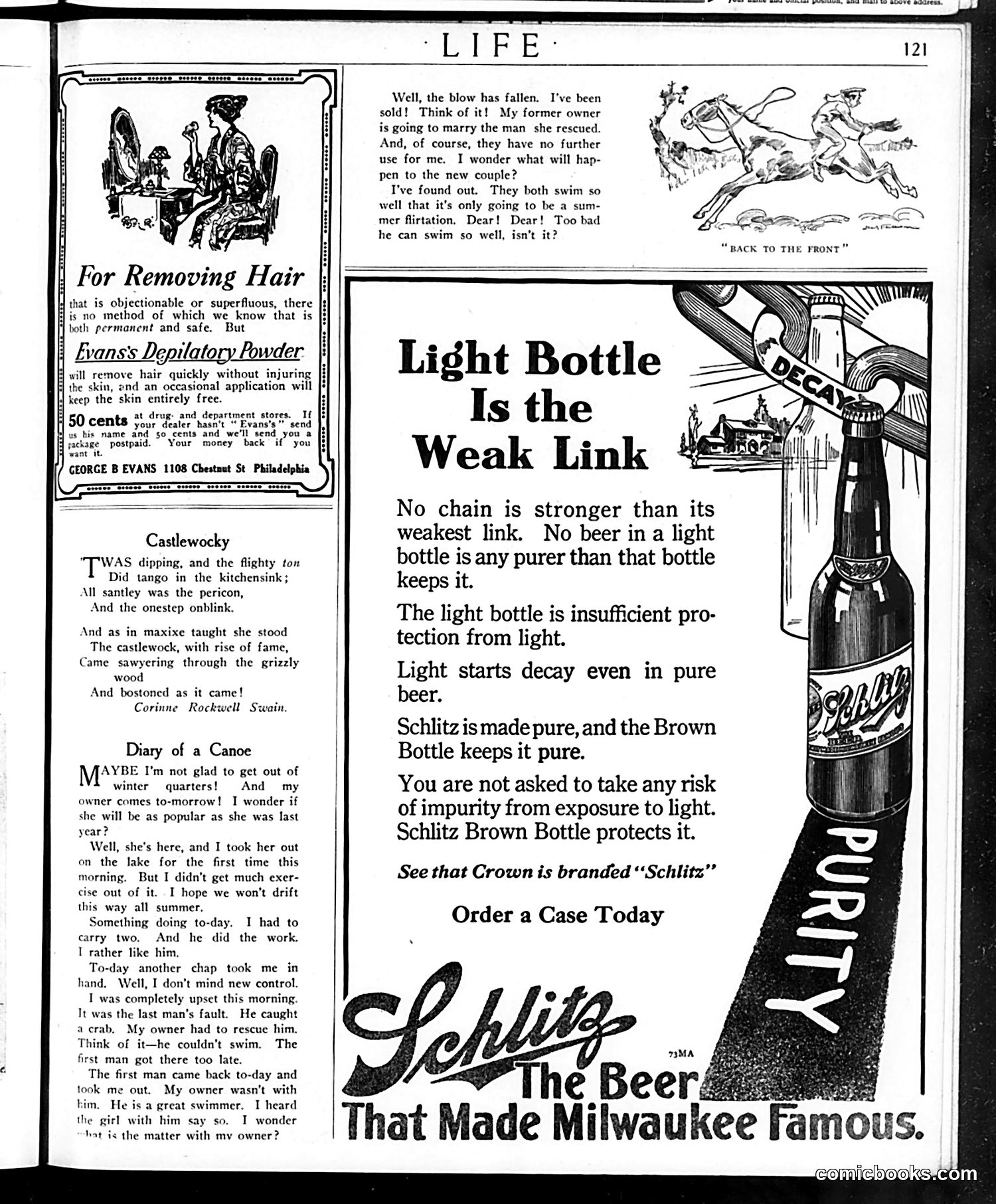
This page contains advertisements and humorous fiction typical of early 20th-century Life magazine. **Top left:** Evans's Depilatory Powder ad—a straightforward beauty product advertisement promising safe hair removal. **Center-left:** Two pieces of light verse. "Castlewocky" is nonsense poetry playing with dance crazes (tango, one-step, maxixe, boston)—faddish dances popular in that era. "Diary of a Canoe" is a first-person narrative from the canoe's perspective, humorously depicting romantic entanglements among its human passengers, culminating in a love triangle where the narrator-canoe wonders which man its owner prefers. **Right side:** A Schlitz beer advertisement arguing that brown bottles protect beer better than clear ones, since light causes decay. The ad uses chain-metaphor reasoning to suggest that a beer is only as pure as its container allows it to remain. The page demonstrates Life's mix of product advertising with satirical and whimsical content aimed at affluent, educated readers familiar with contemporary dance fads and romantic comedy tropes.
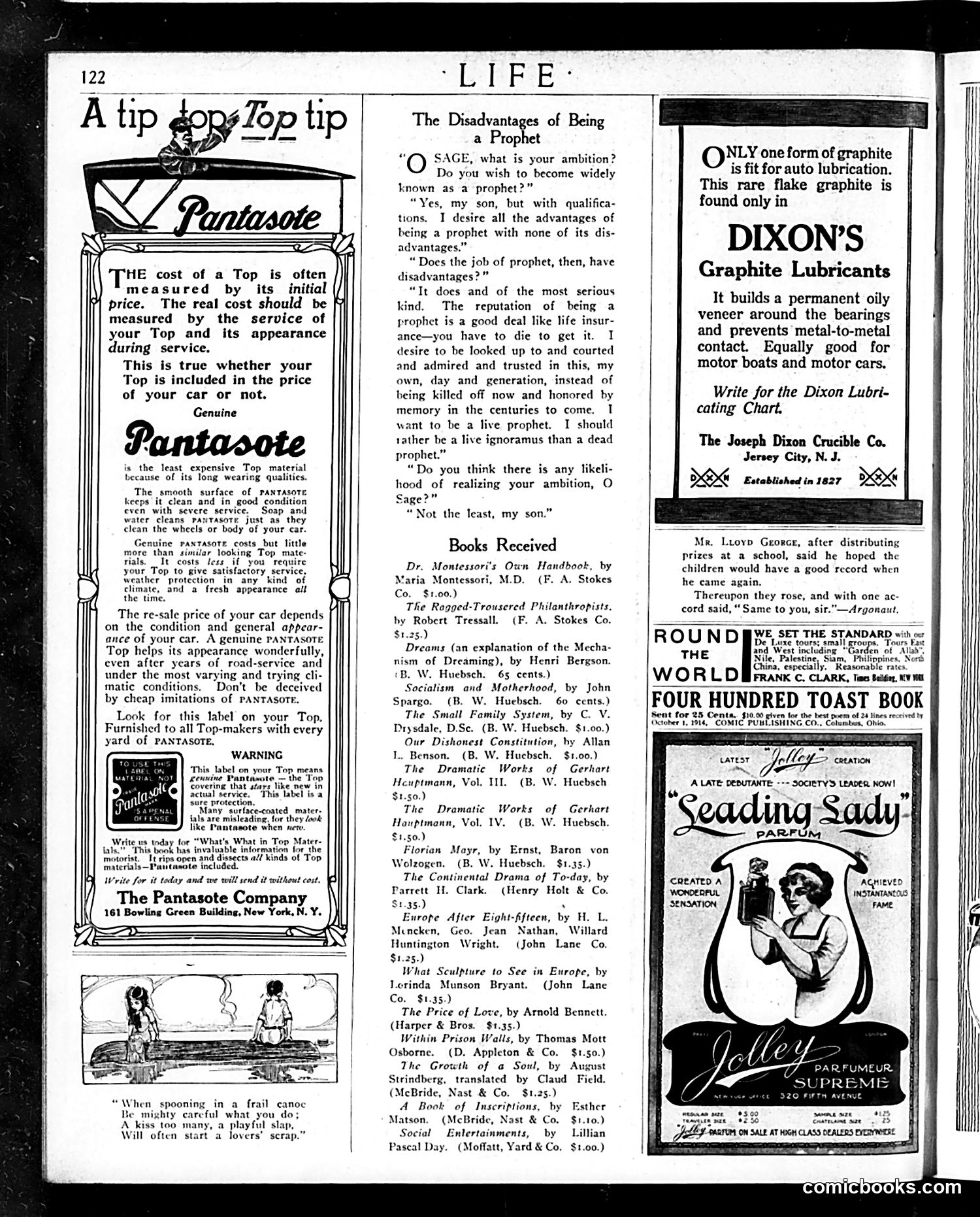
This page contains primarily **advertisements and book reviews** rather than political satire. The main content includes: **Advertisements:** - **Pantasote** (car top material): A lengthy branded message emphasizing durability and value, using the selling technique of distinguishing genuine products from cheap imitations—a common consumer concern of the era. - **Dixon's Graphite Lubricants** and **Jolley Perfume/Reading Lady**: Standard product ads. **Humor Piece:** "The Disadvantages of Being a Prophet"—a philosophical dialogue where a sage explains he wants respect while alive, not posthumous fame. It's gentle satire on how society honors the dead while neglecting the living. **Books Received:** A straightforward literary listing including works on socialism, education (Montessori), and drama—reflecting Progressive Era intellectual interests. **Small Cartoon:** A cautionary verse about canoe romance warns against physical intimacy causing conflict—typical period humor about courtship propriety. The page reflects **early 20th-century consumer culture** and intellectual discourse rather than political commentary.
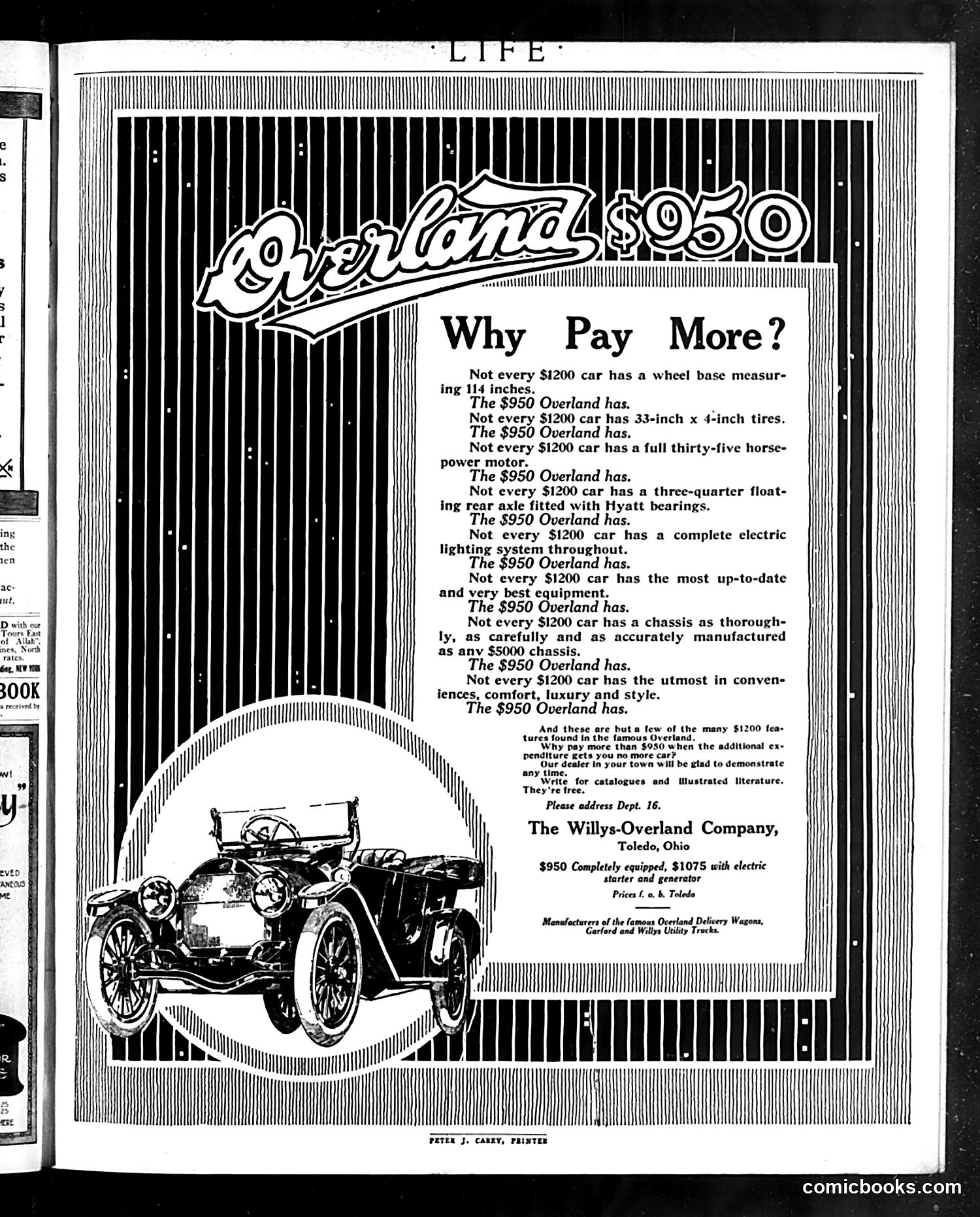
This is a **automobile advertisement**, not political satire. The Willys-Overland Company uses comparative marketing to position their $950 Overland car against unnamed competitors priced at $1200. The advertisement's rhetorical strategy is "Why Pay More?"—a list of features (114-inch wheelbase, 33-inch tires, 35-horsepower motor, floating rear axle with Hyatt bearings, electric lighting, quality chassis construction, comfort and luxury) that the Overland supposedly offers that more expensive cars lack. The illustration shows a period automobile (early 1900s design with open-air seating). **For modern readers:** This reflects early auto-industry competition when cars were luxury items. The ad targets price-conscious buyers by claiming the cheaper Overland matches or exceeds features of $1200 vehicles—an aggressive value-positioning common in automotive advertising today, but here applied to an entirely different market context and vehicle type.
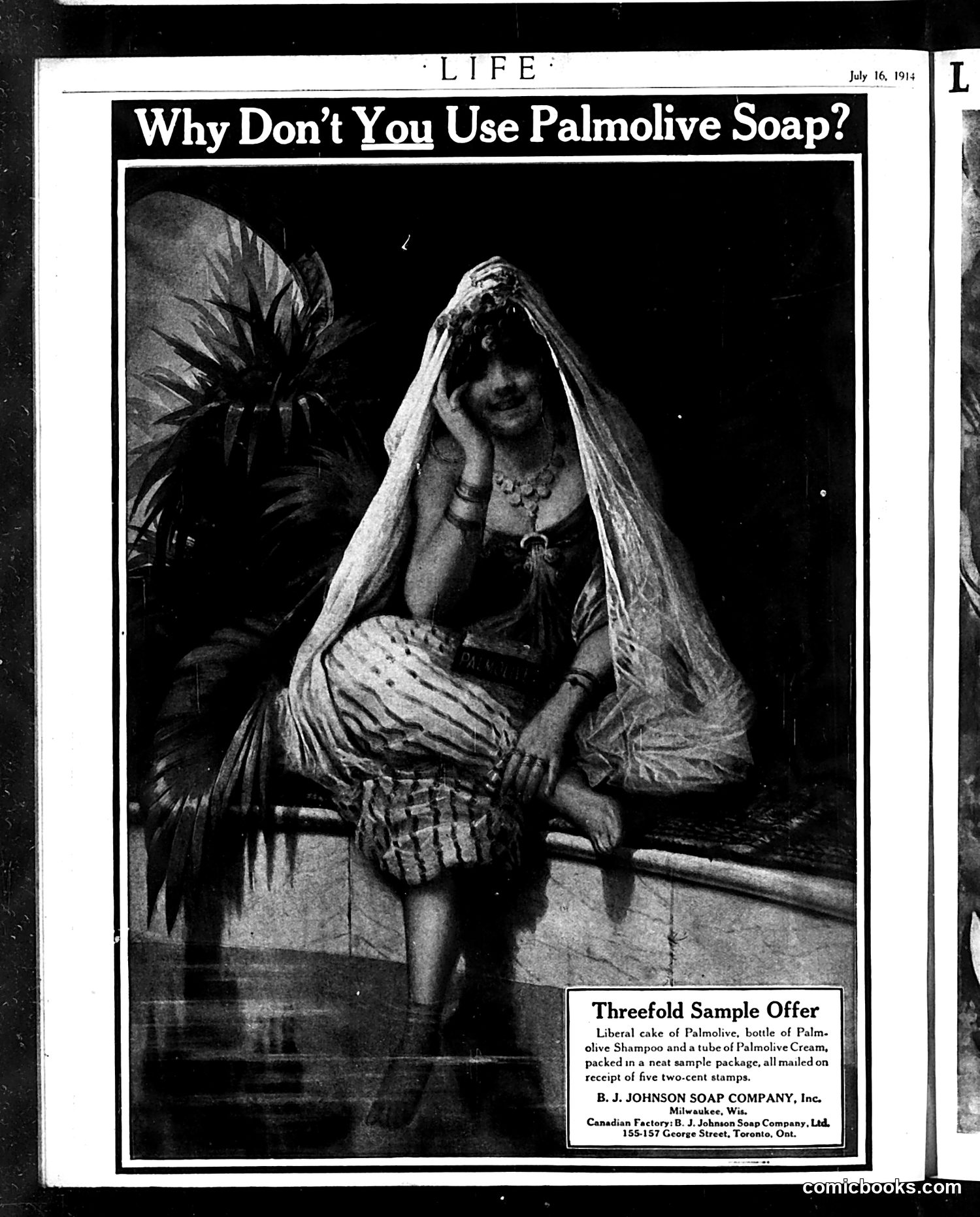
This is primarily a **product advertisement**, not political satire. It features a woman in exotic costume (appearing to represent an "Oriental" or theatrical character type common in 1914 advertising) posed with decorative foliage. The ad promotes Palmolive Soap through a "Threefold Sample Offer"—consumers could mail five two-cent stamps to receive samples of Palmolive soap, shampoo, and cream. The headline "Why Don't You Use Palmolive Soap?" is a direct sales pitch. The exotic imagery was typical marketing strategy of the era, using glamorous or foreign aesthetics to suggest luxury and sophistication. The B.J. Johnson Soap Company (Milwaukee) manufactured Palmolive. This reflects early 20th-century advertising conventions rather than editorial satire.