
Life, 1914-07-16 · page 29 of 40
Life — July 16, 1914 — page 29: what you’re looking at
What you’re looking at
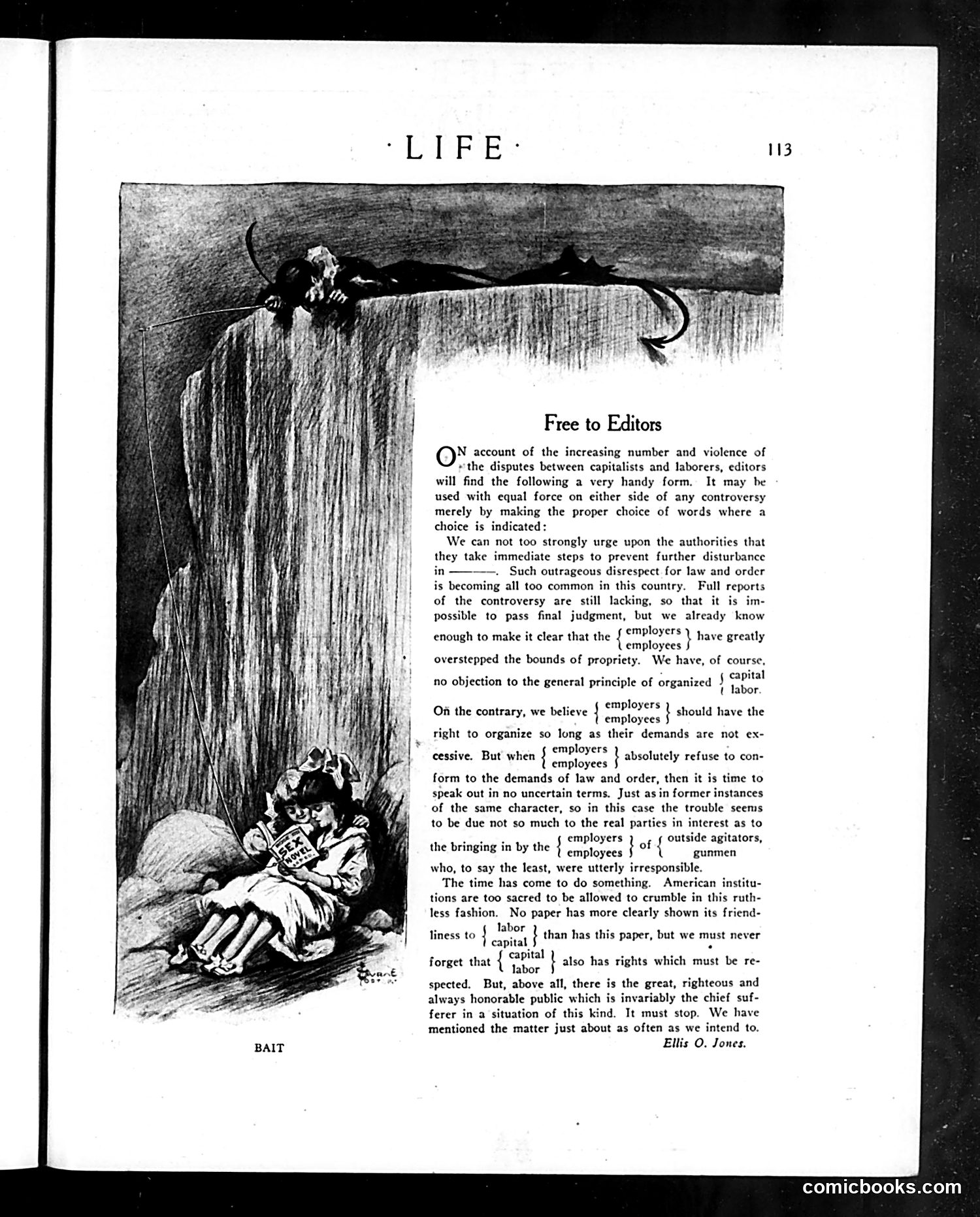
This page satirizes the editorial hypocrisy surrounding labor disputes in early 20th-century America. The cartoon "Bait" depicts a figure dangling from a noose or trap above a small, crouching person below—visualizing how workers are exploited and endangered. The accompanying text by Ellis O. Jones is a **fill-in-the-blank template** mocking standard newspaper editorials about labor-capital conflicts. Editors could swap "employers/employees" in identical sentences to argue either side without changing substance, revealing how newspapers used boilerplate language favoring whoever owned them while claiming neutrality. The satire exposes: editorial dishonesty, the invocation of "law and order" to suppress workers, blaming "outside agitators" for strikes, and the fictional "public interest" used to shut down labor organizing. The template's absurdity—using identical phrasing for opposite positions—reveals how meaningless such editorials actually were.
📄 Transcribed text from this page (OCR, searchable)
Machine-transcribed from the original scan — historical spelling and the odd misread are preserved.
Free to Editors 4 ON account of the increasing number and violence of | »the disputes between capitalists and laborers, editors will find the following a very handy form. It may be used with equal force on either side of any controversy merely by making the proper choice of words where a choice is indicated: We can not too strongly urge upon the authorities that they take immediate steps to prevent further disturbance in ————. Such outrageous disrespect for law and order is becoming all too common in this country. Full reports of the controversy are still lacking, so that it is im- possible to pass final judgment, but we already know employers } have greatly employees overstepped the bounds of propriety. We have, of course, no objection to the general principle of organized J a enough to make it clear that the { employers employees right to organize so long as their demands are not ex- employers employees form to the demands of law and order, then it is time to speak out in no uncertain terms. Just asin former instances of the same character, so in this case the trouble seems to be due not so much to the real parties in interest as to anrar employers outside agitators, the bringing in by the { Crtrovecs $ OF { wunmen who, to say the least, were utterly irresponsible. The time has come to do something. American institu- tions are too sacred to be allowed to crumble in this ruth- less fashion. No paper has more clearly shown its friend- labor capital Of the contrary, we believe { Hl should have the cessive. But’ when { } absolutely refuse to con- liness to | } than has this paper, but we must never forget that { SPH" 1 atso has rights which must be re- spected. But, above all, there is the great, righteous and always honorable public which is invariably the chief suf- ferer in a situation of this kind. It must stop. We have mentioned the matter just about as often as we intend to. Ellis O. Jones. comicbooks.com