
Life, 1914-07-16 · page 25 of 40
Life — July 16, 1914 — page 25: what you’re looking at
What you’re looking at
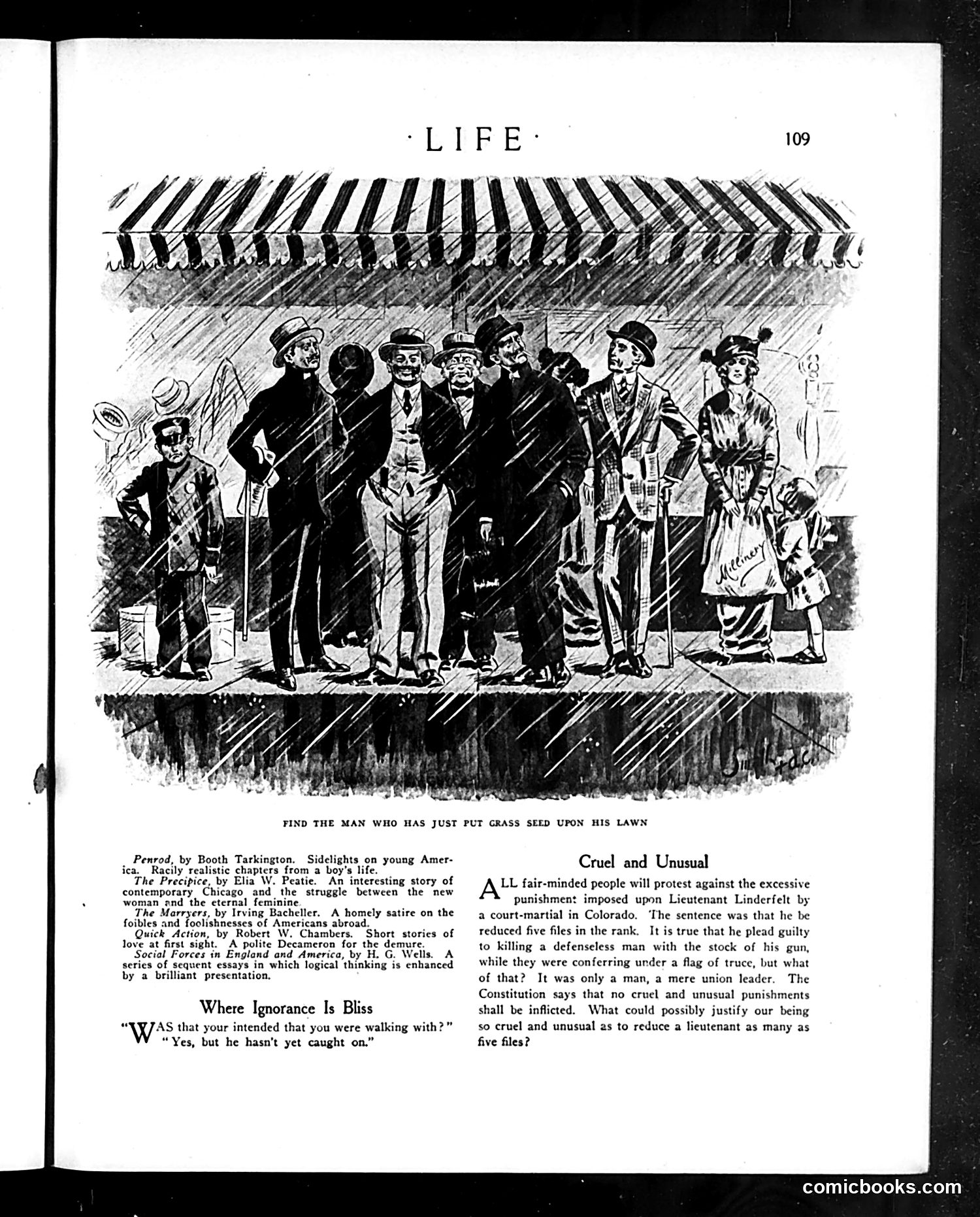
The top illustration is a cartoon captioned "Find the Man Who Has Just Put Grass Seed Upon His Lawn"—a visual puzzle showing a group of well-dressed people standing together, with the joke being that one should spot someone who looks freshly foolish or uncomfortable (though the specific figure isn't clearly identifiable in the image). Below are book advertisements and two brief satirical pieces. "Where Ignorance Is Bliss" is a small joke about a man walking with his fiancée who "hasn't yet caught on"—meaning she's unaware of some unstated flaw or deception, playing on the phrase that ignorance is bliss. "Cruel and Unusual" is heavy sarcasm criticizing a court-martial sentence against Lieutenant Linderfelt in Colorado. The piece sarcastically defends his punishment (reduced rank) for killing an unarmed union leader under a truce flag, mocking those who call the sentence "excessive" by ironically suggesting that punishing an officer for killing a mere "union leader" is itself cruel and unusual. It's biting social commentary about labor violence and class justice.
📄 Transcribed text from this page (OCR, searchable)
Machine-transcribed from the original scan — historical spelling and the odd misread are preserved.
FIND THE MAN WHO HAS JUST PUT GRASS SEED UPON HIS LAWN Penrod, by Booth Tarkington. Sidelights on young Amer- ica. Racily realistic chapters from a boy’s life. The Precipice, by Elia W. Peatie. An interesting story of contemporary Chicago and the struggle between the new woman and the eternal feminine. The Marryers, by Irving Bacheller. A homely satire on the foibles and foolishnesses of Americans abroad. Quick Action, by Robert W. Chambers. Short stories of love at first sight. A polite Decameron for the demure. Social Forces in England and America, by H. G. Wells. A series of sequent essays in which logical thinking is enhanced by a brilliant presentation. Where Ignorance Is Bliss « AS that your intended that you were walking with?” “Yes, but he hasn’t yet caught on.” Cruel and Unusual At fair-minded people will protest against the excessive punishment imposed upon Lieutenant Linderfelt by a court-martial in Colorado. The sentence was that he be reduced five files in the rank, It is true that he plead guilty to killing a defenseless man with the stock of his gun, while they were conferring under a flag of truce, but what of that? It was only a man, a mere union leader. The Constitution says that no cruel and unusual punishments shall be inflicted. What could possibly justify our being so cruel and unusual as to reduce a lieutenant as many as five files? comicbooks.com