
Life, 1914-07-16 · page 36 of 40
Life — July 16, 1914 — page 36: what you’re looking at
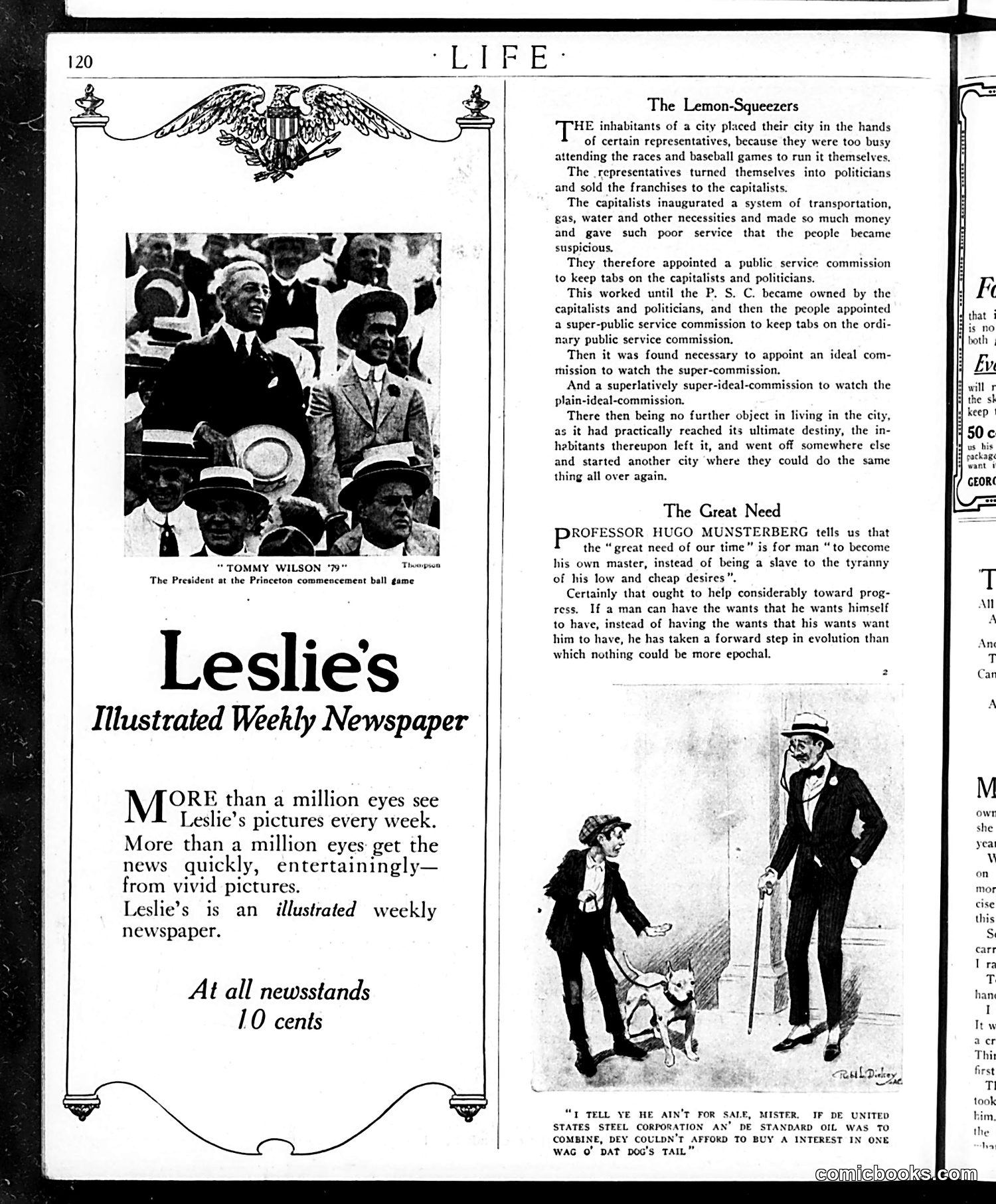
What you’re looking at
**"The Lemon-Squeezers"** is a satirical narrative attacking municipal corruption and regulatory capture. The story describes how citizens delegate city governance to representatives (too busy with sports), who sell franchises to capitalists who provide terrible services. Citizens then create commissions to oversee capitalists—but those commissions become corrupted too. Citizens respond by creating *more* commissions to watch the previous ones, in an infinite regress of bureaucracy. Eventually, exhausted by the absurdity, residents abandon the city entirely to repeat the cycle elsewhere. The satire mocks both corporate exploitation of public utilities and the futile faith in regulatory bureaucracy to solve the problem. **"The Great Need"** ridicules Professor Hugo Munsterberg's philosophy, sarcastically suggesting that wanting what you want (rather than what your wants want) represents epochal human progress—obvious, not profound. **The bottom cartoon** depicts a working-class figure refusing to sell his dog's tail, joking that even the combined might of U.S. Steel and Standard Oil couldn't afford it—a barb at monopolistic corporate power during the trust-busting era. The page also advertises *Leslie's Illustrated Weekly Newspaper* (10 cents).
📄 Transcribed text from this page (OCR, searchable)
Machine-transcribed from the original scan — historical spelling and the odd misread are preserved.
The Lemon-Squeezers Toe inhabitants of a city placed their city in the hands of certain representatives, because they were too busy attending the races and baseball games to run it themselves, The representatives turned themselves into politicians and sold the franchises to the capitalists. The capitalists inaugurated a system of transportation, gas, water and other necessities and made so much money and gave such poor service that the people became suspicious, They therefore appointed a public service commission to keep tabs on the capitalists and politicians. This worked until the P. S. C. became owned by the capitalists and politicians, and then the people appointed a super-public service commission to keep tabs on the ordi- nary public service commission. Then it was found necessary to appoint an ideal com- mission to watch the super-commission. And a superlatively super-ideal-commission to watch the plain-ideal-commission. There then being no further object in living in the city, as it had practically reached its ultimate destiny, the in- habitants thereupon left it, and went off somewhere else and started another city where they could do the same thing all over again, The Great Need a) ROFESSOR HUGO MUNSTERBERG tells us that - Ses | the “great need of our time” is for man “to become “TOMMY WILSON ‘79 Thompwn, his own master, instead of being a slave to the tyranny The President at the Princeton commencement ball game of his low and cheap desires”. Certainly that ought to help considerably toward prog- ress. If a man can have the wants that he wants himself to have, instead of having the wants that his wants want him to have, he has taken a forward step in evolution than I ] i 9 which nothing could be more epochal. Illustrated Weekly Newspaper owt MRE than a million eyes see j Leslie’s pictures every week. Y he More than a million eyes: get the > i yea news quickly, entertainingly— Pa from vivid pictures. mor cise Leslie’s is an_ illustrated weekly newspaper. At all newsstands 10 cents “T TELL YE HE AIN'T FOR SALE, MISTER. IF DE UNITED STATES STEEL CORPORATION AN’ DE STANDARD OIL WAS TO COMBINE, DEY COULDN'T AFFORD TO BUY A INTEREST IN ONE WAG 0’ DAT DOG's TAIL”