
Life, 1914-07-16 · page 24 of 40
Life — July 16, 1914 — page 24: what you’re looking at
What you’re looking at
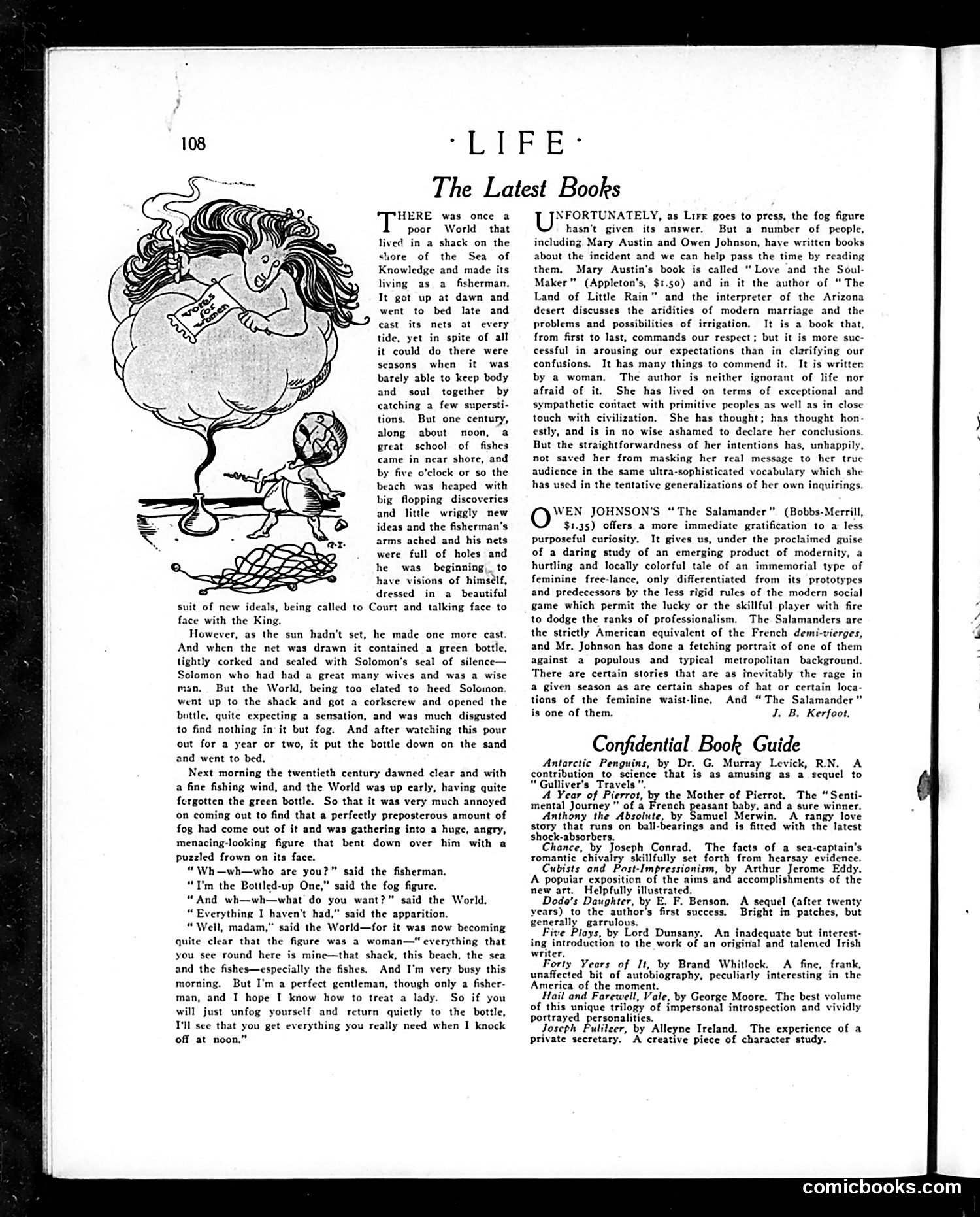
This page features an allegorical cartoon and book review section. The main illustration depicts the "World" as a poor fisherman who discovers a mysterious bottle sealed with "Solomon's seal of silence." When opened, it releases fog that materializes into a demanding female figure—representing suppressed desires or social forces demanding "everything I haven't had." The allegory appears to address tensions between traditional society (the fisherman/World) and emerging demands for change, particularly women's rights and social reform. The "bottled-up" figure represents these pressure points waiting to explode into the twentieth century. The text then transitions to book reviews, notably Mary Austin's *Love and the Soul-Maker*, which addresses modern marriage problems. The reviewer praises Austin's forthright treatment of intimate subjects by a female author unafraid to engage philosophical questions, though notes her sophisticated vocabulary sometimes obscures her message to ordinary readers. This reflects early 1900s anxieties about social change and intellectual discourse on relationships.
📄 Transcribed text from this page (OCR, searchable)
Machine-transcribed from the original scan — historical spelling and the odd misread are preserved.
“LIFE: The Latest Books HERE was once a poor World that lived in a shack on the shore of the Sea of Knowledge and made its living as a fisherman. It got up at dawn and went to bed late and cast its nets at every tide, yet in spite of all it could do there were seasons when it was barely able to keep body and soul together by catching a few supersti- tions, But one century, along about noon, a great school of fishes came in near shore, and by five o'clock or so the beach was heaped with big flopping discoveries and little wriggly new ideas and the fisherman's arms ached and his nets were full of holes and he was beginning, to have visions of himself, ad dressed in a beautiful suit of new ideals, being called to Court and talking face to face with the King. However, as the sun hadn't set, he made one more cast. And when the net was drawn it contained a green bottle, tightly corked and sealed with Solomon's seal of silence— Solomon who had had a great many wives and was a wise man. But the World, being too elated to heed Solomon. went up to the shack and got a corkscrew and opened the bottle, quite expecting a sensation, and was much disgusted to find nothing init but fog. And after watching this pour out for a year or two, it put the bottle down on the sand and went to bed. Next morning the twentieth century dawned clear and with a fine fishing wind, and the World was up early, having quite forgotten the green bottle. So that it was very much annoyed ‘on coming out to find that a perfectly preposterous amount of fog had come out of it and was gathering into a huge, angry, menacing-looking figure that bent down over him with a puzzled frown on its face. “Wh—wh—who are you?” said the fisherman. “I'm the Bottled-up One,” said the fog figure. “And wh—wh—what do you want?" said the World. “ Everything I haven't had,” said the apparition. Well, madam,” said the World—for it was now becoming quite clear that the figure was a woman—" everything that you see round here is mine—that shack, this beach, the sea and the fishes—especially the fishes. And I'm very busy this morning. But I'm a perfect gentleman, though only a fisher- man, and I hope I know how to treat a lady. So if you will just unfog yourself and return quietly to the bottle, T'll sce that you get everything you really need when I knock off at noon.” NFORTUNATELY, as Lire goes to press, the fog figure hasn't given its answer. But a number of people, including Mary Austin and Owen Johnson, have written books about the incident and we can help pass the time by reading them, Mary Austin’s book is called “Love and the Soul- Maker" (Appleton’s, $1.50) and in it the author of “ The Land of Little Rain” and the interpreter of the Arizona desert discusses the aridities of modern marriage and the problems and possibilities of irrigation. It is a book that, from first to last, commands our respect ; but it is more suc- cessful in arousing our expectations than in clarifying our confusions. It has many things to commend it. It is written, by a woman. The author is neither ignorant of life nor afraid of it. She has lived on terms of exceptional and sympathetic contact with primitive peoples as well as in close touch with civilization, She has thought; has thought hon- estly, and is in no wise ashamed to declare her conclusions. But the straightforwardness of her intentions has, unhappi not saved her from masking her real message to her truc audience in the same ultra-sophisticated vocabulary which she has used in the tentative generalizations of her own inquirings. Orr JOHNSON'S “The Salamander” (Bobbs-Merrill, $1.35) offers a more immediate gratification to a less purposeful curiosity. It gives us, under the proclaimed guise of a daring study of an emerging product of modernity, a hurtling and locally colorful tale of an immemorial type of feminine free-lance, only differentiated from its prototypes and predecessors by the less rigid rules of the modern social game which permit the lucky or the skillful player with fire to dodge the ranks of professionalism. The Salamanders are the strictly American equivalent of the French demi-vierges, and Mr. Johnson has done a fetching portrait of one of them against a populous and typical metropolitan background. There are certain stories that are as inevitably the rage in a given season as are certain shapes of hat or certain loca- tions of the feminine waist-line. And “The Salamander” is one of them. J. B. Kerfoot. Confidential Book Guide Antarctic Penguins, by Dr. G. Murray Levick, RN. A contribution to science that is as amusing as a’ sequel to “Gulliver's Travels". Year of Pierrot, the Mother of Pierrot. The “Senti- mental Journey” of a French peasant baby, and a sure winner. ‘Anthony the Absolute, by Samuel Merwin. A rangy love story that runs on ball-bearings and is fitted with the latest shock-absorbers. Chance, by Joseph Conrad. The facts of a sea-captain’s romantic chivalry skillfully set forth from hearsay evidence. Cubists and Post-Impressionism, by Arthur Jerome Eddy. A popuiar exposition of the aims and accomplishments of the new art. Helpfully illustrated, Dode’s Daughter, by E. F. Benson. A sequel (after twenty years) to the author's first success, Bright in patches, but generally garrulous. ve Plays, by Lord Dunsany. An inadequate but interest- ing introduction to the work of an original and talemed Irish writer. Forty Years of It, by Brand Whitlock. A fine, frank, unaffected bit of autobiography, peculiarly interesting in the America of the moment. Hail and Farewell, Vale, by George Moore. The best volume of this unique trilogy of impersonal introspection and vividly portrayed personalities. Joseph Puliteer, by Alleyne Ireland. The experience of a private secretary. A creative piece of character study. comicbooks.com