
Life, 1914-07-16 · page 26 of 40
Life — July 16, 1914 — page 26: what you’re looking at
What you’re looking at
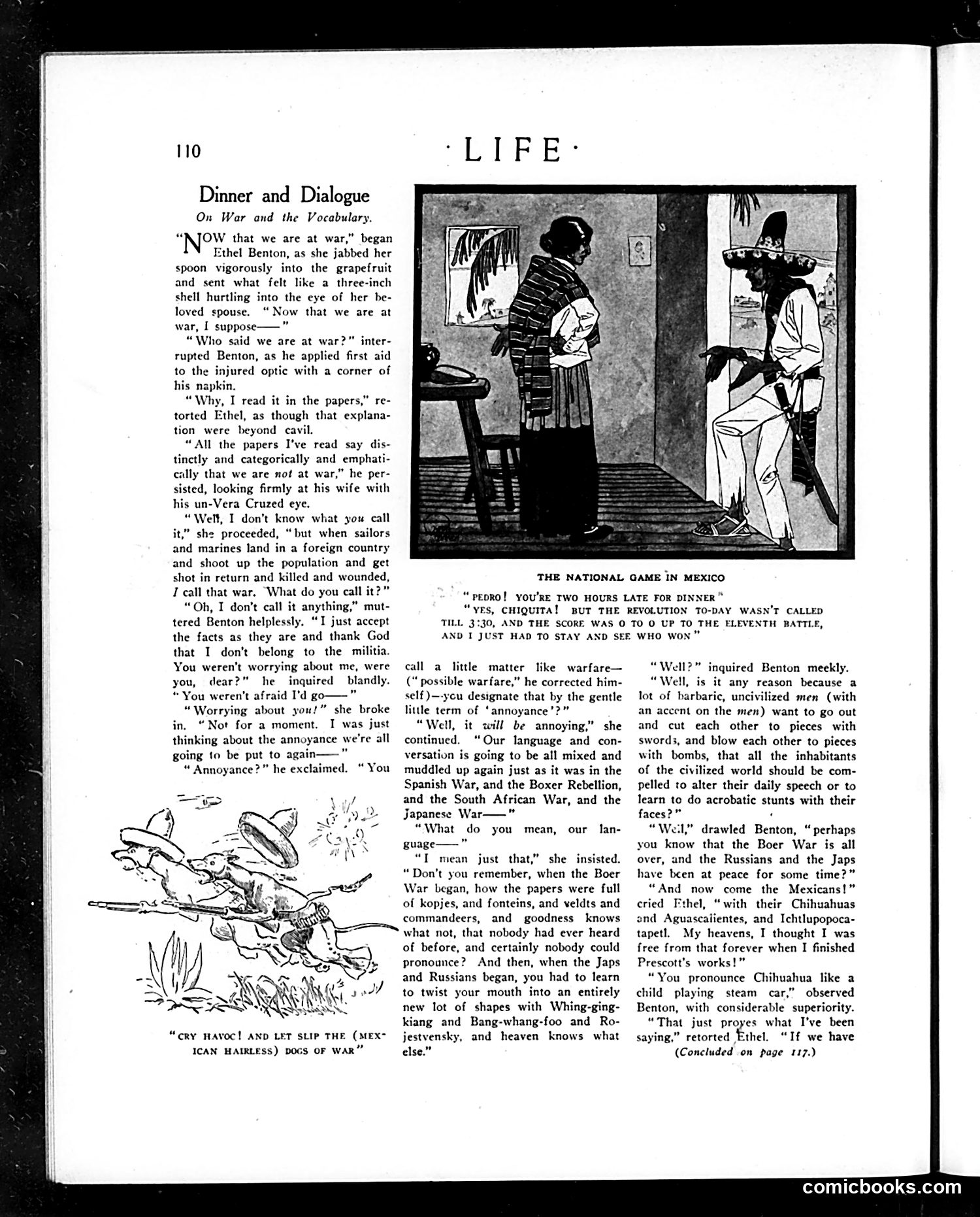
This 1913 *Life* magazine piece satirizes U.S. military interventions and their linguistic fallout. The dialogue between Ethel and Benton centers on America's involvement in Mexico—the text references sailors and marines landing in a foreign country, likely referring to the Veracruz occupation of 1914 (or anticipating it). Ethel's complaint is that each military conflict forces Americans to learn foreign place names and terms: Spanish War, Boxer Rebellion, South African War, Japanese War created vocabularies of "kopjes," "veldts," and "Rojestvensky." Now Mexico threatens more linguistic chaos with "Chihuahuas" and "Aguascalientes." The bottom cartoon, "The National Game in Mexico," uses baseball as metaphor—a Mexican couple quarrels because the husband stayed to watch the "revolution" (scored 0-0 through the eleventh battle) instead of coming to dinner. This equates military conflict to entertainment and absurdity. The satire mocks both unnecessary foreign interventions and Americans' provincial annoyance at having to accommodate foreign vocabulary, suggesting imperial entanglement is an irritating inconvenience rather than serious moral concern.
📄 Transcribed text from this page (OCR, searchable)
Machine-transcribed from the original scan — historical spelling and the odd misread are preserved.
110 Dinner and Dialogue On War and the Vocabulary. OW that we are at war,” began Ethel Benton, as she jabbed her spoon vigorously into the grapefruit and sent what felt like a three-inch shell hurtling into the eye of her be- loved spouse. ow that we are at war, I suppose——” “Who said we are at war?” inter- rupted Benton, as he applied first aid to the injured optic with a corner of his napkin. “Why, I read it in the papers,” re- torted Ethel, as though that explana- tion were beyond cavil. “All the papers I've read say dis- tinctly and categorically and emphati- cally that we are not at war,” he per- sisted, looking firmly at his wife with his un-Vera Cruzed eye. “Welt, I don’t know what you call it,” she proceeded, “but when sailors and marines land in a foreign country and shoot up the population and get shot in return and killed and wounded, J call that war. “What do you call it?” “Oh, I don’t call it anything,” mut- tered Benton helplessly. “I just accept the facts as they are and thank God that I don’t belong to the militia. You weren't worrying about me, were you, dear?” he inquired blandly. “You weren't afraid I'd go—” “Worrying about you!” she broke in. “Not for a moment. I was just thinking about the annoyance we're all going to be put to again—”" “ Annoyance?” he exclaimed. “You CAG he SANG “cry Havoc! AND LET SLIP THE (MEX- ICAN HAIRLESS) DOGS OF WAR THE NATIONAL GAME IN MEXICO “peorO! YOU'RE TWO HOURS LATE FOR DINNER” “yes, cHIQUITA! TILL 3:30, BUT THE REVOLUTION AND THE SCORE WAS 0 TO O UP TO THE ELEVENTH BATTLE, TO-DAY WASN'T CALLED AND I JUST HAD TO STAY AND SEE WHO WON” call a little matter like warfare— (“ possible warfare,” he corrected him- self )—-you designate that by the gentle little term of ‘annoyance’?” “Well, it will be annoying,” she continued. “Our language and con- versation is going to be all mixed and muddled up again just as it was in the Spanish War, and the Boxer Rebellion, and the South African War, and the Japanese War——" “What do you mean, guage—” “T mean just that,” she insisted. “Don’t you remember, when the Boer War began, how the papers were full of kopjes, and fonteins, and veldts and commandeers, and goodness knows what not, that nobody had ever heard of before, and certainly nobody could pronounce? And then, when the Japs and Russians began, you had to learn to twist your mouth into an entirely new lot of shapes with Whing-ging- kiang and Bang-whang-foo and Ro- jestvensky, and heaven knows what else.” our lan- “Well?” inquired Benton meekly. “Well, is it any reason because a lot of barbaric, uncivilized men (with an accent on the men) want to go out and cut each other to pieces with swords, and blow each other to pieces with bombs, that all the inhabitants of the civilized world should be com- pelled to alter their daily speech or to learn to do acrobatic stunts with their faces?” ‘ “Weil,” drawled Benton, “perhaps you know that the Boer War is all over, and the Russians and the Japs have been at peace for some time?” “And now come the Mexicans!” cried Ethel, “with their Chihuahuas ond Aguascalientes, and Ichtlupopoca- tapetl. My heavens, I thought I was free from that forever when I finished Prescott’s works!” “You pronounce Chihuahua like a child playing steam car,” observed Benton, with considerable superiority. “That just proyes what I’ve been saying,” retorted Ethel. “If we have (Concluded on page 117.) comicbooks.com