
Life, 1914-07-16 · page 18 of 40
Life — July 16, 1914 — page 18: what you’re looking at
What you’re looking at
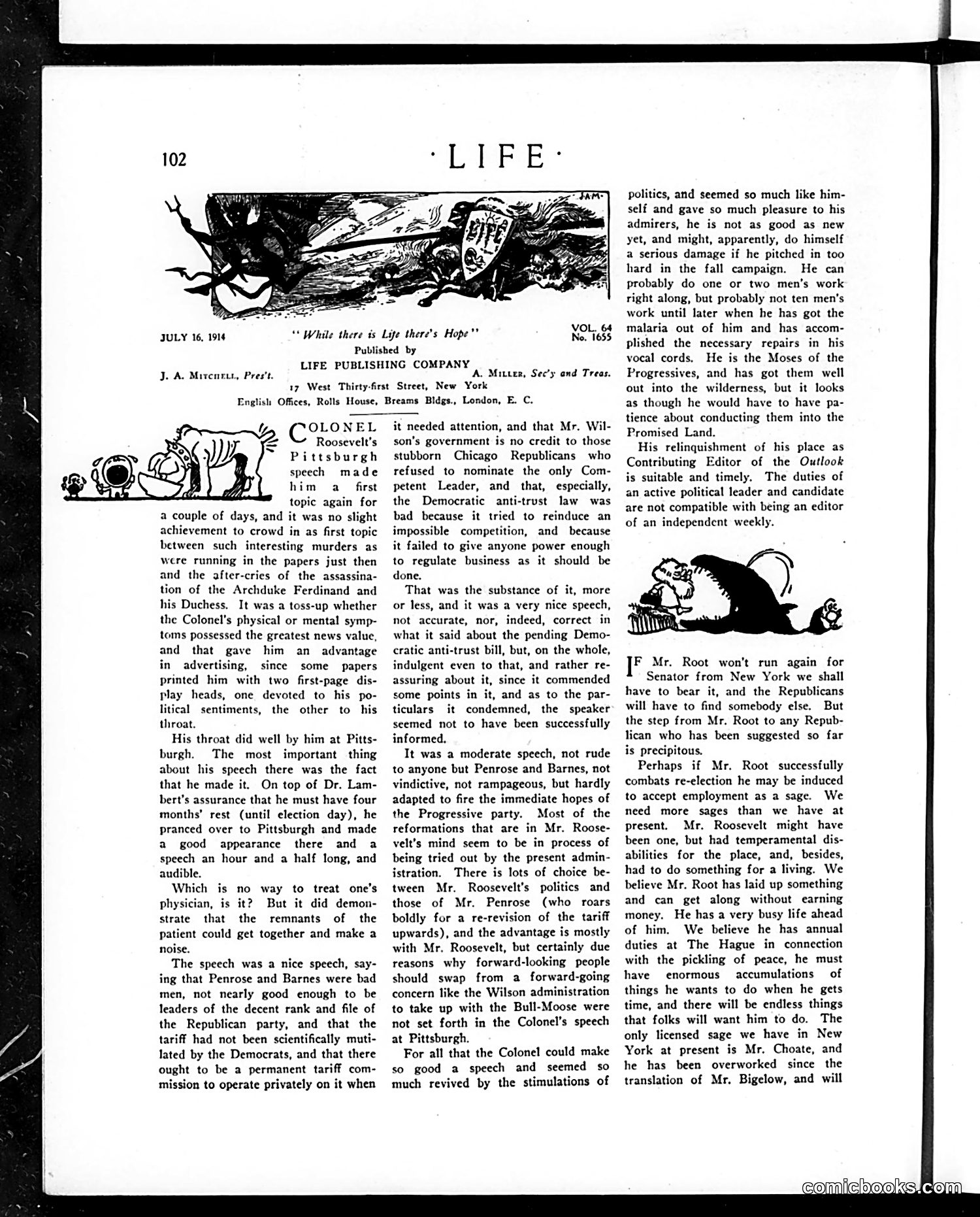
This page satirizes Theodore Roosevelt's Pittsburgh speech following his recent illness. The cartoon depicts Roosevelt as a corpse or skeleton, visually mocking his physical condition after Dr. Lambert advised four months' rest—yet Roosevelt immediately traveled to Pittsburgh to deliver a lengthy public address. The accompanying text is equally cutting: it praises the speech's moderation while suggesting Roosevelt compromised his health recklessly. The author notes Roosevelt criticized Republican leaders Penrose and Barnes, endorsed some Democratic anti-trust measures, and praised the Wilson administration—hardly rousing calls for his Progressive "Bull Moose" party to retake power. The satire's point: Roosevelt appears revitalized by politics but remains genuinely weakened. He might accomplish "one or two men's work" at most, contradicting his vigorous public persona. Life mocks both his physical limitations and the tepid political message that fails to energize his followers.
📄 Transcribed text from this page (OCR, searchable)
Machine-transcribed from the original scan — historical spelling and the odd misread are preserved.
JULY 16, 1914 ‘* While there is Life there’s Hope"" VOL. 64 No, 1655 Published by LIFE PUBLISHING COMPANY J. A. Mivenrus, Pres’t. A. Mitten, Sec’y and Treas. 17 West Thirty-first Street, New York English Offices, Rolls House, Breams Bldgs., London, E. C. OLONEL Roosevelt’s Pittsburgh speech made him a first topic again for a couple of days, and it was no slight achievement to crowd in as first topic between such interesting murders as were running in the papers just then and the after-cries of the assassina- tion of the Archduke Ferdinand and his Duchess, It was a toss-up whether the Colonel's physical or mental symp- toms possessed the greatest news value, and that gave him an advantage in advertising, since some papers printed him with two first-page dis- play heads, one devoted to his po- litical sentiments, the other to his throat. His throat did well by him at Pitts- burgh. The most important thing about his speech there was the fact that he made it. On top of Dr. Lam- bert’s assurance that he must have four months’ rest (until election day), he pranced over to Pittsburgh and made a good appearance there and a speech an hour and a half long, and audible. Which is no way to treat one’s physician, is it? But it did demon- strate that the remnants of the patient could get together and make a noise. The speech was a nice speech, say- ing that Penrose and Barnes were bad men, not nearly good enough to be leaders of the decent rank and file of the Republican party, and that the tariff had not been scientifically muti- lated by the Democrats, and that there ought to be a permanent tariff com- mission to operate privately on it when it needed attention, and that Mr. Wil- son's government is no credit to those stubborn Chicago Republicans who refused to nominate the only Com- petent Leader, and that, especially, the Democratic anti-trust law was bad because it tried to reinduce an impossible competition, and because it failed to give anyone power enough to regulate business as it should be done. That was the substance of it, more or less, and it was a very nice speech, not accurate, nor, indeed, correct in what it said about the pending Demo- cratic anti-trust bill, but, on the whole, indulgent even to that, and rather re- assuring about it, since it commended some points in it, and as to the par- ticulars it condemned, the speaker seemed not to have been successfully informed. It was a moderate speech, not rude to anyone but Penrose and Barnes, not vindictive, not rampageous, but hardly adapted to fire the immediate hopes of the Progressive party. Most of the reformations that are in Mr. Roose- velt's mind seem to be in process of being tried out by the present admin- istration. There is lots of choice be- tween Mr. Roosevelt's politics and those of Mr. Penrose (who roars boldly for a re-revision of the tariff upwards), and the advantage is mostly with Mr. Roosevelt, but certainly due reasons why forward-looking people should swap from a forward-going concern like the Wilson administration to take up with the Bull-Moose were not set forth in the Colonel’s speech at Pittsburgh. For all that the Colonel could make so good a speech and seemed so much revived by the stimulations of politics, and seemed so much like him- self and gave so much pleasure to his admirers, he is not as good as new yet, and might, apparently, do himself a serious damage if he pitched in too hard in the fall campaign. He can probably do one or two men’s work right along, but probably not ten men’s work until later when he has got the malaria out of him and has accom- plished the necessary repairs in his vocal cords. He is the Moses of the Progressives, and has got them well out into the wilderness, but it looks as though he would have to have pa- tience about conducting them into the Promised Land. His relinquishment of his place as Contributing Editor of the Outlook is suitable and timely, The duties of an active political leader and candidate are not compatible with being an editor of an independent weekly. ) F Mr. Root won't run again for Senator from New York we shall have to bear it, and the Republicans will have to find somebody else. But the step from Mr. Root to any Repub- lican who has been suggested so far is precipitous. Perhaps if Mr. Root successfully combats re-election he may be induced to accept employment as a sage. We need more sages than we have at present. Mr. Roosevelt might have been one, but had temperamental dis- abilities for the place, and, besides, had to do something for a living. We believe Mr. Root has laid up something and can get along without earning money. He has a very busy life ahead of him. We believe he has annual duties at The Hague in connection with the pickling of peace, he must have enormous accumulations of things he wants to do when he gets time, and there will be endless things that folks will want him to do. The only licensed sage we have in New York at present is Mr. Choate, and he has been overworked since the translation of Mr. Bigelow, and will