
Life, 1914-07-16 · page 27 of 40
Life — July 16, 1914 — page 27: what you’re looking at
What you’re looking at
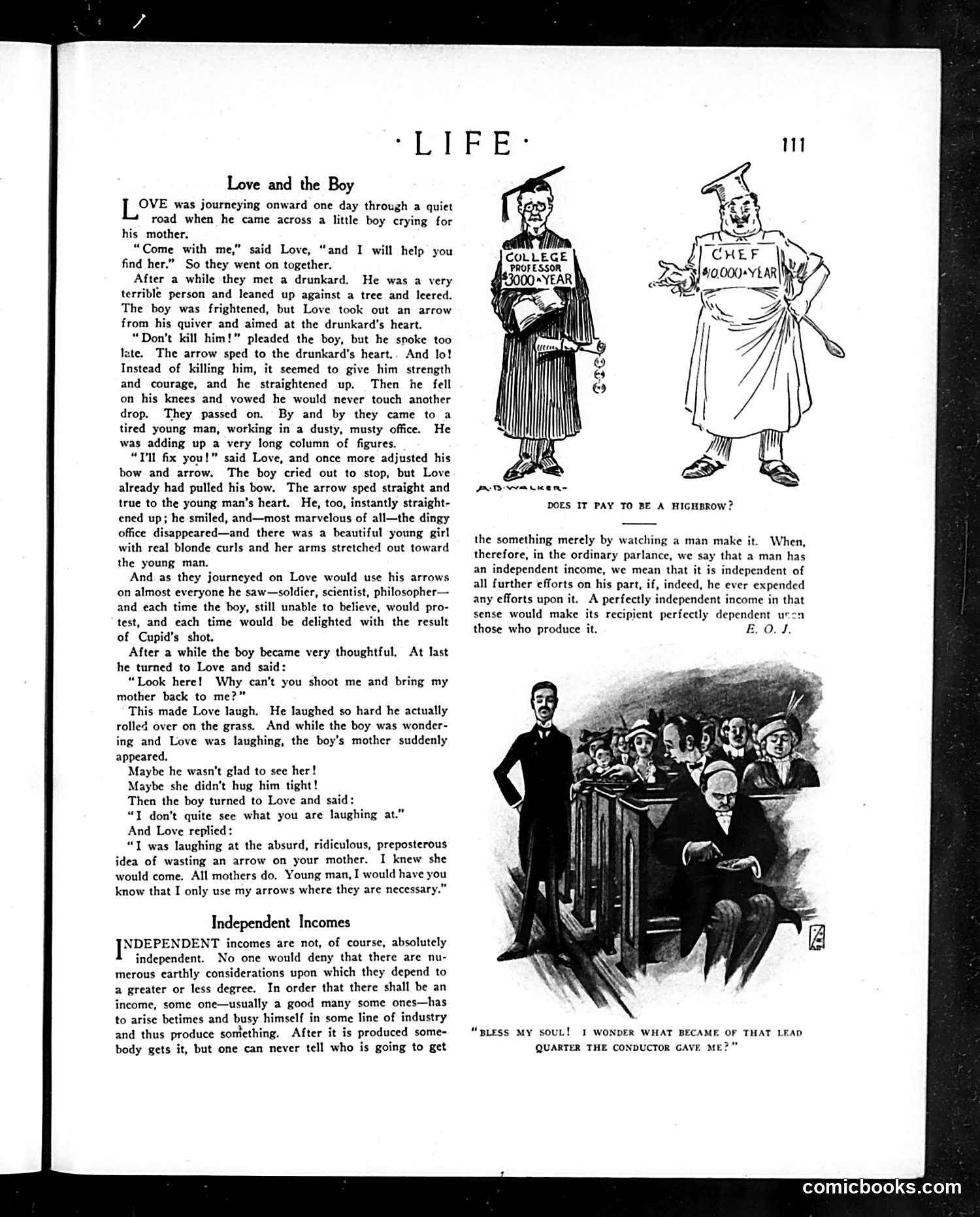
This page contains two distinct satirical pieces: **"Love and the Boy"** (allegorical fable): Cupid's arrows reform a drunkard and inspire a tired office worker by revealing love/beauty to him, but cannot resurrect the boy's mother. The joke mocks maternal inevitability—Love cannot "waste" an arrow on something already guaranteed. The satire targets romantic idealism by suggesting love conquers some human failings but remains powerless against natural certainties. **"Independent Incomes"** (text essay with cartoon): The piece mocks wealthy people claiming "independent" income. The satire exposes the hypocrisy: such income actually depends entirely on others' labor. A truly independent income would paradoxically make its recipient dependent on workers who produce it. The cartoon shows a well-dressed man amid laborers, likely illustrating this dependency the wealthy deny. Both pieces critique self-delusion—romantic fantasy in one case, economic pretension in the other.
📄 Transcribed text from this page (OCR, searchable)
Machine-transcribed from the original scan — historical spelling and the odd misread are preserved.
‘ETRE Love and the Boy [eve was journeying onward one day through a quiet road when he came across a little boy crying for his mother. “Come with me,” said Love, “and I will help you find her.” So they went on together. After a while they met a drunkard. He was a very terrible person and leaned up against a tree and leered. The boy was frightened, but Love took out an arrow from his quiver and aimed at the drunkard’s heart. “Don’t kill him!” pleaded the boy, but he spoke too late. The arrow sped to the drunkard’s heart.. And lo! Instead of killing him, it seemed to give him strength and courage, and he straightened up. Then he fell on his knees and vowed he would never touch another drop. They passed on. By and by they came to a tired young man, working in a dusty, musty office. He was adding up a very long column of figures. “T'll fix you!” said Love, and once more adjusted his bow and arrow. The boy cried out to stop, but Love already had pulled his bow. The arrow sped straight and true to the young man’s heart. He, too, instantly straight- ened up; he smiled, and—most marvelous of all—the dingy office disappeared—and there was a beautiful young girl with real blonde curls and her arms stretched out toward the young man. And as they journeyed on Love would use his arrows on almost everyone he saw—soldier, scientist, philosopher— and each time the boy, still unable to believe, would pro- test, and each time would be delighted with the result of Cupid’s shot. After a while the boy became very thoughtful. At last he turned to Love and said: “Look here! Why can’t you shoot me and bring my mother back to me?” This made Love laugh. He laughed so hard he actually rolled over on the grass. And while the boy was wonder- ing and Love was laughing, the boy’s mother suddenly appeared. Maybe he wasn't glad to see her! Maybe she didn’t hug him tight! Then the boy turned to Love and said: “I don’t quite see what you are laughing at.” And Love replied: “I was laughing at the absurd, ridiculous, preposterous idea of wasting an arrow on your mother. I knew she would come. All mothers do. Young man, I would have you know that I only use my arrows where they are necessary.” Independent Incomes DEPENDENT incomes are not, of course, absolutely independent. No one would deny that there are nu- merous earthly considerations upon which they depend to a greater or less degree. In order that there shall be an income, some one—usually a good many some ones—has to arise betimes and busy himself in some line of industry and thus produce somtething. After it is produced some~ body gets it, but one can never tell who is going to get AVR wa wen= DOES IT PAY TO BE A HIGHBROW? the something merely by watching a man make it. When, therefore, in the ordinary parlance, we say that a man has an independent income, we mean that it is independent of all further efforts on his part, if, indeed, he ever expended any efforts upon it. A perfectly independent income in that sense would make its recipient perfectly dependent urccn those who produce it. BE, 0. J. “BLESS MY SOUL! 1 WONDER WHAT BECAME OF THAT LEAD QUARTER THE CONDUCTOR GAVE comicbooks.com