
Life, 1914-07-16 · page 12 of 40
Life — July 16, 1914 — page 12: what you’re looking at
What you’re looking at
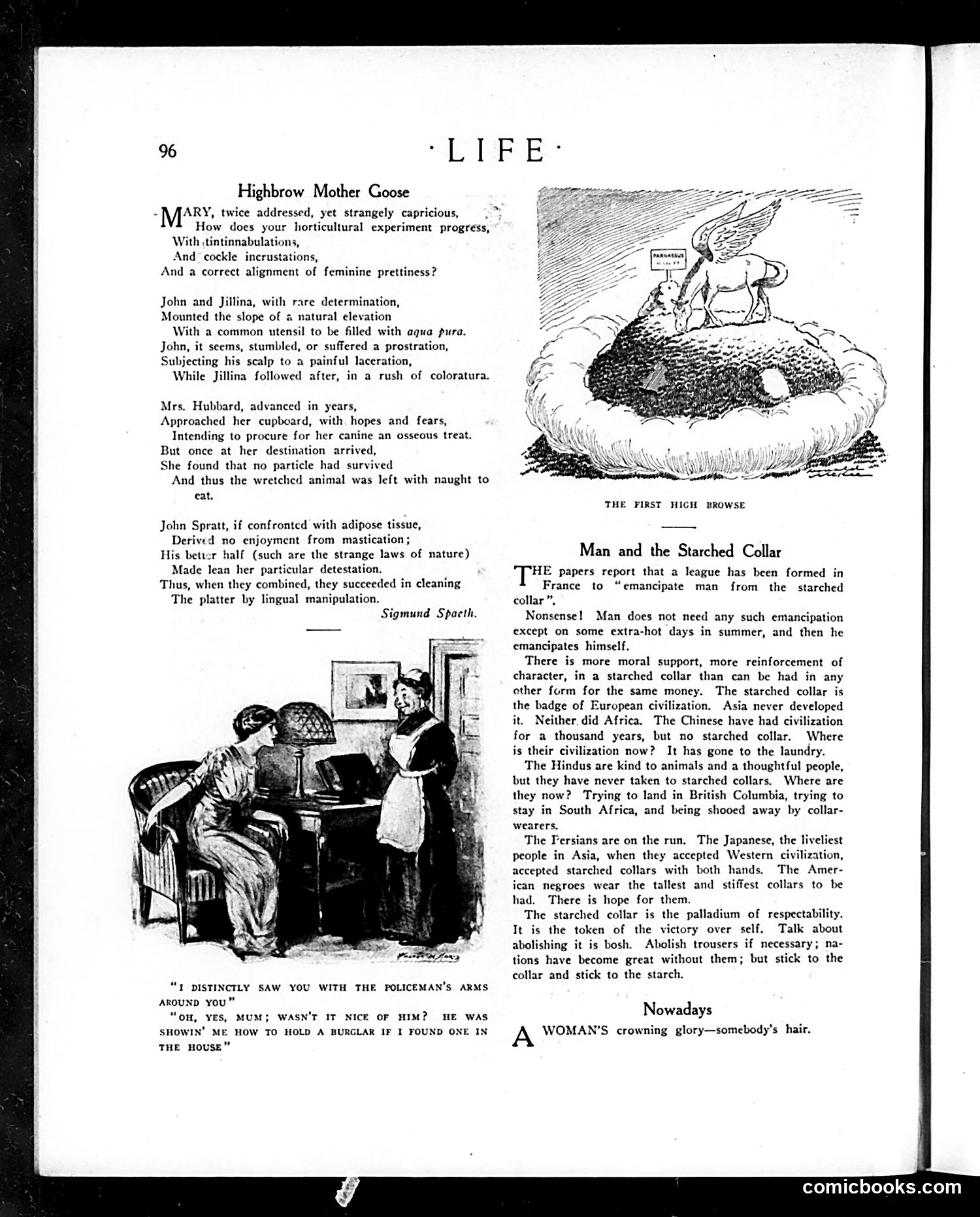
This page contains three distinct pieces of satirical content: 1. **"Highbrow Mother Goose"** (top left): A poem by Sigmund Spaeth mocking overly intellectual approaches to child-rearing, referencing characters named Mary, John, and Jillina engaged in absurd "scientific" parenting experiments. 2. **"The First High Browse"** (top right): An illustration showing a goose on elevated terrain, likely satirizing fashionable or pretentious behavior—the term "browse" suggests both literal grazing and affected social posturing. 3. **"Man and the Starched Collar"** (center): A lengthy essay criticizing the starch collar as a marker of civilization. It argues the starch collar represents superficial European superiority, noting that Asian and African cultures functioned without this "essential" garment. The piece mocks Western pretension to moral progress. 4. **Bottom illustration and caption**: Shows a domestic scene with the caption about a policeman's arms and holding a burglar—appearing to be a separate humorous anecdote.
📄 Transcribed text from this page (OCR, searchable)
Machine-transcribed from the original scan — historical spelling and the odd misread are preserved.
Highbrow Mother Goose ARY, twice addressed, yet strangely capricious, How does your horticultural experiment progress, With :tintinnabulations, And cockle incrustations, And a correct alignment of feminine prettiness? John and Jillina, with rare determination, Mounted the slope of 4 natural elevation With a common utensil to be filled with aqua pura. John, it seems, stumbled, or suffered a prostration, Subjecting his scalp to a painful laceration, While Jillina followed after, in a rush of coloratura. Mrs. Hubbard, advanced in years, Approached her cupboard, with hopes and fears, Intending to procure for her canine an osseous treat. But once at her destination arrived, She found that no particle had survived And thus the wretched animal was left with naught to cat. John Spratt, if confronted with adipose tissue, Derived no enjoyment from mastication ; His betusr half (such are the strange laws of nature) Made lean her particular detestation, Thus, when they combined, they succeeded in cleaning The platter by lingual manipulation, Sigmund Spaeth. “I DISTINCTLY SAW YOU WITH THE POLICEMAN’S ARMS AROUND YoU” “OH, YES, MUM; WASN'T IT NICE OF HIM? HE WAS SHOWIN’ ME HOW TO HOLD A BURGLAR IF I FOUND ONE IN THE HOUSE” THE FIRST HIGH BROWSE Man and the Starched Collar ae Papers report that a league has been formed in France to “emancipate man from the starched collar”, Nonsense! Man does not need any such emancipation except on some extra-hot days in summer, and then he emancipates himself. There is more moral support, more reinforcement of character, in a starched collar than can be had in any other form for the same money. The starched collar is the badge of European civilization. Asia never developed it. Neither. did Africa, The Chinese have had civilization for a thousand years, but no starched collar. Where is their civilization now? It has gone to the laundry. The Hindus are kind to animals and a thoughtful people, but they have never taken to starched collars. Where are they now? Trying to land in British Columbia, trying to stay in South Africa, and being shooed away by collar- wearers, The Fersians are on the run, The Japanese, the liveliest people in Asia, when they accepted Western civilization, accepted starched collars with both hands. The Amer- ican negroes wear the tallest and stiffest collars to be had. There is hope for them. The starched collar is the palladium of respectability. It is the token of the victory over self. Talk about abolishing it is bosh. Abolish trousers if necessary; na- tions have become great without them; but stick to the collar and stick to the starch, Nowadays A WOMAN'S crowning glory—somebody’s hair. comicbooks.com