
Life, 1914-07-16 · page 14 of 40
Life — July 16, 1914 — page 14: what you’re looking at
What you’re looking at
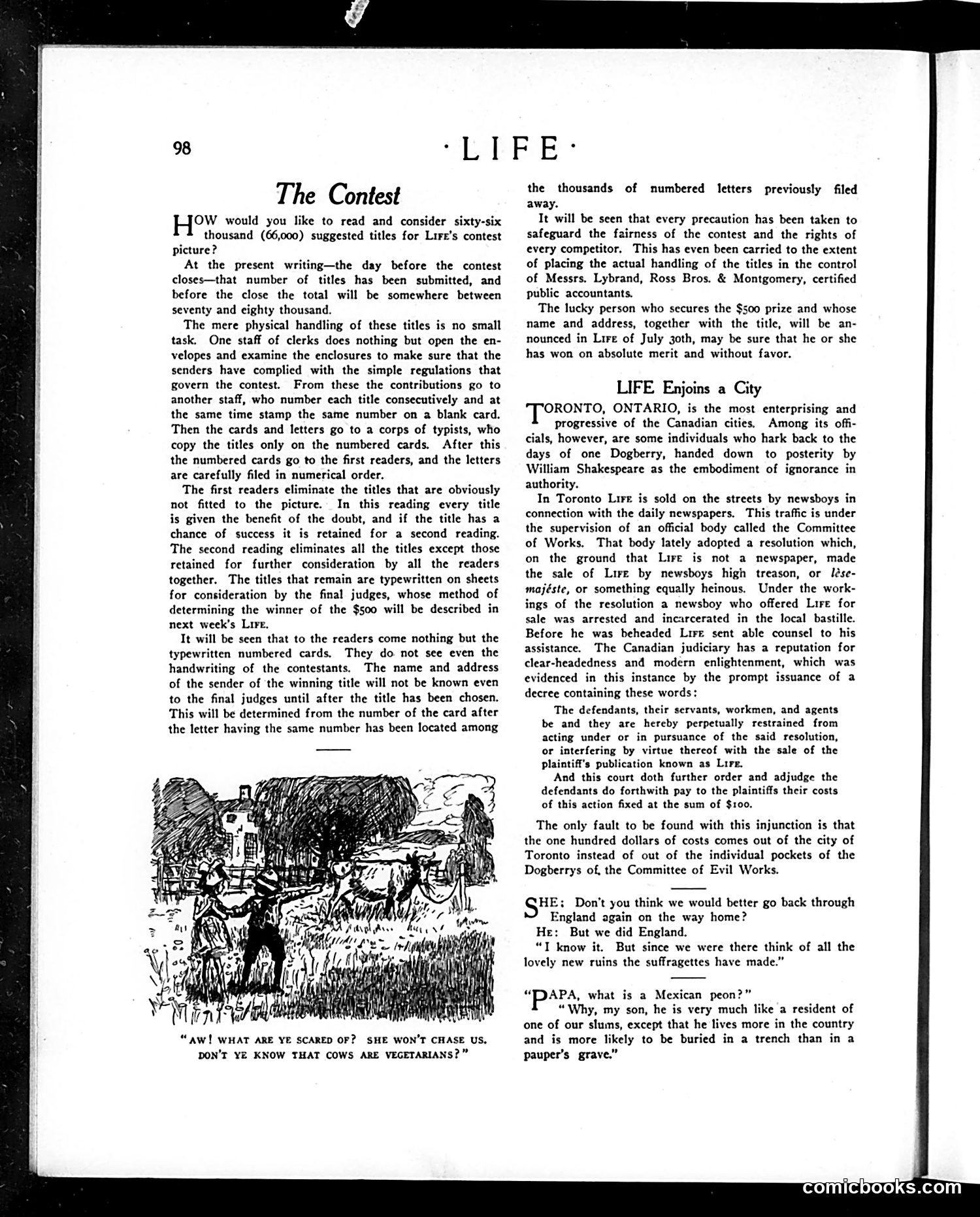
This page contains two distinct elements: **"The Contest"** article describes Life magazine's title-picture competition, explaining the logistical process for judging 66,000 submitted entries fairly. **The cartoon** (bottom left) depicts rural figures alarmed by cattle, with the caption: "Aw! what are ye scared of? She won't chase us. Don't ye know that cows are vegetarians?" The joke relies on simple rural humor—the irony that cows, being vegetarians, shouldn't pose a threat despite the characters' obvious fear. This reflects early 20th-century satirical magazines' use of country-folk stereotypes for comedic effect. **"Life Enjoins a City"** discusses Toronto's legal action against newsboys selling Life magazine, involving copyright disputes and court injunctions.
📄 Transcribed text from this page (OCR, searchable)
Machine-transcribed from the original scan — historical spelling and the odd misread are preserved.
The Contest How would you like to read and consider sixty-six thousand (66,000) suggested titles for Lire’s contest picture? At the present writing—the day before the contest closes—that number of titles has been submitted, and before the close the total will be somewhere between seventy and eighty thousand. The mere physical handling of these titles is no small task. One staff of clerks does nothing but open the en- velopes and examine the enclosures to make sure that the senders have complied with the simple regulations that govern the contest. From these the contributions go to another staff, who number each title consecutively and at the same time stamp the same number on a blank card. Then the cards and letters go to a corps of typists, who copy the titles only on the numbered cards. After this the numbered cards go to the first readers, and the letters are carefully filed in numerical order. The first readers eliminate the titles that are obviously not fitted to the picture. In this reading every title is given the benefit of the doubt, and if the title has a chance of success it is retained for a second reading. The second reading eliminates all the titles except those retained for further consideration by all the readers together. The titles that remain are typewritten on sheets for consideration by the final judges, whose method of determining the winner of the $500 will be described in next week's Lire. It will be seen that to the readers come nothing but the typewritten numbered cards. They do not see even the handwriting of the contestants. The name and address of the sender of the winning title will not be known even to the final judges until after the title has been chosen. This will be determined from the number of the card after the letter having the same number has been located among “AW! WHAT ARE YE SCARED OF? SHE WON’T CHASE US. DON’T YE KNOW THAT COWS ARE VEGETARIANS?” the thousands of numbered letters away. It will be seen that every precaution has been taken to safeguard the fairness of the contest and the rights of every competitor, This has even been carried to the extent of placing the actual handling of the titles in the control of Messrs. Lybrand, Ross Bros. & Montgomery, certified public accountants. The lucky person who secures the $500 prize and whose name and address, together with the title, will be an- nounced in Lire of July 3oth, may be sure that he or she has won on absolute merit and without favor. LIFE Enjoins a City TP ORONTO, ONTARIO, is the most enterprising and Progressive of the Canadian cities, Among its offi- cials, however, are some individuals who hark back to the days of one Dogberry, handed down to posterity by William Shakespeare as the embodiment of ignorance in authority. In Toronto Lire is sold on the streets by newsboys in connection with the daily newspapers. This traffic is under the supervision of an official body called the Committee of Works, That body lately adopted a resolution which, on the ground that Lire is not a newspaper, made the sale of Lire by newsboys high treason, or /ése- majéste, or something equally heinous. Under the work- ings of the resolution a newsboy who offered Lire for sale was arrested and incarcerated in the local bastille. Before he was beheaded Lire sent able counsel to his assistance. The Canadian judiciary has a reputation for clear-headedness and modern enlightenment, which was evidenced in this instance by the prompt issuance of a decree containing these words: The defendants, their servants, workmen, and agents be and they are hereby perpetually restrained from acting under or in pursuance of the said resolution, or interfering by virtue thereof with the sale of the plaintiff's publication known as Lire. And this court doth further order and adjudge the defendants do forthwith pay to the plaintiffs their costs of this action fixed at the sum of $100. previously filed The only fault to be found with this injunction is that the one hundred dollars of costs comes out of the city of Toronto instead of out of the individual pockets of the Dogberrys of, the Committee of Evil Works. SHE: Don’t you think we would better go back through England again on the way home? He: But we did England. “I know it. But since we were there think of all the lovely new ruins the suffragettes have made.’ “DAPA, what is a Mexican peon?” “Why, my son, he is very much like a resident of one of our slums, except that he lives more in the country and is more likely to be buried in a trench than in a pauper’s grave.”