
A complete issue · 52 pages · 1914
Life — May 21, 1914
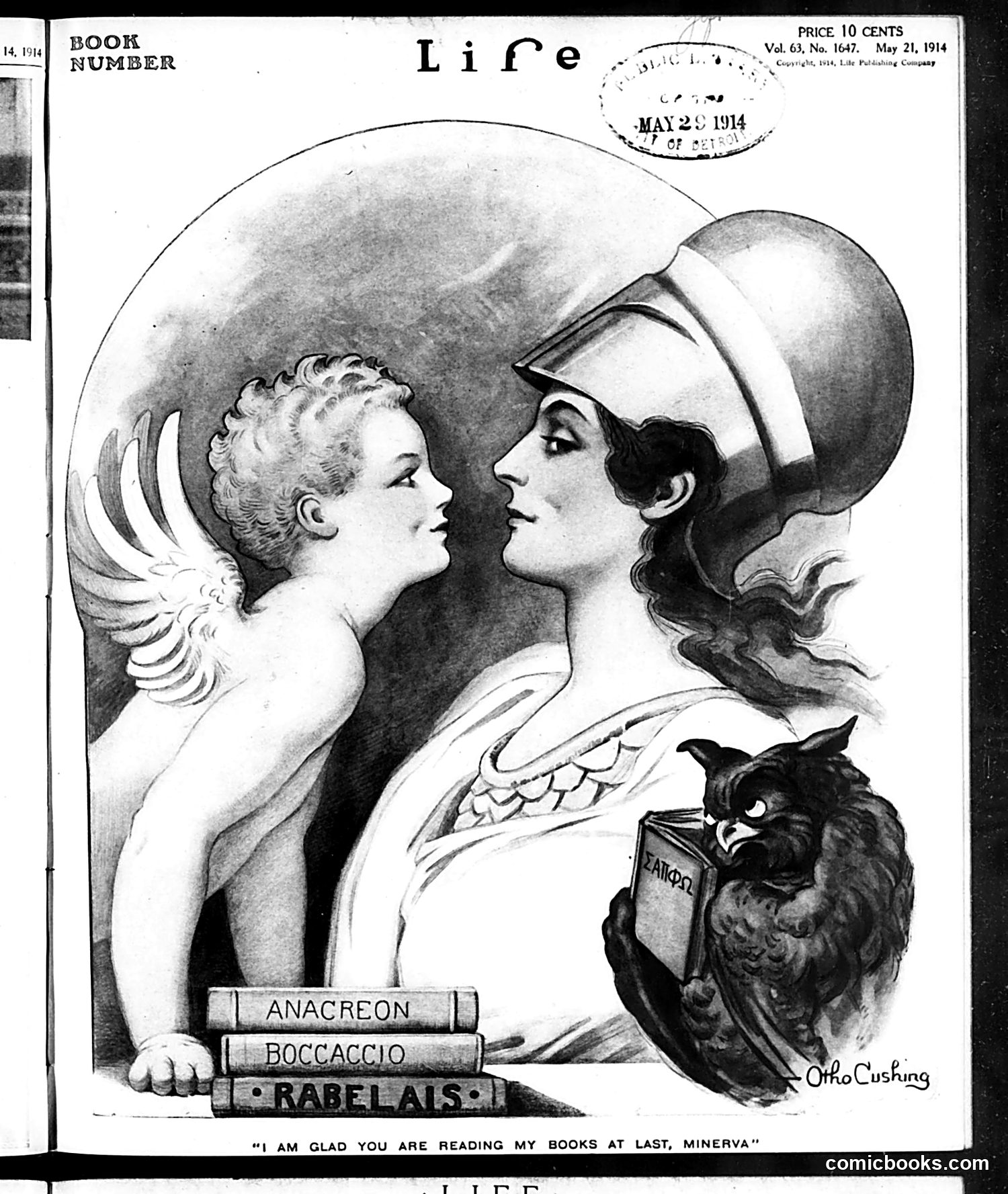
This satirical cover depicts a winged cherub (Cupid) presenting books to a woman labeled "Minerva" (Roman goddess of wisdom). The stacked books shown are *Anacreon*, *Boccaccio*, and *Rabelais*—all classical authors known for bawdy, erotic literature. The joke plays on a tension between intellectual respectability and sensual content. By attributing these risqué books to Minerva (wisdom personified), the cartoonist satirizes either: (1) women's increasing access to "serious" literature previously restricted to men, or (2) the pretense of calling sexually explicit classical works "scholarly" rather than salacious. The owl holding a book suggests literary authority. The caption "I am glad you are reading my books at last, Minerva" implies these works were previously unavailable or forbidden to female readers.
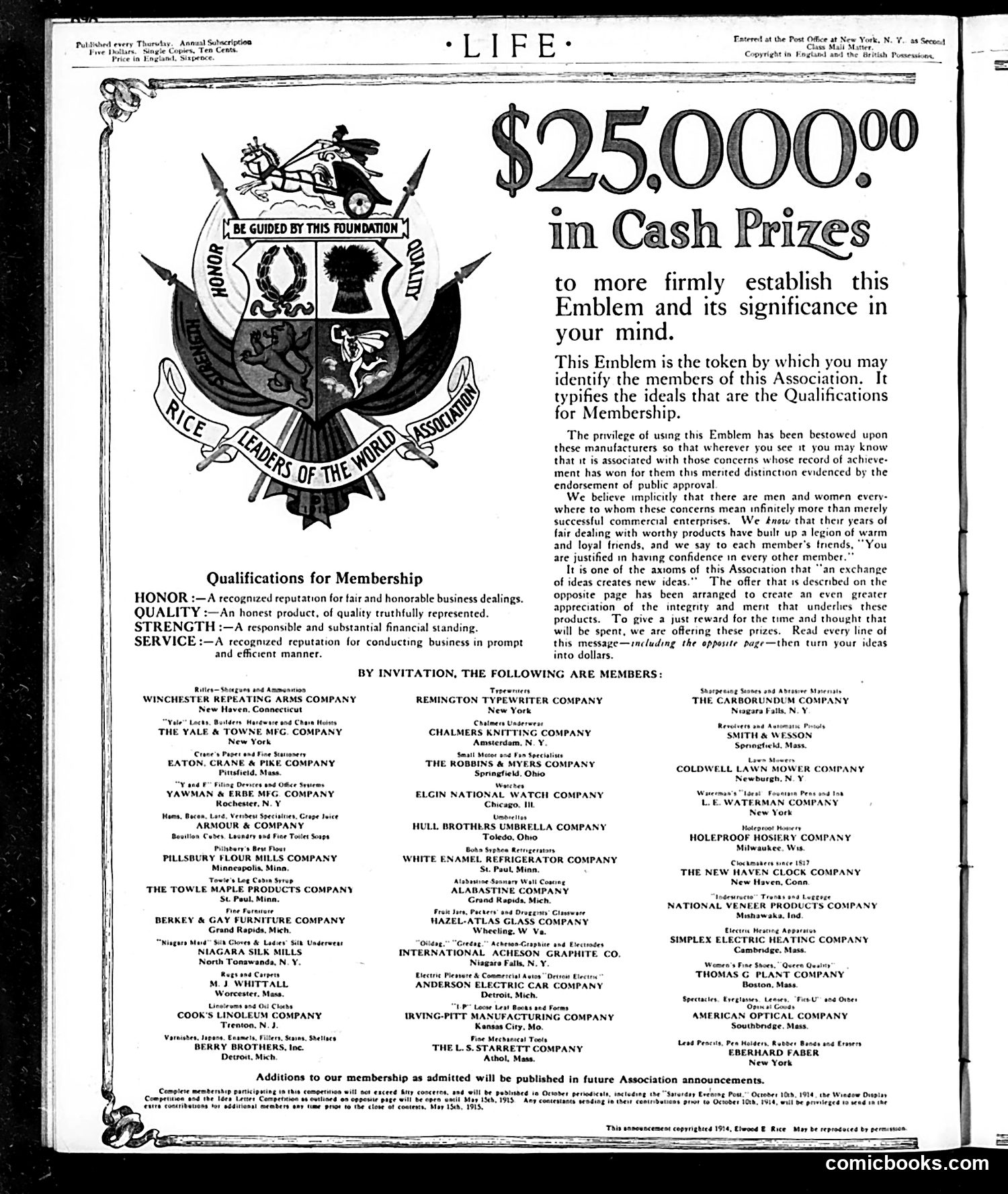
This page is primarily **advertising, not satire**. It promotes membership in an exclusive business association through a $25,000 cash prize contest. The central emblem features an eagle and heraldic shield with the motto "BE GUIDED BY THIS FOUNDATION" and "RICE LEADERS OF THE WORLD ASSOCIATION." The design suggests a prestigious, established organization. The "Qualifications for Membership" emphasize traditional business virtues: **HONOR** (fair dealing), **QUALITY** (excellence), **STRENGTH** (financial standing), and **SERVICE** (prompt efficiency). The bulk of the page lists member companies—primarily manufacturers like Winchester, Yale & Towne, Remington, and Smith & Wesson—establishing credibility through association with recognizable brands. This appears to be a legitimacy-building campaign targeting business leaders, not political satire.
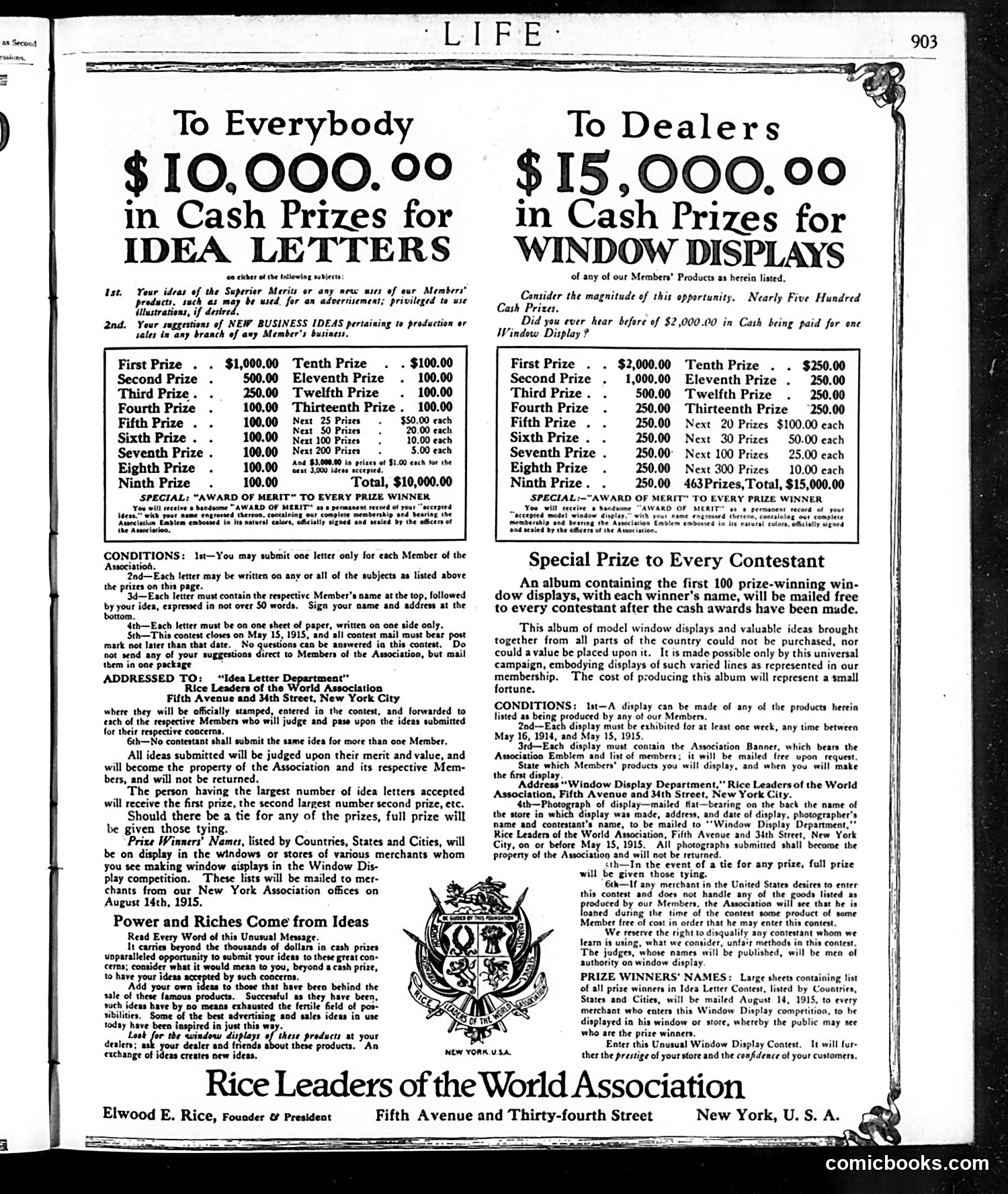
This page contains **no political cartoon or satire**. It is primarily **advertising** for the Rice Leaders of the World Association, promoting two contests: 1. A "$10,000 in Cash Prizes" competition for "Idea Letters" open to the general public 2. A "$15,000 in Cash Prizes" competition for "Window Displays" open to dealers The contests invite submissions of product ideas and creative retail display concepts. Prize structures are detailed in tables, and the page includes official conditions and rules for entry. The decorative heraldic emblem (bottom center) represents the Association itself. This is a straightforward commercial promotion rather than satirical commentary—typical advertising content for *Life* magazine's revenue stream during this period.
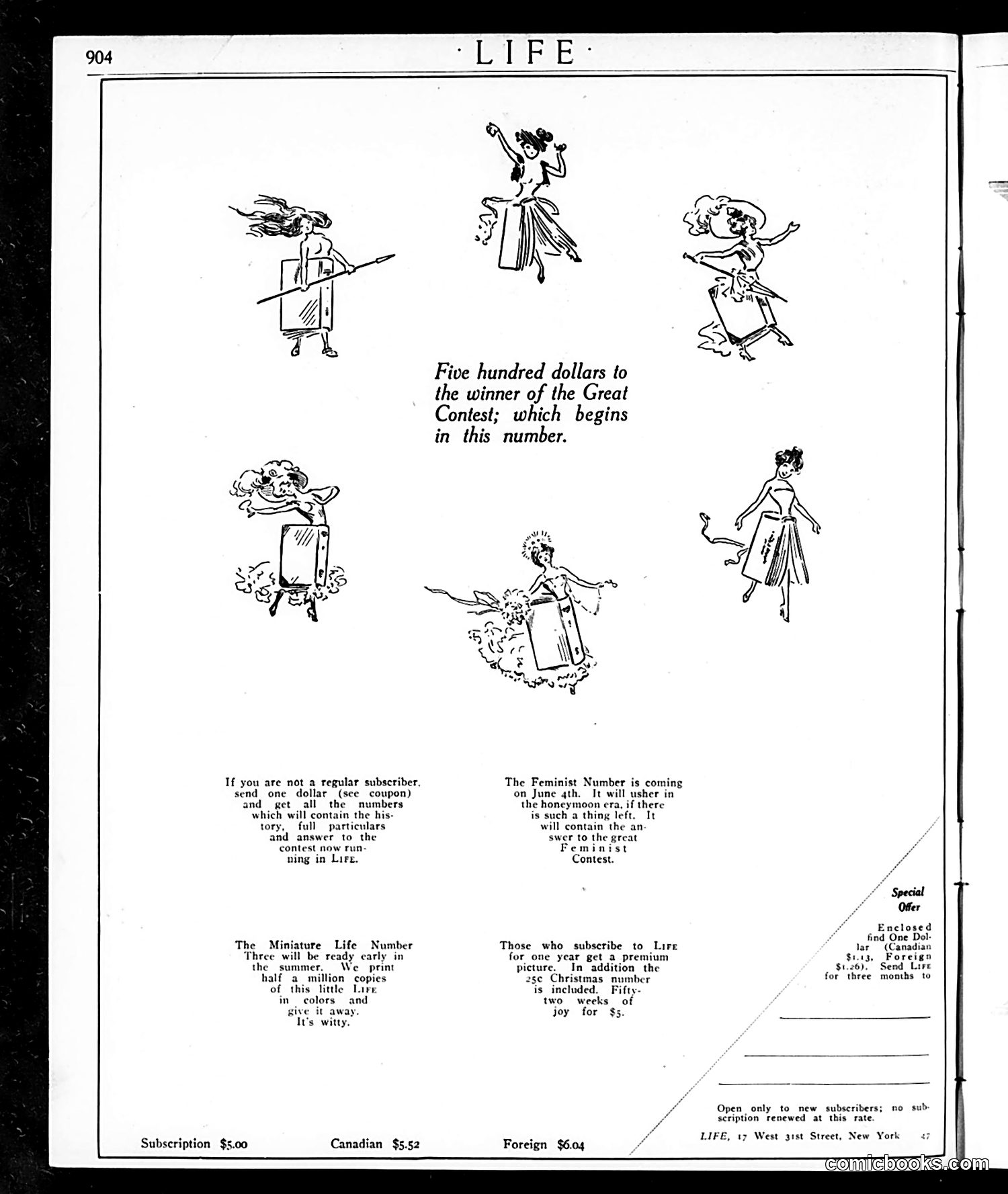
This page is primarily **advertising and promotional content** for Life magazine itself, not political satire. The six illustrated figures at top appear to be **generic "modern women" in various poses**—dancing, jumping, gesturing—representing the magazine's target audience or the spirit of contemporary femininity. The text announces **"The Great Contest"** offering $500 to winners, requiring new subscribers to send $1 and coupons to receive contest details. Additional promotions include a "Miniature Life Number" arriving in summer and subscription offers ($5.00 standard; $5.52 Canadian; $6.04 Foreign). The bottom section contains a **special offer for new annual subscribers**, including a premium picture and "fifty-two weeks of joy for $5." This is essentially a **subscription drive using contest incentives**—common magazine marketing of the era—rather than editorial content with political meaning.
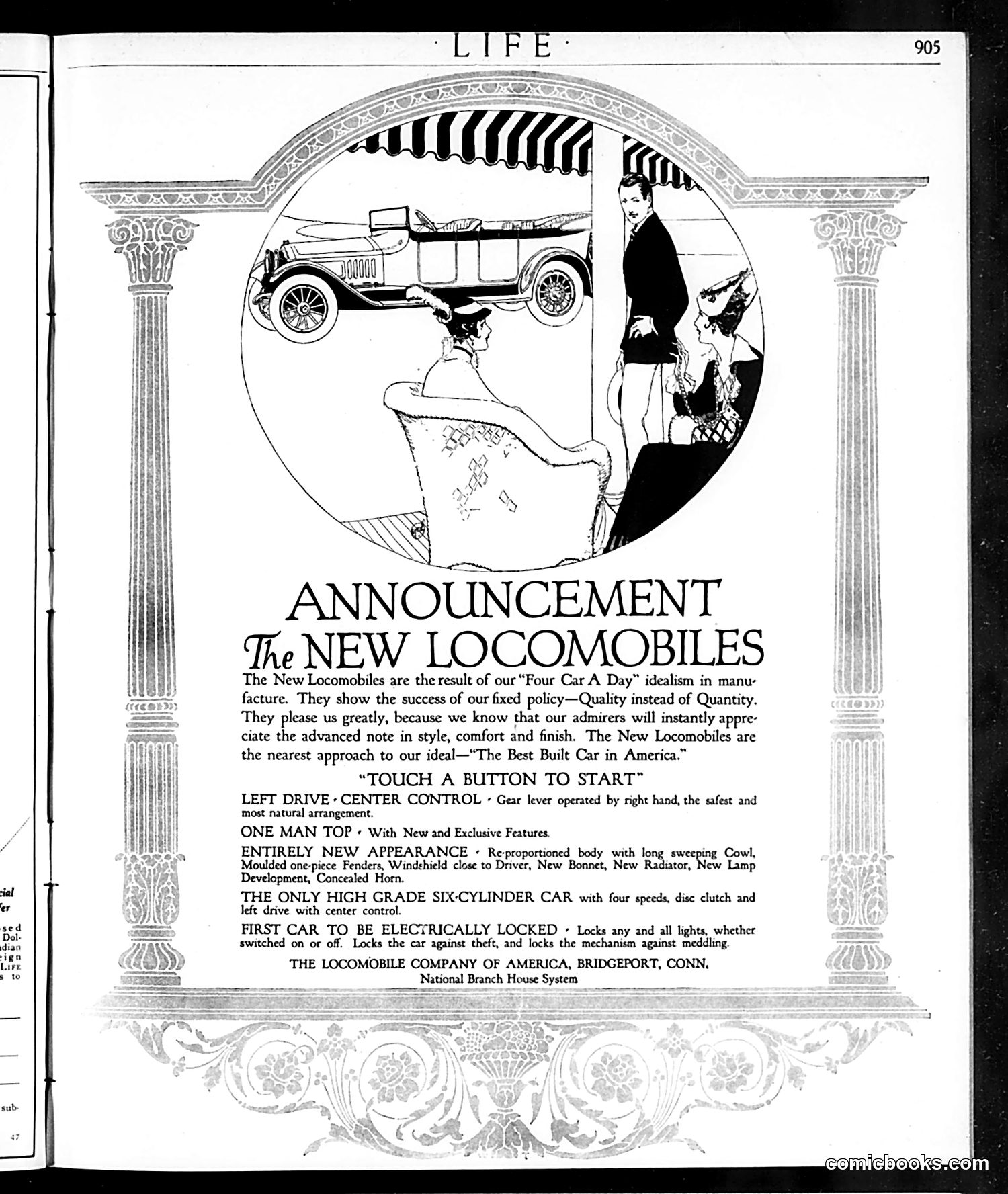
This page is primarily **advertising, not satire or political commentary**. It's an announcement for Locomobile automobiles, published in *Life* magazine (page 905). The ad emphasizes the company's manufacturing philosophy of "Quality instead of Quantity" and promotes the "New Locomobiles" as "The Best Built Car in America." Key features highlighted include: - Touch-button start - Left-hand drive with center control - One-man convertible top - Six-cylinder engine - Electrical locks on doors and lights The decorative classical columns and illustration of well-dressed people with an automobile reflect early 1900s luxury marketing aesthetics. The ad targets affluent consumers, positioning Locomobiles as premium vehicles. No political satire or caricature is present—this is straightforward product promotion.
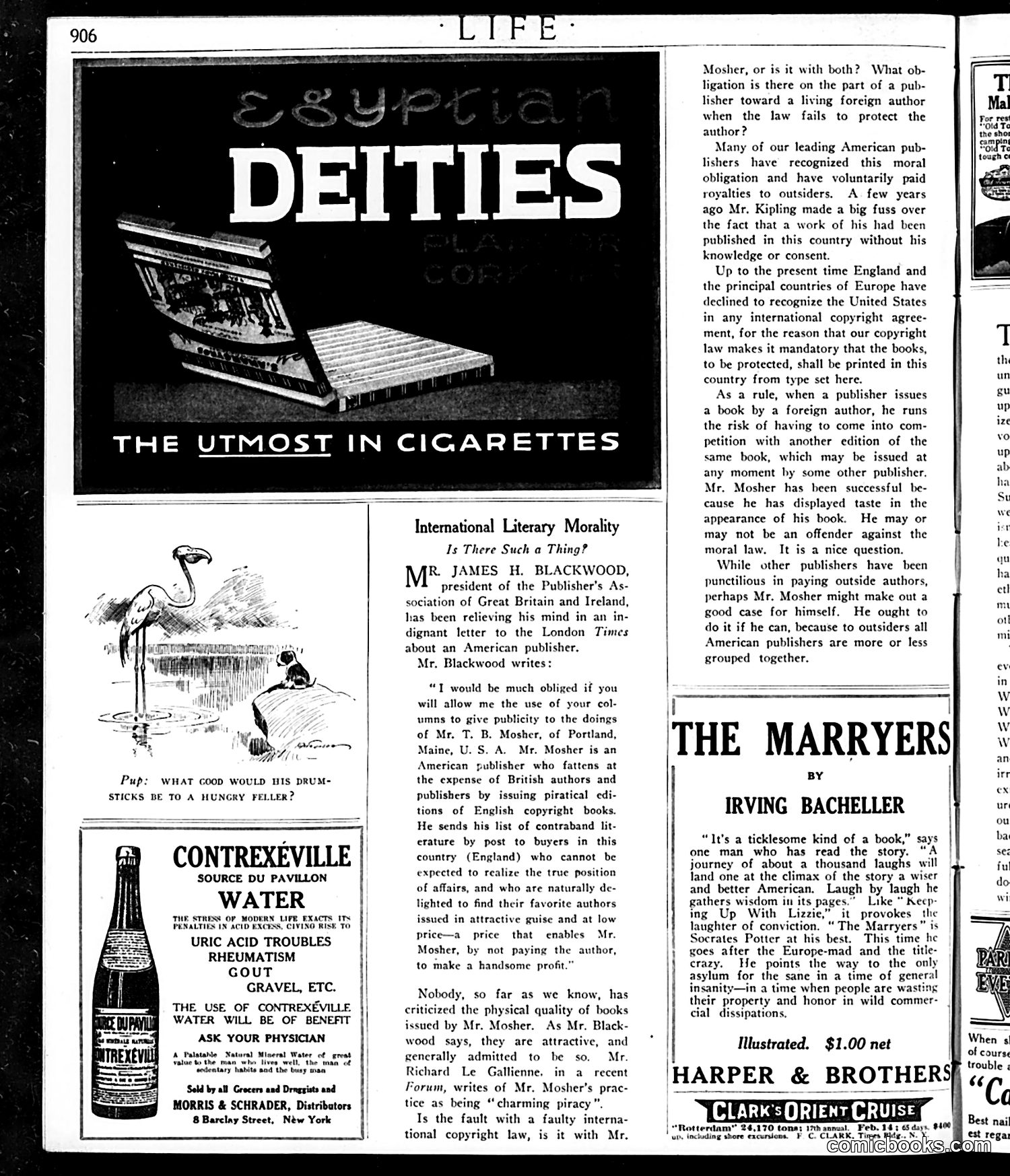
This page is primarily **advertising and book promotion** rather than political satire. The main cartoon shows a **stork carrying a book**, captioned "Pax: What good would the dumbsticks be to a hungry fellow?" This appears to be a visual pun about delivering literature (the stork's traditional role) rather than sustenance—satirizing perhaps the impracticality of books as aid during hardship. The central article by James H. Blackwood, president of the Publisher's Association, discusses **"International Literary Morality"**—specifically criticizing T.B. Mosher, a Portland publisher who allegedly issues unauthorized, low-priced editions of English copyright books. Blackwood frames this as a moral and legal issue about respecting author rights and fair competition. The page otherwise features advertisements for Contrexéville Water and book promotions.
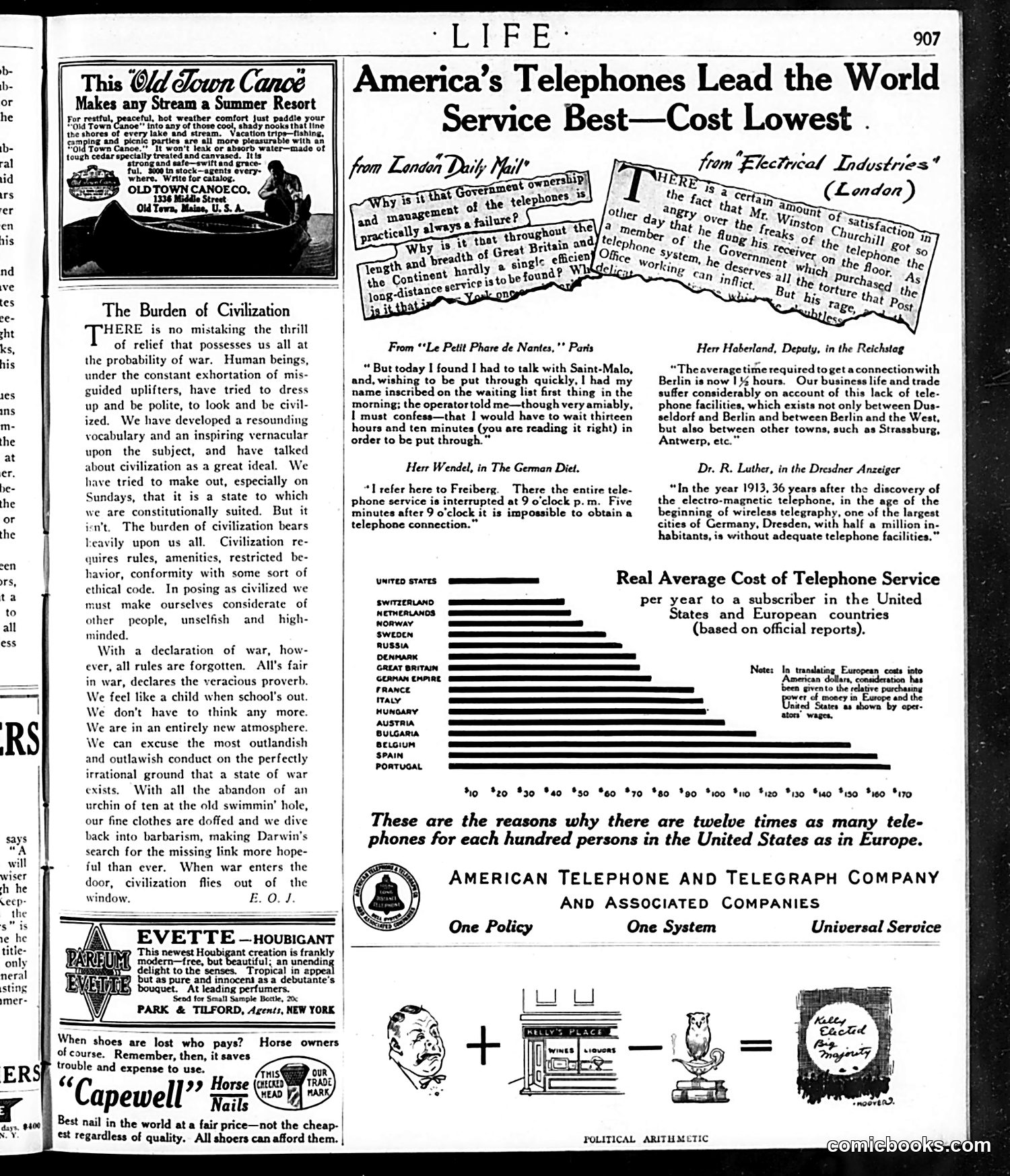
This page is primarily **advertising and corporate propaganda**, not satire. The main content is a full-page advertisement from American Telephone and Telegraph Company claiming America's telephone service is superior to Europe's—with twelve times more phones per capita than European countries. The supporting text includes international quotes (from London, Paris, Germany, and elsewhere) acknowledging Europe's inferior telephone infrastructure. A bar chart compares costs across nations, showing the U.S. offers cheaper service. The page also contains unrelated period advertisements (canoe resort, perfume, horse nails). **The "point"**: This is straightforward corporate messaging presenting American capitalism and technology as demonstrably superior to European systems, likely published during or shortly after World War I when such comparisons had nationalist resonance.
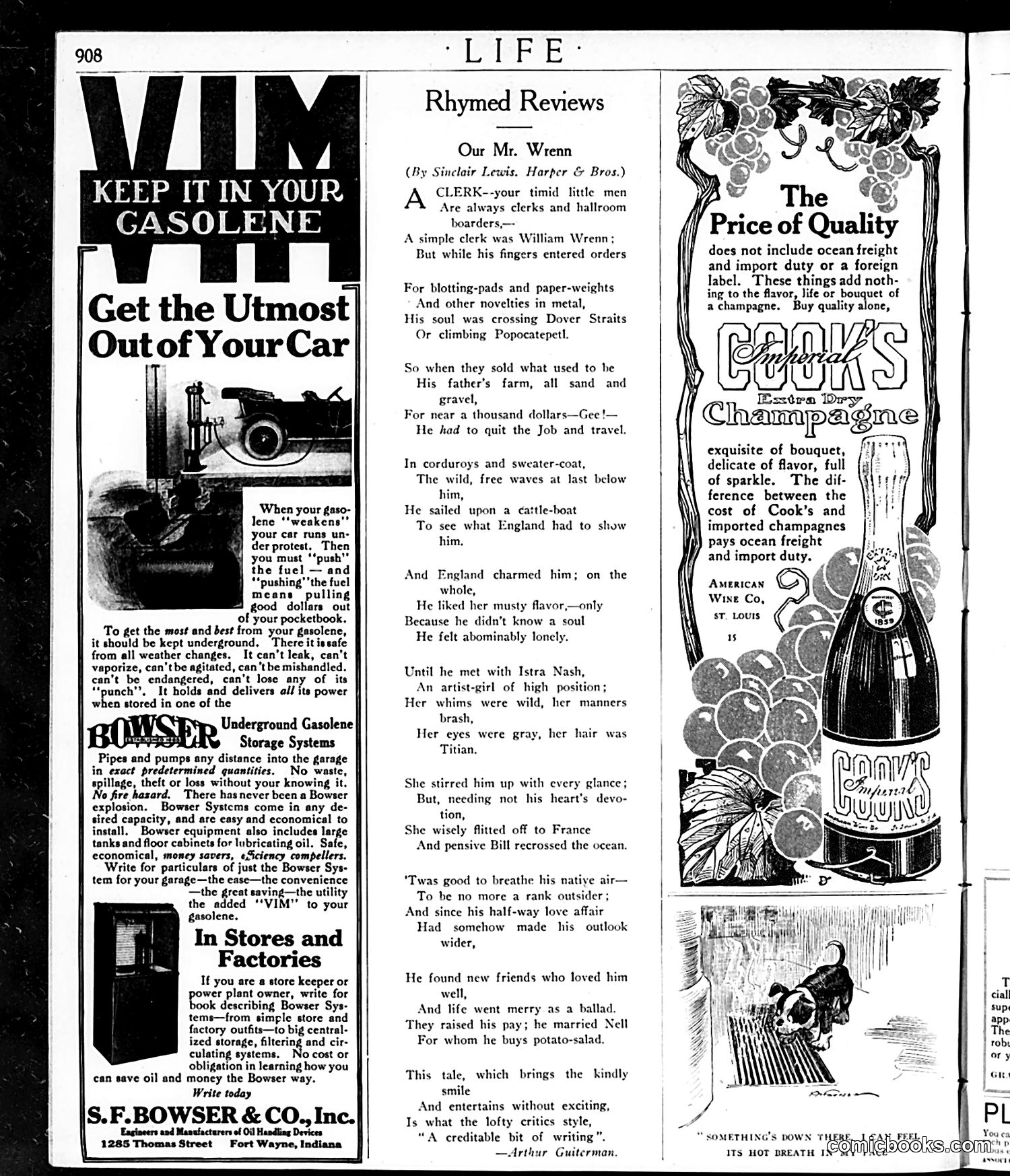
This page contains **advertisements and poetry rather than political cartoons**. **Left side:** A Bowser gasoline storage system ad emphasizing fuel efficiency and reliability for cars and factories during what appears to be the WWI era (references to "fuel" conservation and industrial use). **Center:** "Our Mr. Wrenn," a rhymed poem by Sinclair Lewis about a clerk who escapes his mundane job to travel abroad. The narrative describes his transformation from a timid office worker to a man who experiences adventure, romance with an artist named Istra Nash, and personal fulfillment—ultimately settling into contentment. **Right side:** Cook's champagne advertisement featuring decorative grape imagery and pricing information. The page reflects early 20th-century concerns: industrial efficiency, escapism from routine work, and consumer products.
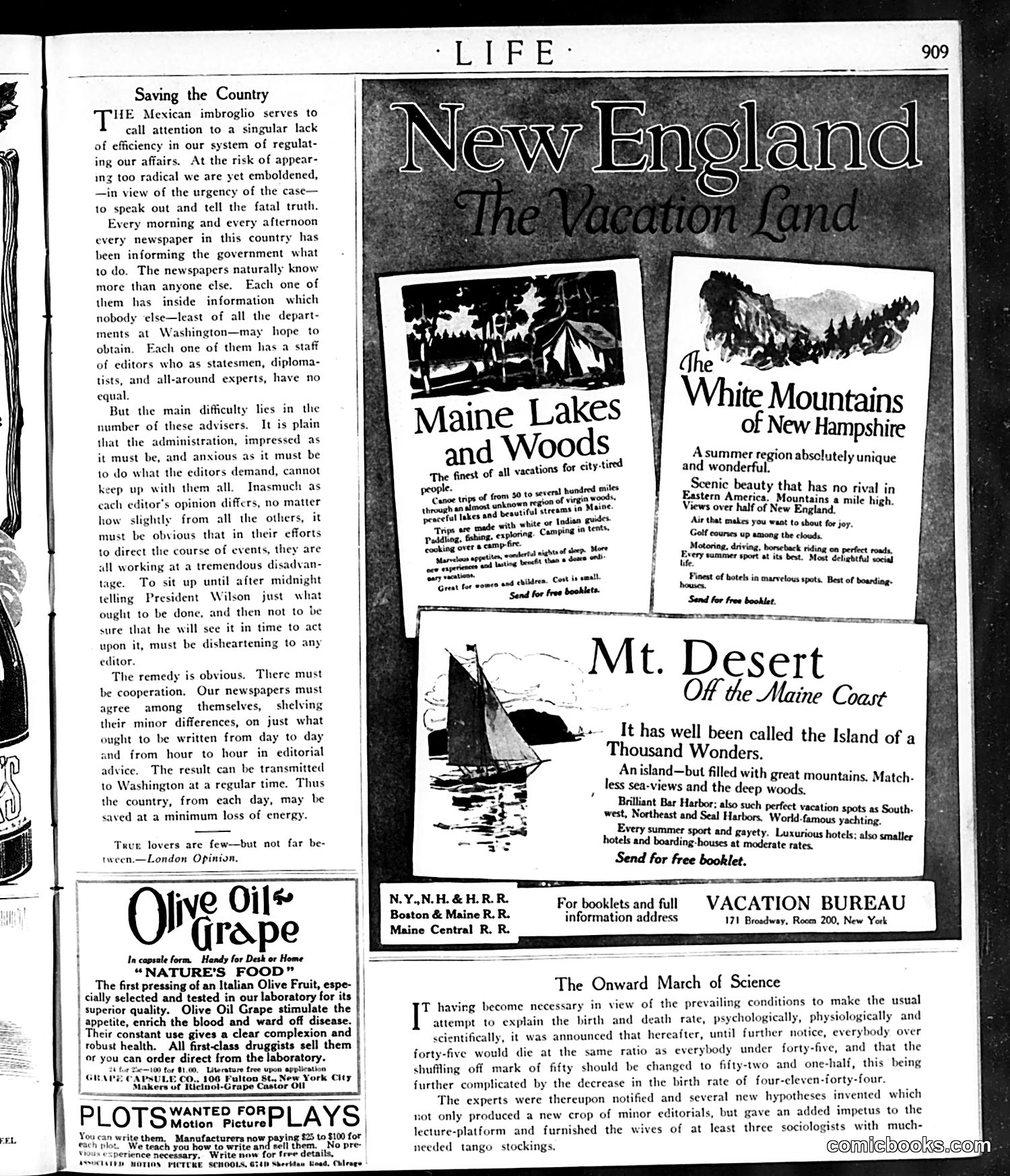
This page is primarily **advertising and travel promotion**, not political satire or comics. The dominant content consists of vacation advertisements for New England destinations—Maine Lakes and Woods, White Mountains of New Hampshire, and Mt. Desert off the Maine Coast. These promote scenic beauty and recreational activities like fishing, camping, and yachting. The left column contains an editorial titled "Saving the Country" critiquing government inefficiency and newspaper advisory roles, but this is standard political commentary rather than illustrated satire. The bottom features an "Olive Oil Grape" advertisement and a brief science article about birth and death rate statistics—typical magazine content of the era. The page reflects 1920s-era travel marketing and administrative commentary, not cartoon satire.
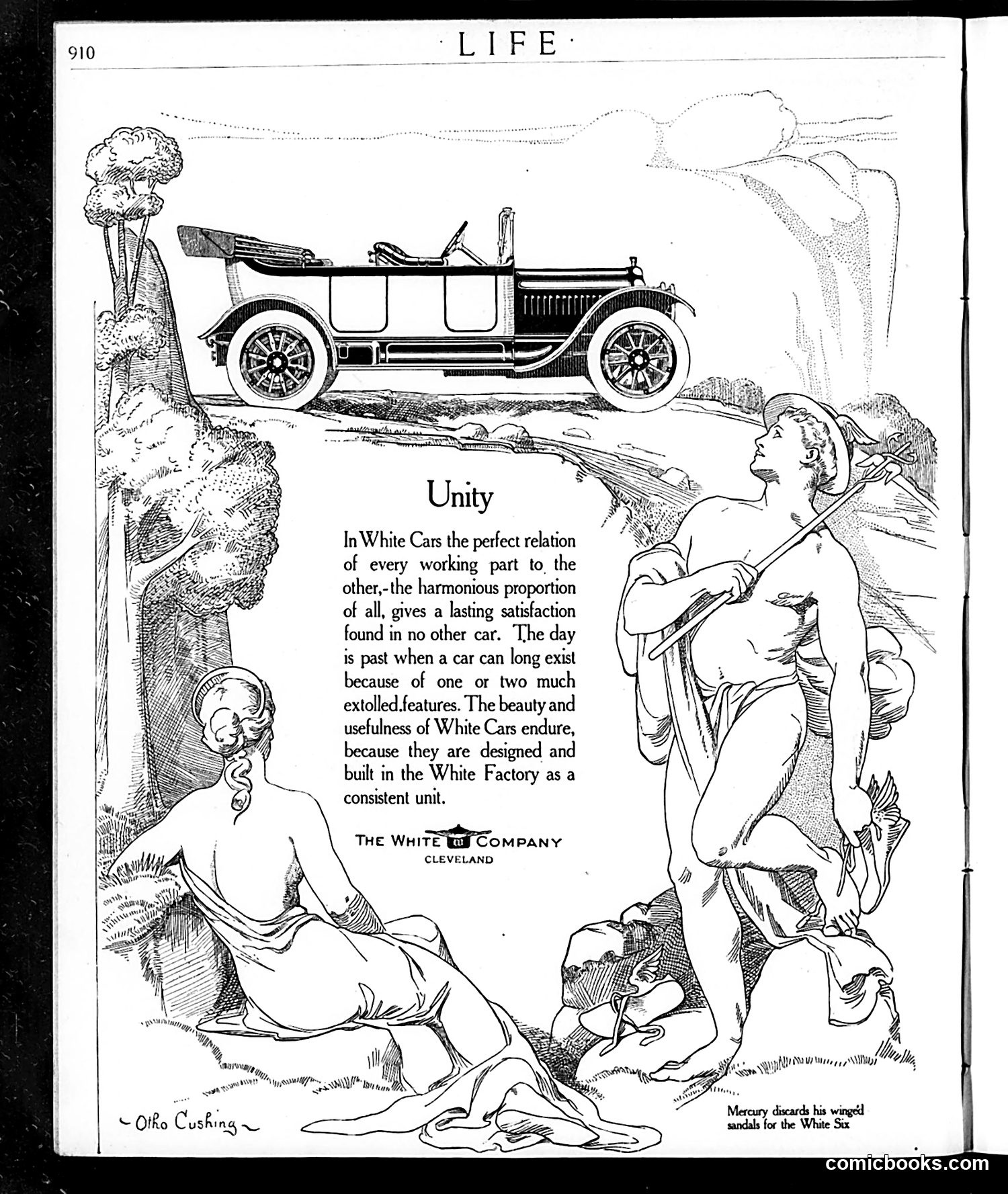
This is a **White Company automobile advertisement** disguised as editorial content in *Life* magazine. The page title "Unity" is the advertising hook. The allegorical illustration shows classical female figures (appearing to represent ideals or virtues) surrounding a White motor car. The ad copy argues that White Cars achieve "perfect relation of every working part to the other" and possess "harmonious proportion"—essentially claiming the vehicle embodies unified, balanced engineering. The classical figures and Mercury imagery (bottom caption) evoke timeless ideals, suggesting the White automobile represents enduring quality and design consistency. This was a common early 20th-century advertising strategy: associating commercial products with classical virtue and permanence to appeal to educated, affluent buyers. The artist is credited as "Orlo Cushing."
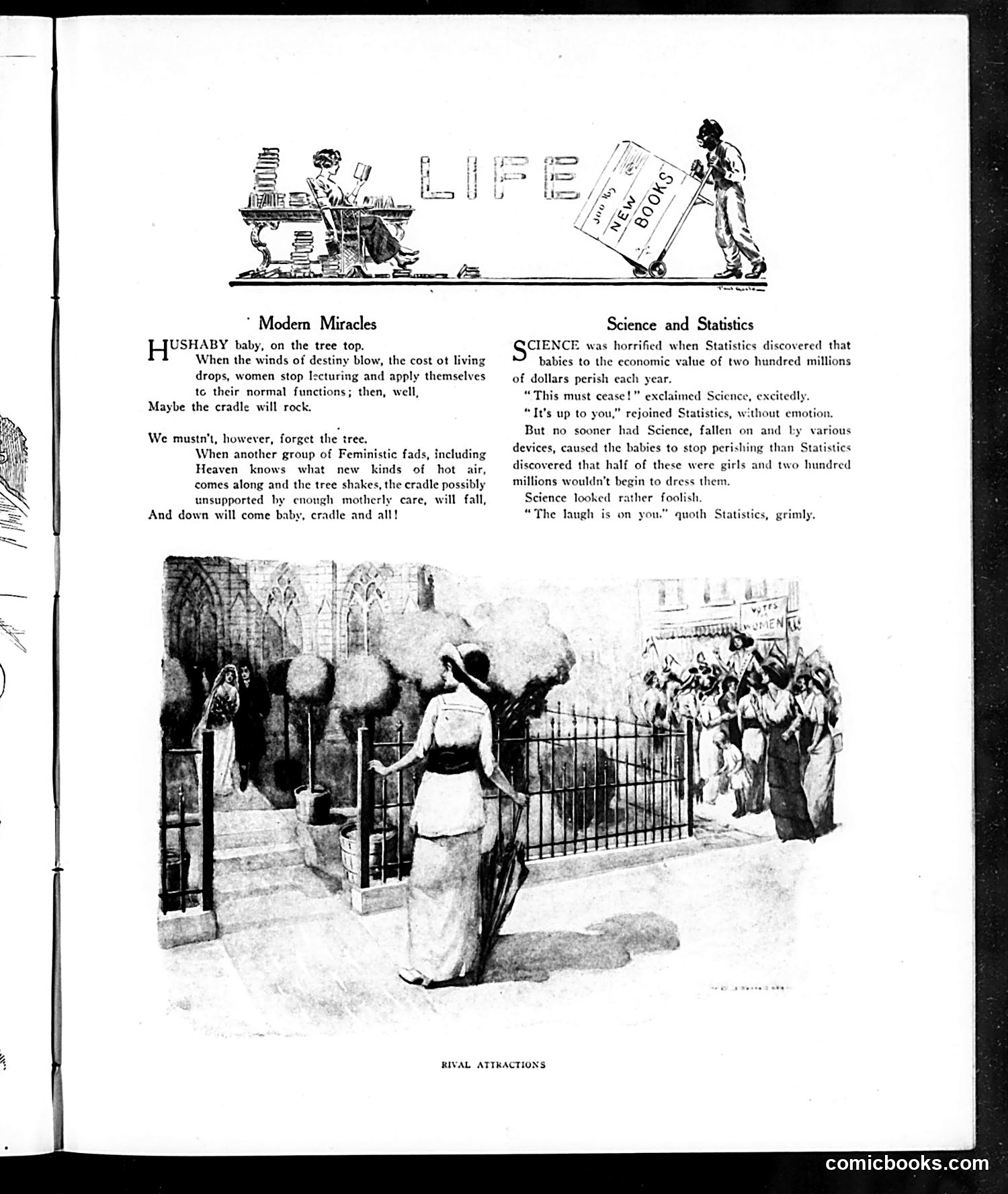
This page presents two satirical pieces critiquing early 20th-century feminism and social trends. **"Modern Miracles"** mocks the "Hushabye baby" nursery rhyme, sarcastically suggesting that when feminists adopt new childcare methods (likely referring to progressive parenting ideas or communal child-rearing), women can abandon traditional motherhood. The poem warns that such "Feministic fads" will cause literal disaster—babies will fall from trees with their cradles. **"Science and Statistics"** uses personification to satirize academic debates: Science and Statistics quarrel over infant mortality rates and the economic value of babies' lives. The satire suggests both fields engage in absurd, emotionless quantification of human welfare. Both pieces mock progressive social reforms of the era as dangerous or ridiculous, using humor to reinforce traditional gender roles.
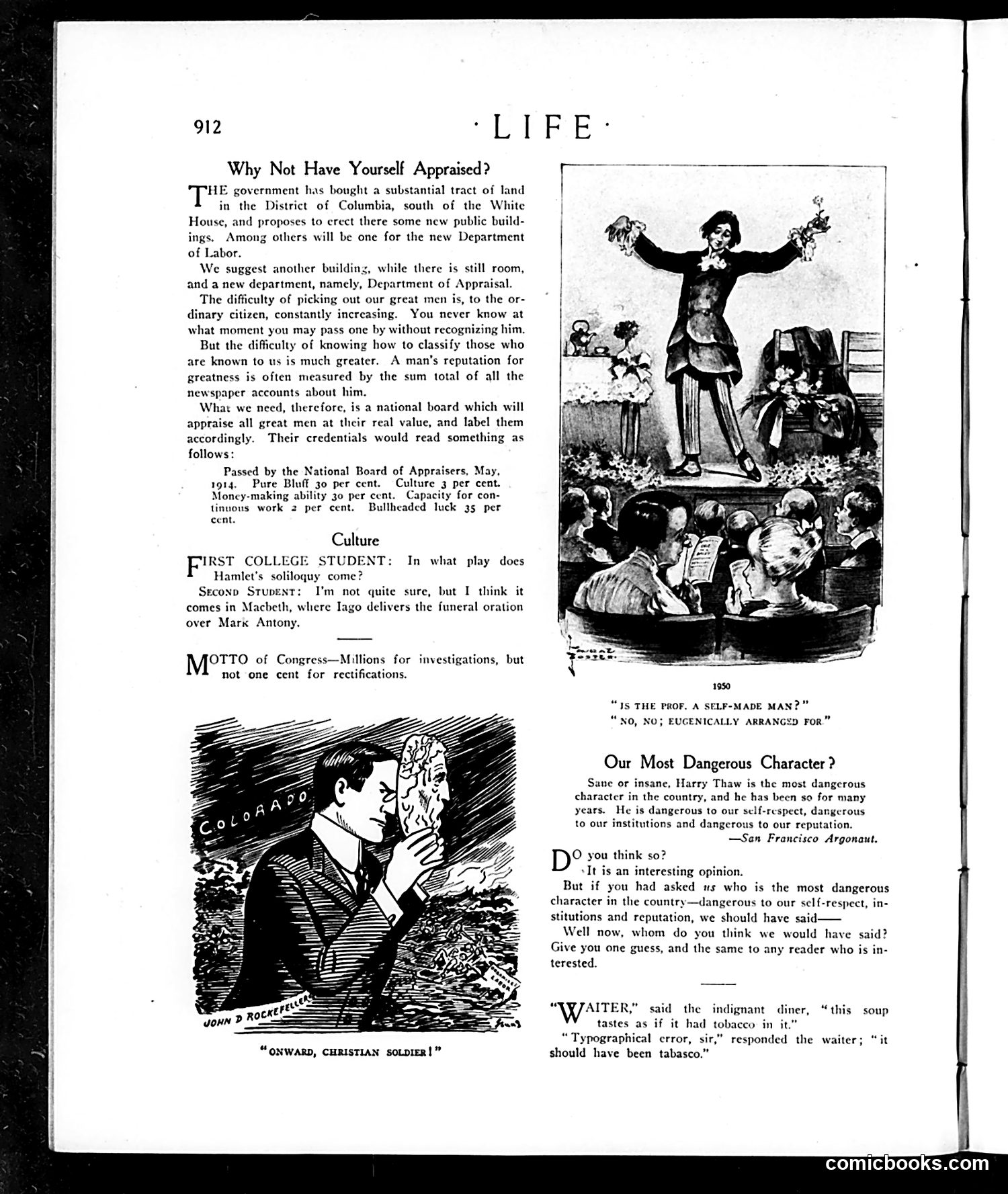
This *Life* magazine page (page 912) contains two satirical cartoons commenting on early 20th-century American politics and society. **Top cartoon:** Shows a figure distributing eugenics propaganda to a crowd. The caption "Is the Prof. a Self-Made Man?" sarcastically questions whether eugenics advocates genuinely achieved their status or merely arranged it through privilege—mocking the pseudoscience of eugenics that was gaining traction in this era. **Bottom cartoon:** Titled "Onward, Christian Soldier!" depicts a Rockefeller figure (labeled "Colorado") confronting labor issues, likely referencing the Rockefeller family's violent suppression of miners' strikes. The satire questions the morality of wealthy industrialists claiming Christian values while brutally opposing workers' rights. The page's text sections offer cultural commentary and humor on various topics, reflecting *Life*'s role as satirical social criticism.
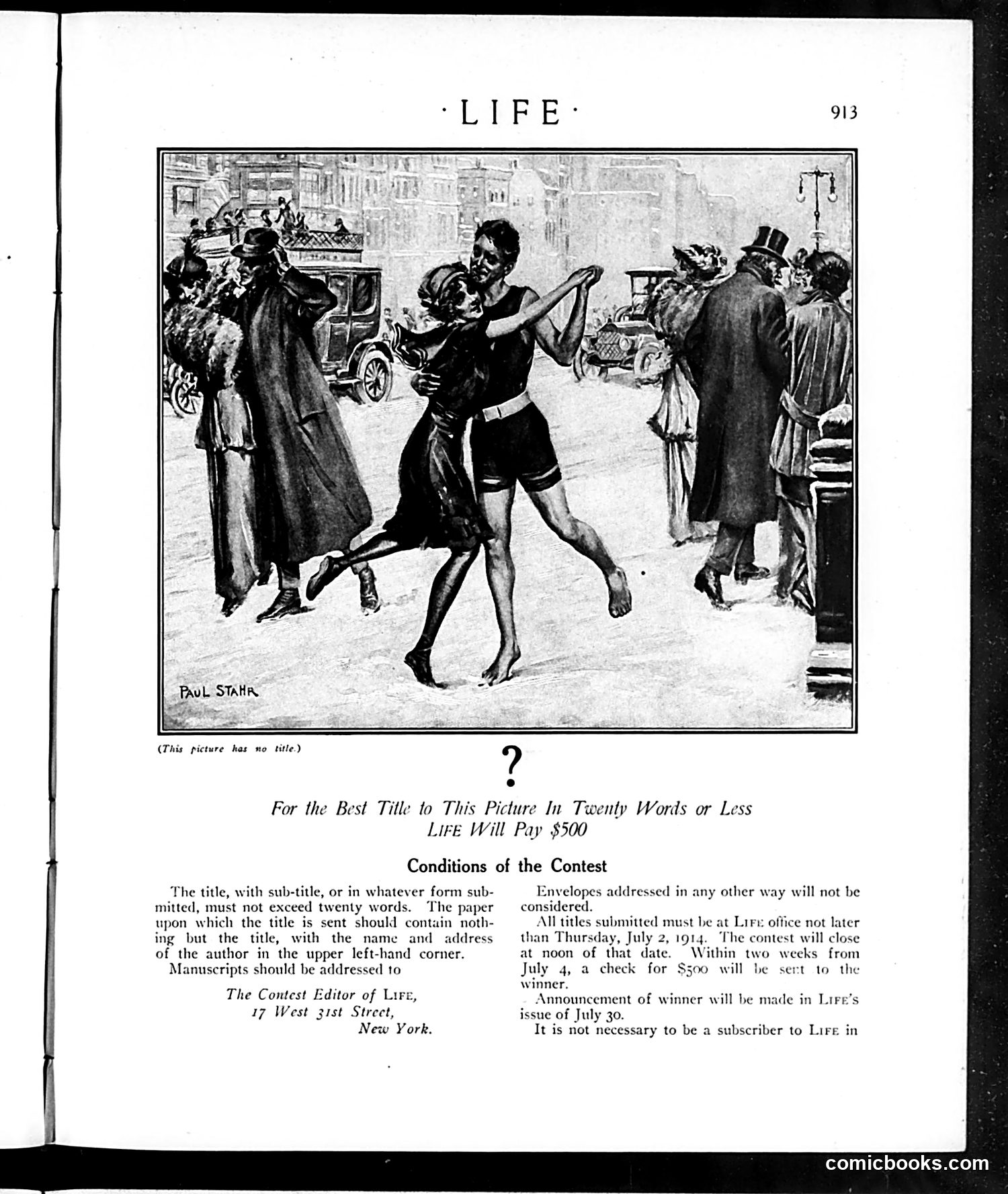
This page features a contest announcement with an illustration by Paul Stahr. The unsigned cartoon depicts a nearly naked man performing an exuberant dance or athletic pose in a city street, surrounded by well-dressed pedestrians and automobiles. The contrast between his minimal clothing and the formally dressed onlookers suggests social satire about public decorum or impropriety. The contest invites readers to submit titles in twenty words or less, offering a $500 prize. The image's deliberately ambiguous nature—noted by "This picture has no title"—appears designed to prompt humorous or clever interpretations from readers about the incongruous scene. Without additional historical context, the specific social commentary remains unclear, though the satirical intent is evident.
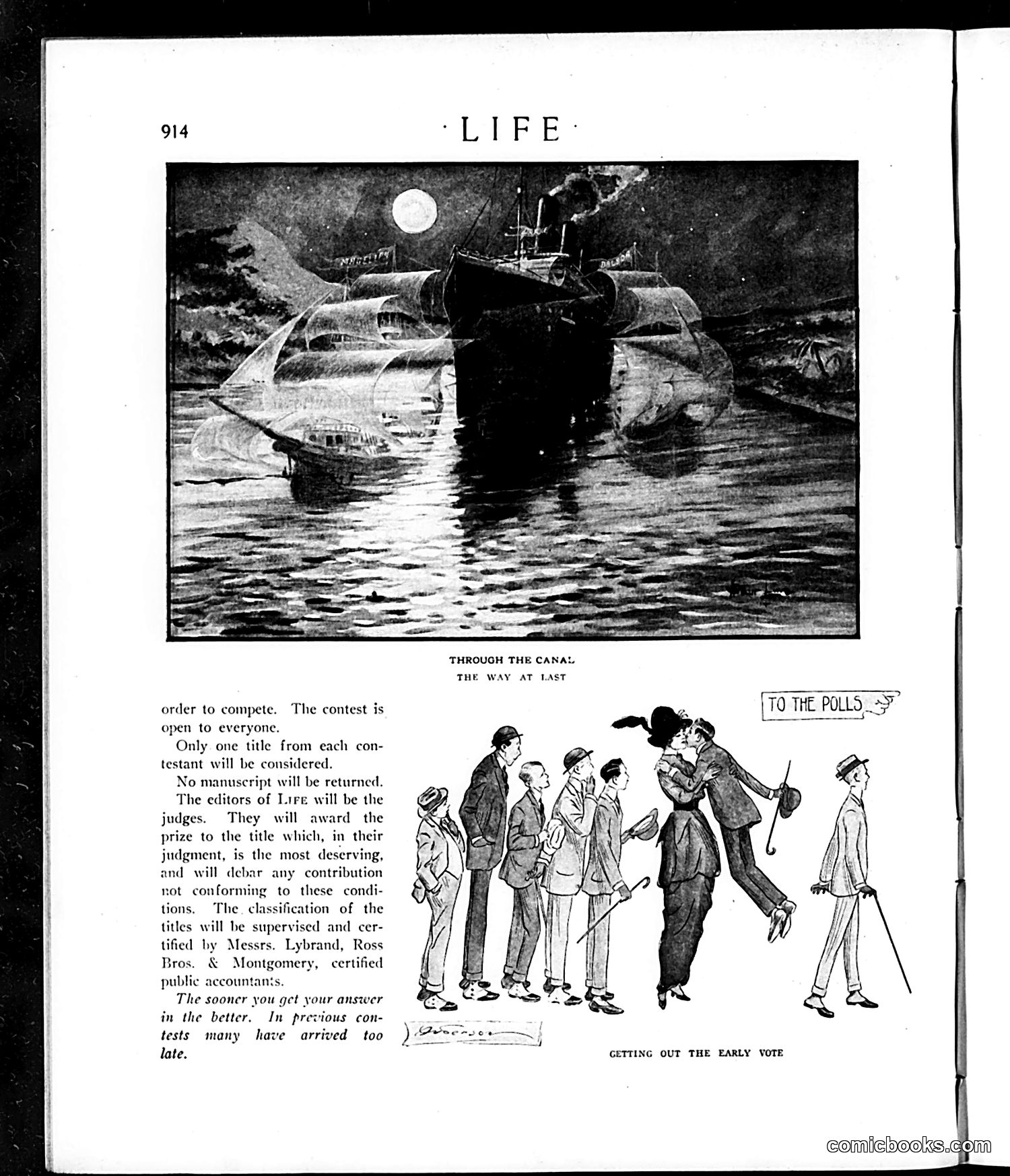
**Top Image:** "Through the Canal: The Way at Last" depicts ships navigating what appears to be the Panama Canal, showing the historic achievement of this engineering project enabling passage between oceans. **Bottom Cartoon:** "Getting Out the Early Vote" satirizes election day voting practices. The illustration shows men heading "To the Polls" with various methods of transportation and apparent urgency. The accompanying text discusses a writing contest, mentioning that "sooner you get your answer in the better. In previous contests many have arrived too late." The satire likely mocks voter fraud or irregularities common in early 20th-century American elections—specifically the practice of people arriving late to vote or using questionable means to participate in elections. The contrast between the canal's efficiency and voting's chaos emphasizes the joke.
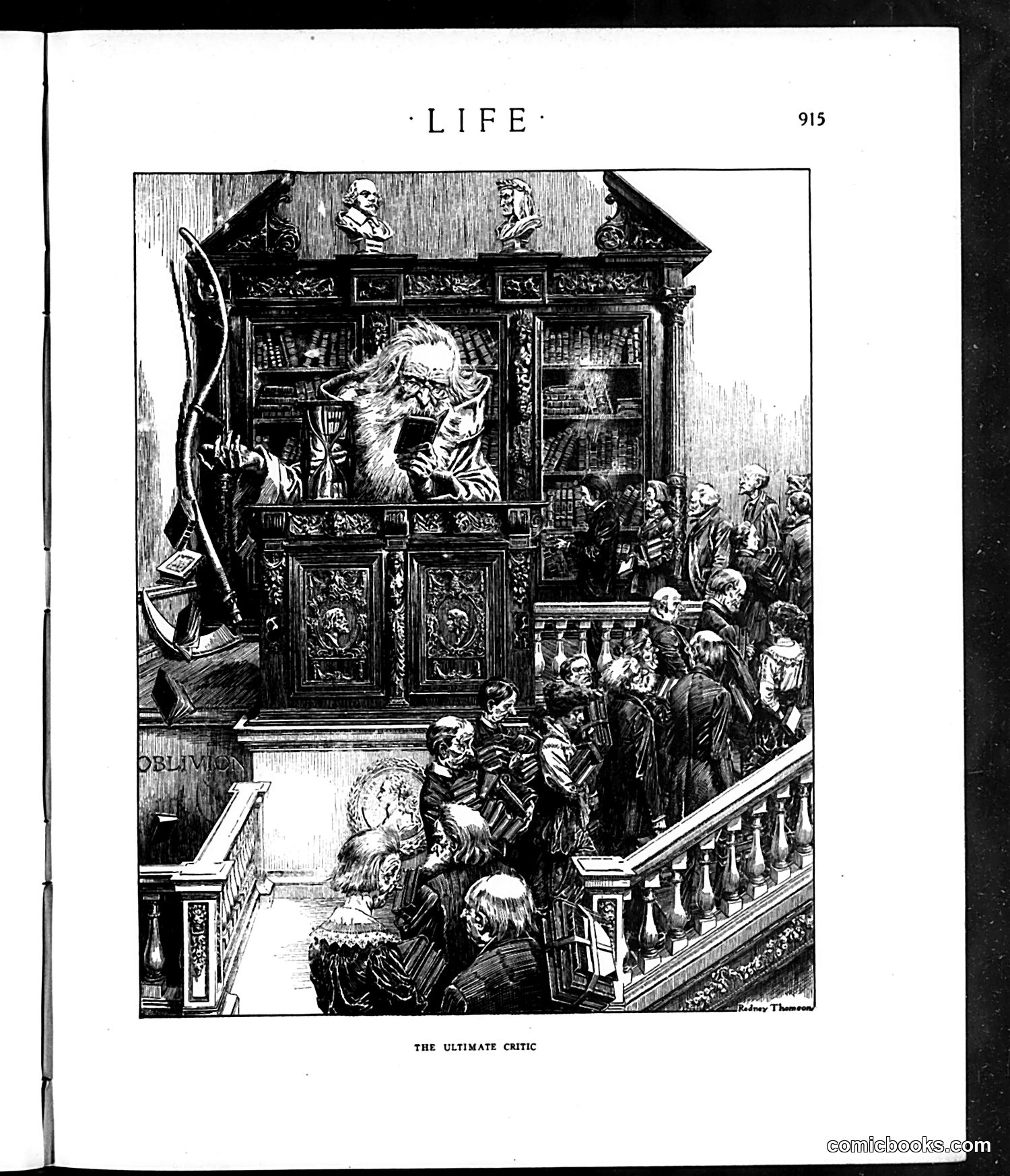
This satirical illustration depicts a bearded man (appearing to be a theater or arts critic) positioned in an ornate booth or window, surveying a crowd of well-dressed people gathered below on a grand staircase. The cartoon's title, "The Ultimate Critic," suggests mockery of someone with supreme or pretentious judgmental authority over cultural matters. The joke appears to target the arrogance of influential critics—the elevated position of the critic above the crowd literally illustrates his inflated sense of importance. The elaborate architectural setting and formal dress suggest this concerns high-society cultural criticism. The cartoon satirizes how critics position themselves as arbiters of taste, watching and judging the public from a position of perceived superiority, rather than engaging with audiences as equals.
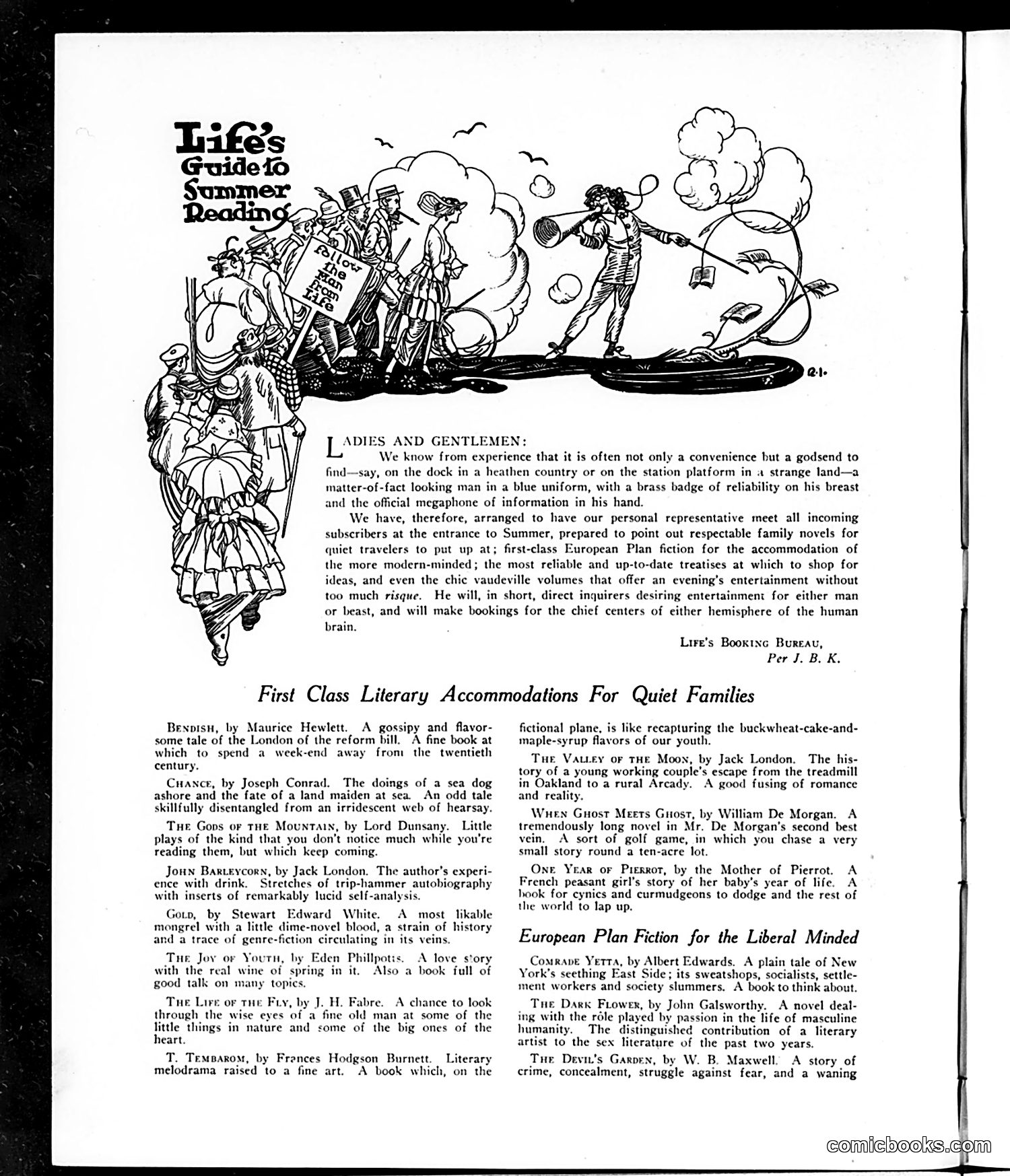
This is a satirical **book-recommendation advertisement** masquerading as a public service announcement. The cartoon depicts Life's "Booking Bureau"—a uniformed official with a megaphone directing literary "travelers" to appropriate summer reading. The satire lies in the patronizing classification system: books are sorted by social class and sophistication level. "First Class Literary Accommodations For Quiet Families" offers respectable, safe novels (Maurice Hewlett, Joseph Conrad), while "European Plan Fiction for the Liberal Minded" caters to intellectuals interested in social issues (sweatshops, sexuality, socialism). The joke mocks both pretentious readers seeking status through literature and publishers' marketing that categorizes books by audience psychology rather than merit. The phrase "for either hemisphere of the human brain" suggests even books are sorted by whether they appeal to emotion or intellect—a commentary on how literature was commercialized and consumed as a commodity in early-20th-century America.
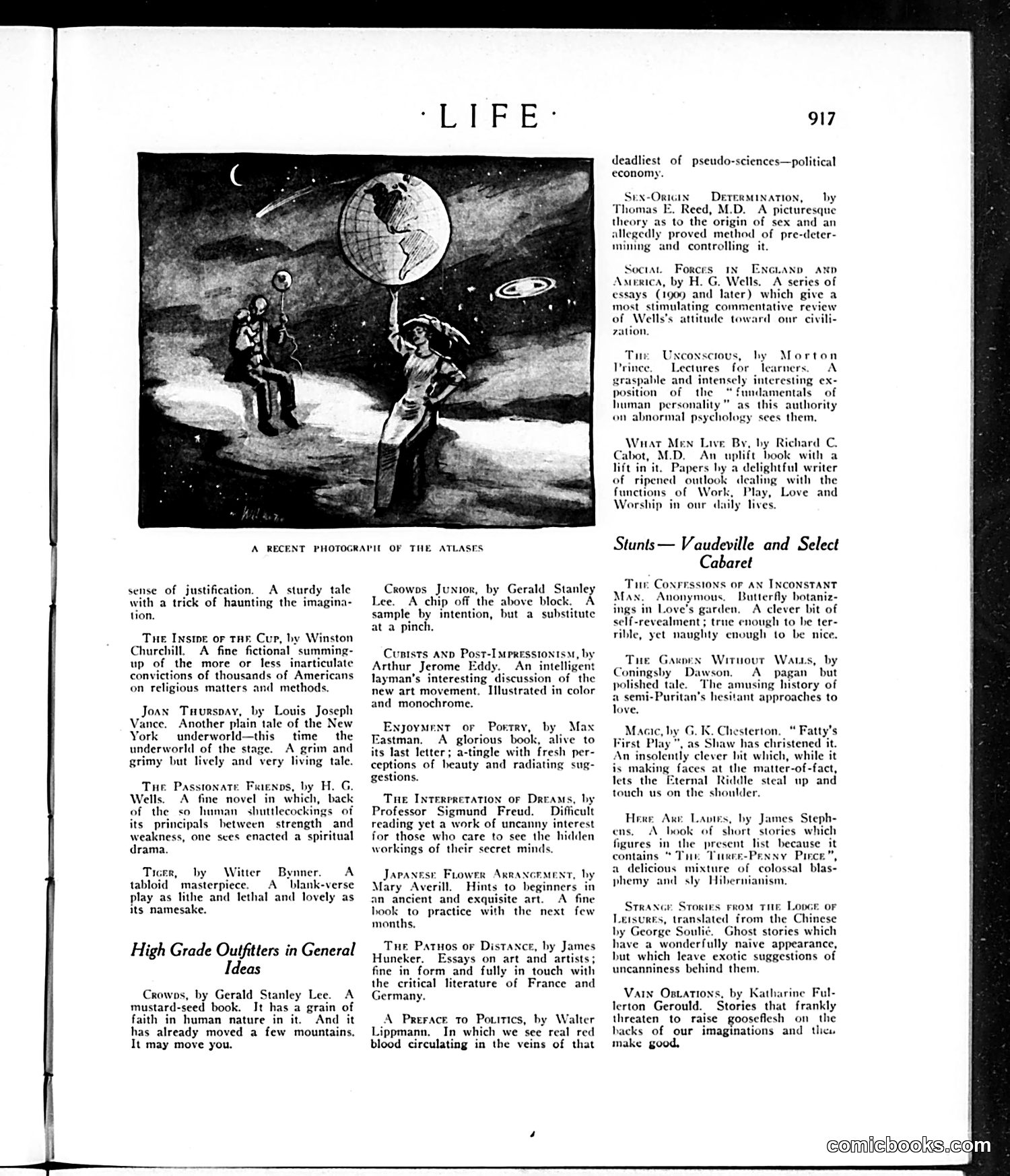
This page features book reviews and recommendations from Life magazine. The illustrated cartoon at top—captioned "A Recent Photograph of the Atlases"—shows two figures examining a globe against a cosmic background, likely a whimsical reference to the atlas/geography books being reviewed below. The page consists primarily of brief critical summaries of contemporary books across various genres: fiction (Winston Churchill's *Inside the Cup*, H.G. Wells novels), philosophy and psychology (Freud's *Interpretation of Dreams*, Morton Prince on the unconscious), art criticism, poetry, and practical guides like Japanese flower arrangement. Notable is the tone: Life presents these as "High Grade Outfitters in General Ideas"—quality intellectual reading for the educated public. The reviews reflect early 20th-century intellectual preoccupations: psychoanalysis, modern art movements, social reform, and questions of human nature and morality.
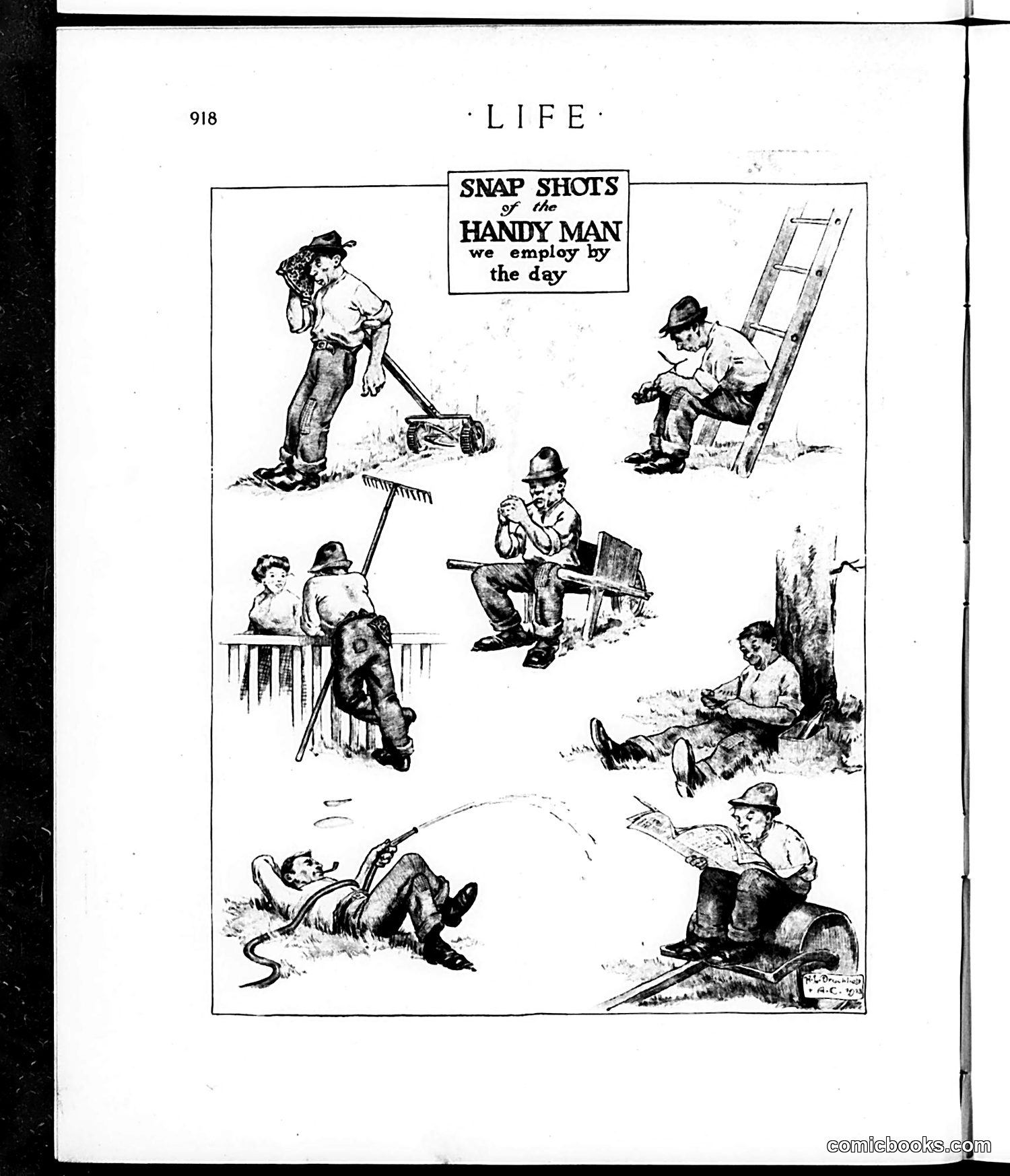
This is a humorous illustrated feature showing various working scenarios of day laborers—casual workers hired for temporary jobs. The cartoon depicts multiple vignettes of the "handy man," a common figure in early 20th-century American life who would be hired for odd jobs. The sketches show him engaged in different tasks: using tools, working with ladders, raking, sitting idle, and operating equipment. The satire likely pokes fun at the stereotype of the day laborer—his versatility, competence (or lack thereof), work ethic, and the various situations employers would find him in. This reflects contemporary attitudes toward working-class laborers during an era when such casual employment was widespread.
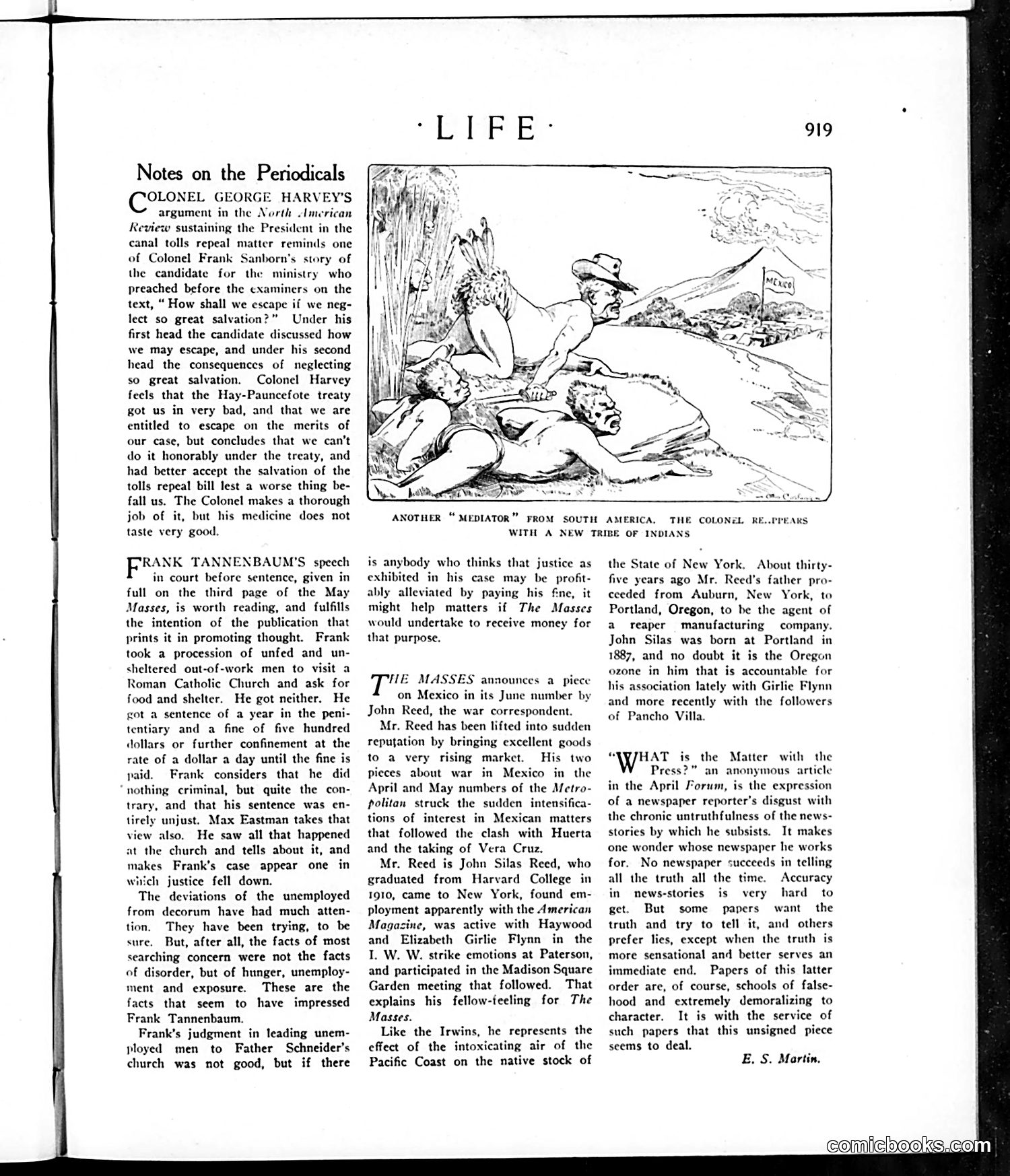
The cartoon depicts a colonial-era figure (labeled "The Colonel") encountering Native Americans in South America, presented as a "mediator" bringing a "new tribe of Indians." This is satirical commentary on American imperialism and canal politics. The "Colonel" represents U.S. diplomatic/military intervention in Latin America, particularly regarding canal tolls disputes (referenced in the accompanying text about the Hay-Pauncefote treaty). The cartoon mocks American claims of "mediation" or peaceful intent in the region by portraying colonial-style conquest imagery. The accompanying text discusses political debates over canal policy and Frank Tannenbaum's arrest for leading unemployed workers to a church seeking aid—connecting wealth/power disparities to American foreign policy rhetoric. The satire suggests the U.S. is merely imposing its will on Latin American nations while claiming diplomatic legitimacy, treating indigenous peoples as obstacles to American interests rather than as equals.
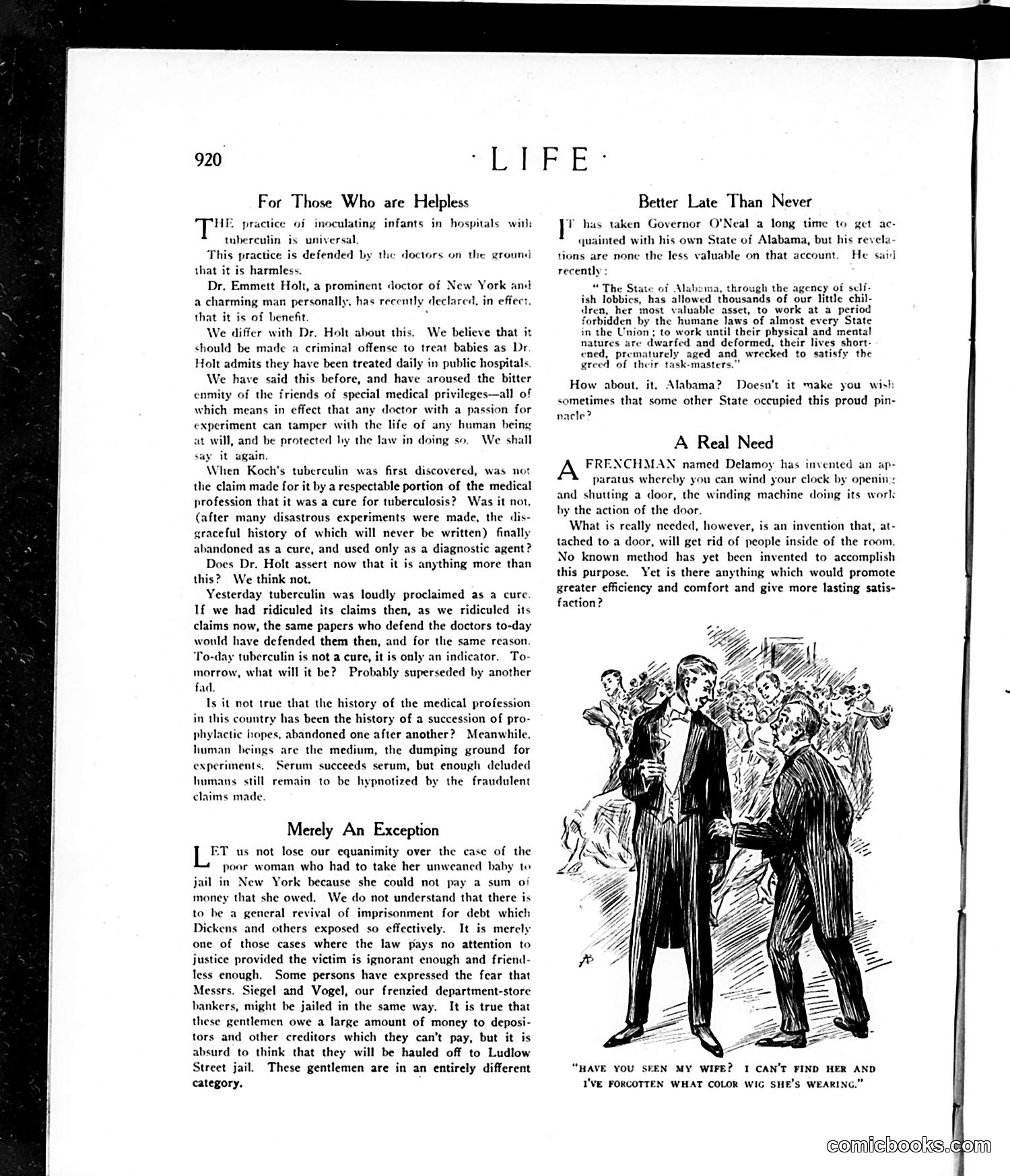
This page from *Life* magazine contains three distinct opinion pieces attacking institutional abuse and hypocrisy: **"For Those Who are Helpless"** criticizes Dr. Emmett Holt and the medical establishment for conducting experiments on infants in public hospitals using tuberculin. The author denounces doctors' "passion for experiment" on vulnerable populations and compares tuberculin to a succession of abandoned medical fads—arguing doctors cannot be trusted with human lives. **"Merely An Exception"** sardonically compares a poor woman jailed for debt with wealthy department-store owners (Siegel and Vogel) who owe creditors vast sums but face no imprisonment. The satire highlights the legal system's class bias: the poor woman is "ignorant and friendless" while rich men occupy a "different category." **"Better Late Than Never"** quotes Alabama Governor O'Neal finally acknowledging child labor exploitation in his state—thousands of children working illegally, their lives "dwarfed and deformed" for profit. The accompanying sketch (bottom right) shows well-dressed men, likely illustrating the wealthy merchants discussed above.
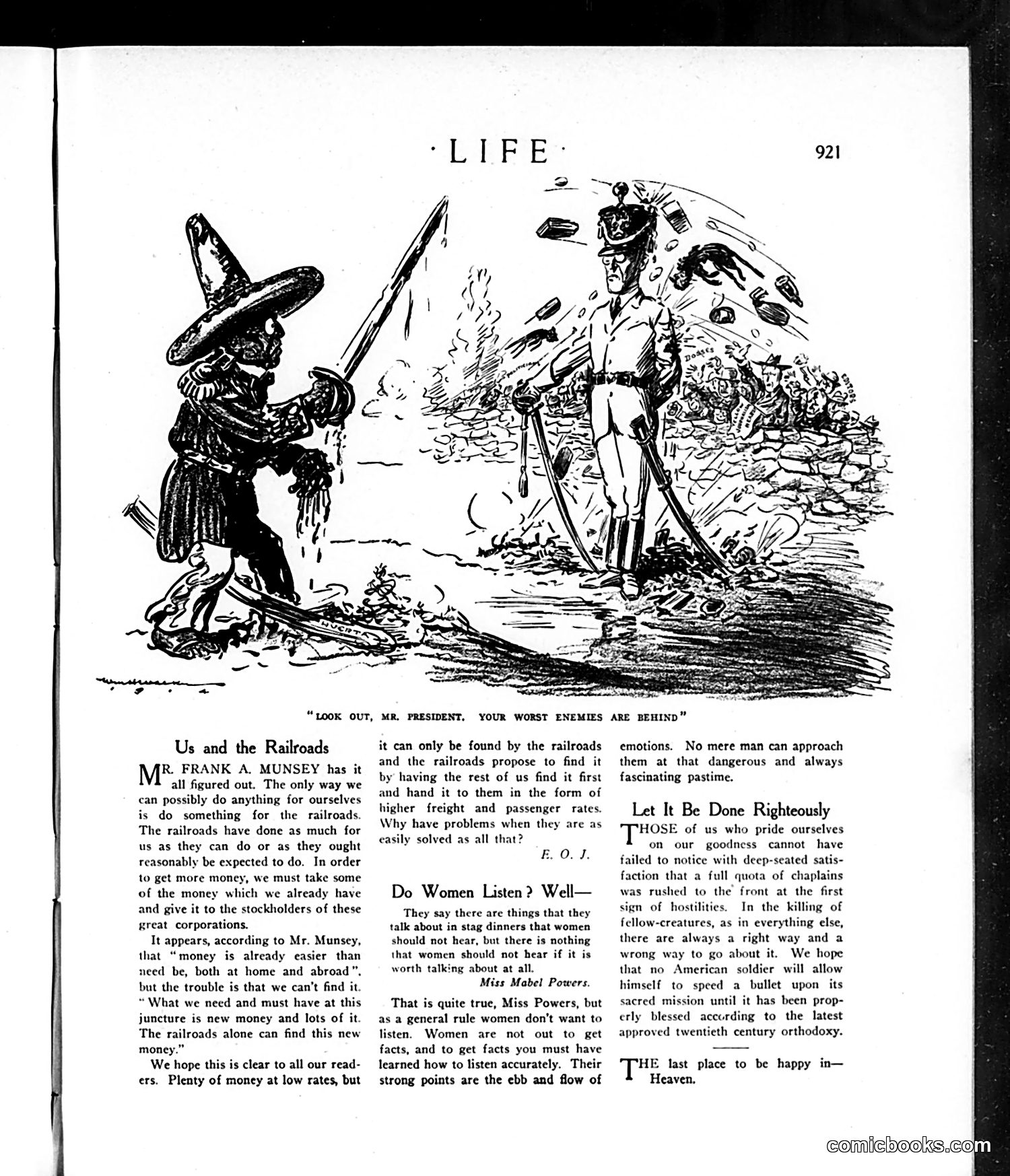
The main cartoon depicts a military officer (labeled "Mr. President") warned by a figure in Mexican dress that "your worst enemies are behind." This appears to reference military threats during an era of U.S.-Mexico tensions, likely related to border conflicts or interventions. The accompanying text critiques Frank Munsey's pro-railroad argument that Americans should subsidize railroads through higher freight and passenger rates to generate "new money." Life's editors mock this circular logic—essentially asking citizens to give money they already possess to railroad corporations. Secondary articles address women's listening abilities and military chaplains. The chaplain piece satirizes sending clergy to "bless" soldiers' bullets before killing, mocking the contradiction between religious morality and warfare. The overall page reflects Progressive Era debates about corporate power, military expansion, and the tension between American ideals and practical conduct. Life positions itself as skeptical of both railroad monopolies and militaristic justifications.
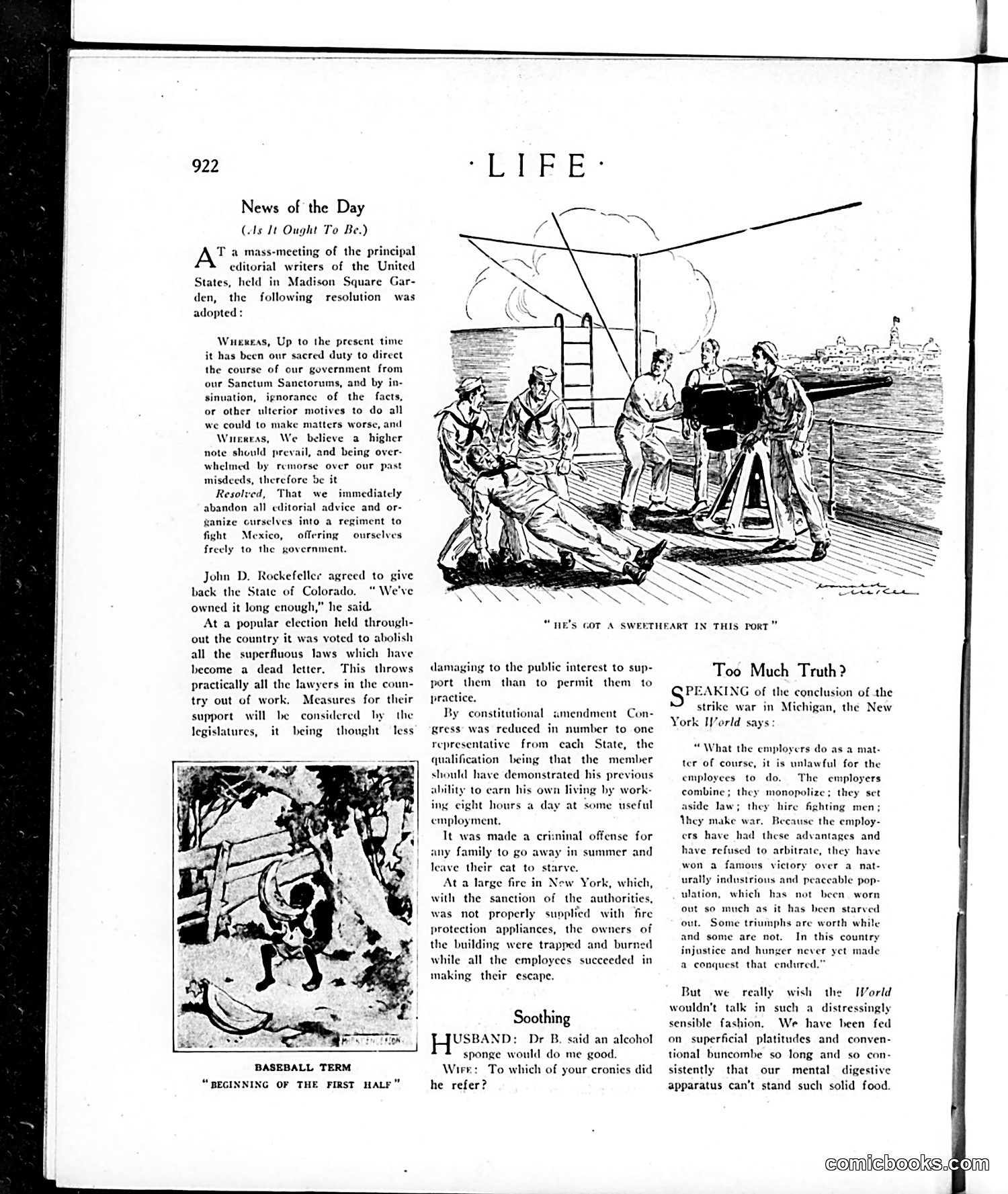
This satirical page mocks American institutions through mock-serious "news" items. The editorial writers' resolution sarcastically confesses to deliberately giving bad government advice for years—admitting to "insinuation, ignorance of the facts, or other ulterior motives"—before pledging reform. Subsequent items parody absurd "reforms": Rockefeller giving back Colorado, abolishing unenforced laws (eliminating lawyers' work), reducing Congress to one representative per state who must work manual labor, and criminalizing leaving cats to starve. A fire scene depicts owners trapped while employees escape—inverting expected sympathy. The "Too Much Truth?" section quotes the *New York World* criticizing how employers can legally combine and hire "fighting men" while employees cannot, describing workers as "starved out" rather than fairly defeated. Life mockingly suggests readers' "mental digestive apparatus" can't handle such "solid food"—such blunt truth—after consuming "superficial platitudes and conventional buncombe" for so long. The satire targets editorial hypocrisy, legal inequality favoring capital over labor, and public complacency.
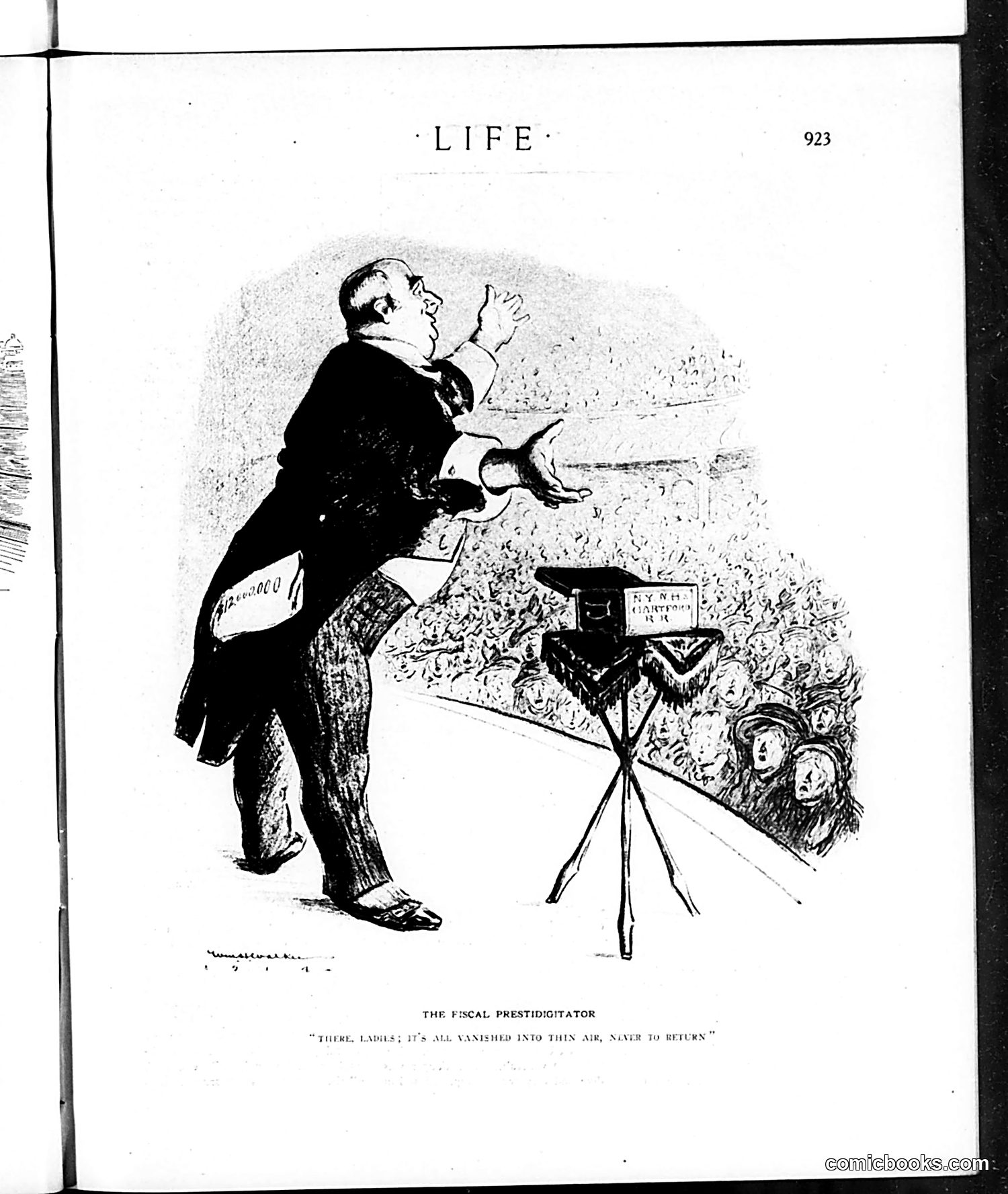
This political cartoon depicts a magician-like figure performing a trick with a telescope or camera pointed at a crowd. The caption reads: "There, ladies; it's all vanished into thin air, never to return." The cartoon satirizes what appears to be a political or financial figure using sleight-of-hand tactics—literally depicted as a magician—to make something "disappear" from public view or concern. The title "Fiscal Prestidigitator" (one who performs financial tricks) suggests this concerns money or economic policy being obscured through misdirection. Without clearer identification of the figure or specific historical context visible in the image, the exact target remains unclear, but the satire criticizes deceptive fiscal practices or the concealment of financial matters from the public through clever rhetoric or manipulation.
This page contains editorial commentary on current events rather than a political cartoon. The main content discusses President Wilson's Mexico policy during the Mexican Revolution. **The Context:** The piece defends Wilson's hands-off approach to Mexico's internal conflict, comparing the situation to a "bad egg"—better left alone than interfered with. It favorably cites capitalist Charles R. Flint's view that Wilson's policy has been "highly successful" in allowing Mexican Constitutionalists to develop strength independently. **The Satirical Elements:** The opening section humorously contrasts strawberries (improving as they ripen) with Colonel Roosevelt, suggesting the Colonel might similarly "brighten" upon his return from exploring a river he'd discovered. This is gentle mockery of Roosevelt's ego and his dispute with London geographers over the river's discovery. **The Peter Cooper Reference:** A footnote mentions an old *Puck* magazine cartoon joking that replica Peter Coopers would be useful for filling seats at charitable events, sparing the elderly original gentleman the trouble. The piece reflects Progressive-era debates over American intervention in Latin America.
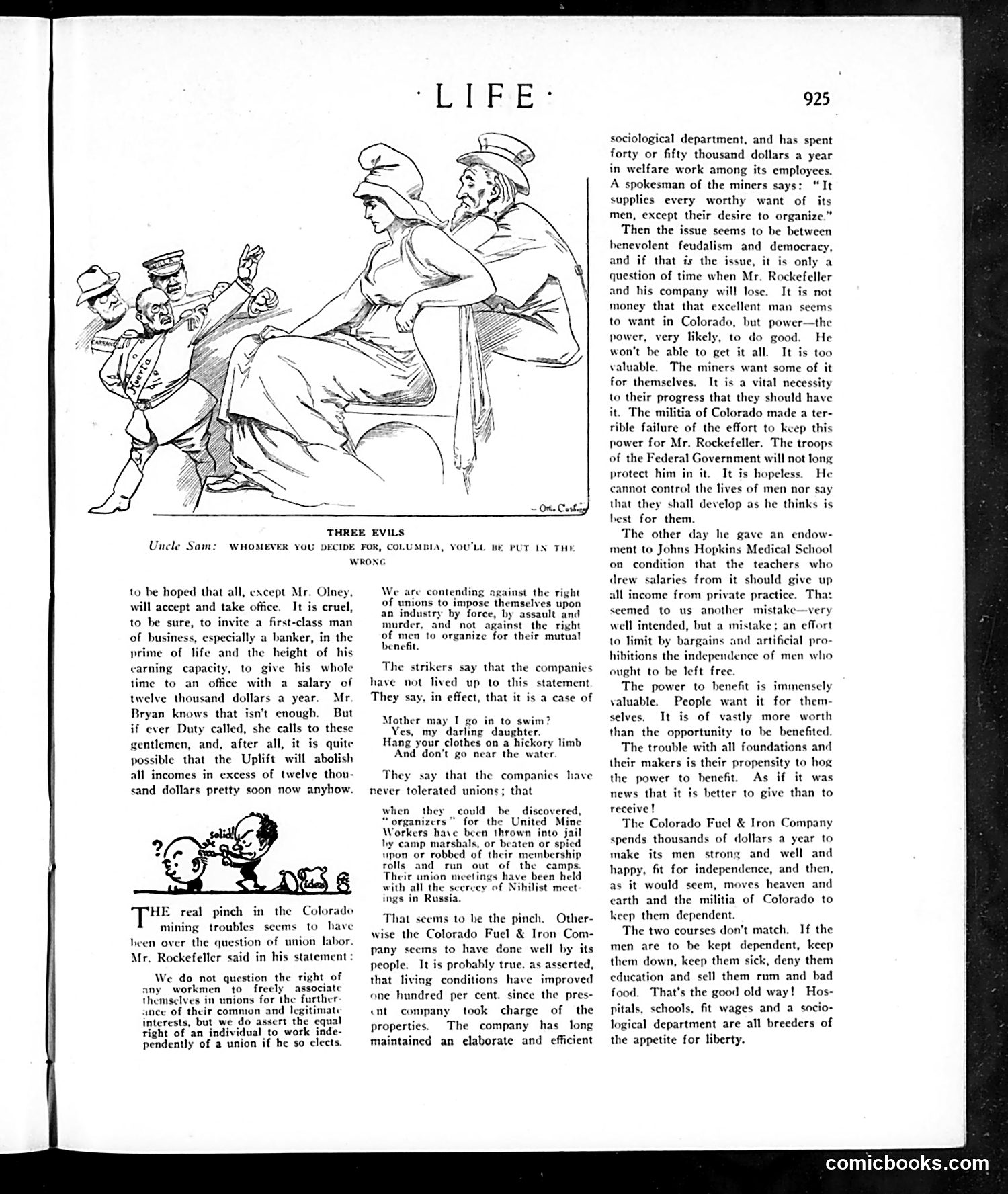
The cartoon depicts Uncle Sam caught between two allegorical female figures representing **Columbia** (America) and Lady Liberty, labeled "Three Evils." The satire addresses the **Colorado mining strikes** and Rockefeller's paternalism. The accompanying article argues that while the Colorado Fuel & Iron Company claims to improve workers' living conditions and provide welfare benefits, it denies them the fundamental right to organize unions. Life's editors identify the core conflict: **benevolent feudalism versus democracy**. The satire's point is that Rockefeller's wealth and power—however well-intentioned—cannot substitute for workers' independence and self-determination. The editors mock his hypocrisy: he donated to Johns Hopkins Medical School but demanded teachers abandon private practice, revealing his desire to *control* rather than genuinely empower others. The cartoon suggests Uncle Sam faces an impossible choice, implying that such paternalistic power arrangements are ultimately untenable in a democratic society.
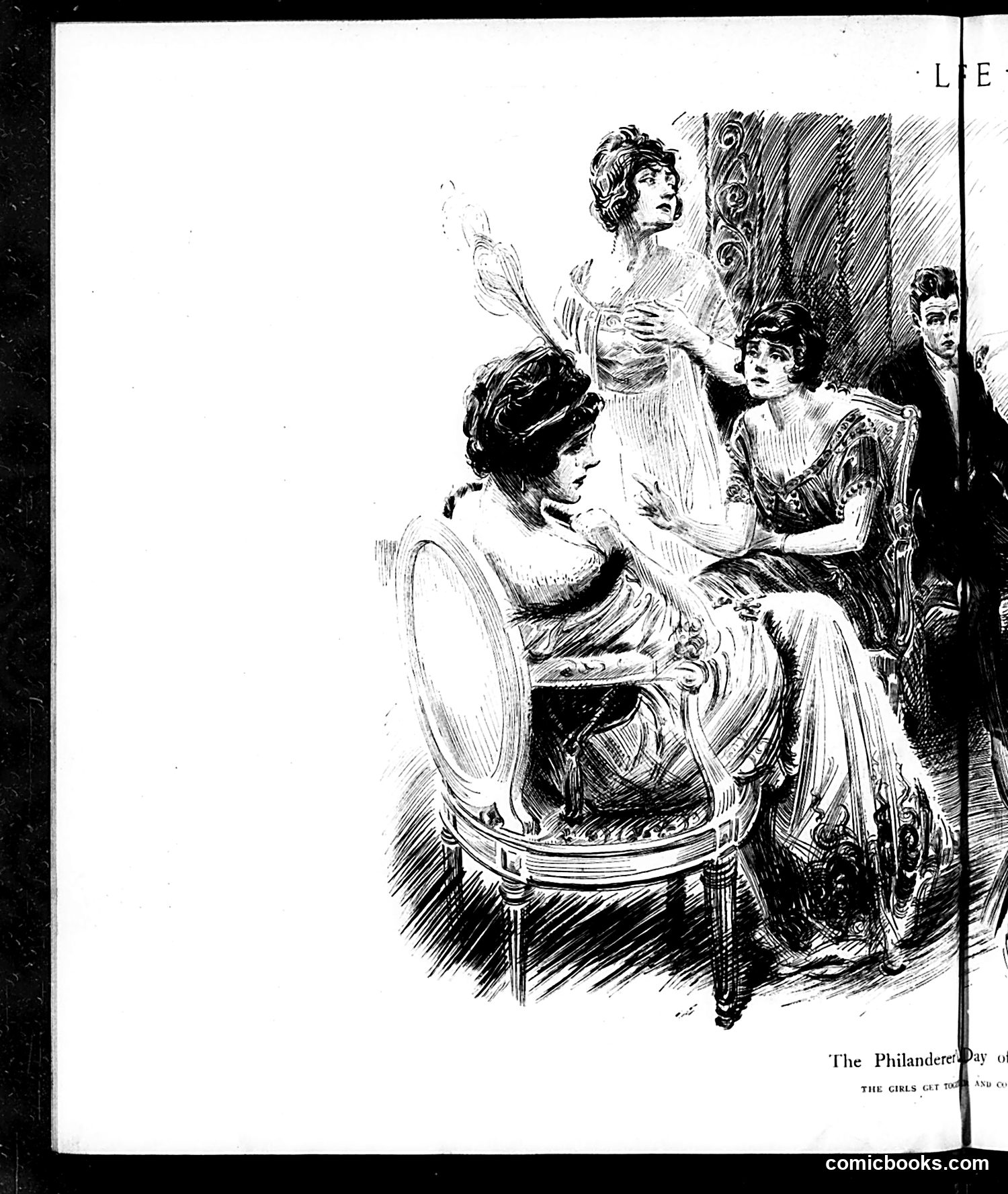
This appears to be a satirical illustration from *Life* magazine showing an elegantly dressed woman seated in an ornate chair, examining herself in a hand mirror with a satisfied expression. Several other figures—including what appears to be attendants or admirers—stand nearby observing her. The partially visible caption reads "The Philandered Day of..." and references "THE GIRLS CUT UP AND CO[...]" The satire likely mocks vanity, self-admiration, or the social pretensions of wealthy women of the Edwardian era. The title's wordplay on "philandered" (suggesting infidelity or frivolous behavior) combined with the woman's narcissistic pose suggests this criticizes shallow materialism or romantic/social scheming among the upper class. The exact historical reference remains unclear without the complete caption.
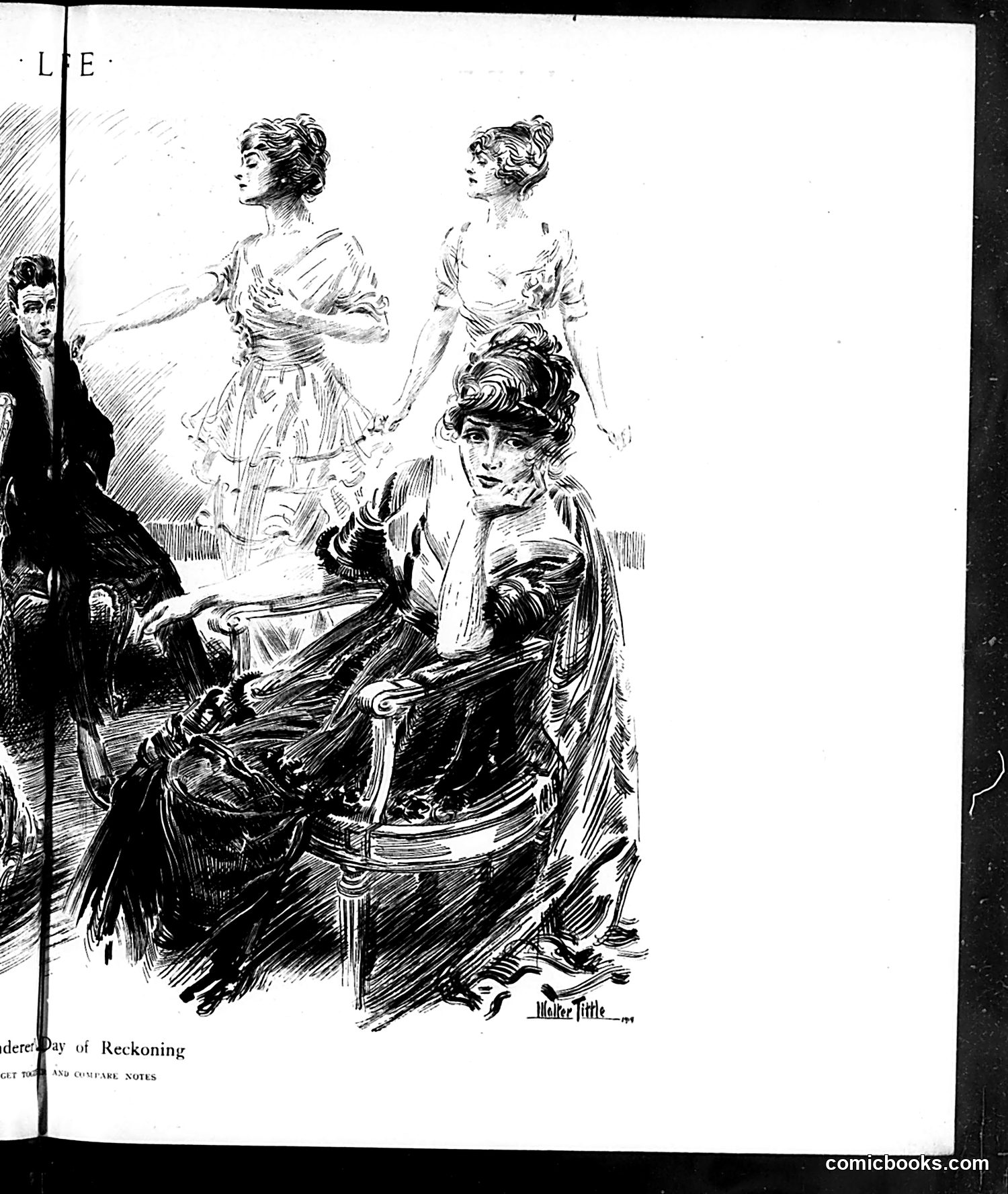
This appears to be a social illustration from *Life* magazine showing a domestic scene. A woman in an elegant dark dress sits prominently in the foreground, while two other women in lighter gowns stand in the background. A man in dark clothing is partially visible on the left side. The title fragment "...ndered Day of Reckoning" and caption "COMPARE NOTES" suggest this depicts women discussing or sharing information—possibly gossip or complaints about men or relationships. The illustration's style and composition suggest commentary on social dynamics, likely satirizing either female sociability, romantic entanglements, or domestic situations of the era. Without the complete title and more context, the specific satirical target remains unclear, though the "compare notes" reference implies humor about women exchanging observations or secrets.
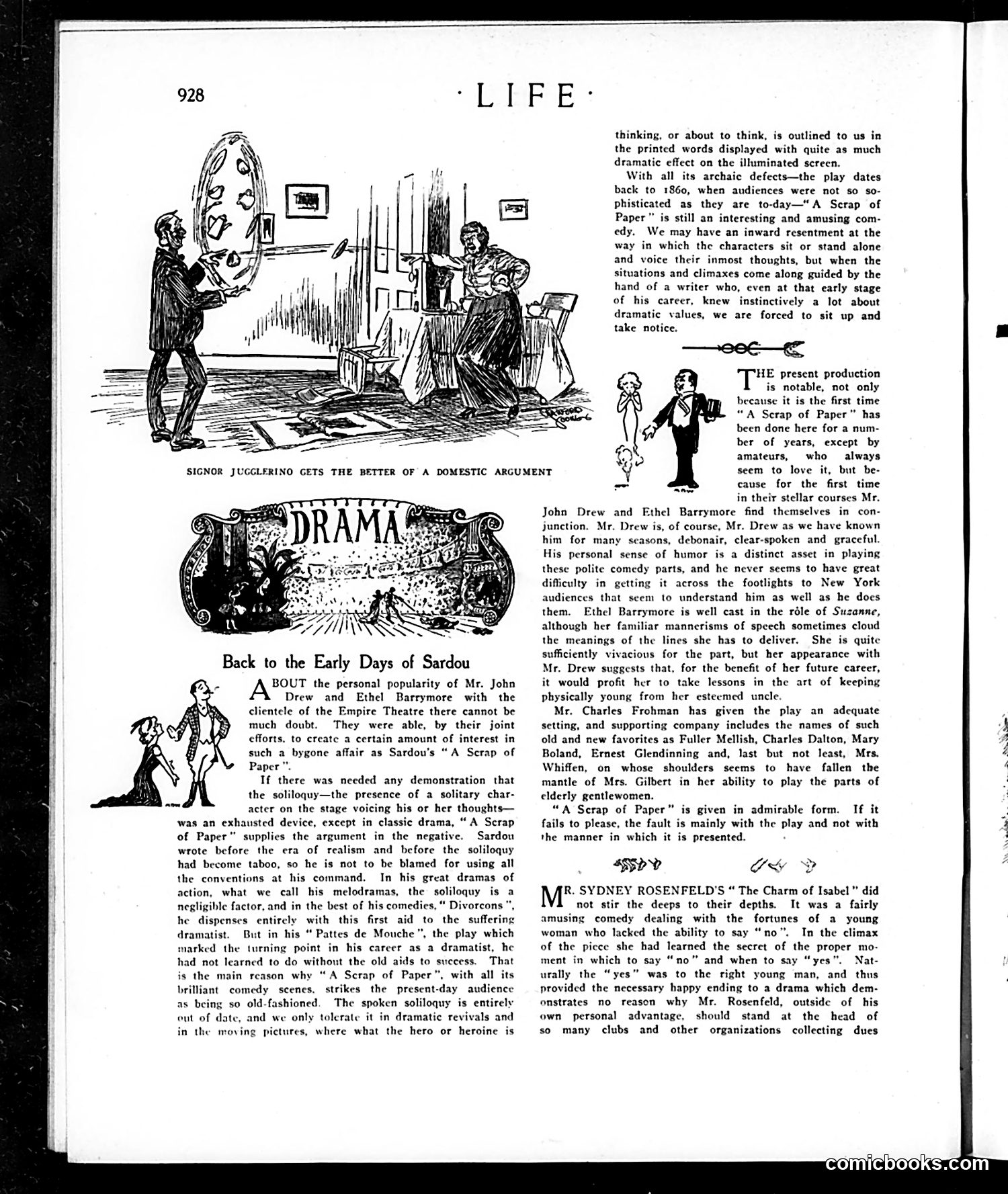
This page reviews a Broadway revival of Victorien Sardou's 1860 French comedy "A Scrap of Paper," starring actors John Drew and Ethel Barrymore at the Empire Theatre. The cartoon at top illustrates a domestic argument scene from the play. The critique centers on the play's "archaic" theatrical conventions—particularly the soliloquy (characters speaking alone to voice thoughts), which the reviewer calls "exhausted" and outdated. However, the reviewer acknowledges the play remains entertaining due to Sardou's skilled dramatic construction. The review praises Drew's "debonair" charm and comedic timing but gently suggests Barrymore, though vivacious, could benefit from elocution lessons. Producer Charles Frohman's staging and supporting cast (including Fuller Mellish and Mrs. Whiffen) receive adequate marks. The page demonstrates how Life magazine blended theatrical criticism with satirical illustration to entertain educated readers interested in Broadway productions.
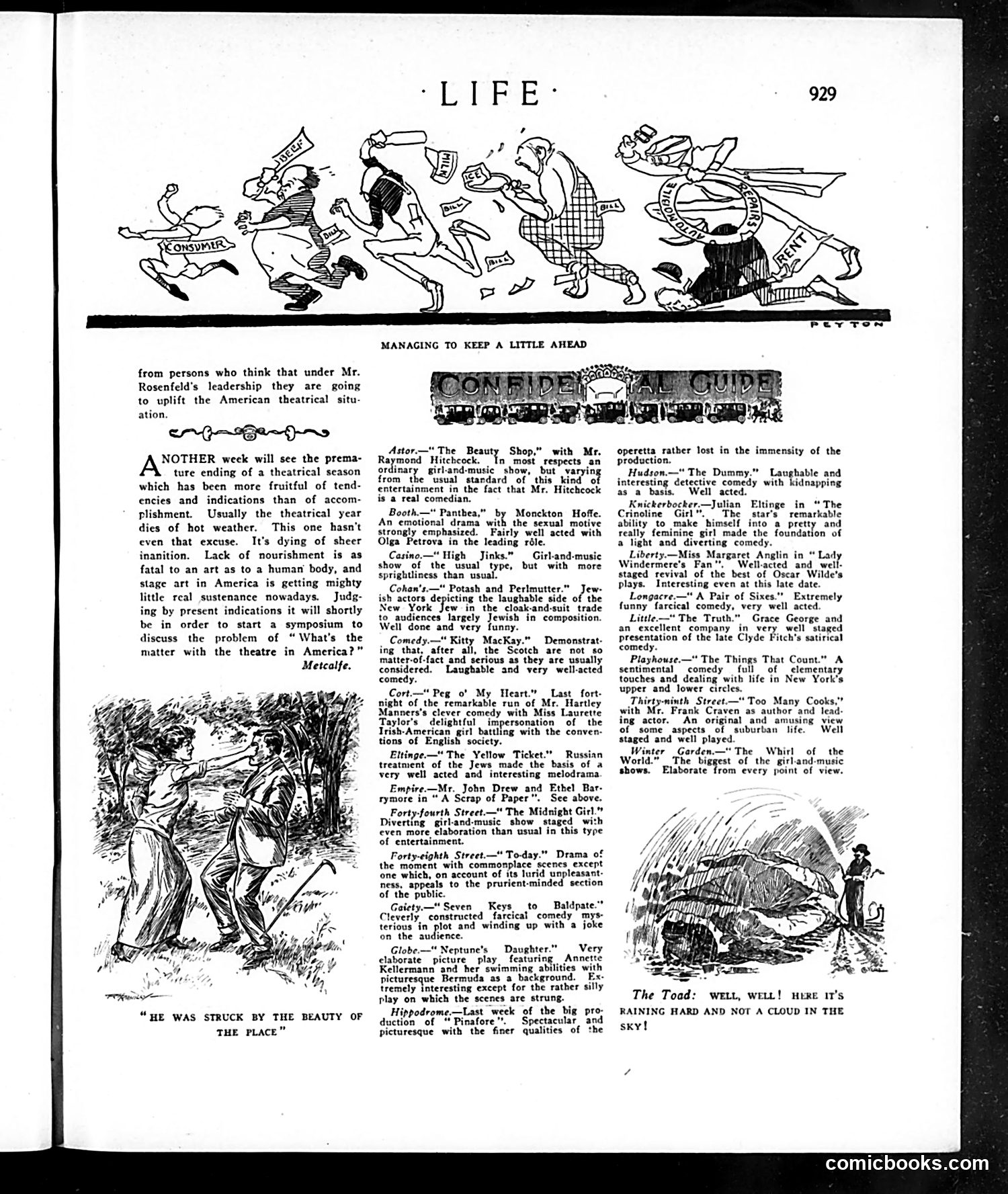
This page from *Life* magazine reviews Broadway theatrical productions, reflecting early 20th-century theater criticism. The top cartoon satirizes American business leadership—specifically referencing Mr. Rosenfeld's theatrical management—showing figures frantically chasing money while labeled "consumer" trails behind. The joke critiques those hoping Rosenfeld would "uplift the American theatrical situation," suggesting financial desperation drives the industry rather than artistic merit. The accompanying essay by Metcalfe laments that American theater is dying from "inanition" (lack of nourishment)—artistic starvation rather than seasonal decline. The theater reviews that follow catalog numerous Broadway shows, many "girl-and-music" productions, with particular note of ethnic humor: "Potash and Perlmutter" depicting New York Jews in the garment trade for largely Jewish audiences. The lower illustrations appear unrelated to the theater content, showing romantic or pastoral scenes.
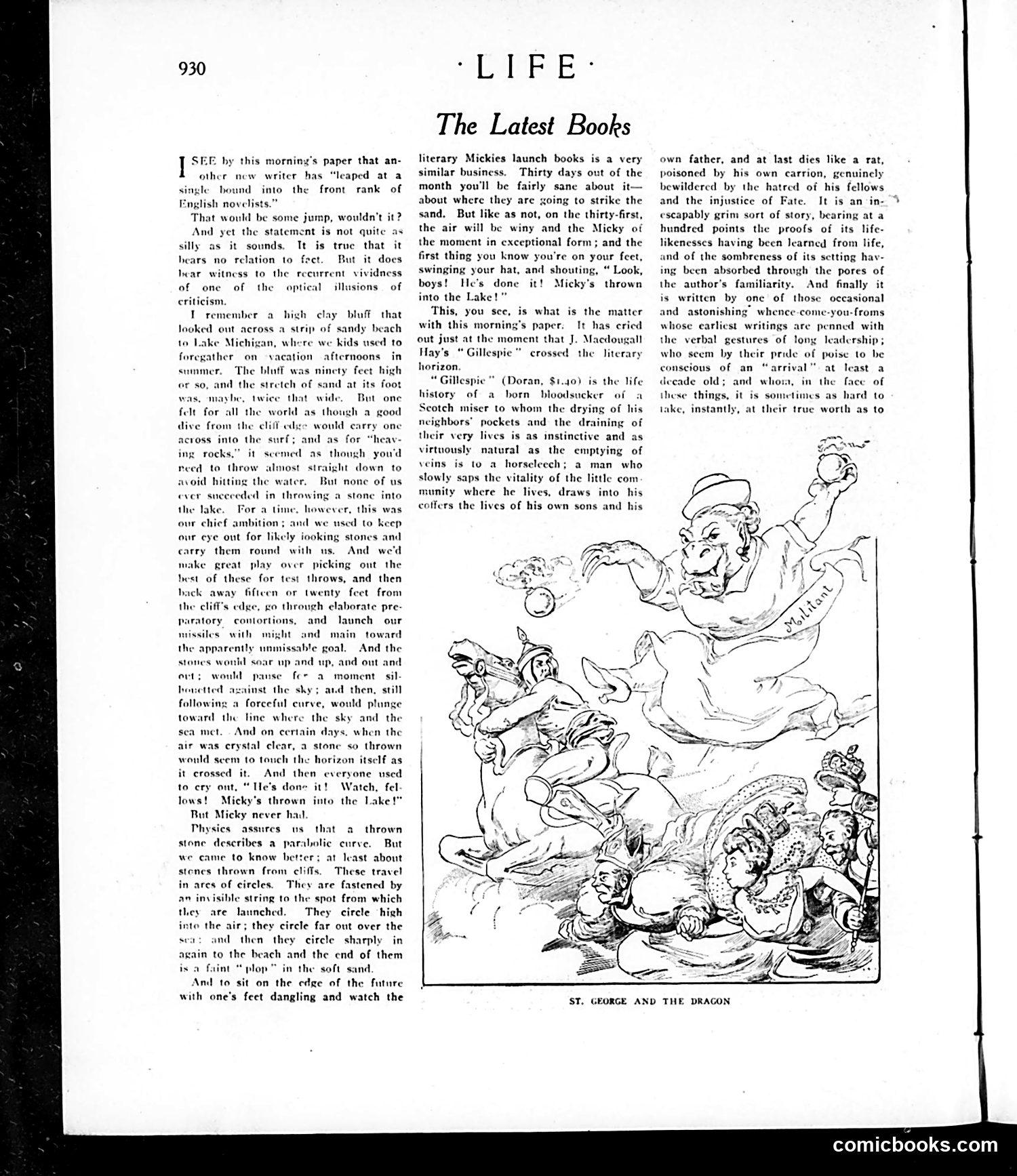
This is a book review column that uses an extended metaphor to critique literary criticism's tendency toward hyperbole. The author compares reviewers' breathless declarations that new writers have "leaped" into the front rank of novelists to children throwing stones from a Lake Michigan cliff—imagining their throws reached the water when physics proves otherwise. The illustration titled "ST. GEORGE AND THE DRAGON" appears to be decorative, though its relevance to the text is unclear from this page. The review then applies this metaphor to J. Macdougall Hay's novel "Gillespie" (published by Doran, $1.40), about a predatory Scottish miser who drains his community's vitality like a "horseleech." The author warns against exaggerated praise, suggesting that today's sensational book announcement may prove as delusional as those childhood stone-throws—the book circles back to reality rather than achieving lasting literary significance.
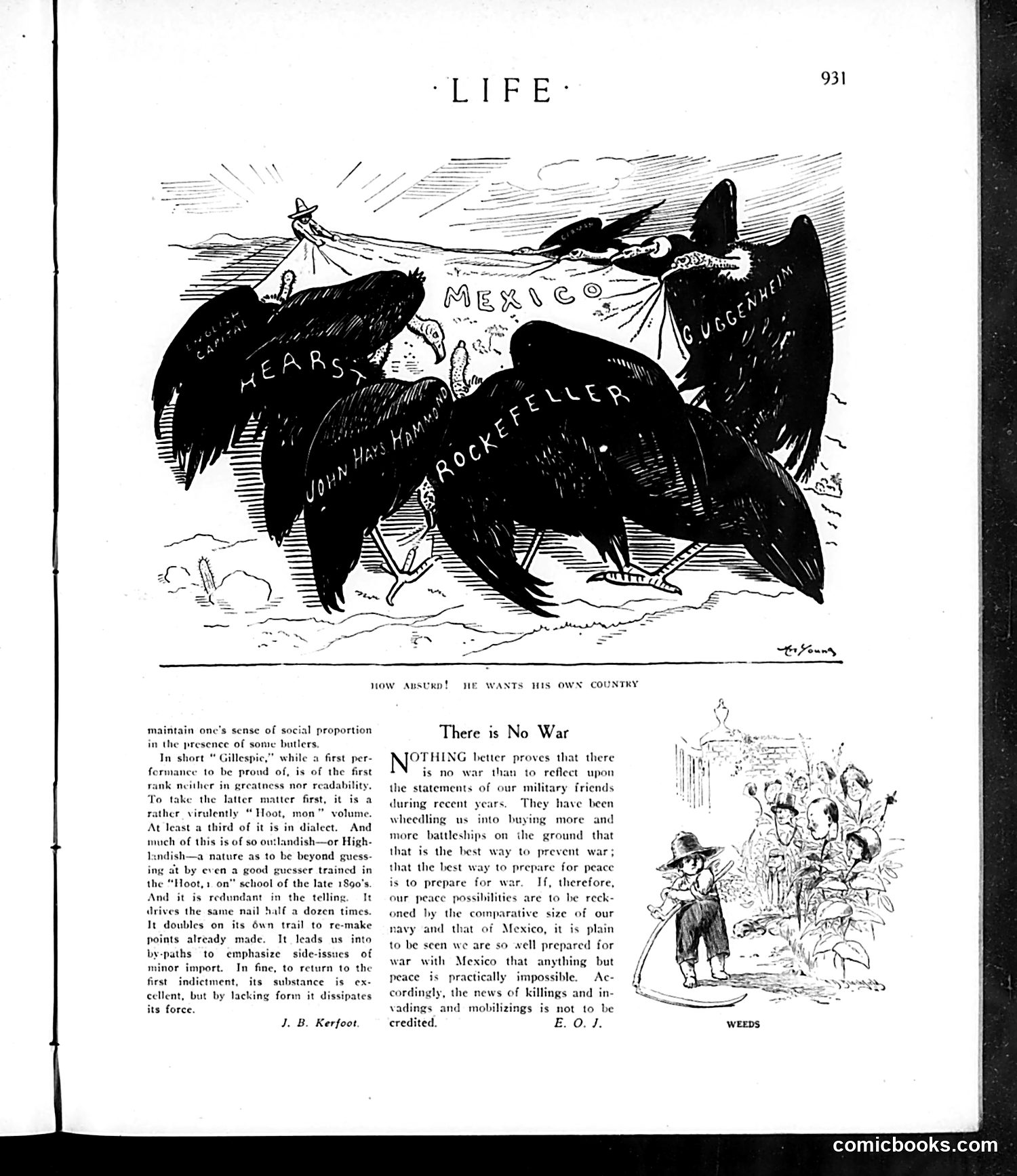
The main cartoon depicts three large birds labeled **Hearst, Rockefeller, and Guggenheim** (prominent American industrialists/media moguls) gathered over a map of **Mexico**. A small airplane flies overhead. The caption reads "Now Absurd! He Wants His Own Country"—sarcastically suggesting these wealthy figures have such outsized power and influence over Mexico that the idea of Mexico maintaining sovereignty is ridiculous. This likely references **early 1910s tensions** between American business interests in Mexico and Mexican nationalist movements, particularly around the Mexican Revolution (1910-1920). The cartoon satirizes how American industrial titans effectively controlled Mexican resources and politics through economic dominance, treating the nation as their personal property rather than an independent country. The accompanying essay "There is No War" uses ironic logic to argue military buildup doesn't prevent conflict—another critique of American interventionism.
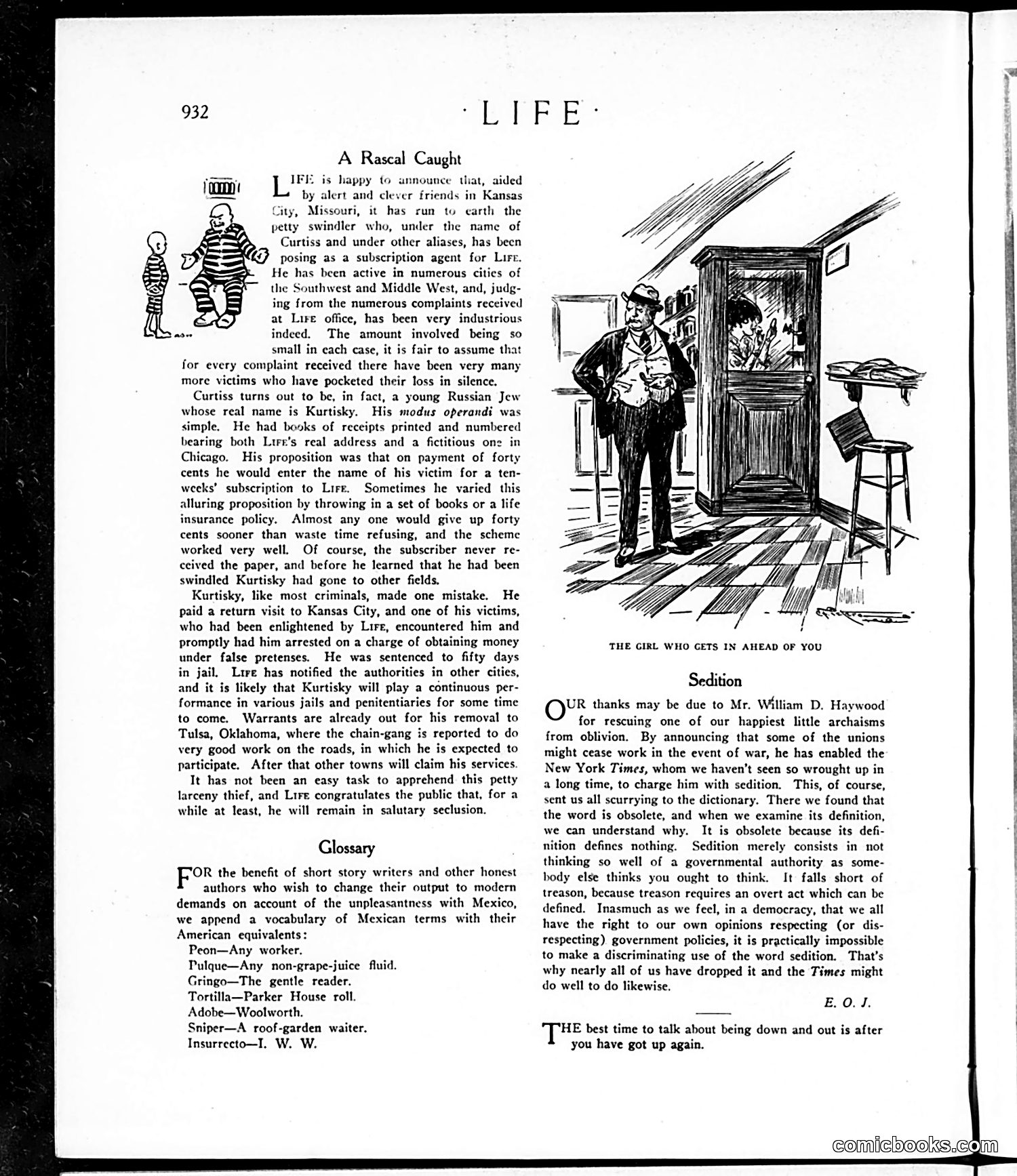
This page contains three distinct pieces of satirical content: **"A Rascal Caught"** (main article with illustration): Life magazine exposes a subscription fraud scheme run by a man named Kurtisky (posing as "Curtiss"), a Russian Jewish con artist operating in the Southwest and Midwest. His simple scam: he'd sell ten-week subscriptions to Life for forty cents using fake Chicago receipts, then disappear without delivering papers. The article celebrates his arrest in Kansas City and fifty-day jail sentence, predicting he'll face additional charges in other states. **"The Girl Who Gets In Ahead of You"** (cartoon): A simple domestic humor sketch showing a woman entering a doorway before a man—likely poking fun at changing gender dynamics of the era. **"Sedition"** (commentary): Life critiques the New York *Times* for charging labor leader William D. Haywood with sedition after unions threatened to strike during wartime. The piece argues "sedition" is an obsolete, meaningless term that merely means "disagreeing with authorities"—distinguishing it from actual treason, which requires concrete action. The page reflects early 20th-century concerns: immigrant crime, labor unrest, and government overreach.
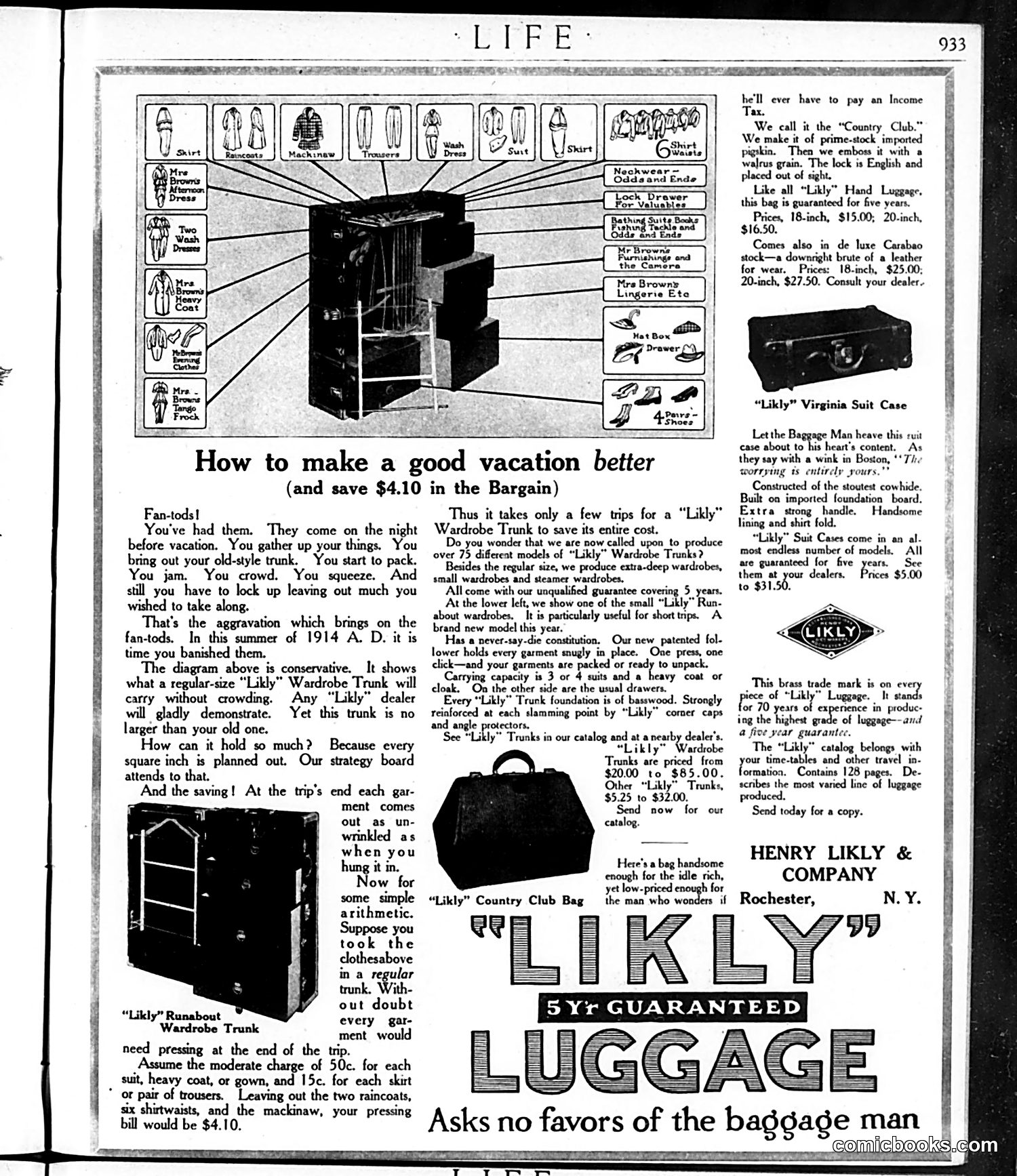
This page is primarily **advertising**, not satire. It promotes "Likly" brand luggage (trunks, suit cases, and bags) from Henry Likly & Company of Rochester, New York. The "cartoon" element is educational rather than satirical: a diagram showing how much clothing fits into a Likly Wardrobe Trunk compared to old-style trunks. The humor is gentle—the "fan-tods" (nervous anxiety) about vacation packing was a relatable 1914 concern. The sales pitch emphasizes practical benefits: wrinkle-free garments, durability ("5 Yr Guaranteed"), and cost savings. A notable detail: the "Country Club Bag" includes a joking reference to income tax, suggesting this product targets relatively affluent travelers worried about taxation—likely referencing discussions around the newly-enacted federal income tax (1913). The page reflects pre-WWI consumer culture, when quality luggage was a significant purchase for leisure travel among the middle and upper classes.
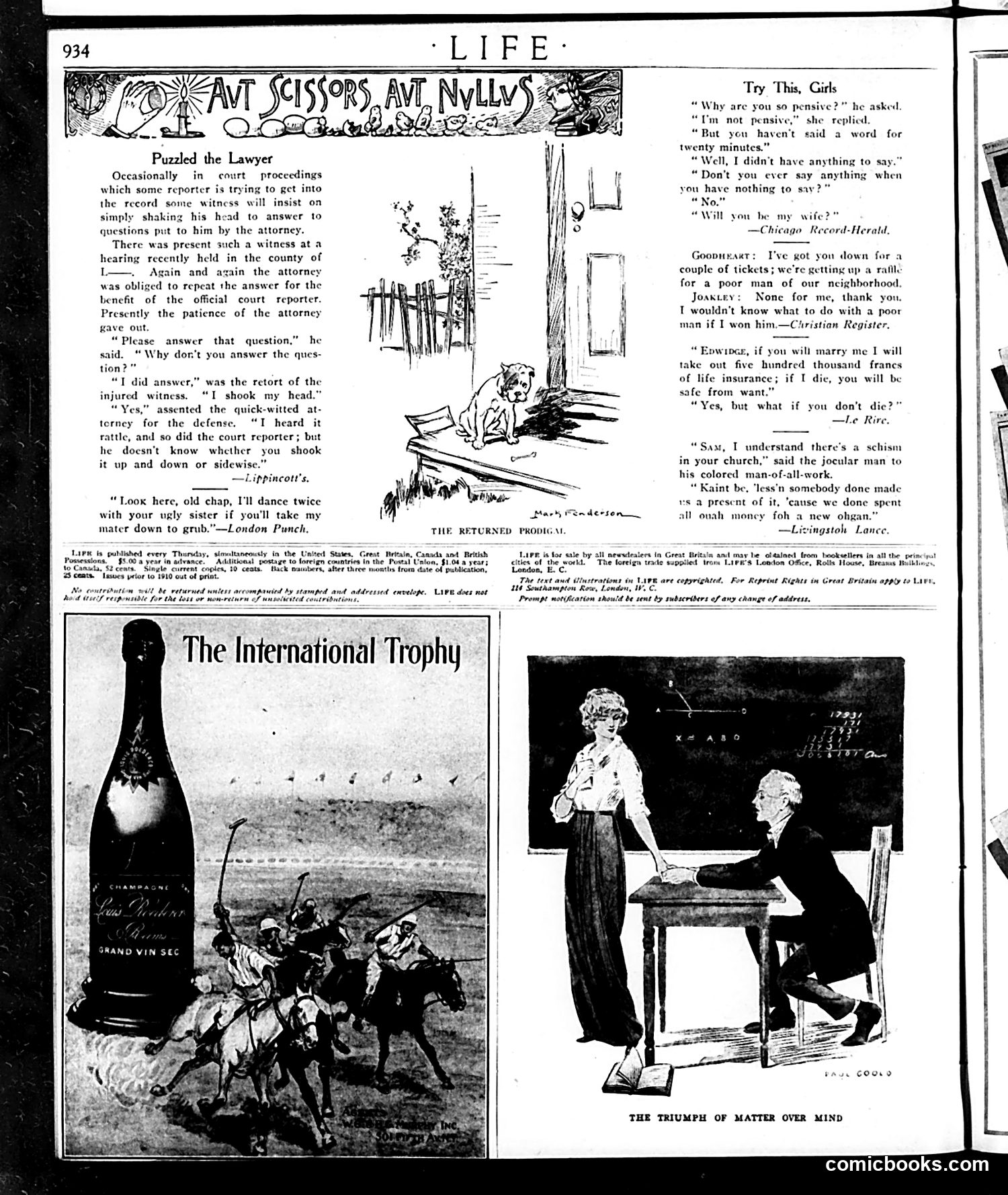
This page contains several humorous anecdotes and cartoons typical of early 20th-century satirical magazines. **"Puzzled the Lawyer"** jokes about a witness who communicates only by shaking his head, frustrating the attorney. The humor relies on the literal interpretation: the attorney hears the head rattle but cannot determine whether it moved up-and-down (yes) or side-to-side (no)—a play on courtroom procedure. **"Try This, Girls"** presents brief romantic/domestic humor aimed at female readers, including a woman's silence being misinterpreted as pensiveness, and a cynical woman rejecting a marriage proposal with life insurance, joking he might survive. **"The Triumph of Matter Over Mind"** (right illustration) shows a schoolmaster at a blackboard with a female student, likely suggesting intellectual or romantic subtext, though the specific reference is unclear. The page also includes **"The International Trophy"** advertisement for champagne at bottom-left. Overall, the content reflects period attitudes toward gender, courtroom procedure, and class relations—typical of Life's satirical humor circa early 1900s.
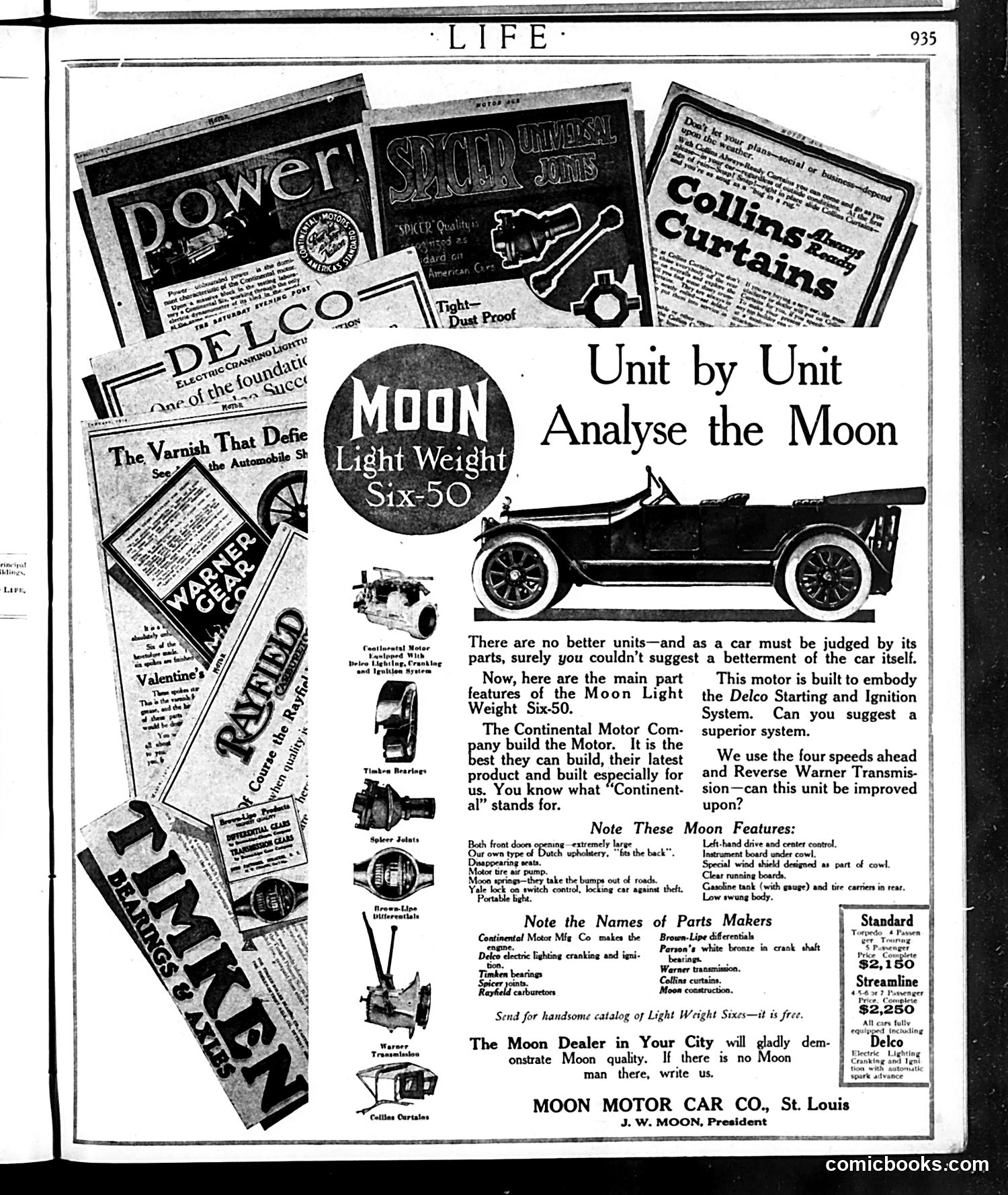
This is **not a cartoon or satire**, but a straightforward automobile advertisement from Life magazine (page 935). The Moon Motor Car Company advertises their "Light Weight Six-50" model, emphasizing its quality through detailed component analysis. The ad uses a "unit by unit" approach, listing prestigious parts manufacturers (Continental Motors, Delco ignition system, Warner transmission) to establish credibility—a common sales technique suggesting superiority through brand-name components. The left side displays endorsements from competing automotive products (Dower, Delco, Spencer, etc.), contextualizing the Moon within the competitive early automobile market. Pricing appears at bottom right ($2,150-$2,250), indicating this was a mid-range vehicle. The ad targets skeptical buyers by arguing a car should be judged by its parts, just as one judges individual mechanical components. This reflects early 1920s consumer consciousness about automobiles as assemblies of standardized, identifiable parts rather than mysterious machines.
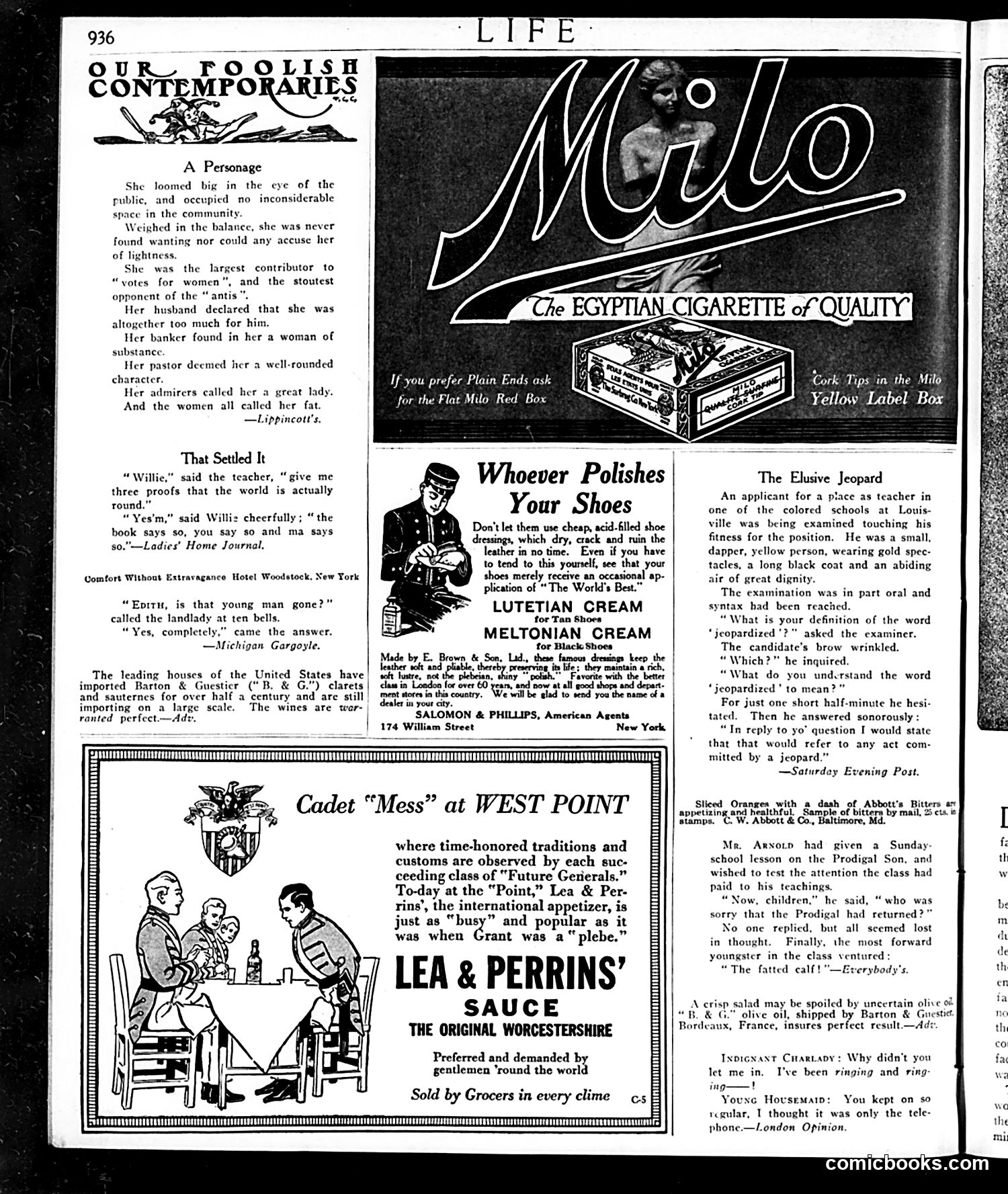
This page from *Life* magazine presents several satirical pieces mocking contemporary American society: **"A Personage"** (top left) satirizes a prominent suffragist woman through the contradiction between how others describe her respectfully—as a "great lady" contributing substantially to women's voting rights—and how women themselves frankly call her "fat." The satire targets the gap between public dignity and private judgment. **"The Elusive Jeopard"** mocks racial attitudes of the era through a teacher's examination of a Black applicant in Louisville. The candidate's humorous but malapropistic answer—defining "jeopardized" by inventing the word "jeopard"—relies on contemporary stereotypes about African American speech patterns for comedic effect. The remaining pieces are brief humor items and advertisements typical of *Life*'s format. The magazine itself was an elite satirical publication targeting educated readers who would recognize these social critiques.
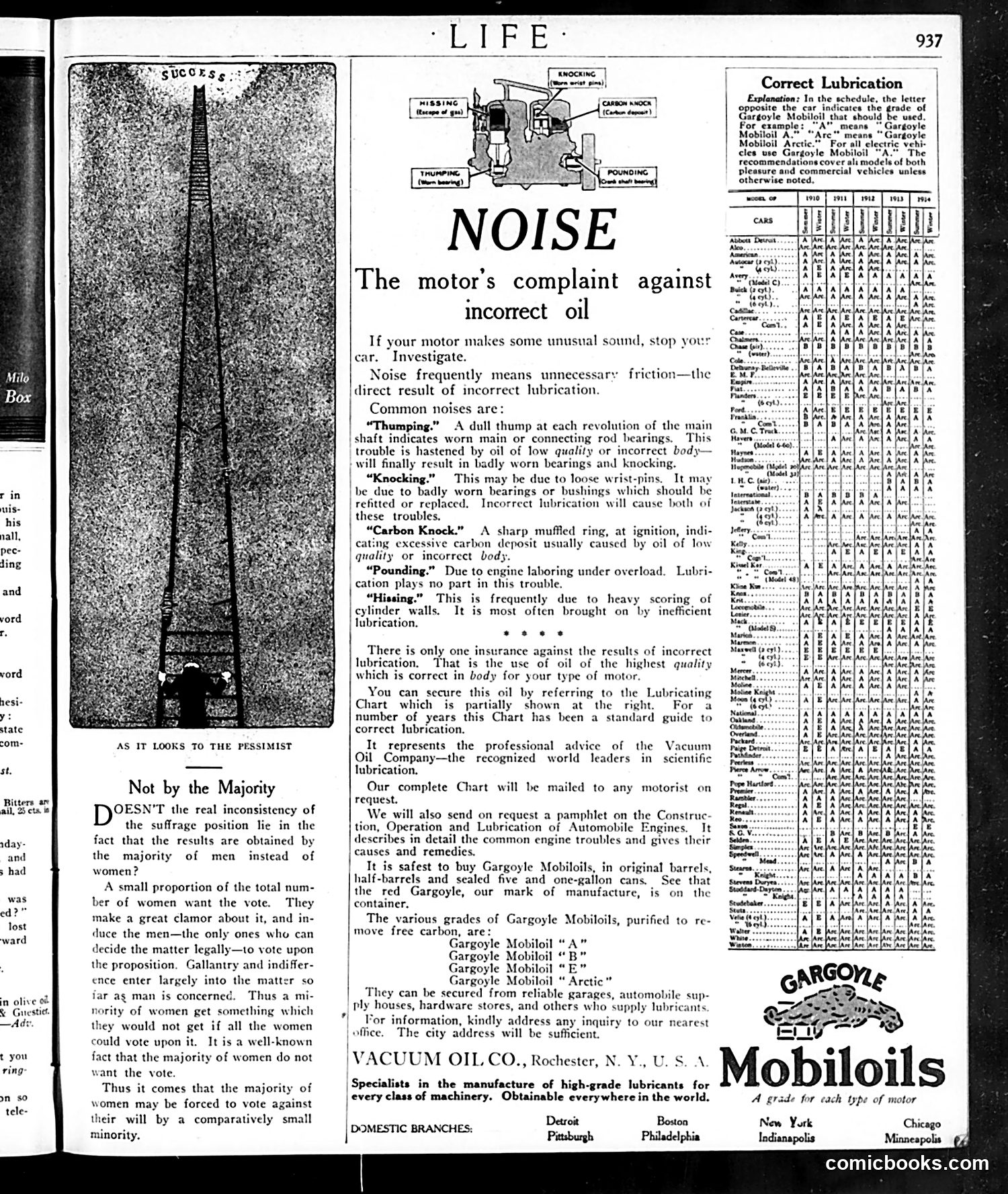
This page contains two distinct items: **Left side—Political cartoon "As It Looks to the Pessimist"**: A satirical attack on women's suffrage. The argument presented claims that only a *minority* of women actually want the vote, yet their activism persuades men (who alone could legally decide the matter) to grant it—thereby forcing the *majority* of women who don't want it to vote against their will. The cartoon's title suggests this is a "pessimist's" view. This reflects genuine anti-suffrage rhetoric from the early 20th century, though the logic is circular and self-serving. **Right side—Advertisement for Gargoyle Mobiloil**: A straightforward commercial for motor oil, explaining engine noises (thumping, knocking, hissing) and attributing them to poor lubrication. Includes a lubrication chart and product information. The juxtaposition is jarring—Life paired serious political argument with mundane automotive advertising, typical of the magazine's satirical format mixing commentary with commerce.
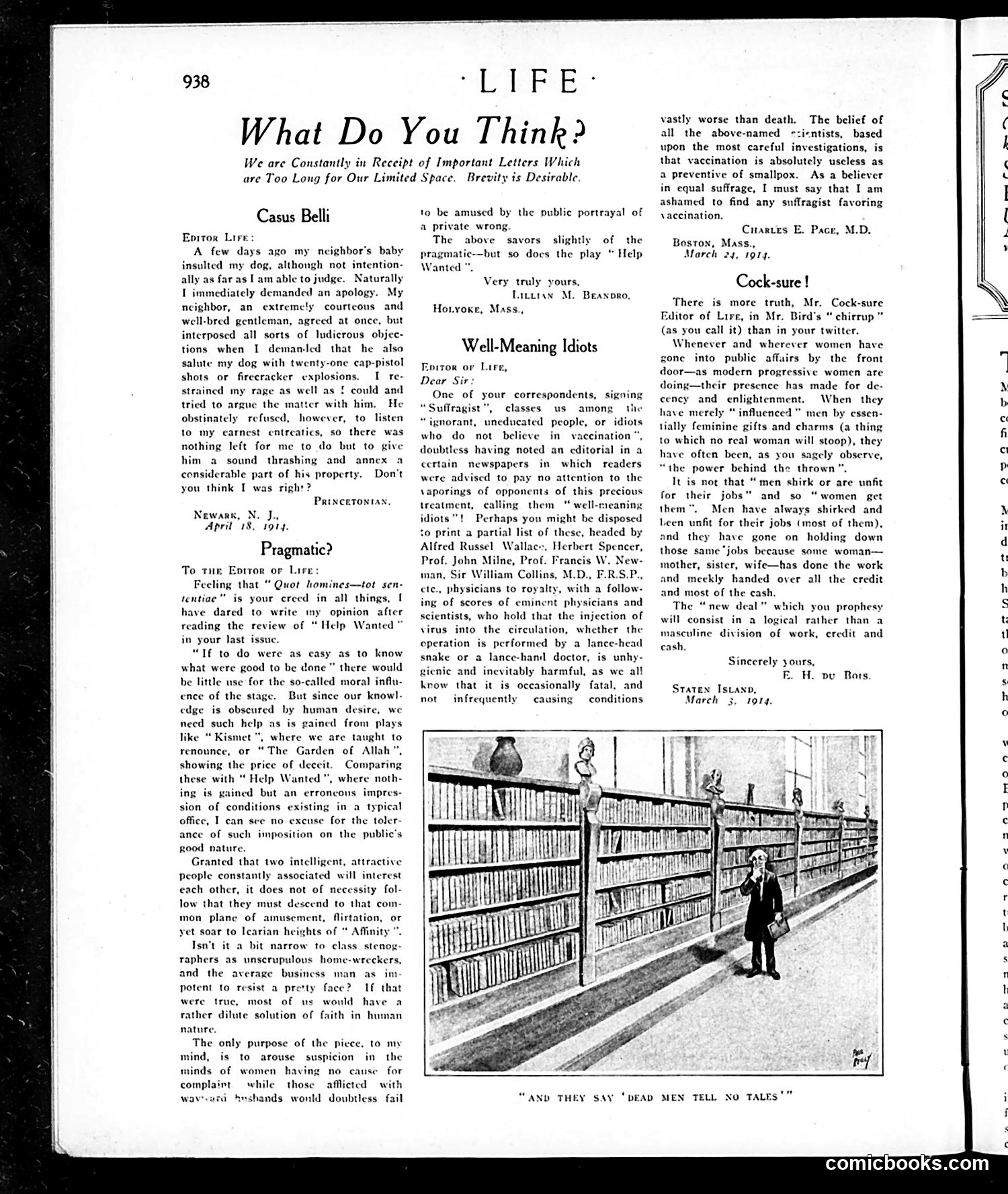
This page presents readers' letters to Life's editor on contemporary issues. The main cartoon shows a library with the caption "AND THEY SAY 'DEAD MEN TELL NO TALES'"—likely satirizing how information or secrets are preserved in books. The letter section addresses three topics: 1. **"Casus Belli"** (Latin: "case for war"): A satirical letter humorously comparing a trivial neighborhood dispute (a baby insulting a dog) to serious international conflicts, mocking how nations justify wars over minor grievances. 2. **"Pragmatic?"** criticizes the play "Help Wanted" for depicting office workers and stenographers negatively, arguing it wrongly suggests businessmen cannot resist attractive women. 3. **"Well-Meaning Idiots"** defends anti-vaccination skeptics by naming prominent scientists and physicians (Wallace, Spencer, etc.) who opposed mandatory vaccination, framing them as intelligent rather than foolish. The page exemplifies early-20th-century debate culture and Life's role as a forum for public opinion on theater, social conduct, and scientific policy.
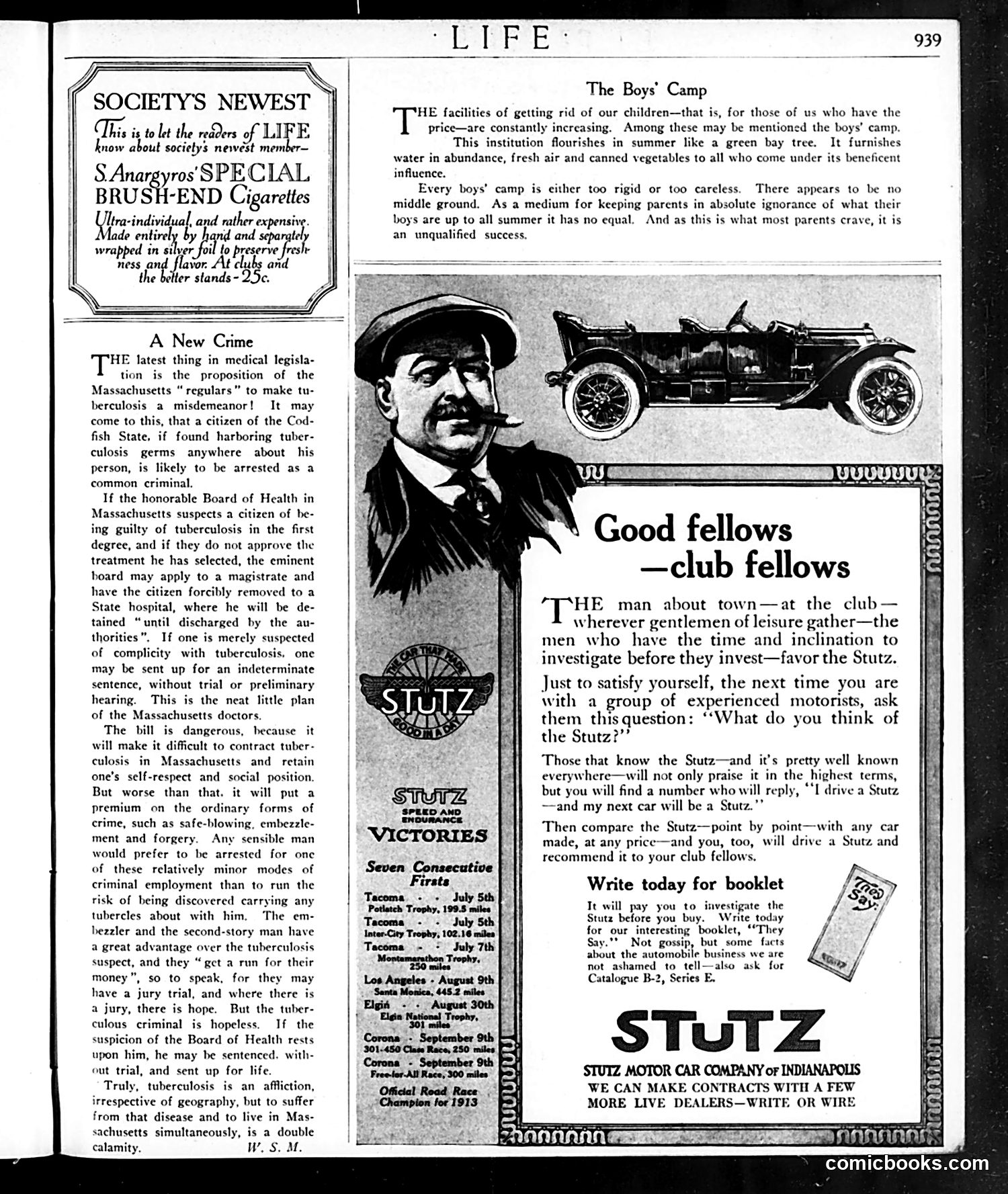
This page contains three distinct pieces of satirical commentary on American society, circa 1913. **"A New Crime"** mocks Massachusetts legislation proposing to criminalize tuberculosis. The satire's point: treating a disease as a criminal offense is absurd and counterproductive. The author argues it would paradoxically make ordinary criminals (embezzlers, burglars) preferable to TB patients, since criminals get jury trials while TB suspects face indefinite detention without trial. It's social commentary on governmental overreach disguised as public health. **"The Boys' Camp"** satirizes the summer camp industry as a way for wealthy parents to warehouse children while remaining ignorant of their activities—presented as exactly what parents want. **The Stutz Advertisement** is a straightforward (non-satirical) automobile advertisement targeting "club fellows"—wealthy leisure-class men—featuring an elegant early motorcar and endorsement language. The page illustrates *Life*'s mix of biting social satire and commercial advertising typical of the era.
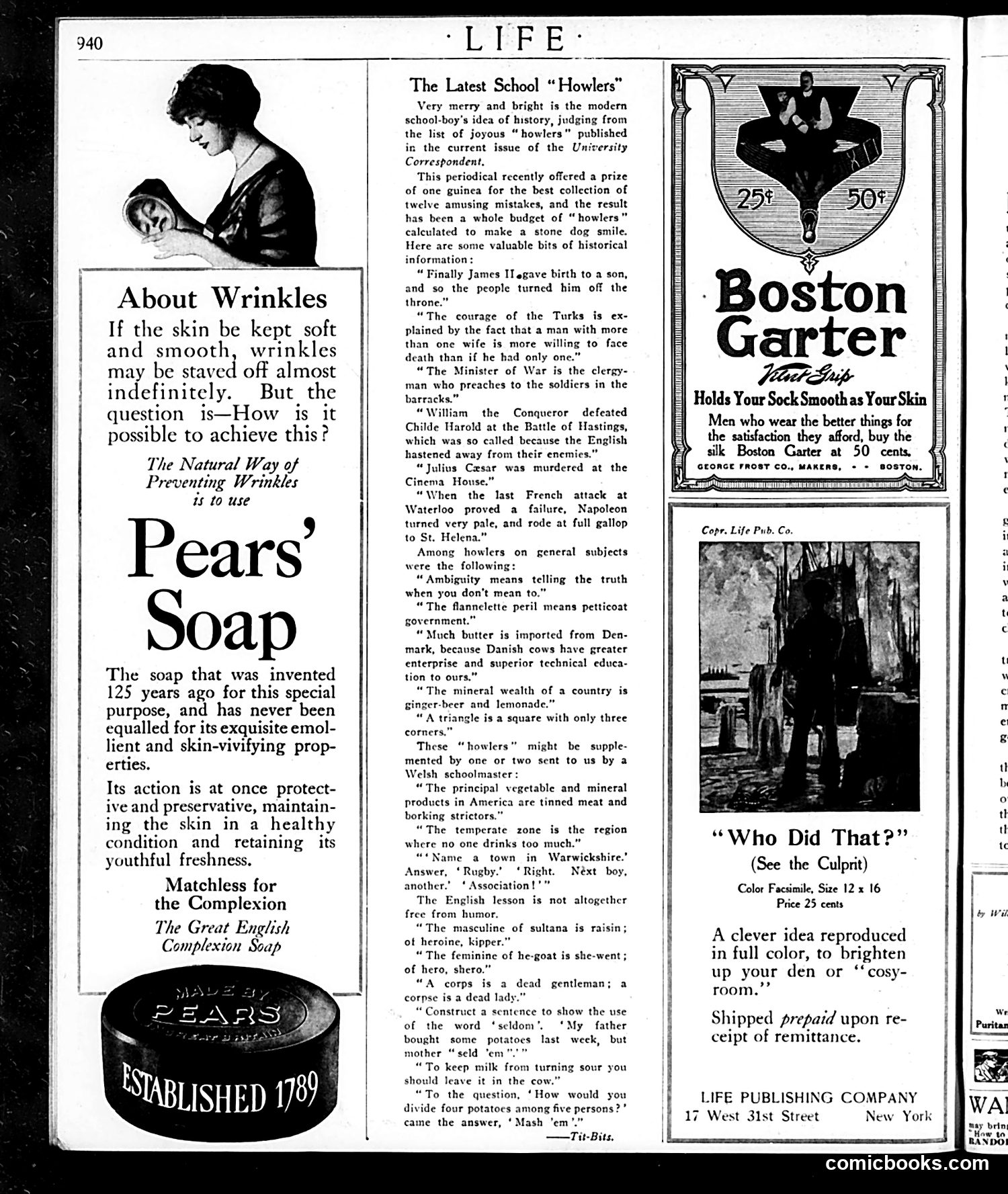
This page is primarily **advertising with humorous filler content**, not political satire. The main features are: **Advertisements:** Pears' Soap (left), Boston Garter socks (right), and a color print offer promote consumer goods with period-typical marketing claims about beauty and quality. **"The Latest School 'Howlers'"** (center): This is the editorial content—a humor feature collecting amusing mistakes from students' essays, likely reprinted from the *University Correspondent*. The "howlers" are genuinely funny malapropisms and logical errors: students confusing "James II gave birth" (misreading history), "Julius Caesar murdered at the Cinema House" (anachronism), defining a triangle as "a square with only three corners," and the pun "Mash 'em" for dividing potatoes. This reflects turn-of-century magazine humor: celebrating student blunders without political agenda, simply showcasing innocent intellectual mishaps for educated adult amusement. The feature's appeal lies in the contrast between formal history/language lessons and children's hilariously literal misunderstandings.
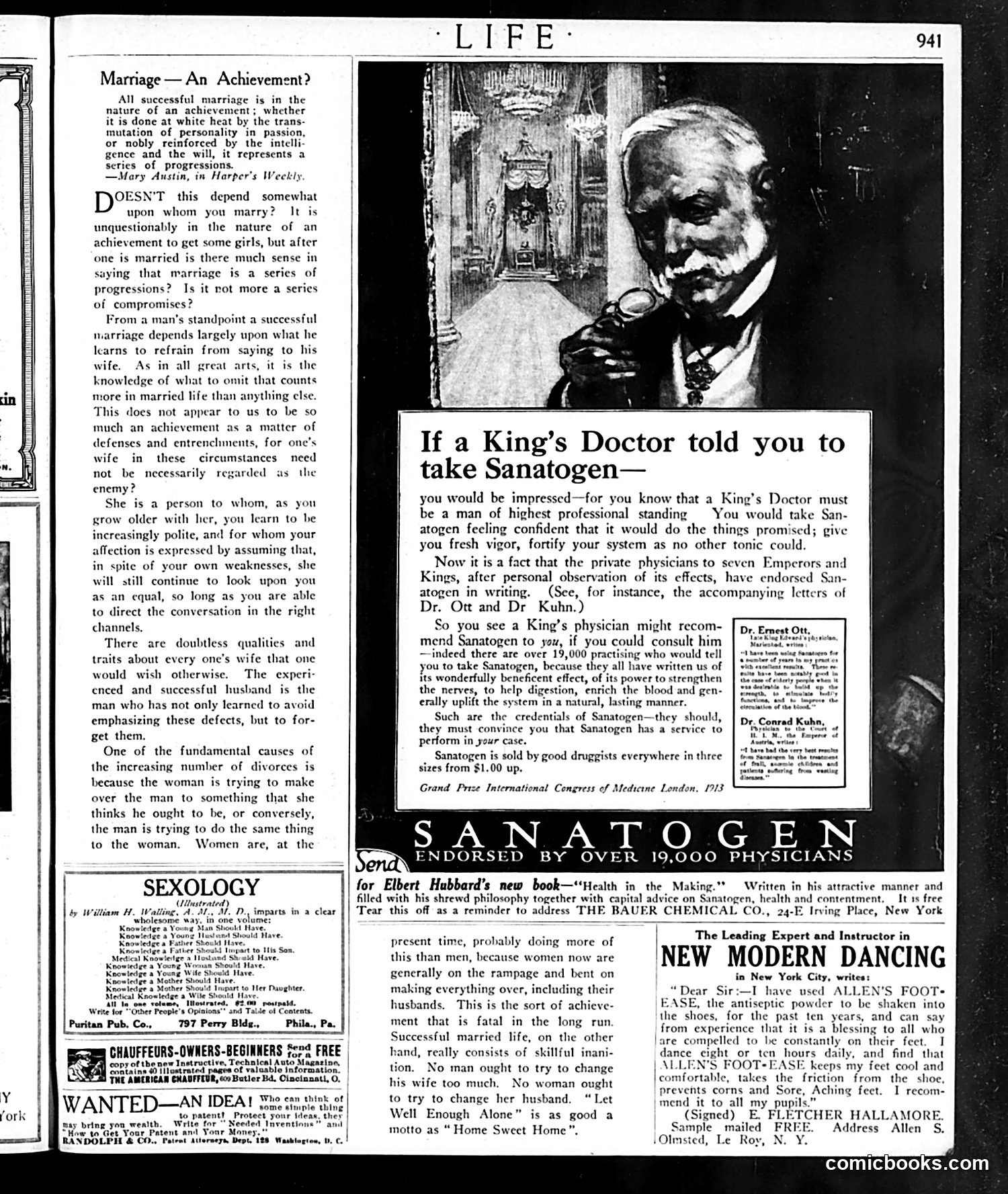
This page presents **satirical commentary on marriage** alongside period advertisements. The main editorial essay, titled "Marriage—An Achievement?", critiques the romantic notion that successful marriage represents personal progression. Instead, the author argues marriage is fundamentally a series of **compromises and defensive strategies**—particularly requiring husbands to learn what *not* to say to their wives. The satire targets both genders: women are mocked for trying to "remake" their husbands, while men are advised that marital success depends on silence and strategic conversation control. The piece sardonically suggests wives should be treated as "equals" primarily through politeness and accepting one's own weakness—hardly an endorsement of partnership. The accompanying advertisements (Sanatogen health tonic, dancing instruction, sexology books) reflect early 20th-century concerns about health, modern social behaviors, and self-improvement—typical companion content for a satirical magazine addressing middle-class readers navigating changing gender roles and marital expectations.
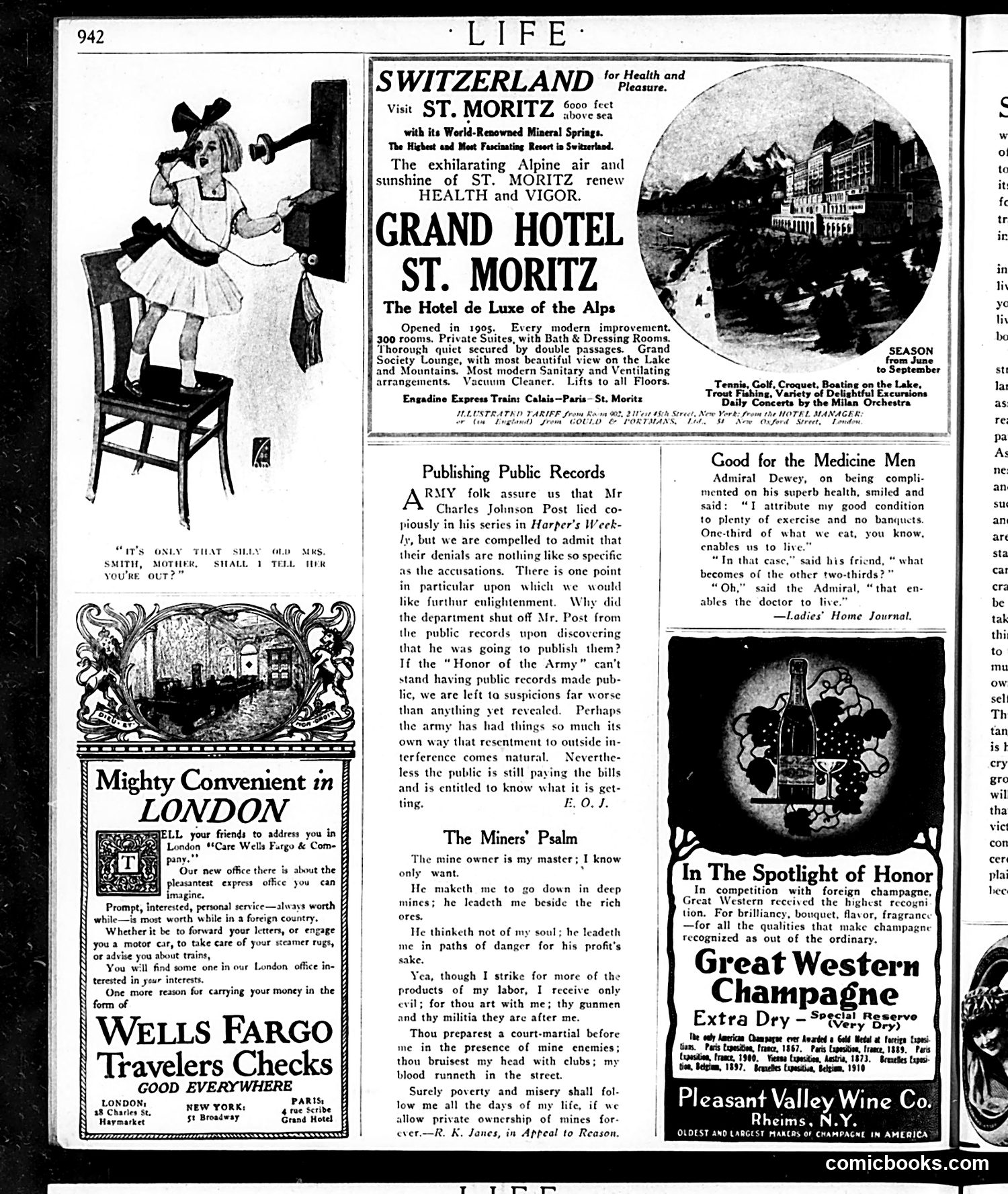
**Main Cartoon (upper left):** A caricatured woman stands on a chair, appearing flustered or alarmed while holding what appears to be a telescope or similar object. The caption reads: "It's only that silly old Mrs. Smith, Mother. Shall I tell her you're out?" This is a domestic humor cartoon poking fun at social pretension—the implication being that the woman is trying to avoid greeting an unwanted visitor by claiming to be unavailable, a common social evasion tactic of the era. **Editorial Content:** The page includes commentary on **Charles Johnson Post's military exposé** in Harper's Weekly, criticizing the Army's suppression of public records and questioning why government would obstruct transparency if nothing improper had occurred. **"The Miners' Psalm"** is a satirical poem critiquing mine owners and labor conditions, drawing Biblical language to condemn worker exploitation and private mine ownership. **Admiral Dewey anecdote** jests about health and medical profiteering—his quip that one-third of food nourishes the body while two-thirds enriches doctors is social commentary on unnecessary medicine. The page is predominantly advertisements for luxury travel services and hotels.
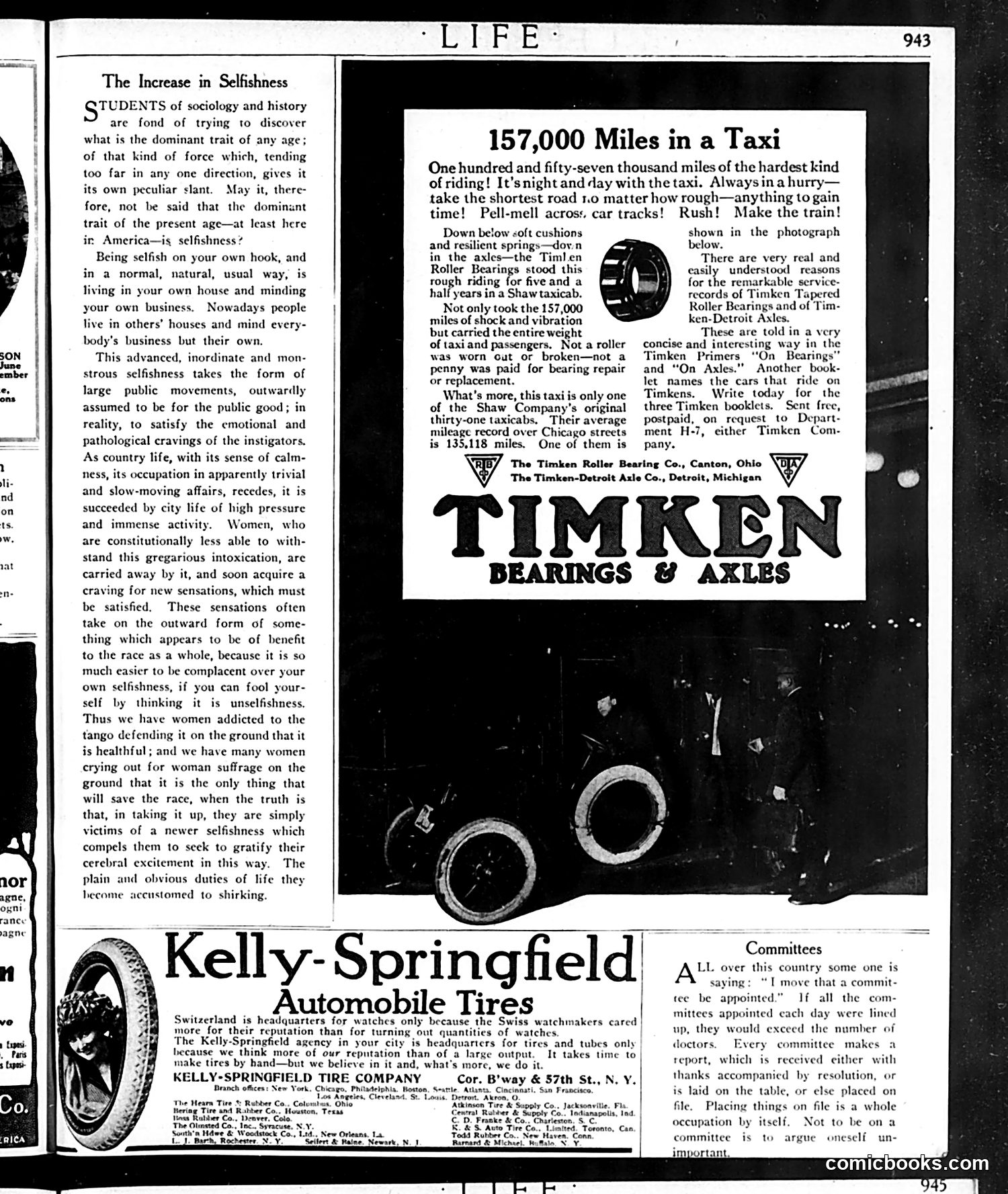
This page contains **social commentary and advertisements** rather than a cartoon. The main editorial, "The Increase in Selfishness," critiques modern American society as increasingly self-centered. The author argues that women, particularly, are susceptible to urban "gregarious intoxication" and channel selfish impulses into ostensibly noble causes like women's suffrage and the tango—activities the author dismisses as mere sensation-seeking disguised as social benefit. This reflects **early 20th-century anti-suffrage sentiment**, positioning women's political activism as emotional rather than principled. The advertisements below promote industrial products (Timken bearings, Kelly-Springfield tires) using reliability narratives—a taxi surviving 157,000 miles—to establish brand trust. The page reflects **progressive-era anxieties about urbanization, gender roles, and women's expanding public participation**, framing female activism skeptically rather than seriously.
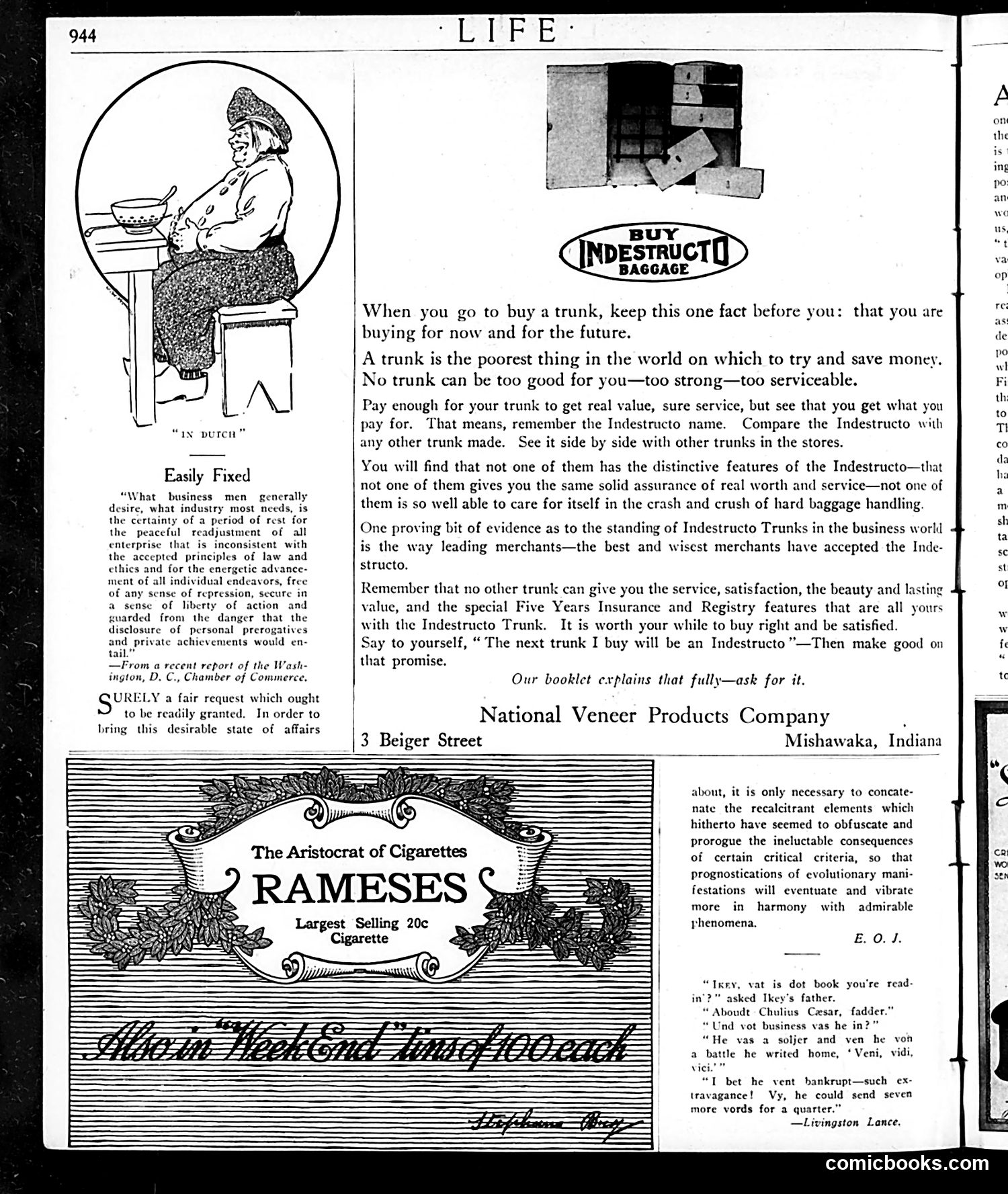
This page contains primarily **advertisements** rather than political cartoons, though it includes one small ethnic humor piece. **Main Content:** The dominant feature is an extended advertisement for Indestructo Trunks (National Veneer Products Company, Mishawaka, Indiana), emphasizing durability and value. The accompanying illustration shows a woman in Dutch dress labeled "In Dutch"—a visual pun on the phrase "in trouble." **Secondary Items:** A Rameses cigarette ad promotes the "largest selling 20c cigarette." A brief comic dialogue (attributed to Livingston Lance) presents Jewish immigrant stereotypes—an Ikey and his father discussing Julius Caesar in heavily accented English. The "joke" relies on ethnic dialect humor and a pun about Caesar's frugality: when the father learns Caesar "writed home" using three Latin words after victory, he expresses mock outrage that Caesar didn't use "seven more vords for a quarter." **Historical Context:** This ethnic humor was mainstream in early 20th-century American publications, though such stereotyping would be considered offensive today.
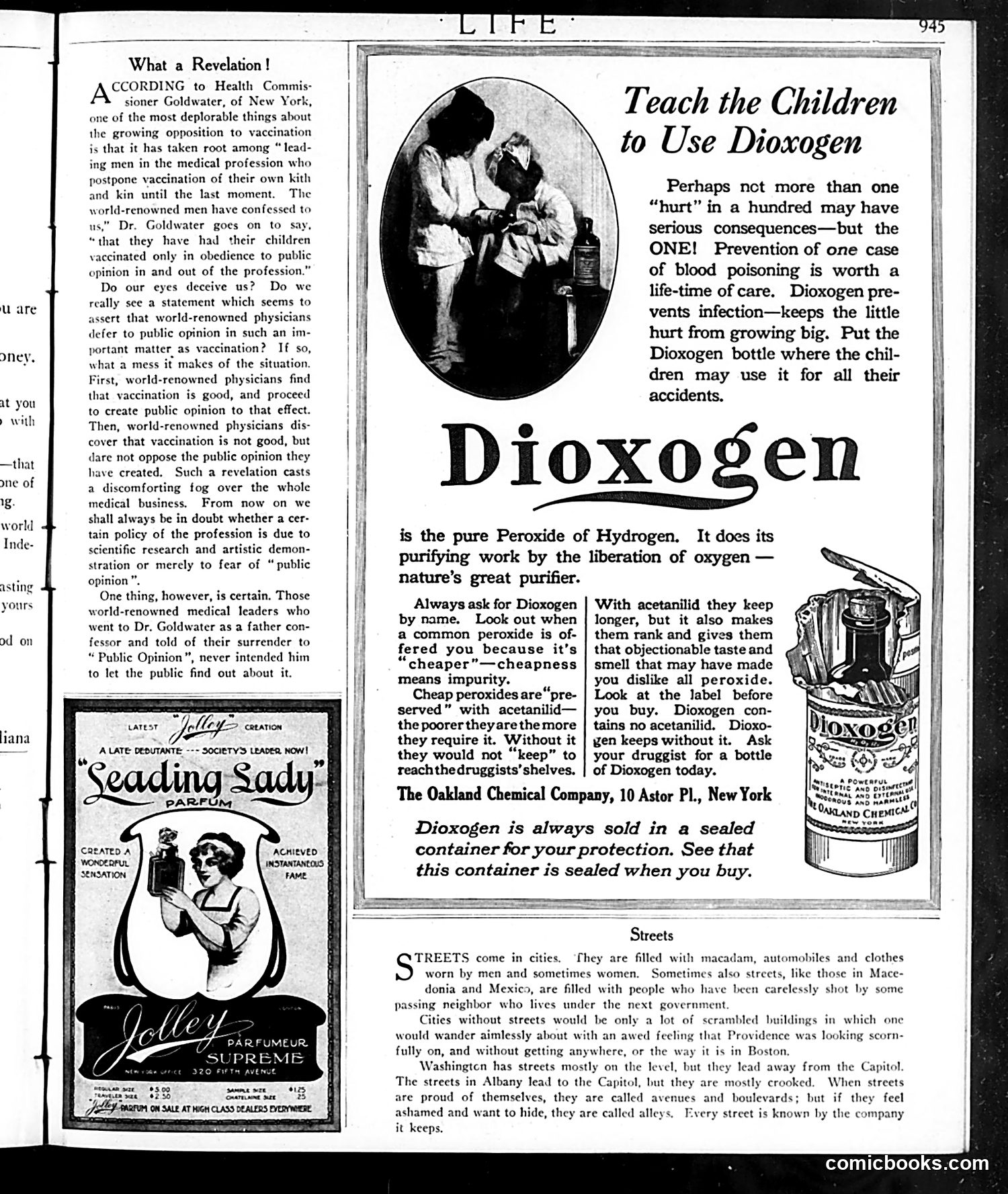
This page contains two distinct elements: **Left Column - "What a Revelation!"** A satirical editorial critiques Health Commissioner Goldwater of New York for revealing that prominent physicians secretly oppose vaccination but publicly support it out of deference to public opinion rather than scientific conviction. The satire's point: this undermines medical credibility. If doctors merely follow public sentiment rather than research, how can the profession be trusted on any health policy? It's presented as a humorous exposé of professional hypocrisy. **Right Side - Advertisement** A Dioxogen (hydrogen peroxide) advertisement targeting parents, positioning the product as essential first-aid for children's minor injuries. The marketing emphasizes purity and warns against cheaper imitations containing acetanilid. **Bottom - "Streets" Essay** Brief humorous commentary on city streets, their purposes, and characteristics—appears to be filler content typical of Life's satirical magazine format. The vaccination critique reflects early 20th-century vaccine skepticism among some physicians, contrasting with modern understanding of vaccination's scientific basis.
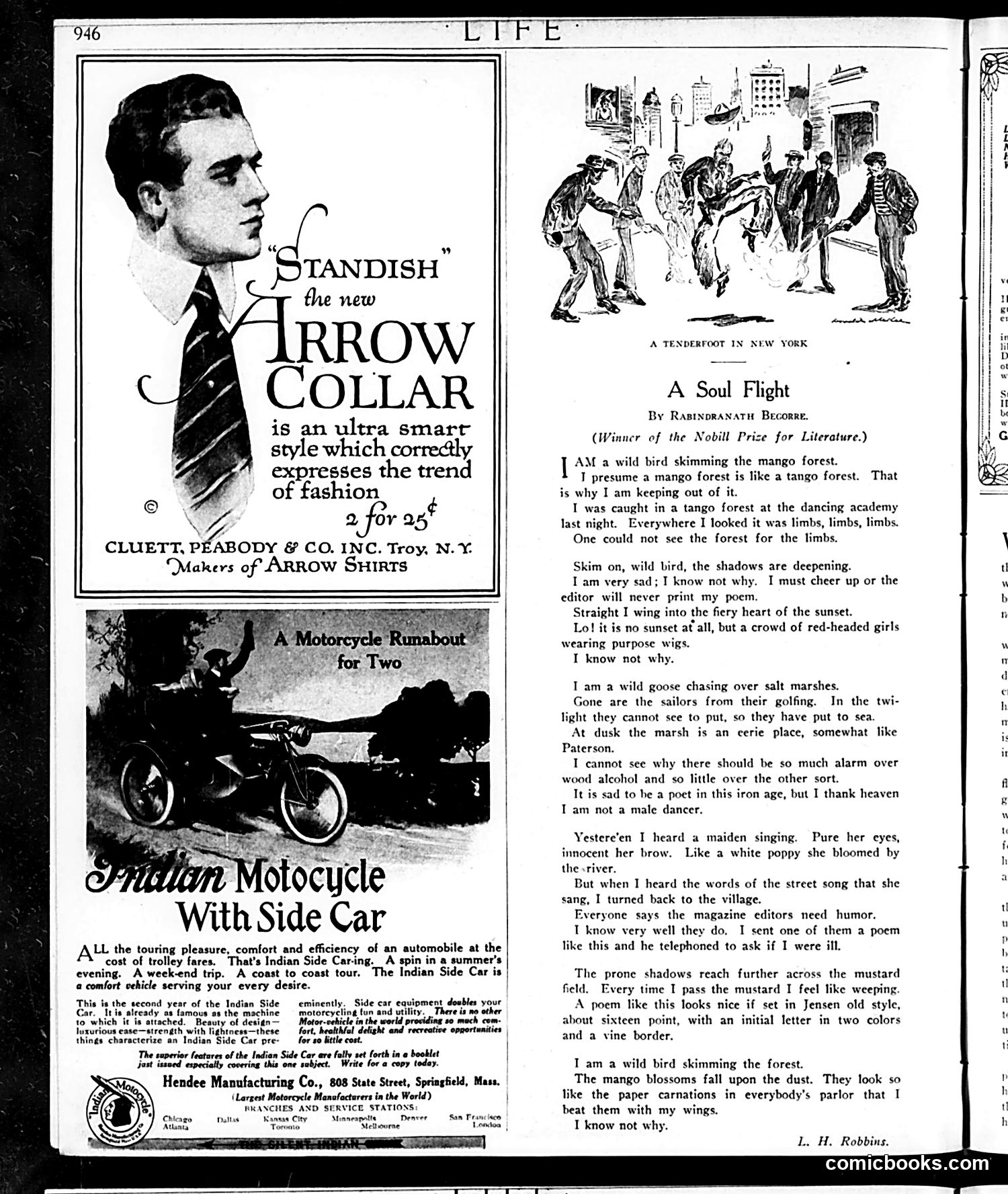
This page contains three unrelated advertisements and a literary piece: **Advertisements**: Arrow Collar (men's fashion), Indian motorcycle with sidecar, and other products typical of early 20th-century magazines. **Main Content**: "A Soul Flight" by Rabindranath Tagore (Nobel Prize winner), presented as satirical verse. The piece parodies flowery, pretentious literary poetry through absurdist comparisons—a "tenderfoot" (inexperienced person) in New York confuses a "mango forest" with a "tango forest," sees a sunset that's actually "red-headed girls wearing purpose wigs," and beats mango blossoms because they resemble cheap parlor decorations. **The Satire**: Life magazine mocks overwrought, mystical poetry and claims editors need genuine humor. The joke is that Tagore's genuine literary reputation is being used to lampoon exactly the kind of pretentious, nonsensical verse that magazines actually published. The narrator admits editors rejected similar work, reinforcing the critique of avant-garde poetry's incomprehensibility to practical readers.
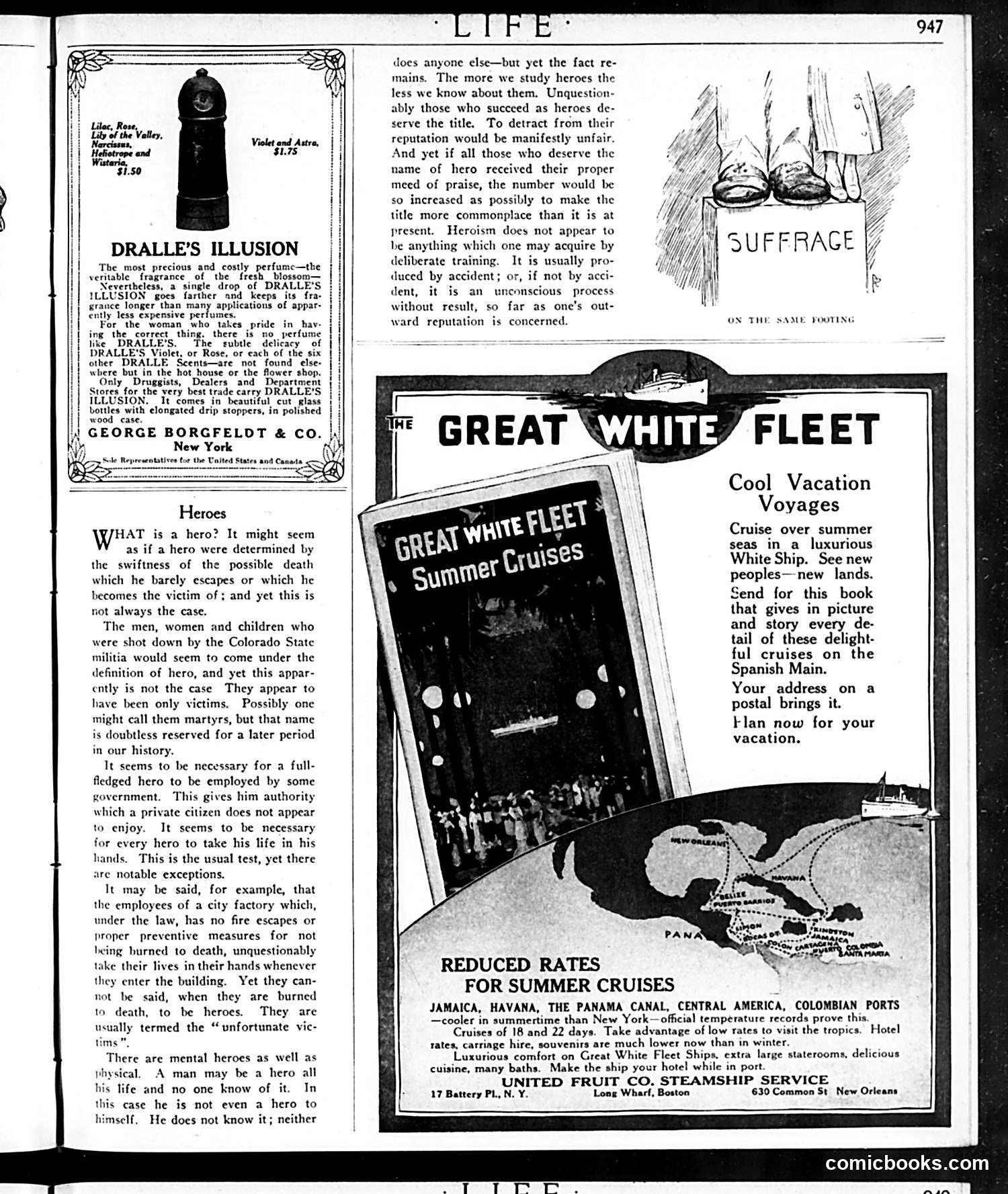
This page contains two distinct elements: **The "Heroes" Essay** (left/center): A philosophical article questioning what constitutes heroism. It critiques the narrow definition of heroes as government-employed risk-takers, pointedly referencing the **Colorado State militia**—likely alluding to the Ludlow Massacre (1914), where militia killed striking miners, women, and children. The author argues these victims should arguably be called heroes or martyrs, yet society reserves the "hero" title only for those serving government authority. The piece satirizes how heroism requires official sanction rather than moral merit. **The Advertisements**: The page also features perfume ads (Dralle's Illusion) and a prominent **Great White Fleet cruise advertisement** promoting Caribbean vacations, with reduced summer rates to Jamaica, Havana, and Panama. **The Satire**: The juxtaposition is pointed—while discussing whether factory workers and massacre victims deserve heroic recognition, luxury cruise advertisements occupy the same page, highlighting class disparities and society's priorities in the Progressive Era.
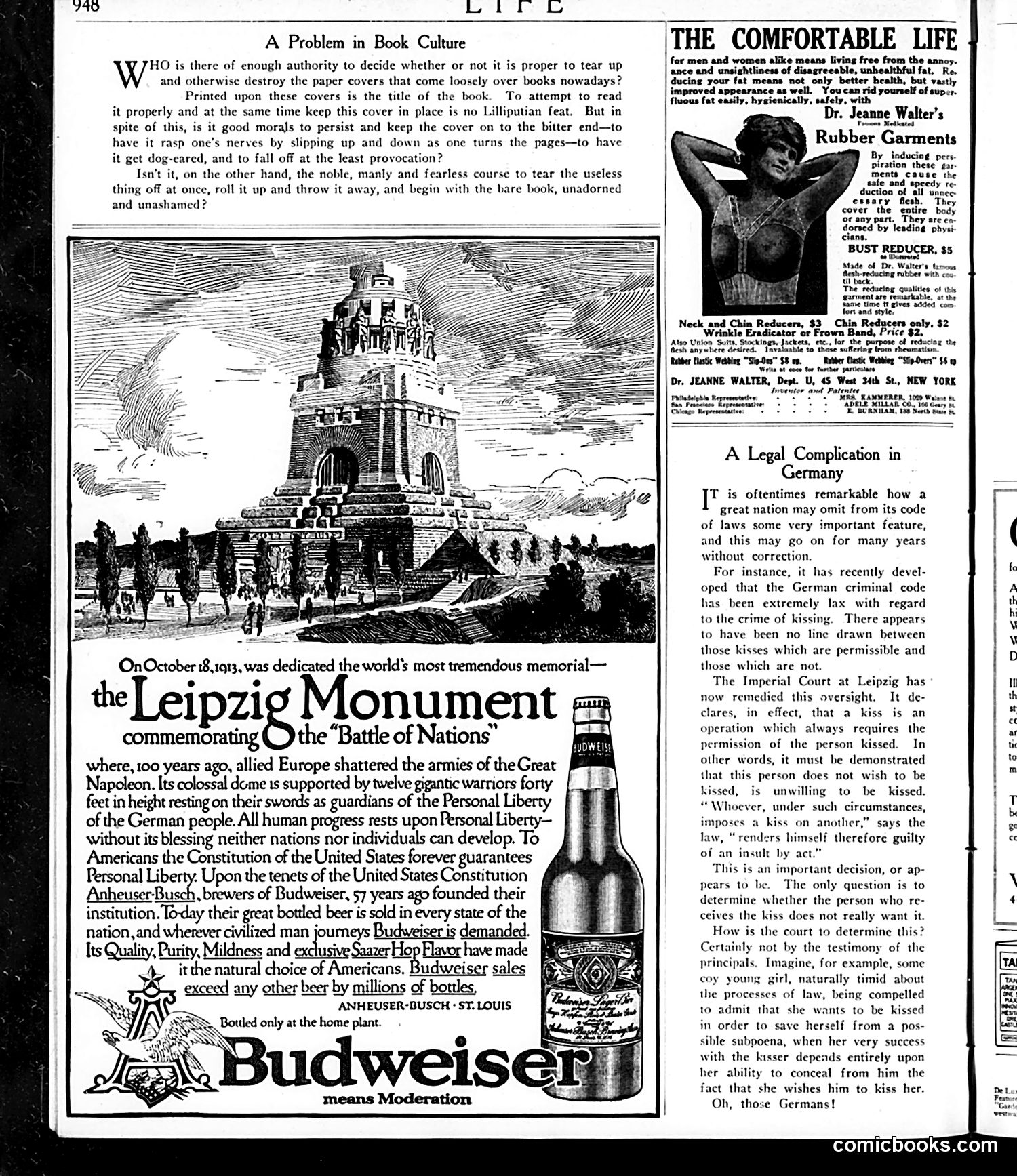
This page contains three distinct elements: **"A Problem in Book Culture"** (left column): A humorous editorial debating whether it's morally acceptable to tear off loose book dust jackets. The author treats this trivial question with mock-serious philosophical language, presenting tearing off covers as either "noble and fearless" or morally questionable depending on one's perspective—satirizing overwrought debates about etiquette and propriety. **Advertisements** (right side): Two ads for reducing garments and rubber corsets by "Dr. Jeanne Walter," and a Budweiser advertisement featuring the Leipzig Monument (commemorating Napoleon's defeat in 1813), which awkwardly connects German liberty to American constitutional values to promote beer as "moderation." **"A Legal Complication in Germany"** (bottom right): A satirical piece about a recent German court ruling that kissing requires the other person's consent. The humor derives from treating a serious legal principle (consent) through absurdly pedantic language, highlighting German bureaucratic rigidity by suggesting they needed an explicit law to clarify what should be obvious. The page exemplifies *Life* magazine's satirical approach: mocking both American consumer culture and European formalism.
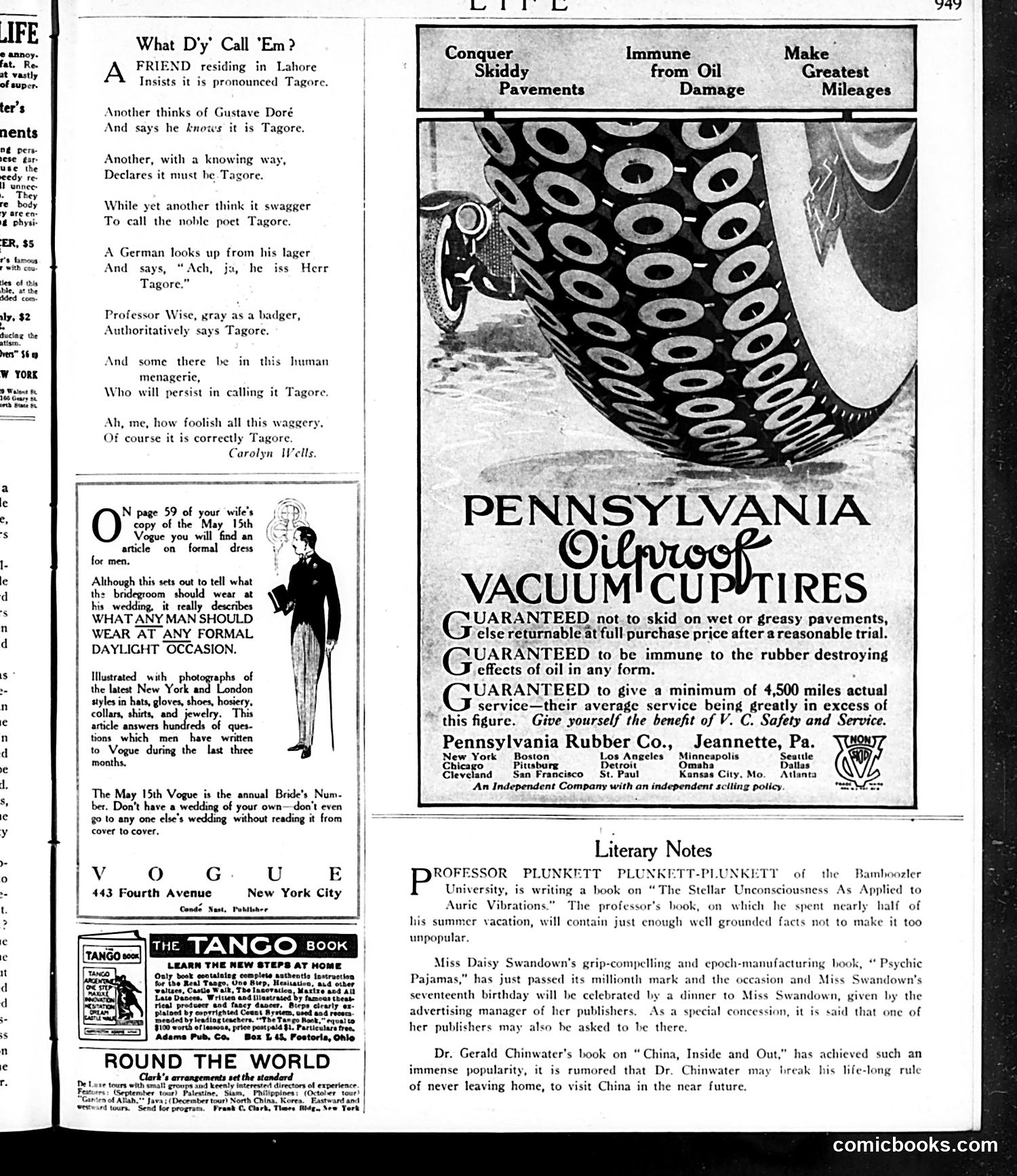
This page contains two distinct satirical pieces: **"What D'y' Call 'Em?"** — A poem by Carolyn Wells mocking the pronunciation uncertainty surrounding Rabindranath Tagore, the Indian poet and Nobel laureate (likely visiting or recently prominent in Western circles). The satire shows various people confidently asserting different pronunciations—a friend from Lahore, a reference to artist Gustave Doré, a German speaker, a professorial authority—each "certain" they're correct. Wells' punchline admits the correct pronunciation is "Tagore," mocking how people confidently mispronounce foreign names without admitting ignorance. **Pennsylvania Oilproof Vacuum Cup Tires Advertisement** — A full-page tire ad emphasizing three benefits: skid-resistance on wet/oily pavements, immunity to oil damage, and 4,500+ miles of service. This reflects early 20th-century automotive concerns about road conditions and tire durability. The remaining content includes fashion advice and literary notes about recently published books, typical of *Life* magazine's miscellaneous content.
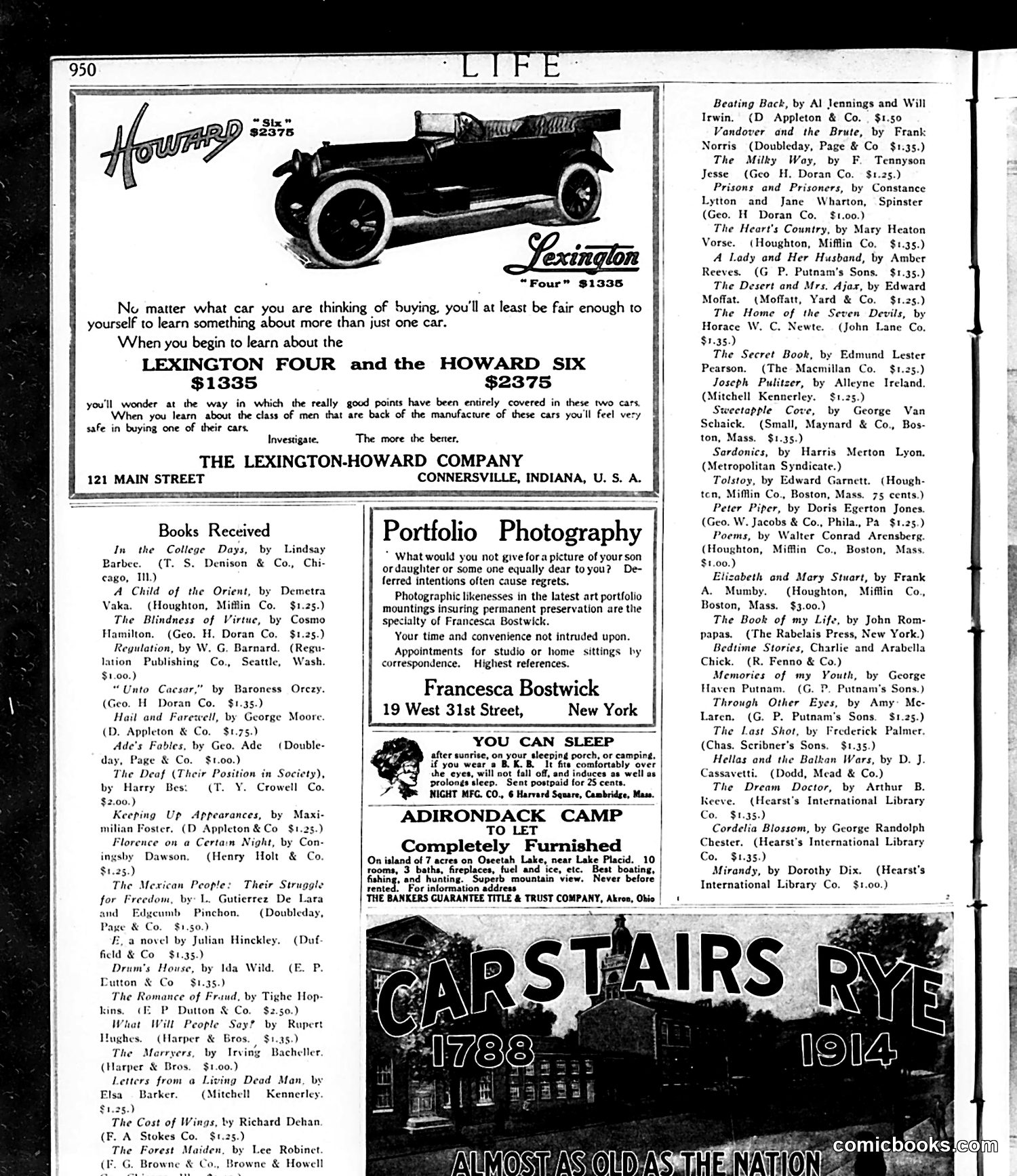
This page is primarily **advertising and book listings**, not political satire or cartoons. The main content includes: 1. **Automobile advertisements** for the Lexington Four ($1,335) and Howard Six ($2,375)—mid-range cars from the Lexington-Howard Company in Connersville, Indiana. The ads appeal to middle-class buyers by emphasizing quality manufacturing and reliability. 2. **"Books Received" section**—a standard literary review listing contemporary novels and their prices (typically $1-2), including works by Baroness Orczy, George Moore, and others. 3. **Service advertisements**: portrait photography by Francesca Bostwick, an "eye sleep mask," and an Adirondack camp rental. 4. **Bottom image**: A historical photograph labeled "Cars Stair Rye 1788-1914" with text "Almost as old as the nation"—likely an advertisement emphasizing a business's long history. There are **no political cartoons or satirical content** on this page. It's a straightforward magazine spread combining classified advertising, book notices, and commercial announcements typical of early-20th-century publications.
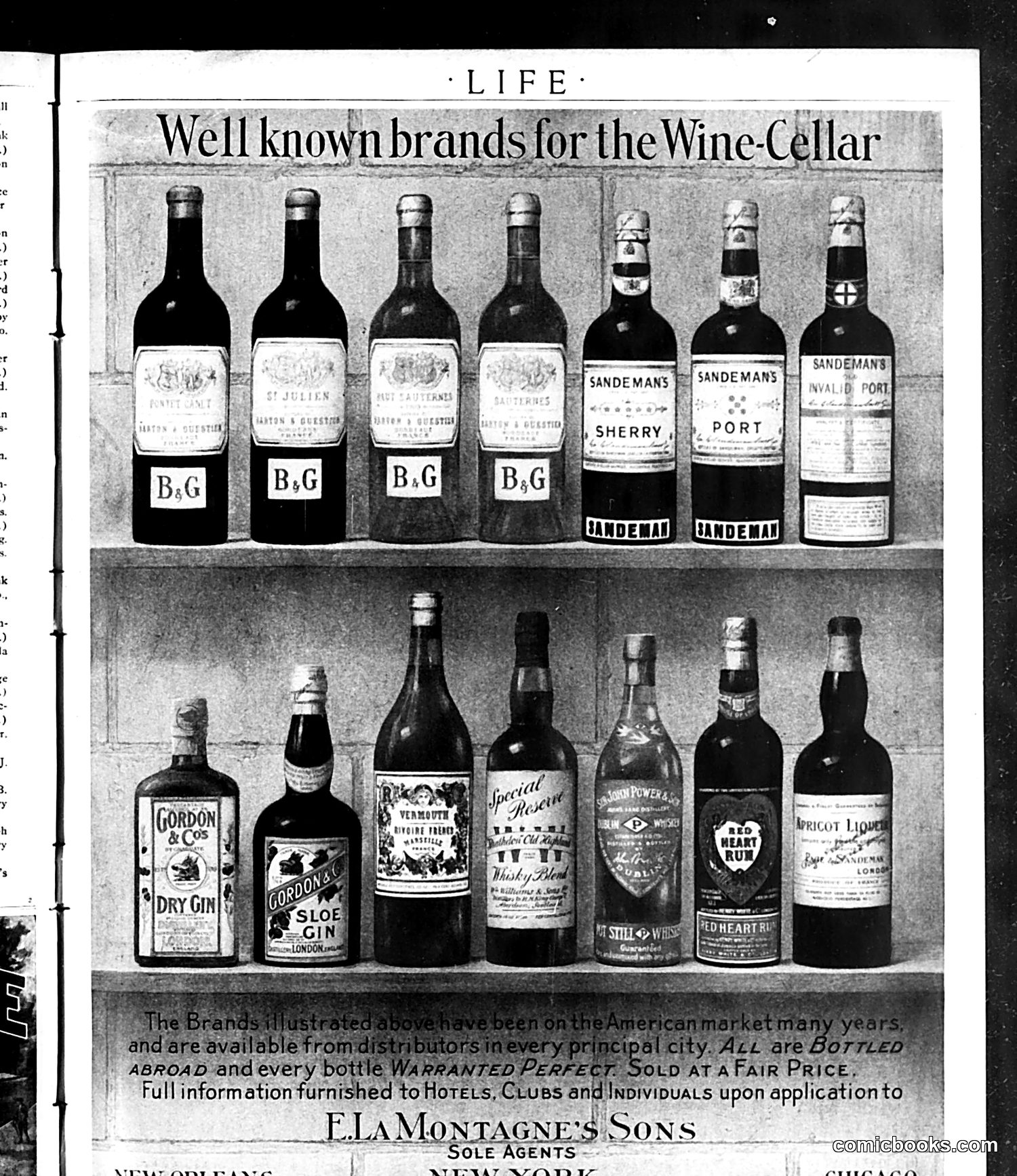
This is **primarily a liquor advertisement**, not political satire or comedy. The page shows "Well known brands for the Wine-Cellar" — two shelves displaying bottles of wine, sherry, port, gin, vermouth, and liqueur from brands like B&G, Sandeman's, and Gordon's. The text emphasizes these are established products "on the American market many years," "bottled abroad," and "warranted perfect." E. La Montagne's Sons is identified as the sole agent. This appears in Life magazine, suggesting it's either a paid advertisement or sponsored content. The page has no satirical intent — it's a straightforward commercial promoting imported alcoholic beverages to American consumers, likely from the early 20th century before Prohibition.

This page is **entirely an advertisement**, not political satire or editorial content. It promotes Williams' "Holder-Top" shaving stick—a patented soap product from The J.B. Williams Company of Glastonbury, Connecticut (May 21, 1914). The ad's pitch emphasizes **practical convenience**: the metal holder allows users to grip the soap stick without touching it directly, and crucially, lets them use every last bit of soap rather than wasting the small end piece. This resonated in an era when economizing was valued. The ad showcases four product variants (stick, cream, powder, in tubes) and offers a trial sample for 4 cents in stamps—standard direct-mail marketing of the period. **There is no cartoon, satire, or hidden political meaning here.** It's straightforward commercial copy emphasizing hygiene, economy, and product innovation—typical of early 20th-century magazine advertising placed among editorial content.