
Life, 1914-05-21 · page 24 of 52
Life — May 21, 1914 — page 24: what you’re looking at
What you’re looking at
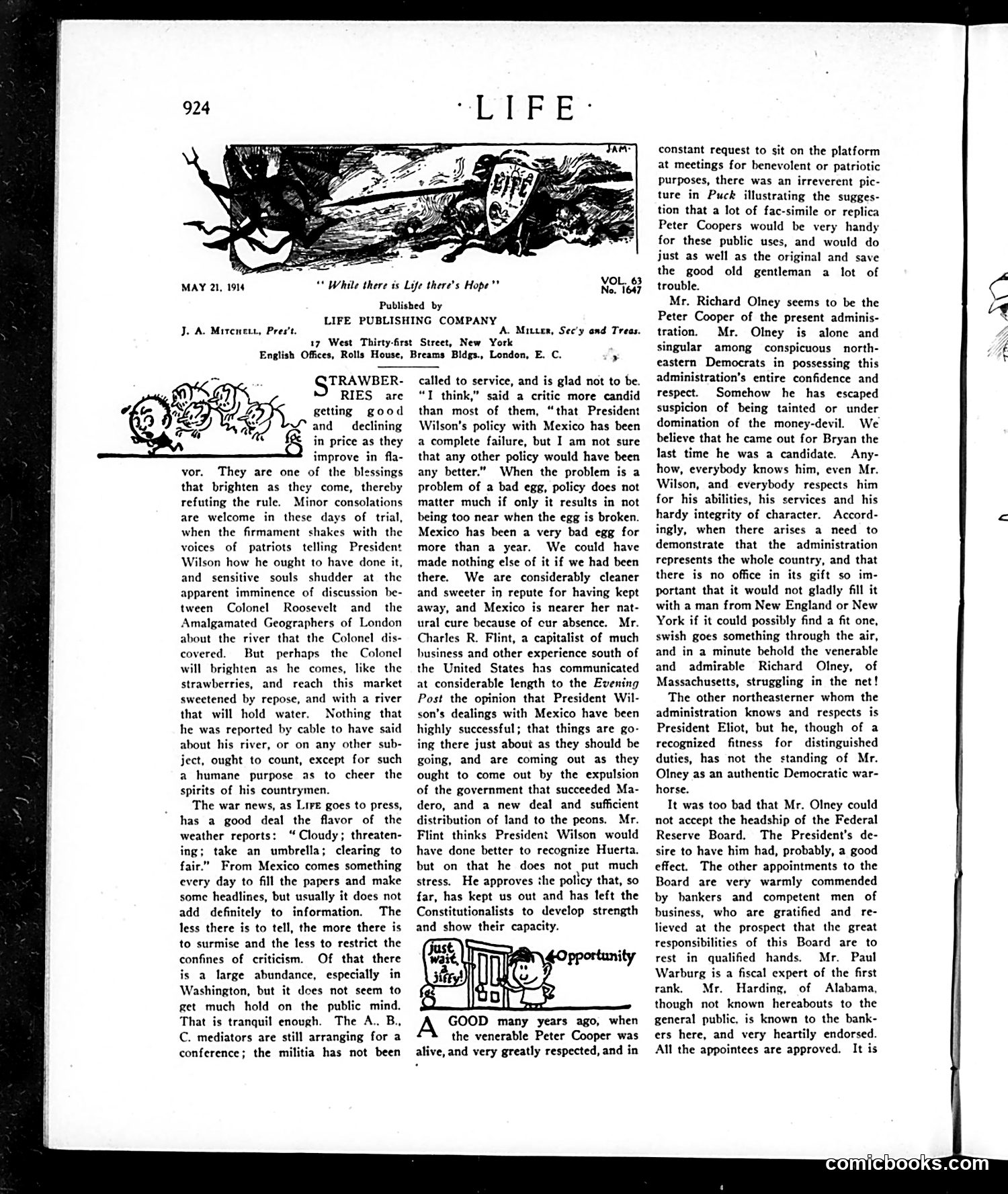
This page contains editorial commentary on current events rather than a political cartoon. The main content discusses President Wilson's Mexico policy during the Mexican Revolution. **The Context:** The piece defends Wilson's hands-off approach to Mexico's internal conflict, comparing the situation to a "bad egg"—better left alone than interfered with. It favorably cites capitalist Charles R. Flint's view that Wilson's policy has been "highly successful" in allowing Mexican Constitutionalists to develop strength independently. **The Satirical Elements:** The opening section humorously contrasts strawberries (improving as they ripen) with Colonel Roosevelt, suggesting the Colonel might similarly "brighten" upon his return from exploring a river he'd discovered. This is gentle mockery of Roosevelt's ego and his dispute with London geographers over the river's discovery. **The Peter Cooper Reference:** A footnote mentions an old *Puck* magazine cartoon joking that replica Peter Coopers would be useful for filling seats at charitable events, sparing the elderly original gentleman the trouble. The piece reflects Progressive-era debates over American intervention in Latin America.
📄 Transcribed text from this page (OCR, searchable)
Machine-transcribed from the original scan — historical spelling and the odd misread are preserved.
MAY 21, 1914 “* While there is Life there's Hope"’ No. 1647 Published by LIFE PUBLISHING COMPANY 17 West Thirty-first Street, New York English Offices, Rolls House, Breams Bldgs., London, E. C. > J. A. Mitcnett, Pres’t. TRAWBER- RIES are getting good sand — declining in price as they improve in fla- vor. They are one of the blessings that brighten as they come, thereby refuting the rule. Minor consolations are welcome in these days of trial, when the firmament shakes with the voices of patriots telling President Wilson how he ought to have done it, and sensitive souls shudder at the apparent imminence of discussion be- tween Colonel Roosevelt and the Amalgamated Geographers of London about the river that the Colonel dis- covered. But perhaps the Colonel will brighten as he comes, like the strawberries, and reach this market sweetened by repose, and with a river that will hold water. Nothing that he was reported by cable to have said about his river, or on any other sub- ject, ought to count, except for such a humane purpose as to cheer the spirits of his countrymen. The war news, as Lire goes to press, has a good deal the flavor of the weather reports: “Cloudy; threaten- i take an umbrella; clearing to From Mexico comes something every day to fill the papers and make some headlines, but usually it does not add definitely to information. The less there is to tell, the more there is to surmise and the less to restrict the confines of criticism. Of that there is a large abundance, especially in Washington, but it does not seem to get much hold on the public mind. That is tranquil enough. The A.. B., C. mediators are still arranging for a conference; the militia has not been A. Miter, Sec’'y and Treas. called to service, and is glad not to be. “T think,” said a critic more candid than most of them, “that President Wilson's policy with Mexico has been a complete failure, but I am not sure that any other policy would have been any better.” When the problem is a problem of a bad egg, policy does not matter much if only it results in not being too near when the egg is broken. Mexico has been a very bad egg for more than a year. We could have made nothing else of it if we had been there. We are considerably cleaner and sweeter in repute for having kept away, and Mexico is nearer her nat- ural cure because of cur absence. Mr. Charles R. Flint, a capitalist of much business and other experience south of the United States has communicated at considerable length to the Evening Post the opinion that President Wil- son’s dealings with Mexico have been highly successful; that things are go- ing there just about as they should be going, and are coming out as they ought to come out by the expulsion of the government that succeeded Ma- dero, and a new deal and sufficient distribution of land to the peons. Mr. Flint thinks President Wilson would have done better to recognize Huerta. but on that he does not put much stress. He approves the policy that, so far, has kept us out and has left the Constitutionalists to develop strength and show their capacity. A alive, and very greatly respected, and in the venerable Peter Cooper was constant request to sit on the platform at meetings for benevolent or patriotic purposes, there was an irreverent pic- ture in Puck illustrating the sugges- tion that a lot of fac-simile or replica Peter Coopers would be very handy for these public uses, and would do just as well as the original and save the good old gentleman a lot of trouble. Mr. Richard Olney seems to be the Peter Cooper of the present adminis- tration, Mr. Olney is alone and singular among conspicuous north- eastern Democrats in possessing this administration's entire confidence and respect. Somehow he has escaped suspicion of being tainted or under domination of the money-devil. We believe that he came out for Bryan the last time he was a candidate. Any- how, everybody knows him, even Mr. Wilson, and everybody respects him for his abilities, his services and his hardy integrity of character. Accord- ingly, when there arises a need to demonstrate that the administration represents the whole country, and that there is no office in its gift so im- portant that it would not gladly fill it with a man from New England or New York if it could possibly find a fit one, swish goes something through the air, and in a minute behold the venerable and admirable Richard Olney, of Massachusetts, struggling in the net! The other northeasterner whom the administration knows and respects is President Eliot, but he, though of a recognized fitness for distinguished duties, has not the standing of Mr. Olney as an authentic Democratic war- horse. It was too bad that Mr. Olney could not accept the headship of the Federal Reserve Board. The President's de- sire to have him had, probably, a good effect. The other appointments to the Board are very warmly commended by bankers and competent men of business, who are gratified and re- lieved at the prospect that the great responsibilities of this Board are to rest in qualified hands. Mr. Paul Warburg is a fiscal expert of the first rank. Mr. Harding, of Alabama, though not known hereabouts to the general public, is known to the bank- ers here, and very heartily endorsed. All the appointees are approved. It is