
Life, 1914-05-21 · page 25 of 52
Life — May 21, 1914 — page 25: what you’re looking at
What you’re looking at
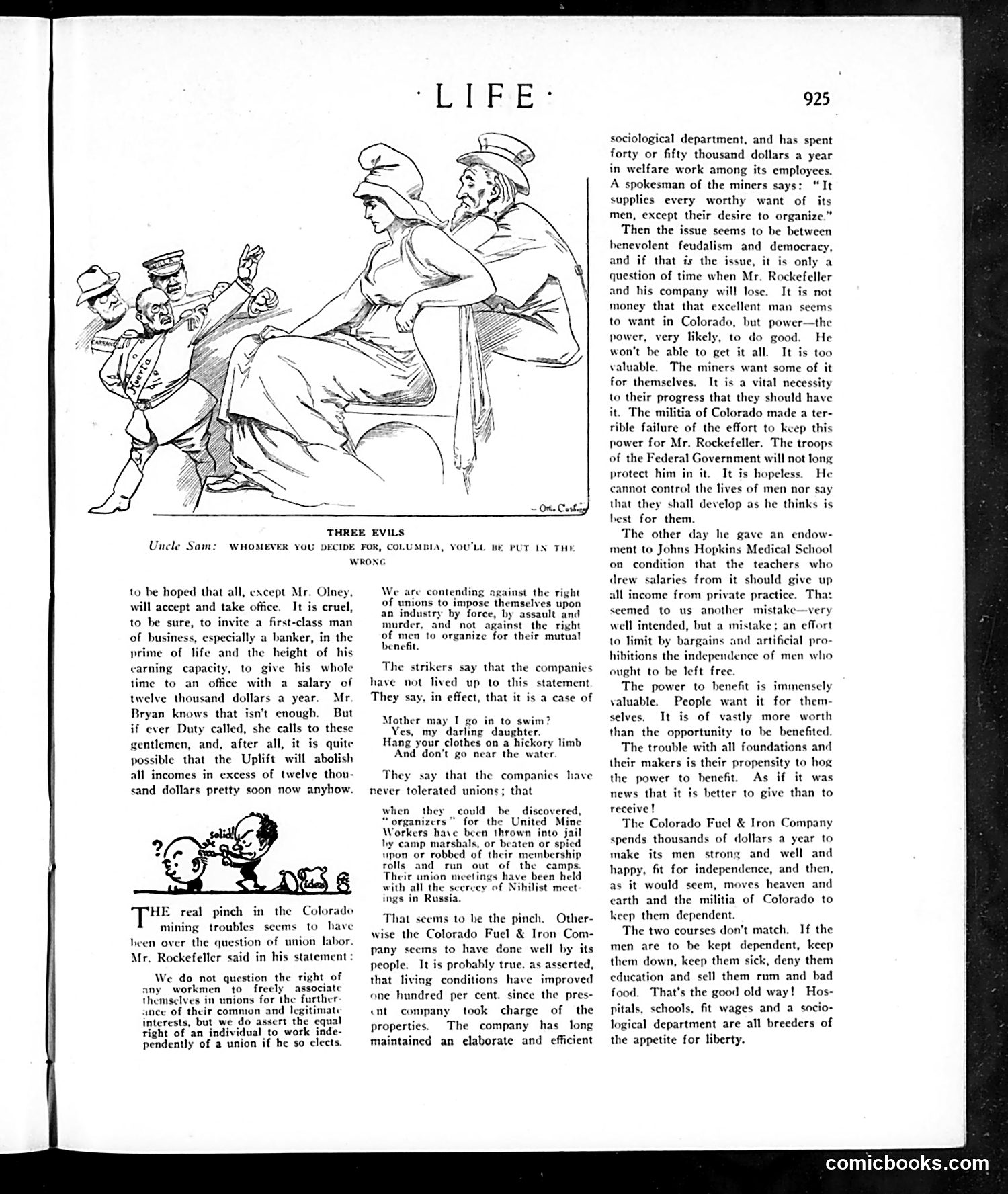
The cartoon depicts Uncle Sam caught between two allegorical female figures representing **Columbia** (America) and Lady Liberty, labeled "Three Evils." The satire addresses the **Colorado mining strikes** and Rockefeller's paternalism. The accompanying article argues that while the Colorado Fuel & Iron Company claims to improve workers' living conditions and provide welfare benefits, it denies them the fundamental right to organize unions. Life's editors identify the core conflict: **benevolent feudalism versus democracy**. The satire's point is that Rockefeller's wealth and power—however well-intentioned—cannot substitute for workers' independence and self-determination. The editors mock his hypocrisy: he donated to Johns Hopkins Medical School but demanded teachers abandon private practice, revealing his desire to *control* rather than genuinely empower others. The cartoon suggests Uncle Sam faces an impossible choice, implying that such paternalistic power arrangements are ultimately untenable in a democratic society.
📄 Transcribed text from this page (OCR, searchable)
Machine-transcribed from the original scan — historical spelling and the odd misread are preserved.
=~ On.C, THREE EVILS Sam: WHOMEVER YOU DECIDE FOR, COLUMBIA, YOU'LL We PUT IN THY WRONG to be hoped that all, except Mr. Olney, will accept and take office. It is cruel, to be sure, to invite a first-class man of business, especially a banker, in the prime of life and the height of his carning capacity, to give his whole time to an office with a salary of twelve thousand dollars a year. Mr. Bryan knows that isn’t enough. But if ever Duty called, she calls to these gentlemen, and, after all, it is quit possible that the Uplift will abolish all incomes in excess of twelve thou- sand dollars pretty soon now anyhow. HE real pinch in the Colorado mining troubles seems to have heen over the question of union labor. Mr. Rockefeller said in his statement : We do not question the right of any workmen to. freely associate themselves in unions for the further ince of their common and legitimat: interests, but we do assert the equal right of an individual to work inde- pendently of a union if he so elects. We are contending against the right of unions to impose themselves upon an industry by force, by assault and murder, and not against the right of men to organize for their mutual benefit. The strikers say that the companies have not lived up to this statement They say, in effect, that it is a case of Mother may I go in to swim? Yes, my darling daughter. Hang your clothes on a hickory limb And don’t go near the water They say that the companies have never tolerated unions; that when th ould be discovered, “organizers” for the United Mine Workers have been thrown into jail hy camp marshals, or beaten or spied upon or robbed of their membership rolls and run out of the camps. Their union meetings have been held with all the sccreey of Nihilist meet ings in Russia. That seems to be the pinch, Other- wise the Colorado Fuel & Iron Com- pany seems to have done well by its people. It is probably true. as asserted, that living conditions have improved one hundred per cent. since the pres- «nt company took charge of the properties. The company has long maintained an elaborate and efficient 925 sociological department, and has spent forty or fifty thousand dollars a year in welfare work among its employees. A spokesman of the miners says: “It supplies every worthy want of i men, except their desire to organize.” Then the issue seems to be between benevolent feudalism and democracy, and if that is the issue, it is only a question of time when Mr. Rockefeller and his company will lose. It is not money that that excellent man seems to want in Colorado, but power—the power, very likely, to do good. He won't be able to get it all. It is too valuable. The miners want some of it for themselves. It is a vital necessity to their progress that they should have it. The militia of Colorado made a ter- rible failure of the effort to keep this power for Mr. Rockefeller. The troops of the Federal Government will not long protect him in it. It is hopeless. He cannot control the lives of men nor say that they shall develop as he thinks is hest for them. The other day he gave an endow- ment to Johns Hopkins Medical School on condition that the teachers who drew salaries from it should give up all income from private practice. Tha: seemed to us another mistake—very well intended, but a mistake; an effort to limit by bargains and artificial pro- hibitions the independence of men who ought to be left free. The power to benefit is immensely valuable. People want it for them- selves. It is of vastly more worth than the opportunity to be benefited. The trouble with all foundations and their makers is their propensity to hog the power to benefit. As if it was news that it is better to give than to receive ! The Colorado Fucl & Iron Company spends thousands of dollars a year to make its men strong and well and happy, fit for independence, and then, as it would seem, moves heaven and earth and the militia of Colorado to keep them dependent. The two courses don’t match. If the men are to be kept dependent, keep them down, keep them sick, deny them education and sell them rum and bad food. That's the good old way! Hos- pitals, schools, fit wages and a socio- logical department are all breeders of the appetite for liberty. comicbooks.com