
Life, 1914-05-21 · page 19 of 52
Life — May 21, 1914 — page 19: what you’re looking at
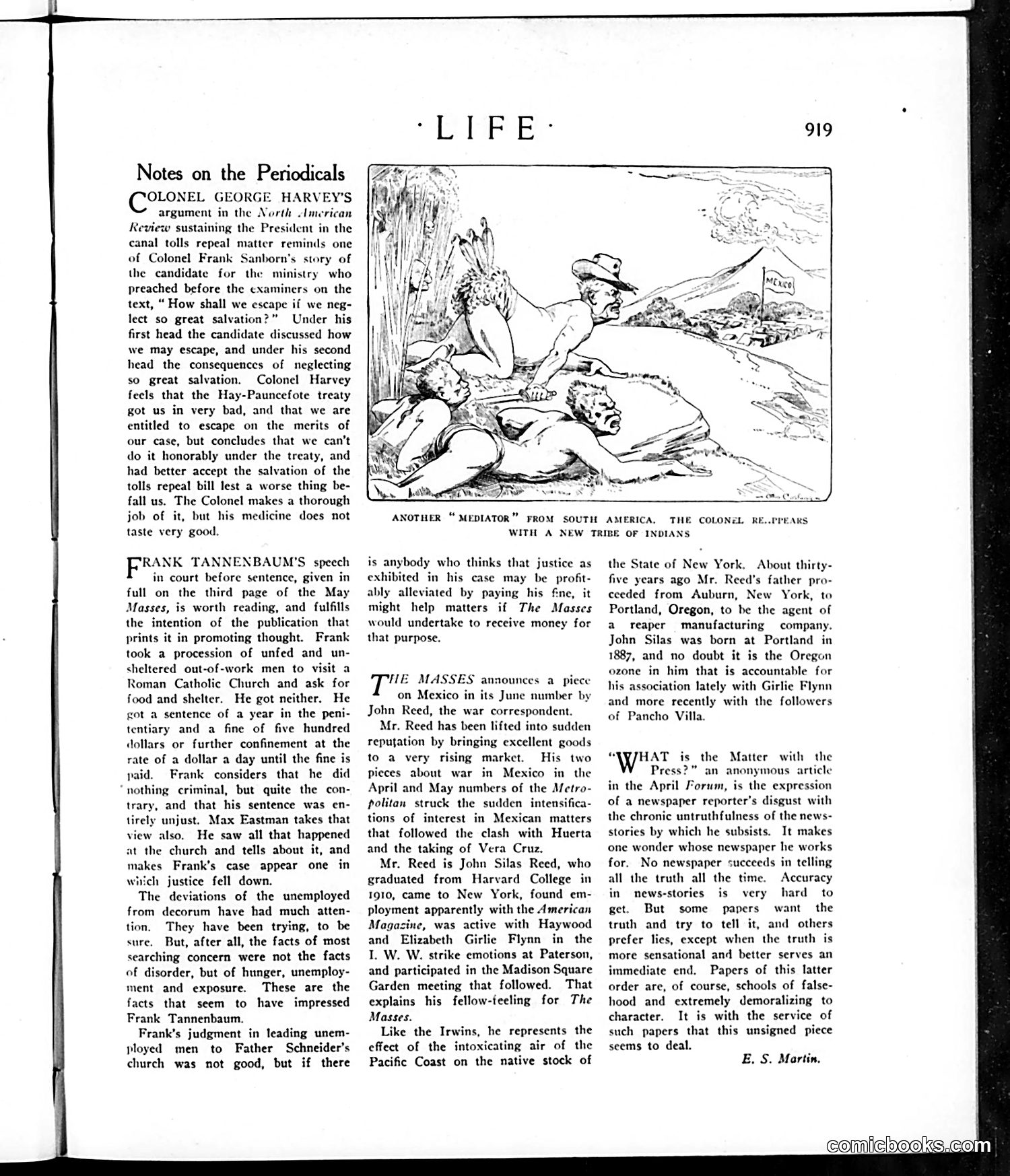
What you’re looking at
The cartoon depicts a colonial-era figure (labeled "The Colonel") encountering Native Americans in South America, presented as a "mediator" bringing a "new tribe of Indians." This is satirical commentary on American imperialism and canal politics. The "Colonel" represents U.S. diplomatic/military intervention in Latin America, particularly regarding canal tolls disputes (referenced in the accompanying text about the Hay-Pauncefote treaty). The cartoon mocks American claims of "mediation" or peaceful intent in the region by portraying colonial-style conquest imagery. The accompanying text discusses political debates over canal policy and Frank Tannenbaum's arrest for leading unemployed workers to a church seeking aid—connecting wealth/power disparities to American foreign policy rhetoric. The satire suggests the U.S. is merely imposing its will on Latin American nations while claiming diplomatic legitimacy, treating indigenous peoples as obstacles to American interests rather than as equals.
📄 Transcribed text from this page (OCR, searchable)
Machine-transcribed from the original scan — historical spelling and the odd misread are preserved.
Notes on the Periodicals OLONEL GEORGE HARVEY'S argument in the North slmerican Keview sustaining the President in the canal tolls repeal matter reminds one of Colonel Frank Sanborn’s story of the candidate for the ministry who preached before the examiners on the text, “ How shall we escape if we neg- lect so great salvation?” Under his first head the candidate discussed how we may escape, and under his second head the consequences of neglecting so great salvation. Colonel Harvey feels that the Hay-Pauncefote treaty got us in very bad, and that we are entitled to escape on the merits of our case, but concludes that we can't do it honorably under the treaty, and had better accept the salvation of the tolls repeal bill lest a worse thing be- fall us. The Colonel makes a thorough job of it, but his medicine does not taste very good. FRASK TANNENBAUM'S specch in court before sentence, given in full on the third page of the May Masses, is worth reading, and fulfills the intention of the publication that prints it in promoting thought. Frank took a procession of unfed and un- sheltered out-of-work men to visit a Roman Catholic Church and ask for food and shelter. He got neither. He got a sentence of a year in the peni- tentiary and a fine of five hundred dollars or further confinement at the rate of a dollar a day until the fine is paid. Frank considers that he did nothing criminal, but quite the con- trary, and that his sentence was en- tirely unjust. Max Eastman takes that view also. He saw all that happened at the church and tells about it, and makes Frank’s case appear one in which justice fell down. The deviations of the unemployed from decorum have had much atten- tion. They have been trying, to be sure. But, after all, the facts of most searching concern were not the facts of disorder, but of hunger, unemploy- ment and exposure. These are the facts that seem to have impressed Frank Tannenbaum. Frank's judgment in leading unem- ployed men to Father Schneider's church was not good, but if there ANOTHER “ MEDIATOR” FROM SOUTIL AMERICA, WITH A is anybody who thinks that justice as exhibited in his case may be profit- ably alleviated by paying his fine, it might help matters if The Masses would undertake to receive money for that purpose, MIE MASSES announces a piece on Mexico in its June number by John Reed, the war correspondent. Mr. Reed has been lifted into sudden reputation by bringing excellent goods to a very rising market. His two pieces about war in Mexico in the April and May numbers of the Metro- politan struck the sudden intensifica- tions of interest in Mexican matters that followed the clash with Huerta and the taking of Vera Cruz. Mr. Reed is John Silas Reed, who graduated from Harvard College in 1910, came to New York, found em- ployment apparently with the American Magazine, was active with Haywood and Elizabeth Girlie Flynn in the I. W. W. strike emotions at Paterson, and participated in the Madison Square Garden meeting that followed. That explains his fellow-feeling for The Masses. Like the Irwins, he represents the effect of the intoxicating air of the Pacific Coast on the native stock of THE COLONEL RE..PrEARS W TRIBE OF INDIANS the State of New York. About thirty- five years ago Mr. Reed’s father pro- eceded from Auburn, New York, to Portland, Oregon, to be the agent of a reaper manufacturing company. John Silas was born at Portland in 1887, and no doubt it is the Oregon ozone in him that is accountable for his association lately with Girlie Flynn and more recently with the followers of Pancho Villa. “NYJHAT is the Matter with the Press?” an anonymous article in the April Forum, is the expression of a newspaper reporter's disgust with the chronic untruthfulness of the news- stories by which he subsists. It makes one wonder whose newspaper he works for. No newspaper succeeds in telling all the truth all the time. Accuracy in news-stories is very hard to get. But some papers want the truth and try to tell it, and others prefer lies, except when the truth is more sensational and better serves an immediate end. Papers of this latter order are, of course, schools of false- hood and extremely demoralizing to character. It is with the service of such papers that this unsigned piece seems to deal. E, S. Martin,