
Life, 1914-05-21 · page 28 of 52
Life — May 21, 1914 — page 28: what you’re looking at
What you’re looking at
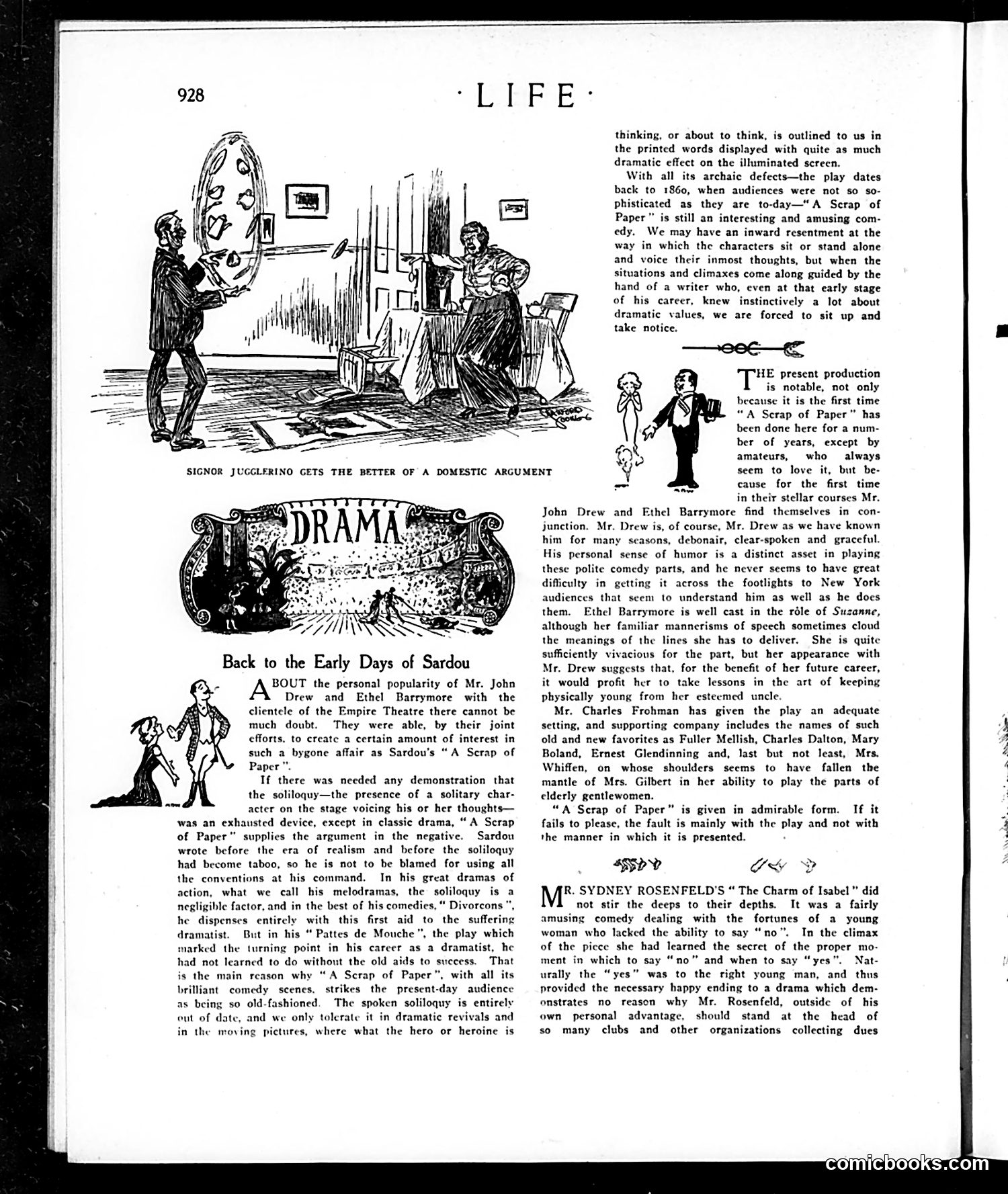
This page reviews a Broadway revival of Victorien Sardou's 1860 French comedy "A Scrap of Paper," starring actors John Drew and Ethel Barrymore at the Empire Theatre. The cartoon at top illustrates a domestic argument scene from the play. The critique centers on the play's "archaic" theatrical conventions—particularly the soliloquy (characters speaking alone to voice thoughts), which the reviewer calls "exhausted" and outdated. However, the reviewer acknowledges the play remains entertaining due to Sardou's skilled dramatic construction. The review praises Drew's "debonair" charm and comedic timing but gently suggests Barrymore, though vivacious, could benefit from elocution lessons. Producer Charles Frohman's staging and supporting cast (including Fuller Mellish and Mrs. Whiffen) receive adequate marks. The page demonstrates how Life magazine blended theatrical criticism with satirical illustration to entertain educated readers interested in Broadway productions.
📄 Transcribed text from this page (OCR, searchable)
Machine-transcribed from the original scan — historical spelling and the odd misread are preserved.
Back to the Early Days of Sardou BOUT the personal popularity of Mr. John Drew and Ethel Barrymore with the clientele of the Empire Theatre there cannot be much doubt. They were able, by their joint efforts, to create a certain amount of interest in such a bygone affair as Sardou's “A Scrap of Paper ". If there was needed any demonstration that the soliloquy—the presence of a solitary char- acter on the stage voicing his or her thoughts— was an exhausted device, except in classic drama, “ A Scrap of Paper” supplies the argument in the negative. Sardou wrote before the era of realism and before the soliloquy had become taboo, so he is not to be blamed for using all the conventions at his command. In his great dramas of action, what we call his melodramas, the soliloquy is negligible factor, and in the best of his comedies,“ Divorcons he dispenses entirely with this first aid to the suffering dramatist. But in his “ Pattes de Mouche", the play which marked the turning point in his career as a dramatist, he had not learned to do without the old aids to success. That is the main reason why “A Scrap of Paper”, with all its brilliant comedy scenes. strikes the present-day audience as being so old-fashioned. The spoken soliloquy is entirely out of date, and we only tolerate it in dramatic revivals and in the moving pictures, where what the hero or heroine is thinking, or about to think, is outlined to us in the printed words displayed with quite as much dramatic effect on the illuminated screen. With all its archaic defects—the play dates back to 1860, when audiences were not so so- phisticated as they are to-day—“A Scrap of Paper” is still an interesting and amusing com- edy. We may have an inward resentment at the way in which the characters sit or stand alone and voice their inmost thoughts, but when the situations and climaxes come along guided by the hand of a writer who, even at that early stage of his career, knew instinctively a lot about dramatic values, we are forced to up and take notice. — eee HE present production is notable, not only because it is the first time “A Scrap of Paper” has been done here for a num- ber of years, except by amateurs, who always seem to love it, but be- cause for the first time in their stellar courses Mr. John Drew and Ethel Barrymore find themselves in con- junction. Mr. Drew is, of course, Mr. Drew as we have known him for many seasons, debonair, clear-spoken and graceful. His personal sense of humor is a distinct asset in playing these polite comedy parts, and he never seems to have great difficulty in getting it across the footlights to New York audiences that seem to understand him as well as he does them. Ethel Barrymore is well cast in the réle of Suzanne, although her familiar mannerisms of speech sometimes cloud the meanings of the lines she has to deliver. She is quite sufficiently vivacious for the part, but her appearance with Mr. Drew suggests that, for the benefit of her future career, it would profit her to take lessons in the art of keeping physically young from her esteemed uncle. Mr. Charles Frohman has given the play an adequate setting, and supporting company includes the names of such old and new favorites as Fuller Mellish, Charles Dalton, Mary Boland, Ernest Glendinning and, last but not least, Mrs. Whiffen, on whose shoulders seems to have fallen the mantle of Mrs. Gilbert in her ability to play the parts of elderly gentlewomen. “<A Scrap of Paper” is given in admirable form. If it fails to please, the fault is mainly with the play and not with the manner in which it is presented. oy Ow R. SYDNEY ROSENFELD'S “ The Charm of Isabel" did not stir the deeps to their depths. It was a fairly amusing comedy dealing with the fortunes of a young woman who lacked the ability to say “no”. In the climax of the picce she had learned the secret of the proper mo- ment in which to say “no” and when to say “yes”. Nat- urally the “yes” was to the right young man, and thus provided the necessary happy ending to a drama which dem- onstrates no reason why Mr. Rosenfeld, outside of his own personal advantage, should stand at the head of so many clubs and other organizations collecting dues nae