
Life, 1914-05-21 · page 6 of 52
Life — May 21, 1914 — page 6: what you’re looking at
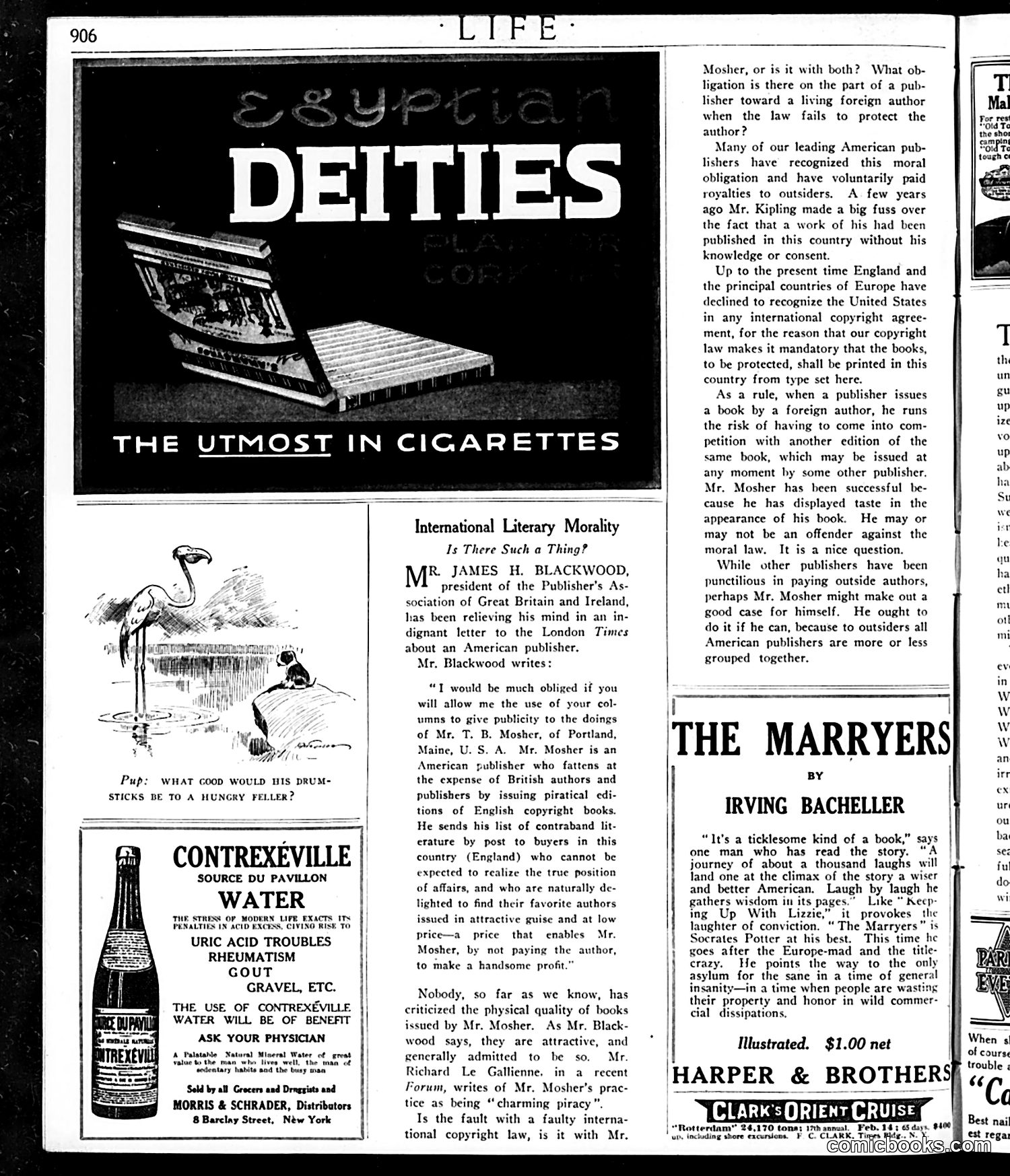
What you’re looking at
This page is primarily **advertising and book promotion** rather than political satire. The main cartoon shows a **stork carrying a book**, captioned "Pax: What good would the dumbsticks be to a hungry fellow?" This appears to be a visual pun about delivering literature (the stork's traditional role) rather than sustenance—satirizing perhaps the impracticality of books as aid during hardship. The central article by James H. Blackwood, president of the Publisher's Association, discusses **"International Literary Morality"**—specifically criticizing T.B. Mosher, a Portland publisher who allegedly issues unauthorized, low-priced editions of English copyright books. Blackwood frames this as a moral and legal issue about respecting author rights and fair competition. The page otherwise features advertisements for Contrexéville Water and book promotions.
📄 Transcribed text from this page (OCR, searchable)
Machine-transcribed from the original scan — historical spelling and the odd misread are preserved.
FR SALE Fa —— Pup: WHAT Good WOULD HIS DRUM- STICKS BE TO A HUNGRY F: CONTREXEVILLE SOURCE DU PAVILLON WATER NESS OF MODER: EXACTS. 11S TES IN ACID EXCESS, CIVINO RISE TO URIC ACID TROUBLES RHEUMATISM GOUT GRAVEL, ETC. THE USE OF CONTREXEVILLE. WATER WILL BE OF BENEFIT ASK YOUR PHYSICIAN A Palatahle Natural Miseral Water of great Falue ts the man who lives well, the man ef ‘codentary habits and the busy maa ‘Sold by all Grocers and Drngzists and MORRIS & SCHRADER, Distributors 8 Barclay Street, New York International Literary Morality Is There Such a Thing? R. JAMES H. BLACKWOOD, president of the Publisher's As- sociation of Great Britain and Ireland, has been relieving his mind in an in- dignant letter to the London Times about an American publisher. Mr. Blackwood writes: “TI would be much obliged if you will allow me the use of your col- umns to give publicity to the doings of Mr. T. B. Mosher, of Portland, Maine, U. S. A. Mr. Mosher is an American publisher who fattens at the expense of British authors and publishers by issuing piratical edi- tions of English copyright books. He sends his list of contraband lit- erature by post to buyers in this country (England) who cannot be expected to realize the true position of affairs, and who are naturally de- lighted to find their favorite authors issued in attractive guise and at low price—a price that enables Mr. Mosher, by not paying the author, to make a handsome profit.” Nobody, so far as we know, has criticized the physical quality of books issued by Mr. Mosher. As Mr. Black- wood says, they are attractive, and generally admitted to be so. Mr. Richard Le Gallienne. in a recent Forum, writes of Mr. Mosher’s prac- tice as being “charming piracy”. Is the fault with a faulty interna- tional copyright law, is it with Mr. 1 Mosher, or is it with both? What ob- ligation is there on the part of a pub- lisher toward a living foreign author when the law fails to protect the author? Many of our leading American pub- lishers have recognized this moral obligation and have voluntarily paid royalties to outsiders. A few years ago Mr. Kipling made a big fuss over the fact that a work of his had been published in this country without his knowledge or consent. Up to the Present time England and the principal countries of Europe have declined to recognize the United States in any international copyright agree- ment, for the reason that our copyright law makes it mandatory that the books, to be protected, shall be printed in this country from type set her As a rule, when a publisher issues a book by a foreign author, he runs the risk of having to come into com- petition with another edition of the same book, which may be issued at any moment by some other publisher. Mr. Mosher has heen successful be- cause he has displayed taste in the appearance of his book. He may or may not be an offender against the moral law. It is a nice question. While other publishers have been punctilious in paying outside authors, perhaps Mr. Mosher might make out a good case for himself. He ought to do it if he can, because to outsiders all American publishers are more or less grouped together. THE MARRYERS IRVING BACHELLER “It's a ticklesome kind of a book,” says one man who has read the story. “A journey of about a thousand laughs will land one at the climax of the story a wiser and better American. Laugh by laugh he gathers wisdom in its pages.” Like “ Keep- ing Up With Lizzie,” it provokes the laughter of conviction. “ The Marryers” is Socrates Potter at his best, This time he goes after the Europe-mad and the title- raz’ He points the way to the only asylum for the sane in a time of genera al insanity—in a time when people are wasting their property and honor in wild commer- cial dissipations. Illustrated. $1.00 net HARPER & BROTHERS, CLAR ORIENT CRUE