
Life, 1914-05-21 · page 30 of 52
Life — May 21, 1914 — page 30: what you’re looking at
What you’re looking at
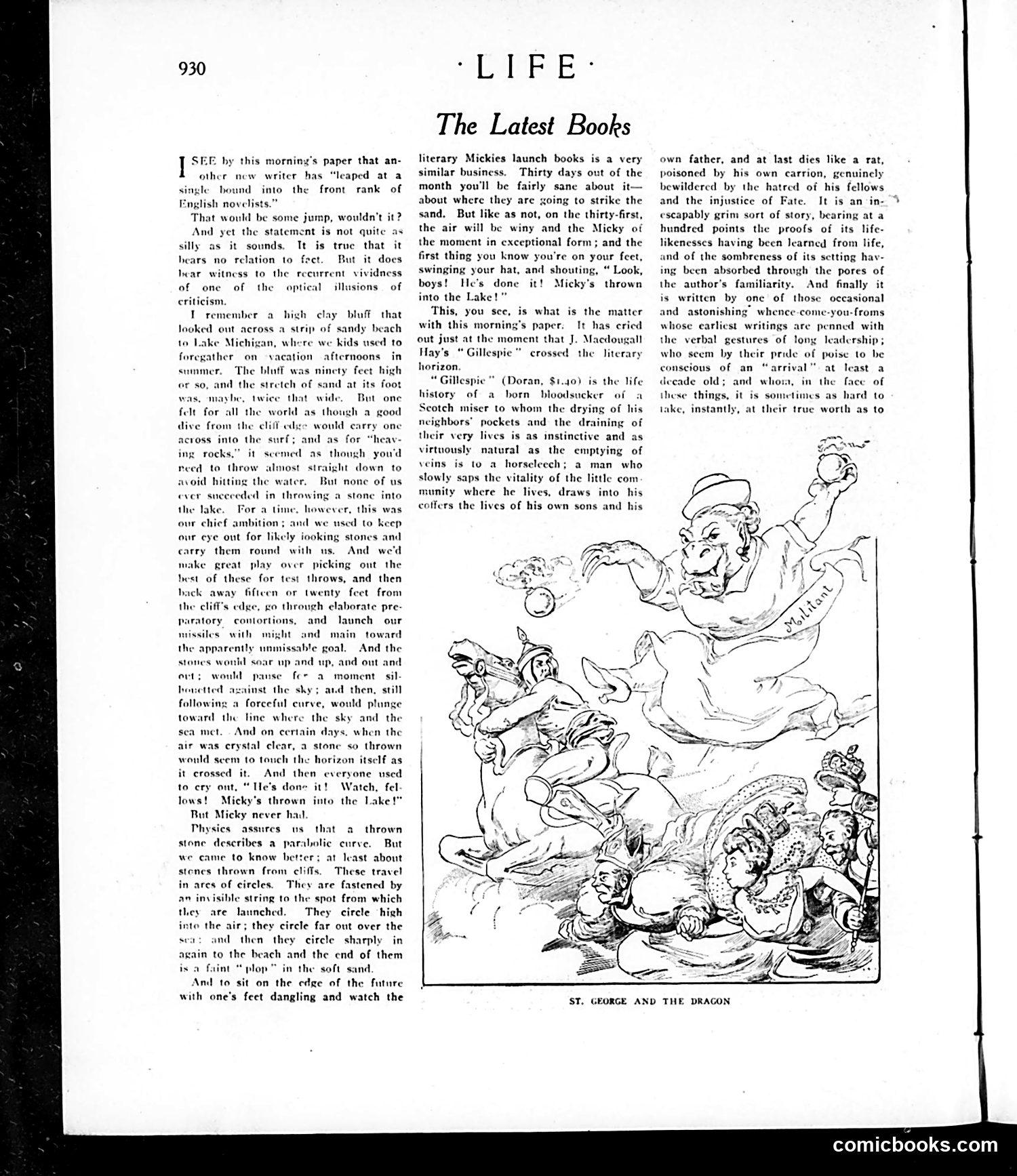
This is a book review column that uses an extended metaphor to critique literary criticism's tendency toward hyperbole. The author compares reviewers' breathless declarations that new writers have "leaped" into the front rank of novelists to children throwing stones from a Lake Michigan cliff—imagining their throws reached the water when physics proves otherwise. The illustration titled "ST. GEORGE AND THE DRAGON" appears to be decorative, though its relevance to the text is unclear from this page. The review then applies this metaphor to J. Macdougall Hay's novel "Gillespie" (published by Doran, $1.40), about a predatory Scottish miser who drains his community's vitality like a "horseleech." The author warns against exaggerated praise, suggesting that today's sensational book announcement may prove as delusional as those childhood stone-throws—the book circles back to reality rather than achieving lasting literary significance.
📄 Transcribed text from this page (OCR, searchable)
Machine-transcribed from the original scan — historical spelling and the odd misread are preserved.
930 SEE hy this morning's paper that an- other new writer has “leaped at a gle bound into the front rank of English novelists.” That would be some jump, wouldn't it? And yet the statement is not quite as silly as it sounds, Tt is truc that it hears no relation to fret. But it does hear witness to the recurrent vividness of one of the optical illusions of criticism. T remember a high clay bluff that looked out across a strip of sandy beach to Lake Michigan, where we kids used to foregather on vacation afternoons in summer. The bl nd the stretch of sand at its foot that wide. Bu the world as though a good ff was ninety feet high or 80, was, mayhe, twie felt for: dive from the cli ede would carry one across into the surf; and as for “heav- ing rocks.” it seemed as though you'd reed to throw almost straight down to avoid hitting the water, But none of us ever sneeceded in throwing a stone into the lake. . this was our chief ambition; and we tsed to keep our cye out for likely iooking stones and carry them round with us. And we'd make great play over picking out the hest of these for test throws, and then hack away fifteen or twenty feet from the cliff’s edge, go through elaborate pre- paratory contortions, and launch our missiles with might) and main toward the apparently unmissable goal. And the nd up, and out and ort; would panse fer a moment sil- henetted azainst the shy; and then, still following a forceful curve, would plunge toward the fine where the sky and the sea met. And on certain days. when the air was crystal clear, a stone so thrown would scem to touch the horizon itself as it crossed it. And then everyone used to cry ont, “He's done it! Watch, fel lows! Micky’s thrown into the Lake!" Rut Micky never had Physics assures us that a thrown stone describes a parabolic enrve. But we came to know hetter; at least about stones thrown from cliffs. These travel in ares of circles. They are fastened by an invisible string to the spot from which they are launched. They circle “high into the air; they circle far out over the sea: and then they circle sharply in again to the beach and the end of them isa faint “plow” in the soft sand. And to sit on the edge of the future with one’s feet dangling and watch the one ora time, howeve stones wonkd soar up “LIFE: The Latest Books literary Mickies launch books is a very similar business. Thirty days out of the month you'll be fairly sane about it— about where they are going to strike the sand. But like as not, on the thirty-first, the air will be winy and the Micky of the moment in exceptional form; and the first thing you know you're on your feet, swinging your hat, and shouting, “ Look, boys! He's done it! Micky'’s thrown into the Lake!" This, you sce, is what is the matter with this morning's paper. It has cried out just at the moment that J. Macdougall Hay’s orizon. Gillespie " (Doran, $1.40) is the life history of a born bloodsucker of a Scotch miser to whom the drying of his neighbors’ pockets and the draining of ir very lives is as instinctive and as virtuously natural as the emptying of veins is to a horseleech; a man who saps the vitality of the little com nunity where he lives, draws into his cotfers the lives of his own sons and his Gillespie" crossed the literary own father, and at last dies like a rat, poisoned by his own carrion, genuinely bewildered by the hatred of his fellows and the injustice of Fate. It is an in- escapably grim sort of story, bearing at a hundred points the proofs of its life- likenesses having been Jearned from and of the sombreness of its setting ing been absorbed through the pores of the author's familiarity. And finally it is written by one of those occasional and astonishing” whence-come-you-froms whose earliest writings are penned with the verbal gestures of long leadership; who scem by their pride of poise to be conscious of an “arrival” at least a ivcade old; and whom, in the face of these thing: nes as hard to take, instantly, at their true worth as to it is son ST. GEORGE AND THE DRAGON comicbooks.com