
A complete issue · 40 pages · 1913
Life — November 27, 1913
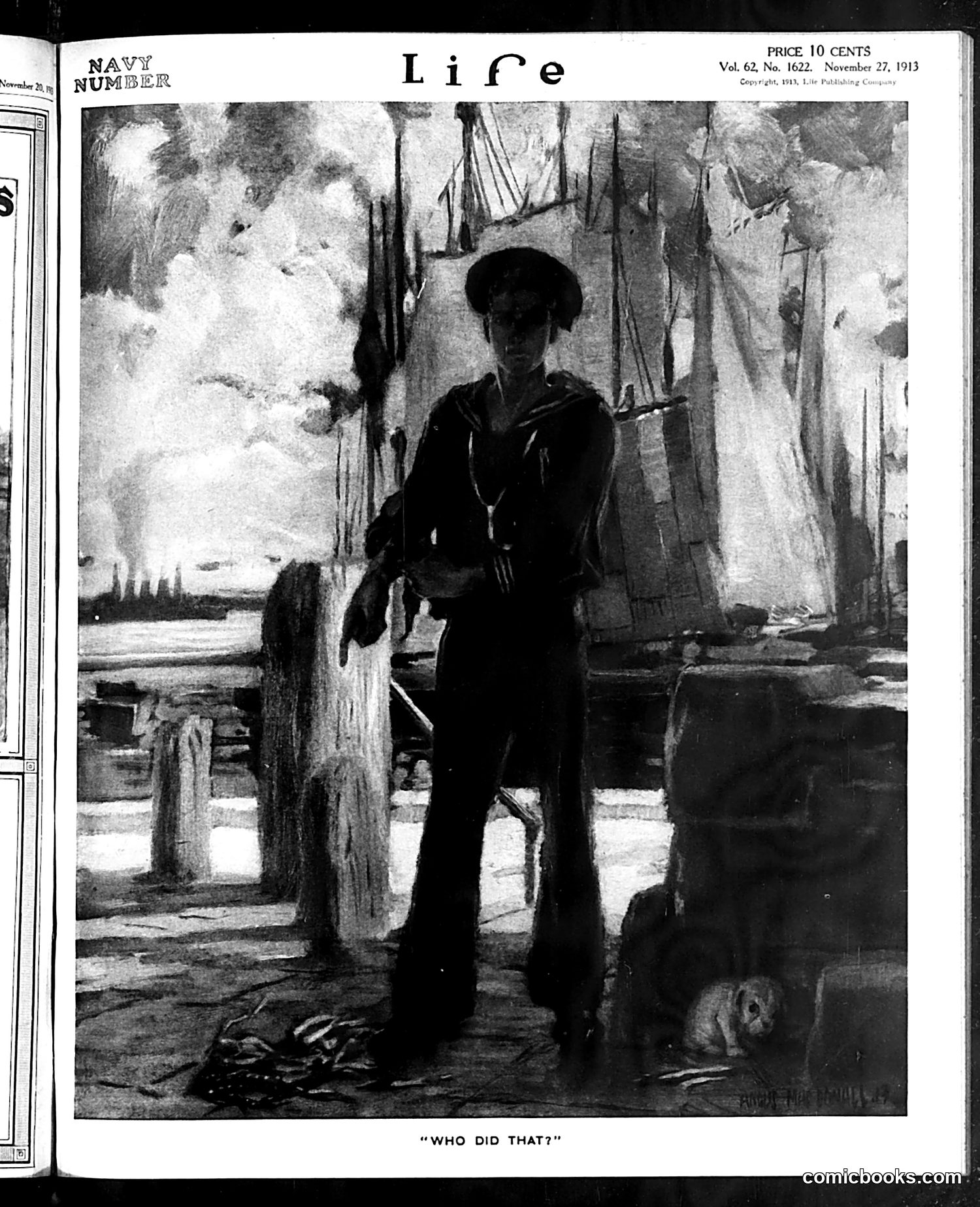
This Life magazine cover from November 27, 1913 shows a silhouetted sailor in naval uniform standing in what appears to be a shipyard or dock, with the caption "WHO DID THAT?" below. The image likely references naval construction or a recent maritime incident of 1913, though the specific event isn't clear from the visual alone. The sailor's prominent silhouette and questioning caption suggest either: (1) blame or accountability for some naval mishap, or (2) commentary on naval incompetence or negligence. Without additional context from the OCR text or page content, I cannot definitively identify which incident this references. The satirical intent appears to focus on responsibility within naval operations during the early 20th century.
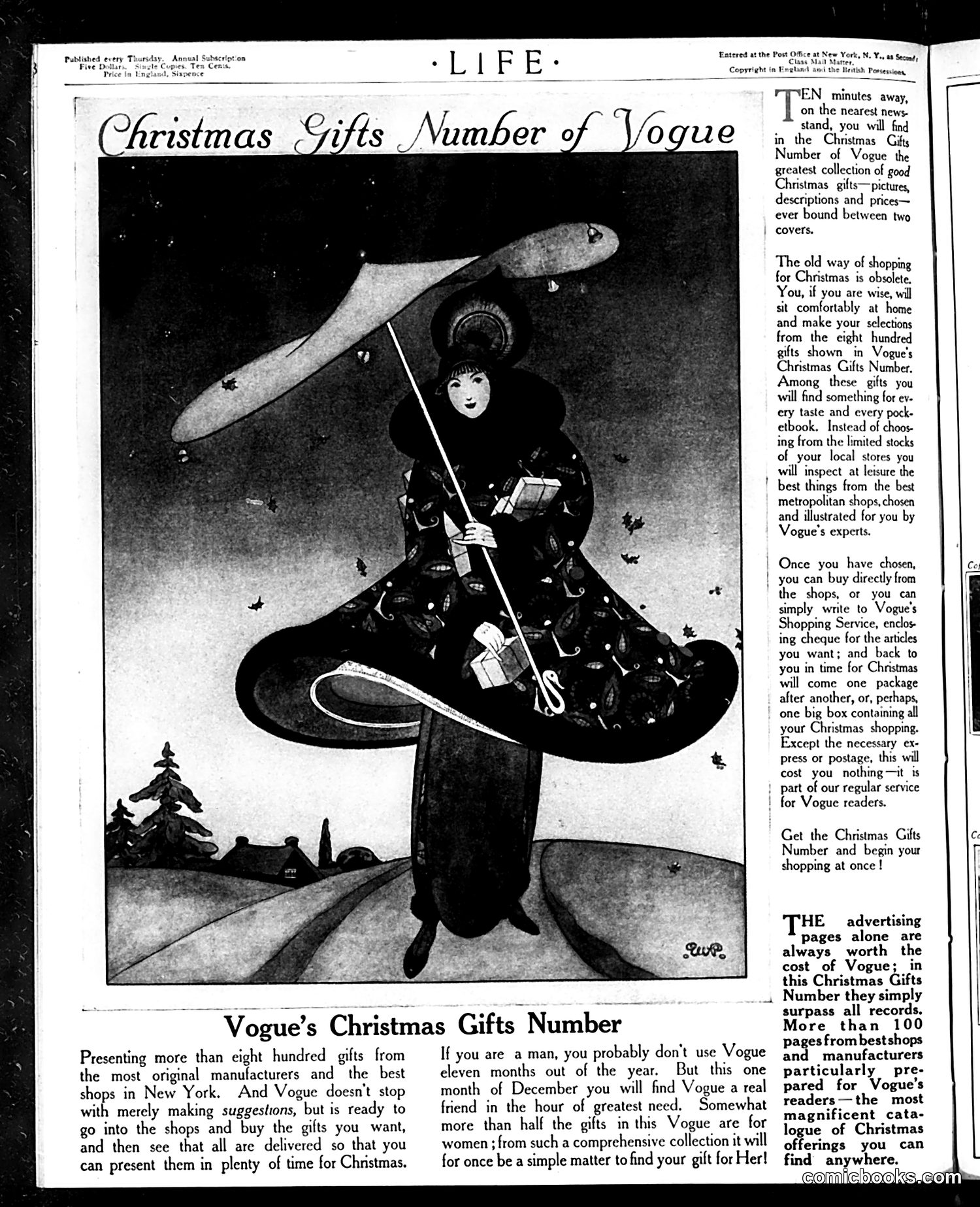
This is primarily **advertising content**, not satire or political commentary. It's a promotional page for Vogue magazine's "Christmas Gifts Number." The illustration depicts a fashionable woman in elegant black clothing riding a mushroom like a magical steed, surrounded by flying gift boxes and a winter landscape below. This whimsical, surreal imagery is purely decorative advertising—designed to appeal to upscale readers. The accompanying text promotes Vogue's shopping service: readers can browse 800+ gift suggestions from the magazine at home, then order items directly through Vogue, which will deliver packages before Christmas. It positions this as modernizing Christmas shopping—replacing trips to local stores with convenient mail-order service. The tone is aspirational and convenience-focused rather than satirical.
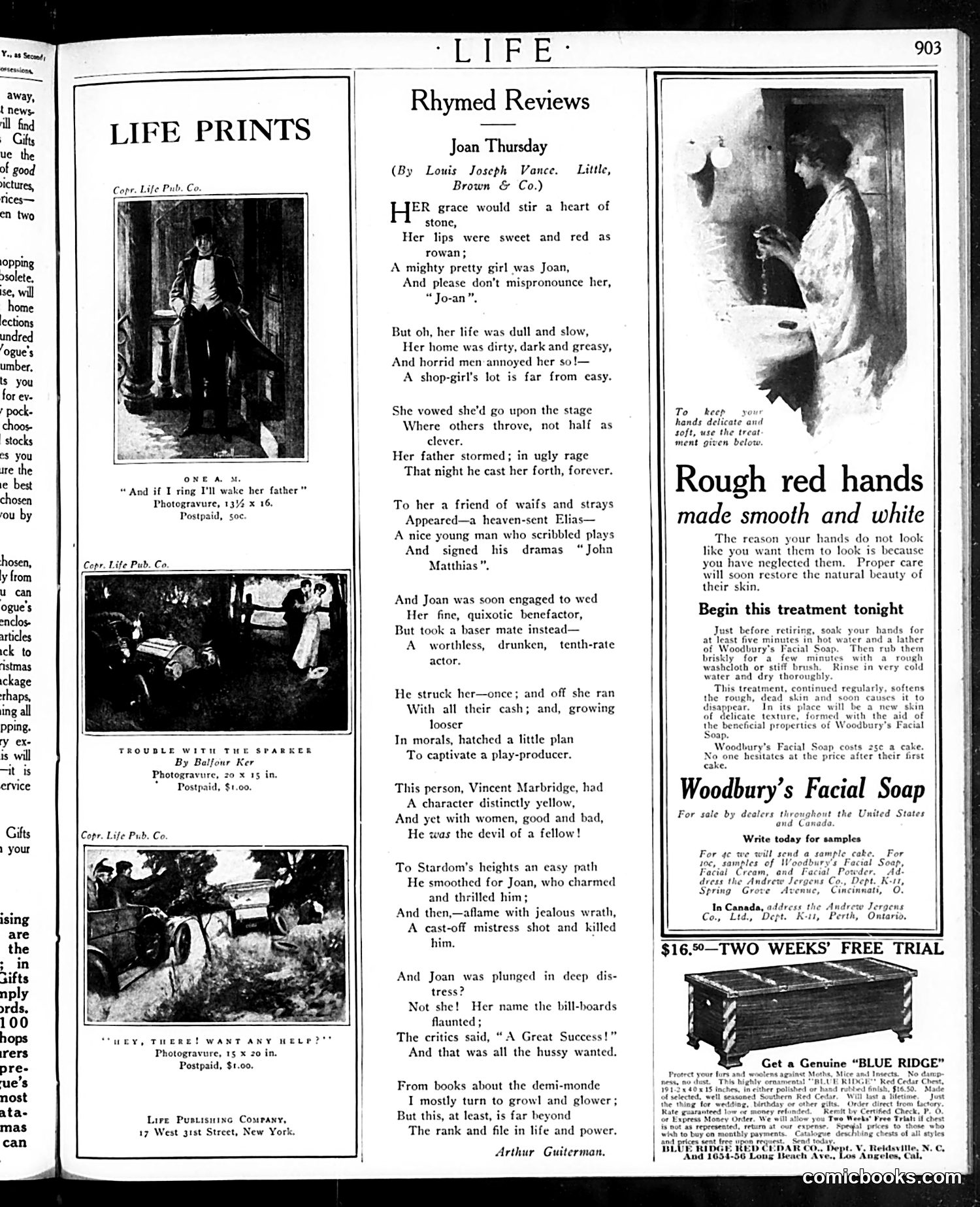
This page is **primarily literary and advertising content**, not political satire. The main feature is "Joan Thursday," a poem by Louis Joseph Vance reviewing a book about a shop girl who becomes a stage actress. The narrative follows her escape from a grim home life through theater, her engagement to a wealthy but dissolute man, and ultimately her plunge into distress—a conventional melodrama about social mobility and moral peril. The left column shows three "Life Prints"—photographic reproductions from films, illustrating theatrical scenes. The right side advertises Woodbury's Facial Soap with beauty advice about hand care. The bottom advertises a "Blue Ridge" bed, offering a free trial. This reflects Life magazine's dual nature: literary/satirical content mixed with consumer advertising targeting middle-class readers.
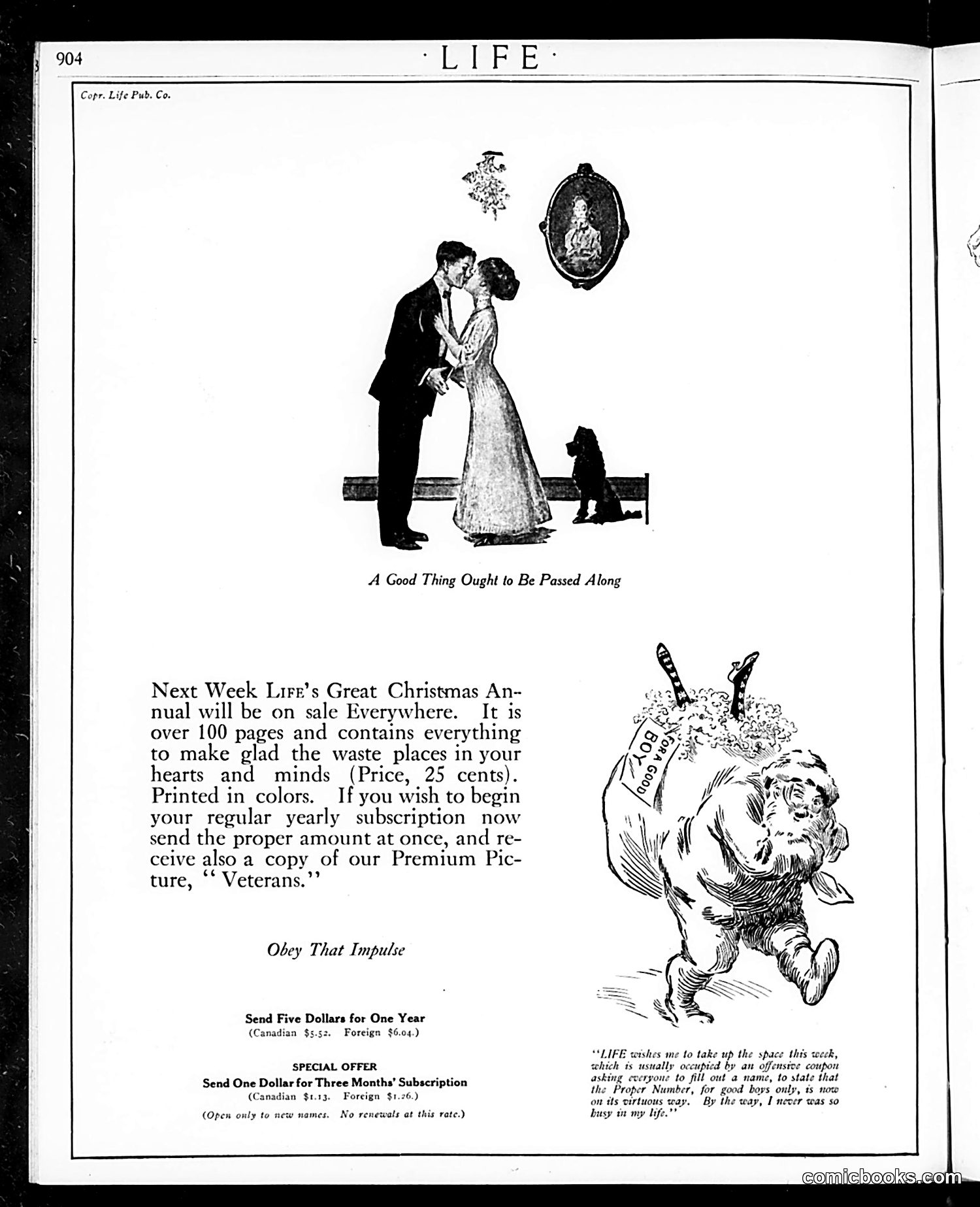
This page is primarily **advertising for Life magazine subscriptions**, not political satire. The top illustration, captioned "A Good Thing Ought to Be Passed Along," depicts a couple kissing while a small dog watches—a lighthearted domestic scene promoting the magazine's appeal. The main text advertises Life's upcoming **Christmas Annual** (over 100 pages, 25 cents, in color) and offers subscription rates: five dollars for one year, or one dollar for three months. The bottom illustration shows **Santa Claus** carrying a sack labeled "1908," with a quote about Life magazine filling "waste places in your hearts and minds"—positioning the publication as a Christmas gift. The page functions as straightforward commercial promotion rather than political commentary or satire.
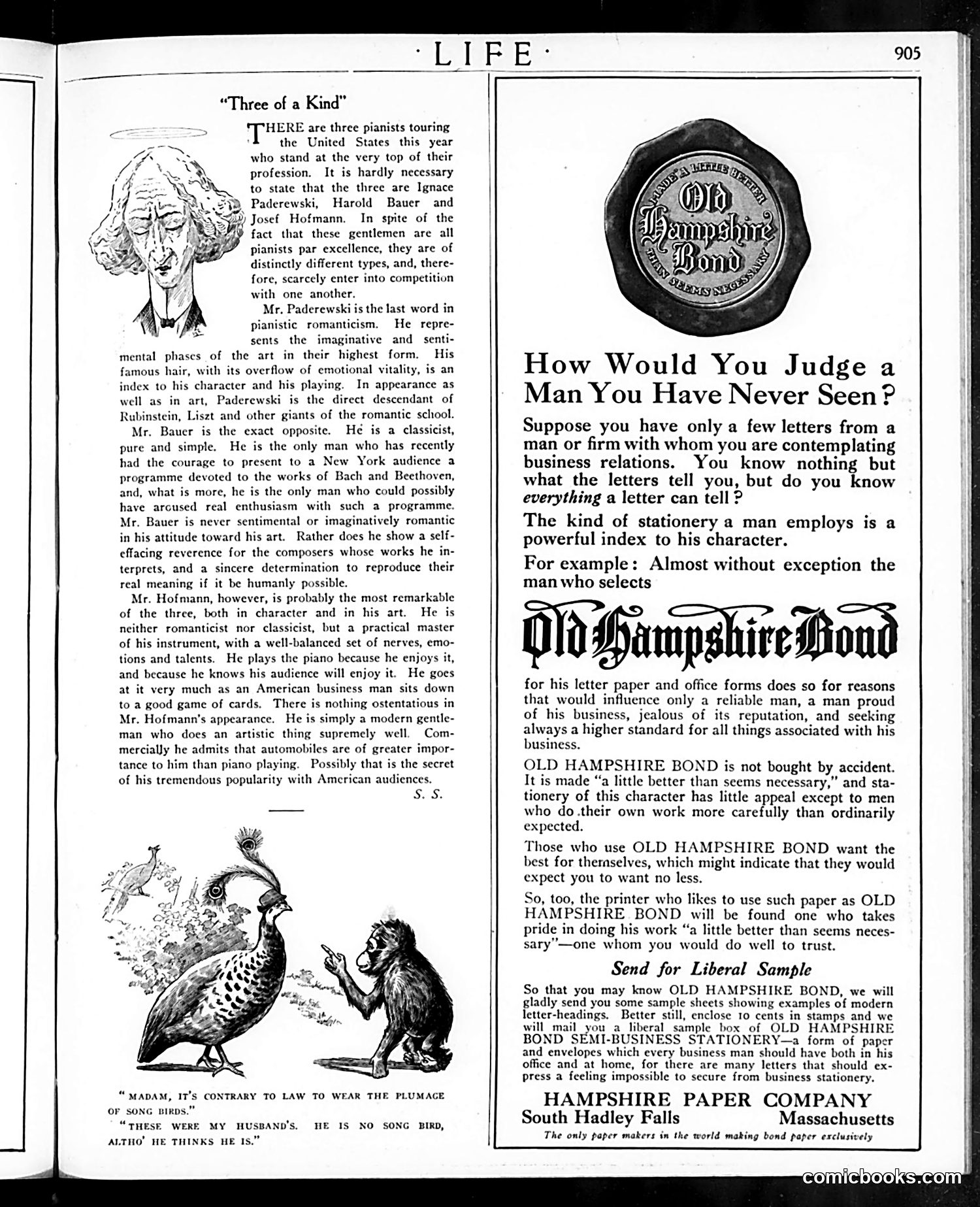
**"Three of a Kind" article** discusses three renowned pianists touring the United States: Ignace Paderewski, Harold Bauer, and Josef Hofmann. The accompanying caricature (left) likely depicts one of these musicians, emphasizing distinctive physical features—a common satirical practice. **The lower cartoon** shows a woman and monkey in dialogue. The woman says her husband is "no song bird," and the monkey responds he's "no song bird" either, suggesting he thinks he is. This appears to be a joke equating human behavior with animal behavior, likely mocking either vanity or the pretensions of someone (possibly a musician?) who overestimates their talents. The right page contains an advertisement for Hampshire Bond stationery, unrelated to the satire.
This is **not a cartoon or satire page** — it's a **straightforward advertisement** for the Locomotile automobile, published in *Life* magazine (page 906). The ad argues that the Locomotile's quality justifies its high price and limited production (only one car per 300 people in the U.S.). Key claims: the car is "made in strictly limited numbers to insure quality," features "peculiar facilities and constant personal attention," and employs quality control methods like hand-made nuts and bolts that other manufacturers don't use. The text positions the Locomotile as a luxury product for affluent buyers who prioritize craftsmanship over affordability. There is no satire here — it's a earnest marketing pitch emphasizing exclusivity and superior manufacturing as selling points.
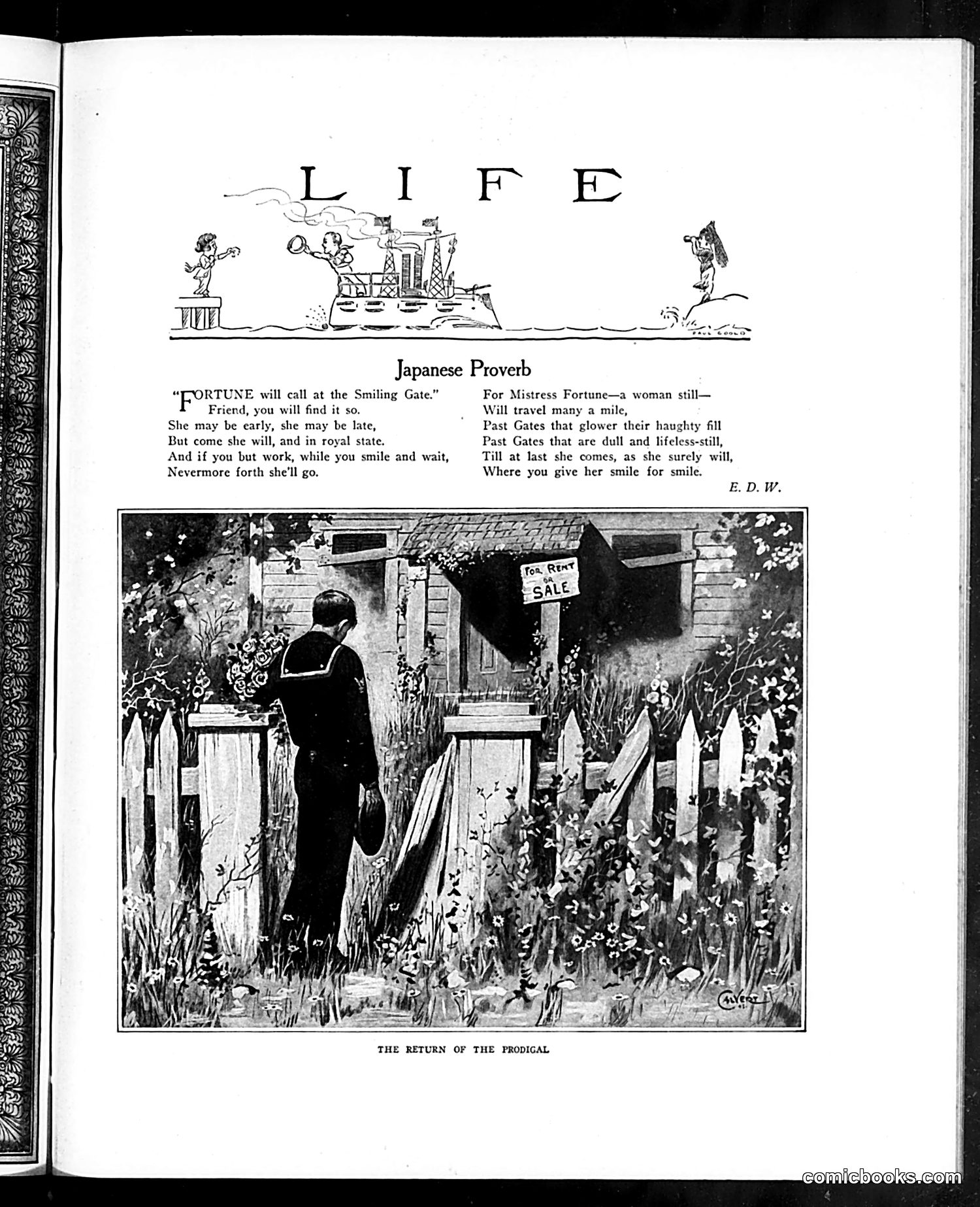
This illustration depicts a man in dark clothing viewing a modest house with a "For Rent" and "Sale" sign, surrounded by an overgrown, neglected garden. The caption references the Biblical parable of the Prodigal Son. The satire appears to comment on economic hardship or property decline—likely depicting someone returning home after absence to find their residence abandoned, in disrepair, or sold. The juxtaposition with the Japanese proverb about Fortune calling at the "Smiling Gate" emphasizes irony: while the proverb promises eventual good fortune to those who remain patient and cheerful, this figure finds only decay and loss. The cartoon likely satirizes economic anxiety of early 20th-century America—unemployment, foreclosure, or homelessness—contrasting optimistic folk wisdom with harsh reality.
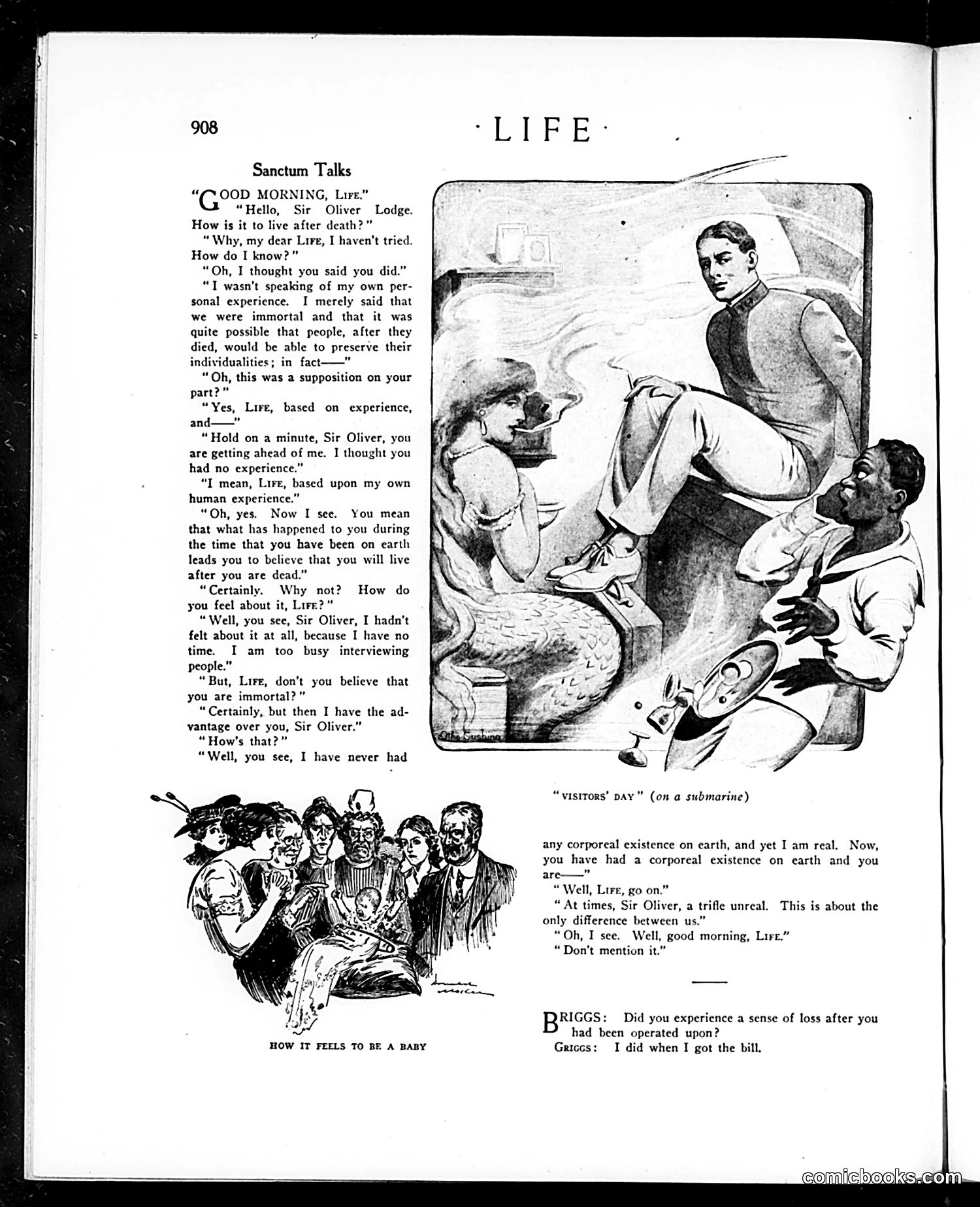
This page from *Life* magazine contains two distinct satirical pieces: **"Sanctum Talks"** (top): A dialogue between "Life" (personified) and "Sir Oliver Lodge" (a real spiritualist/physicist) about afterlife and immortality. Lodge was a prominent figure in early 20th-century spiritualism who publicly advocated for communicating with the dead. The satire mocks his claims by having "Life" challenge his assumptions about personal experience and immortality—essentially questioning the validity of spiritualist beliefs through witty debate. **"Visitors' Day (On a Submarine)"** and **"How It Feels to Be a Baby"** (bottom): These are humorous illustrations with brief comedic captions, typical of *Life*'s satirical humor. The final joke about "Briggs" and sense of loss following surgery makes a dark joke about unexpected medical bills.
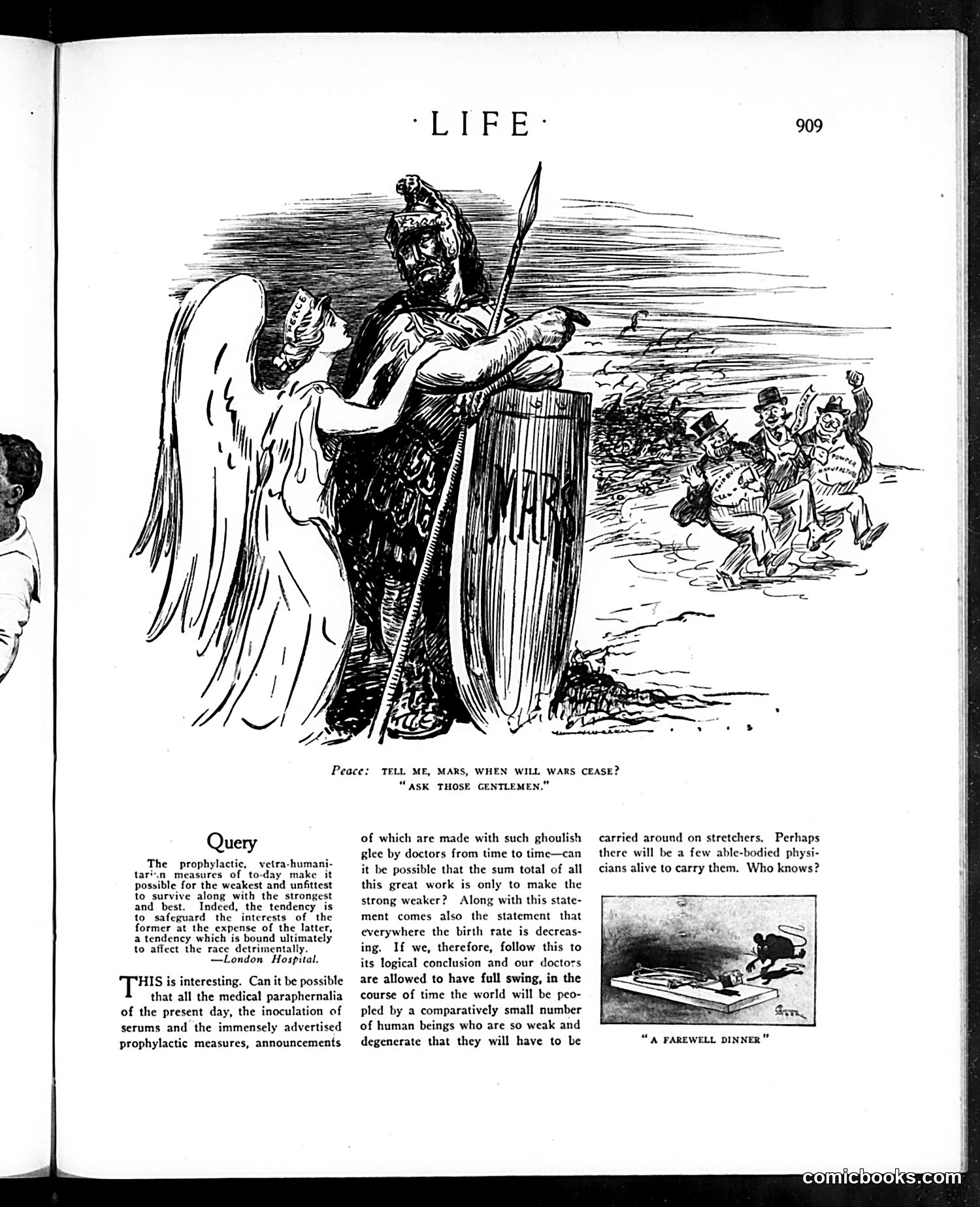
The main cartoon depicts Mars (the Roman god of war), identifiable by his beard, armor, and sword, holding a winged figure (likely Peace or Victory) while pointing toward distant soldiers on a battlefield. The caption reads "Peace: Tell me, Mars, when will wars cease? 'Ask those gentlemen.'" This is anti-war satire suggesting that military leaders and politicians—"those gentlemen" in the distance—bear responsibility for perpetual conflict. By having Mars deflect the question to human decision-makers, the cartoon critiques the notion that war is inevitable or divinely ordained, instead attributing it to human choice and leadership. The accompanying article discusses medical efforts to reduce human suffering and birth rates, questioning whether such measures ultimately strengthen or weaken populations—a eugenic-era concern reflecting early 20th-century anxieties about population management.
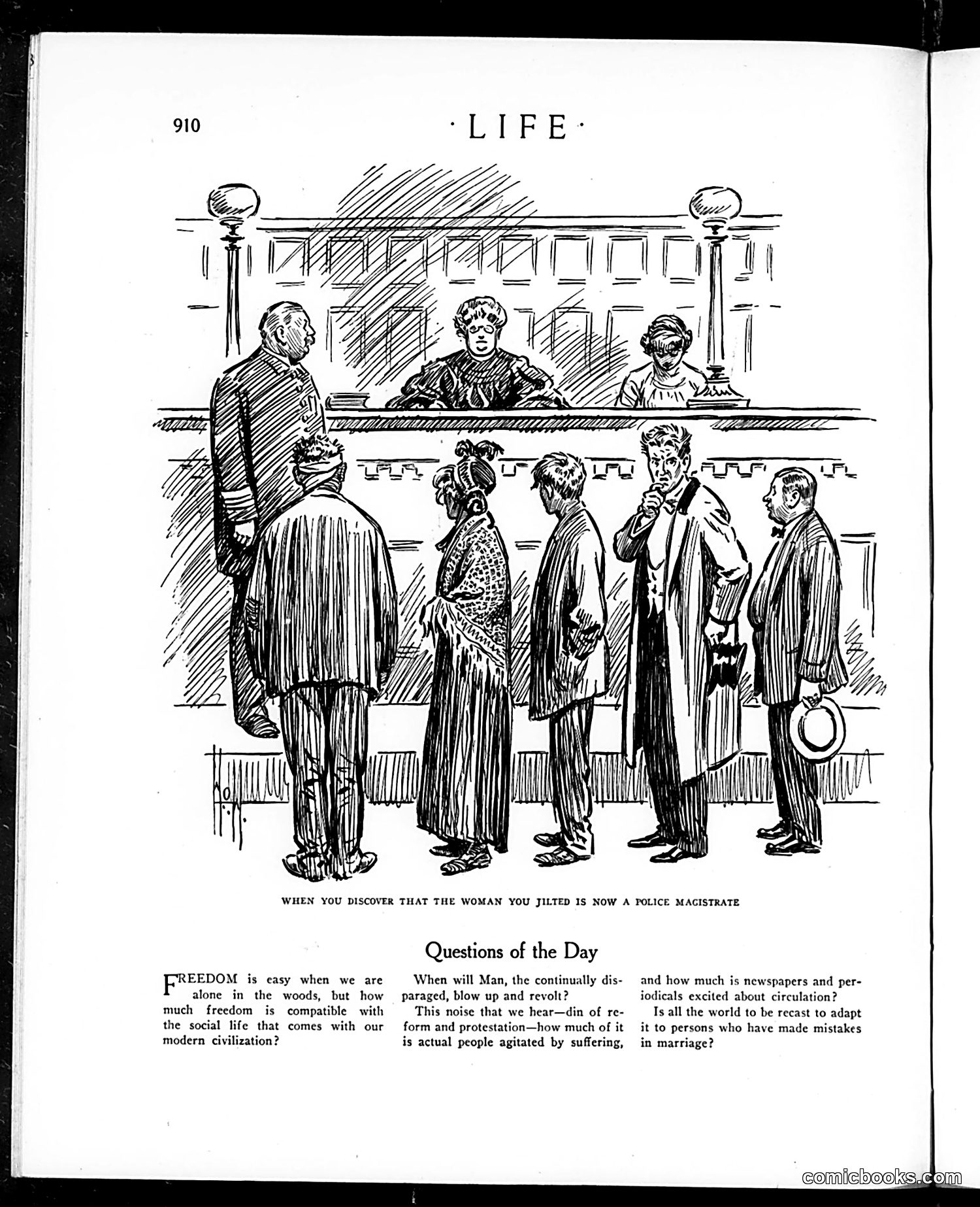
This is a satirical cartoon about women entering the judiciary system. The illustration shows five men in formal attire standing before a courtroom bench where a woman sits as magistrate, with two other women court officials behind her. The caption reads: "WHEN YOU DISCOVER THAT THE WOMAN YOU JILTED IS NOW A POLICE MAGISTRATE" The joke targets the anxieties of the era regarding women's expanding professional roles. The cartoon satirizes the vulnerability of men who might face professional consequences from women they've romantically wronged—suggesting a female magistrate might abuse her judicial authority for personal revenge. This reflects early-20th-century concerns about women's suffrage and judicial appointments, portraying women's professional advancement as potentially dangerous rather than legitimate progress.
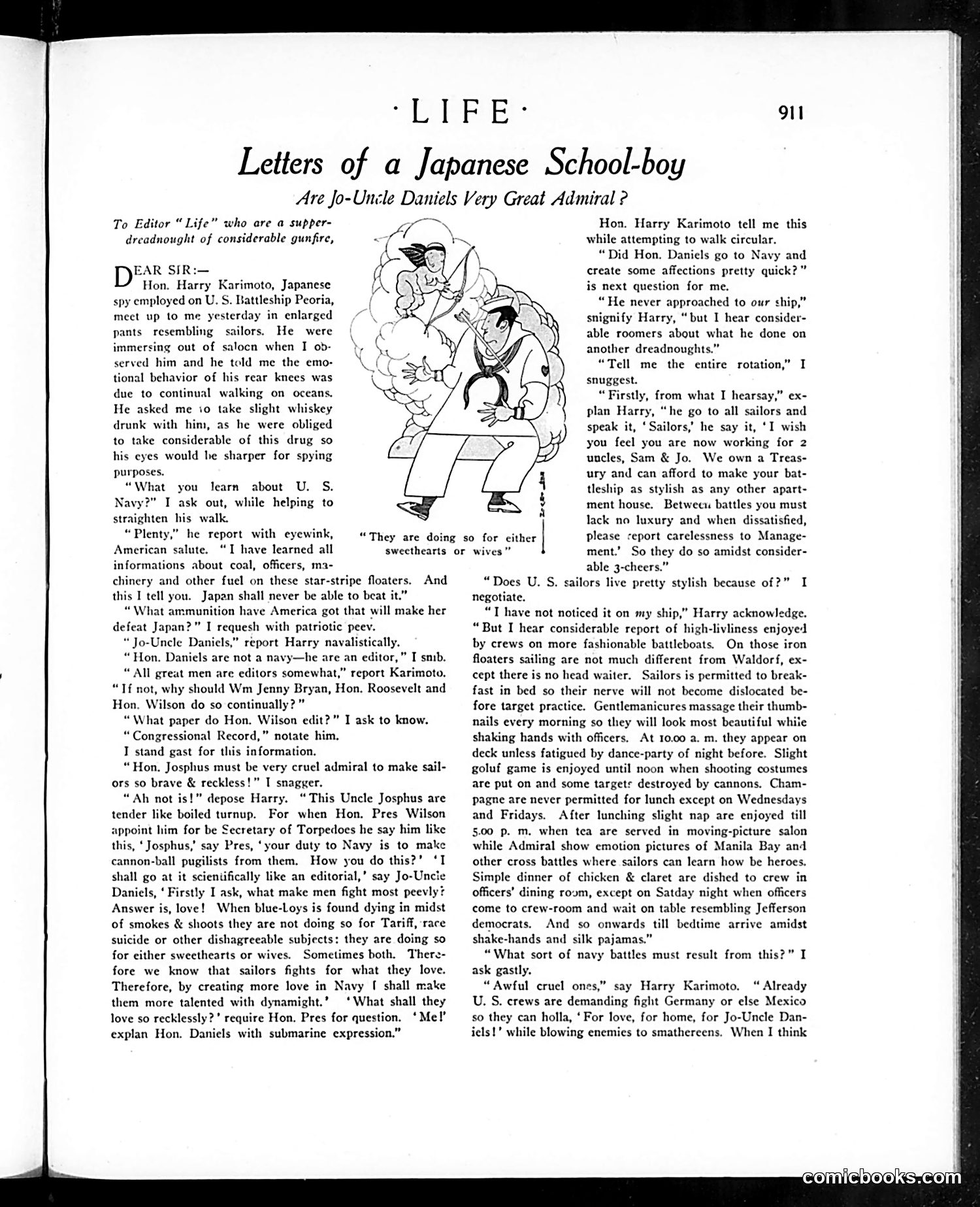
This satirical piece presents a Japanese correspondent's critical observations of the U.S. Navy. The cartoon shows Japanese sailors discussing American naval affairs, with the accompanying letter mocking American naval practices and personnel. The satire targets: - **American naval efficiency and discipline** - critiquing sailors' behavior, living conditions, and lack of formality - **U.S. military leadership** - particularly figures like Hon. Daniels (likely Secretary of the Navy Josephus Daniels), questioning their command decisions - **Naval morale and management** - describing crews as undisciplined, noting officers' excessive socializing The piece uses the device of a "Japanese observer" to present pointed criticism of American military readiness and naval culture from an outsider's perspective, implying that even foreign observers notice America's military shortcomings. This reflects pre-WWI concerns about naval preparedness.
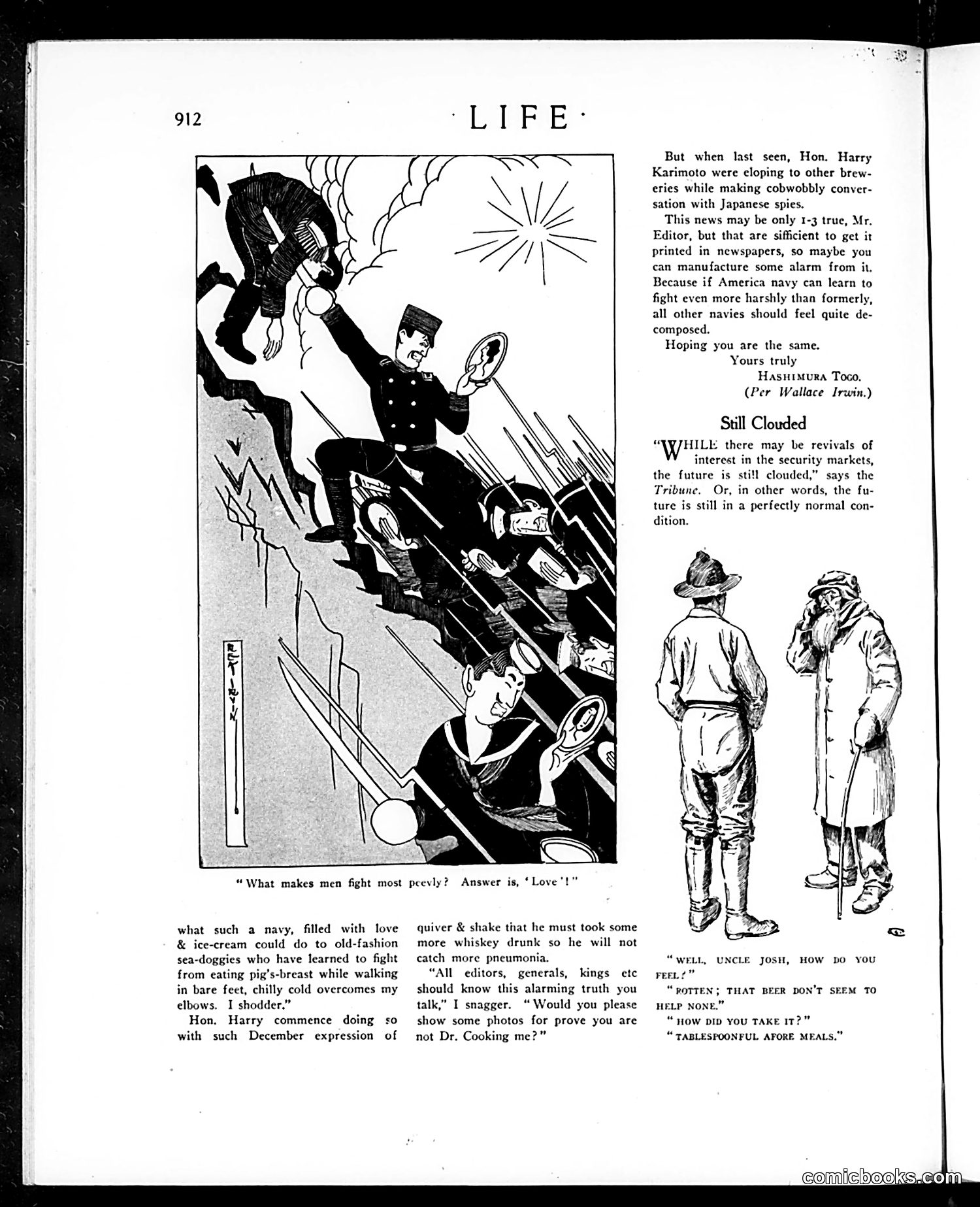
This satirical cartoon depicts military personnel in chaos—a sailor and officer tumbling down with scattered items and explosions. The caption suggests that romantic concerns distract soldiers more than actual combat danger. The accompanying letter from "Hashimura Togo" (a Japanese pseudonymous character common in early-20th-century American satire) warns of Japanese naval espionage, claiming Hon. Harry Karimoto was "eloping to other breweries while making cobbly conversation with Japanese spies." The satire mocks both military readiness concerns and the stereotype that Japanese agents infiltrate American institutions. The right-side cartoon about "Uncle Josh" and beer appears unrelated domestic humor. The overall tone suggests pre-WWI anxieties about national security and military preparedness.
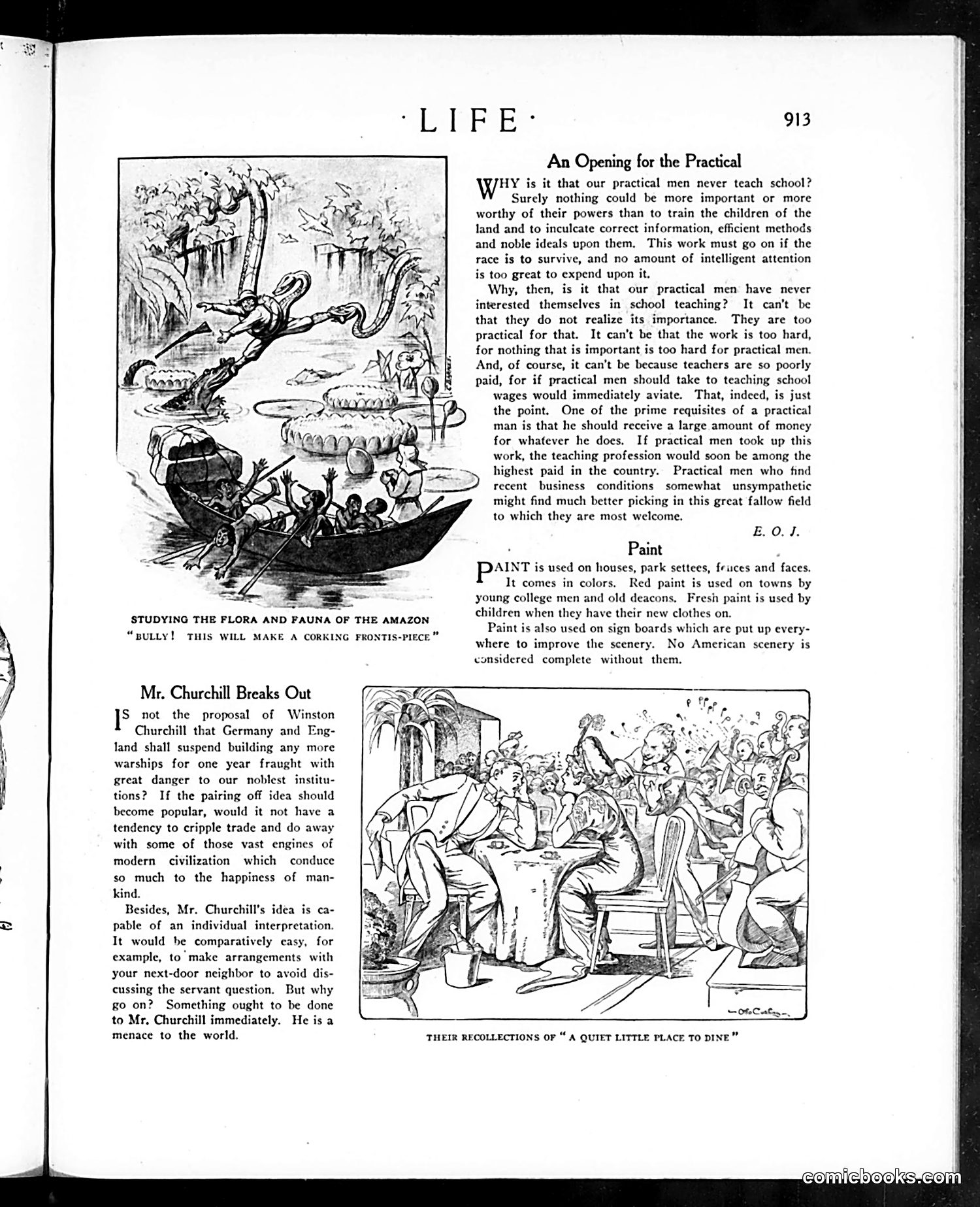
This Life magazine page contains three distinct pieces: 1. **"Studying the Flora and Fauna of the Amazon"** - A whimsical illustration of a man in a boat among fantastical creatures, likely satirizing adventure narratives or naturalist expeditions popular at the time. 2. **"An Opening for the Practical"** - An editorial arguing that practical men should teach in schools, criticizing their absence from education. The piece suggests practical workers avoid teaching because wages are too low, even though teaching should be prestigious work. 3. **"Mr. Churchill Breaks Out"** - Commentary on Winston Churchill's proposal for Germany and England to build warships together. The author suggests Churchill's idea, while individually interpretable, could dangerously promote military cooperation and should be addressed immediately as a threat. The bottom illustration appears to show a social gathering, captioned "Their Recollections of 'A Quiet Little Place to Dine.'"
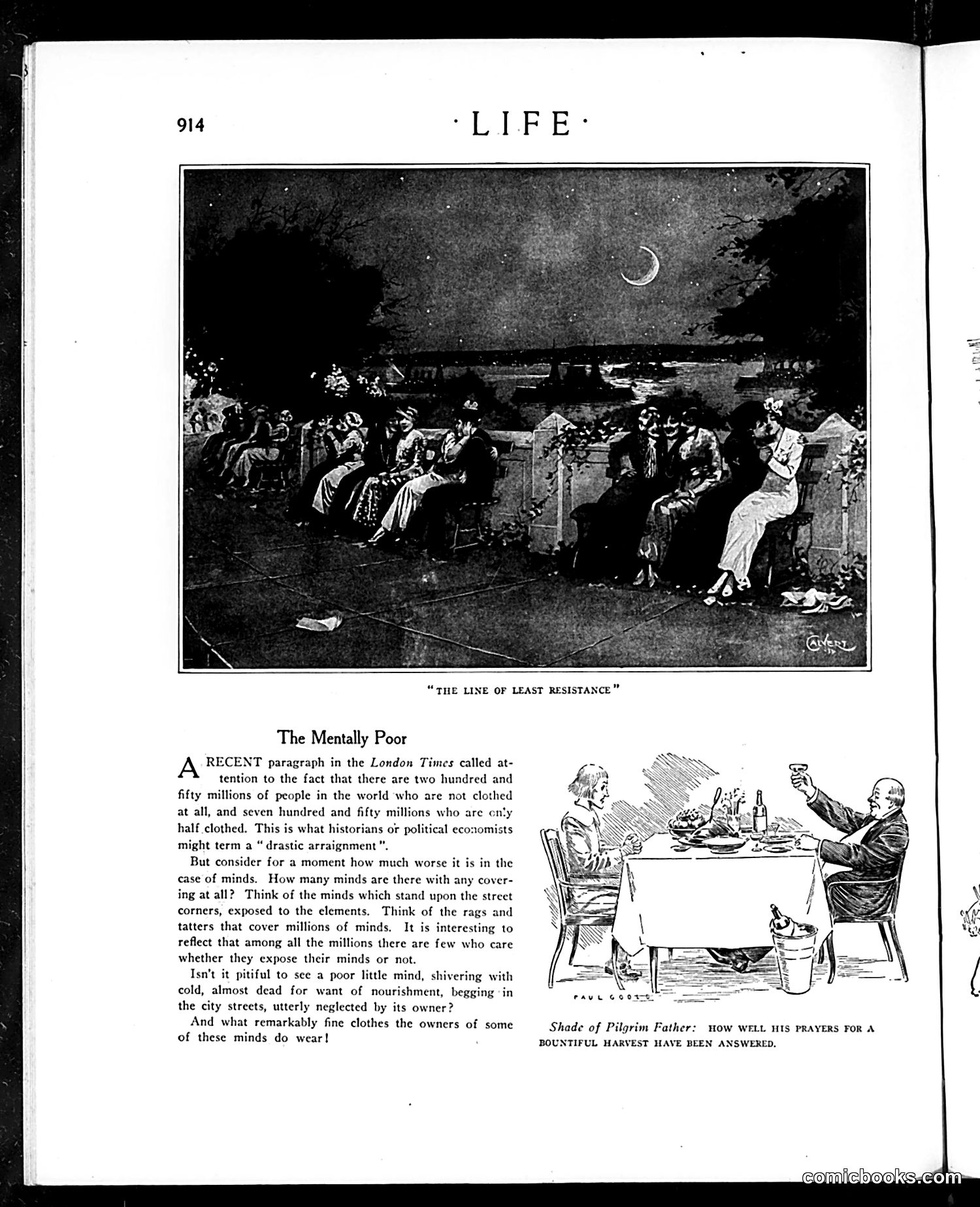
This page critiques class inequality and neglect of the poor. The top illustration, titled "The Line of Least Resistance," depicts impoverished people gathered at night under a crescent moon—visualizing their desperate circumstances. The article argues that while historians note the material poverty of millions worldwide (hundreds of millions without clothing), the mental poverty is equally severe. It highlights children exposed to harsh street conditions, shivering from cold and hunger, entirely neglected by their wealthy owners/employers. The lower cartoon, "Shade of Pilgrim Father," shows a wealthy man dining lavishly while toasting a bountiful harvest—the implied irony being that his prayers for abundance are answered while others starve. The satire targets the hypocrisy of the privileged class's indifference to surrounding human suffering.
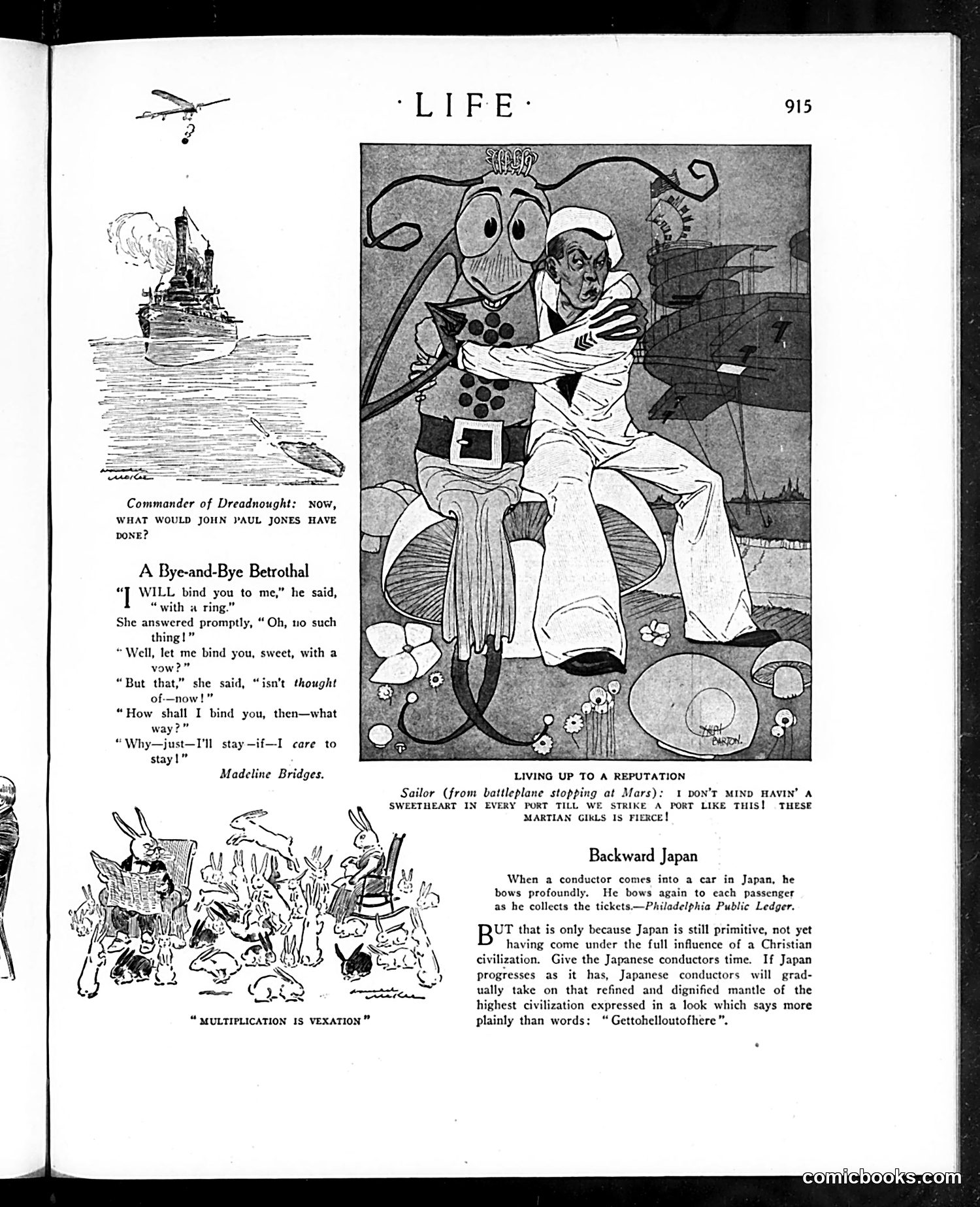
This page contains three distinct satirical pieces: **"A Bye-and-Bye Betrothal"** (poem): A romantic exchange where a man proposes binding commitment through ring, vow, or marriage—each rejected. The woman insists on freedom to leave "if I care to stay," satirizing modern women's independence and rejection of traditional marital constraints. **"Living Up to a Reputation"** (cartoon): A sailor from Mars complains that Martian girls are too fierce/aggressive compared to earthly sweethearts. This appears to be early science-fiction satire, likely poking fun at exaggerated masculine bravado about conquests. **"Backward Japan"** (article/cartoon): The piece sardonically notes that Japanese conductors bow respectfully—attributing this to Japan's "primitiveness" and lack of Christian civilization. The ironic conclusion suggests that "progress" means adopting American rudeness ("Gettohelloutofhere"), satirizing American incivility while criticizing Western claims of superior civilization. The page reflects early 20th-century attitudes toward gender liberation, space-age fantasy, and cultural superiority.
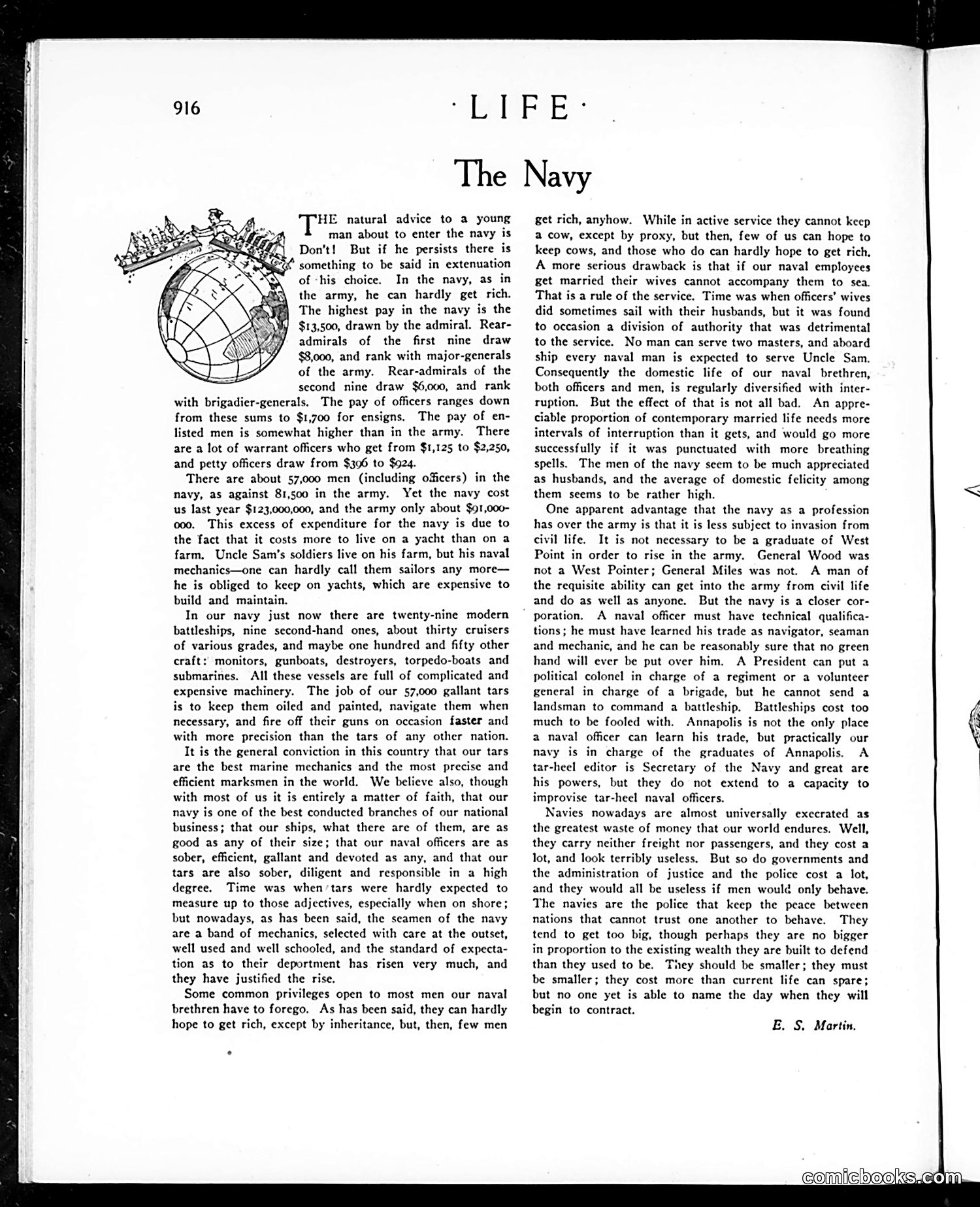
This is a serious editorial essay (not satire) defending the U.S. Navy as a career, signed by E.S. Martin. The accompanying globe illustration is decorative, not satirical. The piece addresses young men considering naval service, acknowledging the profession's drawbacks: low pay (admirals earn $13,500; enlisted men far less), expensive ship maintenance, and forced separation from wives during active duty. However, Martin argues these sacrifices are offset by advantages: naval officers need not be West Point graduates (unlike army officers), the Navy develops skilled mechanics and marksmen, and naval personnel are notably disciplined and well-trained—a marked improvement from earlier eras when sailors had poor reputations ashore. The essay's tone is promotional yet candid, presenting the Navy as a respectable, professionally-managed institution worthy of consideration despite financial limitations. The context reflects early 20th-century American naval expansion and efforts to professionalize military service.
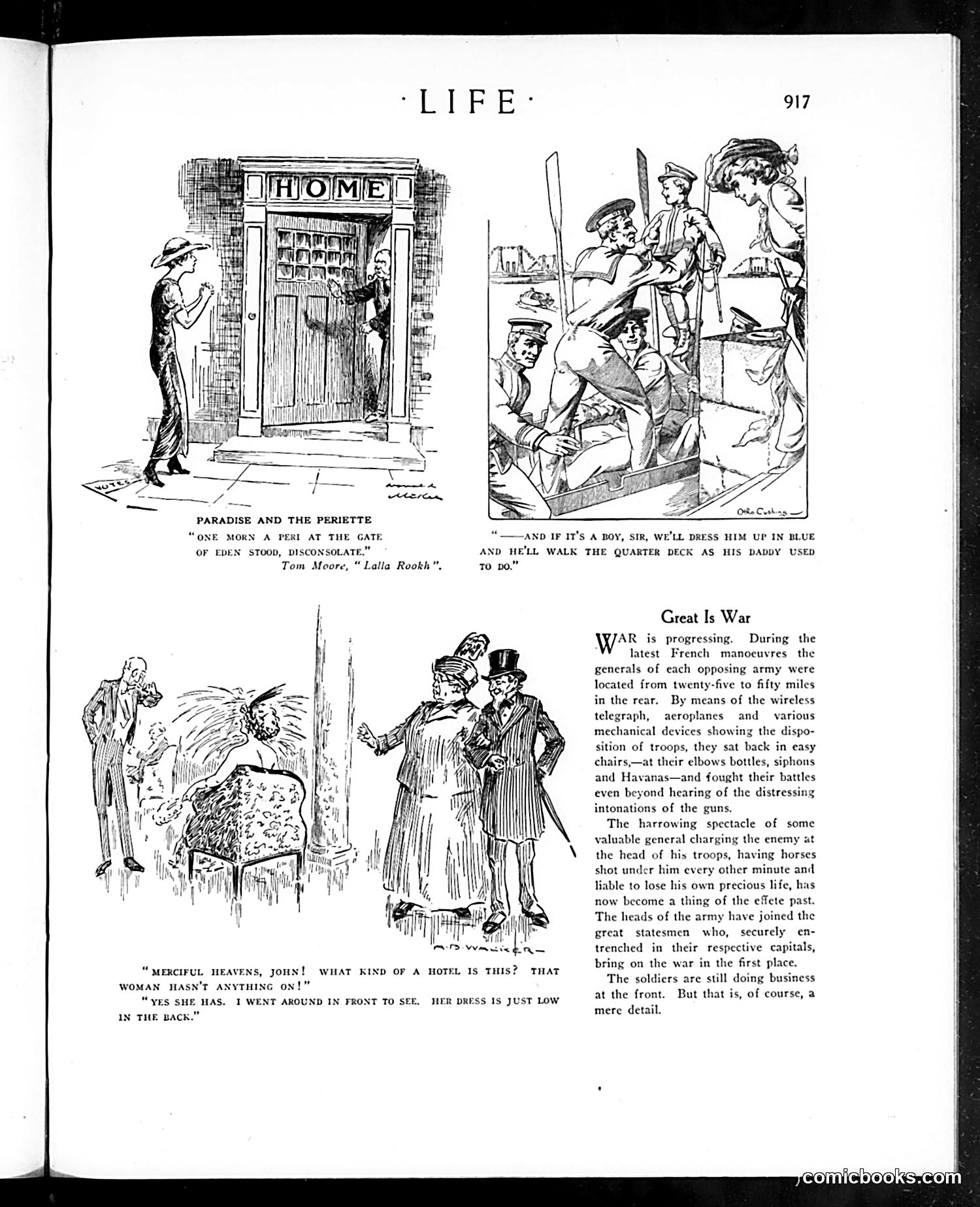
This page contains three satirical cartoons about early 20th-century social observations: 1. **Top left ("Paradise and the Periette")**: A man at a home's door, likely commenting on domestic life or romantic pursuit, quoting Tom Moore's poetry. 2. **Top right**: A naval scene where someone suggests dressing a newborn boy in blue so he'll "walk the quarter deck as his daddy used to"—satirizing military/naval family legacy and pressure to follow paternal footsteps. 3. **Bottom ("Great Is War")**: Critiques modern warfare tactics. The accompanying text mocks how generals now fight battles from comfortable rear positions (25-50 miles back) using wireless telegraph, aeroplanes, and mechanical devices—sitting in easy chairs with cigars and drinks—rather than leading troops directly. This contrasts the "effete past" of generals charging enemy lines with current practice where "soldiers are still doing business at the front" while leadership remains insulated. The cartoon below shows a couple's hotel complaint about a woman's low-backed dress. The satire targets both military modernization's disconnect from frontline reality and broader social pretensions.
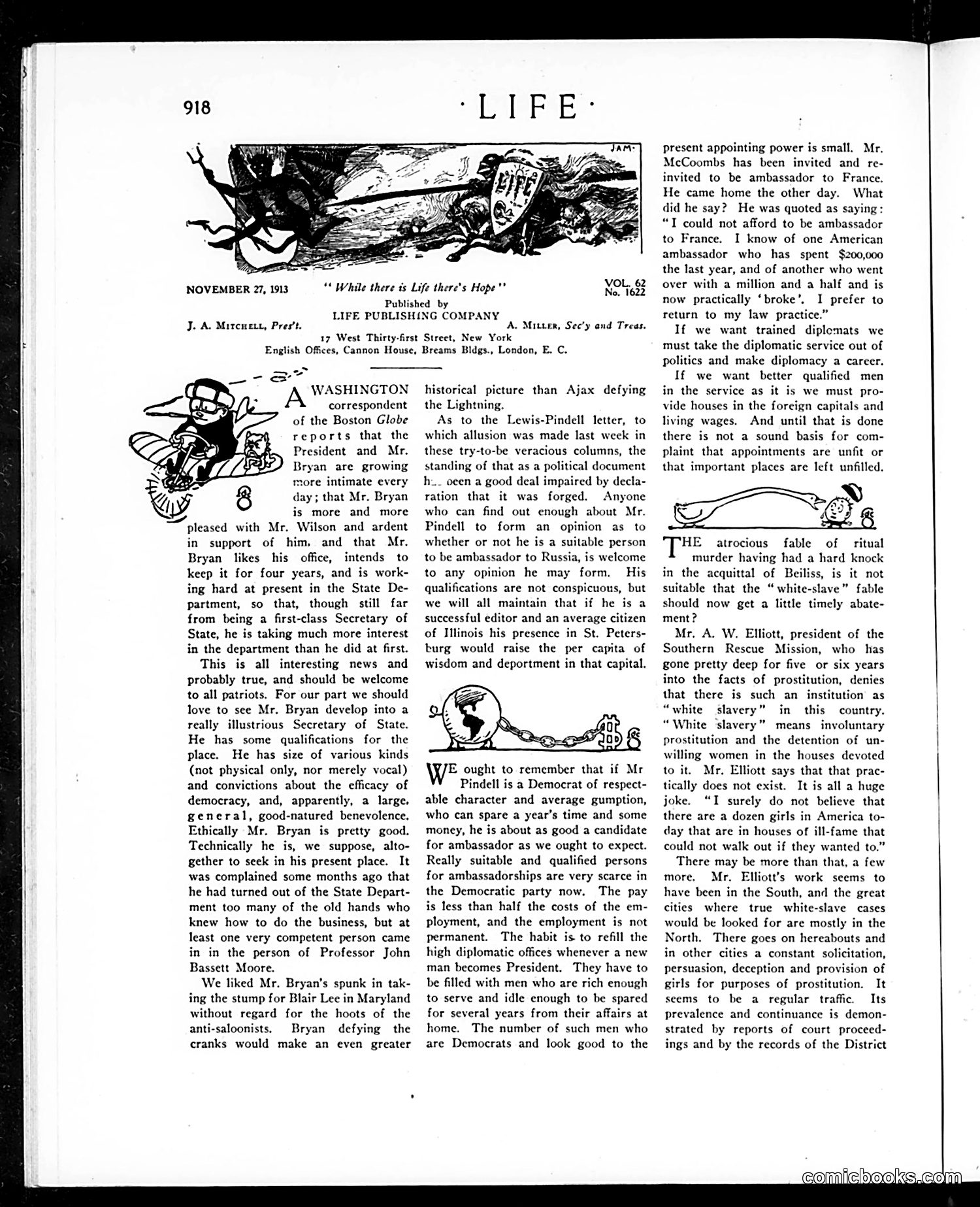
This page critiques President Wilson's diplomatic appointments, particularly focusing on potential ambassadorships. The main article discusses William Jennings Bryan (Wilson's Secretary of State) and a proposed appointment of someone named Pindell as ambassador to Russia. The satire targets the impracticality of diplomatic service: wealthy men must essentially self-fund these prestigious but unpaid positions, creating a system where only the rich can serve. The piece notes that even wealthy appointees often go broke—one ambassador spent $200,000, another $1.5 million. The cartoons (showing figures in chains/constraints) appear to illustrate Bryan's political compromises and the constraining nature of diplomatic appointments. The article criticizes how ambassadorships are filled based on political patronage and personal wealth rather than actual qualifications, a recurring problem when administrations change.
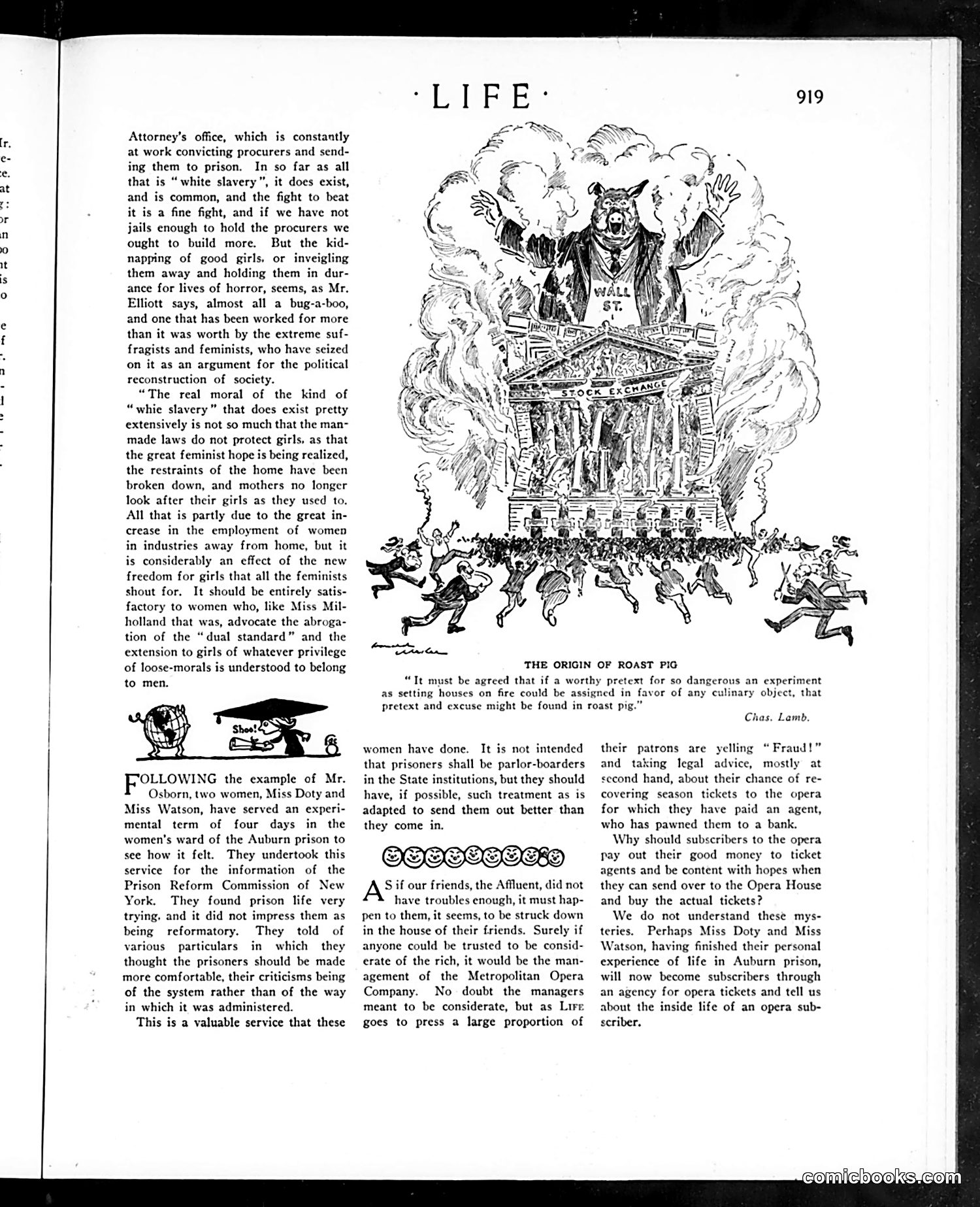
This page satirizes early 20th-century feminism and social reform through multiple arguments: **Main Editorial**: The text criticizes feminists (specifically mentioning "Miss Milholland") for using "white slavery" as a political argument for women's rights. The author claims the real issue isn't inadequate laws but rather feminism's breakdown of parental restraint and traditional family structures. He presents women's industrial employment and sexual freedom as consequences feminists should accept responsibility for. **The Cartoon "Origin of Roast Pig"**: This illustrates the ironic principle that dangerous experiments sometimes have unexpected justifications—here, setting houses on fire to cook pig. It sarcastically comments on how reforms (like the prison visits below) might have dubious practical results. **Prison Reform Anecdote**: Two women (Doty and Watson) spent four days in Auburn prison to report conditions. The piece acknowledges their service as "valuable" but dismisses their comfort-focused criticisms, arguing prisoners shouldn't receive easy treatment. **Metropolitan Opera Fraud**: Subscribers complain about ticket agents pawning their season tickets to banks—a cautionary tale about trusting intermediaries. Overall, the page blends skepticism toward feminist reformers with conservative defense of existing institutions.
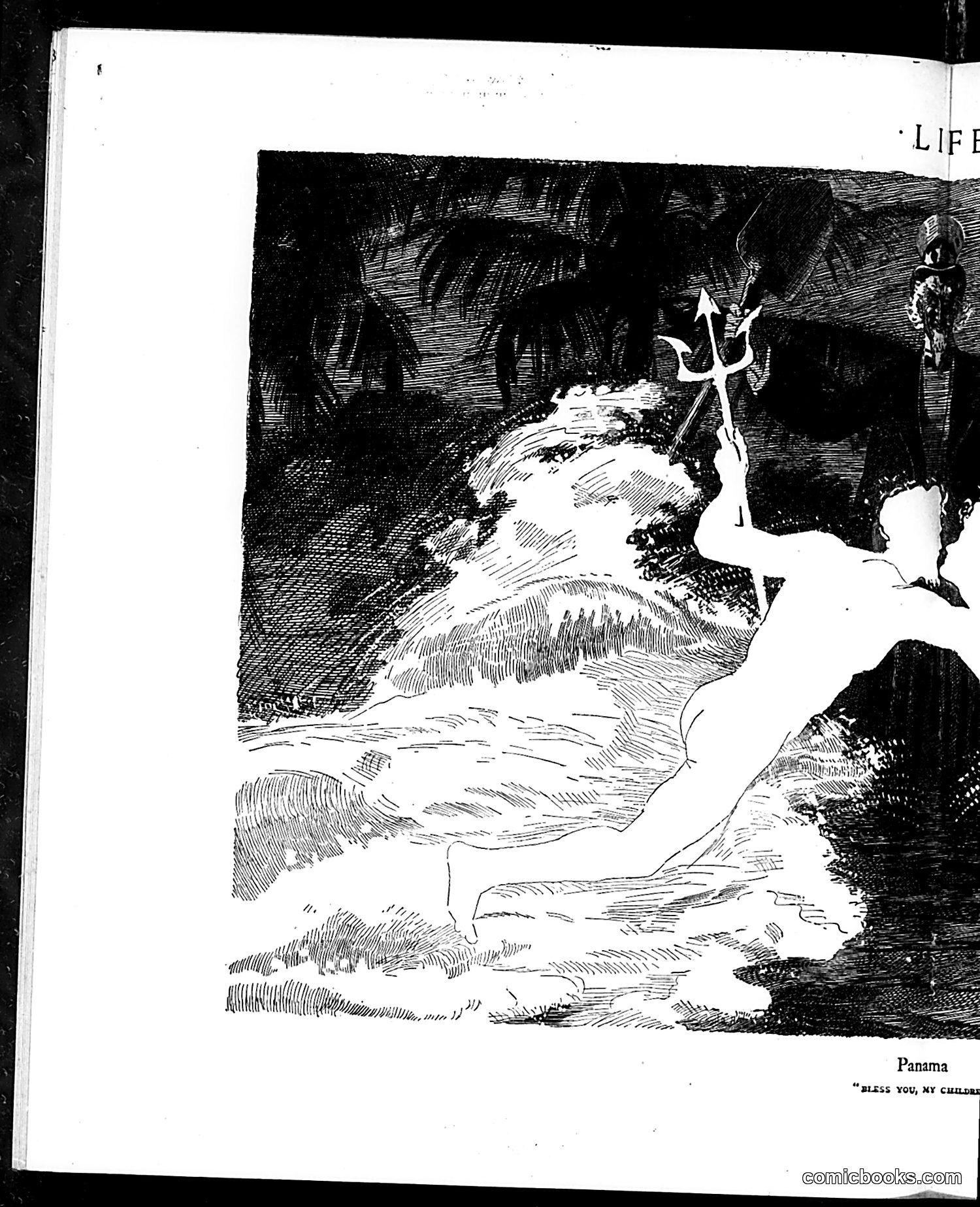
This appears to be a satirical illustration from *Life* magazine depicting a scene labeled "Panama." The image shows a reclining figure in the foreground with a skeleton or death-like figure holding a trident standing over them in a dark, cavernous setting. The caption reads "Bless you, my children," suggesting religious or paternal irony. Without additional context about the specific date, this likely satirizes American involvement in Panama—possibly referencing the Panama Canal construction (early 1900s), disease outbreaks there, or colonial policies. The skeleton figure may represent death or disease claiming lives, while the blessing caption mocks indifference to suffering or casualties associated with American imperial projects. The grim imagery critiques the human cost of Panama-related American expansion or exploitation.
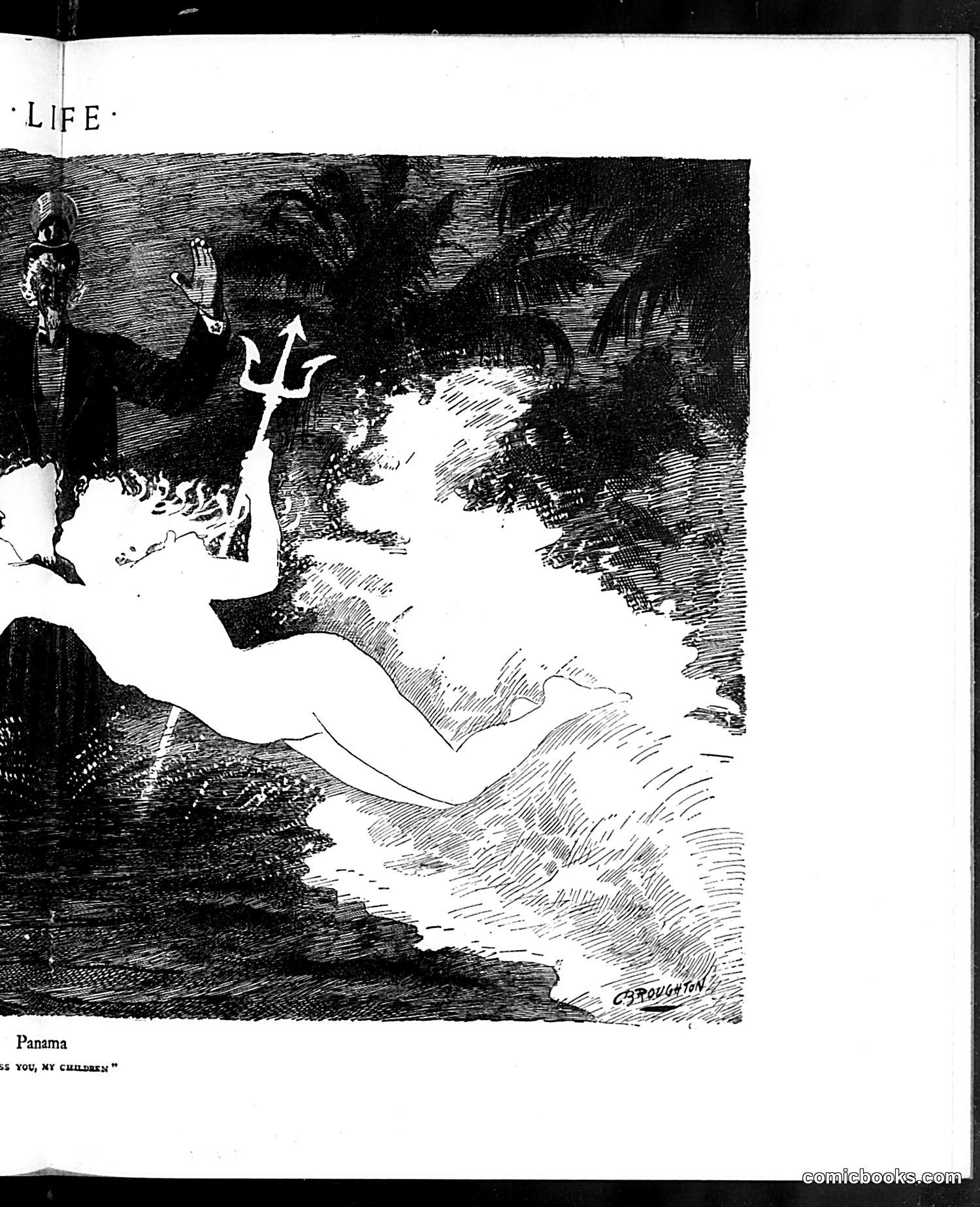
This appears to be a political cartoon from *Life* magazine titled "Panama." The image shows a skeletal or demonic figure holding a trident (suggesting Neptune or death) overlooking what appears to be the Panama Canal region, depicted as a nude female form in white. The cartoon likely critiques American imperial ambitions regarding Panama and the Canal. The classical imagery—the mythological trident, the feminized landscape—sarcastically casts the region as vulnerable and subject to foreign (American) dominance and exploitation. The partial caption "SS YOU, MY CHILDREN" suggests a possessive or patronizing attitude toward Panama, reinforcing themes of colonialism and power. The artist is Stroughton (visible signature). Without knowing the exact publication date, the specific historical moment remains unclear, though the Canal was a major geopolitical focus for decades.
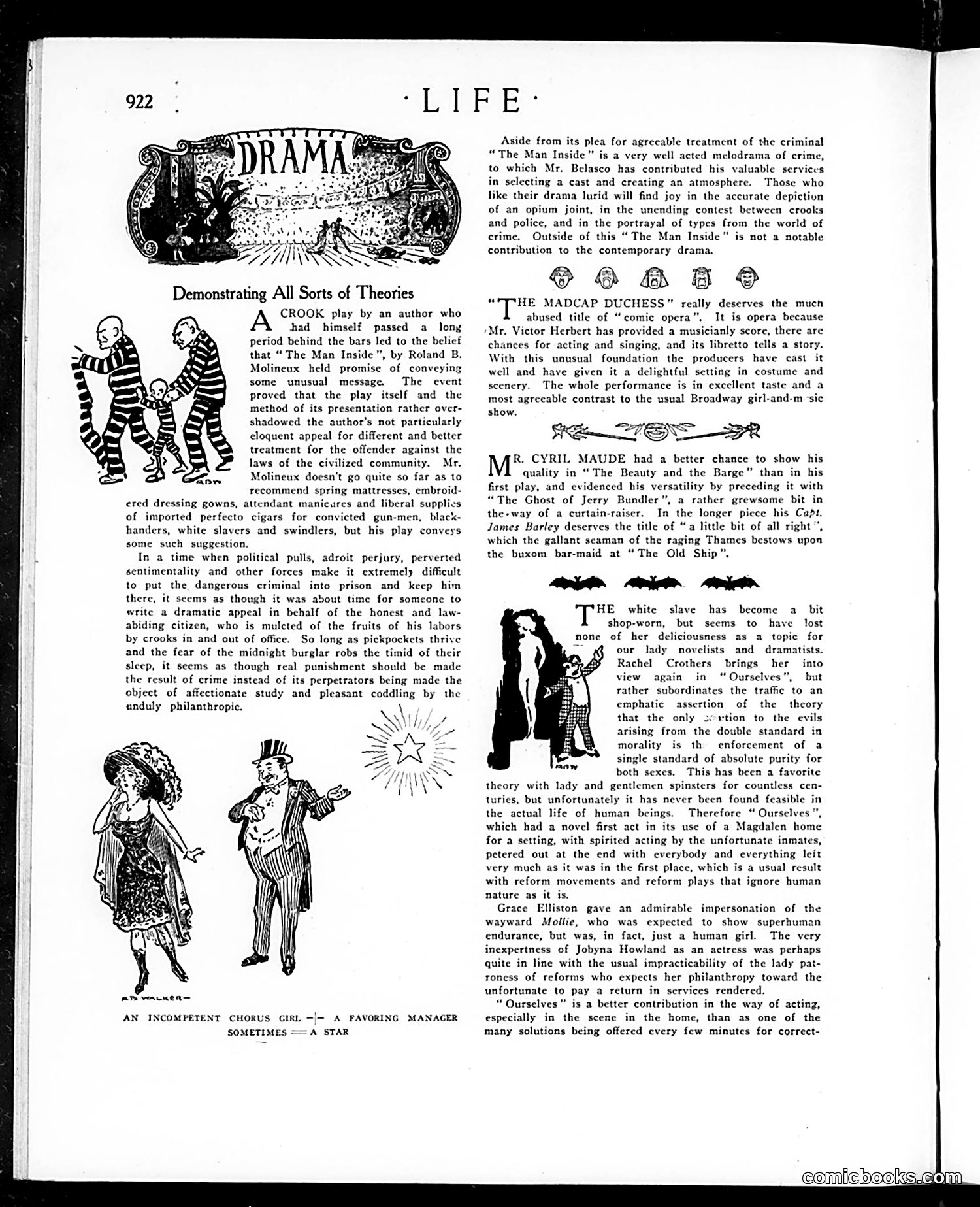
This page from *Life* magazine contains theater reviews critiquing several Broadway productions. The main satirical content is the small cartoon labeled "An Incompetent Chorus Girl—A Favoring Manager Sometimes—A Star," depicting theatrical types in exaggerated dress. The reviews themselves contain sharp social criticism: the critic attacks Roland B. Molineux's play "The Man Inside" for sentimentalizing criminals rather than advocating for protection of law-abiding citizens victimized by "crooks in and out of office." This reflects Progressive-era concerns about crime and justice. The other reviews praise Victor Herbert's "The Madcap Duchess" and Cyril Maude's "The Beauty and the Barge," while criticizing Rachel Crothers' "Ourselves" for promoting an unrealistic "double standard" morality argument about sexual purity. The cartoons illustrate theatrical hierarchies and casting dynamics of the era—showing how incompetent performers sometimes gained roles through managerial favoritism rather than talent.
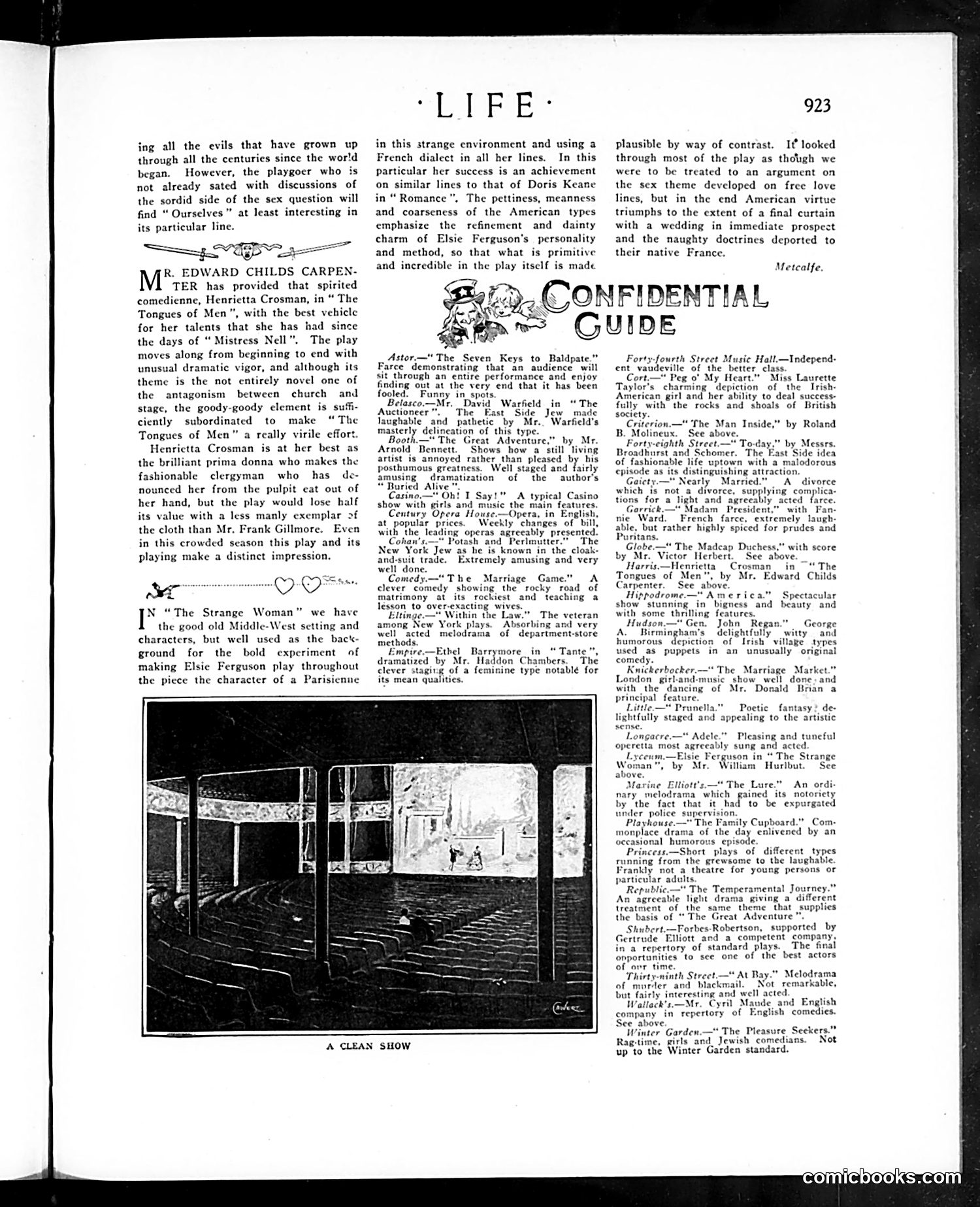
This page from *Life* magazine presents theater reviews and a "Confidential Guide" to New York playhouses. The illustration titled "A Clean Show" depicts a domestic interior—likely representing a middle-class home—suggesting the magazine is praising theatrical productions suitable for family viewing. The reviews discuss contemporary Broadway plays featuring popular actors like Henrietta Crosman and Elsie Ferguson. The critic (signed "Metcalfe") evaluates productions on moral grounds: praising *The Tongues of Men* for handling the church-versus-stage controversy without excessive "goody-goody" moralizing, and noting that *The Strange Woman* ultimately endorses "American virtue" by ending with marriage rather than "free love lines." The guide lists theaters with brief, morality-focused assessments—*Potash and Perlmutter* is "amusing," *Within the Law* is "absorbing." This reflects early 20th-century concerns about theatrical propriety and the cultural gatekeeping function *Life* performed for its middle-class readership.
This page presents satirical book reviews from Life magazine. The opening anecdote about an ancient Athenian painter drawing a perfect circle as his "calling card" establishes the theme: true artists need no advertising—their work speaks for itself. The satire targets modern artists who obsessively promote themselves through "pasteboards" (business cards) listing sales figures and career prospects. Life contrasts this with John Galsworthy, a genuine artist who lets his work identify him without self-promotion. The reviews mock contemporary literature: Chambers's "Business of Life" is dismissed as "salacities posed as a moral object lesson" (false morality masking sexual content). Galsworthy's "The Dark Flower" receives praise for depicting passion authentically without idealization. The central critique: commercialism and self-promotion corrupt artistic integrity. Real artists remain disinterested observers of human nature, while lesser writers peddle moralizing disguises for sensationalism.
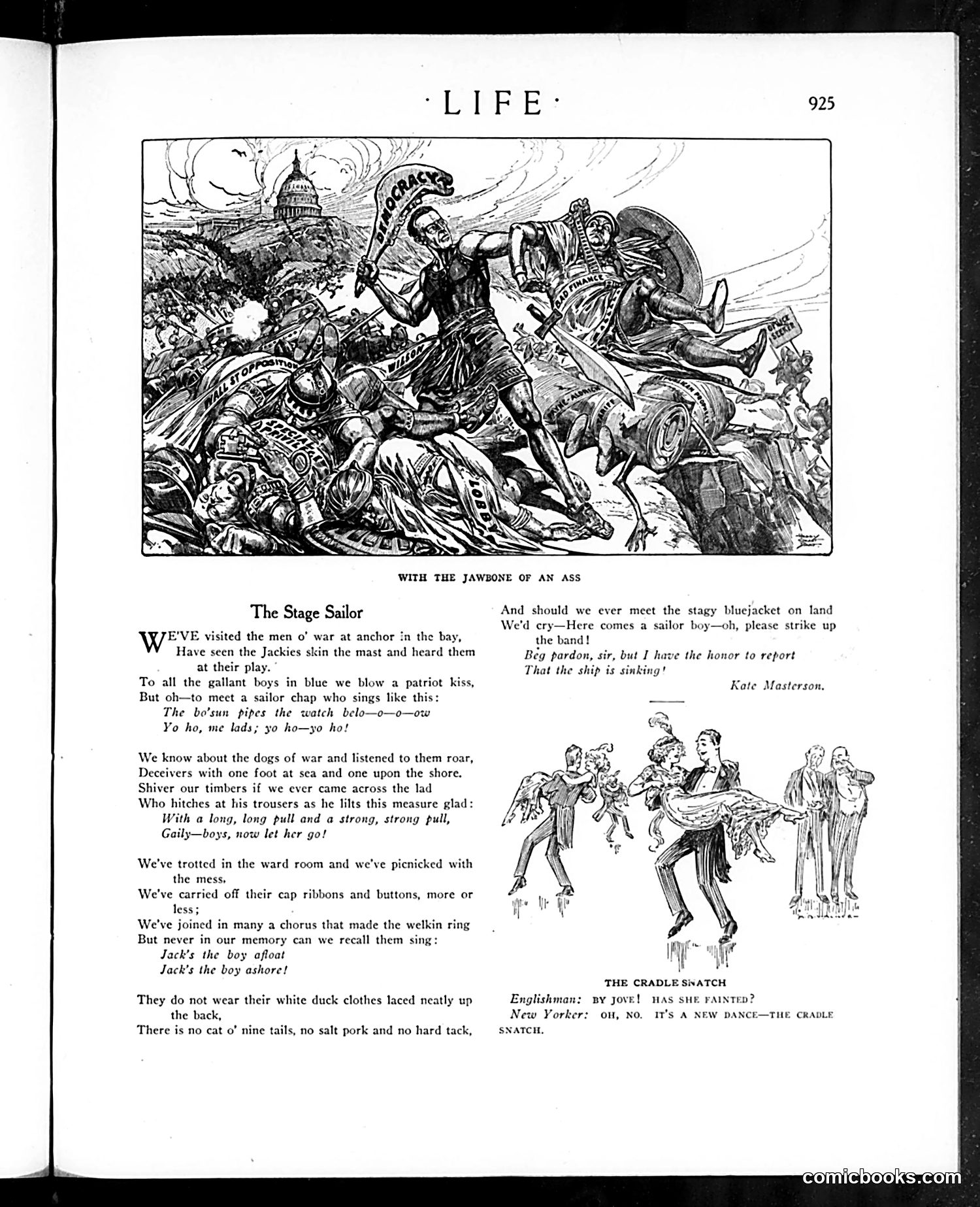
**"The Stage Sailor"** satirizes theatrical portrayals of naval life as wildly inaccurate. The poem contrasts real sailors' behavior with romanticized stage versions—actors sing elaborate sea shanties and wear pristine uniforms, whereas actual sailors use crude language, wear practical clothes, and endure harsh conditions (salt pork, cat-o'-nine-tails whippings). The title references judges 15:16, suggesting satire uses crude weapons against theatrical pretension. **"The Cradle Snatch"** cartoon below depicts a new dance craze where a man swings a woman in an arc. An Englishman mistakes her limp posture for fainting; a New Yorker explains it's simply the latest dance move. This gently mocks both British prudishness (assuming distress) and American enthusiasm for avant-garde fads, likely from the 1910s-1920s jazz age. Both pieces target gap between appearance and reality—one in naval tradition, one in modern social behavior.
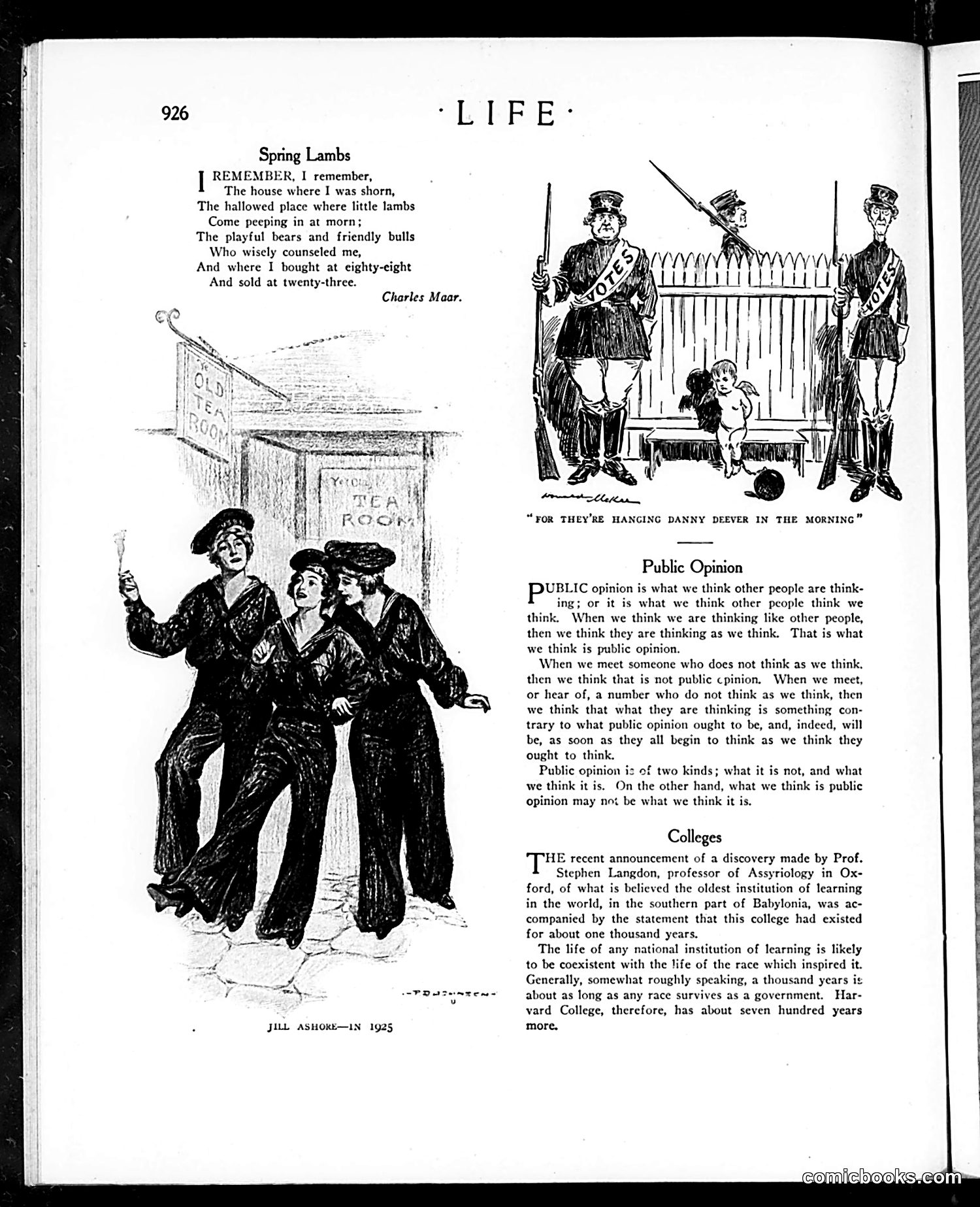
**"Spring Lambs"** (left cartoon): A satirical poem by Charles Maar about stock market speculation. The sheep narrator recalls being "shorn" (fleeced) at a farmyard where he bought stocks at 88 and sold at 23—a ruinous loss. The "playful bears and friendly bulls" are stock market slang for traders betting on declining and rising prices respectively. The joke: naive investors are lambs led to slaughter by market manipulation. **"Jill Ashore—1925"** (illustration): Shows three sailors or military figures, likely referencing a popular song or naval scandal of the 1920s. **"Public Opinion"** (essay): A circular, tongue-in-cheek definition mocking how people form and interpret public opinion—essentially, we think public opinion is what we personally believe others think, creating self-reinforcing conformity. **"Colleges"** (essay): Uses a recent archaeological discovery to humorously suggest Harvard College has "seven hundred years more" to survive, implying American institutions last roughly as long as civilizations (about 1,000 years).
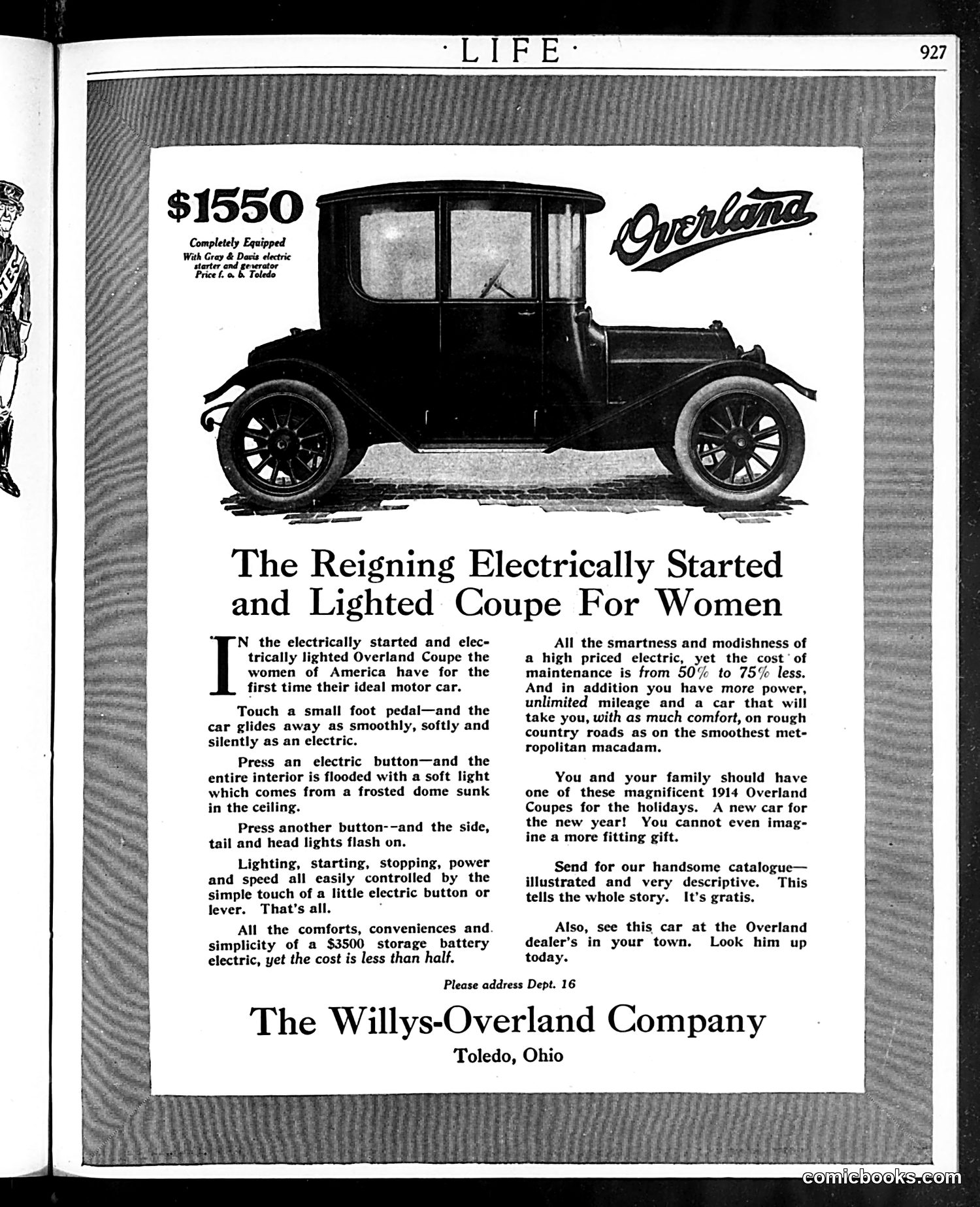
This is a straightforward advertisement, not a political cartoon or satire. The Willys-Overland Company promotes its 1914 Overlander electric coupe, priced at $1550. The ad targets women specifically, emphasizing the car's ease of operation through electric buttons and foot pedals rather than manual cranking—a significant selling point when cars required physical strength to start. The text highlights conveniences like electric lighting and starting, positioning this as an "ideal motor car" for women. The marketing strategy appealed to women's growing independence and mobility while emphasizing comfort and simplicity. This reflects early 20th-century attitudes about gender and technology, where manufacturers explicitly marketed vehicles to women as liberation from mechanical difficulty.
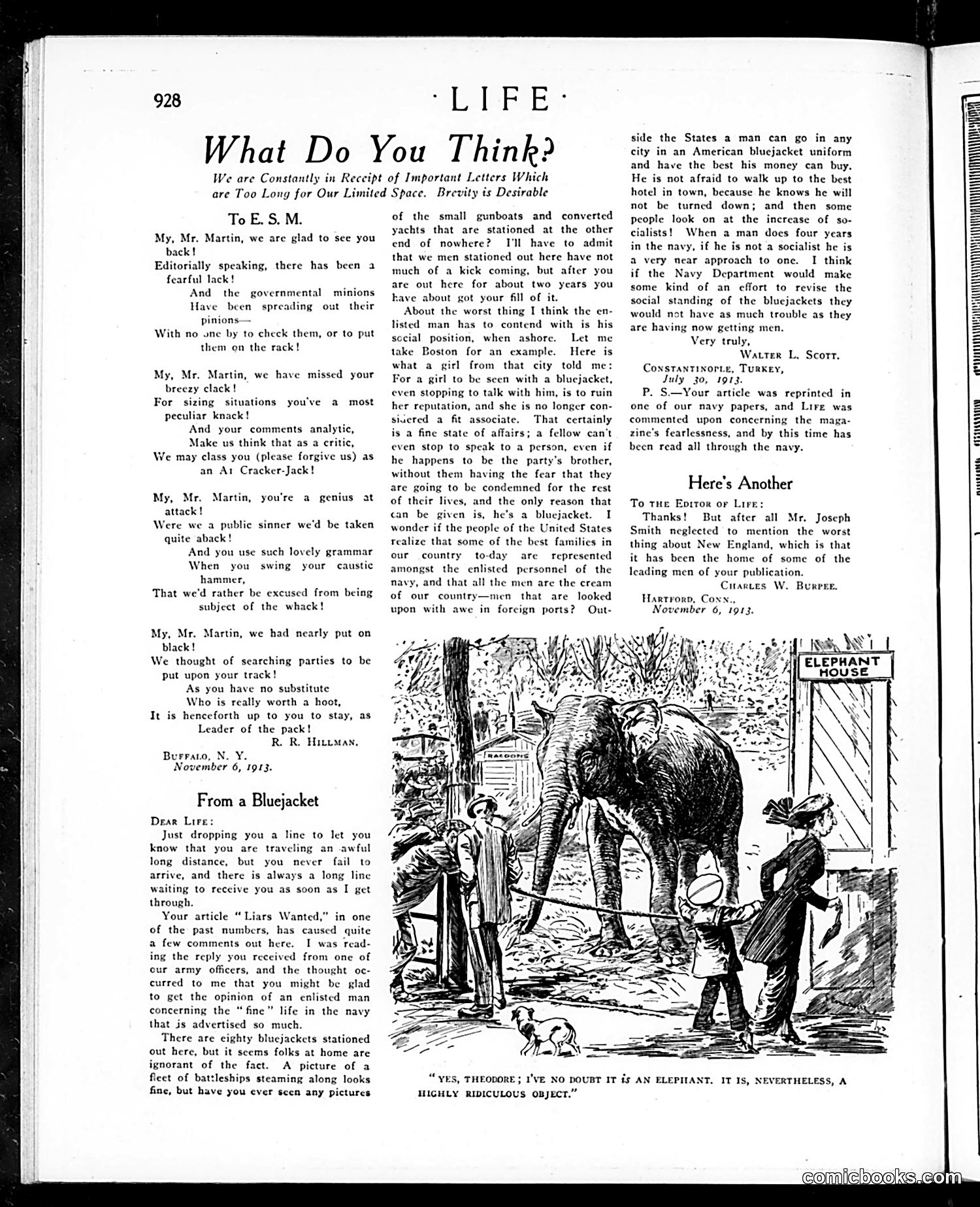
This page contains readers' letters to the editor and one cartoon. The main cartoon depicts an elephant being examined outside an "Elephant House," with the caption suggesting someone (likely "Theodore"—possibly referring to Theodore Roosevelt, known for safari expeditions) confirming it is indeed an elephant, calling it "a highly ridiculous object." The letters discuss social and military issues of 1913: 1. **First letter**: Praises the magazine's Mr. Martin for his editorial commentary 2. **"From a Bluejacket"**: An enlisted sailor criticizes the social stigma against naval personnel ashore, particularly in Boston, where girls reportedly face social ruin for being seen with sailors despite the Navy recruiting "the cream of our country." He notes the irony that American sailors are respected abroad but scorned at home, suggesting this mistreatment breeds socialism among enlisted men. The cartoon's humor likely plays on the absurdity of needing confirmation of an obvious fact—possibly satirizing contemporary political or social pretense.
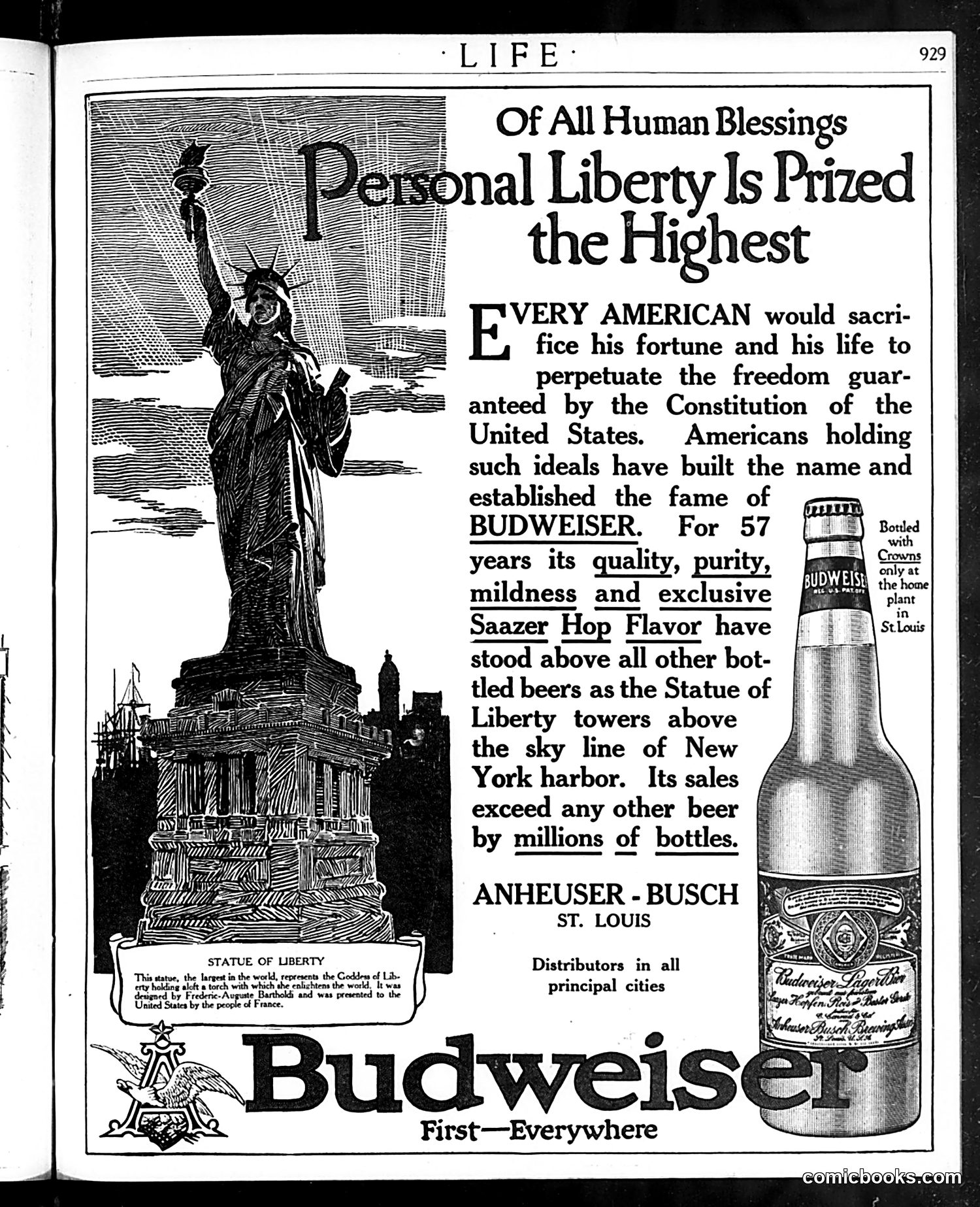
This is a **Budweiser beer advertisement**, not political satire. The page uses patriotic imagery—the Statue of Liberty and rhetoric about American constitutional freedom—to market beer. The ad claims Budweiser has maintained its reputation for "quality, purity, mildness" for 57 years, comparing the brand's dominance to Liberty's prominence in New York Harbor. It explicitly links beer consumption to American ideals, arguing that those who value freedom naturally choose Budweiser. For modern readers, this represents aggressive **patriotic branding**—equating a commercial product with national values. The ad appears in *Life* magazine (a satirical publication), suggesting even humor publications carried straightforward advertising. The comparison is hyperbolic: a beer brand claims the same cultural significance as a symbol of constitutional democracy. This reflects early-20th-century advertising strategy: wrapping consumer products in nationalist rhetoric to boost sales.
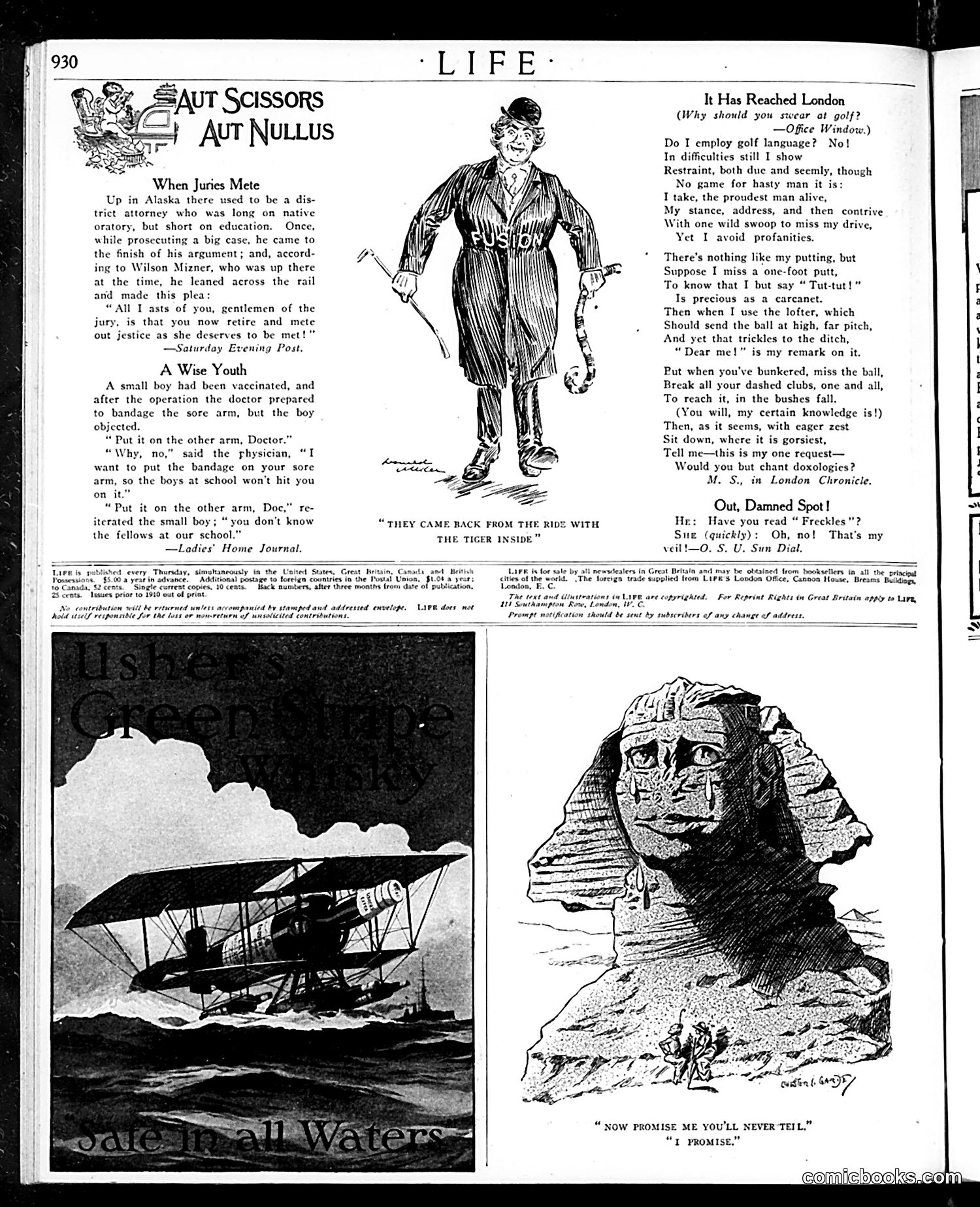
This page contains three separate humorous pieces typical of *Life* magazine's satirical content: **"When Juries Mete"** mocks an uneducated Alaskan district attorney who malapropises "mete out justice" as "mete out jestice," satirizing frontier legal incompetence. **"A Wise Youth"** jokes about a vaccinated boy's logic—he wants the bandage on his uninjured arm to avoid school bullies hitting his sore spot, outwitting the doctor's reasoning. **Golf and Sports Humor** includes poems about restraint in golf (avoiding swearing despite frustration) and a brief joke about "Freckles" (likely the popular comic strip character), showing how literary/cultural references entertained contemporary readers. The page's centerpiece illustration depicts a golfer, reinforcing the golf-humor theme. The Egyptian sphinx drawing below appears unrelated to surrounding text, typical of *Life*'s scattered layout.
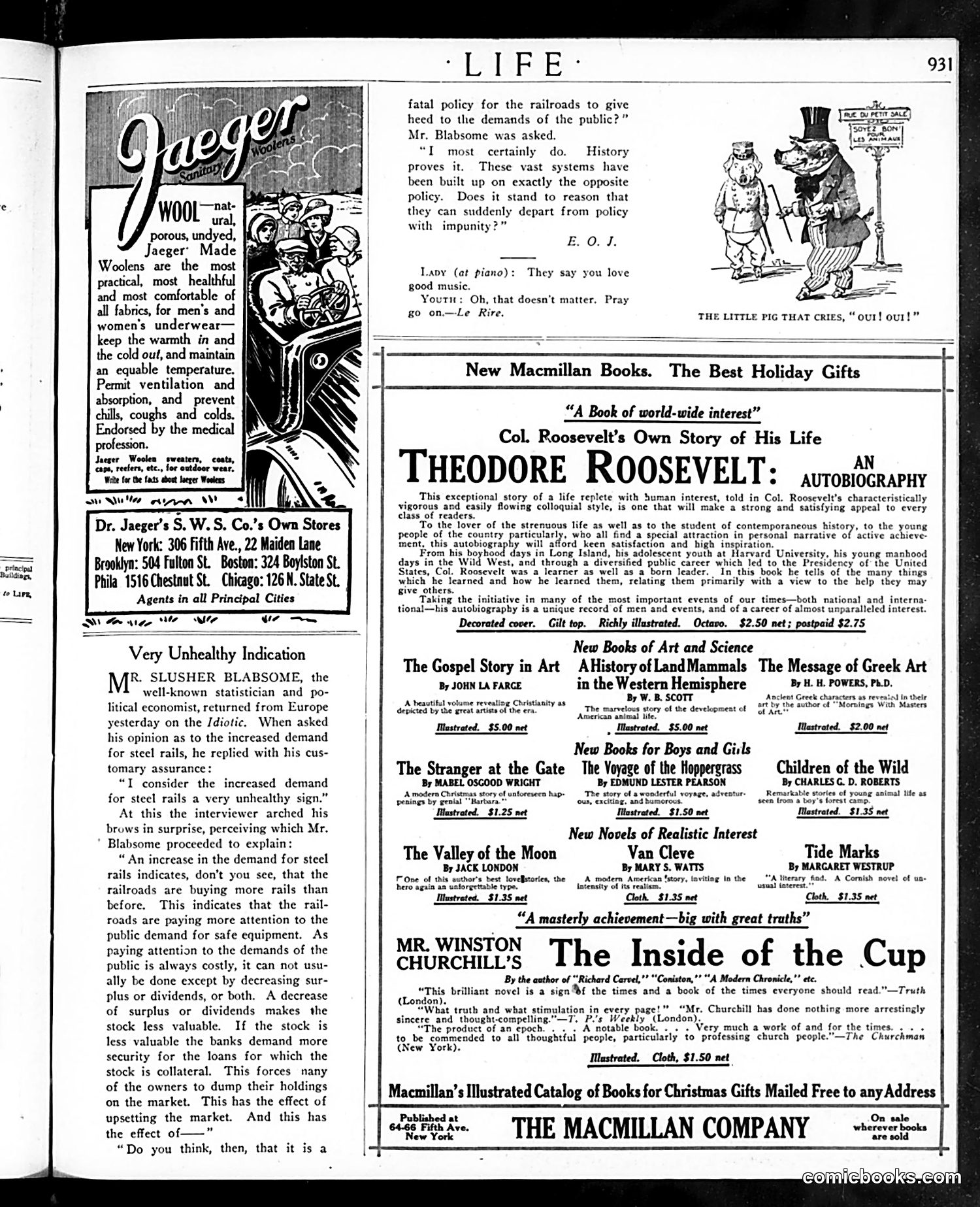
The cartoon depicts a confrontation between what appears to be a farmer or official and a pig, illustrating absurdist political satire. The accompanying article satirizes economist "Slusher Blabsome," a fictional character whose circular logic exemplifies economic sophistry. Blabsome argues that railroads buying steel rails to improve safety is "unhealthy" because it reduces profits, forces stock sales, upsets markets—creating a chain reaction proving railroads shouldn't prioritize public safety. The satire mocks economists and railroad executives who prioritize shareholder value over passenger welfare, a Progressive Era concern. This reflects actual debates about railroad regulation and corporate responsibility versus profit maximization that dominated early 20th-century American politics. The page also advertises Theodore Roosevelt's autobiography, reinforcing the Progressive reformist context of these critiques of corporate malfeasance.
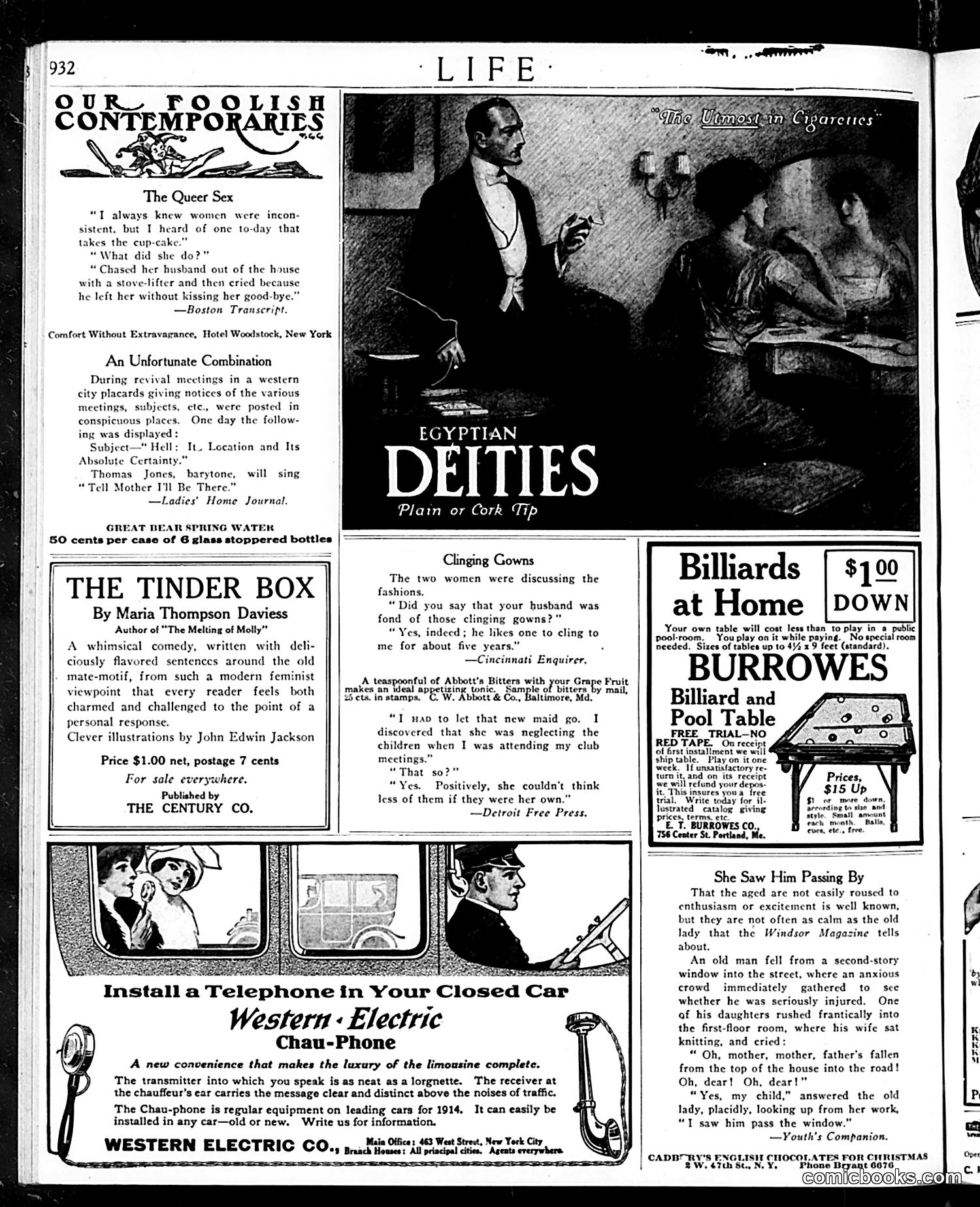
This page from *Life* magazine consists primarily of **short humorous anecdotes** rather than political cartoons. The pieces satirize contemporary social behaviors and gender relations. **Key content:** The opening "Queer Sex" section mocks female inconsistency through an anecdote about a wife who chases her husband out with a stove-lifter, then cries because he leaves without kissing her goodbye—portraying women as irrational. "An Unfortunate Combination" jokes about an unfortunate juxtaposition of revival meeting placards—one announcing "Hell: Its Location and Its Absolute Certainty" placed near a singer's notice. "Clinging Gowns" features a wife implying her husband wants her dependent for five years—satirizing restrictive marriage dynamics. **The cartoon** (lower left) depicts installing a telephone in a car, humorously illustrating modern luxury. The page is primarily **advertising** interspersed with satirical content. The humor reflects early 1910s attitudes toward women, domesticity, and emerging technology.
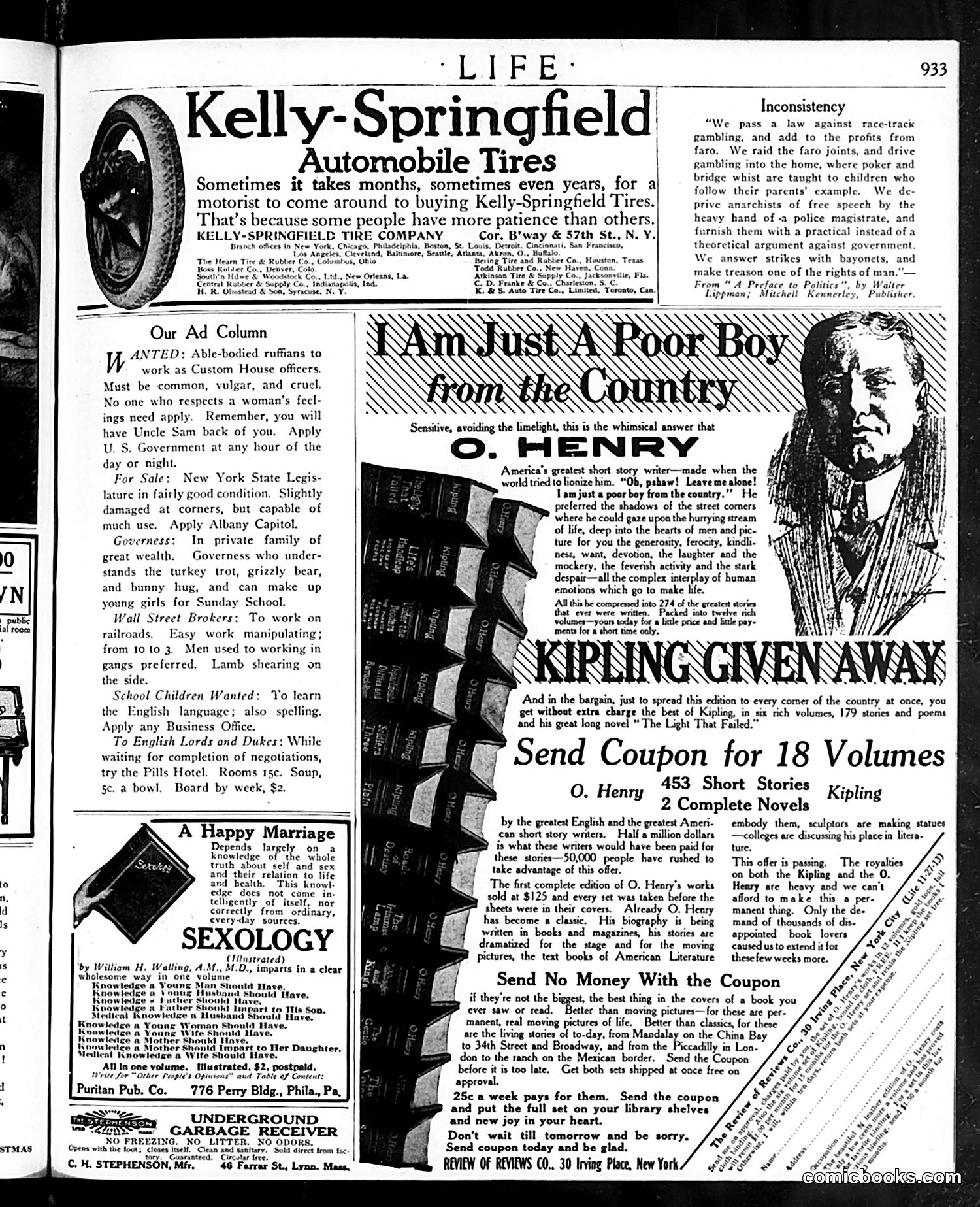
This page mixes advertisements with satirical social commentary. The dominant feature is an O. Henry book advertisement featuring a portrait of the famous short-story writer. It emphasizes Henry's humble origins ("poor boy from the country") and celebrates his ability to capture human emotion and social complexity in 274 stories now offered in a twelve-volume set. The "Inconsistency" editorial snippet critiques governmental hypocrisy: authorities ban race-track gambling while tolerating home card games, suppress anarchist free speech violently, and respond to labor strikes with military force—thereby creating the very conditions they claim to prevent. The satirical "Our Ad Column" mocks various institutions through fake job postings: Custom House officers hired for vulgarity; the New York State Legislature sold as used goods; and English lords waiting to marry American heiresses. This reflects Progressive-era skepticism of corruption in government, Wall Street speculation, and wealthy Europeans targeting American fortunes. The page is otherwise filled with commercial advertisements for tires, books on sexuality education, and household products.
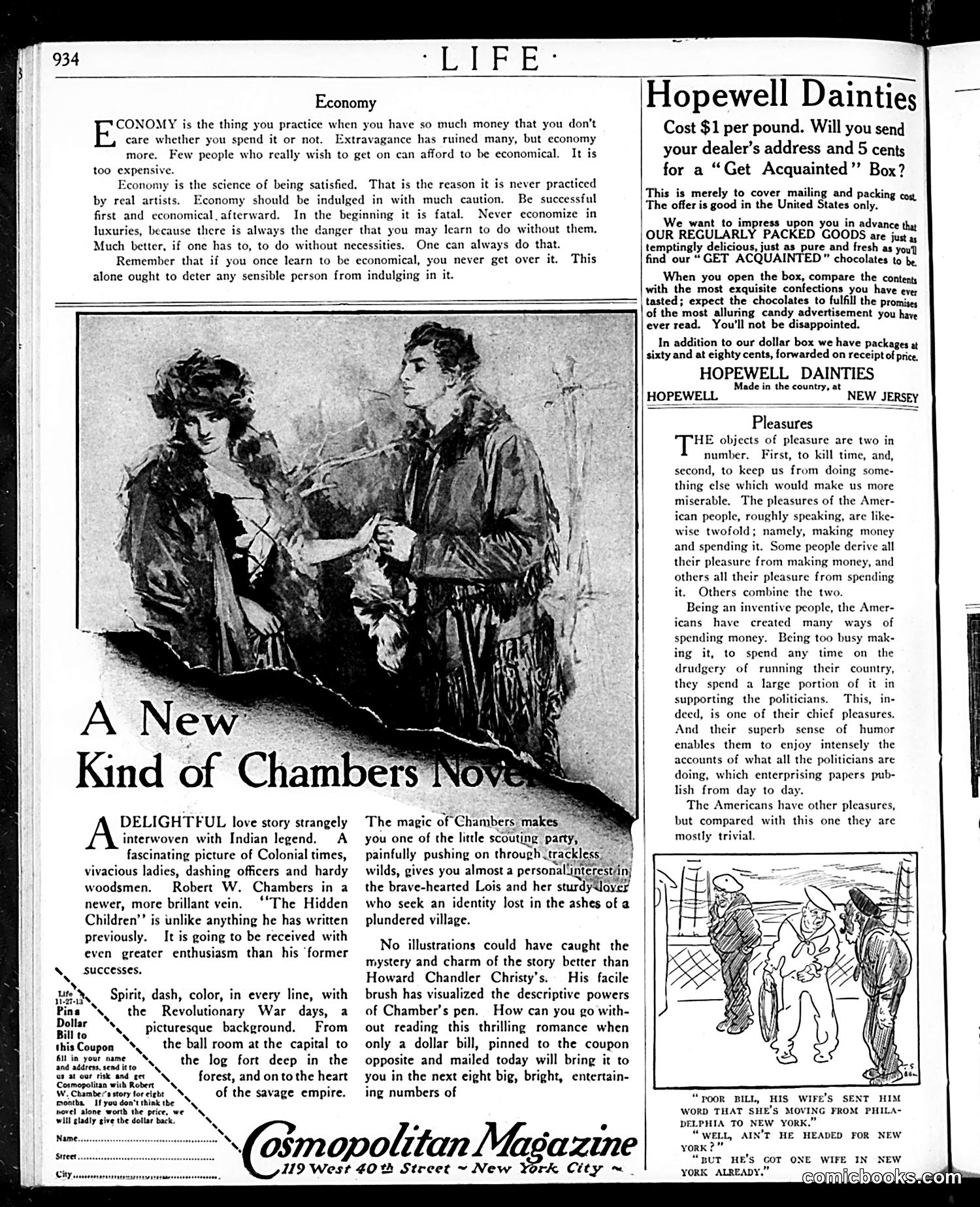
This page mixes satirical essays with period advertising (circa 1910s-1920s). **The "Economy" essay** is cynical social commentary: it mocks the wealthy who practice "economy" as affectation—claiming that true economy is impossible for "real artists" and that learning to economize is a dangerous habit. The joke targets the hypocrisy of the rich pretending frugality while refusing to sacrifice luxuries. **"A New Kind of Chambers Novel"** promotes Robert W. Chambers' book *The Hidden Children*, featuring Revolutionary War-era adventure and romance illustrated by Howard Chandler Christy. The text emphasizes dramatic action and emotional engagement to sell subscriptions. **The accompanying sketch** (captioned "Poor Bill") appears to illustrate domestic comedy—though details are unclear from this reproduction. **Advertisements** for Hopewell Dainties chocolate and magazine subscriptions occupy the right side, typical of Life's revenue model. The page reflects early 20th-century middlebrow American culture: romantic historical fiction, consumer goods marketing, and gentle satire of upper-class pretension.
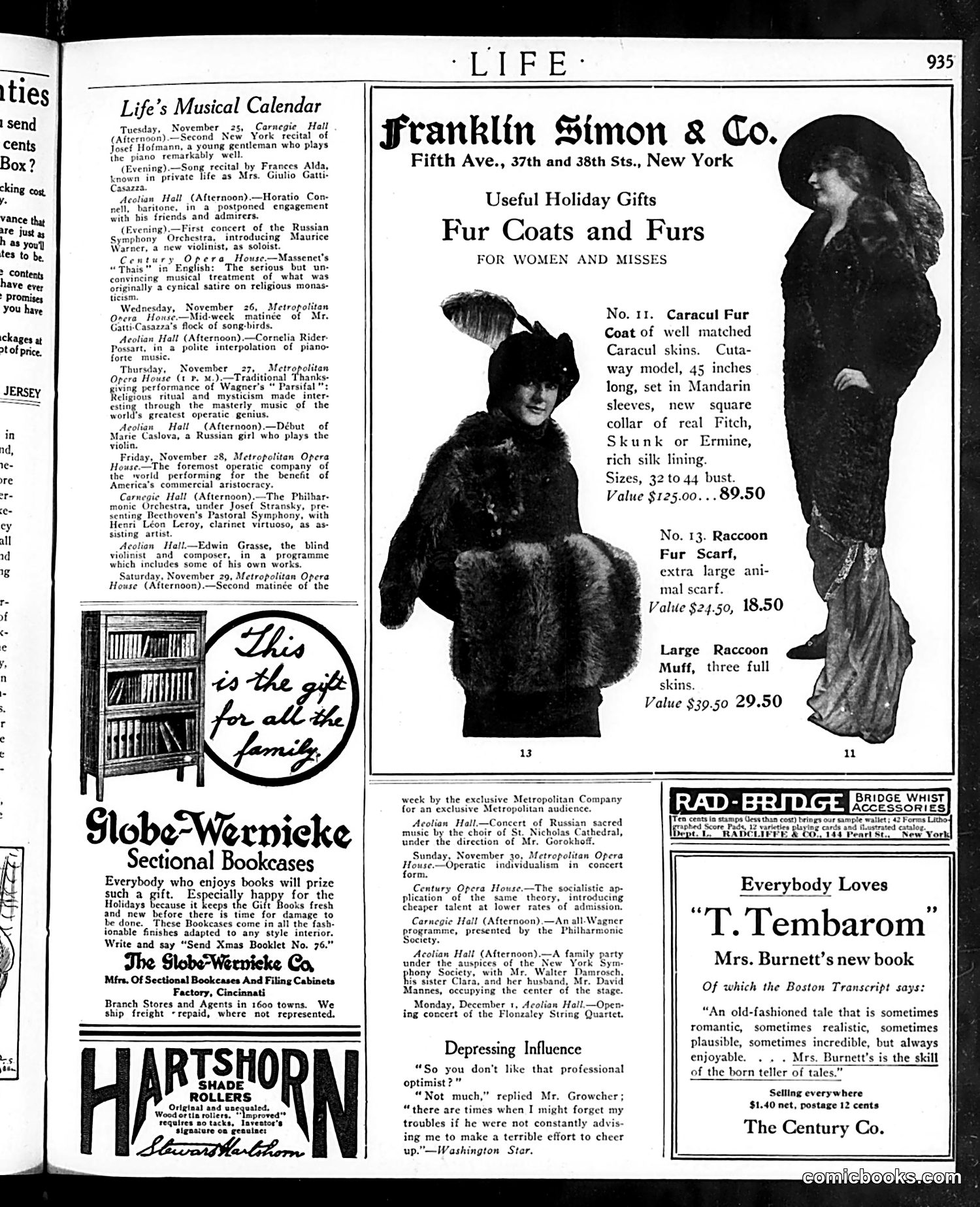
This page is primarily **advertising and entertainment listings**, not political satire. The "Musical Calendar" lists New York concert venues (Metropolitan Opera House, Carnegie Hall, Aeolian Hall) with performances by classical musicians and orchestras. Notable: Josef Hofmann is listed as a "young gentleman" pianist, and various Wagner operas and Russian composers are featured—reflecting the cosmopolitan tastes of wealthy urban audiences. The advertisements showcase luxury goods appropriate for holiday gift-giving: **Franklin Simon & Co.** displays expensive fur coats (caracul, raccoon) for women; **Globe-Wernicke** promotes sectional bookcases as "the gift for all the family"; **Hartshop Rollers** advertises hair products; and **The Century Co.** promotes Mrs. Burnett's novel "T. Tembarom." The page reflects **early 20th-century upper-class consumer culture**—targeting affluent readers with refined cultural pursuits (opera, classical music) and luxury purchasing options. There is no discernible political satire or social commentary present.
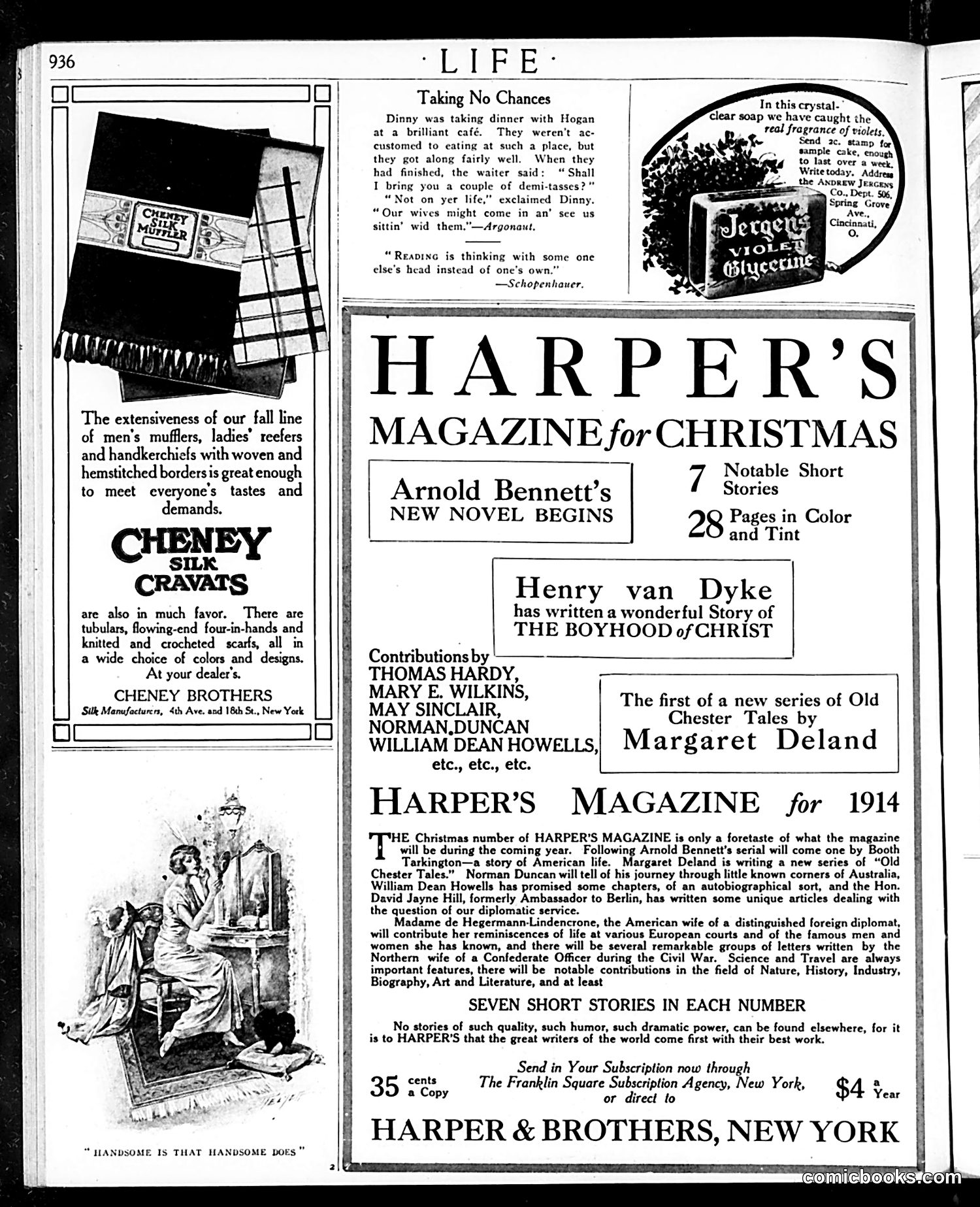
This page is primarily **advertising for Harper's Magazine's 1914 Christmas issue**, with minimal editorial content. ## The Cartoon ("Taking No Chances") The single joke depicts two working-class men (Dinny and Hogan) at an upscale café. When offered after-dinner coffee (demi-tasses), Dinny refuses, fearing his wife might see him there—implying he's claimed to be elsewhere. The humor exploits **class anxiety**: these men feel out of place in a fancy restaurant and worry about being caught in a lie about their whereabouts. The reference to wives suggests this targets male readers who might need plausible excuses for their evening activities, playing on early 20th-century domestic tensions and working-class deception. ## Main Content The remainder is **promotional copy** for Harper's 1914 offerings: Arnold Bennett's new novel, stories by Henry van Dyke, Thomas Hardy, and Margaret Deland. The magazine emphasizes literary prestige and variety (fiction, travel, history, science). The page reflects *Life*'s mixed function as both satirical magazine and advertising venue.
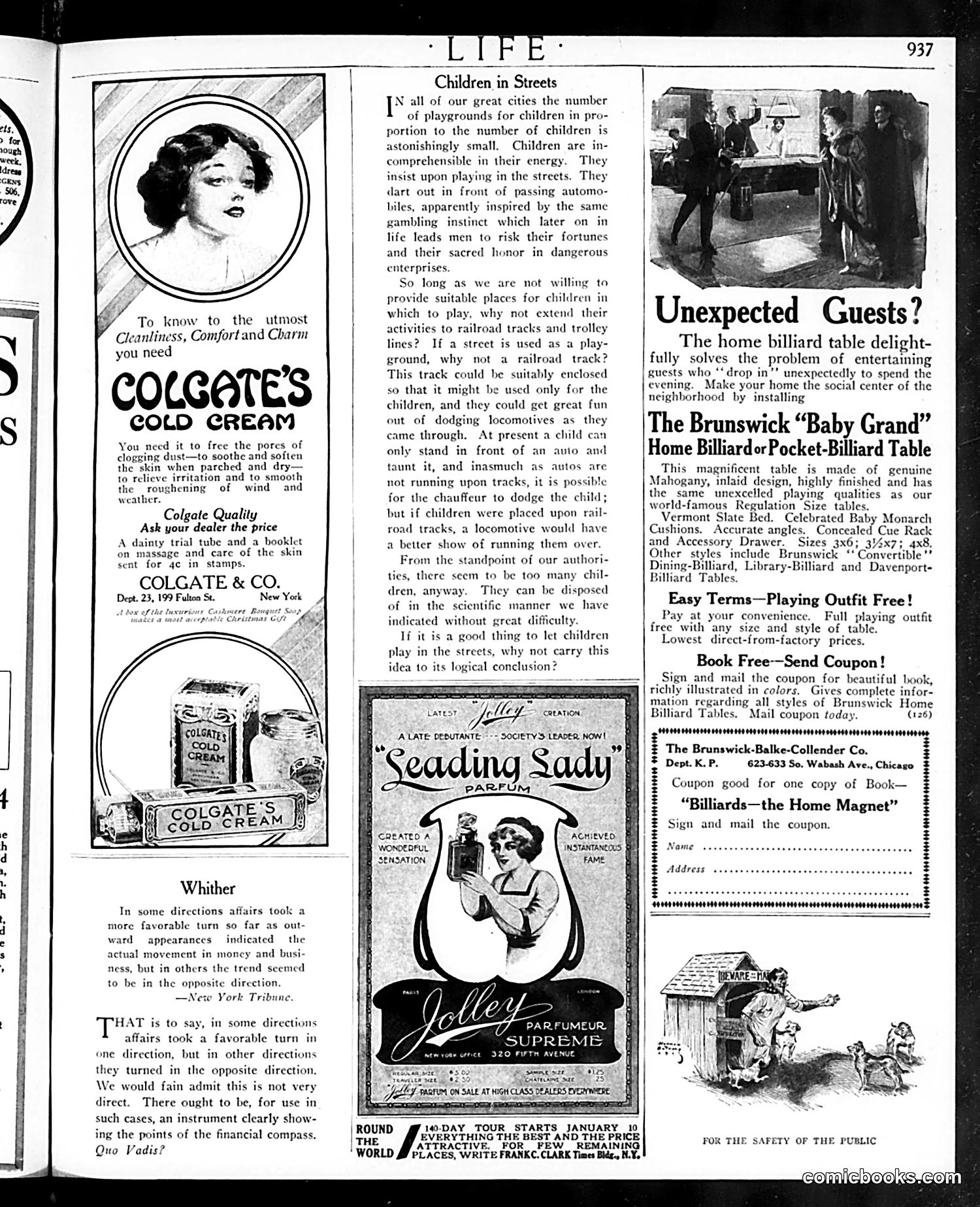
This page mixes advertisements with satirical commentary typical of Life magazine's style. The main satirical piece is titled "Whither" (Where?), mocking vague financial reporting. It quotes the New York Tribune's meaningless claim that "affairs took a favorable turn in one direction, but...the opposite direction in others." The text ridicules this circular logic, suggesting authorities need a "financial compass" to provide actual clarity—a jab at financial journalism and economic uncertainty. The longer article "Children in Streets" uses dark satire to critique urban neglect. It notes cities lack adequate playgrounds, so children dangerously play in streets. The author then sarcastically suggests the logical conclusion: why not let children play on railroad tracks? This mordant joke implies authorities tacitly accept child casualties as population control, exposing indifference to working-class child safety. The remaining content consists of period product advertisements: Colgate's Cold Cream, Jolley Parfum, Brunswick billiard tables, and a world tour offer—typical of Life's revenue model.
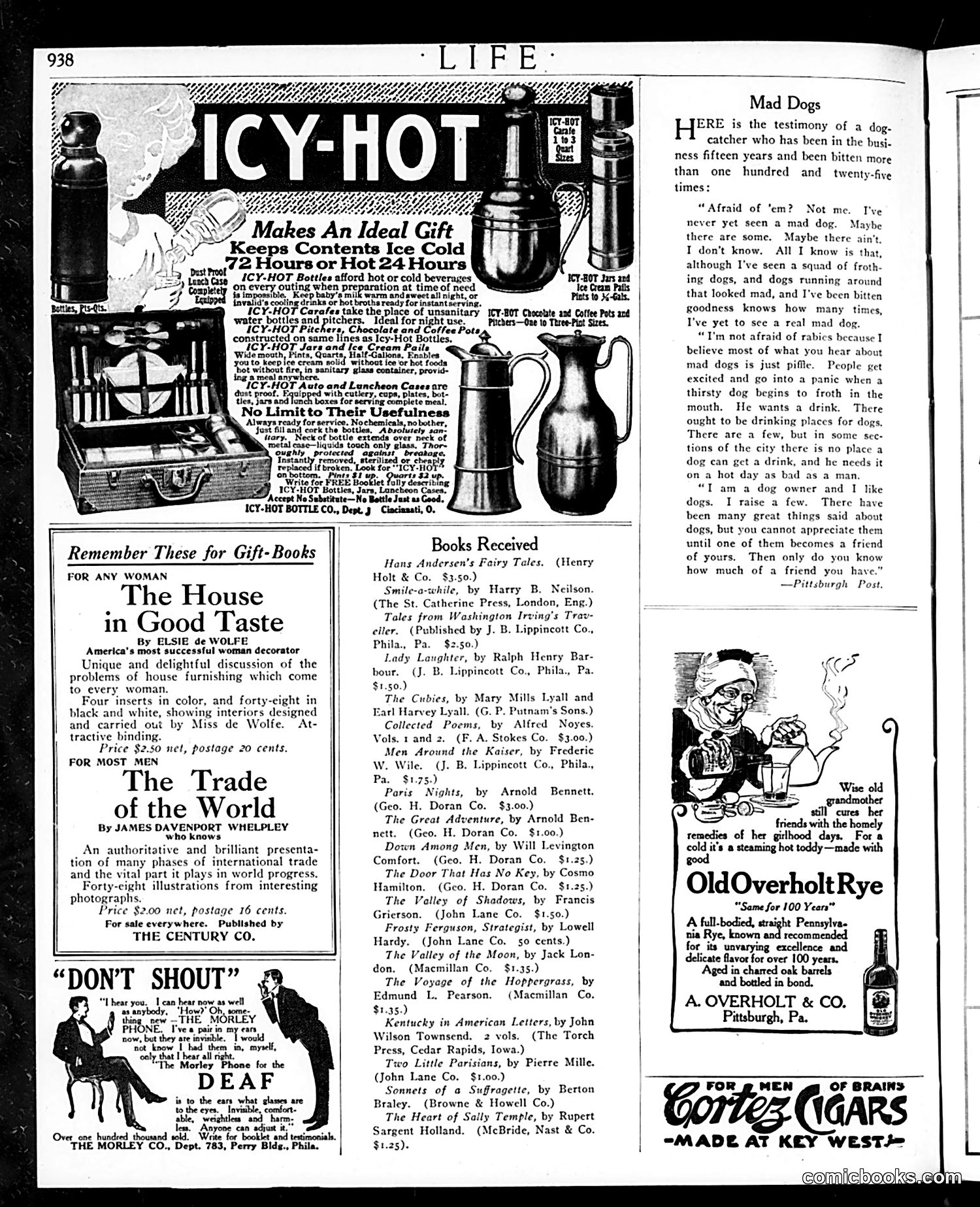
This page is primarily **advertising and book reviews**, not political satire. The dominant feature is a large advertisement for ICY-HOT Bottles—insulated containers for keeping beverages hot or cold. The ad emphasizes their practicality for outings, automobiles, and luncheons, positioning them as sanitary alternatives to shared drinking vessels. The page includes gift book recommendations (interior design, international trade), smaller ads for invisible hearing aids and telephone devices for the deaf, and a book review section. The only notable commentary appears in "Mad Dogs"—a brief article quoting a dog-catcher asserting he's never encountered an actually "mad" (rabid) dog despite 125+ bites in fifteen years. This appears to challenge contemporary fears about rabies rather than offer satire. The page reflects early 20th-century consumer culture and emerging anxieties about public health and disability accommodations.
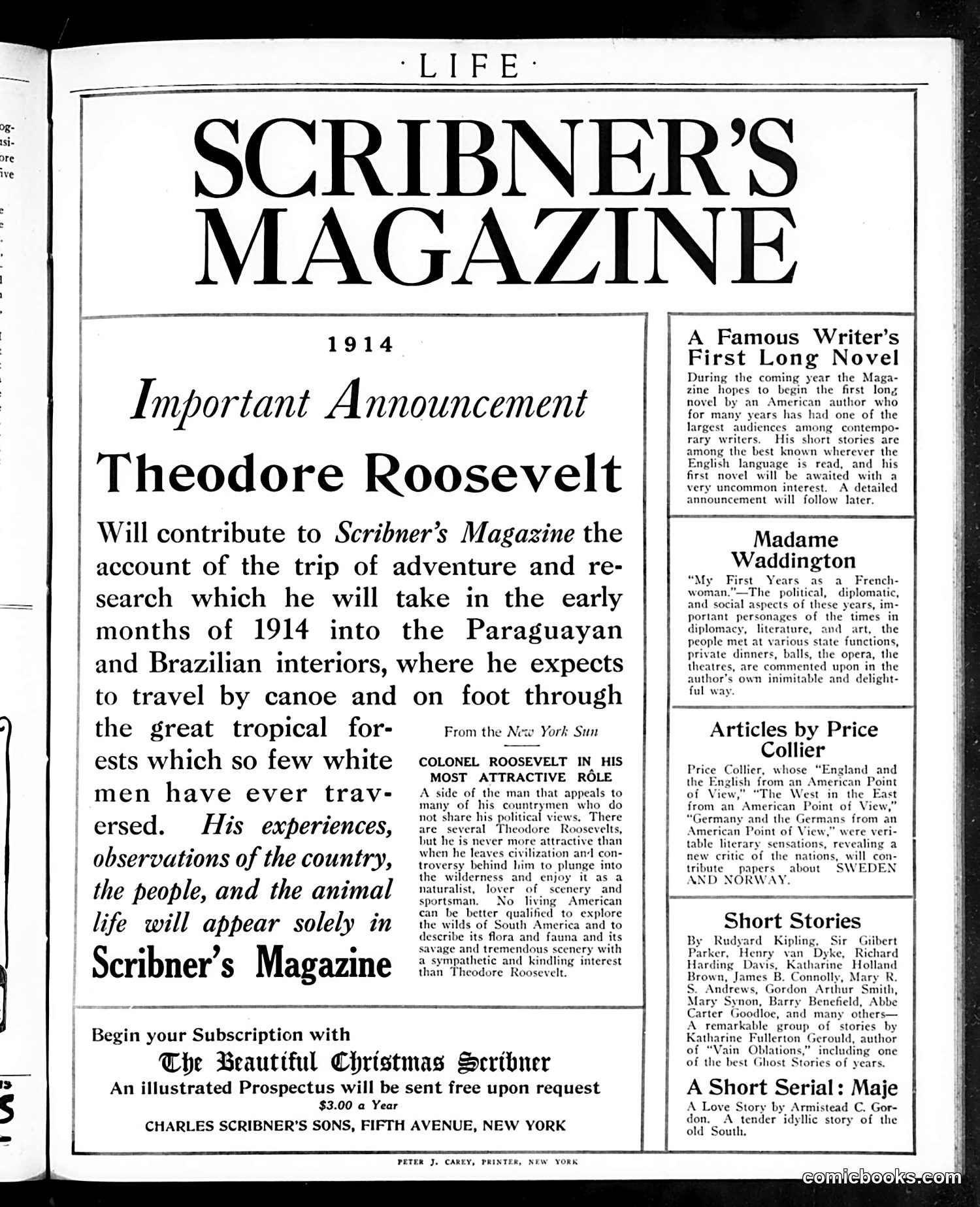
This is primarily a **magazine advertisement**, not a satirical cartoon page. It announces that former President Theodore Roosevelt will contribute exclusive articles to *Scribner's Magazine* about an upcoming 1914 expedition into the Brazilian and Paraguayan wilderness by canoe and on foot. The *New York Sun* quotation frames Roosevelt in his "most attractive role"—as a naturalist and outdoorsman rather than as a controversial politician. This positioning suggests Roosevelt, recently out of office (he left in 1909), was a polarizing figure whose political views divided Americans, but whose adventurer persona appealed across party lines. The page also advertises other *Scribner's* content: a famous American author's first novel, memoirs titled "Madame Waddington," and short stories by prominent writers like Rudyard Kipling and Richard Harding Davis. **No satire is evident here**—this is straightforward promotional material leveraging Roosevelt's celebrity and adventurous reputation to boost magazine subscriptions.
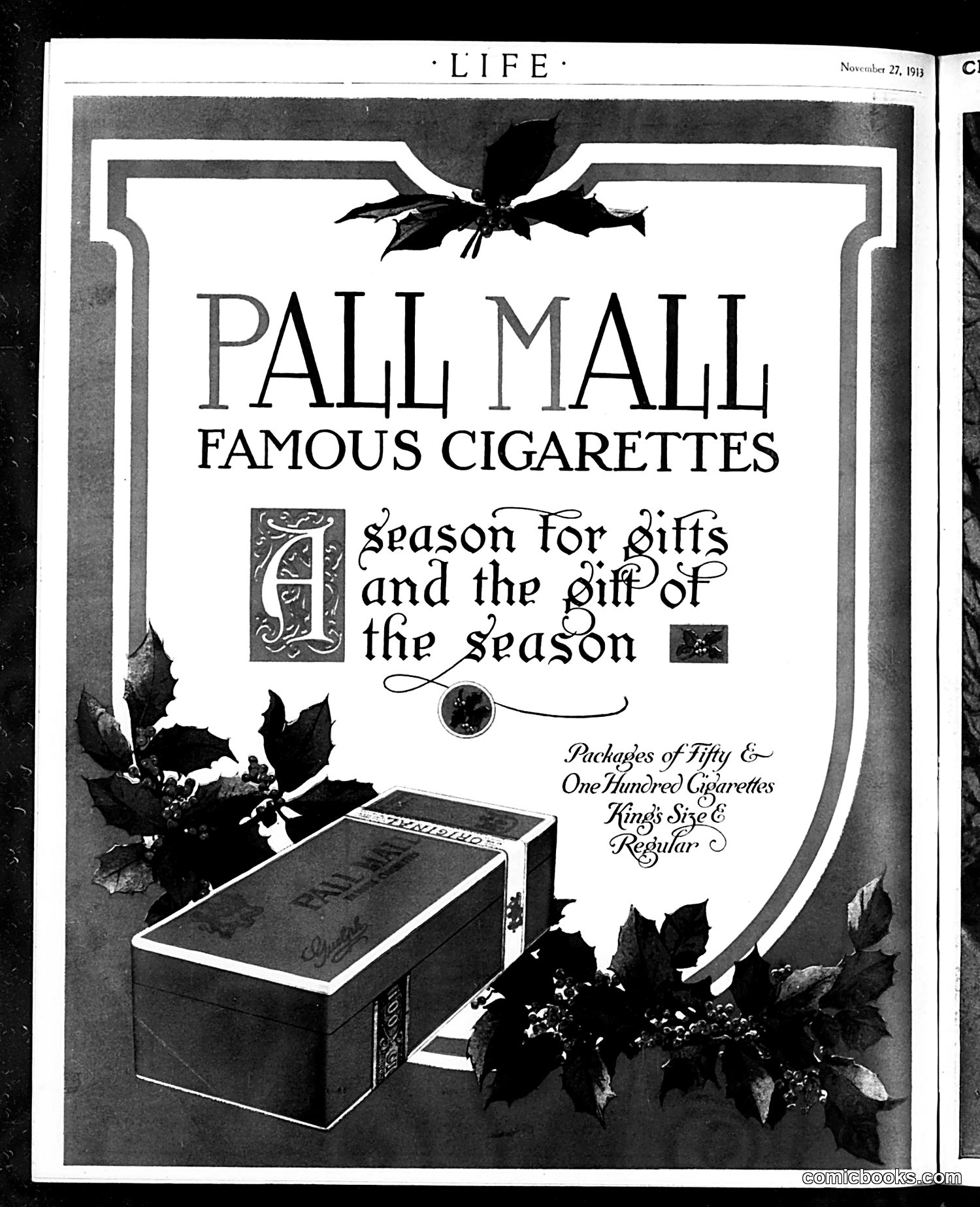
This is a **Pall Mall cigarette advertisement**, not a political cartoon or satirical content. The page appears from the November 27, 1913 issue of *Life* magazine. The ad promotes Pall Mall "Famous Cigarettes" as an ideal gift for the holiday season. It features decorative holly leaves and a product box, emphasizing available package sizes (fifty and one hundred cigarettes in "King's Size" and "Regular"). The text's tagline—"Season for gifts and the gift of the season"—is straightforward holiday marketing, positioning cigarettes as an appropriate seasonal present. There is no satire or political commentary visible; this is simply a commercial advertisement designed to appeal to holiday shoppers in the early 20th century, when cigarette advertising in mainstream publications was standard practice.