
Life, 1913-11-27 · page 6 of 40
Life — November 27, 1913 — page 6: what you’re looking at
What you’re looking at
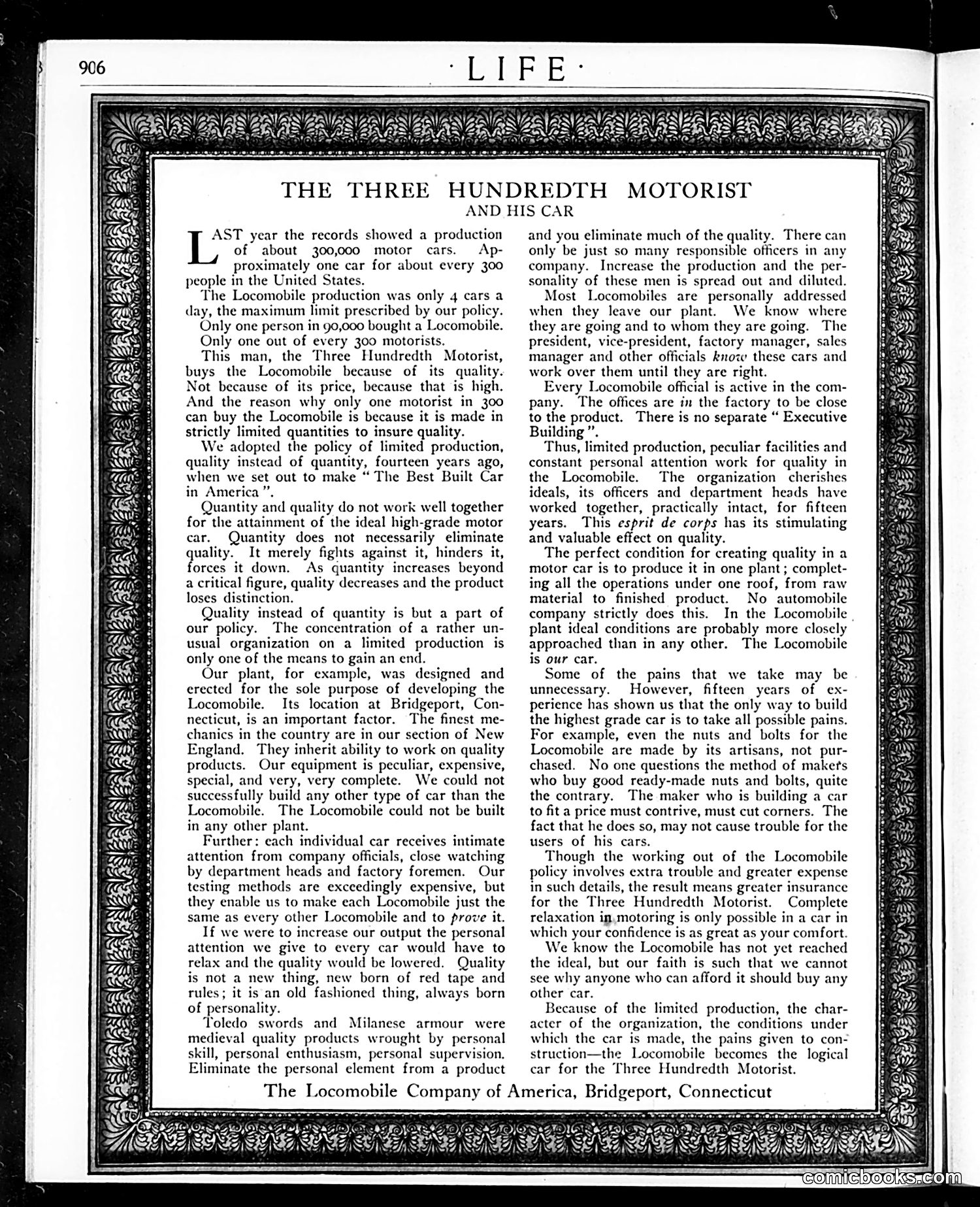
This is **not a cartoon or satire page** — it's a **straightforward advertisement** for the Locomotile automobile, published in *Life* magazine (page 906). The ad argues that the Locomotile's quality justifies its high price and limited production (only one car per 300 people in the U.S.). Key claims: the car is "made in strictly limited numbers to insure quality," features "peculiar facilities and constant personal attention," and employs quality control methods like hand-made nuts and bolts that other manufacturers don't use. The text positions the Locomotile as a luxury product for affluent buyers who prioritize craftsmanship over affordability. There is no satire here — it's a earnest marketing pitch emphasizing exclusivity and superior manufacturing as selling points.
📄 Transcribed text from this page (OCR, searchable)
Machine-transcribed from the original scan — historical spelling and the odd misread are preserved.
AIPAPALN CAA IN DS BAGS BAVA THE THREE HUNDREDTH MOTORIST AND HIS CAR ST year the records showed a production of about 300,000 motor cars. Ap- proximately one car for about every 300 people in the United States. The Locomobile production was only 4 cars a day, the maximum limit prescribed by our policy. Only one person in 90,000 bought a Locomobile. Only one out of every 300 motorists. This man, the Three Hundredth Motorist, buys the Locomobile because of its quality. Not because of its price, because that is high. And the reason why only one motorist in 300 can buy the Locomobile is because it is made in strictly limited quantities to insure quality. We adopted the policy of limited production, quality instead of quantity, fourteen years ago, when we set out to make “ The Best Built Car in America”, Quantity and quality do not work well together for the attainment of the ideal high-grade motor car. Quantity does not necessarily eliminate uality. It merely fights against it, hinders it, orces it down. As quantity increases beyond acritical figure, quality decreases and the product loses distinction. Quality instead of quantity is but a part of our policy. The concentration of a rather un- usual organization on a limited production is only one of the means to gain an end. Our plant, for example, was designed and erected for the sole purpose of developing the Locomobile. Its location at Bridgeport, Con- necticut, is an important factor. The finest me- chanics in the country are in our section of New England. They inherit ability to work on quality products. Our equipment is peculiar, expensive, special, and very, very complete. We could not successfully build any other type of car than the Locomobile. The Locomobile could not be built in any other plant. Further: each individual car receives intimate attention from company officials, close watching by department heads and factory foremen. Our testing methods are exceedingly expensive, but they enable us to make each Locomobile just the same as every other Locomobile and to prove it. If we were to increase our output the personal attention we give to every car would have to relax and the quality would be lowered. Quality is not a new thing, new born of red tape and rules; it is an old fashioned thing, always born of personality. Toledo swords and Milanese armour were medieval quality products wrought by personal skill, personal enthusiasm, personal supervision. Eliminate the personal element from a product and you eliminate much of the quality. There can only be just so many responsible officers in any company. Increase the production and the per- sonality of these men is spread out and diluted. Most Locomobiles are personally addressed when they leave our plant. We know where they are going and to whom they are going. The president, vice-president, factory manager, sales manager and other officials know these cars and work over them until they are right. Every Locomobile official is active in the com- pany. The offices are in the factory to be close to the product. There is no separate “ Executive Building ”. Thus, limited production, peculiar facilities and constant personal attention work for quality in the Locomobile. The organization cherishes ideals, its officers and department heads have worked together, practically intact, for fifteen years. This esprit de corps has its stimulating and valuable effect on quality. The perfect condition for creating quality in a motor car is to produce it in one plant; complet- ing all the operations under one roof, from raw material to finished product. No automobile company strictly does this. In the Locomobile plant ideal conditions are probably more closely approached than in any other. The Locomobile is our car. Some of the pains that we take may be unnecessary. However, fifteen years of ex- perience has shown us that the only way to build the highest grade car is to take all possible pains. For example, even the nuts and bolts for the Locomobile are made by its artisans, not pur- chased. No one questions the method of makers who buy good ready-made nuts and bolts, quite the contrary. The maker who is building a car to fit a price must contrive, must cut corners. The fact that he does so, may not cause trouble for the users of his cars. Though the working out of the Locomobile policy involves extra trouble and greater expense in such details, the result means greater insurance for the Three Hundredth Motorist. Complete relaxation in,motoring is only possible in a car in which your confidence is as great as your comfort. We know the Locomobile has not yet reached the ideal, but our faith is such that we cannot see why anyone who can afford it should buy any other car. Because of the limited production, the char- acter of the organization, the conditions under which the car is made, the pains given to con- struction—the Locomobile becomes the logical car for the Three Hundredth Motorist. The Locomobile Company of America, Bridgeport, Connecticut