
Life, 1913-11-27 · page 28 of 40
Life — November 27, 1913 — page 28: what you’re looking at
What you’re looking at
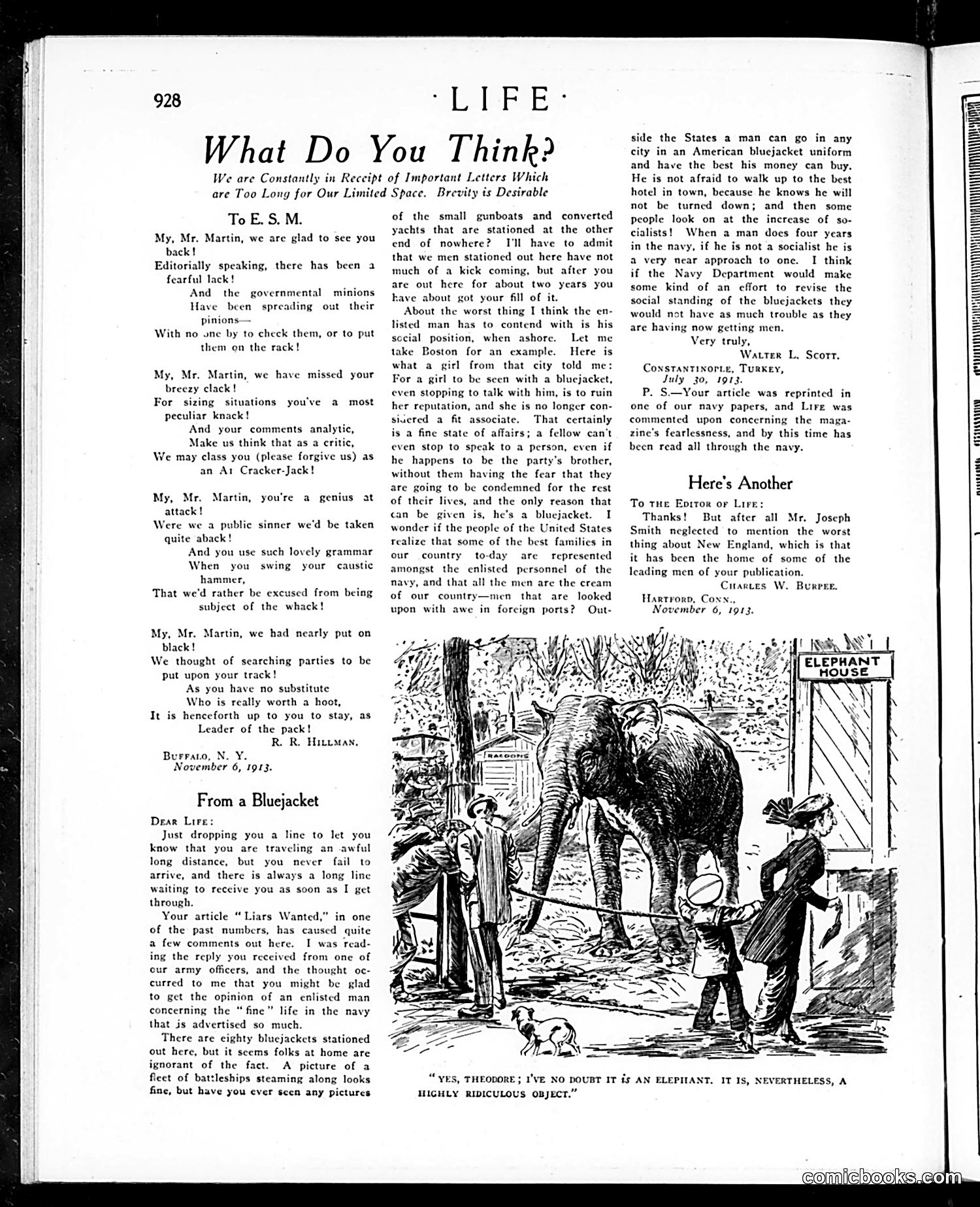
This page contains readers' letters to the editor and one cartoon. The main cartoon depicts an elephant being examined outside an "Elephant House," with the caption suggesting someone (likely "Theodore"—possibly referring to Theodore Roosevelt, known for safari expeditions) confirming it is indeed an elephant, calling it "a highly ridiculous object." The letters discuss social and military issues of 1913: 1. **First letter**: Praises the magazine's Mr. Martin for his editorial commentary 2. **"From a Bluejacket"**: An enlisted sailor criticizes the social stigma against naval personnel ashore, particularly in Boston, where girls reportedly face social ruin for being seen with sailors despite the Navy recruiting "the cream of our country." He notes the irony that American sailors are respected abroad but scorned at home, suggesting this mistreatment breeds socialism among enlisted men. The cartoon's humor likely plays on the absurdity of needing confirmation of an obvious fact—possibly satirizing contemporary political or social pretense.
📄 Transcribed text from this page (OCR, searchable)
Machine-transcribed from the original scan — historical spelling and the odd misread are preserved.
alAESE*; What Do You Think? We are Constantly in Receipt of Important Letters Which are Too Long for Our Limited Space. Brevity is Desirable To E.S.M. My, Mr. Martin, we are glad to see you back! Editorially speaking, there has been a fearful lack! And the governmental minions Have been spreading out their pinions— With no one by to check them, or to put them on the rack! My, Mr. Martin, we have missed your breezy clack! For sizing situations you've a most peculiar knack! And your comments analytic, Make us think that as a critic, We may class you (please forgive us) as an At Cracker-Jack! My, Mr. Martin, you're a genius at attack! Were we a public quite aback! And you use such lovely grammar When you swing your caustic hammer, That we'd rather be excused from being subject of the whack! inner we'd be taken My, Mr. Martin, we had nearly put on black! We thought of searching parties to be put upon your track! As you have no substitute Who is really worth a hoot, It is henceforth up to you to stay, as Leader of the pack! RR. Hiutan, Burrato, N. Y. November 6, 1913. From a Bluejacket Dear Lire: Just dropping you a line to let you know that you are traveling an awful long distance, but you never fail to arrive, and there is always a long line waiting to receive you as soon as I get through. Your article “ Liars Wanted,” in one of the past numbers, has caused quite a few comments out here. I was read- ing the reply you received from one of our army officers, and the thought oc- curred to me that you might be glad to get the opinion of an enlisted man concerning the “fine” life in the navy that is advertised so much. There are eighty bluejackcts stationed out here, but it scems folks at home are ignorant of the fact. A picture of a ficet of battleships steaming along looks fine, but have you ever scen any pictures of the small gunboats and converted yachts that are stationed at the other end of nowhere? I'll have to admit that we men stationed out here have not much of a kick coming, but after you are out here for about two years you kave about got your fill of it. About the worst thing I think the en- listed man has to contend with is his social position, when ashore. Let me take Boston for an example. Here is what a girl from that city told me: ‘or a girl to be scen with a blucjacket, even stopping to talk with him, is to ruin her reputation, and she is no longer con- siuered a fit associate. That certainly is a fine state of affairs; a fellow can't even stop to speak to a person, even if he happens to be the party's brother, without them having the fear that they are going to be condemned for the rest of their lives, and the only reason that can be given is, he’s a bluejacket. I wonder if the people of the United States realize that some of the best families in our country to-day are represented amongst the enlisted personnel of the navy, and that all the men are the cream of our country—men that are looked upon with awe in foreign ports? Out- “YES, THEODORE ; I'VE NO DOUBT IT ig AN ELEPITANT. IT IS, N HIGHLY RIDICULOUS OBJECT.” side the States a man can go in any city in an American bluejacket uniform and have the best his money can buy. He is not afraid to walk up to the best hotel in town, because he knows he will not be turned down; and then some people look on at the increase of so- cialists!] When a man does four years in the navy, if he is not a socialist he is a very near approach to one. I think if the Navy Department would make some kind of an effort to revise the social standing of the bluejackets they would have as much trouble as they are having now getting men. Very truly, Watter L. Scorr. Constantinorie, Turkey, July 30, 1913. P. S.—Your article was reprinted in one of our navy papers, and Lire was commented upon concerning the maga- zine’s fearlessness, and by this time has been read all through the navy. Here's Another To tHe Epitor or Lire: Thanks! But after all Mr. Joseph Smith neglected to mention the worst thing about New England, which is that it has been the home of some of the leading men of your publication. Cuarces W. Burpee. Hartrorp, Coxn., November 6, 1913. ITA