
Life, 1913-11-27 · page 19 of 40
Life — November 27, 1913 — page 19: what you’re looking at
What you’re looking at
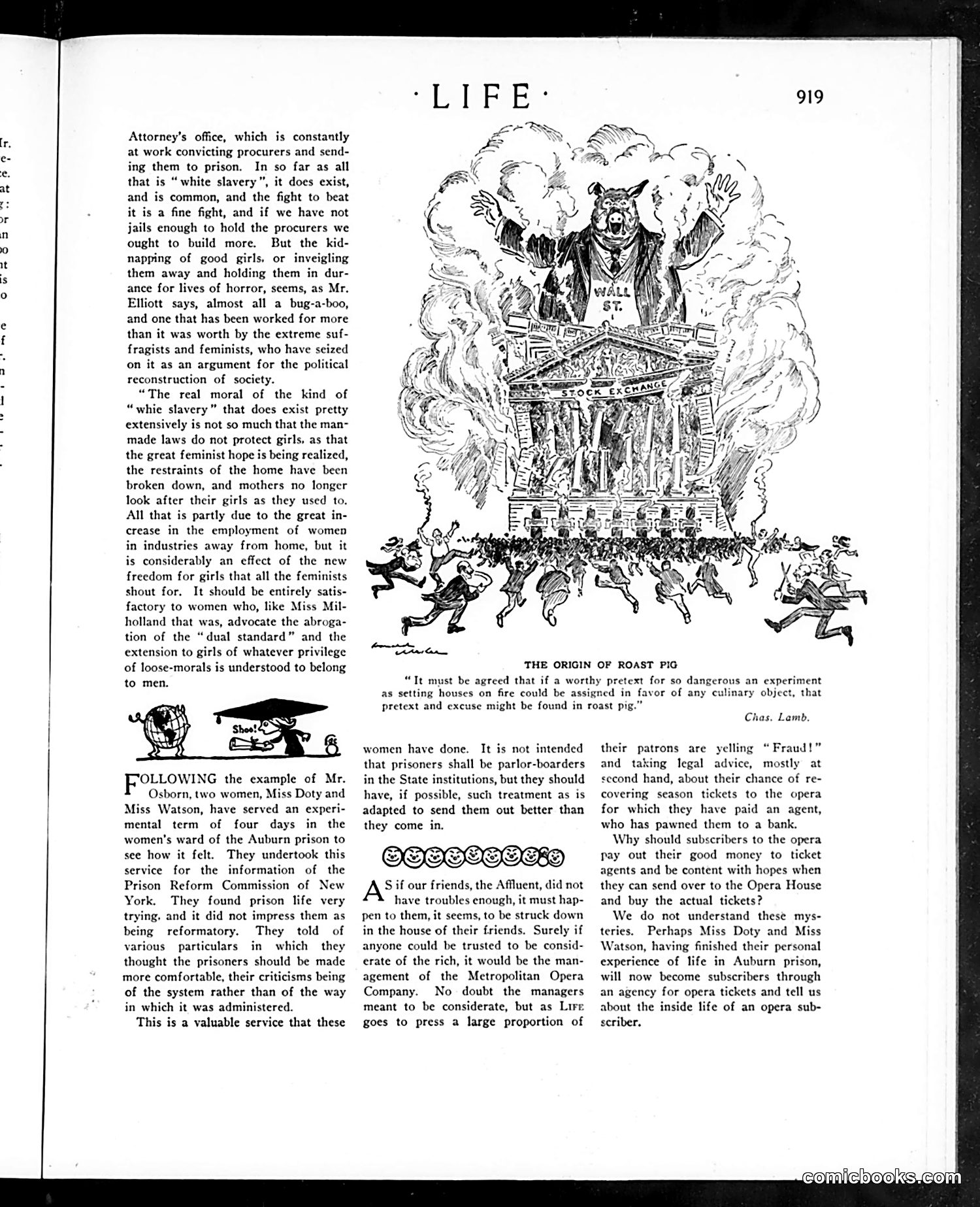
This page satirizes early 20th-century feminism and social reform through multiple arguments: **Main Editorial**: The text criticizes feminists (specifically mentioning "Miss Milholland") for using "white slavery" as a political argument for women's rights. The author claims the real issue isn't inadequate laws but rather feminism's breakdown of parental restraint and traditional family structures. He presents women's industrial employment and sexual freedom as consequences feminists should accept responsibility for. **The Cartoon "Origin of Roast Pig"**: This illustrates the ironic principle that dangerous experiments sometimes have unexpected justifications—here, setting houses on fire to cook pig. It sarcastically comments on how reforms (like the prison visits below) might have dubious practical results. **Prison Reform Anecdote**: Two women (Doty and Watson) spent four days in Auburn prison to report conditions. The piece acknowledges their service as "valuable" but dismisses their comfort-focused criticisms, arguing prisoners shouldn't receive easy treatment. **Metropolitan Opera Fraud**: Subscribers complain about ticket agents pawning their season tickets to banks—a cautionary tale about trusting intermediaries. Overall, the page blends skepticism toward feminist reformers with conservative defense of existing institutions.
📄 Transcribed text from this page (OCR, searchable)
Machine-transcribed from the original scan — historical spelling and the odd misread are preserved.
oe en OM ee: Attorney’s office, which is constantly at work convicting procurers and send- ing them to prison. In so far as all that is “white slavery”, it does exist, and is common, and the fight to beat it is a fine fight, and if we have not jails enough to hold the procurers we ought to build more. But the kid- napping of good girls, or inveigling them away and holding them in dur- ance for lives of horror, seems, as Mr. Elliott says, almost all a bug-a-boo, and one that has been worked for more than it was worth by the extreme suf- fragists and feminists, who have seized on it as an argument for the political reconstruction of society. “The real moral of the kind of “whie slavery” that does exist pretty extensively is not so much that the man- made laws do not protect girls, as that the great feminist hope is being realized, the restraints of the home have been broken down, and mothers no longer look after their girls as they used to. All that is partly due to the great in- crease in the employment of women in industries away from home, but it is considerably an effect of the new freedom for girls that all the femin shout for. It should be entirely satis- factory to women who, like Miss Mil- holland that was, advocate the abroga- tion of the “dual standard” and the extension to girls of whatever privilege of loose-morals is understood to belong to men. OLLOWING the example of Mr. Osborn, two women, Miss Doty and Miss Watson, have served an experi- mental term of four days in the women’s ward of the Auburn prison to see how it felt. They undertook this service for the information of the Prison Reform Commission of New York. They found prison life very trying, and it did not impress them as being reformatory. They told of various particulars in which they thought the prisoners should be made more comfortable, their criticisms being of the system rather than of the way in which it was administered. This is a valuable service that these THE ORIGIN OF ROAST PIG “Tt must be agreed that if a worthy pretext for so dangerous an experiment as setting houses on fire could be assigned in favor of any i pretext and excuse might be found in roast pig.” women have done. It is not intended that prisoners shall be parlor-boarders in the State institutions, but they should have, if possible, such treatment as is adapted to send them out better than they come in, SESCOSEOE.s S if our friends, the Affluent, did not have troubles enough, it must hap- pen to them, it seems, to be struck down in the house of their friends. Surely if anyone could be trusted to be consid- erate of the rich, it would be the man- agement of the Metropolitan Opera Company. No doubt the managers meant to be considerate, but as Lire goes to press a large proportion of ali inary object, that Chas, Lamb, their patrons are yelling “Fraud!” and taking legal advice, mostly at second hand, about their chance of re- covering season tickets to the opera for which they have paid an agent, who has pawned them to a bank. Why should subscribers to the opera pay out their good money to ticket agents and be content with hopes when they can send over to the Opera House and buy the actual tickets? We do not understand these mys- teries. Perhaps Miss Doty and Miss Watson, having finished their personal experience of life in Auburn prison, will now become subscribers through an agency for opera tickets and tell us about the inside life of an opera sub- seriber,