
Life, 1913-11-27 · page 26 of 40
Life — November 27, 1913 — page 26: what you’re looking at
What you’re looking at
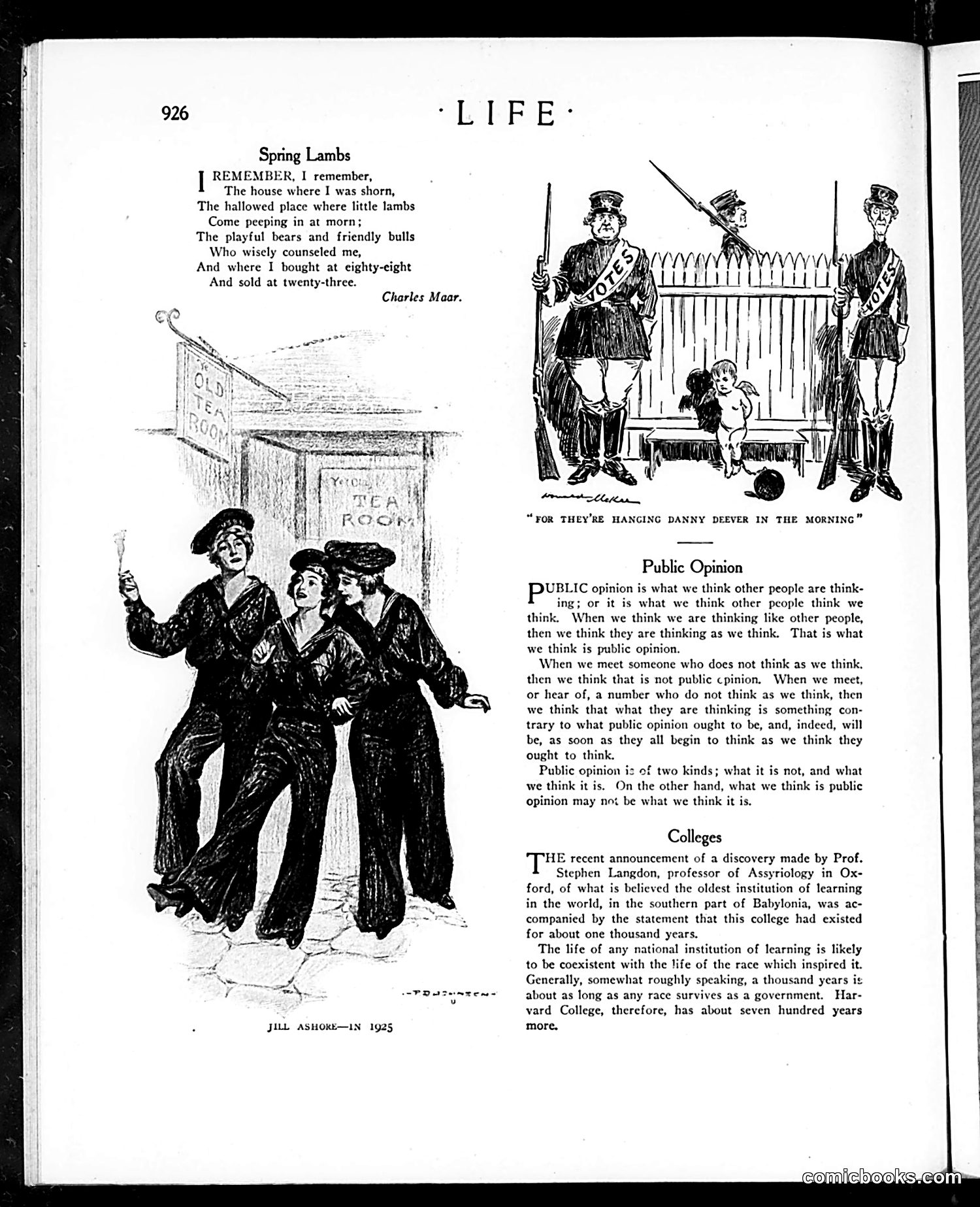
**"Spring Lambs"** (left cartoon): A satirical poem by Charles Maar about stock market speculation. The sheep narrator recalls being "shorn" (fleeced) at a farmyard where he bought stocks at 88 and sold at 23—a ruinous loss. The "playful bears and friendly bulls" are stock market slang for traders betting on declining and rising prices respectively. The joke: naive investors are lambs led to slaughter by market manipulation. **"Jill Ashore—1925"** (illustration): Shows three sailors or military figures, likely referencing a popular song or naval scandal of the 1920s. **"Public Opinion"** (essay): A circular, tongue-in-cheek definition mocking how people form and interpret public opinion—essentially, we think public opinion is what we personally believe others think, creating self-reinforcing conformity. **"Colleges"** (essay): Uses a recent archaeological discovery to humorously suggest Harvard College has "seven hundred years more" to survive, implying American institutions last roughly as long as civilizations (about 1,000 years).
📄 Transcribed text from this page (OCR, searchable)
Machine-transcribed from the original scan — historical spelling and the odd misread are preserved.
Spring Lambs REMEMBER, I remember, The house where I was shorn, The hallowed place where little lambs Come peeping in at morn; The playful bears and friendly bulls Who wisely counseled me, And where I bought at eighty-cight And sold at twenty-three. Charles Maar. JILL ASHOKE—1N 1925 “FOR THEY'RE HANGING DANNY DEEVER IN THE MORNING” Public Opinion UBLIC opinion is what we think other people are think- ing; or it is what we think other pcople think we think. When we think we are thinking like other people, then we think they are thinking as we think. That is what we think is public opinion. When we meet someone who does not think as we think, then we think that is not public cpinion, When we meet, or hear of, a number who do not think as we think, then we think that what they are thinking is something con- trary to what public opinion ought to be, and, indeed, will be, as soon as they all begin to think as we think they ought to think. Public opinion iz of two kinds; what it is not, and what we think it is. On the other hand, what we think is public opinion may noi be what we think it is. Colleges THE recent announcement of a discovery made by Prof. Stephen Langdon, professor of Assyriology in Ox- ford, of what is believed the oldest institution of learning in the world, in the southern part of Babylonia, was ac- companied by the statement that this college had existed for about one thousand years. The life of any national institution of learning is likely to be coexistent with the life of the race which inspired it. Generally, somewhat roughly speaking, a thousand years is about as long as any race survives as a government. Har- vard College, therefore, has about seven hundred years more,