
Life, 1913-11-27 · page 18 of 40
Life — November 27, 1913 — page 18: what you’re looking at
What you’re looking at
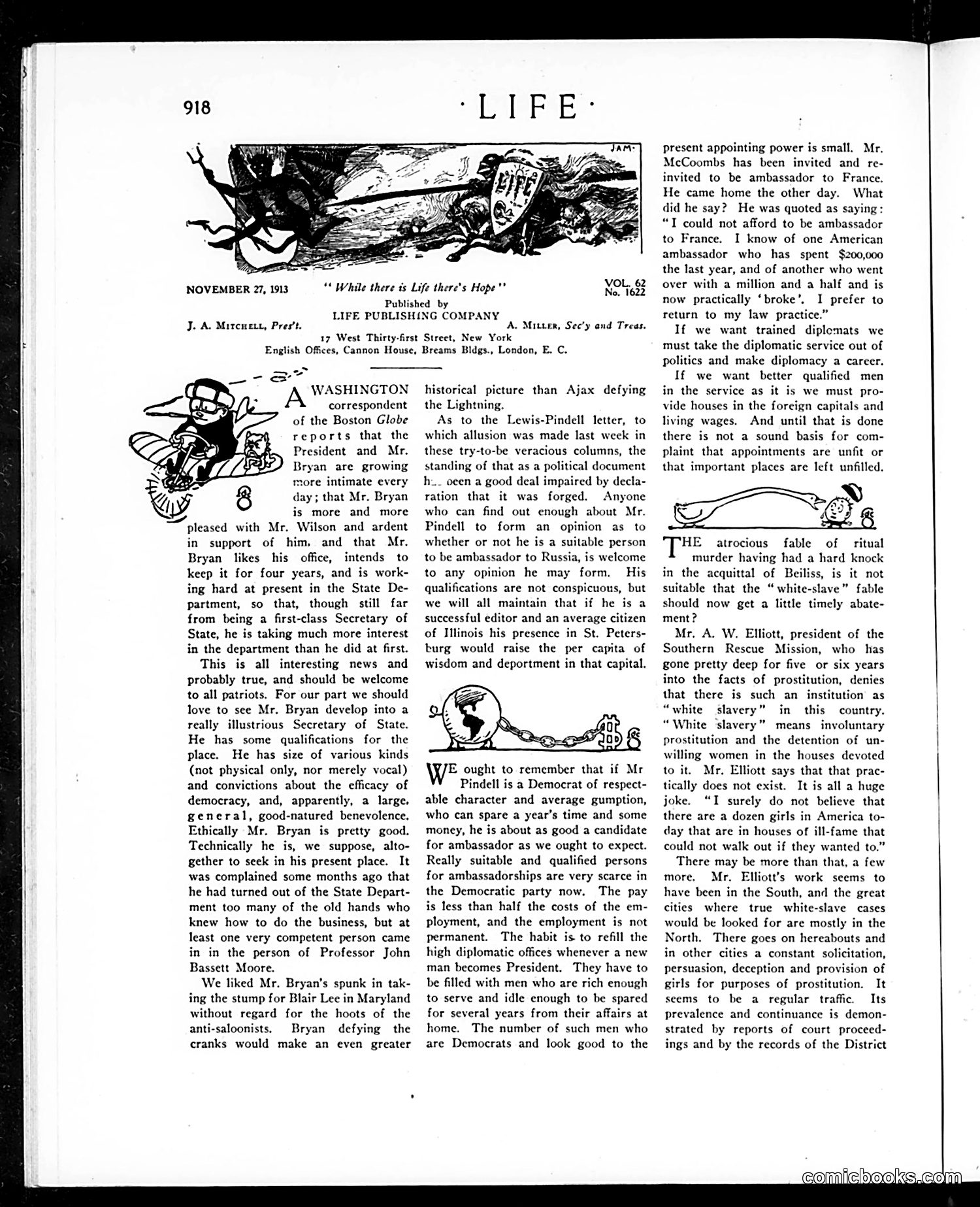
This page critiques President Wilson's diplomatic appointments, particularly focusing on potential ambassadorships. The main article discusses William Jennings Bryan (Wilson's Secretary of State) and a proposed appointment of someone named Pindell as ambassador to Russia. The satire targets the impracticality of diplomatic service: wealthy men must essentially self-fund these prestigious but unpaid positions, creating a system where only the rich can serve. The piece notes that even wealthy appointees often go broke—one ambassador spent $200,000, another $1.5 million. The cartoons (showing figures in chains/constraints) appear to illustrate Bryan's political compromises and the constraining nature of diplomatic appointments. The article criticizes how ambassadorships are filled based on political patronage and personal wealth rather than actual qualifications, a recurring problem when administrations change.
📄 Transcribed text from this page (OCR, searchable)
Machine-transcribed from the original scan — historical spelling and the odd misread are preserved.
NOVEMBER 27, 1913 “ While there is Life there's Hope" MOL. 62 No, 1622 Published by LIFE PUBLISHING COMPANY J. A. Mircnett, Pres’t. A. Mutter, Sec’y and Treas. 17 West Thirty-first Street, New York English Offices, Cannon House, Breams Bldgs., London, E. C. a7 A WASHINGTON correspondent of the Boston Globe reports that the President and Mr. Bryan are growing more intimate every B says that Mr. Bryan is more and more pleased with Mr. Wilson and ardent in support of him, and that Mr. Bryan likes his office, intends to keep it for four years, and is work- ing hard at present in the State De- partment, so that, though still far from being a first-class Secretary of State, he is taking much more interest in the department than he did at first. This is all interesting news and probably true, and should be welcome to all patriots. For our part we should love to see Mr. Bryan develop into a really illustrious Secretary of State. He has some qualifications for the place. He has size of various kinds (not physical only, nor merely vocal) and convictions about the efficacy of democracy, and, apparently, a large, general, good-natured benevolence, Ethically Mr. Bryan is pretty good. Technically he is, we suppose, alto- gether to seek in his present place. It was complained some months ago that he had turned out of the State Depart- ment too many of the old hands who knew how to do the business, but at least one very competent person came in in the person of Professor John Bassett Moore. We liked Mr. Bryan’s spunk in tak- ing the stump for Blair Lee in Maryland without regard for the hoots of the anti-saloonists. Bryan defying the cranks would make an even greater historical picture than Ajax defying the Lightning. As to the Lewis-Pindell letter, to which allusion was made last week in these try-to-be veracious columns, the standing of that as a political document h__ ocen a good deal impaired by decla- ration that it was forged. Anyone who can find out enough about Mr. Pindell to form an opinion as to whether or not he is a suitable person to be ambassador to Russia, is welcome to any opinion he may form. His qualifications are not conspicuous, but we will all maintain that if he is a successful editor and an average citizen of Illinois his presence in St. Peters- burg would raise the per capita of wisdom and deportment in that capital. E ought to remember that if Mr Pindell is a Democrat of respect- able character and average gumption, who can spare a year’s time and some money, he is about as good a candidate for ambassador as we ought to expect. Really suitable and qualified persons for ambassadorships are very scarce in the Democratic party now. The pay is less than half the costs of the em- ployment, and the employment is not permanent. The habit is to refill the high diplomatic offices whenever a new man becomes President. They have to be filled with men who are rich enough to serve and idle enough to be spared for several years from their affairs at home. The number of such men who are Democrats and look good to the present appointing power is small. Mr. McCoombs has been invited and re- invited to be ambassador to France. He came home the other day. What did he say? He was quoted as saying: “TI could not afford to be ambassador to France. I know of one American ambassador who has spent $200,000 the last year, and of another who went over with a million and a half and is now practically ‘broke’, I prefer to return to my law practice.” If we want trained diplomats we must take the diplomatic service out of politics and make diplomacy a career. If we want better qualified men in the service as it is we must pro- vide houses in the foreign capitals and living wages. And until that is done there is not a sound basis for com- plaint that appointments are unfit or that important places are left unfilled. HE atrocious fable of ritual murder having had a hard knock in the acquittal of Beiliss, is it not suitable that the “white-slave” fable should now get a little timely abate- ment? Mr. A. W. Elliott, president of the Southern Rescue Mission, who has gone pretty deep for five or six years into the facts of prostitution, denies that there is such an institution as “white slavery” in this country. “White ‘slavery” means involuntary prostitution and the detention of un- willing women in the houses devoted to it. Mr. Elliott says that that prac- tically does not exist. It is all a huge joke. “I surely do not believe that there are a dozen girls in America to- day that are in houses of ill-fame that could not walk out if they wanted to.” There may be more than that, a few more. Mr. Elliott’s work seems to have been in the South, and the great cities where true white-slave cases would be looked for are mostly in the North, There goes on hereabouts and in other cities a constant solicitation, persuasion, deception and provision of girls for purposes of prostitution. It seems to be a regular traffic. Its prevalence and continuance is demon- strated by reports of court proceed- ings and by the records of the District