
Life, 1913-11-27 · page 34 of 40
Life — November 27, 1913 — page 34: what you’re looking at
What you’re looking at
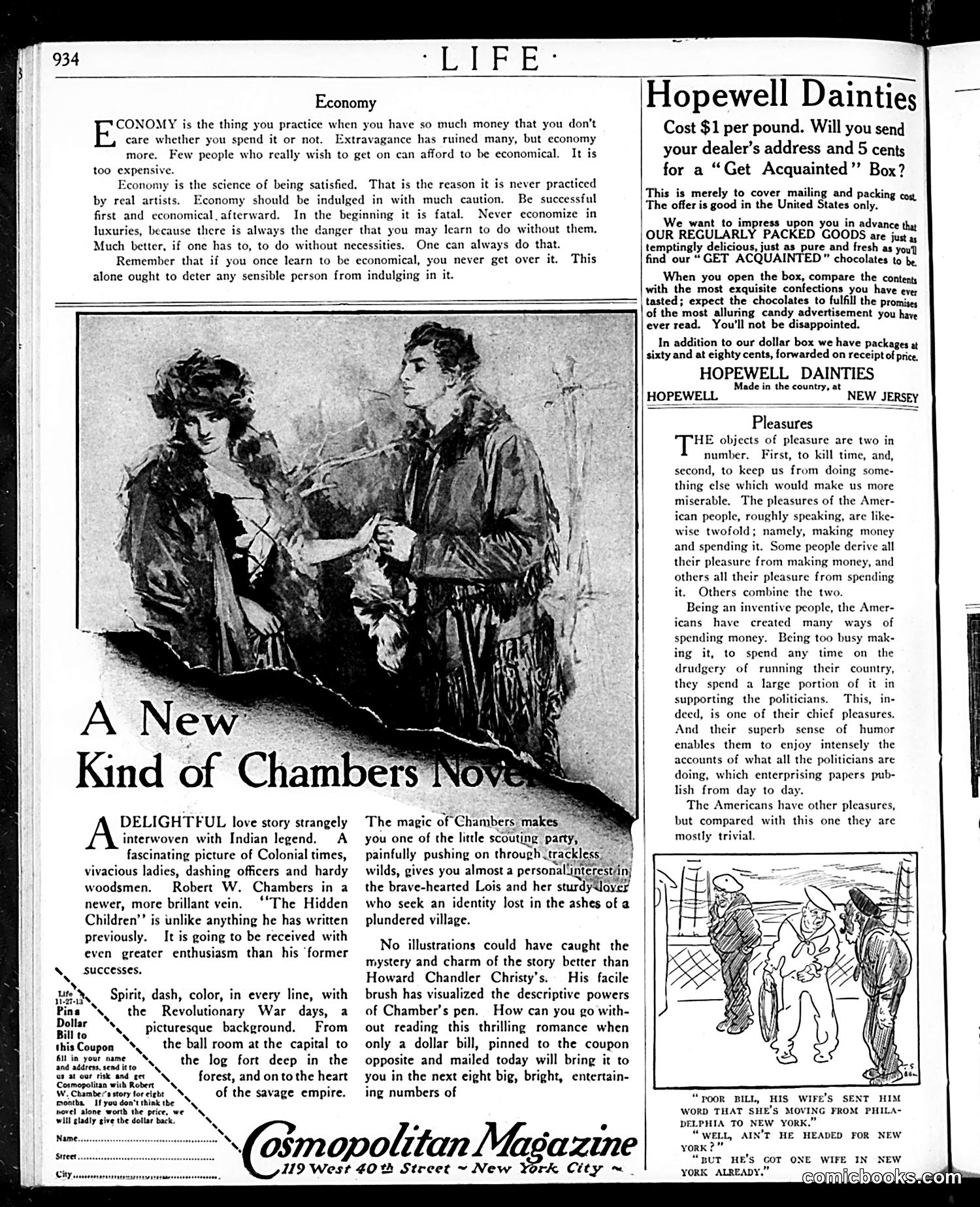
This page mixes satirical essays with period advertising (circa 1910s-1920s). **The "Economy" essay** is cynical social commentary: it mocks the wealthy who practice "economy" as affectation—claiming that true economy is impossible for "real artists" and that learning to economize is a dangerous habit. The joke targets the hypocrisy of the rich pretending frugality while refusing to sacrifice luxuries. **"A New Kind of Chambers Novel"** promotes Robert W. Chambers' book *The Hidden Children*, featuring Revolutionary War-era adventure and romance illustrated by Howard Chandler Christy. The text emphasizes dramatic action and emotional engagement to sell subscriptions. **The accompanying sketch** (captioned "Poor Bill") appears to illustrate domestic comedy—though details are unclear from this reproduction. **Advertisements** for Hopewell Dainties chocolate and magazine subscriptions occupy the right side, typical of Life's revenue model. The page reflects early 20th-century middlebrow American culture: romantic historical fiction, consumer goods marketing, and gentle satire of upper-class pretension.
📄 Transcribed text from this page (OCR, searchable)
Machine-transcribed from the original scan — historical spelling and the odd misread are preserved.
oi | ad She Economy CONOMY is the thing you practice when you have so much money that you don’t care whether you spend it or not. more. too expensive. Extravagance has ruined many, but economy Few people who really wish to get on can afford to be economical. It is Economy is the science of being satisfied. That is the reason it is never practiced by real artists. first and economical, afterward. Zconomy should be indulged in with much caution. In the beginning it is fatal. Be successful Never economize in luxuries, because there is always the danger that you may learn to do without them, Much better, if one has to, to do without necessities. Remember that if you once learn to be economical, you never get over it. One can always do that. This alone ought to deter any sensible person from indulging in it. Kind of Chamber DELIGHTFUL love story strangely interwoven with Indian legend. A fascinating picture of Colonial times, vivacious ladies, dashing officers and hardy woodsmen. Robert W. Chambers in a newer, more brillant vein. ‘The Hidden Children’’ is unlike anything he has written previously. It is going to be received with even greater enthusiasm than his ‘former NQ successes. ‘, . ee . n . ite. Spirit, dash, color, in every line, with Pina “\ the Revolutionary War days, a Fioe . y YS, Dollar \. picturesque background. From thisCoupon “S, — the ball room at the capital to fil in your name S, # tei cider ena. the log fort deep in the forest, and on tothe heart \. of the savage empire. novel alone worth the price, we “\. will gladly give the dollar back. ‘, City savssccororvsnanncaneninsstnanersssssceseeeny The magic of Chambers makes you one of the little scouting party, painfully pushing on through <trackless, wilds, gives you almost a personallinterestiin| the brave-hearted Lois and her sturdydover who seek an identity lost in the ashes of a plundered village. No illustrations could have caught the mystery and charm of the story better than Howard Chandler Christy’s. His facile brush has visualized the descriptive powers of Chamber’s pen. How can you go with- out reading this thrilling romance when only a dollar bill, pinned to the coupon opposite and mailed today will bring it to you in the next eight big, bright, entertain- ing numbers of \(e3mopolitan Ma iazin '9 West 40 th Street ~ New rk City ~ Hopewell Dainties Cost $1 per pound. Will you send your dealer’s address and 5 cents for a “Get Acquainted” Box? The rere eed a the Usted Sates arene We want to impress upon you in advance OUR REGULARLY PACKED GOODS are ioe temptingly delicious, just as pure and fresh as youl] find our “GET ACQUAINTED” chocolates to be. When you open the box, compare the content with the most exquisite confections you have ever tasted; expect the chocolates to fulfill the promises of the most alluring candy advertisement you have ever read. You'll not be disappointed. In addition to our dollar box we have packages at sixty and at eighty cents, forwarded on receipt of price, HOPEWELL DAINTIES Made in the country, at HOPEWELL Pleasures HE objects of pleasure are two in number. First, to kill time, and, second, to keep us from doing some- thing else which would make us more miserable, The pleasures of the Amer- ican people, roughly speaking, are like- wise twofold; namely, making money and spending it. Some people derive all their pleasure from making money, and others all their pleasure from spending it. Others combine the two. Being an inventive people, the Amer- icans have created many ways of spending money. Being too busy mak- ing it, to spend any time on the drudgery of running their country, they spend a large portion of it in supporting the politicians. This, in- deed, is one of their chief pleasures. And their superb sense of humor enables them to enjoy intensely the accounts of what all the politicians are doing, which enterprising papers pub- lish from day to day. The Americans have other pleasures, but compared with this one they are mostly trivial. “pooR BILL, HIS WIFE'S SENT HIM WORD THAT SHE'S MOVING FROM PHILA- DELPHIA TO NEW YORK.” “WELL, AIN'T HE HEADED FOR NEW york?" “BUT HE'S GOT ONE WIFE IN NEW YORK ALREADY,’ Fi