
Life, 1913-11-27 · page 16 of 40
Life — November 27, 1913 — page 16: what you’re looking at
What you’re looking at
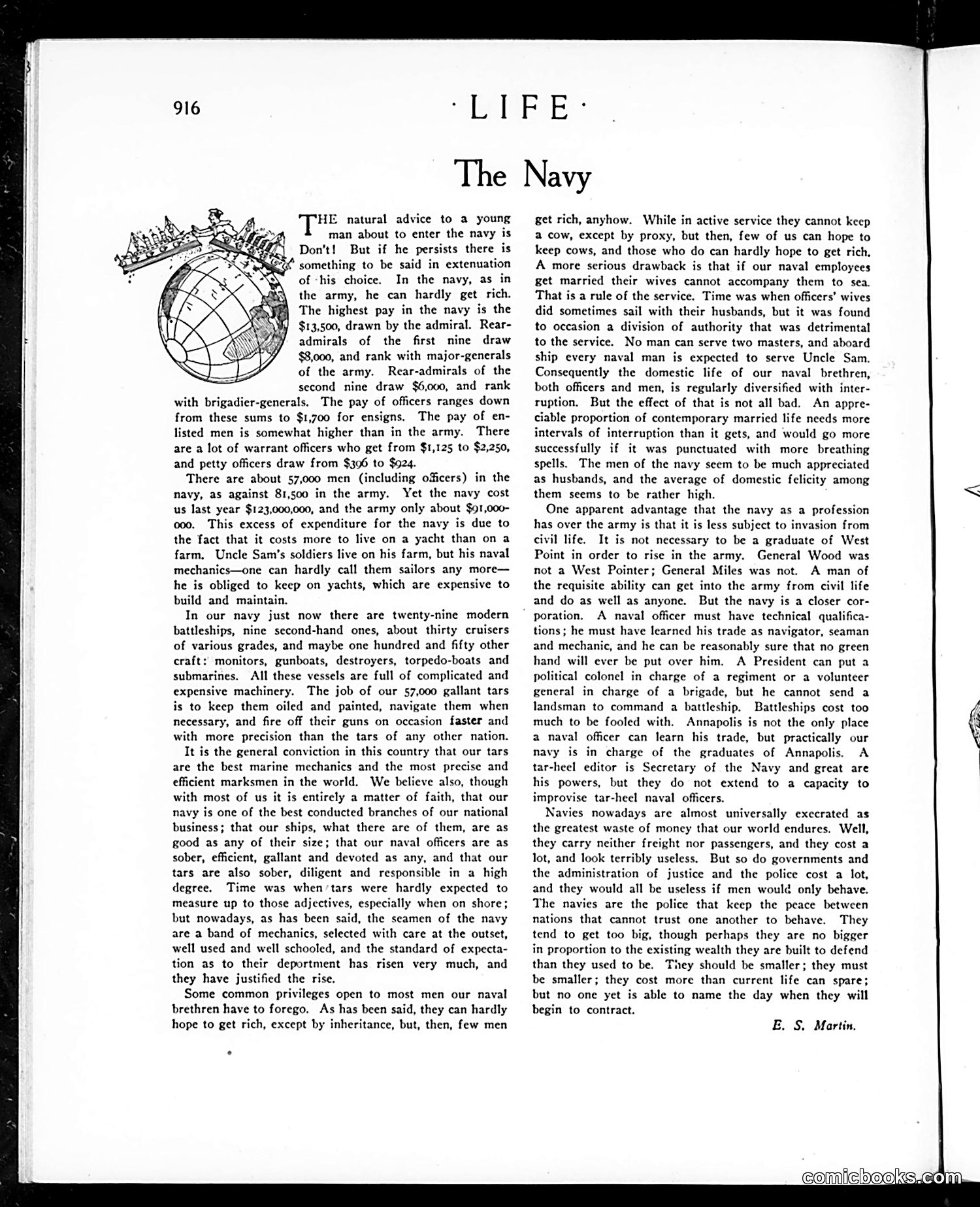
This is a serious editorial essay (not satire) defending the U.S. Navy as a career, signed by E.S. Martin. The accompanying globe illustration is decorative, not satirical. The piece addresses young men considering naval service, acknowledging the profession's drawbacks: low pay (admirals earn $13,500; enlisted men far less), expensive ship maintenance, and forced separation from wives during active duty. However, Martin argues these sacrifices are offset by advantages: naval officers need not be West Point graduates (unlike army officers), the Navy develops skilled mechanics and marksmen, and naval personnel are notably disciplined and well-trained—a marked improvement from earlier eras when sailors had poor reputations ashore. The essay's tone is promotional yet candid, presenting the Navy as a respectable, professionally-managed institution worthy of consideration despite financial limitations. The context reflects early 20th-century American naval expansion and efforts to professionalize military service.
📄 Transcribed text from this page (OCR, searchable)
Machine-transcribed from the original scan — historical spelling and the odd misread are preserved.
ESE The Navy HE natural advice to a young Kor Py man about to enter the navy is SPRY) Don't! But if he persists there is ¢ something to be said in extenuation of -his choice. In the navy, as in the army, he can hardly get rich. The highest pay in the navy is the $13,500, drawn by the admiral. Rear- admirals of the first nine draw $8,000, and rank with major-generals of the army. Rear-admirals of the second nine draw $6,000, and rank with brigadier-generals, The pay of officers ranges down from these sums to $1,700 for ensigns. The pay of en- listed men is somewhat higher than in the army. There are a lot of warrant officers who get from $1,125 to $2,250, and petty officers draw from $396 to $924. There are about 57,000 men (including officers) in the navy, as against 81,500 in the army. Yet the navy cost us last year $123,000,000, and the army only about $91,000- 000. This excess of expenditure for the navy is due to the fact that it costs more to live on a yacht than on a farm, Uncle Sam’s soldiers live on his farm, but his naval mechanics—one can hardly call them sailors any more— he is obliged to keep on yachts, which are expensive to build and maintain. In our navy just now there are twenty-nine modern battleships, nine second-hand ones, about thirty cruisers of various grades, and maybe one hundred and fifty other craft: monitors, gunboats, destroyers, torpedo-boats and submarines. All these vessels are full of complicated and expensive machinery. The job of our 57,000 gallant tars is to keep them oiled and painted, navigate them when necessary, and fire off their guns on occasion faster and with more precision than the tars of any other nation. It is the general conviction in this country that our tars are the best marine mechanics and the most precise and efficient marksmen in the world. We believe also, though with most of us it is entirely a matter of faith, that our navy is one of the best conducted branches of our national business; that our ships, what there are of them, are as good as any of their size; that our naval officers are as sober, efficient, gallant and devoted as any, and that our tars are also sober, diligent and responsible in a high degree. Time was when’tars were hardly expected to measure up to those adjectives, especially when on shore; but nowadays, as has been said, the seamen of the navy are a band of mechanics, selected with care at the outset, well used and well schooled, and the standard of expecta- tion as to their deportment has risen very much, and they have justified the rise. Some common privileges open to most men our naval brethren have to forego. As has been said, they can hardly hope to get rich, except by inheritance, but, then, few men get rich, anyhow. While in active service they cannot keep a cow, except by proxy, but then, few of us can hope to keep cows, and those who do can hardly hope to get rich. A more serious drawback is that if our naval employees get married their wives cannot accompany them to sea. That is a rule of the service. Time was when officers’ wives did sometimes sail with their husbands, but it was found to occasion a division of authority that was detrimental to the service. No man can serve two masters, and aboard ship every naval man is expected to serve Uncle Sam. Consequently the domestic life of our naval brethren, both officers and men, is regularly diversified with inter- ruption. But the effect of that is not all bad. An appre- ciable proportion of contemporary married life needs more intervals of interruption than it gets, and would go more successfully if it was punctuated with more breathing spells. The men of the navy seem to be much appreciated as husbands, and the average of domestic felicity among them seems to be rather high. One apparent advantage that the navy as a profession has over the army is that it is less subject to invasion from civil life. It is not necessary to be a graduate of West Point in order to rise in the army. General Wood was not a West Pointer; General Miles was not. A man of the requisite ability can get into the army from civil life and do as well as anyone. But the navy is a closer cor- poration, A naval officer must have technical qualifica- tions; he must have learned his trade as navigator, seaman and mechanic, and he can be reasonably sure that no green hand will ever be put over him. A President can put a political colonel in charge of a regiment or a volunteer general in charge of a brigade, but he cannot send a landsman to command a battleship. Battleships cost too much to be fooled with. Annapolis is not the only place a naval officer can learn his trade, but practically our navy is in charge of the graduates of Annapolis. A tar-heel editor is Secretary of the Navy and great are his powers, but they do not extend to a capacity to improvise tar-heel naval officers. Navies nowadays are almost universally exccrated as the greatest waste of money that our world endures. Well, they carry neither freight nor passengers, and they cost a lot, and look terribly useless. But so do governments and the administration of justice and the police cost a lot, and they would all be useless if men would only behave. The navies are the police that keep the peace between nations that cannot trust one another to behave. They tend to get too big, though perhaps they are no bigger in proportion to the existing wealth they are built to defend than they used to be. They should be smaller; they must be smaller; they cost more than current life can spare; but no one yet is able to name the day when they will begin to contract. EB, S. Martin.