
Life, 1913-11-27 · page 22 of 40
Life — November 27, 1913 — page 22: what you’re looking at
What you’re looking at
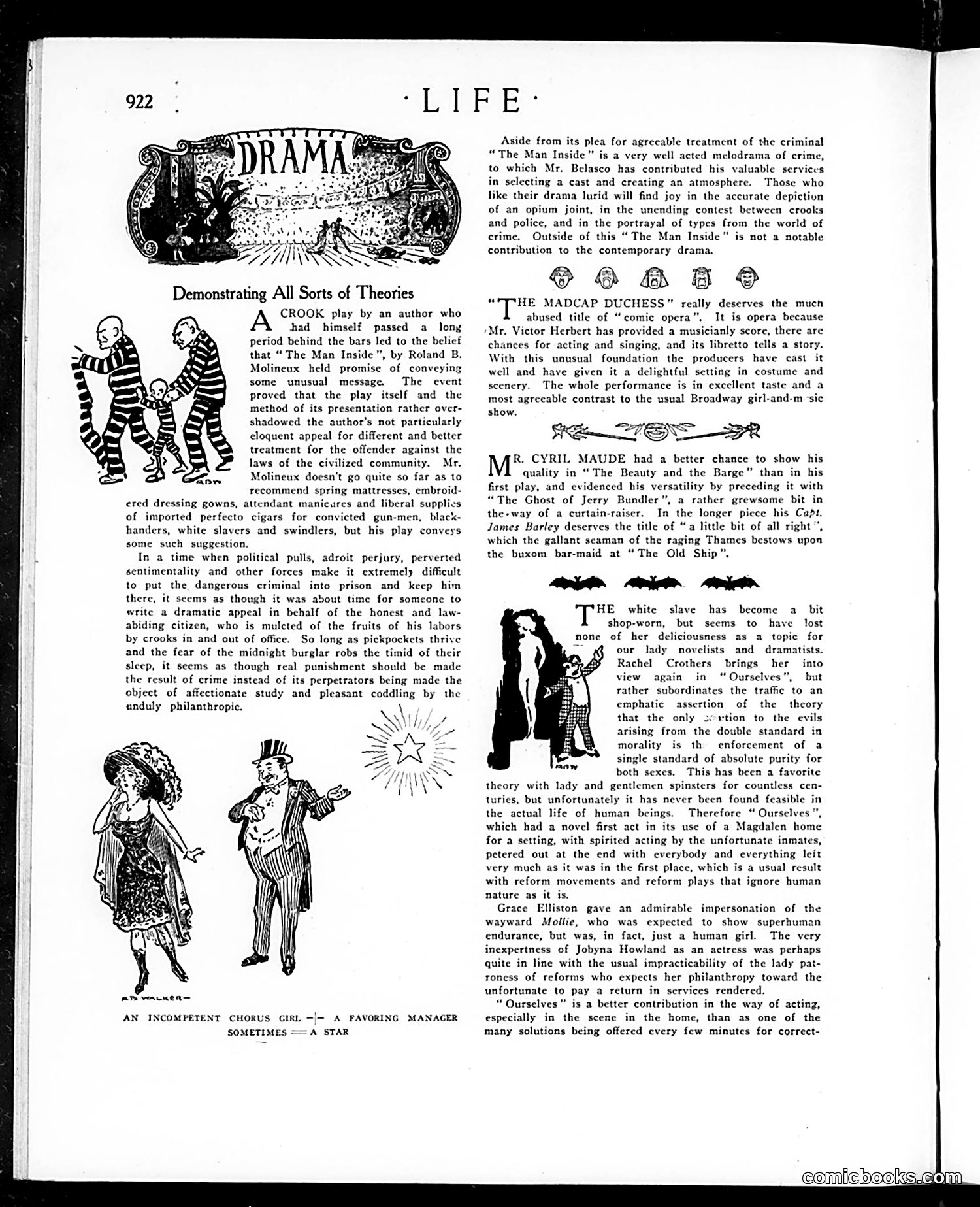
This page from *Life* magazine contains theater reviews critiquing several Broadway productions. The main satirical content is the small cartoon labeled "An Incompetent Chorus Girl—A Favoring Manager Sometimes—A Star," depicting theatrical types in exaggerated dress. The reviews themselves contain sharp social criticism: the critic attacks Roland B. Molineux's play "The Man Inside" for sentimentalizing criminals rather than advocating for protection of law-abiding citizens victimized by "crooks in and out of office." This reflects Progressive-era concerns about crime and justice. The other reviews praise Victor Herbert's "The Madcap Duchess" and Cyril Maude's "The Beauty and the Barge," while criticizing Rachel Crothers' "Ourselves" for promoting an unrealistic "double standard" morality argument about sexual purity. The cartoons illustrate theatrical hierarchies and casting dynamics of the era—showing how incompetent performers sometimes gained roles through managerial favoritism rather than talent.
📄 Transcribed text from this page (OCR, searchable)
Machine-transcribed from the original scan — historical spelling and the odd misread are preserved.
| Us) | ea) Demonstrating All Sorts of Theories CROOK play by an author who had himself passed a long period behind the bars led to the belief that “ The Man Inside”, by Roland B, Molineux held promise of conveying some unusual message. The event proved that the play itself and the method of its presentation rather over- shadowed the author's not particularly eloquent appeal for different and better treatment for the offender against the laws of the civilized community. Mr. Molineux doesn't go quite so far as to recommend spring mattresses, embroid- ered dressing gowns, attendant manicures and liberal supplies of imported perfecto cigars for convicted gun-men, black- handers, white slavers and swindlers, but his play conveys some such suggestion. In a time when political pulls, adroit perjury, perverted sentimentality and other forces make it extremely difficult to put the dangerous criminal into prison and keep him there, it seems as though it was about time for someone to write a dramatic appeal in behalf of the honest and law- abiding citizen, who is mulcted of the fruits of his labors by crooks in and out of office. So long as pickpockets thrive and the fear of the midnight burglar robs the timid of their sleep, it seems as though real punishment should be made the result of crime instead of its perpetrators being made the object of affectionate study and pleasant coddling by the unduly philanthropic. Ar wacnen= Girl. —|— A FAVORING MANAGER A STAR AN INCOMPETENT CHORU: SOMETIMES Aside from its plea for agreeable treatment of the criminal “The Man Inside” is a very well acted melodrama of crime, to which Mr. Belasco has contributed his valuable services in selecting a cast and creating an atmosphere. Those who like their drama lurid will find joy in the accurate depiction of an opium joint, in the unending contest between crooks and police, and in the portrayal of types from the world of crime. Outside of this “The Man Inside” is not a notable contribution to the contemporary drama. HE MADCAP DUCHESS” really deserves the much abused title of “comic opera”. It is opera because ‘Mr. Victor Herbert has provided a musicianly score, there are chances for acting and singing, and its libretto tells a story. With this unusual foundation the producers have cast it well and have given it a delightful setting in costume and scenery. The whole performance is in excellent taste and a most agreeable contrast to the usual Broadway girl-and-m ‘sic Oe TENE R R. CYRIL MAUDE had a better chance to show his quality in “The Beauty and the Barge” than in his first play, and evidenced his versatility by preceding it with “The Ghost of Jerry Bundler”, a rather grewsome bit in the-way of a curtain-raiser. In the longer picce his Capt. James Barley deserves the title of “a little bit of all right”, which the gallant seaman of the raging Thames bestows upon the buxom bar-maid at “The Old Ship”. ne ee wie HE white slave has become a_ bit shop-worn, but seems to have lost none of her deliciousness as a topic for oe our lady novelists and dramatists. Rachel Crothers brings her into view again in “Ourselves”, but rather subordinates the traffic to an emphatic assertion of the that the only co rtion to the e arising from the double standard in morality is th enforcement of a single standard of absolute purity for both sexes. This has been a favorite theory with lady and gentlemen spinsters for countless cen- turies, but unfortunately it has never been found feasible in the actual life of human beings. Therefore “ Ourselves”, which had a novel first act in its use of a Magdalen home for a setting, with spirited acting by the unfortunate inmates, petered out at the end with everybody and everything left very much as it was in the first place, which is a usual result with reform movements and reform plays that ignore human nature as it is. Grace Elliston gave an admirable impersonation of the wayward Mollie, who was expected to show superhuman endurance, but was, in fact, just a human girl. The very inexpertness of Jobyna Howland as an actress was perhaps quite in line with the usual impracticability of the lady pat- roncss of reforms who expects her philanthropy toward the unfortunate to pay a return in services rendered. “ Ourselves” is a better contribution in the way of acting, especially in the scene in the home, than as one of the many solutions being offered every few minutes for correct- comichooks.aen