
Life, 1913-11-27 · page 5 of 40
Life — November 27, 1913 — page 5: what you’re looking at
What you’re looking at
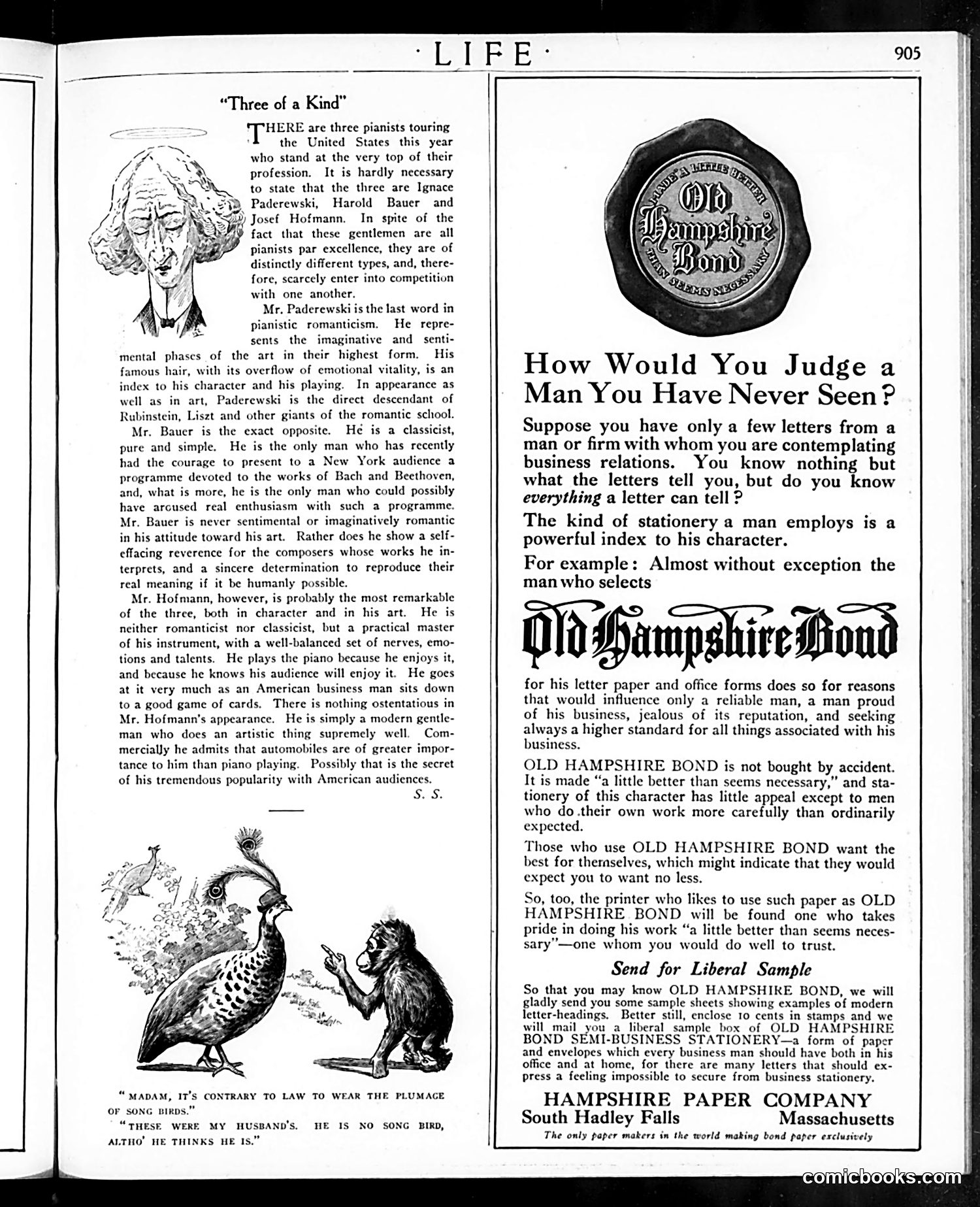
**"Three of a Kind" article** discusses three renowned pianists touring the United States: Ignace Paderewski, Harold Bauer, and Josef Hofmann. The accompanying caricature (left) likely depicts one of these musicians, emphasizing distinctive physical features—a common satirical practice. **The lower cartoon** shows a woman and monkey in dialogue. The woman says her husband is "no song bird," and the monkey responds he's "no song bird" either, suggesting he thinks he is. This appears to be a joke equating human behavior with animal behavior, likely mocking either vanity or the pretensions of someone (possibly a musician?) who overestimates their talents. The right page contains an advertisement for Hampshire Bond stationery, unrelated to the satire.
📄 Transcribed text from this page (OCR, searchable)
Machine-transcribed from the original scan — historical spelling and the odd misread are preserved.
“Three of a Kind” HERE are three pianists touring the United States this year who stand at the very top of their a profession. It is hardly necessary SK to state that the three are Ignace “32 Paderewski, Harold Bauer and Spy Jose! Hofmann, In spite of the ZY fact that these gentlemen are all pianists par excellence, they are of distinctly different types, and, there- fore, scarcely enter into competition with one another. Mr. Paderewski is the last word in pianistic romanticism. He repre- sents the imaginative and_ senti- mental phases of the art in their highest form. His famous hair, with its overflow of emotional vitality, is an index to his character and his playing. In appearance as well as in art, Paderewski is the direct descendant of Rubinstein, Liszt and other giants of the romantic school. Mr. Bauer is the exact opposite. He is a classicist, pure and simple. He is the only man who has recently had the courage to present to a New York audience a programme devoted to the works of Bach and Becthoven, and, what is more, he is the only man who could possibly have aroused real enthusiasm with such a programme. Mr. Bauer is never sentimental or imaginatively romantic in his attitude toward his art. Rather does he show a self- effacing reverence for the composers whose works he in- terprets, and a sincere determination to reproduce their real meaning if it be humanly possible. Mr. Hofmann, however, is probably the most remarkable of the three, both in character and in his art. He is neither romanticist nor classicist, but a practical master of his instrument, with a well-balanced set of nerves, emo- tions and talents. He plays the piano because he enjoys it, and because he knows his audience will enjoy it. He goes at it very much as an American business man sits down to a good game of cards. There is nothing ostentatious in Mr. Hofmann’s appearance. He is simply a modern gentle- man who does an artistic thing supremely well. Com- mercially he admits that automobiles are of greater impor- tance to him than piano playing. Possibly that is the secret of his tremendous popularity with American audiences. SS. “MADAM, IT’S CONTRARY TO LAW TO WEAR THE PLUMAGE OF SONG BIRDS.” SE WERE MY HUSBAND'S. HE IS NO SONG BIRD, ALTHO’ HE THINKS HE Is.” How Would You Judge a Man You Have Never Seen P Suppose you have only a few letters from a man or firm with whom you are contemplating business relations. You know nothing but what the letters tell you, but do you know everything a letter can tell ? The kind of stationery a man employs is a powerful index to his character. For example: Almost without exception the man who selects ld HampshireHio for his letter paper and office forms does so for reasons that would influence only a reliable man, a man proud of his business, jealous of its reputation, and seeking always a higher standard for all things associated with his business. OLD HAMPSHIRE BOND is not bought by accident. It is made “‘a little better than seems necessary,” and sta- tionery of this character has little appeal except to men who do.their own work more carefully than ordinarily expected. Those who use OLD HAMPSHIRE BOND want the best for thernselves, which might indicate that they would expect you to want no less. So, too, the printer who likes to use such paper as OLD HAMPSHIRE BOND will be found one who takes pride in doing his work “a little better than seems neces- sary”—one whom you would do well to trust. Send for Liberal Sample So that you may know OLD HAMPSHIRE BOND, we will gladly send you some sample sheets showing examples of modern letter-headings. Better still, enclose 10 cents in stamps and we will mail you a liberal sample box of OLD HAMPSHIRE BOND SEMI-BUSINESS STATIONERY—a form of paper and envelopes which every business man should have both in his office and at home, for there are many letters that should ex- press a feeling impossible to secure from business stationery, HAMPSHIRE PAPER COMPANY South Hadley Falls Massachusetts The only paper makers in the world making bond paper exclusively