
Life, 1913-11-27 · page 23 of 40
Life — November 27, 1913 — page 23: what you’re looking at
What you’re looking at
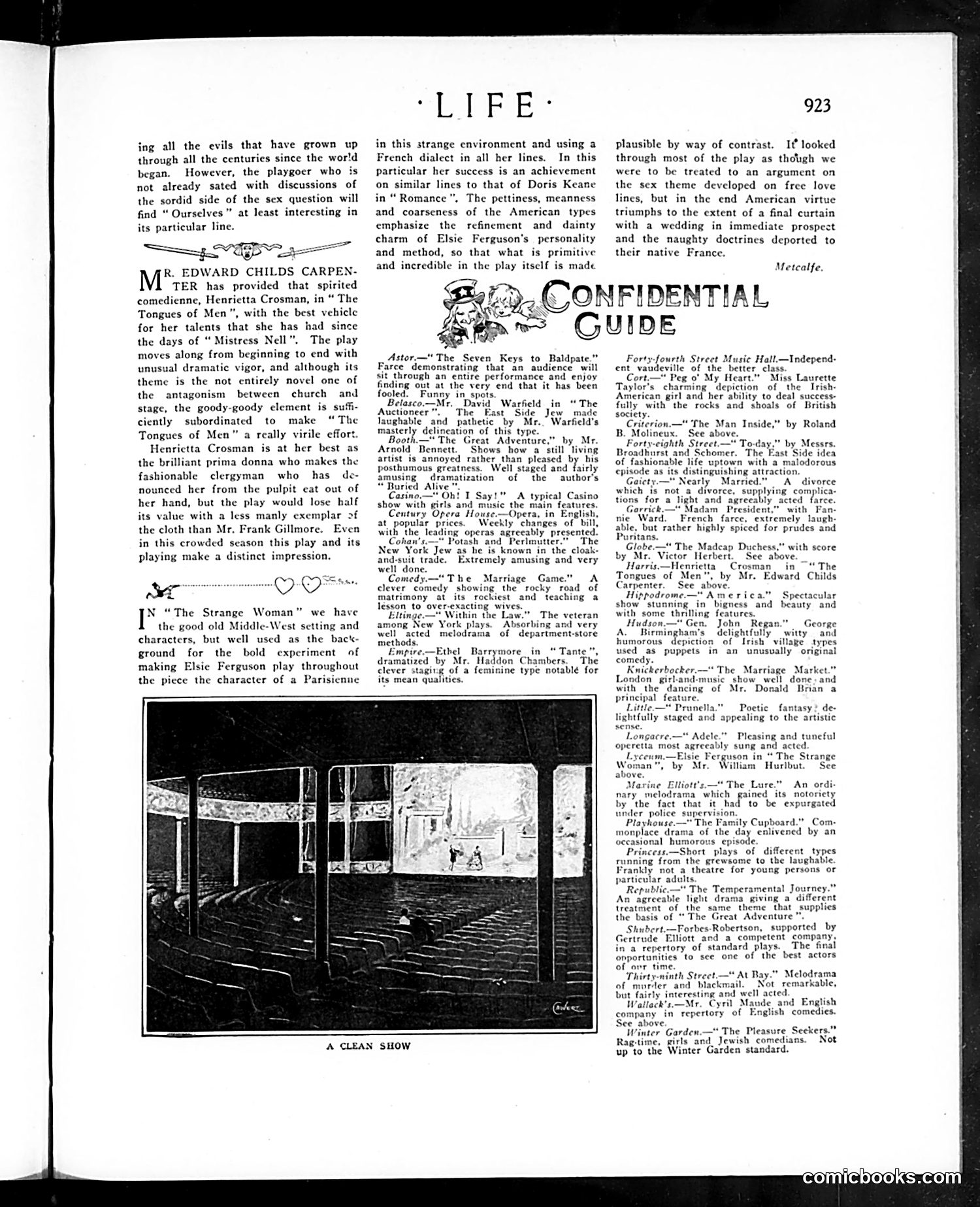
This page from *Life* magazine presents theater reviews and a "Confidential Guide" to New York playhouses. The illustration titled "A Clean Show" depicts a domestic interior—likely representing a middle-class home—suggesting the magazine is praising theatrical productions suitable for family viewing. The reviews discuss contemporary Broadway plays featuring popular actors like Henrietta Crosman and Elsie Ferguson. The critic (signed "Metcalfe") evaluates productions on moral grounds: praising *The Tongues of Men* for handling the church-versus-stage controversy without excessive "goody-goody" moralizing, and noting that *The Strange Woman* ultimately endorses "American virtue" by ending with marriage rather than "free love lines." The guide lists theaters with brief, morality-focused assessments—*Potash and Perlmutter* is "amusing," *Within the Law* is "absorbing." This reflects early 20th-century concerns about theatrical propriety and the cultural gatekeeping function *Life* performed for its middle-class readership.
📄 Transcribed text from this page (OCR, searchable)
Machine-transcribed from the original scan — historical spelling and the odd misread are preserved.
ing all the evils that have grown up through all the centuries since the wor!d began. However, the playgoer who is not already sated with discussions of the sordid side of the sex question will find “ Ourselves” at least interesting in its particular line. SEV R. EDWARD CHILDS CARPEN- TER has provided that spirited comedienne, Henrietta Crosman, in “ The Tongues of Men”, with the best vehicle for her talents that she has had since the days of “ Mistress Nell”. The play moves along from beginning to end with unusual dramatic vigor, and although its theme is the not entirely novel one of the antagonism between church and stage, the goody-goody element is suffi- ciently subordinated to make “ The Tongues of Men” a really virile effort. Henrietta Crosman is at her best as the brilliant prima donna who makes the fashionable clergyman who has de- nounced her from the pulpit eat out of her hand, but the play would lose half its value with a less manly exemplar of the cloth than Mr, Frank Gillmore. Even in this crowded season this play and its playing make a distinct impression. Ix The Strange Woman" we have the good old Middle-West setting and characters, but well used as the back- ground for the bold experiment of making Elsic Ferguson play throughout the piece the character of a Parisienne a Oe) Bh) as in this strange environment and using a French dialect in all her lines. In this particular her success is an achievement on similar lines to that of Doris Keane in “Romance. The pettiness, meanness and coarseness of the American types emphasize the refinement and dainty charm of Elsie Ferguson's personality and method, so that what is primitive and incredible in the play itself is made 923 plausible by way of contrast. It’ looked through most of the play as thotigh we were to be treated to an argument on the sex theme developed on free love lines, but in the end American virtue triumphs to the extent of a final curtain with a wedding in immediate prospect and the naughty doctrines deported to their native France. Metcalfe. DENTIAL GUIDE Astor—"The Seven Keys to Baldpate.” Farce demonstrating that an audience will sit through an entire performance and enjoy finding out at the very end that it has been fooled. Funny in spots. Belasco.—Mr. David Warfield in “The Auctioneer”. “The East Side Jew made laughable and pathetic by Mr.. Warfield’s masterly delineation of this type. Booth.—* The Great Adventure,” by Mr. Arnold Bennett. Shows how a still living artist is annoyed rather than pleased by his posthumous greatness. Well staged rly amusing dramatization of the author's “ Buried Alive”. Casino.—" Ohi I Say!" A typical Casino show with girls and music the main features. Century Opera House.—Opera, in English, at popular prices. Weekly changes of bill, with the leading operas agreeably presented. Cok “ Potash and Perlmutter.” The New York Jew as he is known in the cloak- and-suit trade. Extremely amusing and very well done. Comedy.—" The Marriage clever comedy showing the rocky road of matrimony at its rockiest and teaching a lesson to over-exacting wives. Eltinge—" Within the Law." The veteran among New York plays. Absorbing and very well acted melodrama of department-store methods. Empire.—Ethel dramatized by Mr. clever staging of a fer its mean qualities. Game.” A Barrymore _in “ Tante”, Haddon Chambers. The ine type notablé for A CLEAN SHOW Forty-fourth Street Music Hall—Independ- ent_vaudeville of the better class. Cort.—" Peg o' My Heart.” Miss Laurette Taylor's charming depiction of the Irish: American gitl and her ability to deal success- fully with the rocks and shoals of British society. Criterion.—" ‘The Man Inside," by Roland B. Molineux. See above. Forty-eighth Street.—" To-day,” by Messrs. Broadhurst and Schomer. The East Side idea of fashionable life uptown with a malodorous episode as its distinguishing attraction. Gaicty.—" Nearly Married.” A divorce which is nota divorce, supplying complica: tions for a light and agreeably acted fh ‘ce. President. with nie Ward. rench farce, extremely laugh: able, but rather highly spiced for prudes and Puritans. Globe.—" The Madcap Duchess,” with score by Mr. Victor Herbert. See above. Harris.—Henrietta | Crosman in ~“ The Tongues of Men”, by Mr. Edward Childs Carpenter. See above. Hippodrome.—" America.” show stunning bigness and with some thrilling features. Hudson.—" Gen. John Regan. A. Birmingham's delightfully witty and humorous depiction of Irish village types used as puppets in an unusually original comedy. Knickerbocker.—" The Marriage Marke Lo: n girl-and-music show well done: and with the dancing of Mr. Donald Brian a principal feature. Little —" Prunella." Poetic fantasy? de- lightfully staged and appealing to the artistic sense. Longacre.—" Adele.” Pleasing and tuneful operetta most agreeably sung and acted. Lyceum.—Elsie Ferguson in “ The Strange Wo » by Mr. William Hurlbut. See Spectacular beauty and George The Lure.” An ordi nary mel h gained its notoriety by ‘the fact that it had to be expurgated under police supervision. Playhouse.—" The Family Cupboard.” Com- monplace drama of the day enlivened by an occasional humorous episode. Princess.—Short plays of different types running from the grewsome to the laughable. Frankly not a theatre for young persons or particular adults. Republic. —" The Temperamental Journey.” An agreeable light drama giving a different treatment of the sa theme that supplies the basis of “The Great Adventure ”. Shubert.—Forbes-Robertson, supported by Gertrude Elliott and a competent company, in a repertory of standard plays. The final onportunities to see one of the best actors of ovr time Thirty-ninth Street—" At Bay.” Melodrama of murder a |. fot remarkable, but fairly interesting and well acted. Wallack’s.—Mr. Cyril Maude and English company in repertory of English comedies. See above. Winter Garden.— Rag-time, girls and Jewish comedians. up to the Winter Garden standard. ine Elliott's — The Pleasure Seekers.” Not