
Life, 1913-11-27 · page 24 of 40
Life — November 27, 1913 — page 24: what you’re looking at
What you’re looking at
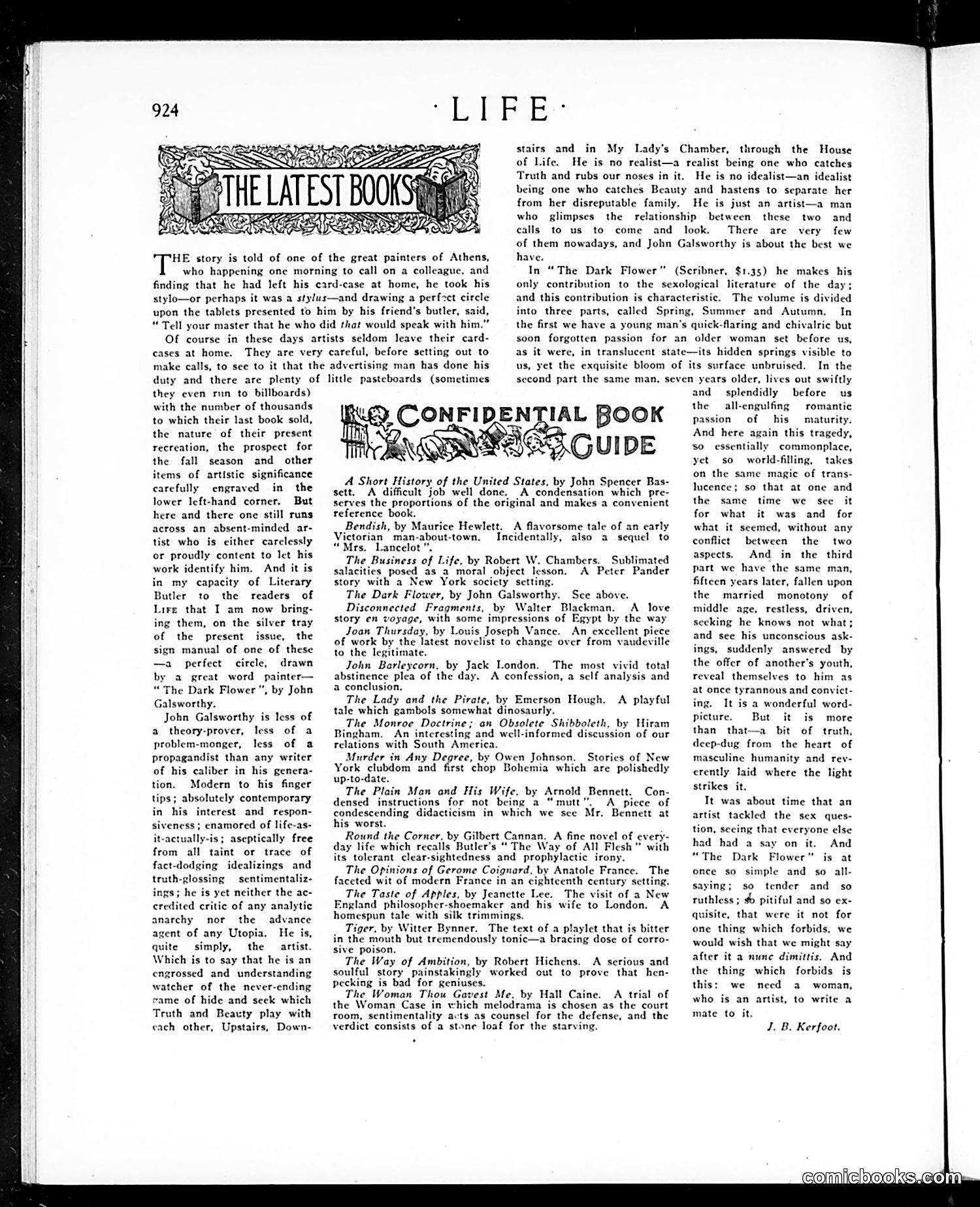
This page presents satirical book reviews from Life magazine. The opening anecdote about an ancient Athenian painter drawing a perfect circle as his "calling card" establishes the theme: true artists need no advertising—their work speaks for itself. The satire targets modern artists who obsessively promote themselves through "pasteboards" (business cards) listing sales figures and career prospects. Life contrasts this with John Galsworthy, a genuine artist who lets his work identify him without self-promotion. The reviews mock contemporary literature: Chambers's "Business of Life" is dismissed as "salacities posed as a moral object lesson" (false morality masking sexual content). Galsworthy's "The Dark Flower" receives praise for depicting passion authentically without idealization. The central critique: commercialism and self-promotion corrupt artistic integrity. Real artists remain disinterested observers of human nature, while lesser writers peddle moralizing disguises for sensationalism.
📄 Transcribed text from this page (OCR, searchable)
Machine-transcribed from the original scan — historical spelling and the odd misread are preserved.
eB RSEs HE story is told of one of the great painters of Athens, who happening one morning to call on a colleague, and finding that he had left his card-case at home, he took his stylo—or perhaps it was a stylus—and drawing a perfzct circle upon the tablets presented to him by his friend's butler, said “Tell your master that he who did that would speak with him Of course in these days artists seldom leave their card- cases at home. They are very careful, before setting out to make calls, to see to it that the advertising man has done his duty and there are plenty of little pasteboards (sometimes stairs and in My Lady's Chamber, through the House of Life. He is no realist—a realist being one who catches Truth and rubs our noses in it. He is no idealist—an idealist being one who catches Beauty and hastens to separate her from her disreputable family. He is just an artist—a man who glimpses the relationship between these two and calls to us to come and look. There are very few of them nowadays, and John Galsworthy is about the best we have. In “The Dark Flower” (Scribner, $1.35) he makes his only contribution to the sexological literature of the da and this contribution is characteristic. The volume is into three parts, called Spring, Summer and Autumn. the first we have a young man’s quick-flaring and chivalric but soon forgotten passion for an older woman set before us, as it were, in translucent state—its hidden springs visible to us, yet the exquisite bloom of its surface unbruised. In the second part the same man, seven years older, lives out swiftly they even mn to billboards) with the number of thousands to which their last book sold, the nature of their present recreation, the prospect for the fall season and other items of artistic significance carefully engraved in the lower left-hand corner. But here and there one still runs across an absent-minded ar- tist who is either carelessly or proudly content to let his work identify him. And it is in my capacity of Literary Butler to the readers of Lire that I am now bring- ing them, on the silver tray of the present issue, the sign manual of one of these —a perfect circle, drawn by a great word painter— “The Dark Flower”, by John Galsworthy. John Galsworthy is less of a theory-prover, less of a problem-monger, less of a propagandist than any writer of his caliber in his genera- tion. Modern to his finger tips; absolutely contemporary in his interest and respon- siveness ; enamored of life-as- it-actually-is; aseptically free from all taint or trace of fact-dodging idealizings and truth-glossing ings; he is yet neither the ac- credited critic of any analytic anarchy nor the advance agent of any Utopia. He is, quite ply, the artist. Which is to say that he is an engrossed and understanding watcher of the never-ending came of hide and seek which Truth and Beauty play with cach other, Upstairs, Down- sentimentaliz- “GQ CONFIDENTIAL BOOK SaaS GUIDE A Short History of the United States, by John Spencer Bas- sett. A difficult job well done. A condensation which pre- serves the proportions of the original and makes a convenient reference book. Bendish, by Maurice Hewlett. Victorian man-about-town. “Mrs. Lancelot". The Business of Life, by Robert W. Chambers. Sublimated salacities posed as a moral object lesson. A Peter Pander story with a New York socicty setting. The Dark Flower, by John Galsworthy. A flavorsome tale of an early Incidentally, also a sequel to Sce above. A love story en voyage, with some impressions of Egypt by the way Joan Thursday, by Louis Joseph Vance. An excellent piece of work by the latest novelist to change over from vaudeville to the legitimate. John Barleycorn, by Jack London. The most vivid total abstinence plea of the day. A confession, a sclf analysis and a conclusion. The Lady and the Pirate, by Emerson Hough. tale which gambols somewhat dinosaurly. The Monroe Doctrine; an Obsolete Shibboleth, by Hiram Bingham. An interesting and well-informed discussion of our relations with South America. Murder in Any Degree, by Owen Johnson, Stories of New York clubdom and first chop Bohemia which are polishedly up-to-date. The Plain Man and His Wife, by Arnold Bennett. Con- densed instructions for not being a “mutt™. A_ piece of condescending didacticism in which we sce Mr. Bennett at his worst. Round the Corner, by Gilbert Cannan. A fine novel of every- day life which recalls Butler's “ The Way of All Flesh” with its tolerant clear-sightedness and prophylactic irony. The Opinions of Gerome Coignard, by Anatole France. The faceted wit of modern France in an cightcenth century setting. The Taste of Apples, by Jeanette Lee. The visit of a New England philosopher-shoemakcr and his wife to London. A homespun tale with silk trimmings. Tiger, by Witter Bynner. The text of a playlet that is bitter in the mouth but tremendously tonic—a bracing dose of corro- sive poison. The Way of Ambition, by Robert Hichens. A serious and soulful story painstakingly worked out to prove that. hen- pecking is bad for geniuses. The Woman Thou Gavest Me. by Hall Caine. A trial of the Woman Case in which melodrama is chosen as the court room, sentimentality acts as counsel for the defense, and the verdict consists of a stone loaf for the starving. Disconnected Fragments, by Walter Blackman. A playful and splendidly before us the all-engulfing romantic passion of his maturity. And here again this tragedy, ‘so essentially commonplace, yet so world-filling, takes on the same magic of trans- lucence; so that at one and the same time we sec it for what it was and for what it seemed, without any conflict between the two aspects. And in the third part we have the same man, fifteen years later, fallen upon the married monotony of middle age, restless, driven, seeking he knows not wha! and see his unconscious ask- ings, suddenly answered by the offer of another's youth, reveal themselves to him as at once tyrannous and convict- ing. It is a wonderful word- picture. But it is more than that—a bit of truth, deep-dug from the heart of masculine humanity and rev- erently laid where the light strikes it. It was about time that an artist tackled the sex ques- tion, seeing that everyone else had had a on it. And “The Dark Flower" is at once so simple and so all- saying; so tender and so ruthless ; $ pitiful and so ex- quisite, that were it not for one thing which forbids, we would wish that we might say after it a nunc dimittis. And the thing which forbids is this: we need a woman, who is an artist, to write a mate to it, J. B. Kerfoot.