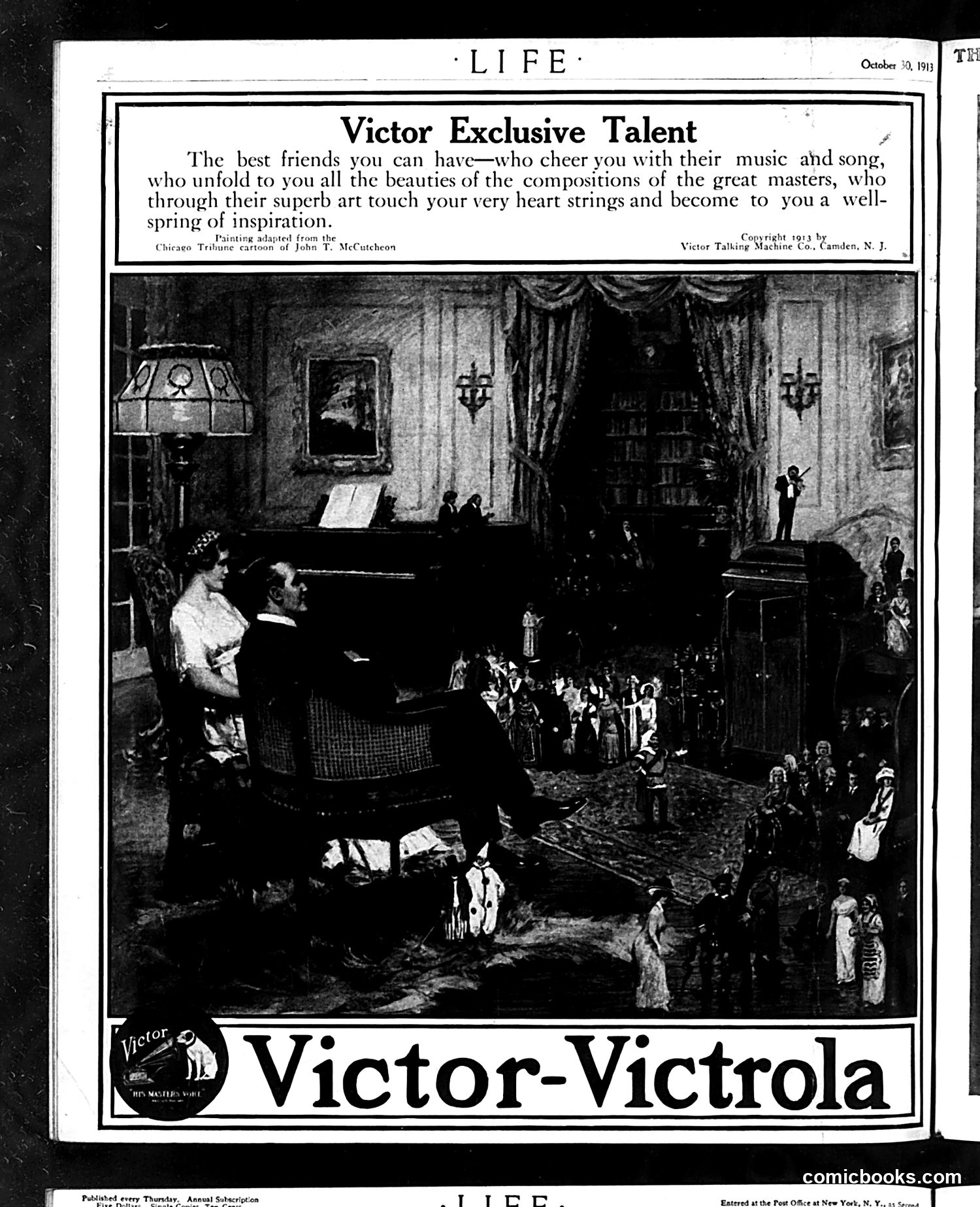
A complete issue · 40 pages · 1913
Life — October 30, 1913
This page from *Life* magazine (October 30, 1912) shows a single dramatic illustration captioned "BEWARE!" The image is extremely dark with minimal visible detail—primarily a white crescent shape against blackness, with what appears to be a shadowy figure or form. The stark, threatening composition and caption suggest this is political satire, likely warning of some danger or threat relevant to the 1912 election period. However, **I cannot definitively identify the specific figure, caricature, or political reference** from the image alone. The darkness and abstraction make it impossible to determine which candidate, political movement, or contemporary threat this warns against. Additional context about *Life*'s 1912 editorial stance would be needed to explain the cartoon's precise meaning to a modern reader.
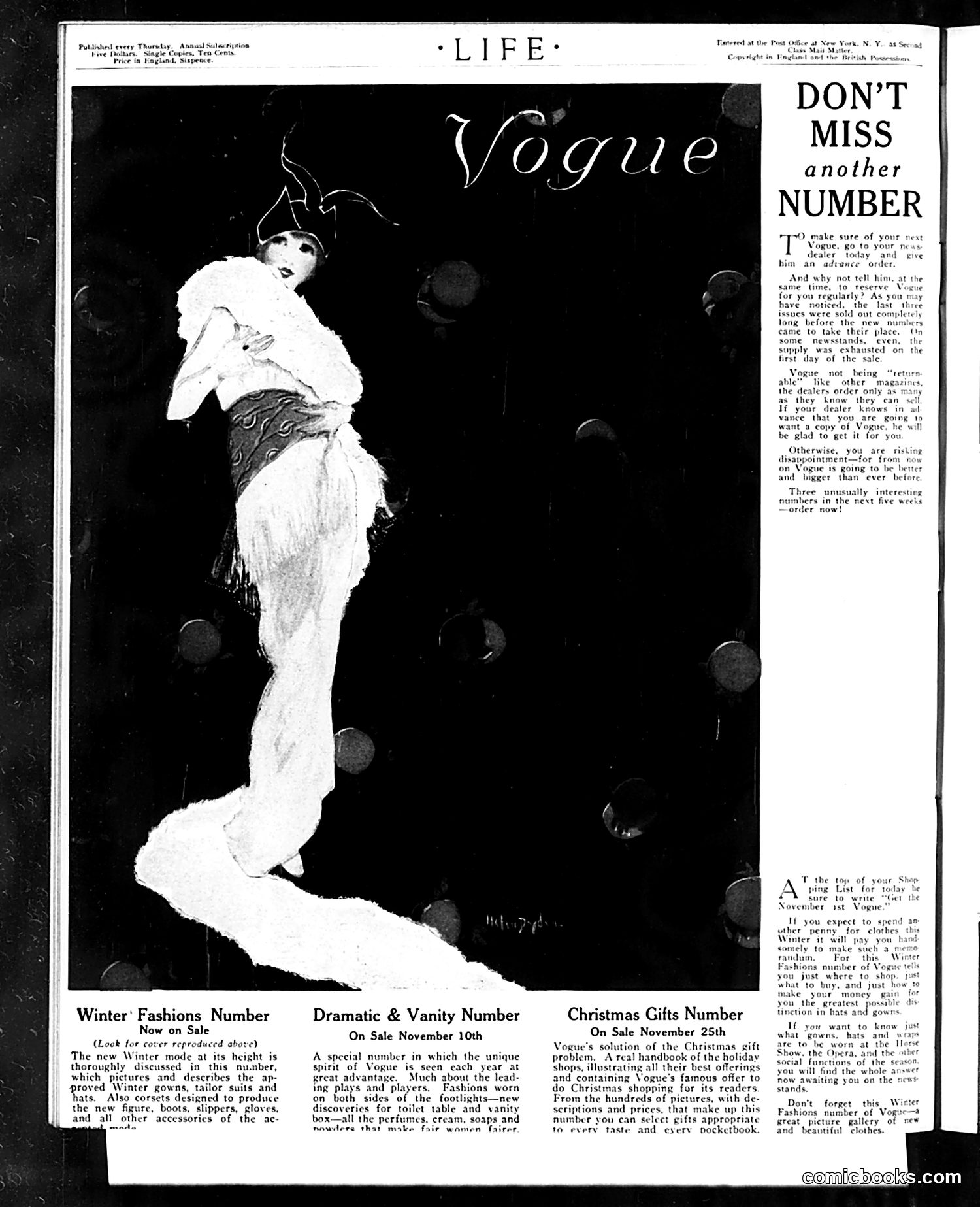
This page is primarily **advertising for Vogue magazine**, not political satire. The large illustration depicts an elegant woman in fashionable winter wear—a white fur wrap and draped skirt with decorative belt—advertising Vogue's upcoming special issues. The right column contains subscription pitches for three themed issues: "Winter Fashions Number," "Dramatic & Vanity Number" (on sale November 10th), and "Christmas Gifts Number" (on sale November 25th). The text emphasizes Vogue's authority on fashion, suggesting readers consult it before shopping. There is **no political cartoon or social satire** present. This is straightforward early-20th-century magazine advertising using elegant illustration to promote fashion-focused content to affluent readers.
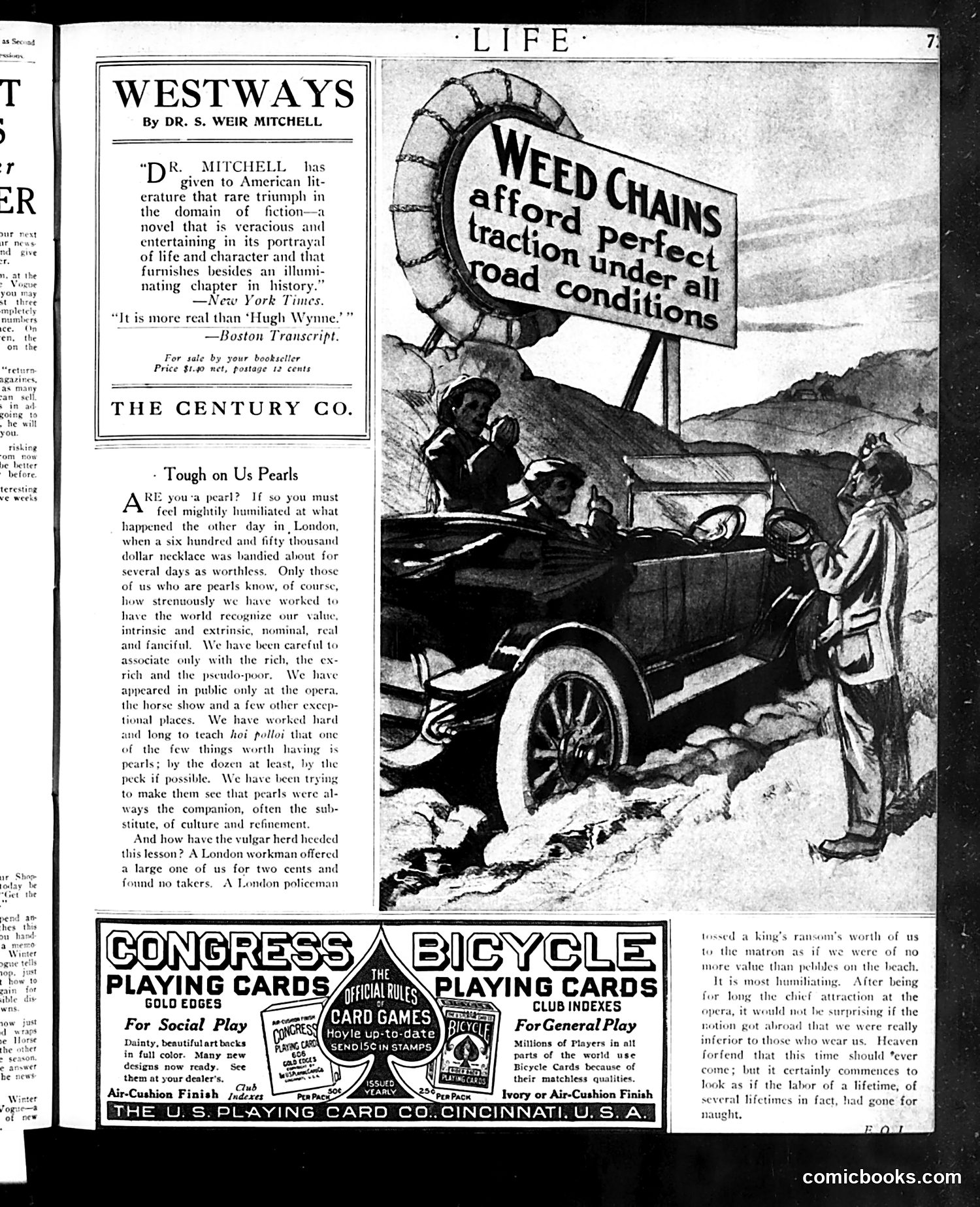
This page is primarily **advertising, not satire**. The dominant image is a commercial advertisement for "Weed Chains," tire chains designed to improve traction on poor road conditions. The illustration shows an early automobile stuck in mud while a figure stands nearby, with text promoting the product's effectiveness "under all road conditions." The page also includes ads for books ("Westways" by Dr. S. Weir Mitchell), playing cards (Congress and Bicycle brands), and a short article titled "Tough on Us Pearls" discussing the social status of pearls among the wealthy. There is **no political cartoon** here—this is straightforward early-1900s consumer advertising alongside editorial content, reflecting the magazine's commercial nature alongside satire.
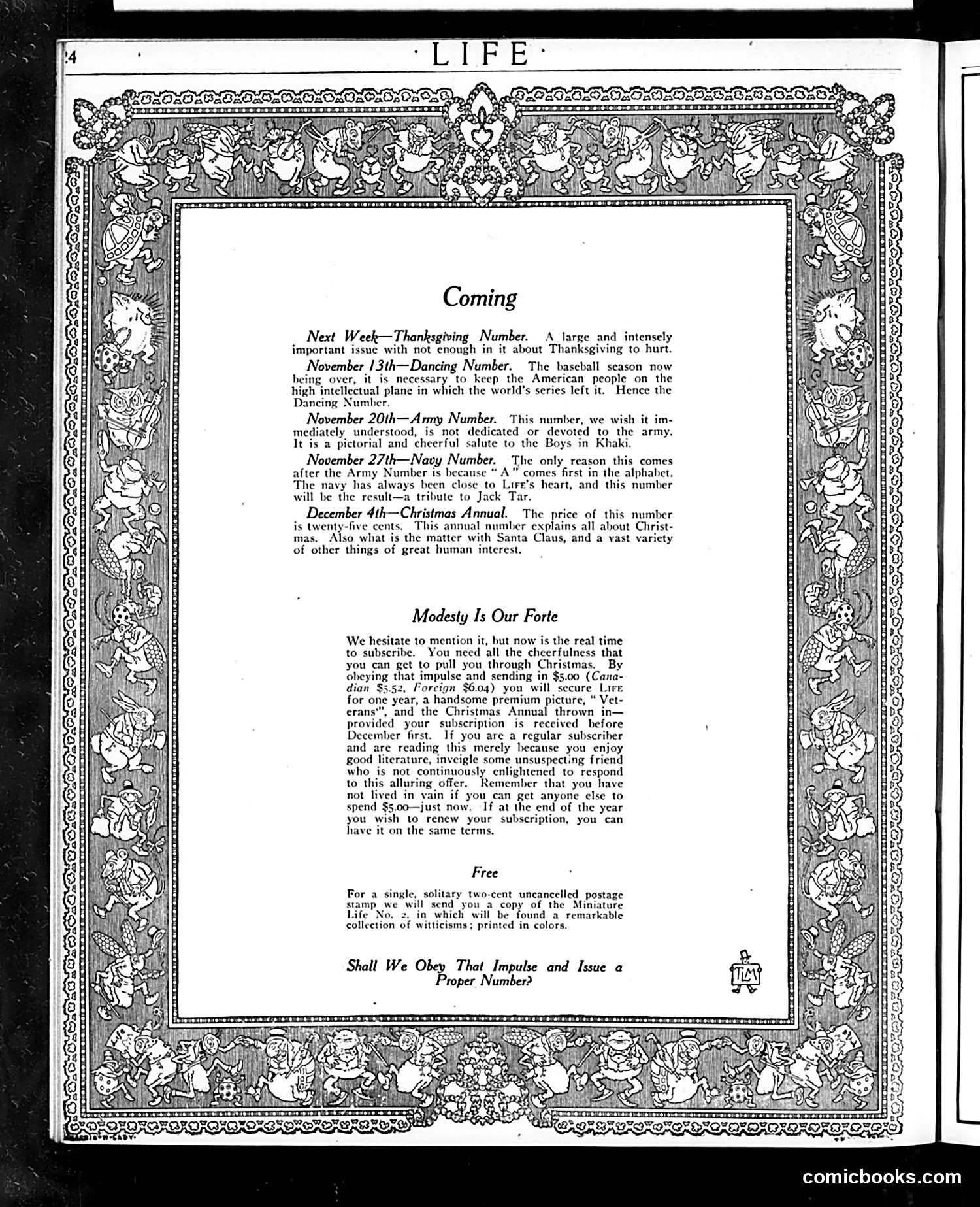
This page is primarily **editorial/promotional content** rather than political cartoons. The "Coming" section advertises upcoming special issues: - **Thanksgiving Number** (addressing holiday themes) - **Dancing Number** (capitalizing on post-baseball season entertainment) - **Army Number** (likely WWI-related, given the era) - **Navy Number** (referencing "Jack Tar," naval slang) - **Christmas Annual** The "Modesty Is Our Forte" section uses humor to encourage subscriptions, self-deprecatingly suggesting readers should "inveigh some unsuspected friend" to subscribe. The ornate decorative border with classical figures is typical of early 20th-century magazine design. **No specific political figures or satire are present**—this is primarily a circulation-building advertisement disguised as editorial content.
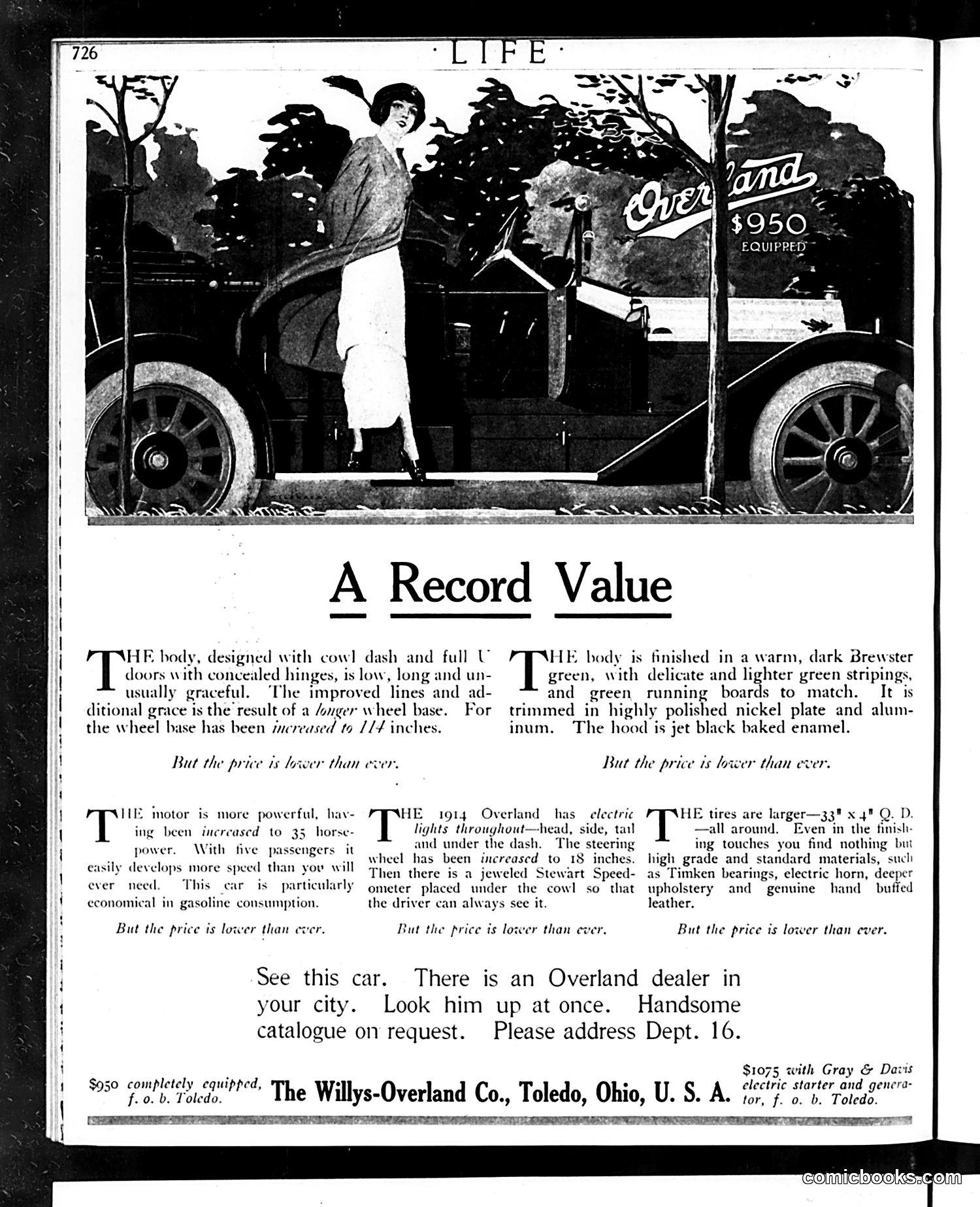
This is **not a political cartoon or satire page**—it's a straightforward **automobile advertisement** for the 1914 Overland car, priced at $950. The image shows a woman in period dress standing beside the vehicle in a pastoral setting, a common advertising trope of the era meant to convey elegance and appeal to potential buyers. The text highlights the car's features: longer wheelbase, improved lines, powerful motor, electric lights, larger tires, and quality materials. The repeated phrase "But the price is lower than ever" emphasizes the value proposition. This represents typical early 20th-century magazine advertising, where Life magazine (then a humor publication) sold premium advertising space to manufacturers. There is no satirical or political content present.
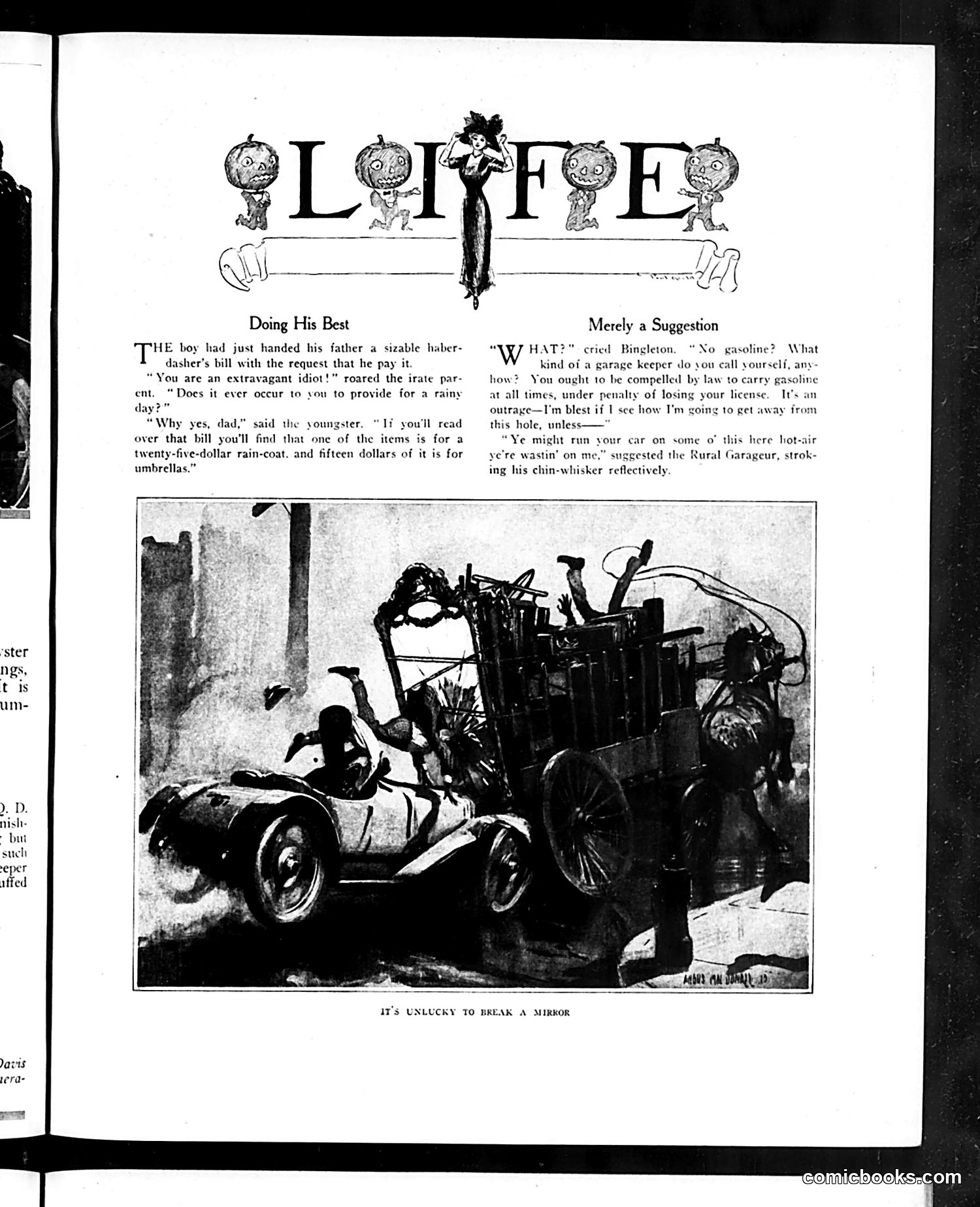
This page contains two sections: **"Doing His Best"** (left): A father-son dialogue about providing for "rainy days." The boy suggests his father buy a twenty-five-dollar rain-coat and fifteen-dollar umbrella to prepare, turning a financial lecture into comic absurdity about consumer spending versus actual preparedness. **"Merely a Suggestion"** (right): Bingleton, apparently a garage keeper, faces a customer angry about gasoline rationing (suggesting WWI-era fuel restrictions). The Rural Garageur sarcastically suggests running the car on "hot-air" instead—satirizing bureaucratic complaints and suggesting people waste breath complaining rather than accepting wartime constraints. The illustration "It's Unlucky to Break a Mirror" shows a collision between a small car and large truck, playing on superstition about broken objects bringing misfortune.
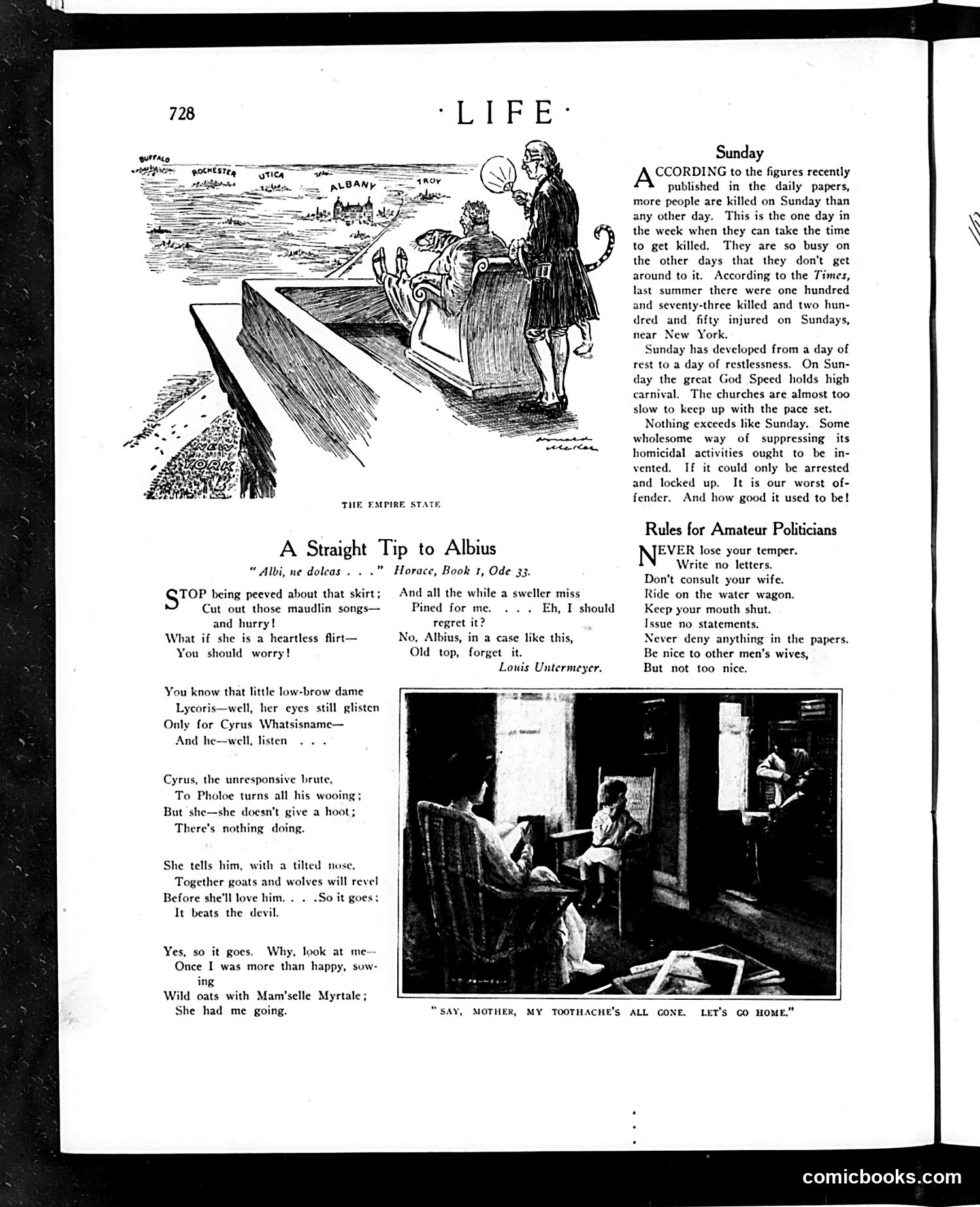
This page contains two distinct pieces: **"Sunday" Editorial (top right):** A satirical commentary on weekend fatalities. The text cites statistics showing more people die on Sundays than other weekdays—173 killed and 50 injured near New York in one summer. The piece argues that Sunday's shift from "rest to restlessness" and the "great God Speed" of carnival activities makes it dangerously chaotic. It's a social critique of modern leisure culture, suggesting that suppressing "homicidal activities" on Sundays would be society's "worst offender." **"A Straight Tip to Albius" (poem, center-left):** A classical-style poem addressing someone named Albius about romantic disappointment, referencing Horace. The illustration shows two figures by a river (likely the Hudson, given the Albany reference visible in the map). **Bottom photograph:** Captioned "Say, Mother, my toothache's all gone. Let's go home"—a domestic scene with darkly humorous implications about dentistry or medical mishaps.
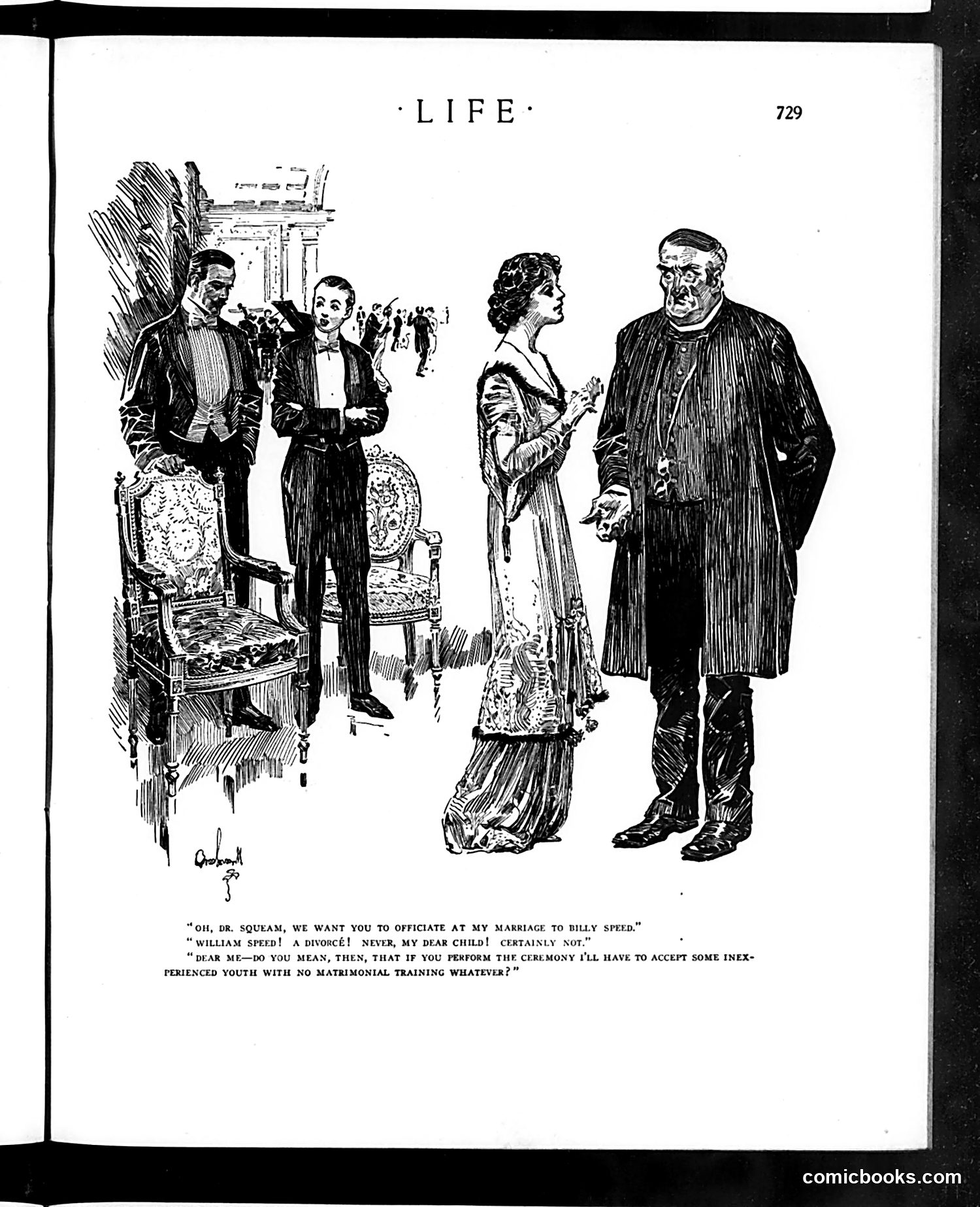
This is a satirical cartoon from *Life* magazine depicting a social comedy scene. A clergyman (Dr. Squam) is being asked to officiate a marriage between William Speed and Billy Speed. The humor centers on the bride's concern: she wants assurance that performing this ceremony won't require her to accept "inexperienced youth with no matrimonial training whatever." The joke plays on gender role expectations of the era—the implication being that the bride worries about her groom's lack of experience in marriage. The satire mocks both the formality of marriage negotiations among the upper classes and period attitudes about women's matrimonial expectations. The elegant clothing and formal interior setting emphasize the social pretension being ridiculed.
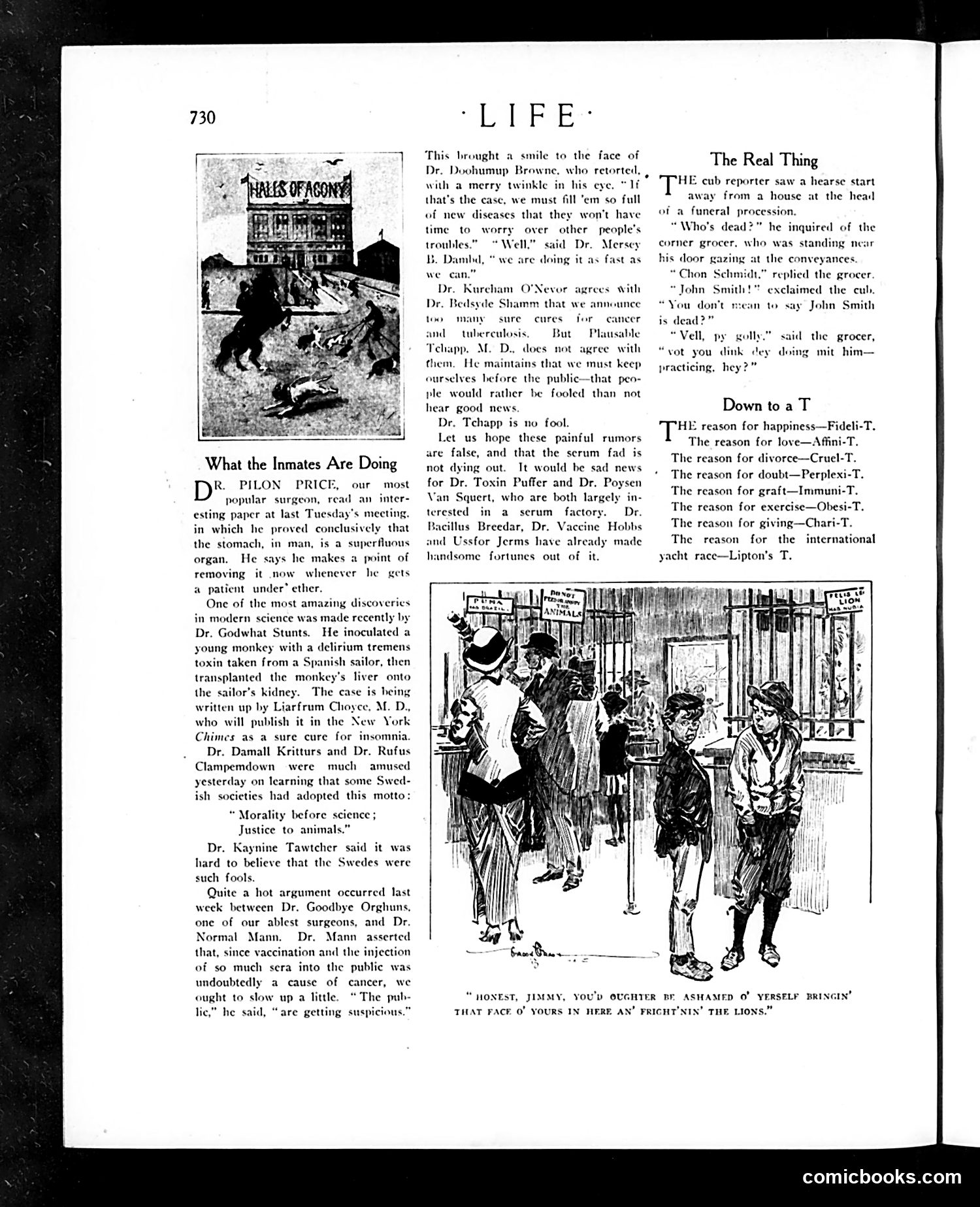
This page contains medical/scientific commentary rather than political cartoons. The main article, "What the Inmates Are Doing," discusses Dr. Pilon Price's presentation about medical discoveries, including Dr. Goodhart Stants' controversial experiment transplanting a monkey's liver into a sailor's kidney as a potential insomnia cure. The satire targets the credulity of the medical establishment and public toward dubious experimental treatments. Swedish medical societies are mocked for adopting the motto "Morality before science; Justice to animals!"—sarcastically suggesting they prioritize animal welfare over scientific advancement. The lower cartoon depicts crowded urban life with the caption about feeling ashamed showing one's face "frightenin' the lions," suggesting social embarrassment about poverty or poor appearance in public.
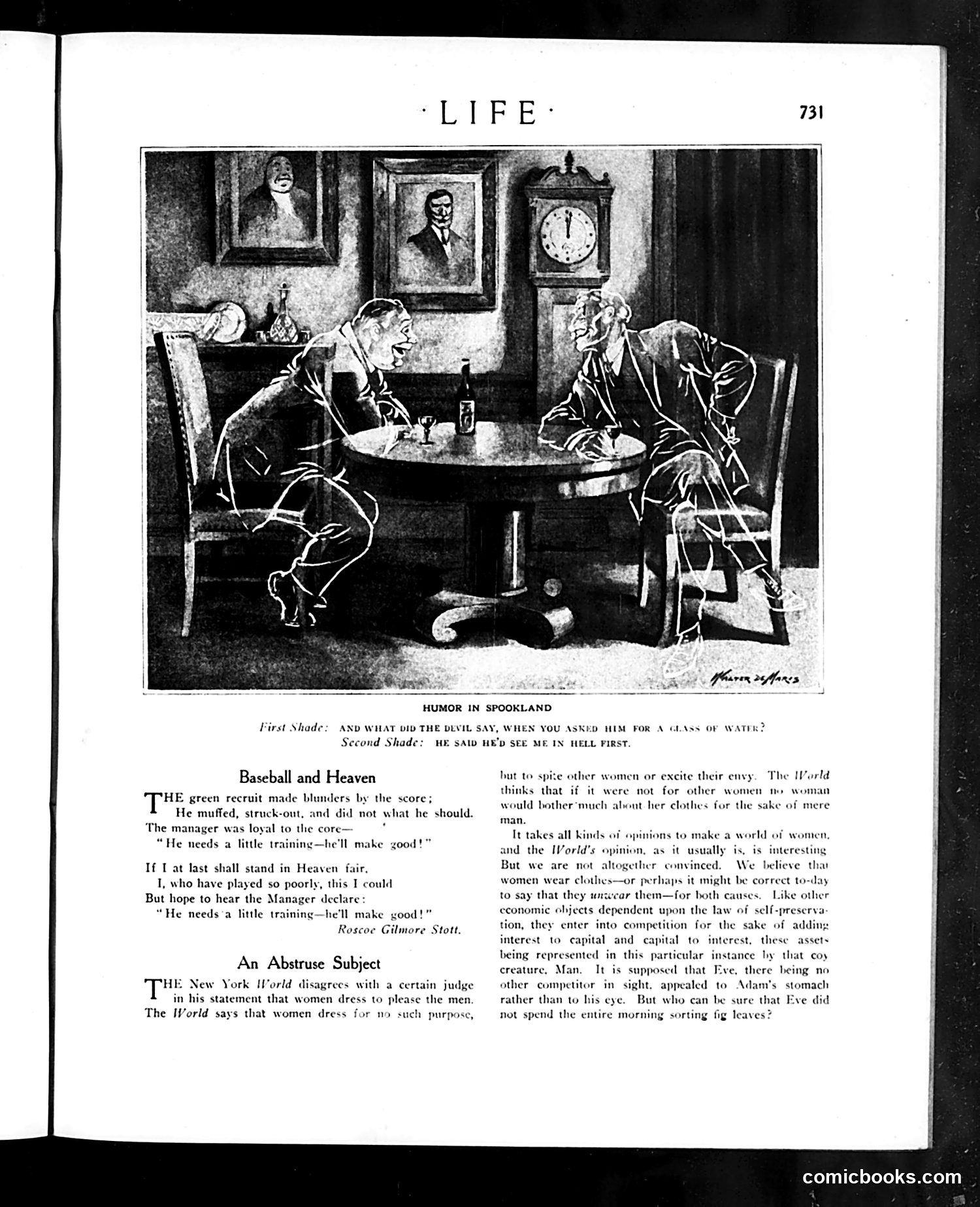
The page contains a cartoon titled "Humor in Spookland" showing two men in conversation, with a joke about the Devil offering water in Hell. Below are two brief satirical pieces. "Baseball and Heaven" quotes Roscoe Gilmore Stett, using a baseball manager's comment about a struggling player to make a religious metaphor about improvement and training. "An Abtruse Subject" critiques the New York *World* newspaper's claim that women dress to please men, arguing instead that women wear clothes for practical reasons and economic competition—not male attention. The satire mocks the *World's* oversimplified views on women's motivations and dress. Both pieces represent early 20th-century commentary on gender attitudes and social behavior.
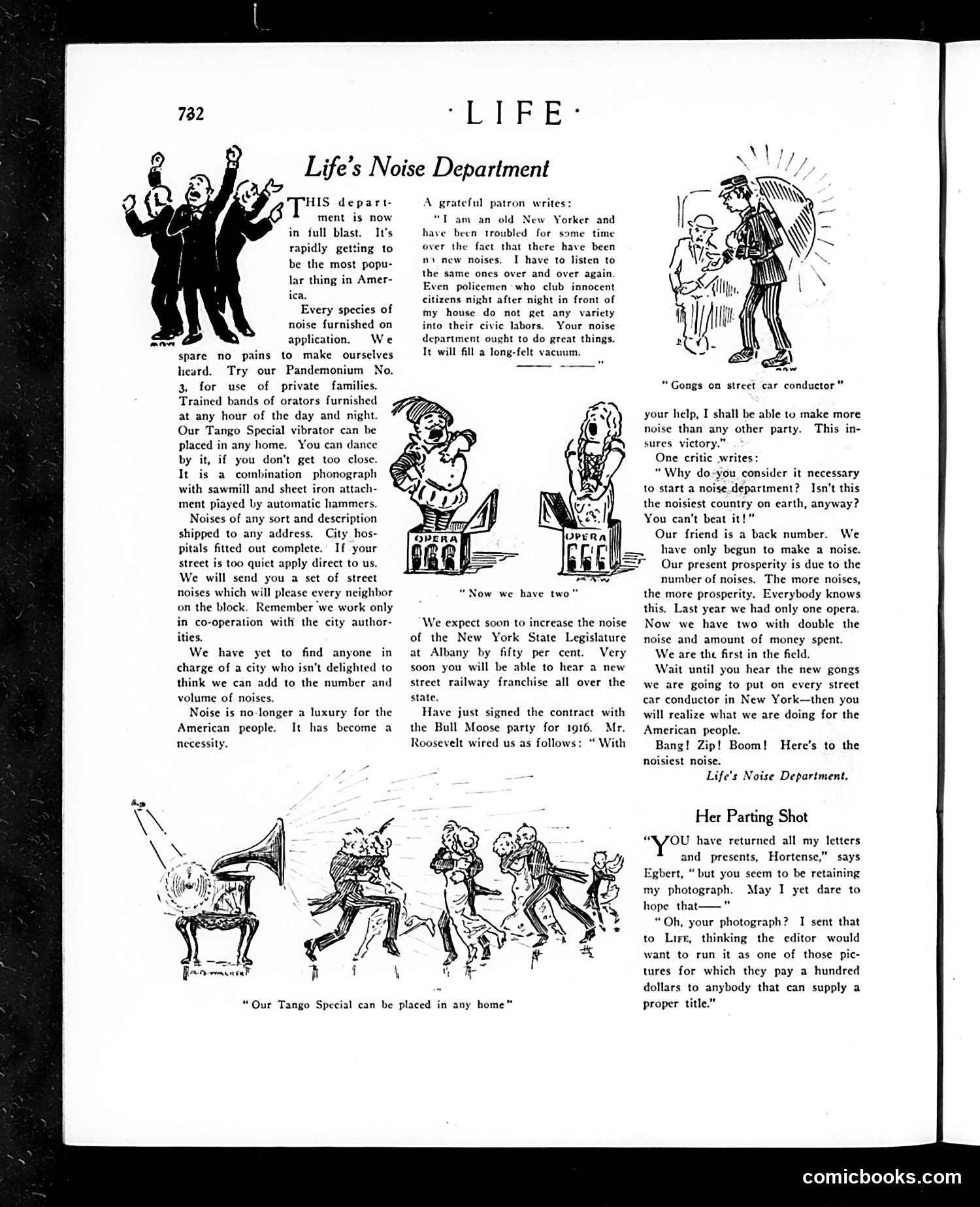
This satirical piece mocks the proliferation of urban noise in early 20th-century America. The "Noise Department" is a fictional service offering solutions to make neighborhoods louder—the opposite of what citizens actually want. The humor works through inversion: while a grateful patron complains about "new noises" plaguing his New York neighborhood, Life's satirists propose increasing noise further. References to the "Tango Special vibrator" and plans to place opera singers and gongs on every street car conductor suggest that manufacturers and entertainment venues were aggressively adding noise to city life. The piece satirizes both commercial excess and public complaints about urban congestion. "Her Parting Shot" below is an unrelated anecdote about a photograph dispute.
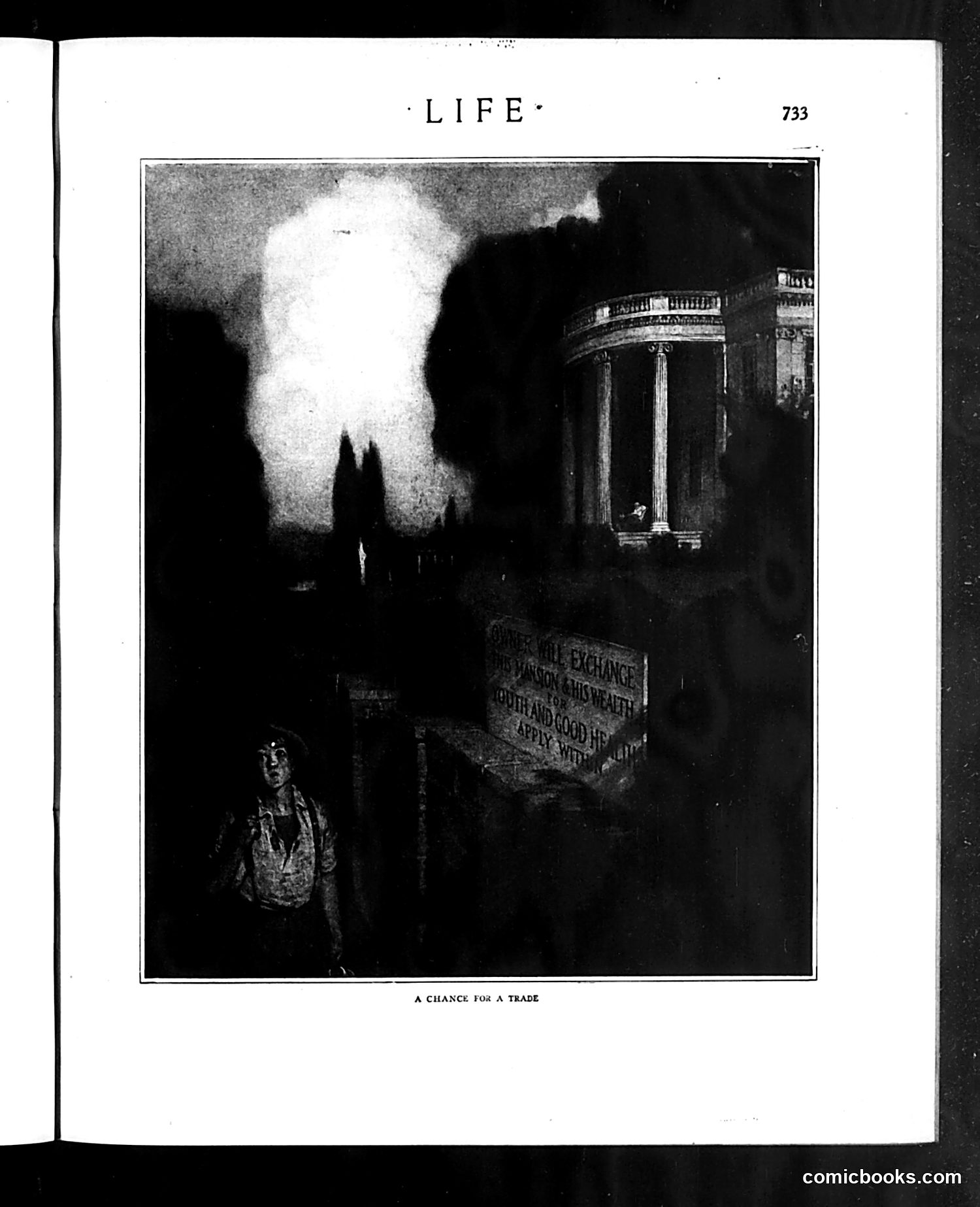
This political cartoon depicts a nighttime scene at what appears to be a classical government building (likely the White House, given the columned portico). A bright explosion or fire erupts in the background, while a figure in the foreground stands before a sign reading text about "CHANGE" and "GOOD HEALTH" (partially legible). The title "A Chance for a Trade" suggests a satirical commentary on political or commercial opportunity amid crisis or destruction. The explosion likely represents a contemporary catastrophe or scandal. However, without the publication date or clearer sign text, I cannot definitively identify which specific political event or figure this targets. The cartoon's point appears to be mocking someone attempting to profit or gain advantage from chaos or disaster.
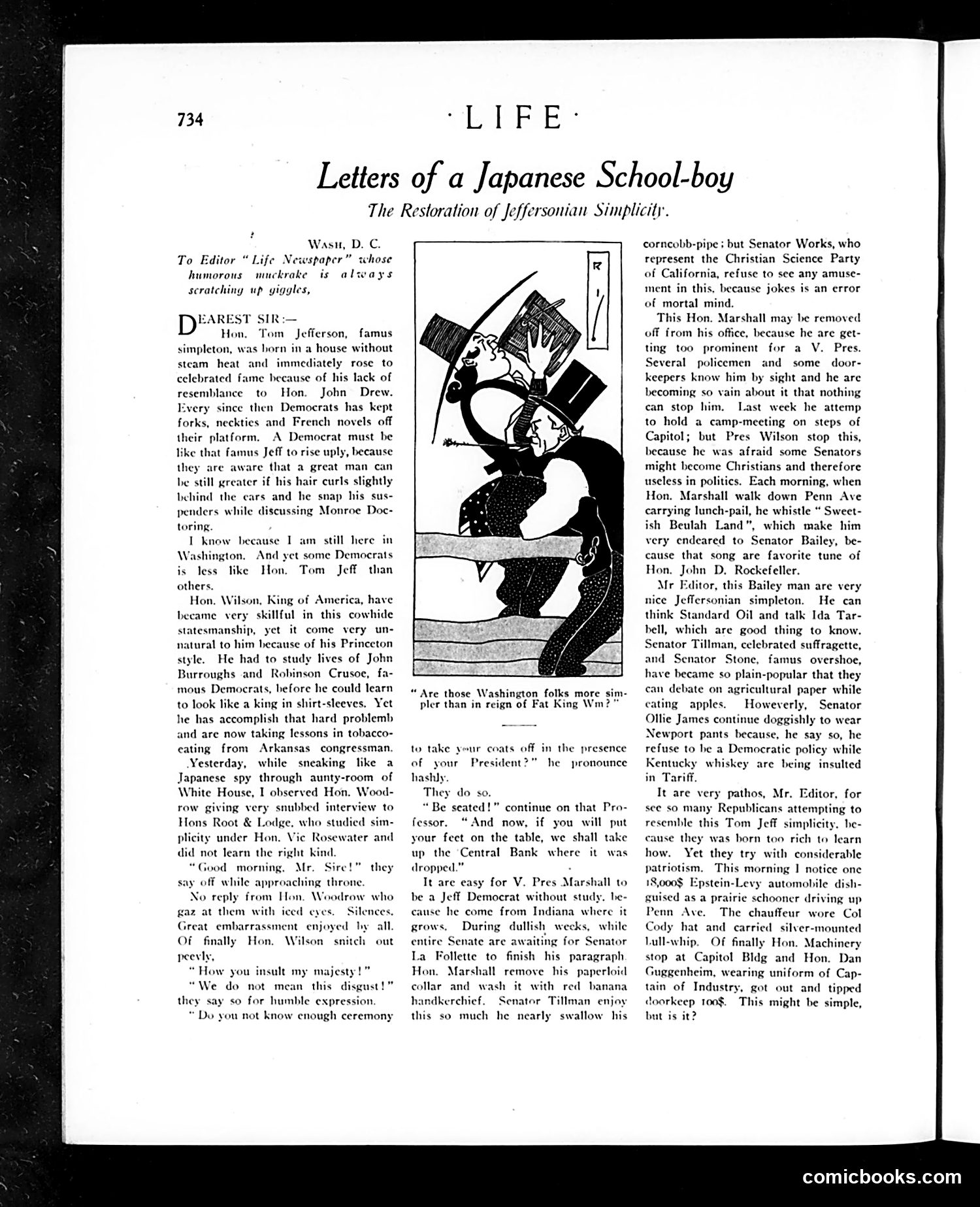
This satirical article mocks Washington politicians by comparing them to Tom Jefferson—implying they lack his famous simplicity and dignity. The accompanying cartoon depicts a caricatured figure (likely representing a bloated politician) struggling under the weight of various burdens: books, papers, and what appears to be a cornucopia of excess. The text references specific politicians including Senator Works, Senator Marshall, Senator Tillman, and Senator Stone, criticizing their vanity, pretension, and inability to maintain Jefferson's ideals of humble republicanism. The satire suggests Washington elites have become ridiculous caricatures of themselves, obsessed with status symbols while abandoning democratic principles. The "Japanese school-boy" perspective serves as an outsider's critical lens on American political hypocrisy.
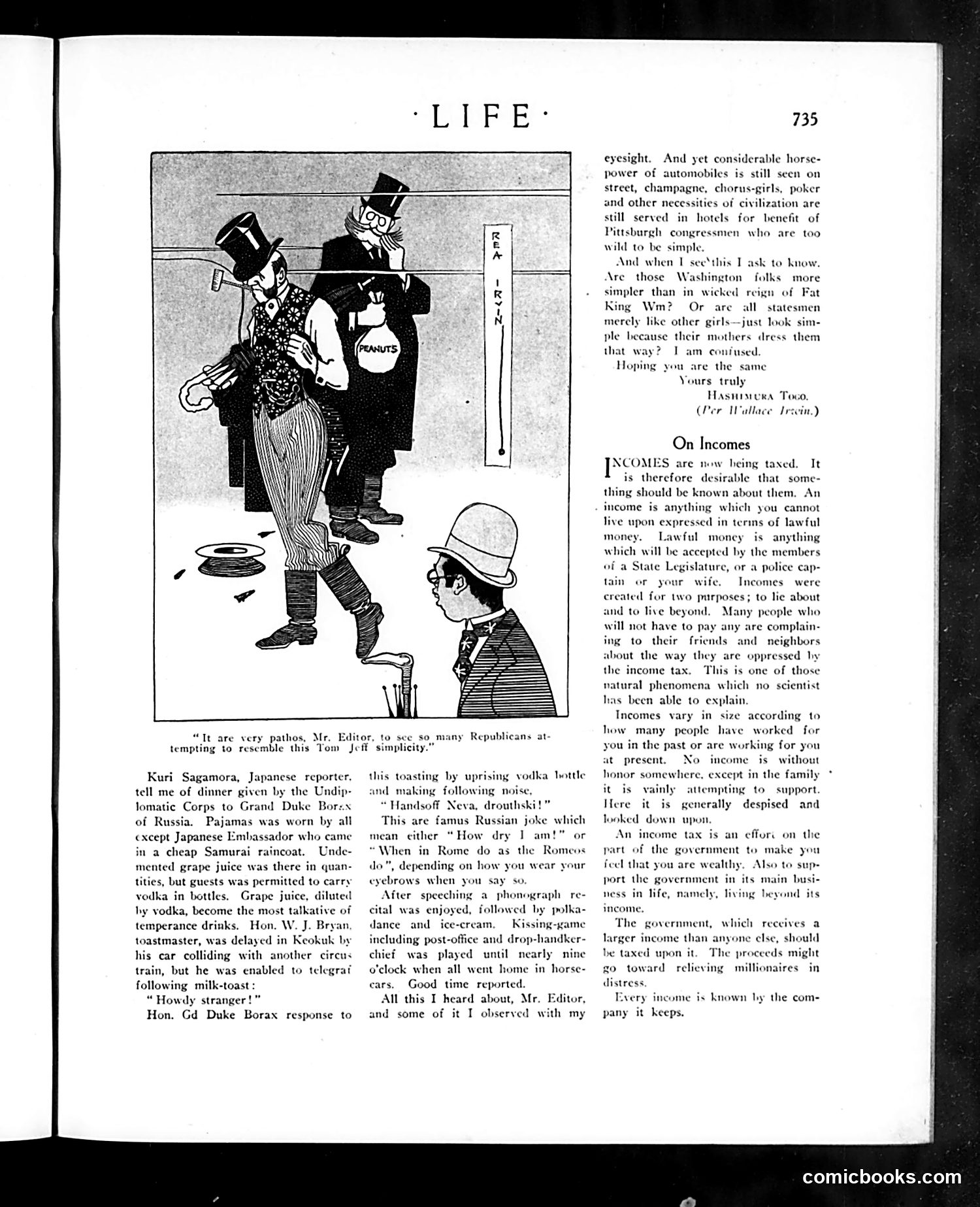
This page contains two distinct satirical pieces: **The Cartoon (top):** Depicts a Japanese reporter (Kuri Sagamora) describing a diplomatic dinner hosted by the "Undiplomatick Corps" for a Russian Grand Duke. The figures wear top hats and formal dress; one holds a "Peanuts" bag. The satire mocks diplomatic pretension—the event supposedly featured grape juice (Prohibition-era substitute for alcohol) mixed with vodka, and included parlor games like "post-office" (a kissing game). The joke: high-level diplomacy devolves into juvenile frivolity. The broken English ("Handsoff Neva, drouthski!") plays on ethnic stereotypes. **"On Incomes" (text article):** A humorous definition of income taxation (newly implemented). It satirizes wealthy people who claim poverty to avoid taxes, and criticizes government hypocrisy—the government itself lives "beyond its income." The piece uses deadpan logic to expose tax evasion and fiscal irresponsibility among the wealthy and government alike. Both pieces target elite pretension and hypocrisy.
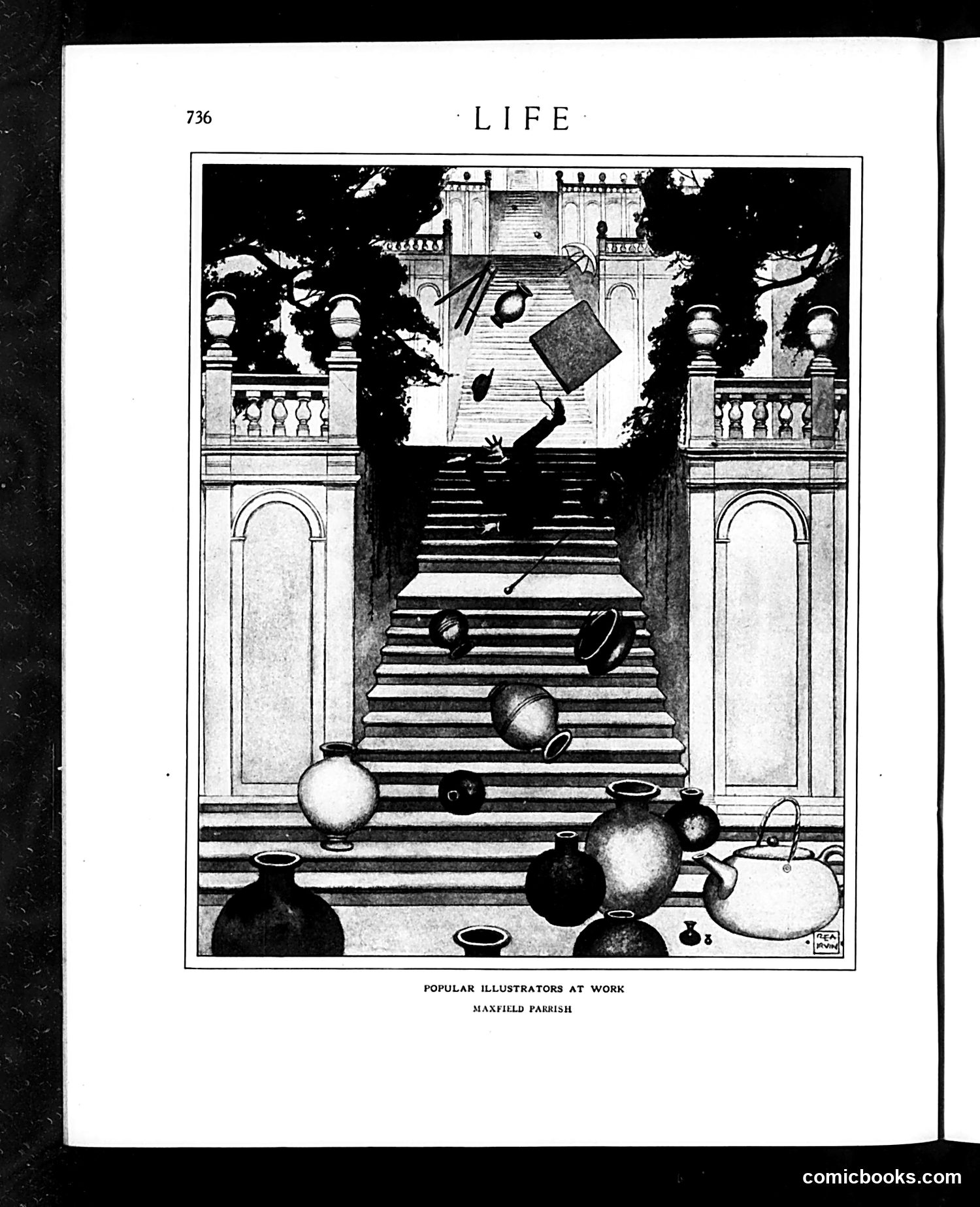
This is an illustration credited to **Maxfield Parrish**, a prominent early-20th-century American illustrator known for decorative, fantastical imagery. The page itself isn't satirical—it's a showcase of Parrish's artistic work. The image depicts a surreal classical scene: a grand staircase leading to an ornate building, with various spheres (some solid, some translucent) scattered across the steps like juggling balls or toys. A figure at the top appears to be tossing objects downward. The classical architecture and dreamlike composition are characteristic of Parrish's style. This appears to be a "Popular Illustrators at Work" feature—likely a regular Life magazine column celebrating notable commercial artists of the era by reproducing examples of their illustration work.
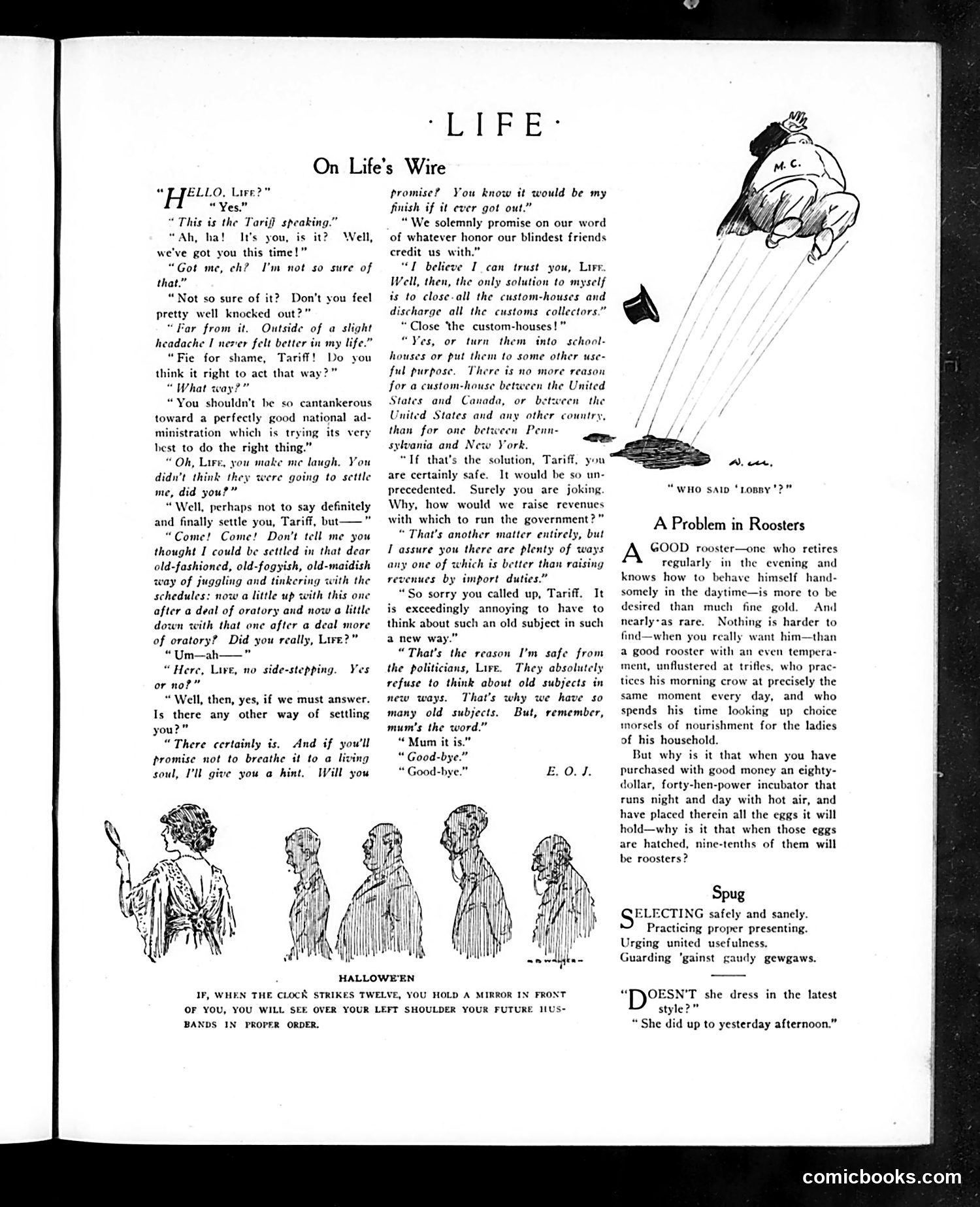
This dialogue satirizes early 20th-century American tariff policy debates. "Life" (representing the nation/general public) confronts the "Tariff" (personified as an adversary), attempting to "knock it out" through government policy changes. The satire mocks the futility of tariff reform: Life believes protective tariffs have been defeated, but Tariff claims it remains unharmed. When pressed for solutions, Tariff provocatively suggests eliminating all customs houses—essentially proposing free trade between states and nations. Life recoils, realizing this radical solution is politically impossible, revealing why tariff problems persist: politicians refuse to seriously reconsider old policies in fundamentally new ways. The cartoon criticizes both protectionist resistance to reform and reformers' inability to imagine genuine solutions. The accompanying illustrations show figures in period dress, emphasizing the entrenched nature of the debate.
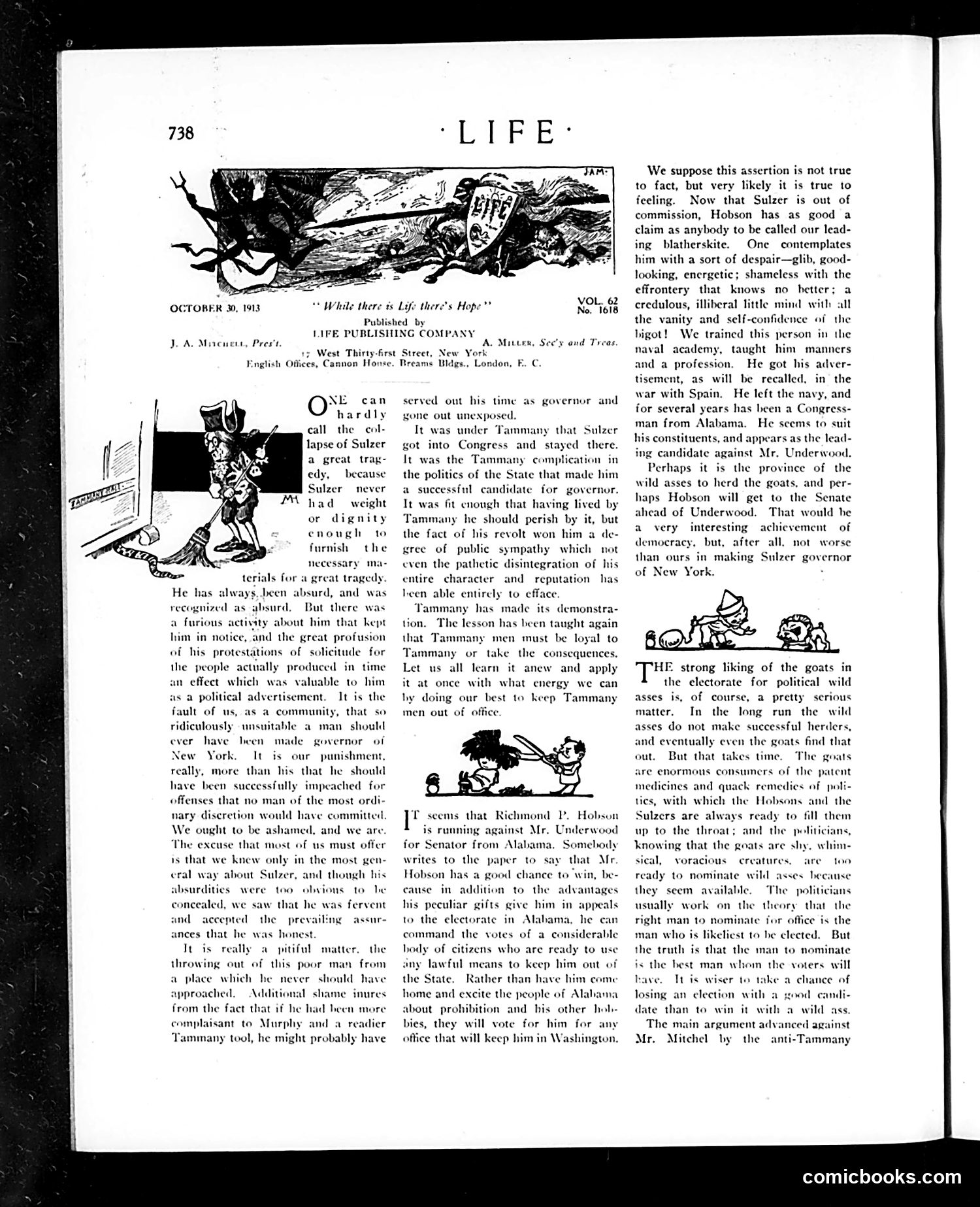
This page critiques **William Sulzer**, New York's recently impeached governor. The text argues Sulzer was inherently unsuitable for office—absurd and lacking dignity—yet remained visible through loud proclamations of concern for the people. The article blames New York voters for electing him, noting he was backed by Tammany Hall (the Democratic political machine). Ironically, Sulzer's downfall came when he rebelled against Tammany, gaining some public sympathy through his defiance before his character entirely collapsed. The page also attacks **Richmond P. Hobson**, running for Senate in Alabama. Life calls him a "blatherskite" (loud talker)—glib, energetic, and shameless. The magazine notes Alabamans may vote for him for Senate specifically to keep him away from the state, given his zealous prohibitionism and moral crusading. The cartoons (illustrations visible but not fully legible) appear to satirize these political figures as incompetent or ridiculous.
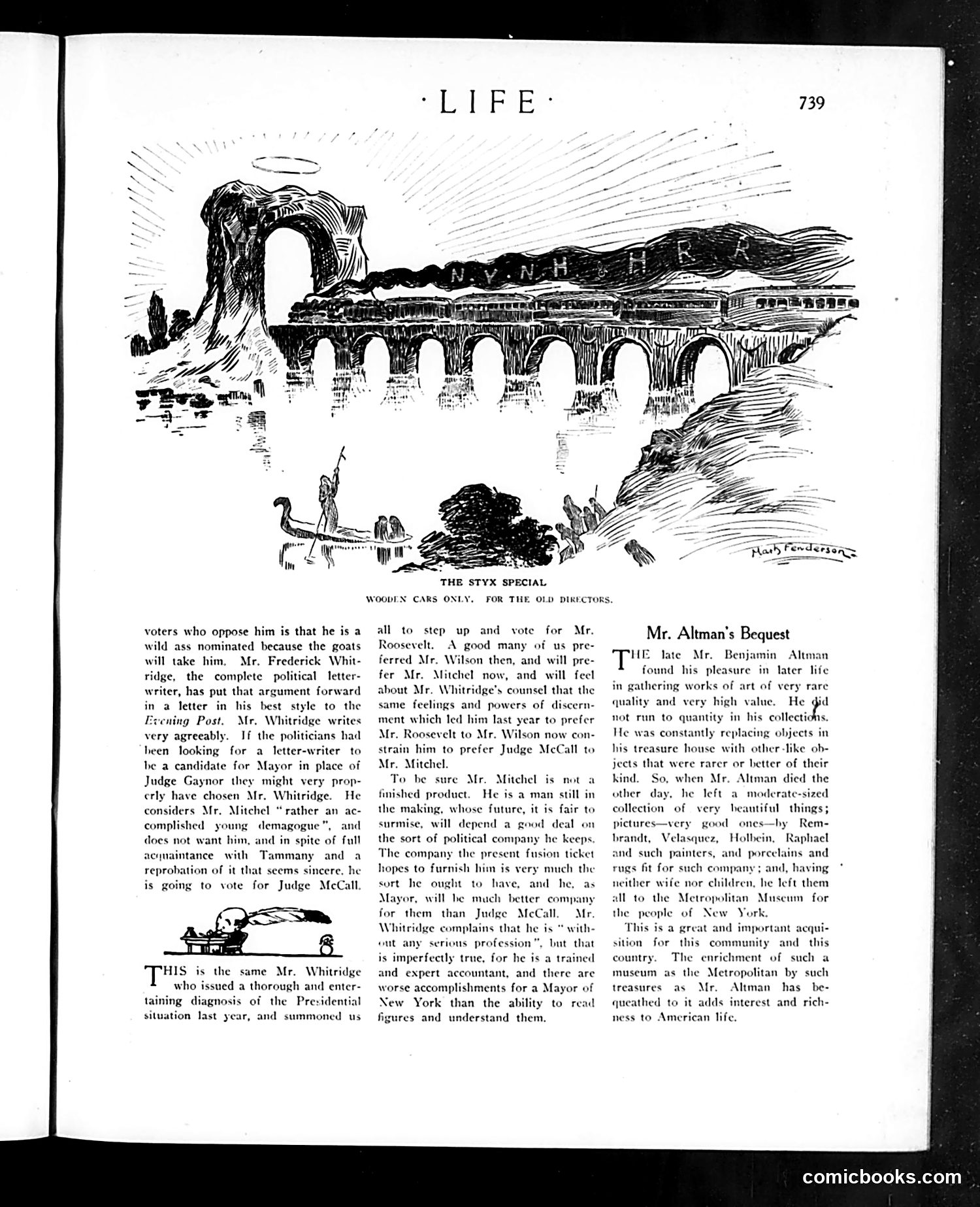
This Life magazine page satirizes New York City politics, specifically mocking Frederick Whitridge, a political commentator and letter-writer. The cartoon depicts "The Styx Special"—a mythological reference suggesting Whitridge's political judgment is spiritually dead or ferrying the wrong passengers (wooden cars for "old directors"). The satire targets Whitridge's inconsistency: he previously championed Theodore Roosevelt over Woodrow Wilson in the 1912 presidential election, yet now opposes mayoral candidate Mitchel in favor of Judge McCall. The magazine implies Whitridge's political endorsements are unreliable and contradictory. The text defends Mitchel as a competent, reform-minded "fusion ticket" candidate—meaning a coalition ticket—despite being unfinished politically. It mocks Whitridge's complaint that Mitchel lacks "profession," noting Mitchel is actually a trained accountant fit for the position. The secondary article celebrates Benjamin Altman's art bequest to the Metropolitan Museum, presented as a counterpoint to destructive political judgment.
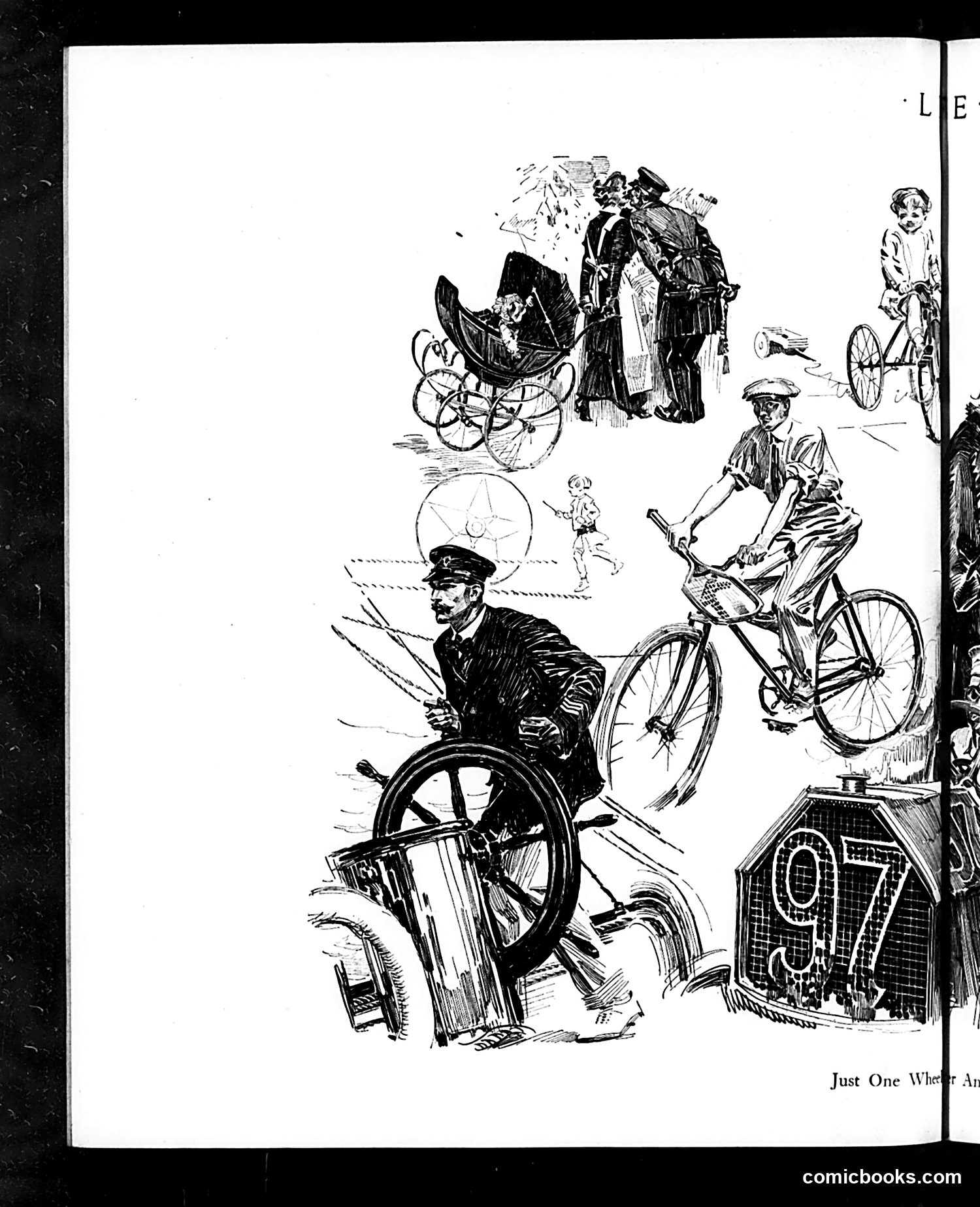
This page features satirical illustrations about bicycles and early automotive transportation, likely from the 1890s-1900s based on the style and subject matter. The central figure is a man operating what appears to be an early motorized vehicle or bicycle with a large steering wheel, depicted in a somewhat comedic, struggling pose. Above him, upper-class figures with a baby carriage and well-dressed pedestrians represent traditional society. Other figures ride bicycles, suggesting the bicycle craze of that era. The satire appears to mock the awkwardness and danger of early motorized vehicles compared to established transportation methods. The caption fragment "Just One Whe[re] Ar[e]" and the page number "97" suggest this is part of a longer piece, but without complete text, the specific satirical point remains unclear.
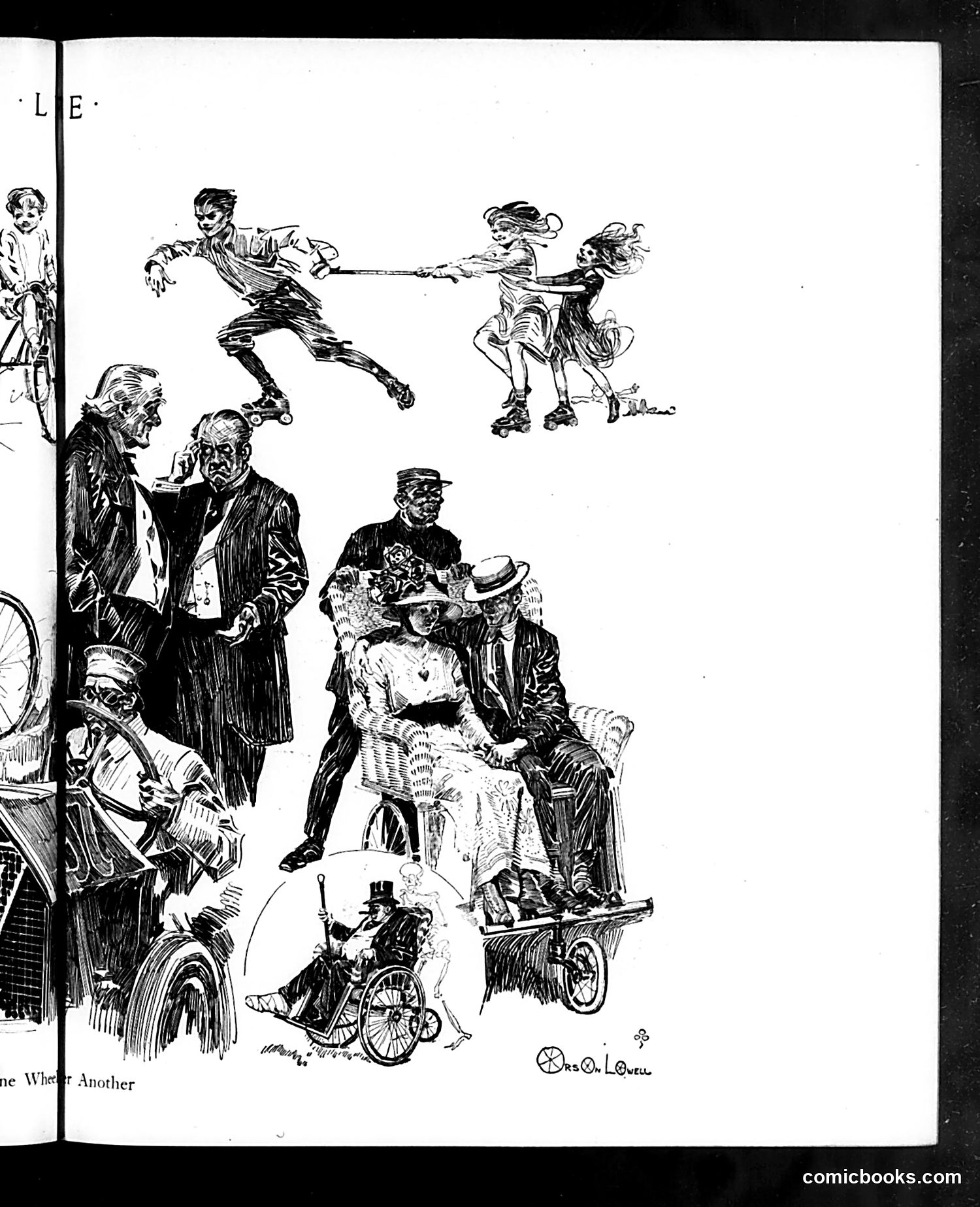
This page from *Life* magazine features a satirical illustration signed by O.L. Lovell showing social commentary on early 20th-century urban life. The cartoon depicts a contrast between classes: well-dressed adults (appearing to be wealthy or middle-class figures in formal clothing) observe children playing on roller skates in the street. A woman sits in what appears to be an automobile or carriage, surrounded by attendants. The satire likely critiques the disconnect between adults absorbed in their own social pursuits and concerns versus children freely enjoying simple street play—a commentary on modern urban society's priorities and class divisions. The title fragment "ne Wher Another" remains unclear without the complete text. The illustration style and subject matter are typical of *Life*'s early satirical commentary on American social customs and inequalities.
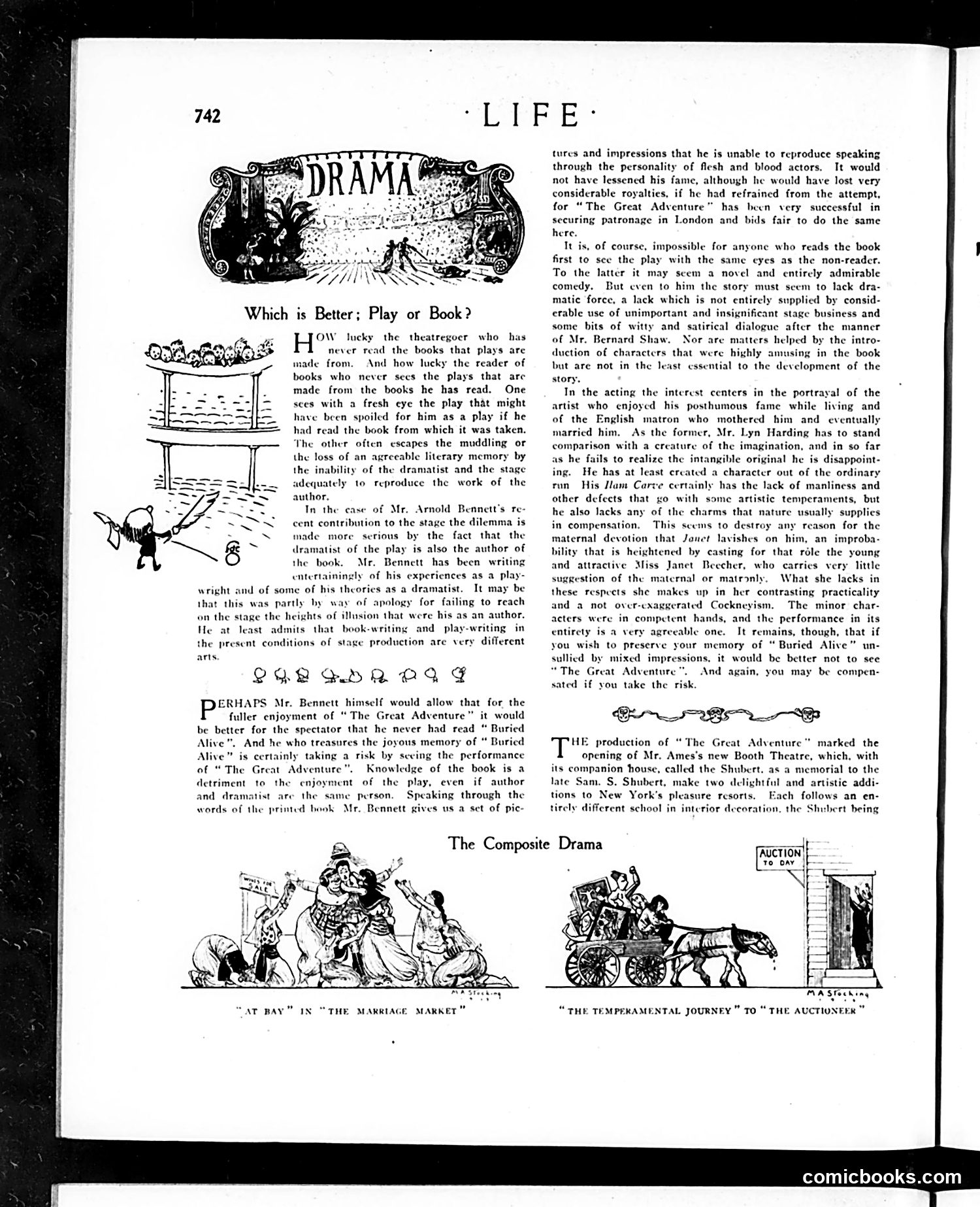
This page discusses whether Arnold Bennett's play "The Great Adventure" (adapted from his novel "Buried Alive") is better experienced as a book or theatrical performance. The article argues that **knowing the source material diminishes enjoyment of the stage adaptation**. The critic contends that Bennett, writing as author and dramatist, cannot translate the rich "pictures and impressions" of his prose into convincing live performance. Reading the book first prevents viewers from seeing the play "with the same eyes as the non-reader." The review criticizes specific casting choices—particularly actor Lyn Harding's portrayal of the artist protagonist, which the critic finds disappointing compared to "a creature of the imagination." It also questions why actress Janet Beecher was cast as the maternal figure, as she appears too young and attractive to believably inspire maternal devotion. The bottom illustrations show comedic scenes from other dramatic productions ("At Bay" and "The Temperamental Journey"), representing "The Composite Drama" — apparently examples of theatrical offerings. This reflects early 20th-century theater criticism and the common debate about literary adaptations.
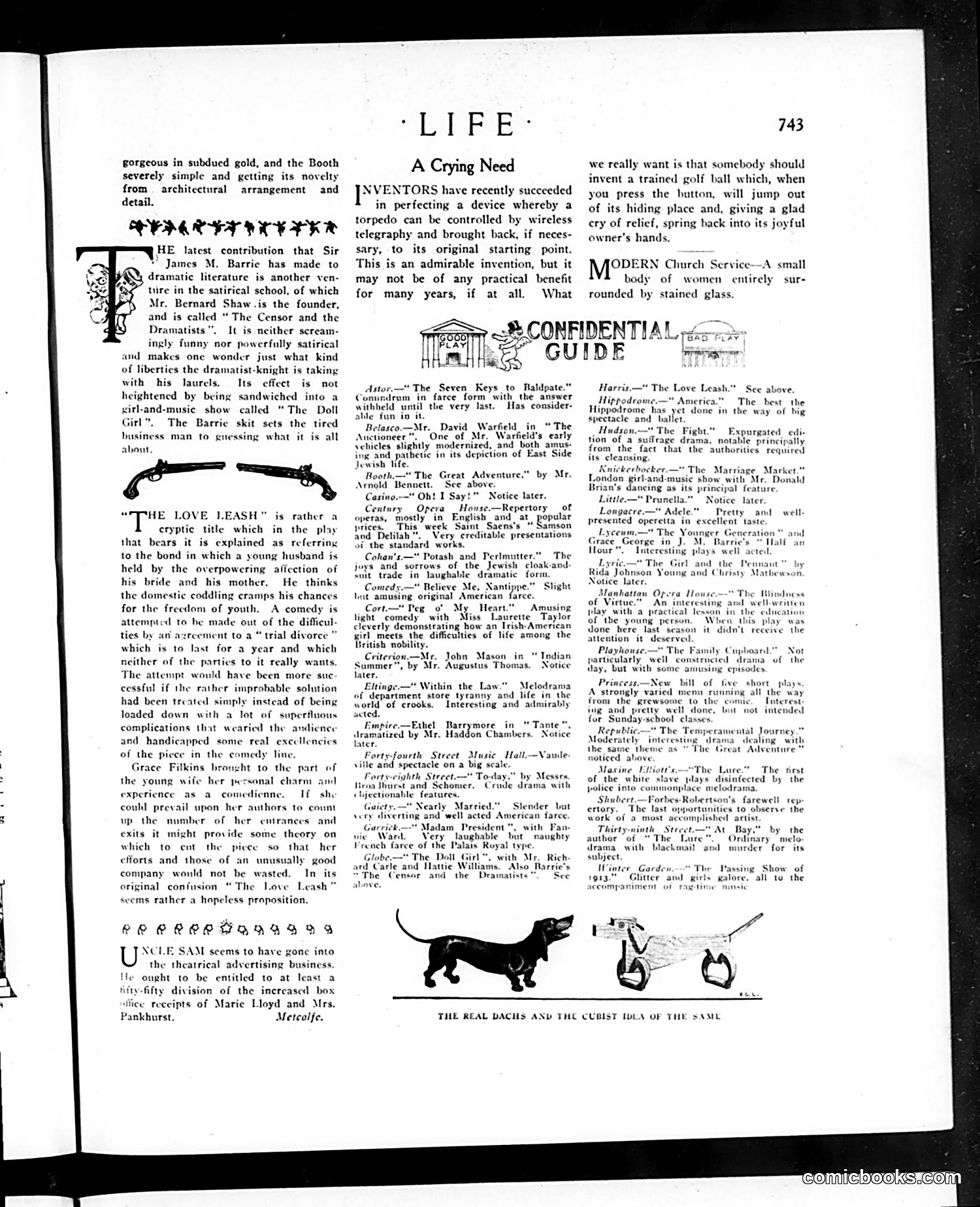
This page from Life magazine contains theater reviews and brief comedic commentary. The most notable cartoon appears at the bottom: a simple line drawing showing a dachshund and a tricycle, captioned "THE REAL DACHS AND THE CUBIST IDEA OF THE SAML." This is a joke about Cubism, the avant-garde art movement. The "real dachs" (dachshund) is drawn realistically, while the tricycle represents how Cubists would supposedly depict the dog—fragmented and abstract. The humor mocks Cubism as absurdly distorting recognizable subjects into incomprehensibility. The page also includes a brief joke: "UNCLE SAM seems to have gone into the theatrical advertising business," suggesting the U.S. government's public activities were inadvertently promoting Broadway shows (likely referring to newsworthy government actions). The bulk of the page reviews contemporary plays and operas, typical of Life's entertainment coverage during this era.
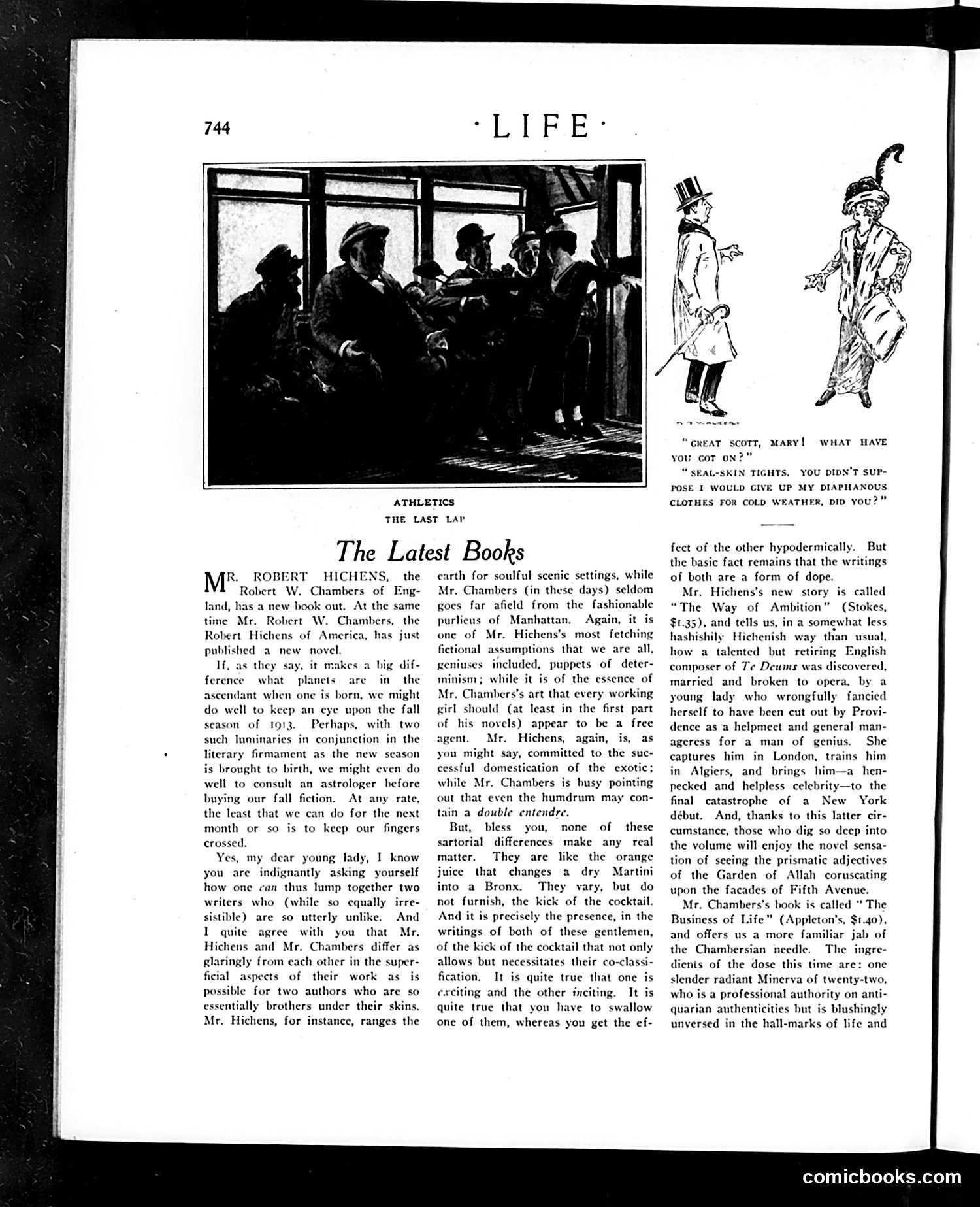
This page from *Life* magazine (circa 1913) compares two contemporary novelists: British author Robert Hichens and American author Robert W. Chambers. The reviewer humorously notes they share the same name pattern but write very differently—Hichens explores exotic global settings and determinism, while Chambers focuses on Manhattan's fashionable circles and free will. The reviewer's central metaphor is that both authors' works function like cocktails: addictive, pleasurable "dope" for readers despite their superficial differences. Hichens's new novel follows an English composer manipulated by an ambitious woman; Chambers's offers familiar romantic melodrama. The cartoon above shows densely packed subway/transit riders, captioned "Athletics: The Last Lap"—likely satirizing urban crowding. The sketch to the right depicts fashionable people debating whether seal-skin tights constitute appropriate cold-weather attire—mocking society's vanity over practicality. Both reinforce *Life*'s satirical focus on contemporary urban American life.
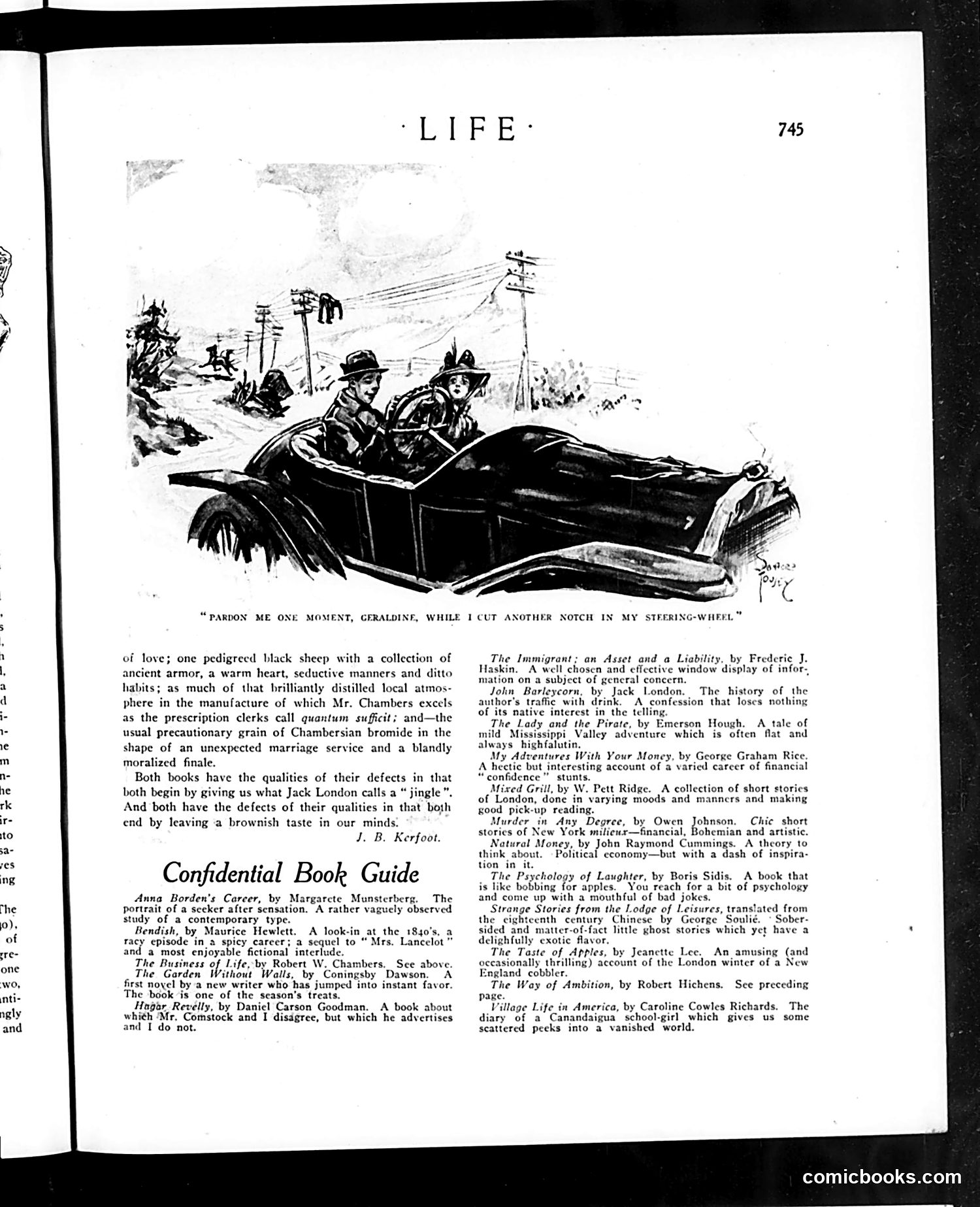
This cartoon depicts a man and woman in an old automobile, with the man saying he needs to "cut another notch in my steering-wheel" before continuing. The humor relies on a double meaning: "cutting notches" was slang for seducing women—each notch representing a conquest. The joke satirizes the casual, predatory attitudes toward women common in early 20th-century culture. The man treats romantic conquests as trophies to be tallied, interrupting even a current romantic encounter (with "Geraldine") to record another. The automobile setting emphasizes the modern era while the behavior reveals persistent, unenlightened attitudes about women. The cartoon mocks this masculine braggadocio while implicitly critiquing the objectification underlying such "conquest mentality."
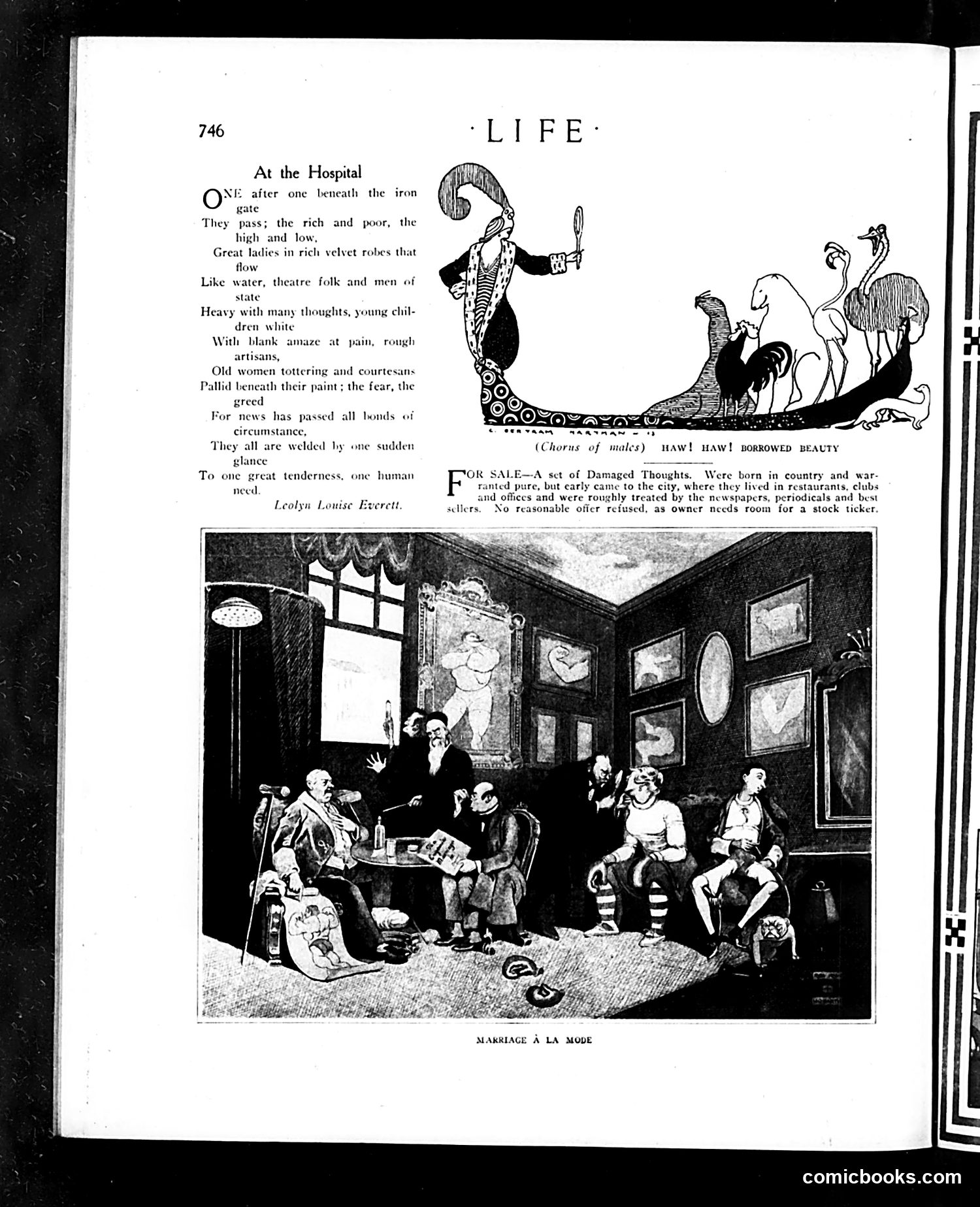
This page contains **two distinct satirical pieces**: **"At the Hospital"** (poem with illustration): A sentimental poem about how a hospital democratizes society—rich and poor, society figures and working people all unite in shared human concern during medical crisis. The decorative illustration shows fashionable figures and peacocks, contrasting elegant artificiality with the poem's theme of stripped-away pretense. **"Marriage à la Mode"** (lower cartoon): A scene depicting urban social climbing and materialism. The caption suggests borrowed or fraudulent wealth—animals (likely peacocks or similar, referenced as "HAW! HAW! BORROWED BEAUTY") represent people living superficially in restaurants and clubs, treated harshly by press. The French title evokes Hogarth's famous satirical series on marriage and social excess. Both pieces critique **artificial social hierarchies and borrowed/false status**, juxtaposing genuine human connection against superficial urban pretension. The magazine targets early 20th-century consumer culture and status-seeking among the wealthy.
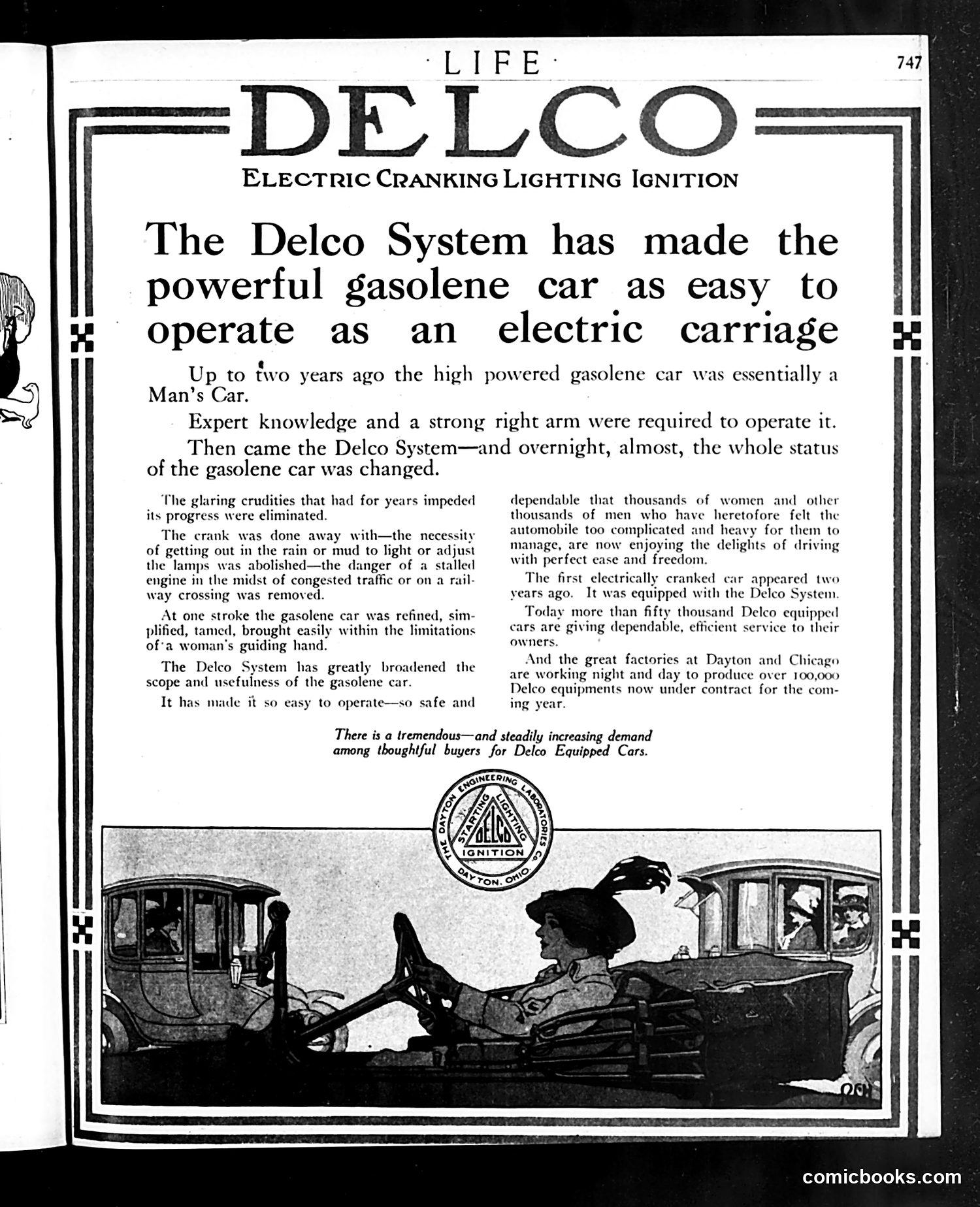
This is a **Delco automobile advertisement**, not political satire. It promotes the Delco electric starter system for gasoline cars. The ad's central argument is explicitly gendered: gasoline cars were previously "essentially a Man's Car" requiring "expert knowledge and a strong right arm" to operate (manual hand-cranking to start). The Delco system—with electric cranking and lighting—made cars so simple that women could drive them safely. The illustration shows a woman confidently at the steering wheel, emphasizing the ad's claim that cars are now "easy to operate—so safe" enough for female drivers. The text celebrates how this technology democratized automobile ownership beyond male enthusiasts. By modern standards, the ad's logic is revealing: it frames women's participation in driving as dependent on removing mechanical difficulty, rather than on capability or interest. The marketing strategy treats female drivers as a new market segment created by technological simplification, not as equal operators.
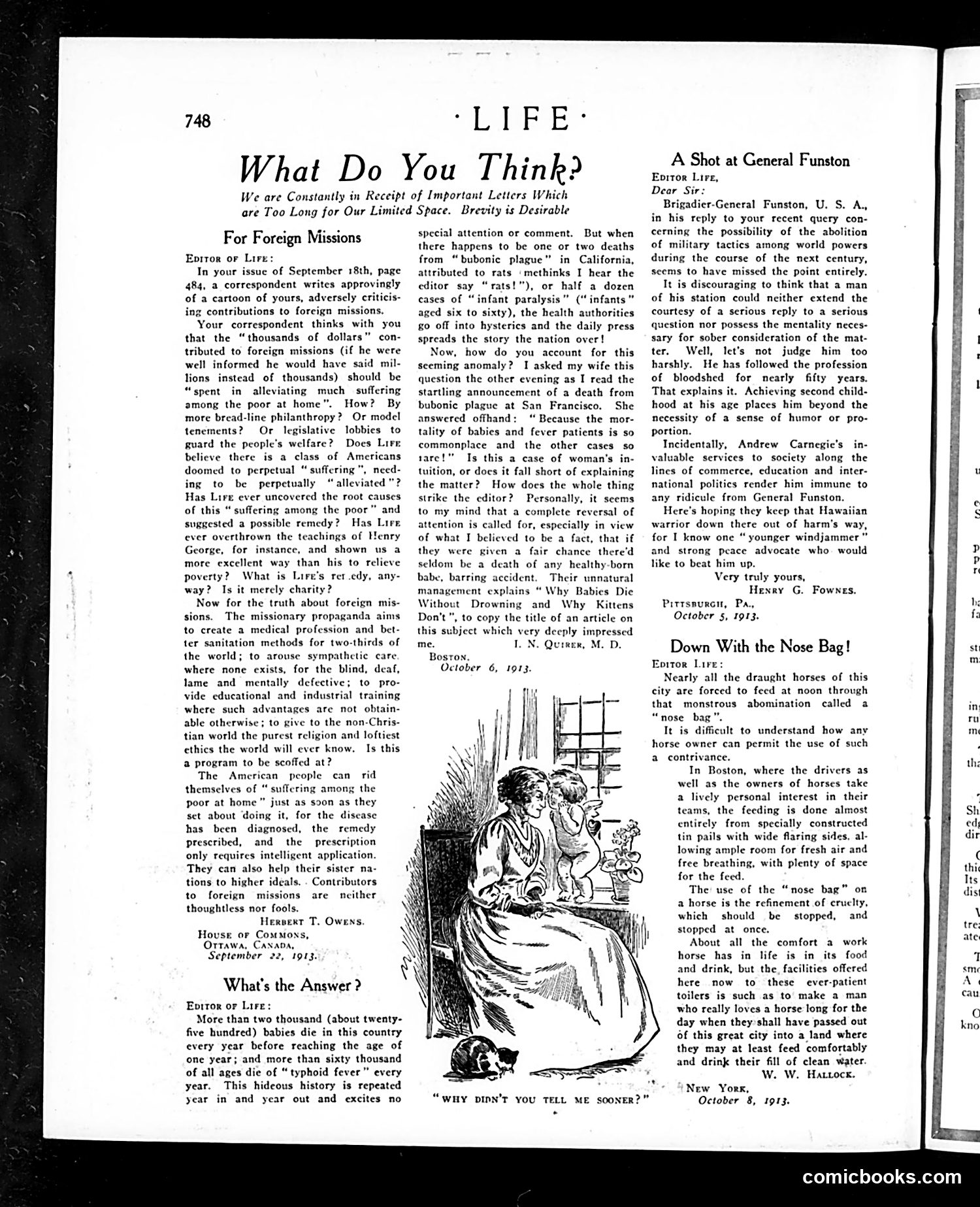
This page presents readers' letters debating two social issues: **"For Foreign Missions"** features a heated exchange about charitable priorities. A Canadian correspondent (Herbert T. Owens) defends missionary work abroad, arguing it provides medical care, sanitation, and education to two-thirds of the world's population. He challenges Life's earlier cartoon criticizing foreign aid while domestic poverty exists, demanding: what's *Life's* alternative solution? **"Down With the Nose Bag"** complains about horses forced to wear restrictive feeding devices in Boston, calling it cruel. The accompanying sketch shows a woman asking a man, "Why didn't you tell me sooner?"—implying neglected animal welfare concerns. **"What's the Answer?"** questions why rare diseases (bubonic plague, infantile paralysis) receive sensational press coverage while endemic killers—infant mortality and typhoid fever—cause thousands of yearly deaths with barely a mention. The writer suggests the public's attention is irrationally skewed toward dramatic but statistically minor threats. All three letters represent typical early-20th-century Progressive Era debates: foreign aid versus domestic poverty, animal welfare, and public health priorities.
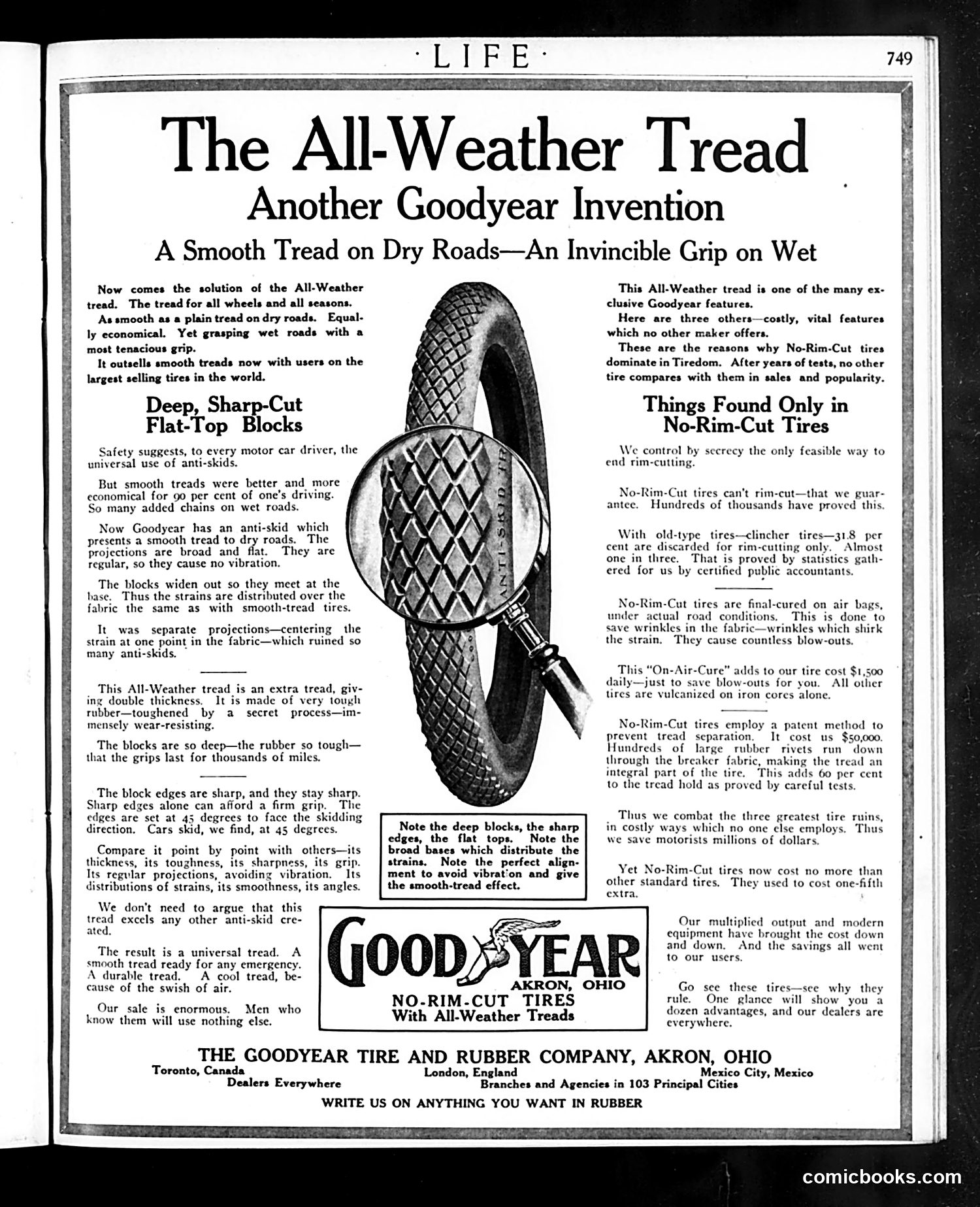
This is **not a cartoon or satire**—it's a straightforward **Goodyear tire advertisement** from *Life* magazine (page 749). The page promotes Goodyear's "All-Weather Tread" and "No-Rim-Cut" tire technology. The large central image shows a tire's tread pattern in cross-section, illustrating the deep, sharp-edged blocks designed for wet-road grip while maintaining smoothness on dry roads. The advertisement emphasizes three exclusive Goodyear features: the all-weather tread design, rim-cutting prevention, and a proprietary "air-cure" vulcanization process. The copy argues these innovations reduce three major tire failures—rim-cutting, tread separation, and blow-outs—saving consumers money long-term. This represents early automotive advertising, highlighting technical innovation as a selling point. The dense, detailed copy and emphasis on engineering superiority reflect 1920s-era marketing approaches before modern advertising brevity.
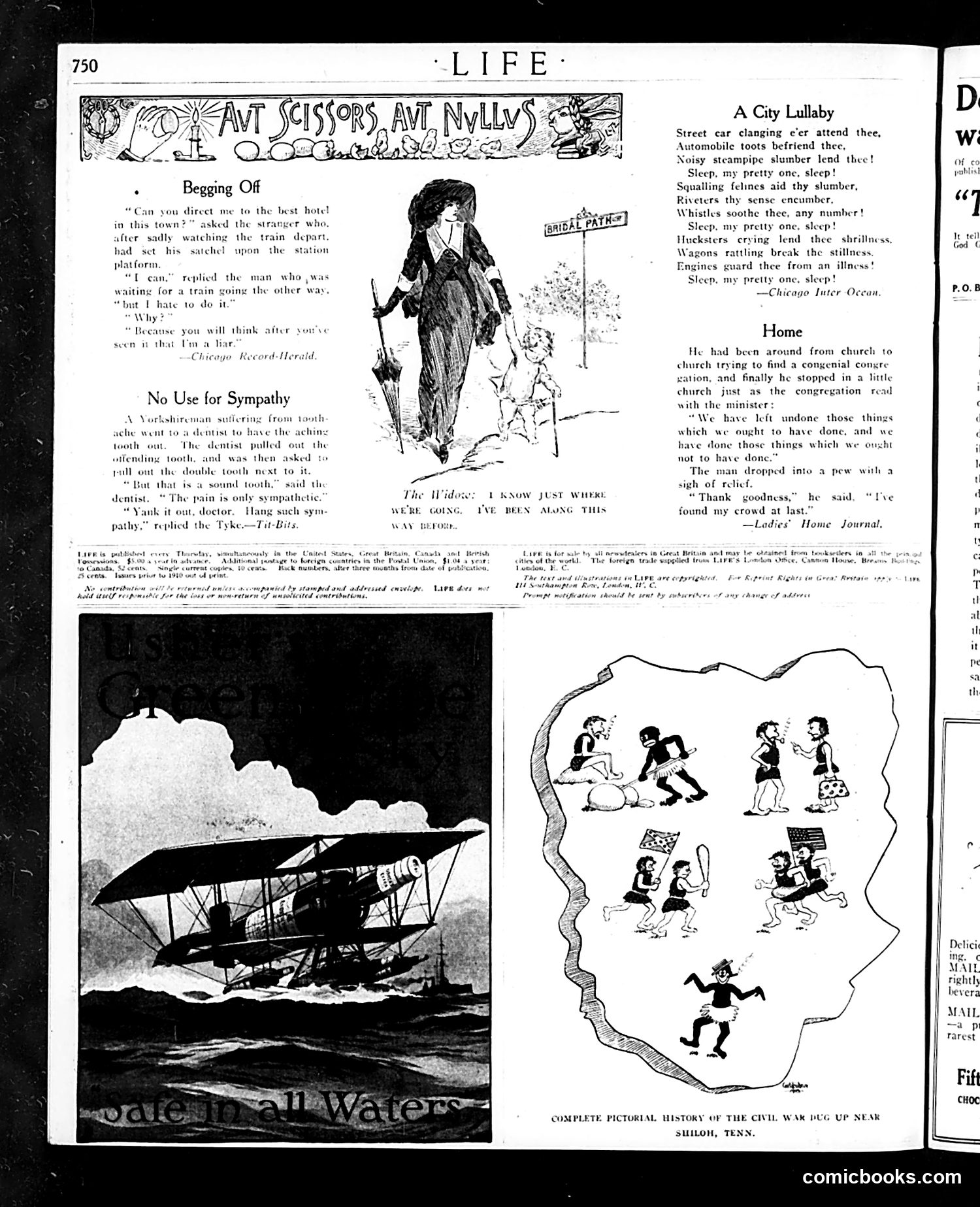
This page contains three satirical humor pieces typical of early 20th-century Life magazine: **"Begging Off"** mocks small-town pride. A stranger asks directions to the best hotel; a local admits he can't recommend it because the stranger will then realize the town's poor accommodations and think the local a liar. **"No Use for Sympathy"** satirizes Yorkshire working-class practicality. A dentist pulls a tooth causing pain in an adjacent healthy tooth; the patient dismissively says to extract that one too rather than tolerate "sympathetic" suffering—rejecting sentimental sentimentality in favor of blunt efficiency. **"A City Lullaby"** ironically celebrates urban noise as a baby's lullaby: street cars, automobiles, steam pipes, felines, riveters, and whistles supposedly soothe rather than disturb sleep. It satirizes modern industrial city life's relentless cacophony. The other content includes a brief joke about finding a compatible church congregation, an image of a WWI-era aircraft, and a Civil War pictorial reference.
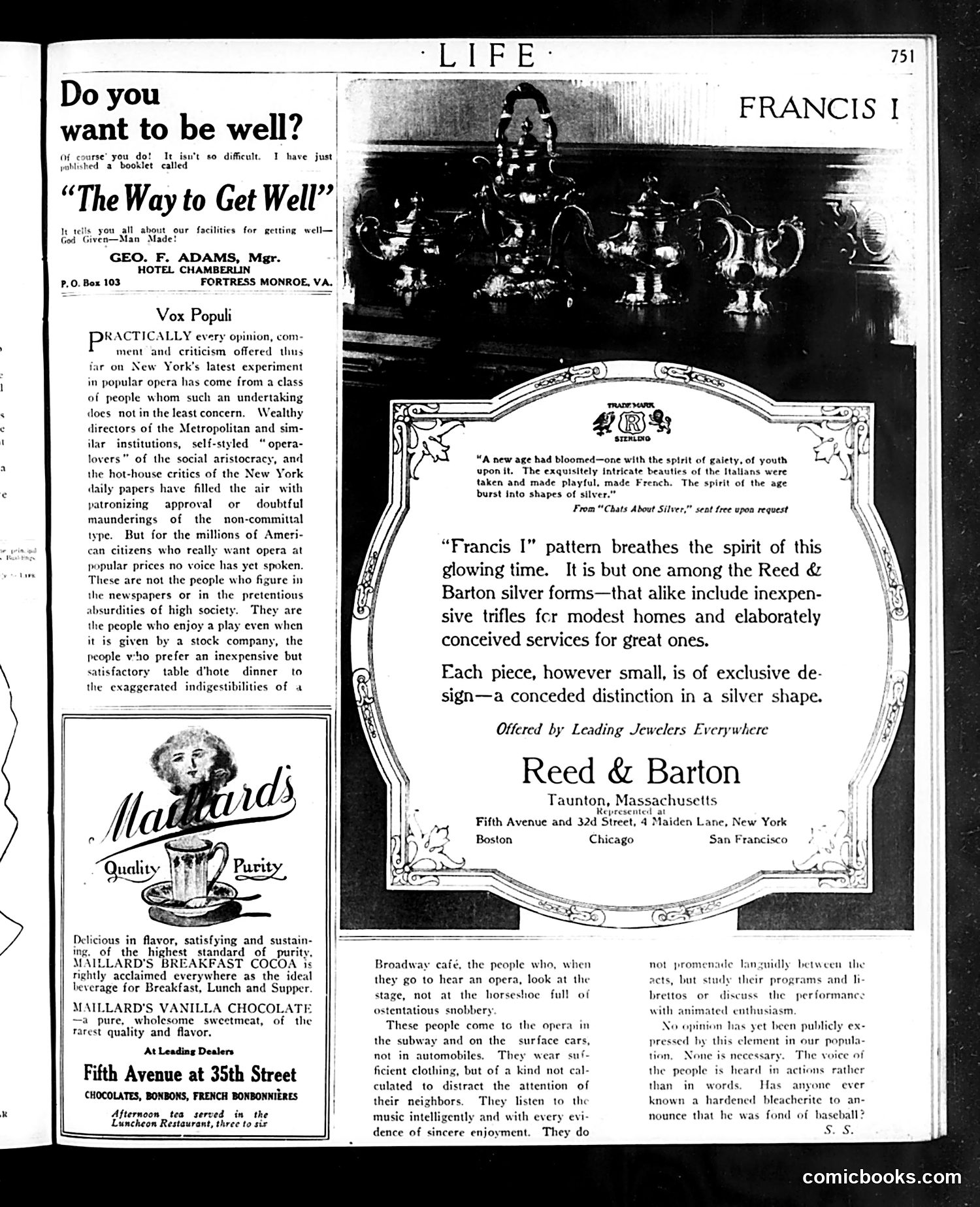
This page's main satirical article attacks the hypocrisy of high-society opera critics. The piece argues that wealthy Metropolitan Opera patrons and New York newspaper critics have monopolized discussion of the city's new "popular opera" experiment, despite having no real stake in it. The satire's core point: the actual working-class New Yorkers who *actually use* affordable opera—riding subways, wearing modest clothes, studying programs seriously—never get heard. Yet their genuine enjoyment proves the opera's success more than any snobbish critic's opinion. The comparison to baseball fans clinches it: just as working people don't brag about loving baseball (they simply enjoy it), the common opera-goer's silent appreciation speaks louder than society critics' pretentious commentary. The article mocks class-based cultural gatekeeping—the assumption that only elites deserve authority over artistic judgment.
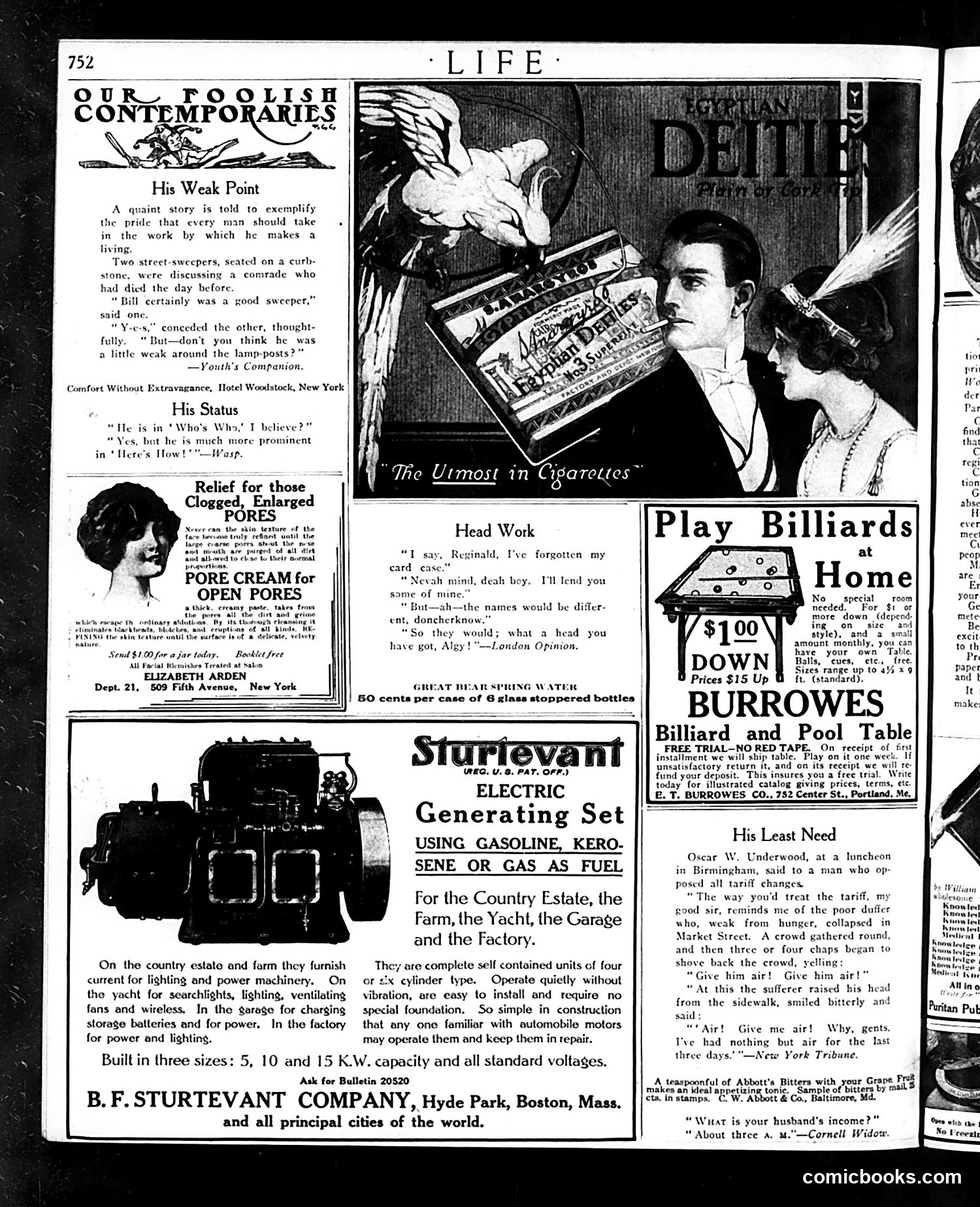
This page contains several short humorous pieces typical of early 20th-century satirical magazines: **"His Weak Point"** mocks excessive pride in menial work—two street-sweepers debate whether a deceased colleague was truly excellent, with one noting he was "weak around the lamp-posts." **"His Status"** jokes about prominence: a man is in *Who's Who* but more notably in *"Here's How!"* (a drinking guide), satirizing priorities among the social elite. **"Head Work"** features two upper-class British characters (Reginald and Algy) where one borrows the other's "head"—implying the borrower lacks intelligence. The humor relies on class-coded speech patterns ("doncherknow"). **"His Least Need"** references Oscar W. Underwood, a real politician, in an anecdote about tariffs. A starving man collapses, and bystanders yell "Give him air!"—he responds he's had only "air" (nothing substantial) for days, paralleling how tariff opposition offers no real economic relief. The remaining content is period advertising for pore cream, electrical generators, and billiard tables.
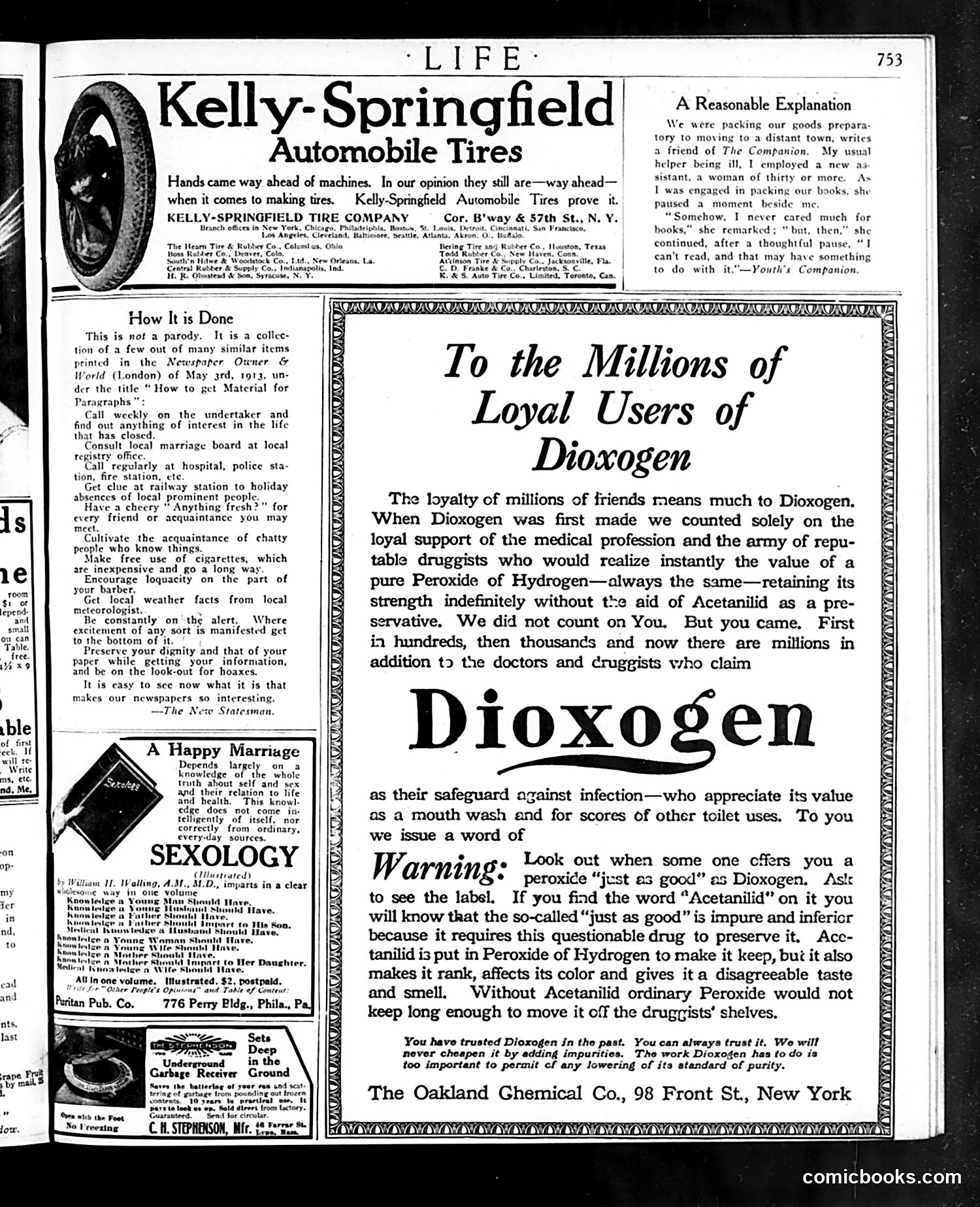
This page is primarily **advertising**, not satire or political commentary. It contains: 1. **Kelly-Springfield Automobile Tires ad** (top left): A straightforward product advertisement emphasizing handcrafted quality over machines in tire manufacturing. 2. **"A Reasonable Explanation"** (top right): A brief humorous anecdote about a woman helper who admits she can't read, explaining her disinterest in books—a gentle joke playing on ironic self-awareness. 3. **"How It is Done"** (middle left): Editorial advice from a 1913 newspaper trade journal listing practical tips for journalists gathering local news (visiting undertakers, hospitals, police stations, etc.), presented without satirical intent. 4. **"A Happy Marriage" book ad** (lower left): Advertisement for a sexology instructional book. 5. **Large Dioxogen ad** (right half): A testimonial advertisement for hydrogen peroxide solution, warning against inferior imitations containing Acetanilid as a preservative. The page reflects early 1910s advertising and lifestyle content with no evident political satire.
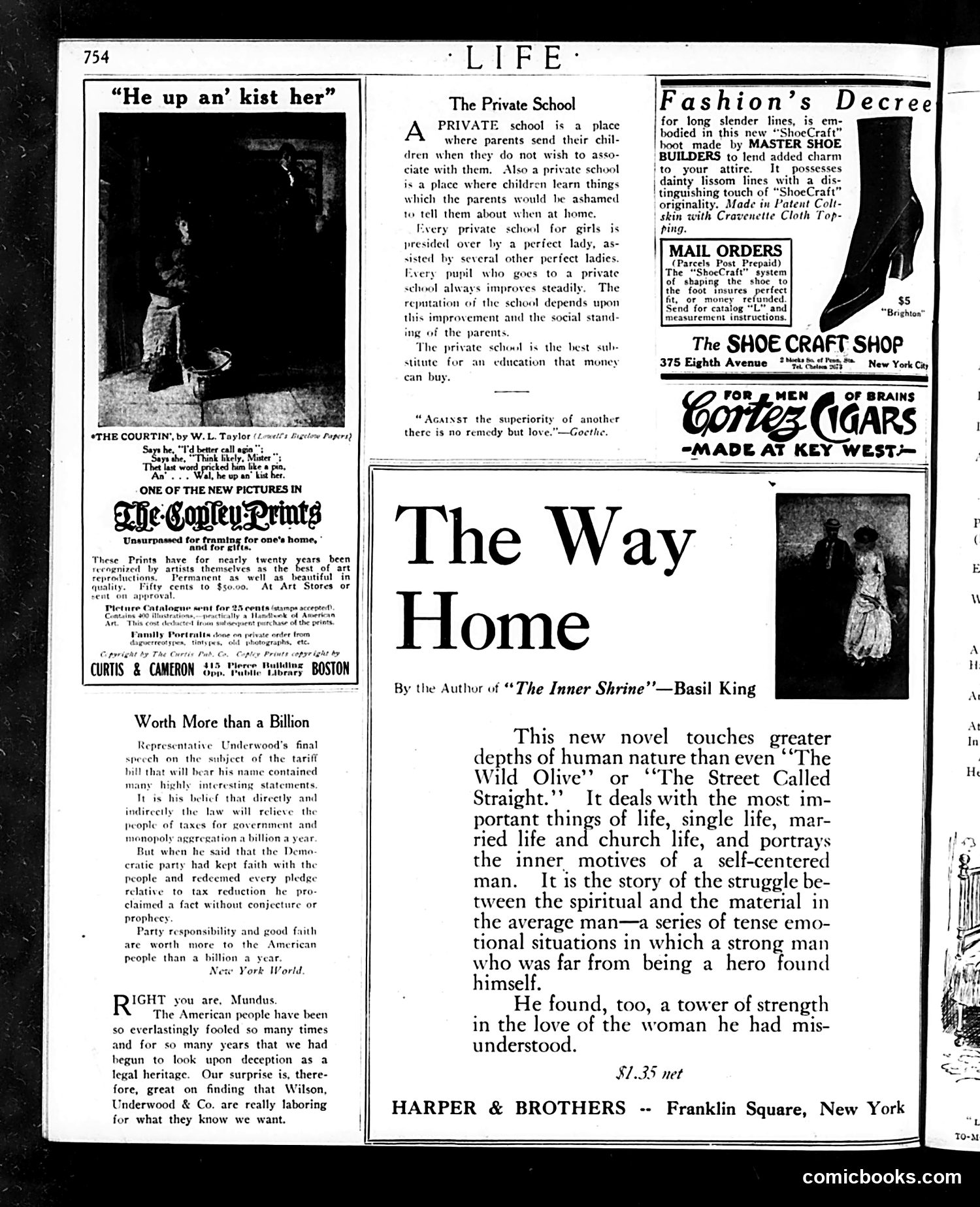
This page is primarily **advertising and book promotion** rather than political satire. The main content includes: **"The Way Home" advertisement**: A novel by Basil King about spiritual versus material struggle in an average man's life—typical early 20th-century literary marketing. **The small cartoon** ("He up an' kist her") appears to be from *Courtey Prints*, showing a domestic scene with dialect humor common to the era. **Other advertisements** promote: private schools (emphasizing social status and respectability), the "ShoeCraft" shoe system, Cortez cigars, and Courtley art prints. **Editorial content** includes a piece on tariffs by Representative Underwood, praising Democratic fiscal responsibility—reflecting Progressive-era political debate. The page reflects **contemporary anxieties about class, education, and propriety** rather than containing pointed satire. References are to actual commercial products and political figures of the period, though the specific context of Underwood's tariff speech is unclear without additional historical knowledge.
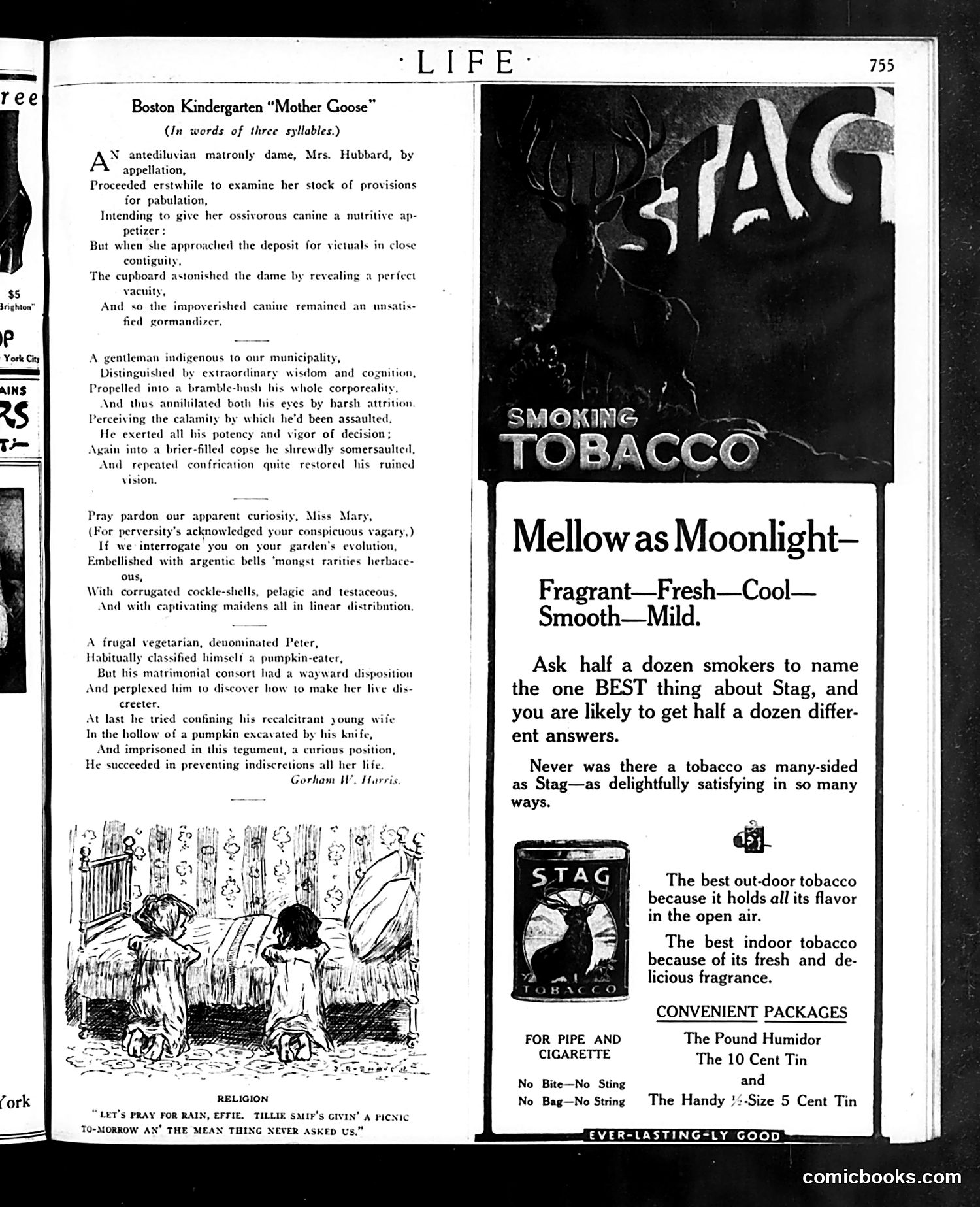
This Life magazine page contains two distinct sections: **Left side:** A humorous parody titled "Boston Kindergarten 'Mother Goose'" that renders classic nursery rhymes in deliberately overwrought, polysyllabic language. For example, "Old Mother Hubbard" becomes a story of an "antediluvian matronly dame" discovering "vacuity" in her cupboard. The satire mocks pretentious, verbose speech—likely targeting affected Boston society or overeducated affectation. A small cartoon below shows children playing, with a caption about prayer and a neighborhood picnic, suggesting mild social commentary on everyday life. **Right side:** A full-page advertisement for Stag Smoking Tobacco, emphasizing its versatility ("many-sided") and multiple appealing qualities (outdoor vs. indoor use, various packaging options). The ad uses straightforward marketing language contrasting sharply with the overwrought text opposite. The juxtaposition appears intentional—the page satirizes linguistic pretension while simultaneously running a plainspoken commercial, creating implicit social commentary about class and communication styles.
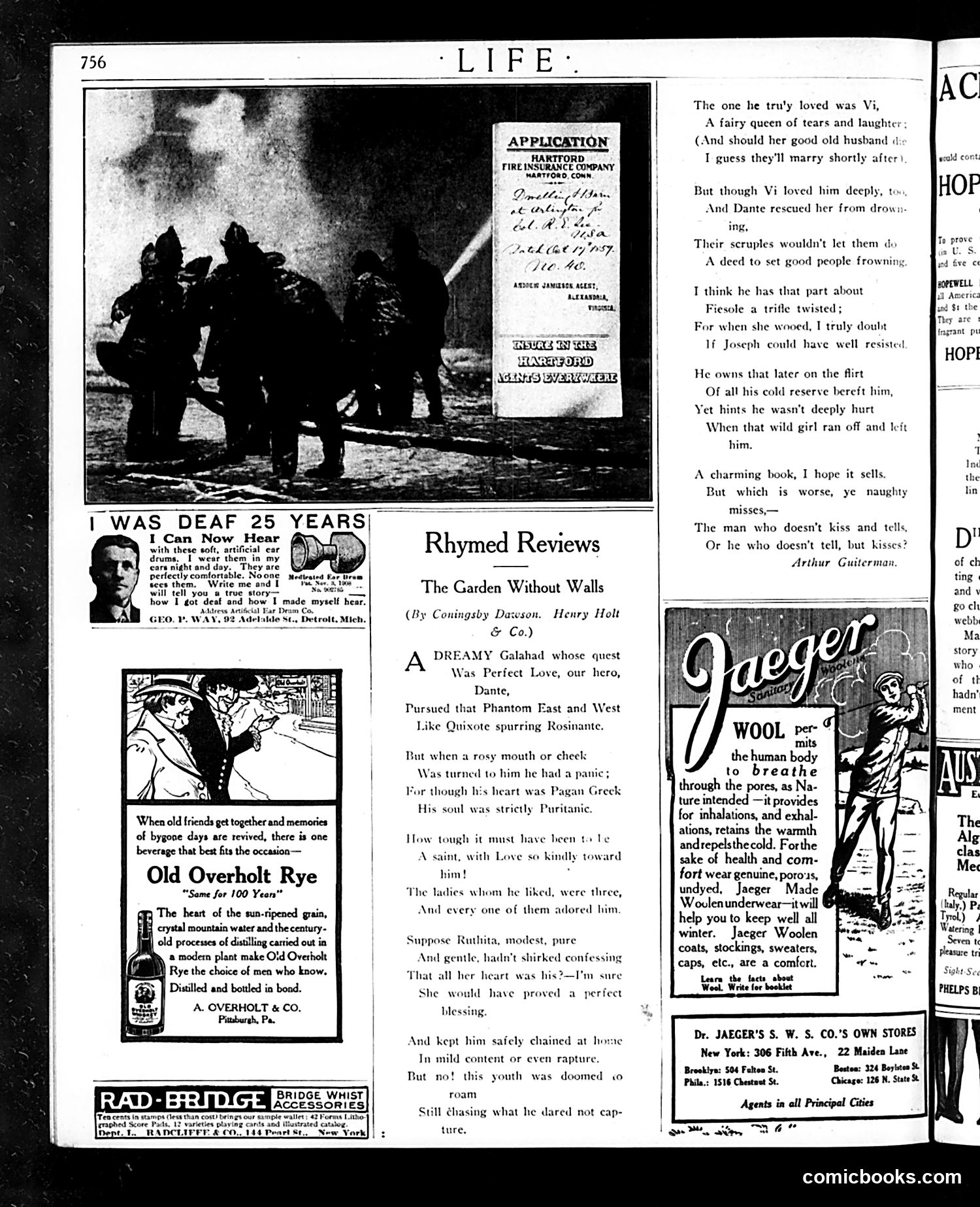
This page is primarily **advertising and book reviews**, not political satire. The main content features a book review of *The Garden Without Walls* by Coningsby Dawson—a romantic novel about an idealistic man named Dante who pursues "Perfect Love" across three female admirers but is paralyzed by Puritanical morality. Critic Arthur Guiterman's verse summary mocks the protagonist's inability to act on romantic opportunities, posing a witty closing question about whether it's worse to kiss without telling or tell without kissing. The page is surrounded by period advertisements: hearing aids, whiskey (Old Overholt Rye), wool undergarments (Jaeger brand), tire insurance, and bridge supplies. These reflect early 20th-century consumer products and marketing strategies. There is **no political cartoon** on this page—it's a typical Life magazine layout combining literary criticism with commercial advertising.
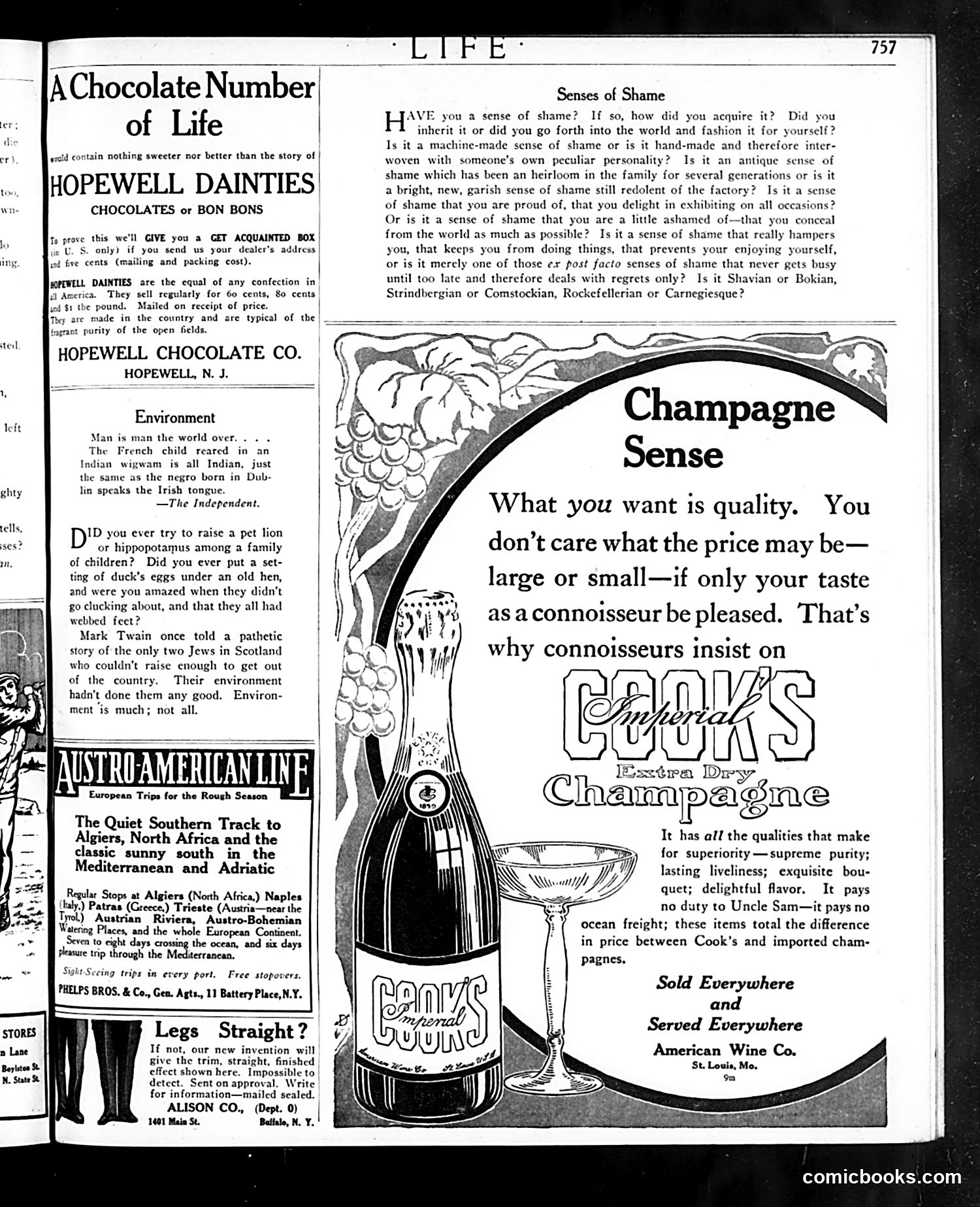
This page is primarily **advertisements and light satirical essays**, not political cartoons in the traditional sense. The main content includes: 1. **"Senses of Shame"** — A philosophical essay questioning what "shame" means: Is it inherited or self-made? Machine-made or authentic? The references to "Shavian or Bokian, Strindbergian or Comstockian" invoke contemporary playwrights and social critics (George Bernard Shaw, August Strindberg, Anthony Comstock). This satirizes modern anxiety about authenticity and social propriety. 2. **"Environment"** — A brief satirical piece mocking determinism, using absurd examples (Mark Twain's story about Scottish Jews; duck eggs under hens) to argue that environment alone doesn't determine character. 3. **Advertisements** dominate: Hopewell Dainties chocolates, Austro-American shipping line, and Cook's champagne—positioned as appeals to sophistication and refined taste. The page reflects early 20th-century *Life* magazine's style: mixing consumer culture advertising with mild social satire targeting educated, middle-class readers anxious about propriety, authenticity, and taste.
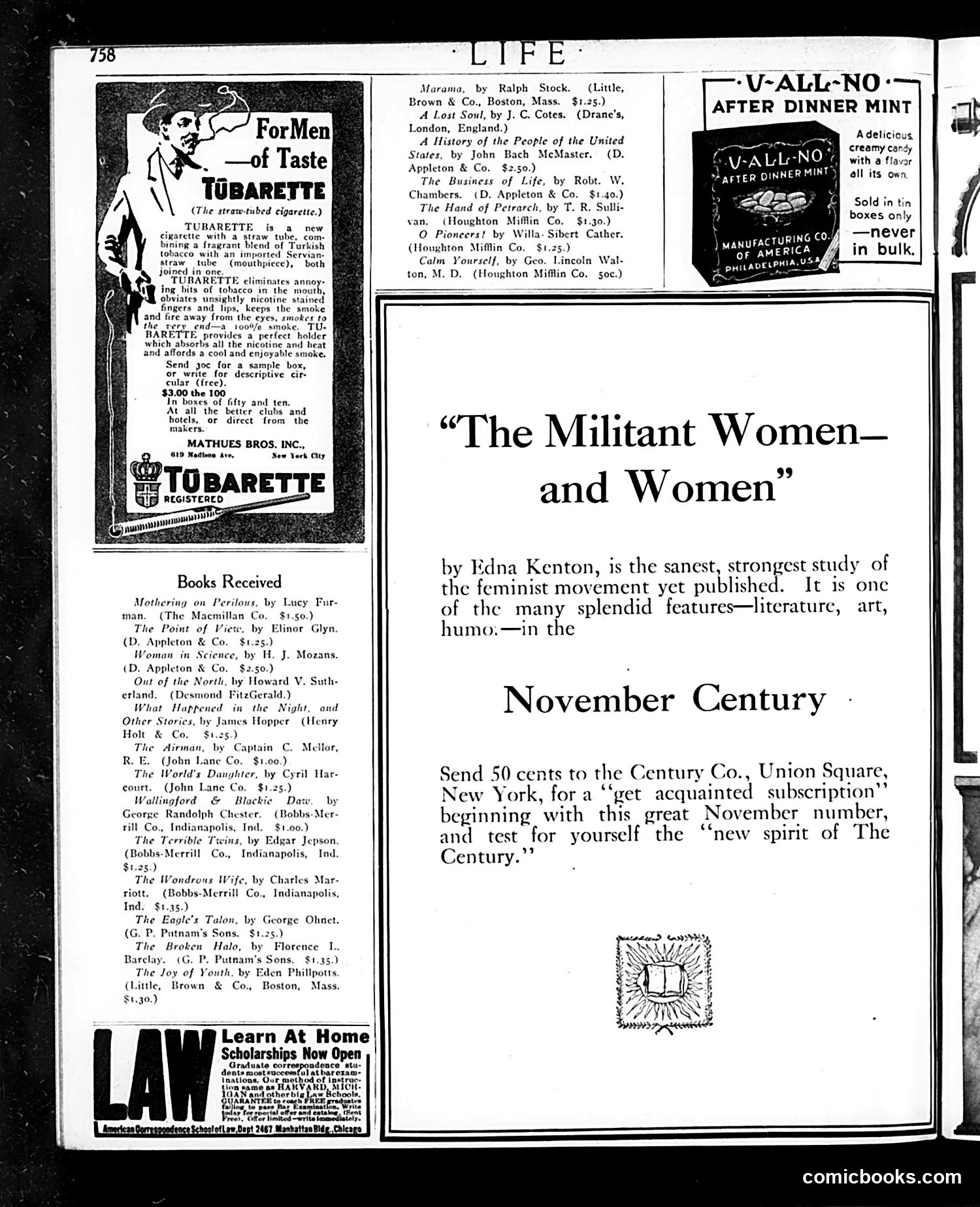
This page is primarily **advertising and book reviews**, not political satire or comics. The main content includes: **Advertisements:** - **Tobarette cigarettes** (left): A novelty product featuring a Serbian straw tube mouthpiece, marketed to men as eliminating tobacco bits, stained fingers, and keeping "fire away from the eyes." This represents early 1900s tobacco marketing targeting male consumers with pseudo-scientific health claims. - **V-All-No After Dinner Mints** (top right): A candy product sold in tins, advertised as never sold in bulk. **Editorial Content:** - A list of recently published books - An advertisement for *The Century* magazine, highlighting an article titled **"The Militant Women—and Women"** by Edna Kenton, described as "the sanest, strongest study of the feminist movement yet published" The page reflects early 20th-century advertising conventions and the contemporary feminist movement's growing visibility in mainstream publications.
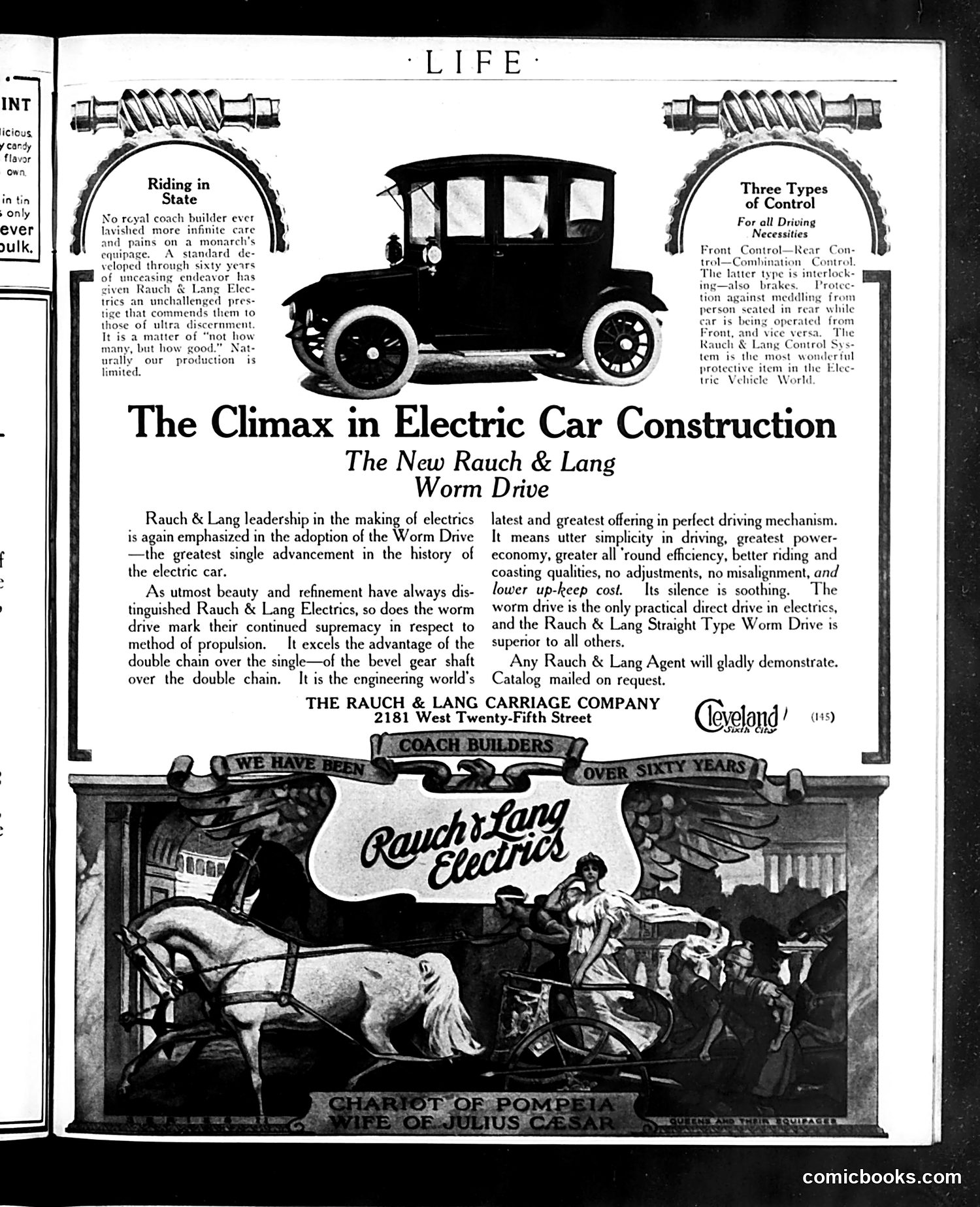
This is primarily **a luxury automobile advertisement**, not satire. The Rauch & Lang Carriage Company advertises their electric car's new "Worm Drive" transmission as "the climax in electric car construction." The page includes two sidebar text boxes praising the vehicle's refinement ("riding in state") and safety features (three types of control systems). The bottom features a decorative historical illustration labeled "Chariot of Pompeia—Wife of Julius Caesar," comparing the car's elegant craftsmanship to ancient Roman coach-building. **For modern readers:** This represents the brief era (early 1900s) when electric vehicles competed seriously with gasoline cars. The ad targets wealthy buyers seeking luxury and reliability. The Roman chariot reference emphasizes timeless craftsmanship. Electric cars eventually lost this market battle to cheaper gasoline alternatives. This page documents a forgotten technology that dominated high-end markets before internal combustion engines became dominant.